UK FCA makes pound stablecoin payments a 2026 priority

cointelegraphPublicado a 2025-12-11Actualizado a 2025-12-11

Resumen

The UK Financial Conduct Authority (FCA) has made pound-denominated stablecoin payments a top policy priority for 2026. It is fast-tracking a regulatory sandbox for prospective issuers, allowing them to test their products in a controlled environment before new digital asset regulations take full effect. Applications for the sandbox must be submitted by January 18, 2026. The initiative is part of broader efforts to strengthen the UK’s position as a global financial hub by supporting faster and more convenient payment methods. The move aligns with the FCA’s growth strategy and follows calls for industry feedback on upcoming regulatory frameworks. Meanwhile, jurisdictions like Guernsey are also advancing their own digital finance regulations, including requirements for stablecoins to be fully backed by high-quality liquid assets. UK and Channel Islands policymakers aim to maintain competitiveness amid growing regulatory developments in regions like the EU.

The United Kingdom’s Financial Conduct Authority (FCA) has elevated British pound‐denominated stablecoin payments to a top policy priority for 2026, fast-tracking a dedicated regulatory sandbox for prospective issuers ahead of new digital asset regulations.

The watchdog said the move is part of a package of “ambitious new growth measures” for next year, aimed at supporting UK‐issued stablecoins as a way to make payments faster and more convenient.

In a letter to Prime Minister Sir Kier Starmer this week, the regulator outlined nearly 50 reforms aimed at strengthening the UK’s position as a global financial hub. Among them, the FCA flagged advancing UK-issued pound stablecoins in 2026 as a central milestone in its broader growth strategy.

Testing stablecoin solutions before new rules apply

Firms that plan to issue a pound stablecoin in the UK and want to test their products should apply to the regulatory sandbox by Jan. 18, 2026, which is designed to let firms pilot stablecoin solutions in a controlled environment before the full regime takes effect.

Related: UK finance regulator FCA a ‘deterrent’ to crypto industry, says CryptoUK

The sandbox will sit under the FCA’s existing Digital Sandbox framework, providing participants with regulatory guidance as they test compliance, stability, and consumer-protection measures for sterling-backed digital currencies.
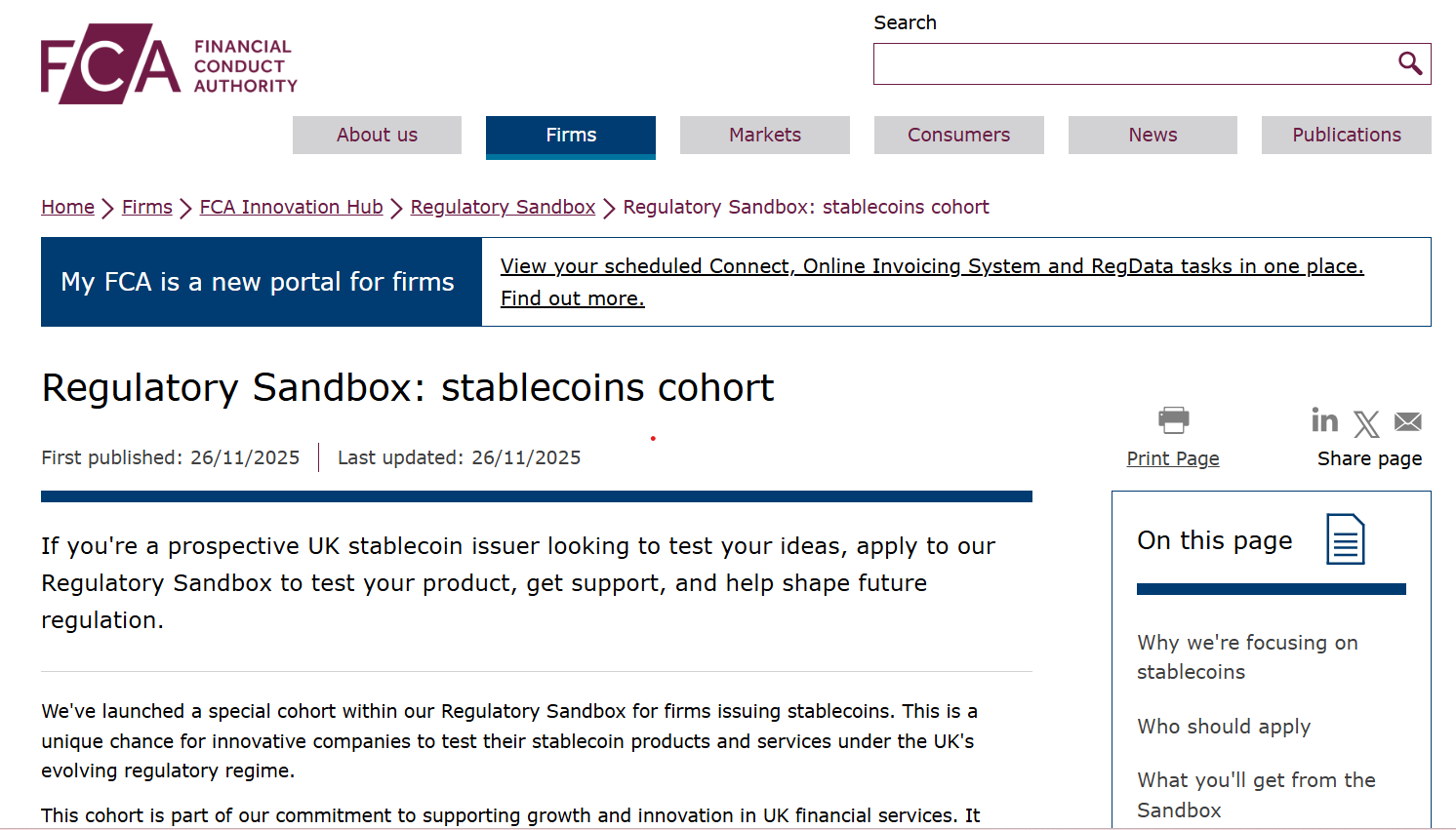
Regulatory Sandbox for Stablecoin Issuers | Source: FCA

The announcement comes as crypto industry stakeholders have been encouraged to submit feedback on UK investment reforms. Earlier this week, the watchdog invited comments from firms involved in digital assets on a series of draft guidance papers expected to feed into the 2026 regulatory framework.

Related: Tether’s stablecoin business set for another record year of profitability

A wider race for competitiveness

Smaller jurisdictions connected to the UK’s financial ecosystem are also making pushes of their own. The Bailiwick of Guernsey’s Financial Services Commission (GFSC) opened a new consultation on its Digital Finance Initiative on Dec. 11, seeking feedback on tokenization, blockchain infrastructure, and stablecoin regulation.

The Digital Finance Initiative is a new regulatory framework for stablecoins, requiring 100% backing by high-quality liquid assets and introducing capital, reporting, and redemption requirements.

Digital Finance Initiative | Source: GFSC

Chris Hutley-Hurst, head at Walkers Channel Island Regulatory & Risk Advisory Group, has actively engaged in discussions with the GFSC. He told Cointelegraph:

“The GFSC’s Consultation marks a pivotal moment for Guernsey’s digital finance landscape. By introducing clear frameworks for stablecoins, tokenization, and custody, the proposals strike the right balance between innovation and robust regulation. This approach not only supports emerging technologies but also reinforces Guernsey’s ambition to be a leading jurisdiction for digital assets and sustainable growth.”

UK and Channel Islands policymakers appear intent on keeping the region attractive for innovative financial firms, particularly as global competitors like the European Union advance their own stablecoin regimes.

“Our reforms help the UK maintain its global competitive edge in our world-leading wholesale markets, attract international investment, and lead on innovation in financial services,” Nikhil Rathi, chief executive of the FCA, said in a statement.

Lecturas Relacionadas

Will Warsh Compromise with Trump? A Look at the 70-Year Power Struggle Between the President and the Fed

Will the Fed's new chair, Kevin Warsh, yield to pressure from President Trump? A White House-administered oath ceremony for Warsh breaks recent precedent, spotlighting a seven-decade power struggle between the presidency and the Federal Reserve. Historically, each Fed chair has balanced political pressure with policy independence. Warsh's situation, however, is uniquely complex, inheriting a divided Federal Open Market Committee (FOMC) with some members opposing even hints of rate cuts, while Trump expects easing. The report from Caitong Securities reviews this history: from William Martin establishing independence, to Arthur Burns compromising under Nixon, Paul Volcker building institutional credibility, Alan Greenspan navigating political waters, and Jerome Powell facing severe pressure from Trump, ultimately hardening the Fed's defensive stance. Warsh, a former Fed governor known for questioning quantitative easing, is not a traditional dove. His recent statements emphasize a nuanced view of Fed independence, skepticism of forward guidance, serious concern over inflation (contradicting Trump's "fake inflation" claims), and the potential for AI-driven productivity gains to allow rate cuts. The analysis concludes Warsh's policy will likely feature a clear direction but cautious pace. Rate cuts are probable but constrained by persistent inflation above target; if Trump pressures heavily, Warsh may delay cuts to defend Fed independence. Balance sheet reduction is seen as necessary but will be gradual to avoid premature conflict. Ultimately, Warsh's path will depend more on macroeconomic trends—inflation, growth, oil prices—than on his personal stance or the immediate political relationship.

marsbitHace 7 min(s)

Will Warsh Compromise with Trump? A Look at the 70-Year Power Struggle Between the President and the Fed

marsbitHace 7 min(s)

Musk's 'One-Man Dynasty' Set to Ring the Bell on June 12th

SpaceX Files for IPO, Targets Up to $2 Trillion Valuation SpaceX has officially filed for an initial public offering (IPO) with the U.S. SEC, planning to list on Nasdaq under the ticker "SPCX" on June 12. The company aims to raise $70-$80 billion, targeting a historic valuation between $1.75 and $2 trillion. Despite going public, founder Elon Musk will retain approximately 85% of the voting power through a dual-class share structure, maintaining absolute control. The S-1 filing reveals a company with sharply contrasting financial segments. In 2025, SpaceX reported $18.67 billion in revenue but a net loss of $4.94 billion. The loss was primarily driven by its AI unit, xAI, which burned $6.4 billion. In contrast, the Starlink satellite internet business was highly profitable, generating $11.4 billion in revenue and $4.4 billion in operating profit with an impressive 63% EBITDA margin. Starlink's user base grew to 10.3 million by Q1 2026, though average revenue per user has been declining. A key driver of the sky-high valuation is the recent $1.25 trillion merger with xAI, which added an AI narrative to the core aerospace business. SpaceX plans futuristic ventures like orbital AI data centers and space mining, though these are not yet revenue-generating. The company's capital expenditures are massive, exceeding $20.7 billion in 2025, with AI spending surpassing that of space operations. The IPO, led by Goldman Sachs, has drawn both enthusiasm and skepticism from Wall Street. While some hail it as a generational investment opportunity, others question the steep valuation multiples and the sustainability of funding xAI's significant losses with Starlink's profits. The listing represents a major test of market faith in Musk's long-term vision and his unique model of centralized control.

marsbitHace 8 min(s)

Musk's 'One-Man Dynasty' Set to Ring the Bell on June 12th

marsbitHace 8 min(s)

SpaceX and OpenAI Are Rushing to Go Public. Is Wall Street Ready?

SpaceX and OpenAI Rush to IPO: Is Wall Street Ready? SpaceX and OpenAI, led by former partners turned rivals Elon Musk and Sam Altman, are on a collision course to go public, igniting a potential Wall Street showdown. SpaceX filed for an IPO targeting a staggering $1.75-$2 trillion valuation. Its financials are starkly divided: while the Starlink (Connectivity) segment is profitable, these earnings are being consumed by massive losses in its core Aerospace business (rocket/Starship development) and the newly integrated AI business, formerly xAI. The entire IPO narrative hinges on investors betting that Starlink can fund Musk's long-term vision of orbital AI data centers, lunar infrastructure, and Mars colonization. OpenAI, following its legal victory over Musk, is reportedly preparing a secret IPO filing with a target to list by September. Its move is framed as a necessary "lifeline." Despite high revenue, OpenAI is burning cash at an alarming rate. Facing intense competition from rivals like Anthropic (which is nearing profitability) and pressure to sustain enormous compute costs, the IPO is seen as a critical step to secure public market funding for survival. Both companies present investors with a high-stakes gamble on future value versus present-day financial realities. SpaceX's valuation is a bet on unproven, capital-intensive space-based infrastructure. OpenAI's hinges on AI becoming a foundational platform, despite current monetization challenges and heavy losses. Their IPOs test whether Wall Street will pay a historic premium for these grand, long-term narratives or demand more conventional proof of near-term profitability, potentially setting the stage for a significant market reckoning.

marsbitHace 24 min(s)

SpaceX and OpenAI Are Rushing to Go Public. Is Wall Street Ready?

marsbitHace 24 min(s)

AI Server Power Supply Undergoes Major Transformation, ADI Bets Big with a $1.5 Billion Investment

**Title: AI Server Power Supply Undergoes Major Shift as ADI Makes $1.5 Billion Bet** **Summary:** Analog Devices Inc. (ADI) has announced a definitive agreement to acquire Empower Semiconductor in an all-cash transaction valued at approximately $1.5 billion. This move highlights the critical and growing importance of advanced power delivery technologies in the era of data-intensive AI computing. The acquisition targets Empower's key technologies that address fundamental power challenges in high-performance AI data centers: **Integrated Voltage Regulators (IVR)**, which integrate dozens of discrete components into a single IC for high density and nanosecond transient response; **ECAP Silicon Capacitors (SiCaps)**, offering ultra-low ESL/ESR for high-frequency filtering; **Vertical Power Delivery (VPD)** architecture, which reduces transmission distance and losses; and the overarching **FinFast** technology platform. ADI's strategy aims to fill the "last millimeter" gap in power delivery from the board level to directly beneath the processor die. The deal follows ADI's recent product launches and strategy focused on AI data center power, including µModule solutions, SiC switches, and 800V high-voltage DC systems. The article details the industry-wide trend towards higher integration and VPD to manage soaring GPU/accelerator power demands, now reaching kilowatt levels per card. It examines the three evolutionary stages of AI power: traditional lateral power delivery, VPD, and ultimately substrate-integrated voltage regulators (SIVR). Competitors like Infineon, MPS, Vicor, and TDK are also advancing VPD solutions, while companies like Murata, Samsung Electro-Mechanics, and Rohm are leading in silicon capacitor development. In conclusion, as AI server power consumption escalates dramatically, technologies like IVR, SiCaps, and VPD are becoming essential for efficient power delivery within constrained spaces. ADI's significant investment signals an urgent industry need for innovation in this domain.

marsbitHace 1 hora(s)

AI Server Power Supply Undergoes Major Transformation, ADI Bets Big with a $1.5 Billion Investment

marsbitHace 1 hora(s)

Trading

Spot
Futuros

Artículos destacados

Cómo comprar HPP

¡Bienvenido a HTX.com! Hemos hecho que comprar House Party Protocol (HPP) sea simple y conveniente. Sigue nuestra guía paso a paso para iniciar tu viaje de criptos.Paso 1: crea tu cuenta HTXUtiliza tu correo electrónico o número de teléfono para registrarte y obtener una cuenta gratuita en HTX. Experimenta un proceso de registro sin complicaciones y desbloquea todas las funciones.Obtener mi cuentaPaso 2: ve a Comprar cripto y elige tu método de pagoTarjeta de crédito/débito: usa tu Visa o Mastercard para comprar House Party Protocol (HPP) al instante.Saldo: utiliza fondos del saldo de tu cuenta HTX para tradear sin problemas.Terceros: hemos agregado métodos de pago populares como Google Pay y Apple Pay para mejorar la comodidad.P2P: tradear directamente con otros usuarios en HTX.Over-the-Counter (OTC): ofrecemos servicios personalizados y tipos de cambio competitivos para los traders.Paso 3: guarda tu House Party Protocol (HPP)Después de comprar tu House Party Protocol (HPP), guárdalo en tu cuenta HTX. Alternativamente, puedes enviarlo a otro lugar mediante transferencia blockchain o utilizarlo para tradear otras criptomonedas.Paso 4: tradear House Party Protocol (HPP)Tradear fácilmente con House Party Protocol (HPP) en HTX's mercado spot. Simplemente accede a tu cuenta, selecciona tu par de trading, ejecuta tus trades y monitorea en tiempo real. Ofrecemos una experiencia fácil de usar tanto para principiantes como para traders experimentados.

145 Vistas totalesPublicado en 2026.04.29Actualizado en 2026.04.29

Cómo comprar HPP

Qué es GENIUS

I. Introducción al Proyecto1. ¿Qué es Genius?Genius (GENIUS) se posiciona como el “terminal en cadena definitivo”, una plataforma de trading descentralizada enfocada en la privacidad y la velocidad. Al integrar tecnología de privacidad de primer nivel, busca construir una infraestructura de trading privado de próxima generación en redes como BNB Chain, permitiendo a los usuarios interactuar en cadena con una experiencia fluida comparable a los intercambios centralizados.2. ¿Cómo Funciona Genius?La arquitectura técnica central de Genius está estructurada de la siguiente manera:(1) Invisible en la cadena: Los usuarios no necesitan manejar manualmente aprobaciones de múltiples pasos para operaciones entre cadenas, envoltura de activos o gestión compleja de gas.(2) Trading sin firma: A través de integraciones como Turnkey, Genius permite el trading instantáneo sin confirmaciones emergentes o autorización por transacción.(3) Agregador de Agregadores: Genius está impulsado por una pila de agregación de clase mundial integrada con más de 150 DEXs, reclamando una eficiencia de cotización superior en comparación con productos competidores.(4) Gestión de Cuentas: La plataforma adopta una arquitectura no custodial y aprovecha Turnkey y Lit Protocol para la gestión de claves, permitiendo a los usuarios acceder de manera segura a sus cuentas a través de claves de acceso.3. ¿Quién Creó Genius?Según sus Términos de Servicio oficiales, Genius fue desarrollado por Shuttle Labs, Inc. Basado en la cuenta oficial de X del proyecto, Ryan Myher es uno de los contribuyentes clave que impulsa la iteración del producto, incluyendo desarrollos como el lanzamiento del protocolo Ghost, así como un mayor compromiso con la comunidad.El fundador de Binance, CZ, se ha unido oficialmente al proyecto como asesor, con el objetivo de ayudar al equipo a construir una experiencia de trading en cadena más rápida y que preserve la privacidad.Además, el proyecto ha recibido un fuerte respaldo de YZi Labs, que ha invertido en Genius y trabaja junto a la Fundación Genius, responsable de mantener el Protocolo Genius Bridge (GBP).4. Tokenómica de GeniusGENIUS es el token nativo del ecosistema Genius. Hasta ahora, el proyecto no ha publicado un documento completo de tokenómica.Según las últimas divulgaciones oficiales, Genius incorpora un mecanismo deflacionario, y el 4.6% del suministro total de tokens ya había sido quemado durante la fase de lanzamiento inicial.Sistema de Puntos Genius (GP):(1) Comercio para Ganar: La plataforma ha establecido un fondo de recompensas de 200 millones de Puntos Genius, y los usuarios ganan GP por cada comercio ejecutado a través del terminal.(2) Clasificación y Insignias: Genius cuenta con un sistema de insignias basado en progresión que va desde Inteligente hasta Dios, con niveles más altos desbloqueando beneficios y ventajas adicionales.(3) Rendimiento Nativo: Los usuarios que posean activos designados como usdGG en el panel pueden ganar rendimiento nativo directamente sin pasar por un staking complejo.(4) Incentivos por Referidos: Los referidores pueden ganar reembolsos de tarifas de más del 45% pagados en USDC, junto con GP adicionales.5. Cronograma & Hitos ClaveMarzo 2020: Se creó la cuenta oficial de X del proyecto, marcando el inicio de su fase de preparación temprana.13 de enero de 2026: Genius anunció una inversión de varios millones de dólares de YZi Labs y simultáneamente confirmó a CZ como asesor para acelerar la construcción de su infraestructura de trading privado.18 de abril de 2026: El proyecto anunció que el protocolo de privacidad Ghost se lanzaría pronto.29 de abril de 2026: El protocolo Ghost se abrió oficialmente a sus primeros 50 testers, marcando el comienzo de una nueva era para el trading privado en BNB Chain. Al mismo tiempo, el equipo confirmó que el 4.6% de los tokens han sido quemados.​II. Información del Token1) Información BásicaNombre del token: GENIUS (Genius)III. Enlaces RelacionadosSitio web:https://www.tradegenius.com/homeExploradores:https://bscscan.com/address/0x1f12b85aac097e43aa1555b2881e98a51090e9a6Redes Sociales:https://x.com/GeniusTerminalNota: La introducción del proyecto proviene de los materiales publicados o proporcionados por el equipo oficial del proyecto, que es solo para referencia y no constituye asesoramiento de inversión. HTX no se hace responsable de ninguna pérdida directa o indirecta resultante.

254 Vistas totalesPublicado en 2026.04.29Actualizado en 2026.05.12

Qué es GENIUS

Cómo comprar GENIUS

¡Bienvenido a HTX.com! Hemos hecho que comprar Genius (GENIUS) sea simple y conveniente. Sigue nuestra guía paso a paso para iniciar tu viaje de criptos.Paso 1: crea tu cuenta HTXUtiliza tu correo electrónico o número de teléfono para registrarte y obtener una cuenta gratuita en HTX. Experimenta un proceso de registro sin complicaciones y desbloquea todas las funciones.Obtener mi cuentaPaso 2: ve a Comprar cripto y elige tu método de pagoTarjeta de crédito/débito: usa tu Visa o Mastercard para comprar Genius (GENIUS) al instante.Saldo: utiliza fondos del saldo de tu cuenta HTX para tradear sin problemas.Terceros: hemos agregado métodos de pago populares como Google Pay y Apple Pay para mejorar la comodidad.P2P: tradear directamente con otros usuarios en HTX.Over-the-Counter (OTC): ofrecemos servicios personalizados y tipos de cambio competitivos para los traders.Paso 3: guarda tu Genius (GENIUS)Después de comprar tu Genius (GENIUS), guárdalo en tu cuenta HTX. Alternativamente, puedes enviarlo a otro lugar mediante transferencia blockchain o utilizarlo para tradear otras criptomonedas.Paso 4: tradear Genius (GENIUS)Tradear fácilmente con Genius (GENIUS) en HTX's mercado spot. Simplemente accede a tu cuenta, selecciona tu par de trading, ejecuta tus trades y monitorea en tiempo real. Ofrecemos una experiencia fácil de usar tanto para principiantes como para traders experimentados.

183 Vistas totalesPublicado en 2026.04.29Actualizado en 2026.05.12

Cómo comprar GENIUS

Discusiones

Bienvenido a la comunidad de HTX. Aquí puedes mantenerte informado sobre los últimos desarrollos de la plataforma y acceder a análisis profesionales del mercado. A continuación se presentan las opiniones de los usuarios sobre el precio de A (A).

活动图片