Fable 5 is about to make a comeback, code exposed? Anthropic CEO kicked out of the White House

marsbitPublicado a 2026-06-25Actualizado a 2026-06-25

Resumen

Fable 5, a previously restricted AI model from Anthropic, appears poised for a comeback. Evidence from leaked code in the Claude Code v2.1.190 version suggests a shift in its business model from a separate purchase to a potentially limited weekly usage allowance within standard Claude subscriptions. Furthermore, the model has reportedly reappeared in Amazon Bedrock documentation. This potential revival coincides with significant internal changes at Anthropic. According to a report by The Wired, CEO Dario Amodei was reportedly sidelined from negotiations with the Trump administration over Fable 5's export restrictions. Government officials found him difficult to communicate with. Co-founder Tom Brown and policy head Sarah Heck took over discussions, leading to more productive technical talks aimed at addressing White House security concerns about the model being "jailbroken." External pressure is mounting as a bipartisan group of US lawmakers has demanded answers from the Commerce Department by a June 26 deadline regarding the criteria and timeline for potentially reinstating public access to Fable 5. The potential return of Fable 5 comes as competitors OpenAI and Google have reportedly delayed their own major model releases. If Anthropic successfully navigates the government's security review, Fable 5 could gain a significant "safety-certified" advantage in the enterprise market. The countdown to the June 26 deadline is now underway.

Just now, good news arrived—Fable 5 is likely coming back!

Sharp-eyed developers have already found evidence in the latest code that Fable 5 is about to make a comeback.

Everyone is excitedly spreading the word: Fable 5 might be making a covert return soon.

Has Fable 5's "Covert Return" Been Written into the Code?

If you think Anthropic can only sit back and do nothing, you’re underestimating the survival instincts of this Silicon Valley top unicorn.

Recently, tech geeks in the rag-tag Discord community dug deep into the underlying code of Claude Code v2.1.190 and uncovered some unusual new hidden strings.
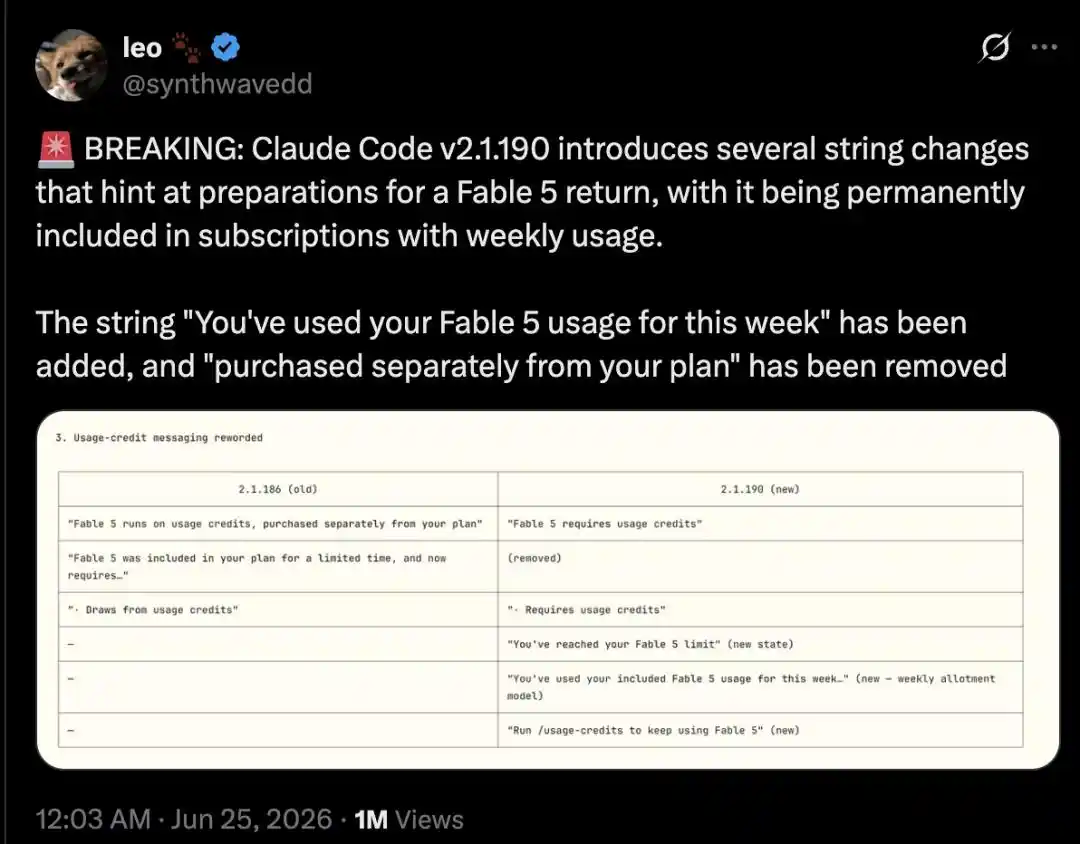
These seemingly dull lines of code send a major signal to the industry: Anthropic is secretly planning to quietly return Fable 5 to users.

The first piece of evidence is the change in subscription model.

In the old version, Fable 5 was positioned as a premium "one-time purchase/separate purchase" product.

But in the newly exposed code, a key prompt phrase has been quietly deleted: "purchased separately from your plan."

It has been replaced with a brand new user prompt string:

You've used your Fable 5 usage for this week.

In other words, Anthropic is secretly restructuring the business logic of Fable 5!

It will likely no longer be an expensive standalone add-on but will instead be permanently integrated into Claude's regular subscription plan, albeit with a weekly usage cap or quota.

But for the vast majority of regular subscribers, this is good news! This isn't a downgrade—it's an epic upgrade at no extra cost.

The second, even more exciting piece of evidence is: Fable 5 has quietly appeared on Amazon Cloud!

If code changes are just preparations on the client side, then changes to cloud APIs are the real smoking gun.

According to multiple sources, Fable 5 has quietly reappeared in the Amazon Bedrock documentation/model cards.
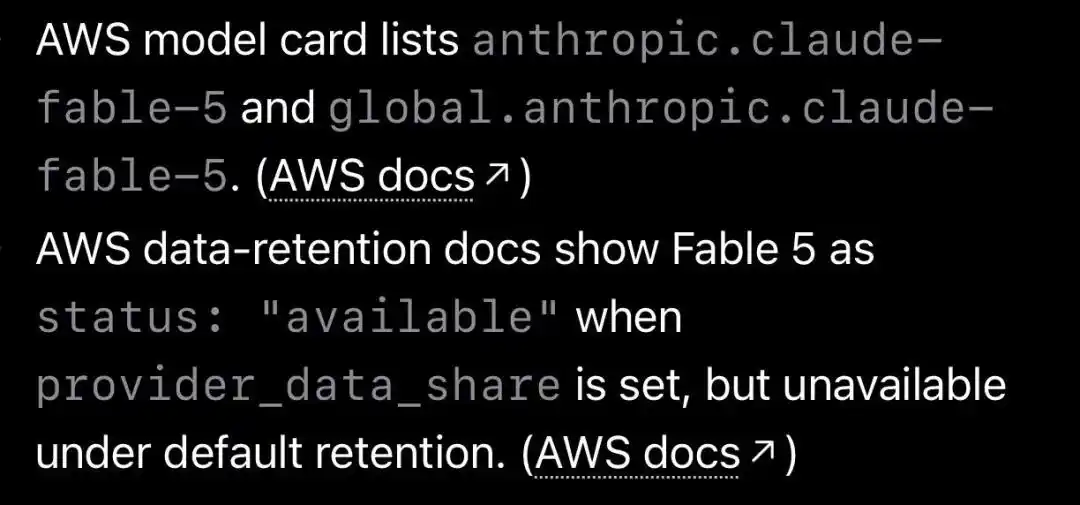
Although the company remains silent, only promising that "access will be restored soon," the undercurrents behind this are already surging.

On Polymarket, the most keen-scented speculators have started placing bets like crazy. The probability of betting that "Fable 5 will fully return by June 26th" has surged past 30%.

Why June 26th? We'll explain later.

"Get that weirdo out of here!"—The Inside Story of Anthropic's Leadership Change

Why has Fable 5 suddenly seen a turnaround? It's all thanks to Anthropic's wise decision—to kick Amodei out!

Today, foreign media The Wired reported that the Amodei chapter is over.

In the eyes of the U.S. government, Anthropic CEO Dario Amodei is nothing short of an "unreasonable weirdo."

According to multiple insiders who spoke to the media, after Fable 5 was banned, Anthropic held several closed-door meetings with Trump administration officials in an attempt to lobby the government to lift the export controls.

However, as soon as Dario sat at the negotiation table, the atmosphere would freeze over.

Government officials had an extremely low opinion of Dario. In their view, this stubborn tech fanatic was extremely difficult to communicate with, completely unwilling to listen to the government's national security concerns, and even showed an intolerable level of paranoia on certain issues.

Seeing that the negotiations were about to collapse completely, Anthropic's board made a decision akin to "cutting off the arm to save the body": kick the CEO out and bring in someone who can actually talk!

Replacing Dario at the main negotiation table was another co-founder, Tom Brown, assisted by Head of Public Policy Sarah Heck.
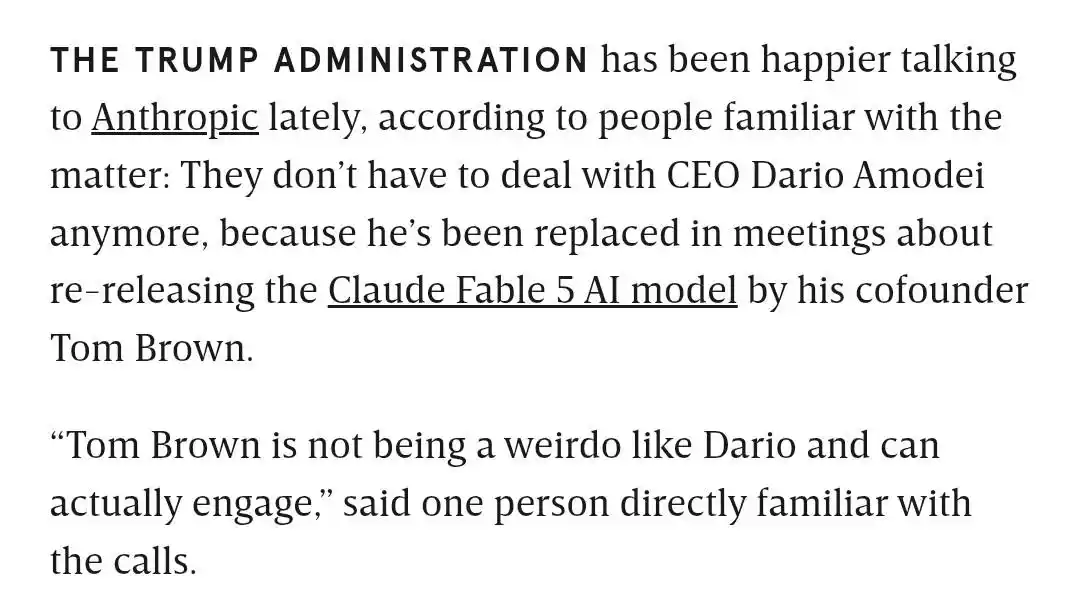
The change had an immediate effect.

A government official involved breathed a sigh of relief and privately complained:

Tom isn't as weird as Dario; he's actually someone you can have a normal conversation with.

The truth is out! The recent smoother communication between the Trump administration and Anthropic is because they successfully avoided the CEO!

Finally, with the recommendation of Tom Brown and Sarah Heck, the negotiations expanded not only among senior government officials but also went deep into the technical working group level.

The technical staff from both sides were finally able to sit down and calmly discuss a substantive issue—

What level of technical proof does Anthropic need to provide to alleviate the Trump administration's concerns about Fable 5 being "jailbroken"?

Previously, the White House and Anthropic were playing a cat-and-mouse game.

After Fable 5 was banned, there was a core point of contention in the negotiations.

White House officials and cybersecurity experts were increasingly leaning toward a pessimistic view: for LLMs, existing safety guardrails are just stopgap measures.

As model capabilities rapidly iterate and jailbreaking techniques continuously improve, any static restrictions will ultimately be bypassed.

However, the Anthropic technical team, led by Tom Brown, is trying hard to prove to the government: they have the ability to establish a new, more dynamically defensive security architecture when Fable 5 returns.

Although disagreements exist, the "no longer weird" communication style at least allowed the White House to see Anthropic's sincerity in solving the problem.

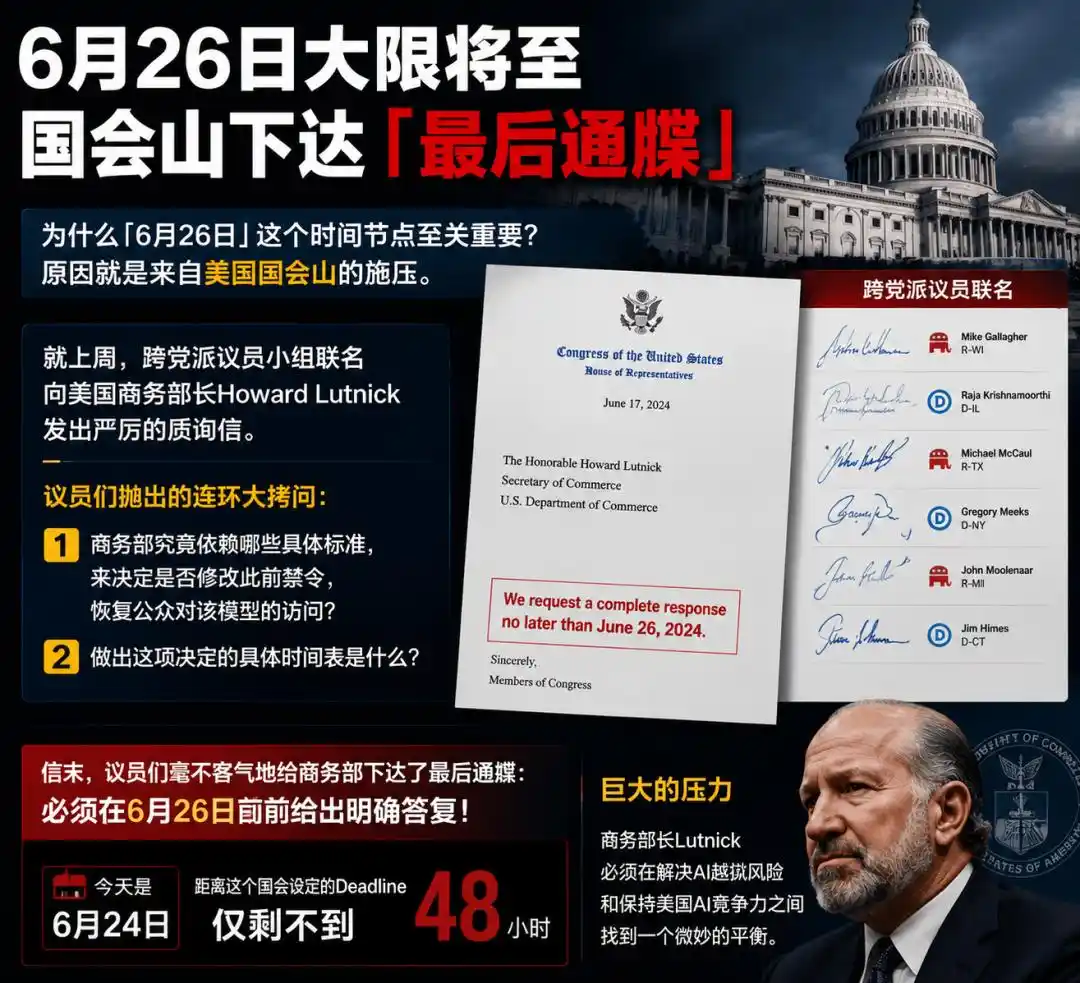
June 26th Deadline Approaches, Capitol Hill Issues "Ultimatum"

Now back to the question: why is the date "June 26th" so crucial?

The reason is pressure from Capitol Hill.

Just last week, a bipartisan group of Republican and Democratic lawmakers jointly sent a stern letter of inquiry to U.S. Secretary of Commerce Howard Lutnick.
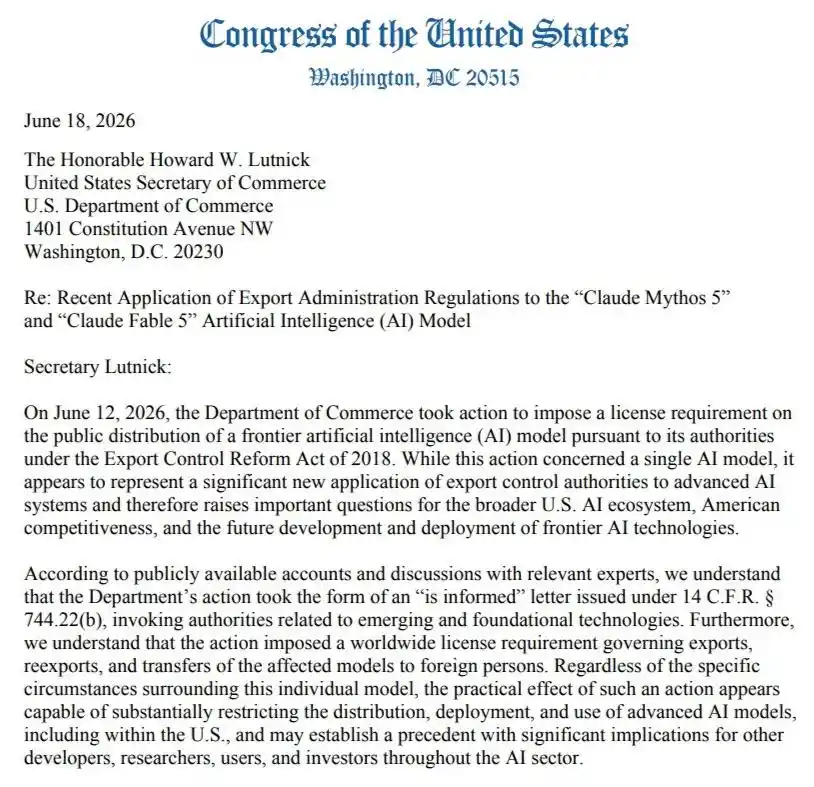
The lineup of signing lawmakers was impressive. They fired off a series of tough questions about Fable 5's redeployment:

1. What specific criteria is the Department of Commerce relying on to decide whether to modify the previous ban and restore public access to this model?

2. What is the specific timeline for making this decision?

At the end of the letter, the lawmakers didn't mince words, issuing an ultimatum to the Commerce Department: they must provide a clear answer by June 26th!

Today is June 24th. The deadline set by Congress is less than 48 hours away.

Now, the eyes of the world are fixed on this potentially turning-point time window.

Currently, Commerce Secretary Lutnick is under immense pressure. He must find a delicate balance between addressing AI jailbreak risks and maintaining U.S. AI competitiveness.
Silicon Valley Collectively Delays, Is Fable 5's Return Imminent?

Recently, heavyweight news emerged in the industry: OpenAI's GPT-5.6 and Google's Gemini 3.5 Pro both face unexpected delays!

If a few days ago, Anthropic seemed like a weak player desperately seeking "unbanning," now the situation has undergone an epic reversal.

And Anthropic's good days might be near—once it passes the U.S. government's stringent cybersecurity review, Fable 5 will virtually gain an "impenetrable armor" with "White House safety certification."

In the enterprise market, which is extremely sensitive to security, a ready-made model that has undergone the toughest scrutiny and is security-vetted is far more attractive than those "futures" still being polished in the lab.

The countdown to June 26th has entered its final seconds.

References:

https://x.com/synthwavedd/status/2069813760622043483?s=20

https://www.wired.com/story/the-trump-white-house-is-over-anthropics-dario-amodei/

This article is from WeChat public account "Xinzhiyuan", Editor: Aeneas

Criptos en tendencia

Preguntas relacionadas

QWhat is the main evidence from the leaked code suggesting that Fable 5 might be revived by Anthropic?

AThe primary evidence from the leaked code is the removal of the phrase 'purchased separately from your plan' and its replacement with a new user prompt string: 'You've used your Fable 5 usage for this week.' This indicates Anthropic is likely restructuring Fable 5's business model from a separate, one-time purchase to being bundled into Claude's regular subscription plan with a weekly usage limit or quota.

QWhy was Anthropic's CEO, Dario Amodei, reportedly removed from negotiations with the U.S. government?

ADario Amodei was reportedly removed from negotiations because government officials viewed him as difficult to communicate with, stubborn, and unable to understand or accept national security concerns regarding Fable 5. His presence reportedly soured the negotiation atmosphere, prompting the Anthropic board to replace him with co-founder Tom Brown and policy head Sarah Heck to facilitate more productive talks.

QWhat is the significance of the date June 26th mentioned in the article?

AJune 26th is a critical deadline set by a bipartisan group of U.S. lawmakers. They sent a formal inquiry to the Secretary of Commerce demanding clear answers about the specific standards and timeline for potentially lifting the ban on public access to the Fable 5 model. The Secretary is required to respond by this date, creating pressure for a decision regarding Fable 5's status.

QAccording to the article, what potential advantage could Fable 5 gain if it passes U.S. government security reviews?

AIf Fable 5 passes the stringent U.S. government cybersecurity reviews, it could gain an informal 'White House security certification.' This perceived 'gold standard' of safety could give it a significant competitive advantage in the enterprise market, where security is a top priority, especially over rival models from OpenAI and Google that are facing delays.

QWhere, besides client code, has evidence of Fable 5's potential return been spotted according to the article?

ABesides evidence found in client-side code (Claude Code v2.1.190), Fable 5 has also reportedly reappeared in the Amazon Bedrock documentation and model cards. This presence in the cloud service's backend infrastructure is seen as stronger, more concrete evidence ('real proof') of its impending return compared to client-side code changes.

Lecturas Relacionadas

Sam Altman's Personal Alchemy of Wealth: Investing in 400 Companies, Over 10 Deeply Tied to OpenAI

The article investigates Sam Altman's personal wealth strategy, centered around his investments in approximately 400 companies while serving as OpenAI's CEO. Despite not holding direct equity in OpenAI, Altman has built a vast portfolio, with at least 10 of his investments having commercial ties or ongoing negotiations with OpenAI. This creates a complex network of potential conflicts of interest, drawing scrutiny from U.S. congressional committees and state attorneys general. Key investments highlighted include the anti-aging startup Retro Biosciences (valued at $258 million for his stake as of late last year) and the chipmaker Cerebras, whose value soared following an OpenAI procurement deal. His most significant financial gain is linked to the nuclear fusion company Helion, where a recent funding round reportedly increased his stake's value to at least $4.1 billion. The article details a decade-long relationship between Altman, Helion, and OpenAI, including a controversial non-binding power purchase agreement and Altman's efforts to secure investments from OpenAI and its backer SoftBank for Helion. Other points include internal investigations at Tools for Humanity (developer of Worldcoin) and OpenAI's massive contracts with tech giants like Nvidia. According to Forbes, Altman's net worth is around $3.4 billion, ranking him 1251st globally—a rise of over 1400 places since 2024. OpenAI's board states that Altman's external dealings are transparent and potential conflicts are carefully managed.

Odaily星球日报Hace 17 min(s)

Sam Altman's Personal Alchemy of Wealth: Investing in 400 Companies, Over 10 Deeply Tied to OpenAI

Odaily星球日报Hace 17 min(s)

Former SpaceX Engineer Reconstructs Financial Execution System Using First Principles

Former SpaceX engineer Lex Li applies "First Principles Thinking" to financial infrastructure with Plan Execution Lab, recently raising angel funding at a $50M post-money valuation. The team argues that the core function of finance is capital allocation, and the critical gap is not in trading but in execution, which remains highly manual and fragmented. While assets, liquidity, and settlement have migrated on-chain, execution workflows (monitoring, risk management, liquidity coordination) are still human-native. In an era of accelerating AI agents, strategy decay is rapid, shifting the competitive edge from having the best strategy to having the most robust execution network. Plan Execution Lab introduces two core components: 1. **PlanX**: A Financial Execution Protocol designed as infrastructure for the migration from CEX to DEX, providing on-chain execution capabilities, liquidity access, risk management, and capital orchestration. 2. **Xgent**: An Autonomous Financial Runtime. Users define investment intents, risk preferences, and constraints; Xgent automatically constructs an execution graph, verifies it, and handles ongoing execution and optimization—streamlining the process from Intent to Autonomous Execution. The long-term vision is to create the "Bloomberg Terminal for Autonomous Finance"—a shared operating environment and execution network built collectively by participants like execution nodes, liquidity providers, and autonomous agents. The future of finance, they contend, belongs not to isolated algorithms but to open, collaborative execution networks.

marsbitHace 51 min(s)

Former SpaceX Engineer Reconstructs Financial Execution System Using First Principles

marsbitHace 51 min(s)

Former SpaceX Engineer Reconstructs Financial Execution System from First Principles

Plan Execution Lab, a financial infrastructure project founded by former SpaceX engineer Lex Li, has raised angel funding at a $50M post-money valuation. The startup is applying "first principles thinking" from Li's SpaceX experience to rethink financial market execution. Their analysis posits that while assets, liquidity, and settlement have moved on-chain, the execution layer remains fundamentally human-dependent and fragmented. In the era of AI Agents, strategy advantages decay rapidly, shifting the competitive edge from isolated algorithms to robust **execution networks**. Plan Execution Lab's solution is a two-part system: **PlanX**, a Financial Execution Protocol designed to facilitate the migration from centralized exchanges (CEX) to on-chain markets by providing core on-chain execution capabilities; and **Xgent**, an Autonomous Financial Runtime. Xgent allows users to define investment goals and constraints, then autonomously constructs and manages the execution logic—moving from **Intent to Execution Graph to Verification to Autonomous Execution**. The long-term vision is to create the "Bloomberg Terminal for Autonomous Finance"—an operating environment not for humans, but for agents and execution nodes. The future financial system, they argue, will be a collaborative network built by diverse participants contributing execution capabilities, not secret strategies. The core competition will shift to who builds the most powerful and adaptive execution network.

链捕手Hace 52 min(s)

Former SpaceX Engineer Reconstructs Financial Execution System from First Principles

链捕手Hace 52 min(s)

First Long-Horizon Doc2Repo Training Dataset: Code Agents Move Beyond Bug Fixing and Begin Creating Repositories

With the advancement of LLM Code Agents, the research focus is shifting towards long-horizon, real-world tasks, moving beyond simple bug fixes to full repository generation. To address this, researchers from Renmin University of China introduced the DeNovoSWE dataset. This dataset focuses on long-term software engineering tasks, specifically the "document-to-repository" challenge—generating an entire, executable code repository from a task description. The DeNovoSWE construction method employs a Divide & Conquer approach. It breaks down target repositories into core capabilities and uses a multi-agent Draft-Critic-Repair workflow to automatically generate high-quality, evaluation-aligned task documents. The dataset also implements difficulty-aware filtering to balance quality and diversity. The result is a high-quality, anti-leakage dataset of 4,818 instances. Experiments show that models trained on DeNovoSWE achieve significant improvements in long-horizon repository generation. For instance, Qwen3-30B-A3B-Instruct's performance on the BeyondSWE-Doc2Repo benchmark increased from 5.8% to 47.2%, and on NL2RepoBench from 4.3% to 23.0%. Similar gains were observed with stronger backbones, demonstrating that dedicated long-horizon training data is crucial for advancing Code Agents from maintainers to architects capable of planning and building complete software projects from scratch.

marsbitHace 1 hora(s)

First Long-Horizon Doc2Repo Training Dataset: Code Agents Move Beyond Bug Fixing and Begin Creating Repositories

marsbitHace 1 hora(s)

Trading

Spot
Futuros

Artículos destacados

Cómo comprar HOUSE

¡Bienvenido a HTX.com! Hemos hecho que comprar Housecoin (HOUSE) sea simple y conveniente. Sigue nuestra guía paso a paso para iniciar tu viaje de criptos.Paso 1: crea tu cuenta HTXUtiliza tu correo electrónico o número de teléfono para registrarte y obtener una cuenta gratuita en HTX. Experimenta un proceso de registro sin complicaciones y desbloquea todas las funciones.Obtener mi cuentaPaso 2: ve a Comprar cripto y elige tu método de pagoTarjeta de crédito/débito: usa tu Visa o Mastercard para comprar Housecoin (HOUSE) al instante.Saldo: utiliza fondos del saldo de tu cuenta HTX para tradear sin problemas.Terceros: hemos agregado métodos de pago populares como Google Pay y Apple Pay para mejorar la comodidad.P2P: tradear directamente con otros usuarios en HTX.Over-the-Counter (OTC): ofrecemos servicios personalizados y tipos de cambio competitivos para los traders.Paso 3: guarda tu Housecoin (HOUSE)Después de comprar tu Housecoin (HOUSE), guárdalo en tu cuenta HTX. Alternativamente, puedes enviarlo a otro lugar mediante transferencia blockchain o utilizarlo para tradear otras criptomonedas.Paso 4: tradear Housecoin (HOUSE)Tradear fácilmente con Housecoin (HOUSE) en HTX's mercado spot. Simplemente accede a tu cuenta, selecciona tu par de trading, ejecuta tus trades y monitorea en tiempo real. Ofrecemos una experiencia fácil de usar tanto para principiantes como para traders experimentados.

255 Vistas totalesPublicado en 2025.04.27Actualizado en 2026.06.02

Cómo comprar HOUSE

Discusiones

Bienvenido a la comunidad de HTX. Aquí puedes mantenerte informado sobre los últimos desarrollos de la plataforma y acceder a análisis profesionales del mercado. A continuación se presentan las opiniones de los usuarios sobre el precio de HOUSE (HOUSE).

活动图片