In the city of Rossosh, Voronezh Region, energy workers discovered a hidden crypto farm consisting of 110 mining devices. The inspection was conducted by specialists from "Voronezhenergo" and "Rosseti Center" following complaints from residents about unstable electricity supply.
How the Mining Farm Was Discovered
The reason for the on-site visit was appeals from the village of Yevstratovka, as well as the hamlets of Malaya Mezhenka and Slavyanka. People reported voltage fluctuations and brief power outages. During the inspection of the non-residential building, energy workers found signs of tampering with the electricity metering system.
Jumper wires had been installed in the measurement circuits. This scheme allowed for understated consumption readings while the equipment continued to operate under high load. Cryptocurrency mining requires a stable power supply, and with large volumes of load, problems quickly affect neighboring consumers.
Damage Estimated at Almost 6 Million Rubles
According to the energy workers' estimate, the volume of unaccounted electricity exceeded 1.27 million kWh. The cost of this volume amounted to about 5.9 million rubles. The crypto farm was documented with photos and videos, after which the materials were handed over to local law enforcement agencies.
After the equipment was disconnected, the load on the supply line, according to "Voronezhenergo," decreased by approximately half. The company stated that power supply interruptions had ceased, and voltage in nearby settlements was successfully stabilized.
Why Such Cases are Important for the Mining Market
This incident occurred in the Voronezh Region, not the Irkutsk Region, which is often associated with energy-intensive mining in Russia. But the essence of the problem remains common: when cryptocurrency is mined by bypassing metering, not only the networks suffer, but also residents connected to the same line.
For a legal business, transparent calculations for electricity and clear operating rules are important. In Russia, mining should rely on a legal connection to the power grid, proper consumption metering, and payment for the electricity actually used. Investments in equipment, whether a GPU or another mining device, only make sense with a legal connection. Otherwise, any mining algorithm, including the one used for Bitcoin, turns a project from a technological business into a risky scheme: possible disconnection, damage assessment, and inspection by law enforcement.
For a mining business, a legal connection and transparent payment for electricity are no less important than the equipment itself: without this, a farm turns into a source of legal and financial risks.
What is Mining and How a Crypto Farm Works
Mining, in simple terms, is the work of equipment that performs computations for a cryptocurrency network and receives a reward if the mining is successful. A crypto farm combines many devices: they constantly calculate an algorithm, consume electricity, and generate heat. In such a setup, not only the GPU or ASIC is important, but also power supply, cooling, network connection, and stable electricity consumption metering.
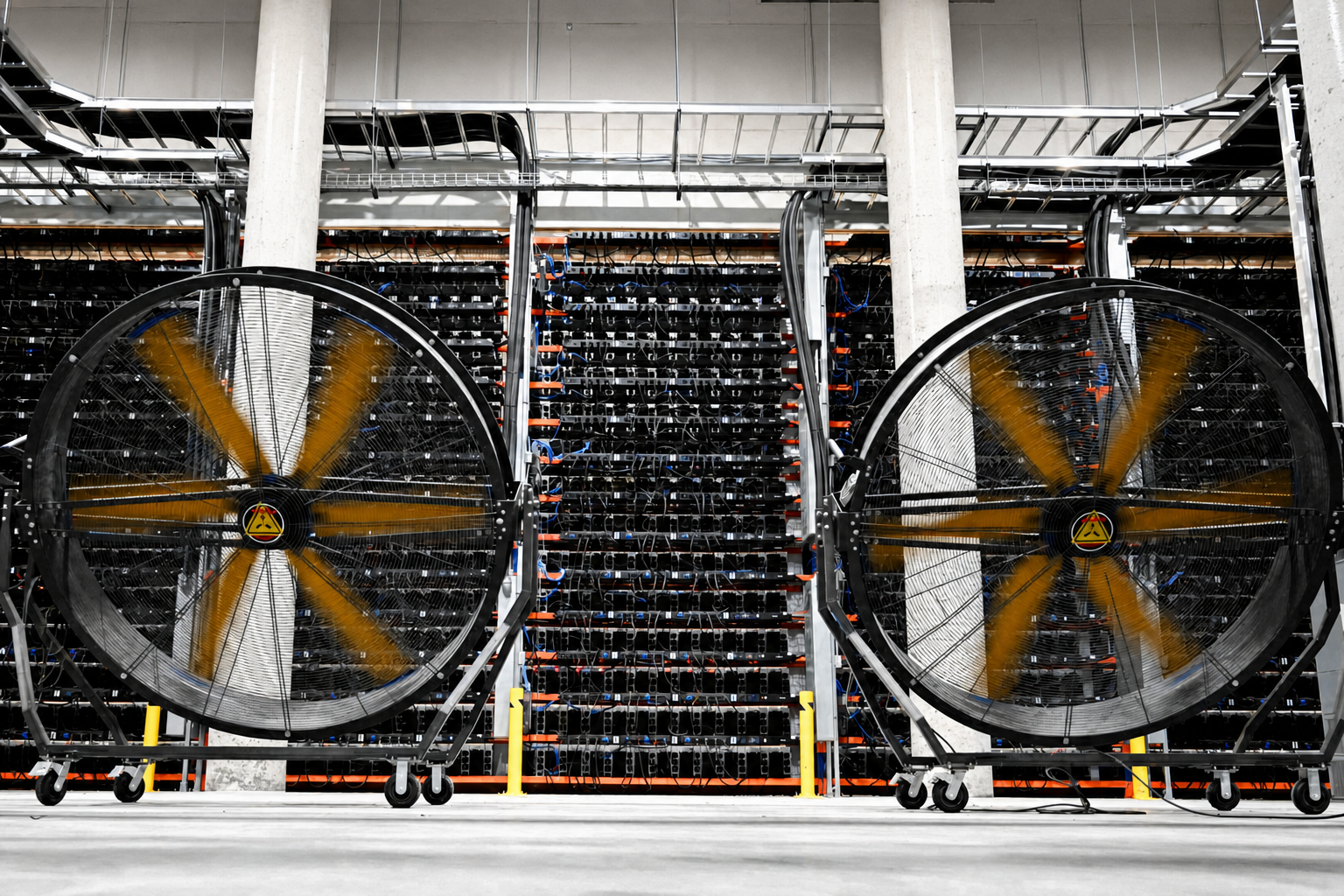
Typically, a crypto farm requires graphics cards or ASIC devices, power supply units, a cooling system, an internet connection, and a place where the equipment can operate without overheating. A GPU farm is more flexible and allows switching between different algorithms, while an ASIC is designed for a specific task and requires especially stable power.
Profitability, Launch, and Cryptocurrency Selection
The profitability of a mining farm is calculated not by the number of devices alone, but by the revenue from the mined cryptocurrency minus expenses for electricity and maintenance. The result is influenced by the price of the chosen cryptocurrency, mining difficulty, equipment power, electricity tariff, downtime, and repairs. Therefore, a farm with 6 graphics cards can yield different results in different months: first, the estimated revenue is assessed, then the cost of electricity and current expenses are subtracted.
Launching from scratch boils down to a clear chain: select equipment, prepare electrical and cooling systems, configure the devices, connect to a pool, and only then start mining. The cryptocurrency for mining is chosen based on compatibility with the equipment, network difficulty, expected revenue, and electricity costs; if it's about Bitcoin, the power of the devices and the cost of power are especially important.
Home Mining, Expenses, and Risks
Keeping a small farm at home is possible, but home mining has limitations: load on wiring, noise, heat, and the risk of voltage drops. To reduce electricity costs, energy-efficient equipment is chosen, power settings are monitored, and the line is not overloaded.
The main risks of mining are technical, financial, and legal. They are mitigated by proper connection, accurate electricity metering, profitability calculations, equipment maintenance, and operating within the rules. Illegal connection, as the case in Rossosh shows, quickly ceases to be a question of profitability and becomes a reason for inspection and handing over materials to law enforcement.
The situation is not directly related to the securities market, but it clearly shows why the state and energy companies are paying closer attention to large electricity consumers. Previously, employees of a Siberian branch of "Rosseti," together with police, found another crypto farm in the village of Berezovo, Kemerovo Region: 40 mining devices were operating on the territory of a sawmill.
end-content