Connecticut can’t take action against Kalshi for now, judge rules

cointelegraphPublished on 2025-12-10Last updated on 2025-12-10

Abstract

A US judge has temporarily blocked Connecticut from taking enforcement action against prediction markets platform Kalshi, which received a cease and desist order from the state’s Department of Consumer Protection (DCP) for allegedly conducting unlicensed sports gambling. Kalshi sued the DCP, arguing its event contracts are legal under federal law and fall under the exclusive jurisdiction of the Commodity Futures Trading Commission. The court has paused enforcement while it reviews Kalshi’s motion for a preliminary injunction, with further legal proceedings scheduled through February. Kalshi, a CFTC-regulated platform that saw record trading volume in November, is also engaged in similar legal battles with multiple states, including New York, Massachusetts, New Jersey, Nevada, Maryland, and Ohio, over regulatory jurisdiction and gambling licensing.

A US judge has granted prediction markets platform Kalshi a temporary reprieve from enforcement after the state of Connecticut sent it a cease and desist order last week for allegedly conducting unlicensed gambling.

The Connecticut Department of Consumer Protection (DCP) sent Kalshi, along with Robinhood and Crypto.com, cease and desist orders on Dec. 2, accusing them of “conducting unlicensed online gambling, more specifically sports wagering, in Connecticut through its online sports event contracts.”

Kalshi sued the DCP a day later, arguing its event contracts “are lawful under federal law” and its platform was subject to the Commodity Futures Trading Commission’s “exclusive jurisdiction,” and filed a motion on Friday to temporarily stop the DCP’s action.
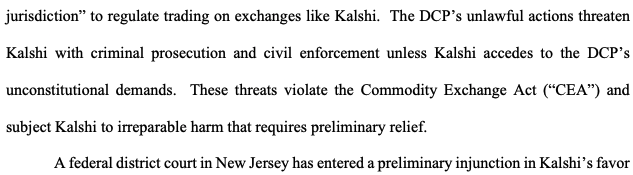
An excerpt from Kalshi’s preliminary injunction motion arguing that the DCP’s action violates federal commodities laws. Source: CourtListener

Connecticut federal court judge Vernon Oliver said in an order on Monday that the DCP must “refrain from taking enforcement action against Kalshi” as the court considers the company’s bid to temporarily stop the regulator.

The order adds that the DCP should file a response to the company by Jan. 9 and Kalshi should file further support for its motion by Jan. 30, with oral arguments for the case to be held in mid-February.

Kalshi is in a battle with multiple US states

Kalshi is a federally regulated designated contract maker under the CFTC and, in January, began offering contracts nationally that allow bets on the outcome of events such as sports and politics.

Related: How prediction markets raise insider trading and credit risks

Its platform has become hugely popular this year and saw a record $4.54 billion monthly trading volume in November, attracting billions in investments, with Kalshi closing a $1 billion funding round earlier this month at a valuation of $11 billion.

However, multiple US state regulators have taken issue with Kalshi’s offerings, which have led to the company being embroiled in lawsuits over whether it is subject to state-level gambling laws.

Kalshi sued the New York State Gaming Commission in October after the regulator sent a cease and desist order claiming it offered a platform for sports wagering without a license.

In September, Massachusetts’ state attorney general sued Kalshi in state court, which the company asked to be tossed. So far this year, Kalshi has sued state regulators in New Jersey, Nevada, Maryland and Ohio, accusing each of regulatory overreach.

Magazine: Can Robinhood or Kraken’s tokenized stocks ever be truly decentralized?

Related Reads

Afraid of Wasting 8 Years in Crypto? How to Find a Successful Life?

The Truth About Crypto Success: What Really Leads to Wealth and Freedom Most people enter crypto chasing symbols of success—Bitcoin, luxury cars, cash stacks, and freedom—but these are only the end results. True success isn’t about luck or quick wins; it’s built through discipline, patience, and a deep understanding of the market. Key insights include: 1. The first victory is mental, not financial: wealth comes from understanding narratives, liquidity flows, and human behavior, not gambling. 2. The game rewards observers, not reactive traders. Winners act slowly, observe patiently, and strike with conviction. 3. You can’t “copy trade” a mindset: success requires personal discipline, emotional control, and conviction. 4. The biggest advantage is survival: staying in the game long enough to capture asymmetric opportunities. 5. True wealth comes from noticing overlooked information—developer activity, early liquidity moves, policy shifts, and narrative cycles. 6. Freedom isn’t bought—it’s built through the realization that you no longer trade time for money. 7. Most fail because they seek shortcuts, not mastery. Consistency in learning, tracking, and waiting separates winners from the crowd. 8. The choice defines the outcome: are you here to gamble or to build? Crypto offers a path to redesign your life through understanding and discipline—not miracles. Real wealth grows silently through focused effort, not hype.

深潮Hace 2 min(s)

Afraid of Wasting 8 Years in Crypto? How to Find a Successful Life?

深潮Hace 2 min(s)

Trading

Spot
Futures
活动图片