US Senate Targets Fall 2026 Release for Crypto Tax Bill Amid CLARITY Act Push

TheNewsCryptoPublicado a 2026-06-24Actualizado a 2026-06-24

Resumen

U.S. Senators are targeting Fall 2026 for the potential release of a dedicated cryptocurrency tax bill. Senator Steve Daines revealed that Republicans have already developed a framework for the legislation, which aligns closely with recent crypto tax proposals from the House of Representatives. The Senate Finance Committee's move is driven by growing congressional interest in establishing clearer tax rules for virtual assets, addressing areas like staking rewards and mining. Concurrently, lawmakers continue to prioritize the broader Digital Asset Market CLARITY Act, which passed the Senate Banking Committee with bipartisan support. This act aims to create comprehensive regulations and define federal regulatory authority over cryptocurrencies. Over 200 industry groups are advocating for its passage, arguing that regulatory clarity will boost innovation and investment. Market observers view the tax bill and the CLARITY Act as complementary efforts to build a more complete regulatory framework for digital assets. While neither proposal has been finalized, the legislative activity signals accelerating progress in U.S. crypto regulation.

U.S. Lawmakers continue to advance digital asset regulations as the Senate moves closer to introducing dedicated cryptocurrency tax legislation. Senator Steve Daines revealed that Republican senators had already developed the framework. During an interview with Bloomberg Tax, Sen. Steve Daines said, “sooner rather than later”. He also said, “We’ve put together a framework,” Which means Congress has developed a framework for deliberation and discussion. Although Daines did not reveal any further information, he added that the plan is very similar to recent cryptocurrency tax bills proposed by the House of Representatives.
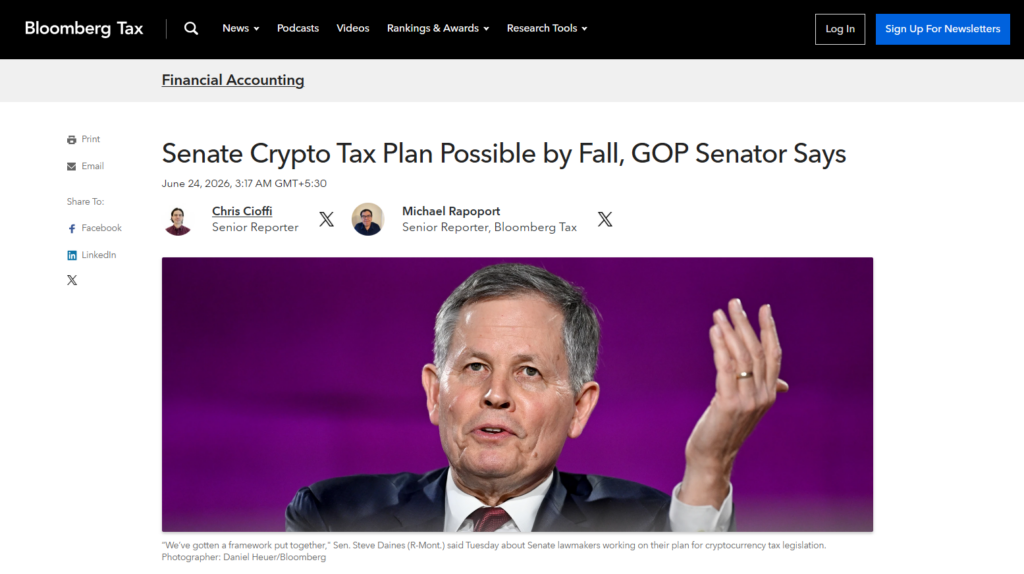
Source: Bloomberg Tax

Growing congressional interest in clearer tax rules for virtual assets prompted the Senate to develop the proposal. The Senate Finance Committee has previously discussed cryptocurrency tax legislation. Especially during hearings on staking rewards, mining, and other issues associated with the reporting of digital assets.

Additionally, several drafts of cryptocurrency tax legislation have been proposed in the House of Representatives, including by the House Ways and Means Committee. The legislation deals with such issues as staking, mining, decentralized finance operations, stablecoin transactions, and others.

CLARITY Act Still the Top Priority

While the Senate is moving forward with its tax proposal, the lawmakers are still discussing the Digital Asset Market CLARITY Act. This act aims at building an all-encompassing regulation for cryptocurrencies and defining regulatory authority for both federal authorities. The Senate Banking Committee passed this bill via a 15-9 bipartisan vote. Although the Senate is awaiting other provisions, the act is already under discussion.

Meanwhile, industry groups remain advocates for the bill, with over 200 cryptocurrency companies calling on the Senate leadership to put the bill up for a vote. They say that clear regulations will spur innovation and investments in the US digital assets market.

Regulatory Clarity Is Still at the Top of the Agenda

Both projects will be followed by market players because taxation and regulation are always crucial for the crypto business and investors. It is believed that the tax provision of the Senate and the CLARITY Act are complementary moves that aim at creating a more complete framework for digital assets. Despite the fact that neither of the projects has been finally approved yet, the activity of Congress demonstrates that the development of legislation for cryptocurrencies is gaining pace. It may be quite interesting for the next few months.

Highlighted Crypto News:

Ripple Secures Preliminary MiCA Approval in Luxembourg for Europe-Wide Expansion

TagsBlockchainBloombergClarity ACTCrypto Taxcrypto taxationSenatorU.SU.S Congress

Criptos en tendencia

Preguntas relacionadas

QWhat is the target release timeline for the US Senate's crypto tax bill, according to the article?

AThe US Senate is targeting a Fall 2026 release for its cryptocurrency tax bill.

QAccording to Senator Steve Daines, what stage has Congress reached regarding the crypto tax framework?

AAccording to Senator Steve Daines, Congress has developed a framework for the cryptocurrency tax legislation for deliberation and discussion.

QWhat is the main goal of the Digital Asset Market CLARITY Act mentioned in the article?

AThe main goal of the CLARITY Act is to build an all-encompassing regulation for cryptocurrencies and define regulatory authority for federal authorities.

QWhy are market players closely following both the Senate's tax proposal and the CLARITY Act?

AMarket players are closely following both projects because taxation and regulation are crucial for the crypto business and investors, and these moves aim to create a more complete framework for digital assets.

QHow did the industry show its support for the CLARITY Act, as per the article?

AOver 200 cryptocurrency companies called on the Senate leadership to put the CLARITY Act up for a vote, advocating that clear regulations will spur innovation and investments in the US digital assets market.

Lecturas Relacionadas

DRAM ETF Issuer: Samsung, SK Hynix, Micron All Surpass $1 Trillion, the AI Era of Memory Chips Has Only Just Begun

Authors: Dave Mazza, Thomas DiFazio | Source: Deep Tide TechFlow The article, written by Roundhill Investments (issuer of the DRAM ETF), responds to Morningstar's caution about investing in memory chip stocks. Morningstar warns of the sector's history of boom-bust cycles, a lack of economic moats, and potential momentum-driven overvaluation. Roundhill argues the current situation is structurally different due to AI. Key points in Roundhill's rebuttal include: * **Changed Demand & Supply Dynamics:** AI infrastructure, not consumer electronics, is now the primary growth driver for memory demand. New, strict long-term supply agreements with hyperscalers reflect the high capital intensity of advanced manufacturing. * **Existence of a Moat:** High-Bandwidth Memory (HBM), essential for AI, has extremely high manufacturing barriers. The market is dominated by Samsung, SK Hynix, and Micron, with new entrants blocked by technological complexity and long lead times for equipment like ASML's EUV machines. * **Strong Fundamental Outlook:** Analyst consensus projects the three companies will rank among the world's most profitable by 2027, with combined profits of $704 billion on over $1 trillion in revenue. Their operating margins have already reached record highs. * **Valuation Re-rating:** Despite significant stock price gains, memory stocks trade at attractive valuations (e.g., a median NTM P/E of 8.37x for the DRAM ETF) relative to projected explosive EPS growth. Roundhill suggests historical valuation frameworks may no longer apply given the new profitability paradigm. Conclusion: Roundhill contends the rally is justified by fundamentals, marking a structural shift for the memory industry into a new era of sustained, AI-driven demand against constrained supply, rather than a repeat of past cycles.

marsbitHace 11 min(s)

DRAM ETF Issuer: Samsung, SK Hynix, Micron All Surpass $1 Trillion, the AI Era of Memory Chips Has Only Just Begun

marsbitHace 11 min(s)

EF's Epic Reorganization: 20% Layoffs, Budget Halved, Is Ethereum Gearing Up for a Leaner Future?

The Ethereum Foundation (EF) has announced a major organizational restructuring, involving a 20% staff reduction (approx. 54 employees) and a division into functional clusters like Protocol, Access, User, Community, and Institutional layers. Co-founder Vitalik Buterin further revealed plans to cut the EF's budget by around 40% over the coming years, aiming to reduce its annual spending rate from about 15% to roughly 5% by 2030, transitioning to an endowment-driven model. This overhaul is seen as a long-overdue correction to the EF's ambiguous role. As Ethereum grew, the foundation faced persistent criticism over ETH sales, perceived lack of execution, and unclear strategy, often becoming a focal point for community frustration amid ETH's price stagnation. The reform aims to redefine the EF's boundaries, narrowing its focus to core protocol research, public goods funding, and ecosystem coordination, while offloading more applied development work to the broader market. Concurrently, ecosystem forces like the newly formed Ethlabs (founded by ex-EF researchers) and other independent groups are stepping in to fill the space, signaling a shift from a centralized model to a more distributed, collaborative ecosystem structure. The move was notably praised by Solana co-founder toly, who viewed a "leaner" EF as potentially more decisive and agile.

Odaily星球日报Hace 51 min(s)

EF's Epic Reorganization: 20% Layoffs, Budget Halved, Is Ethereum Gearing Up for a Leaner Future?

Odaily星球日报Hace 51 min(s)

Dragonfly Partner Haseeb: The Fastest-Growing Companies of the Future May All Get Stuck at 149 Employees

Dragonfly partner Haseeb explores the distorted economics of AI model pricing, drawing parallels to tax policy. He notes that startups and small teams (under 150 users) enjoy heavily subsidized, fixed-price AI subscriptions (like Claude Code), where the marginal cost of an additional token is effectively zero. This creates a powerful incentive for them to maximize token usage ("token-maxxing") and innovate aggressively with AI automation. In contrast, large enterprises (over 150 users) are forced onto "Enterprise" plans, paying per-token API fees with high (~75%) markups. This acts like a steep "tax" on AI-powered labor, disincentivizing marginal automation and experimental use, and encouraging them to retain more human workers. Haseeb argues this pricing creates a "150-person cliff," a regulatory notch similar to labor laws in France that discourage firms from growing past 50 employees. He predicts the fastest-growing future companies may deliberately cap their headcount at 149 to avoid the punitive enterprise pricing. This would foster an "AI-first" management philosophy obsessed with automation and outsourcing to stay lean. While not intentionally designed, this bifurcated pricing could become one of the most influential de facto tax policies, shaping how AI replaces labor—not through mass layoffs at big firms, but through agile, AI-native startups outcompeting them.

marsbitHace 1 hora(s)

Dragonfly Partner Haseeb: The Fastest-Growing Companies of the Future May All Get Stuck at 149 Employees

marsbitHace 1 hora(s)

How xBubble Breaks Through in the VC-Heavily-Backed OPC Economy

xBubble: Addressing the Structural Gap in the VC-Backed OPC Economy The concept of OPC (One Person Company) is evolving from a buzzword to a significant AI-driven market. While AI coding tools like Replit and Lovable have validated demand from non-technical users wanting to build applications, a key gap remains: the leap from creating a demo to running a stable, evolving business. These tools still require users to manage the development process, including technical judgments for integrations, modifications, and deployments—a major hurdle for OPCs. xBubble, by DAPPOS, tackles this by shifting from "Prompt-to-Code" to "SOP-to-Business." Instead of generating code from instructions, its core is a system of pre-organized SOPs (Standard Operating Procedures) that translate business goals—like "sell World Cup merchandise"—into complete, executable workflows. This includes generating cohesive assets, pages, payment systems, and backend logic. The platform is augmented by a network of third-party service providers who handle infrastructure (hosting, domains, payment setup), acting like "on-site service engineers." Users can pay for these services directly with xBubble credits, simplifying onboarding. This ecosystem aims to deliver not just an app, but a complete, modifiable business launch path. xBubble targets a clear OPC segment: small commercial nodes (e.g., creators, merchants) with existing products, customers, or channels, but for whom a full tech team is unjustifiable. Its potential lies in SOPs accumulating expertise from real cases, improving reliability and reducing delivery costs over time. Additionally, its native support for crypto payments caters to global or digital-native OPCs. In summary, as AI democratizes software creation, xBubble's opportunity is to prove that "SOP-to-Business" provides more immediate value for launching a real, operational business than a powerful but unstructured AI coding tool.

链捕手Hace 1 hora(s)

How xBubble Breaks Through in the VC-Heavily-Backed OPC Economy

链捕手Hace 1 hora(s)

Trading

Spot
Futuros

Artículos destacados

Cómo comprar PUSH

¡Bienvenido a HTX.com! Hemos hecho que comprar Push Protocol (PUSH) sea simple y conveniente. Sigue nuestra guía paso a paso para iniciar tu viaje de criptos.Paso 1: crea tu cuenta HTXUtiliza tu correo electrónico o número de teléfono para registrarte y obtener una cuenta gratuita en HTX. Experimenta un proceso de registro sin complicaciones y desbloquea todas las funciones.Obtener mi cuentaPaso 2: ve a Comprar cripto y elige tu método de pagoTarjeta de crédito/débito: usa tu Visa o Mastercard para comprar Push Protocol (PUSH) al instante.Saldo: utiliza fondos del saldo de tu cuenta HTX para tradear sin problemas.Terceros: hemos agregado métodos de pago populares como Google Pay y Apple Pay para mejorar la comodidad.P2P: tradear directamente con otros usuarios en HTX.Over-the-Counter (OTC): ofrecemos servicios personalizados y tipos de cambio competitivos para los traders.Paso 3: guarda tu Push Protocol (PUSH)Después de comprar tu Push Protocol (PUSH), guárdalo en tu cuenta HTX. Alternativamente, puedes enviarlo a otro lugar mediante transferencia blockchain o utilizarlo para tradear otras criptomonedas.Paso 4: tradear Push Protocol (PUSH)Tradear fácilmente con Push Protocol (PUSH) en HTX's mercado spot. Simplemente accede a tu cuenta, selecciona tu par de trading, ejecuta tus trades y monitorea en tiempo real. Ofrecemos una experiencia fácil de usar tanto para principiantes como para traders experimentados.

220 Vistas totalesPublicado en 2024.12.13Actualizado en 2026.06.02

Cómo comprar PUSH

Discusiones

Bienvenido a la comunidad de HTX. Aquí puedes mantenerte informado sobre los últimos desarrollos de la plataforma y acceder a análisis profesionales del mercado. A continuación se presentan las opiniones de los usuarios sobre el precio de PUSH (PUSH).

活动图片