Altman Returns to Stanford and Admits Mistake: Outsourcing Thinking to AI, a Generation's Brains Are Atrophying

marsbitPublicado a 2026-07-16Actualizado a 2026-07-16

Resumen

Sam Altman returned to Stanford University and admitted he was wrong about AI's impact on education. He predicted that after an initial phase of student cheating with ChatGPT, the education system would rapidly reform itself to teach more critical thinking. However, three and a half years later, while AI has advanced dramatically, teaching and assessment methods remain largely unchanged—still focused on memorization, standardized answers, and closed-book exams. Altman expressed deep concern that this disconnect is causing a "cognitive atrophy," where outsourcing thinking to AI erodes students' critical reasoning skills. Research supports this: grades have dropped in high-stakes exams after ChatGPT's introduction, and while assignment scores in writing and coding have inflated due to AI use, exam performance hasn't improved, indicating "outsourcing" rather than learning. He argues the problem lies in institutional inertia. The education system, built on the premise that tasks are time-consuming, hasn't adapted to a world where AI makes shortcuts effortless. Students are being evaluated by outdated standards, risking a generational gap in essential cognitive skills. Altman proposes a shift: education should move from testing memorization to fostering judgment, creativity, and the ability to ask better questions. Core practices like writing and programming remain vital not for their outputs, which AI can generate, but for the thinking process they train. The urgent need is to...

Everyone thought schools would be forced to drastically transform by AI.

But three and a half years after ChatGPT's debut, education has barely changed.

In May of this year, Sam Altman returned to his alma mater, Stanford University, took the stage in the CS153 class, and admitted his mistake:

This was one of my prediction errors.

He also issued a stern warning: if we don't change, human thinking capacity will atrophy.

Not long ago, on the CS153 stage at Stanford, OpenAI CEO Sam Altman was asked: What do you think about education?

He paused: "I'm very worried. I thought it would have changed by now."
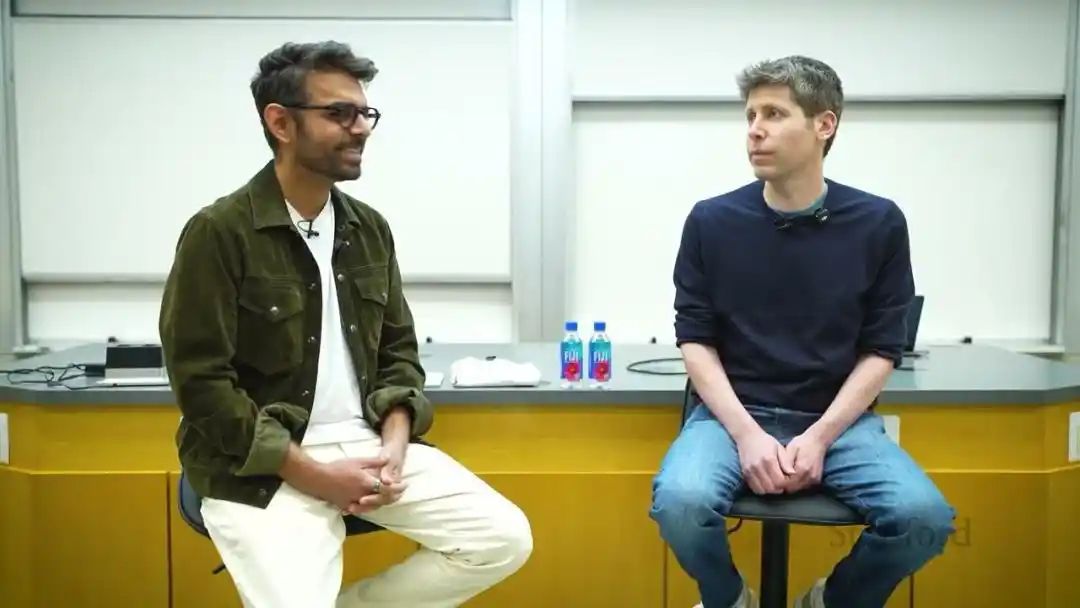
Altman appears at Stanford CS153 class discussing education in the AI era, admitting he underestimated the speed of the education system's transformation. (Source: Stanford Online)

Three and a half years ago, right after ChatGPT launched, Altman predicted that students would cheat for a year, then the entire education system would be forced to restructure itself, teaching people to think better than before.

However, three and a half years later, the script didn't unfold as Altman imagined.

On the AI side, it evolved from GPT-3.5, which could only write copy, to models that can disprove mathematical conjectures that stumped mathematicians for decades.

On the school side, they're still testing students with the same old things: rote memorization, standard answers, closed-book exams.

Homework, exams, theses... everything remains the same. Scouring the entire education system, he couldn't find a single significant structural change.

A man who bet correctly on the "Scaling Law" turned out to be mistaken about education.

He said this was one of his biggest prediction mistakes in recent years.

A person who constantly talks about Artificial General Intelligence (AGI) is actually anxious about the classroom.

What exactly is he afraid of?

He Thought Schools Should Have Changed Already

Rewind to November 2022, just after ChatGPT's release.

Back then, Altman's assessment was still optimistic:

The first year, students would use it to cheat and learn little; then the education system would reinvent itself, teaching courses much better than before.

According to his vision, teachers would assign projects that necessitated using AI, forcing students to use their brains more and come up with new ideas.

In 2024, he publicly expressed optimism: superintelligence would bring a personal tutor for everyone, education would shift from rote memorization to problem-solving, to critical thinking.

The result? AI advanced by leaps and bounds year after year, while education remained stagnant.

AI Outsourcing Is Hollowing Out Critical Thinking

This disconnect is what Altman is truly worried about.

He says if we continue to teach and evaluate students using the methods of the "pre-AGI world," it will not only render these methods ineffective but also cause people to "fail to learn how to think," leading to the gradual atrophy of critical thinking.

Outsourcing thinking to AI starts as just a shortcut.

But use it or lose it—the mental muscle responsible for independent thinking, like an unused arm, will subtly shrink and weaken, or as Altman puts it—muscle atrophy.

Is this just Altman's concern, or is it already a reality?

Some research shows that after ChatGPT entered the classroom, monthly test scores dropped by about 20% within six months; for high-stakes entrance exams that truly determine one's future, scores fell by 18% and 24% respectively, and this deficit takes up to two years to gradually become apparent.

More telling is an analysis from the University of California, Berkeley (UC Berkeley).

Among over 500,000 grade samples, grades in subjects like writing and programming noticeably shifted upward after ChatGPT, but the increase was entirely in homework scores, while exam scores remained unchanged.
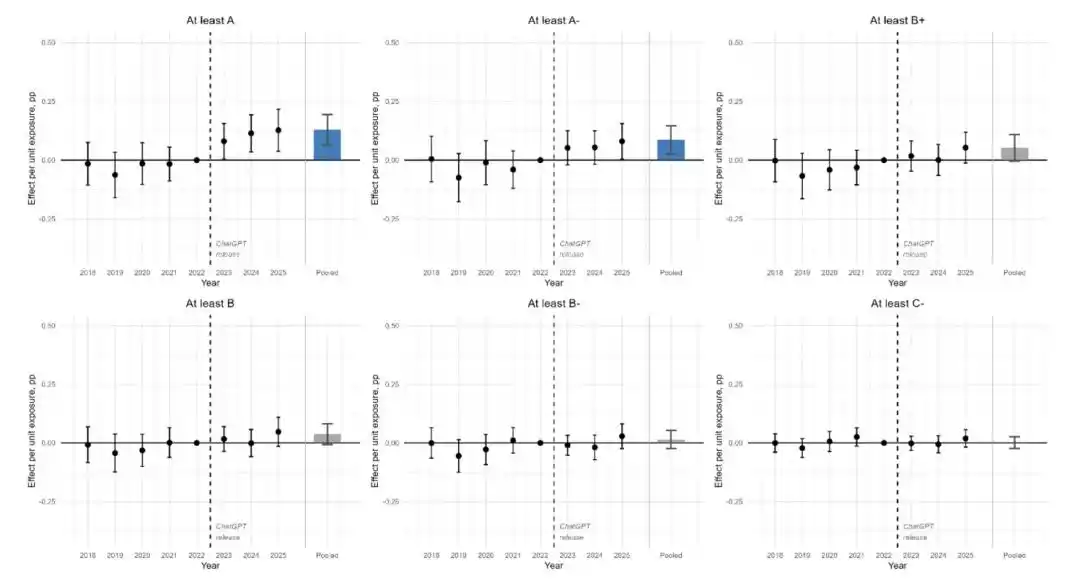
UC Berkeley analysis of over 500,000 grades: After ChatGPT's release, the proportion of A and A- grades in writing and programming courses significantly increased (blue significantly positive), while B+ and below barely moved. (Source: Chirikov/CSHE)

Why? This is "outsourcing," not "learning."

Another study spanning ten years and covering millions of US math interactions points to the same conclusion: with the arrival of chatbots, problems are solved faster, but less is learned.

Homework submissions are getting more polished, but minds are getting emptier.

Where Is the Promised Renaissance in Education?

Altman isn't the only one puzzled.
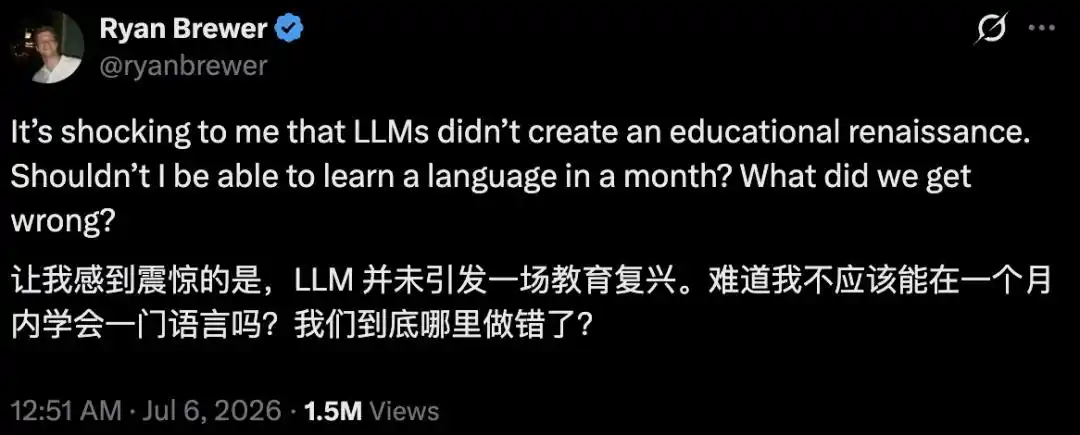
OpenAI technical team member Ryan Brewer posted, saying it's shocking that large language models haven't sparked an educational renaissance:

Shouldn't I be able to learn a language in a month? Where did we go wrong?

Similar doubts spread rapidly on X: With the most powerful learning tool in history in hand, why haven't AI tutors entered every household? Why is the education revolution so delayed?

The answer lies not in technology, but in institutional inertia.

The university's evaluation system—exams, theses, homework—has been built over centuries on an implicit premise: these tasks are too time-consuming for anyone to take shortcuts.

AI has changed that premise.

But schools are still using pre-AGI standards to measure a new generation raised with AI, even as the first generation of ChatGPT natives have already graduated.

Tools update with a version number; systems update over a generation: the technology is already here, but the rules remain in the previous era.

A 24/7, tireless, personalized, almost-free AI tutor could theoretically be given to every child today.

But it hasn't arrived, and the real reason is the pace at which the education system restructures itself.

In the same speech, Altman offered another prediction:

It's been three and a half years since ChatGPT appeared. Even if AI merely progresses along the same curve for another three and a half years, what human society can do will be on a completely different scale than today.

As technology races ahead exponentially, the gap between it and education will only widen, ultimately to be filled by the students currently sitting in old exams, old homework, and old evaluation systems.

The skills they learn may be taken over by AI the moment they leave school; the judgment they fail to develop may be difficult to recover in a lifetime.

The debt incurred is a generation's "cognitive deficit."

If Machines Can Write, Why Must Humans Still Learn?

So what should we still teach?

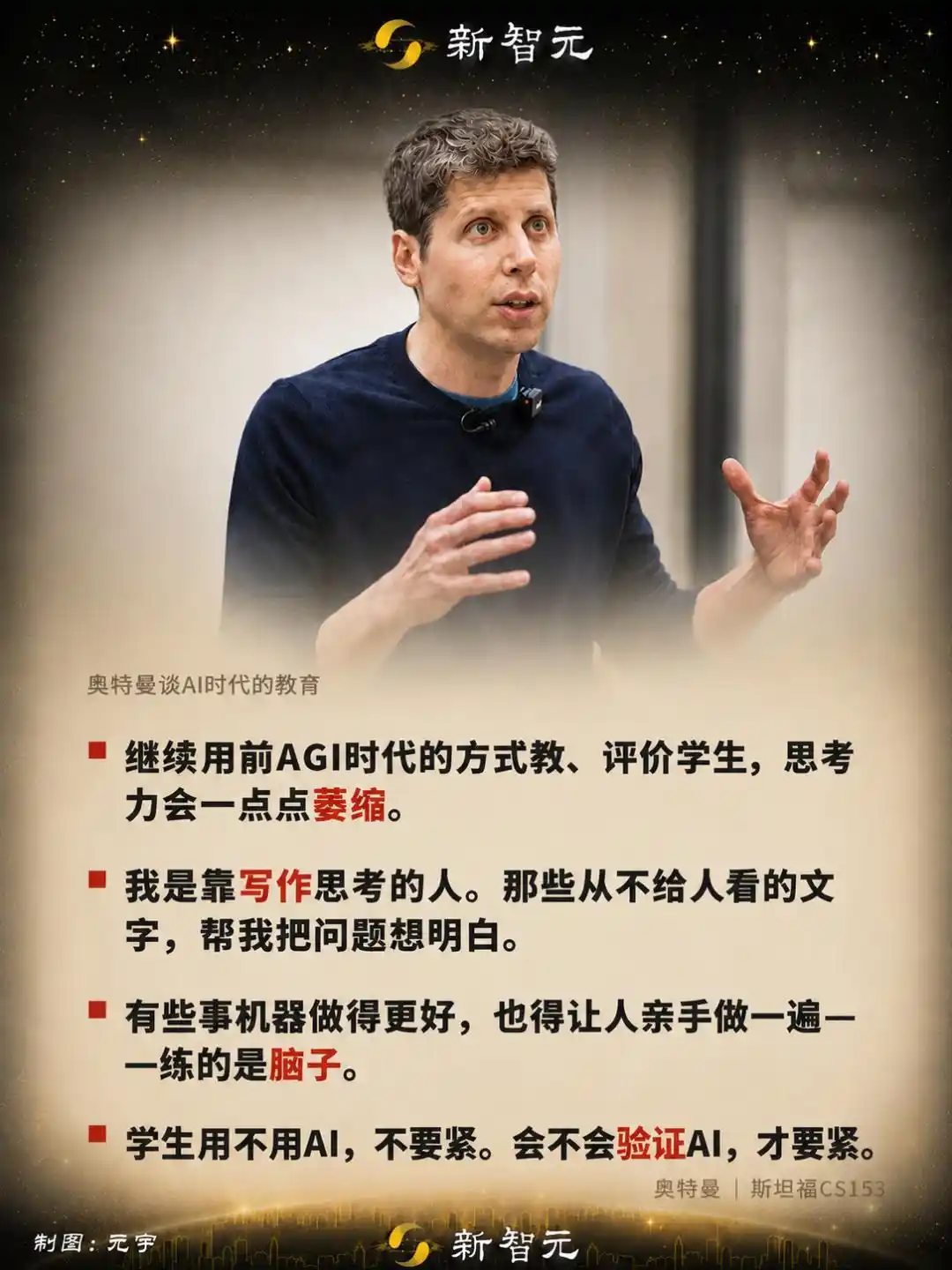
Altman's answer is somewhat counterintuitive: Some things, even though machines can do them better, humans must still do them by hand.

He gave his own example.

He said he's the kind of person who "thinks by writing," producing a lot of text never meant for anyone else, just to clarify a problem, and he's grateful he learned to write.

Programming is the same; AI can generate code in a second, but the process of building logic by hand trains the brain.

In essence, writing and programming are like math proofs in the calculator era: the machine already knows the answer, but we still have students derive it themselves. The goal isn't the answer behind the problem, but the meta-skills of "thinking" and "learning," and writing and programming are the tools to train them.

Following this logic, Altman advocates shifting the goal of education from "remembering more knowledge" to "asking better questions"; from testing memory to testing judgment, creativity, and genuine interdisciplinary skills.
And the root of the problem lies precisely in the evaluation system.

What do today's exams still test?

Memory, standard answers, completing tasks alone and closed-book. These three things are exactly what AI is best at and can most easily do for you.

When schools still evaluate students by "who remembers more, who answers more accurately," AI has turned "remembering more, answering accurately" into a zero-cost commodity.

How much meaning remains in numbers measured by a ruler that AI can easily pass, when used to gauge the abilities of the next generation?

This is what truly worries Altman: It's not most crucial whether students use AI; what's crucial is whether they can *verify* AI.

More concerning than over-reliance on AI is using AI without knowing how to verify it, accepting the machine's output at face value.

If this inertia persists for another three and a half years, a generation will gradually lose the training ground for independent thought, only to realize too late: they've almost forgotten how to think for themselves.

References:

https://www.youtube.com/watch?v=F_7M4Hc-usM

https://x.com/hesamation/status/2073884828861071557

https://x.com/ryanbrewer/status/2073812031988535760

This article is from the WeChat public account "Xin Zhi Yuan", author: ASI Revelations

Criptos en tendencia

Preguntas relacionadas

QWhat was Sam Altman's original prediction about the impact of ChatGPT on education, and how did reality differ from his expectation?

ASam Altman initially predicted that after a year of students using ChatGPT to cheat, the education system would be forced to fundamentally restructure itself to teach people how to think better. However, three and a half years later, he admitted this was a major prediction error, as education has seen almost no significant structural change while AI has advanced rapidly.

QAccording to Sam Altman, what is the primary danger of continuing to use pre-AGI teaching and assessment methods in an AI era?

AThe primary danger is the atrophy of critical thinking skills. If students outsource their thinking to AI and education systems continue to rely on methods that value memorization and standardized answers over genuine understanding, the 'muscle' for independent thought will weaken and shrink due to lack of use.

QWhat evidence from UC Berkeley's grade analysis suggests students are 'outsourcing' rather than 'learning' with AI?

AAn analysis of over 500,000 grades at UC Berkeley showed that in courses like writing and programming, the proportion of students receiving A and A- grades increased significantly after ChatGPT's release, but grades for exams (B+ and below) remained virtually unchanged. This indicates AI is helping improve homework scores without corresponding gains in exam performance, pointing to outsourcing of work rather than deeper learning.

QWhy does Sam Altman believe that activities like writing and programming remain essential to learn, even though AI can do them well?

AHe believes the process of doing these activities trains the 'meta-skills' of thinking and learning. Just as students still work through math proofs in the calculator era, writing and programming are tools to structure logic and clarify thought. The value is not in the final product but in the cognitive exercise the process provides for the brain.

QWhat does Sam Altman suggest should be the new focus of education in the age of AI, and what is the main obstacle to achieving this shift?

AHe suggests shifting the focus from memorizing knowledge to asking better questions, and from testing memory to assessing judgment, creativity, and interdisciplinary skills. The main obstacle is the inertia of the current evaluation system, which still relies on assessing memorization, standardized answers, and closed-book tasks—precisely the areas where AI excels, making such assessments increasingly meaningless.

Lecturas Relacionadas

Top 11 NFT games to play in July 2026

NFT games provide players with true ownership of in-game assets through blockchain technology, unlike traditional games. Here are the top 11 NFT games for July 2026: 1. **RavenQuest:** A free-to-play MMORPG with player-driven economy, housing NFTs, and guild wars. 2. **Decentraland:** A user-owned Ethereum-based virtual world for socializing, gaming, and buying digital real estate (LAND NFTs). 3. **Axie Infinity:** A pioneering play-to-earn game where players collect, breed, and battle NFT creatures called Axies. 4. **Pixels:** A free-to-play Ronin-based game focused on farming, crafting, and managing Pixelmon avatars in a player-driven economy. 5. **Gods Unchained:** A free-to-play strategy card game where every card is an NFT, built on Ethereum with Immutable X. 6. **My DeFi Pet:** Combines pet collection, breeding, and battling with DeFi mechanics, using the DPET token. 7. **Alien Worlds:** A fast-paced, decentralized metaverse game where players (explorers) mine resources and compete for the TLM token. 8. **The Sandbox:** A blockchain metaverse where users buy LAND NFTs and create, own, and monetize gaming experiences. 9. **Wreck League:** A mech fighting game with customizable NFT parts, featuring a hybrid Web2/Web3 model and strategic combat. 10. **Undeads Game:** A zombie apocalypse-themed game where players choose to be humans or zombies, with all assets as tradable NFTs. 11. **Shrapnel:** A first-person shooter set in 2043 where players battle for a resource called Sigma, with weapons and gear as NFTs. NFT games offer innovative formats and true digital ownership, but players should research each game before committing.

ambcryptoHace 1 hora(s)

Top 11 NFT games to play in July 2026

ambcryptoHace 1 hora(s)

Bitcoin Consolidation Underway: Selling Pressure from Long-Term Holders Eases, ETF Outflows Slow

Bitcoin is in the process of bottoming out, with key dynamics shifting. Long-term holder capitulation has cooled from its peak, and profit-taking has largely subsided. The sell-off at the June lows was absorbed by broad-based buying. The price is now recovering and testing towards key overhead resistance around the short-term holder cost basis near $69,000, where significant supply pressure is expected. Macro drivers are evolving: Bitcoin is increasingly reacting inversely to the US dollar and showing a more positive response to favorable economic data like soft inflation reports, while its correlation with equities has weakened. On-chain data shows that long-term holders are now mainly selling at a loss, a classic late-cycle signal. This primary source of sell-side pressure is no longer expanding. ETF outflows have slowed but haven't reversed, indicating institutional selling has paused but not turned into buying. In derivatives markets, bearish bets are being unwound as seen in falling put/call ratios and reduced crash protection costs, though this positioning adjustment hasn't yet translated into strong spot market buying. Volatility has compressed to yearly lows, a potential calm before the next decisive move. While the foundation for a recovery is being laid with seller exhaustion and demand absorption at lows, confirmation is still missing. A sustainable uptrend requires spot-driven buying to decisively break and hold above the short-term holder cost basis. Failure to do so, or a reacceleration of long-term holder losses, would signal a return to range-bound trading.

marsbitHace 1 hora(s)

Bitcoin Consolidation Underway: Selling Pressure from Long-Term Holders Eases, ETF Outflows Slow

marsbitHace 1 hora(s)

Trading

Spot

Artículos destacados

Qué es $S$

Entendiendo SPERO: Una Visión General Completa Introducción a SPERO A medida que el panorama de la innovación continúa evolucionando, la aparición de tecnologías web3 y proyectos de criptomonedas juega un papel fundamental en la configuración del futuro digital. Un proyecto que ha atraído la atención en este campo dinámico es SPERO, denotado como SPERO,$$s$. Este artículo tiene como objetivo reunir y presentar información detallada sobre SPERO, para ayudar a entusiastas e inversores a comprender sus fundamentos, objetivos e innovaciones dentro de los dominios web3 y cripto. ¿Qué es SPERO,$$s$? SPERO,$$s$ es un proyecto único dentro del espacio cripto que busca aprovechar los principios de descentralización y tecnología blockchain para crear un ecosistema que promueva la participación, la utilidad y la inclusión financiera. El proyecto está diseñado para facilitar interacciones de igual a igual de nuevas maneras, proporcionando a los usuarios soluciones y servicios financieros innovadores. En su esencia, SPERO,$$s$ tiene como objetivo empoderar a los individuos al proporcionar herramientas y plataformas que mejoren la experiencia del usuario en el espacio de las criptomonedas. Esto incluye habilitar métodos de transacción más flexibles, fomentar iniciativas impulsadas por la comunidad y crear caminos para oportunidades financieras a través de aplicaciones descentralizadas (dApps). La visión subyacente de SPERO,$$s$ gira en torno a la inclusividad, buscando cerrar brechas dentro de las finanzas tradicionales mientras aprovecha los beneficios de la tecnología blockchain. ¿Quién es el Creador de SPERO,$$s$? La identidad del creador de SPERO,$$s$ sigue siendo algo oscura, ya que hay recursos públicos limitados que proporcionan información de fondo detallada sobre su(s) fundador(es). Esta falta de transparencia puede derivarse del compromiso del proyecto con la descentralización, una ética que muchos proyectos web3 comparten, priorizando las contribuciones colectivas sobre el reconocimiento individual. Al centrar las discusiones en torno a la comunidad y sus objetivos colectivos, SPERO,$$s$ encarna la esencia del empoderamiento sin señalar a individuos específicos. Como tal, comprender la ética y la misión de SPERO sigue siendo más importante que identificar a un creador singular. ¿Quiénes son los Inversores de SPERO,$$s$? SPERO,$$s$ cuenta con el apoyo de una diversa gama de inversores que van desde capitalistas de riesgo hasta inversores ángeles dedicados a fomentar la innovación en el sector cripto. El enfoque de estos inversores generalmente se alinea con la misión de SPERO, priorizando proyectos que prometen avances tecnológicos sociales, inclusión financiera y gobernanza descentralizada. Estas fundaciones de inversores suelen estar interesadas en proyectos que no solo ofrecen productos innovadores, sino que también contribuyen positivamente a la comunidad blockchain y sus ecosistemas. El respaldo de estos inversores refuerza a SPERO,$$s$ como un contendiente notable en el dominio de proyectos cripto que evoluciona rápidamente. ¿Cómo Funciona SPERO,$$s$? SPERO,$$s$ emplea un marco multifacético que lo distingue de los proyectos de criptomonedas convencionales. Aquí hay algunas de las características clave que subrayan su singularidad e innovación: Gobernanza Descentralizada: SPERO,$$s$ integra modelos de gobernanza descentralizada, empoderando a los usuarios para participar activamente en los procesos de toma de decisiones sobre el futuro del proyecto. Este enfoque fomenta un sentido de propiedad y responsabilidad entre los miembros de la comunidad. Utilidad del Token: SPERO,$$s$ utiliza su propio token de criptomoneda, diseñado para servir diversas funciones dentro del ecosistema. Estos tokens permiten transacciones, recompensas y la facilitación de servicios ofrecidos en la plataforma, mejorando la participación y la utilidad general. Arquitectura en Capas: La arquitectura técnica de SPERO,$$s$ apoya la modularidad y escalabilidad, permitiendo la integración fluida de características y aplicaciones adicionales a medida que el proyecto evoluciona. Esta adaptabilidad es fundamental para mantener la relevancia en el cambiante paisaje cripto. Participación de la Comunidad: El proyecto enfatiza iniciativas impulsadas por la comunidad, empleando mecanismos que incentivan la colaboración y la retroalimentación. Al nutrir una comunidad sólida, SPERO,$$s$ puede abordar mejor las necesidades de los usuarios y adaptarse a las tendencias del mercado. Enfoque en la Inclusión: Al ofrecer tarifas de transacción bajas e interfaces amigables para el usuario, SPERO,$$s$ busca atraer a una base de usuarios diversa, incluyendo a individuos que anteriormente pueden no haber participado en el espacio cripto. Este compromiso con la inclusión se alinea con su misión general de empoderamiento a través de la accesibilidad. Cronología de SPERO,$$s$ Entender la historia de un proyecto proporciona información crucial sobre su trayectoria de desarrollo y hitos. A continuación se presenta una cronología sugerida que mapea eventos significativos en la evolución de SPERO,$$s$: Fase de Conceptualización e Ideación: Las ideas iniciales que forman la base de SPERO,$$s$ fueron concebidas, alineándose estrechamente con los principios de descentralización y enfoque comunitario dentro de la industria blockchain. Lanzamiento del Whitepaper del Proyecto: Tras la fase conceptual, se lanzó un whitepaper completo que detalla la visión, los objetivos y la infraestructura tecnológica de SPERO,$$s$ para generar interés y retroalimentación de la comunidad. Construcción de Comunidad y Primeras Interacciones: Se realizaron esfuerzos de divulgación activa para construir una comunidad de primeros adoptantes y posibles inversores, facilitando discusiones en torno a los objetivos del proyecto y obteniendo apoyo. Evento de Generación de Tokens: SPERO,$$s$ llevó a cabo un evento de generación de tokens (TGE) para distribuir sus tokens nativos a los primeros seguidores y establecer liquidez inicial dentro del ecosistema. Lanzamiento de la dApp Inicial: La primera aplicación descentralizada (dApp) asociada con SPERO,$$s$ se puso en marcha, permitiendo a los usuarios interactuar con las funcionalidades centrales de la plataforma. Desarrollo Continuo y Alianzas: Actualizaciones y mejoras continuas a las ofertas del proyecto, incluyendo alianzas estratégicas con otros actores en el espacio blockchain, han moldeado a SPERO,$$s$ en un jugador competitivo y en evolución en el mercado cripto. Conclusión SPERO,$$s$ se erige como un testimonio del potencial de web3 y las criptomonedas para revolucionar los sistemas financieros y empoderar a los individuos. Con un compromiso con la gobernanza descentralizada, la participación comunitaria y funcionalidades diseñadas de manera innovadora, allana el camino hacia un paisaje financiero más inclusivo. Como con cualquier inversión en el espacio cripto que evoluciona rápidamente, se anima a los posibles inversores y usuarios a investigar a fondo y participar de manera reflexiva con los desarrollos en curso dentro de SPERO,$$s$. El proyecto muestra el espíritu innovador de la industria cripto, invitando a una mayor exploración de sus innumerables posibilidades. Mientras el viaje de SPERO,$$s$ aún se desarrolla, sus principios fundamentales pueden, de hecho, influir en el futuro de cómo interactuamos con la tecnología, las finanzas y entre nosotros en ecosistemas digitales interconectados.

122 Vistas totalesPublicado en 2024.12.17Actualizado en 2024.12.17

Qué es $S$

Qué es AGENT S

Agent S: El Futuro de la Interacción Autónoma en Web3 Introducción En el paisaje en constante evolución de Web3 y las criptomonedas, las innovaciones están redefiniendo constantemente cómo los individuos interactúan con las plataformas digitales. Uno de estos proyectos pioneros, Agent S, promete revolucionar la interacción humano-computadora a través de su marco agente abierto. Al allanar el camino para interacciones autónomas, Agent S busca simplificar tareas complejas, ofreciendo aplicaciones transformadoras en inteligencia artificial (IA). Esta exploración detallada profundizará en las complejidades del proyecto, sus características únicas y las implicaciones para el dominio de las criptomonedas. ¿Qué es Agent S? Agent S se presenta como un marco agente abierto innovador, diseñado específicamente para abordar tres desafíos fundamentales en la automatización de tareas informáticas: Adquisición de Conocimiento Específico del Dominio: El marco aprende inteligentemente de diversas fuentes de conocimiento externas y experiencias internas. Este enfoque dual le permite construir un rico repositorio de conocimiento específico del dominio, mejorando su rendimiento en la ejecución de tareas. Planificación a Largo Plazo de Tareas: Agent S emplea planificación jerárquica aumentada por la experiencia, un enfoque estratégico que facilita la descomposición y ejecución eficiente de tareas complejas. Esta característica mejora significativamente su capacidad para gestionar múltiples subtareas de manera eficiente y efectiva. Manejo de Interfaces Dinámicas y No Uniformes: El proyecto introduce la Interfaz Agente-Computadora (ACI), una solución innovadora que mejora la interacción entre agentes y usuarios. Utilizando Modelos de Lenguaje Multimodal de Gran Escala (MLLMs), Agent S puede navegar y manipular diversas interfaces gráficas de usuario sin problemas. A través de estas características pioneras, Agent S proporciona un marco robusto que aborda las complejidades involucradas en la automatización de la interacción humana con las máquinas, preparando el terreno para una multitud de aplicaciones en IA y más allá. ¿Quién es el Creador de Agent S? Si bien el concepto de Agent S es fundamentalmente innovador, la información específica sobre su creador sigue siendo elusiva. El creador es actualmente desconocido, lo que resalta ya sea la etapa incipiente del proyecto o la elección estratégica de mantener a los miembros fundadores en el anonimato. Independientemente de la anonimidad, el enfoque sigue siendo en las capacidades y el potencial del marco. ¿Quiénes son los Inversores de Agent S? Dado que Agent S es relativamente nuevo en el ecosistema criptográfico, la información detallada sobre sus inversores y patrocinadores financieros no está documentada explícitamente. La falta de información disponible públicamente sobre las bases de inversión u organizaciones que apoyan el proyecto plantea preguntas sobre su estructura de financiamiento y hoja de ruta de desarrollo. Comprender el respaldo es crucial para evaluar la sostenibilidad del proyecto y su posible impacto en el mercado. ¿Cómo Funciona Agent S? En el núcleo de Agent S se encuentra una tecnología de vanguardia que le permite funcionar de manera efectiva en diversos entornos. Su modelo operativo se basa en varias características clave: Interacción Humano-Computadora Similar a la Humana: El marco ofrece planificación avanzada de IA, esforzándose por hacer que las interacciones con las computadoras sean más intuitivas. Al imitar el comportamiento humano en la ejecución de tareas, promete elevar las experiencias de los usuarios. Memoria Narrativa: Empleada para aprovechar experiencias de alto nivel, Agent S utiliza memoria narrativa para hacer un seguimiento de las historias de tareas, mejorando así sus procesos de toma de decisiones. Memoria Episódica: Esta característica proporciona a los usuarios una guía paso a paso, permitiendo que el marco ofrezca apoyo contextual a medida que se desarrollan las tareas. Soporte para OpenACI: Con la capacidad de ejecutarse localmente, Agent S permite a los usuarios mantener el control sobre sus interacciones y flujos de trabajo, alineándose con la ética descentralizada de Web3. Fácil Integración con APIs Externas: Su versatilidad y compatibilidad con varias plataformas de IA aseguran que Agent S pueda encajar sin problemas en ecosistemas tecnológicos existentes, convirtiéndolo en una opción atractiva para desarrolladores y organizaciones. Estas funcionalidades contribuyen colectivamente a la posición única de Agent S dentro del espacio cripto, ya que automatiza tareas complejas y de múltiples pasos con una intervención humana mínima. A medida que el proyecto evoluciona, sus posibles aplicaciones en Web3 podrían redefinir cómo se desarrollan las interacciones digitales. Cronología de Agent S El desarrollo y los hitos de Agent S pueden encapsularse en una cronología que resalta sus eventos significativos: 27 de septiembre de 2024: El concepto de Agent S fue lanzado en un documento de investigación integral titulado “Un Marco Agente Abierto que Usa Computadoras Como un Humano”, mostrando las bases del proyecto. 10 de octubre de 2024: El documento de investigación fue puesto a disposición del público en arXiv, ofreciendo una exploración profunda del marco y su evaluación de rendimiento basada en el benchmark OSWorld. 12 de octubre de 2024: Se lanzó una presentación en video, proporcionando una visión visual de las capacidades y características de Agent S, involucrando aún más a posibles usuarios e inversores. Estos marcadores en la cronología no solo ilustran el progreso de Agent S, sino que también indican su compromiso con la transparencia y la participación comunitaria. Puntos Clave Sobre Agent S A medida que el marco Agent S continúa evolucionando, varios atributos clave destacan, subrayando su naturaleza innovadora y potencial: Marco Innovador: Diseñado para proporcionar un uso intuitivo de las computadoras similar a la interacción humana, Agent S aporta un enfoque novedoso a la automatización de tareas. Interacción Autónoma: La capacidad de interactuar de manera autónoma con las computadoras a través de GUI significa un salto hacia soluciones informáticas más inteligentes y eficientes. Automatización de Tareas Complejas: Con su metodología robusta, puede automatizar tareas complejas y de múltiples pasos, haciendo que los procesos sean más rápidos y menos propensos a errores. Mejora Continua: Los mecanismos de aprendizaje permiten a Agent S mejorar a partir de experiencias pasadas, mejorando continuamente su rendimiento y eficacia. Versatilidad: Su adaptabilidad en diferentes entornos operativos como OSWorld y WindowsAgentArena asegura que pueda servir a una amplia gama de aplicaciones. A medida que Agent S se posiciona en el paisaje de Web3 y criptomonedas, su potencial para mejorar las capacidades de interacción y automatizar procesos significa un avance significativo en las tecnologías de IA. A través de su marco innovador, Agent S ejemplifica el futuro de las interacciones digitales, prometiendo una experiencia más fluida y eficiente para los usuarios en diversas industrias. Conclusión Agent S representa un audaz avance en la unión de la IA y Web3, con la capacidad de redefinir cómo interactuamos con la tecnología. Aunque aún se encuentra en sus primeras etapas, las posibilidades para su aplicación son vastas y atractivas. A través de su marco integral que aborda desafíos críticos, Agent S busca llevar las interacciones autónomas al primer plano de la experiencia digital. A medida que nos adentramos más en los reinos de las criptomonedas y la descentralización, proyectos como Agent S sin duda desempeñarán un papel crucial en la configuración del futuro de la tecnología y la colaboración humano-computadora.

533 Vistas totalesPublicado en 2025.01.14Actualizado en 2025.01.14

Qué es AGENT S

Cómo comprar S

¡Bienvenido a HTX.com! Hemos hecho que comprar Sonic (S) sea simple y conveniente. Sigue nuestra guía paso a paso para iniciar tu viaje de criptos.Paso 1: crea tu cuenta HTXUtiliza tu correo electrónico o número de teléfono para registrarte y obtener una cuenta gratuita en HTX. Experimenta un proceso de registro sin complicaciones y desbloquea todas las funciones.Obtener mi cuentaPaso 2: ve a Comprar cripto y elige tu método de pagoTarjeta de crédito/débito: usa tu Visa o Mastercard para comprar Sonic (S) al instante.Saldo: utiliza fondos del saldo de tu cuenta HTX para tradear sin problemas.Terceros: hemos agregado métodos de pago populares como Google Pay y Apple Pay para mejorar la comodidad.P2P: tradear directamente con otros usuarios en HTX.Over-the-Counter (OTC): ofrecemos servicios personalizados y tipos de cambio competitivos para los traders.Paso 3: guarda tu Sonic (S)Después de comprar tu Sonic (S), guárdalo en tu cuenta HTX. Alternativamente, puedes enviarlo a otro lugar mediante transferencia blockchain o utilizarlo para tradear otras criptomonedas.Paso 4: tradear Sonic (S)Tradear fácilmente con Sonic (S) en HTX's mercado spot. Simplemente accede a tu cuenta, selecciona tu par de trading, ejecuta tus trades y monitorea en tiempo real. Ofrecemos una experiencia fácil de usar tanto para principiantes como para traders experimentados.

1.1k Vistas totalesPublicado en 2025.01.15Actualizado en 2026.06.02

Cómo comprar S

Discusiones

Bienvenido a la comunidad de HTX. Aquí puedes mantenerte informado sobre los últimos desarrollos de la plataforma y acceder a análisis profesionales del mercado. A continuación se presentan las opiniones de los usuarios sobre el precio de S (S).

活动图片