From Speculation to Risk Management: Predictive Markets Are Filling the Gap in Commercial Insurance

marsbitPublicado a 2026-08-17Actualizado a 2026-08-17

Resumen

From Speculation to Risk Management: Predictive Markets Filling the Commercial Insurance Gap The emergence of AI risk management tools like Blanket is exploring the potential of predictive markets as a genuine insurance tool for businesses. These markets, with their simple contract structure—paying $1 if an event occurs, $0 if not—allow the real-time market price to reflect collective probability assessments. Businesses can use them to hedge against operational risks (e.g., abnormal weather, energy price fluctuations) that are often not covered by traditional business interruption insurance, which typically requires physical damage. A key question is whether these markets are genuinely used for hedging or remain primarily speculative. Analysis of Kalshi markets from August 2025 to August 2026 compared weather contracts (a potential hedge instrument) against sports contracts (largely speculative) and traditional CME grain futures. Three behavioral metrics were examined: 1. **Daily Turnover Rate:** Weather contracts showed the lowest rate (0.210), lower than corn futures (0.266) and significantly lower than sports contracts (0.315), suggesting longer holding periods. 2. **Hold-to-Expiry Ratio:** Weather contracts had a much higher ratio (over 0.5) compared to near-zero ratios for sports contracts, indicating a stronger tendency to hold positions until settlement, consistent with hedging behavior. 3. **Position Buildup Timing:** Weather market positions reached 50% of their...

Written by: G_Gyeomm

Compiled by: AIdidiaoJP, Foresight News

I. A New Type of Insurance Directly Priced by the Market

The recently launched AI risk management tool Blanket is attempting to turn predictive markets into a genuine insurance tool usable by businesses. The logic is straightforward: a business inputs its operational information, the system automatically diagnoses its main risk exposures, and then recommends corresponding Kalshi event contracts to help the business hedge against these risks.

The hedging mechanism itself is not complex. The contract structure of a predictive market is extremely clear — it pays $1 if an event occurs and $0 if it doesn't. The contract's real-time price represents the market's collective judgment on the probability of that event occurring.

It is precisely this simple structure that gives predictive markets the potential to become real hedging tools. Businesses can preemptively purchase contracts for events that could impact their operations, such as abnormal weather, energy price volatility, or tariff policy changes. If these risks materialize, the contract payouts can partially or fully offset the operational losses.

A specific example: an ice cream shop that would lose about $20,000 in revenue if the summer is unusually cool.

The hedging operation is as follows: buy 20,000 temperature contracts at $0.30 each. If the average summer temperature falls below a preset threshold, each contract pays out $1. The total cost is $6,000.

There are only two possible outcomes:

  • Cool Summer: The temperature is below the threshold, revenue is down $20,000, but the contracts pay out $20,000 in total. The net loss is locked at $6,000 — exactly the initial cost of buying the contracts.
  • Hot Summer: The temperature is above the threshold, revenue is unaffected, but the contracts expire worthless, and the $6,000 cost is completely lost.

Regardless of the outcome, the final loss is firmly locked at $6,000. This $6,000 is essentially the insurance premium. And the rate for this premium is not set by an insurance company's actuary or any traditional underwriting institution, but by the market itself — the price quoted in real-time by countless buyers and sellers with real money.

II. Is the Hedging Market Really Functioning?

Predictive markets have already accumulated enough speculative demand. They first gained fame through election predictions, then smoothly expanded into the sports arena, largely solving the volume problem. The industry generally believes the next growth space lies in expanding more practical use cases, with hedging needs repeatedly mentioned as one of the most promising directions.

In principle, its value is indeed significant. The gaps not covered by existing hedging tools are quite broad. Traditional business interruption insurance in commercial insurance typically requires physical damage as a precondition. A ski shop losing revenue because there was hardly any snow all winter — this kind of pure "operational risk" — is almost impossible to find suitable insurance products to cover on the market.

There are mature hedging tools in the futures market, but the barriers are high: requiring an ISDA agreement, opening a specialized futures account, posting margin, and minimum contract size limits. These are not issues for large institutions, but are almost unattainable for ordinary small and medium-sized enterprises. Goldman Sachs can maintain a professional derivatives trading team, but the cafe on the corner obviously cannot.

The problem is, there has always been a clear chasm between theoretical rationality and actual use. Predictive markets have long carried the label of "gambling," and whether they can truly operate as an independent hedging market — rather than just a speculative tool — has never been systematically verified.

The real question that needs answering is: Are predictive markets actually being used for hedging? Does real hedging demand exist? Trading behavior itself can provide clues. We selected three sets of data for comparison.

The first set is CME grain futures — a typical traditional hedging market, primarily used to mitigate losses from price fluctuations in agricultural and livestock products.

The second set is the Kalshi sports market — where hedging demand is extremely limited, and trading is almost entirely driven by speculation.

The third set is the Kalshi weather market — it handles weather risk in a manner similar to CME weather futures, while sharing the exact same event contract structure and trading environment with the Kalshi sports market. This makes it an excellent test sample — to see which side its trading behavior is closer to.

Hedging and speculation typically exhibit different trading characteristics. Hedgers tend to establish positions well before the actual risk window arrives and hold them until expiration; speculators move in and out more frequently, chasing prices, with noticeably higher turnover rates.

If the Kalshi weather market's turnover rate and holding behavior are closer to traditional hedging markets than to the sports market, then hedging demand is real.

Conversely, if it's not much different from the sports market, then actual usage is closer to pure speculation. In that case, tools like Blanket might be responding to a nice industry hypothesis, not a real demand confirmed by data.

The dataset for this analysis covers 1,265 Kalshi markets settled between August 2025 and August 2026. The screening criteria were: cumulative trading volume of at least 500 contracts, and trading lasting at least three days.

III. Data Point 1: Average Daily Turnover Rate

First, look at how frequently positions are traded in each market. Turnover rate is defined as daily trading volume divided by open interest (OI) for that day. We calculated the daily turnover rate for each contract in each market and then took the median for the entire trading cycle.

The results are clear: Kalshi weather contracts have the lowest turnover rate, only 0.210. The traditional hedging product corn futures is 0.266, and Kalshi sports contracts are the highest at 0.315.
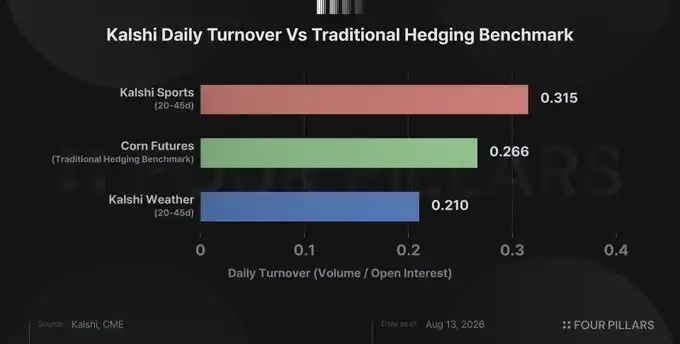
Sports contracts turn over about 1.5 times faster than weather contracts. This indicates a relatively longer holding tendency for weather contracts, initially suggesting the possible existence of real hedging demand.

However, a caveat: Corn futures' turnover rate sits in the middle, and the differences among the three data sets are not particularly stark. Based on turnover rate alone, we cannot fully confirm the existence of hedging demand in the weather market. What this data can definitively tell us so far is only that weather contract turnover is significantly lower than sports contract turnover.

IV. Data Point 2: Hold-to-Expiration Ratio

The second key metric is the hold-to-expiration ratio — measuring how many positions remain untouched in the market at settlement. It is calculated as the final open interest for each contract divided by the cumulative trading volume. A higher value indicates more positions were firmly held until the expiration date.
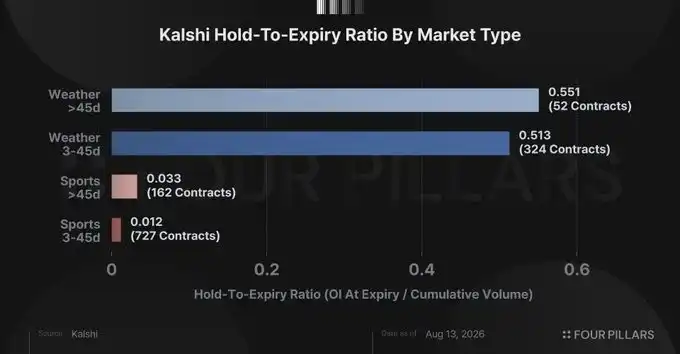
The difference in results is very striking: regardless of trading duration, the hold-to-expiration ratio for weather contracts exceeds 0.5. In contrast, sports contracts are only 0.012 and 0.033 respectively. In the 3 to 45-day trading interval, weather is 42.8 times that of sports; in the over 45-day interval, the gap is still 16.7 times.

This clearly shows: Weather contracts are far more inclined to "buy and hold" than sports contracts. Hedgers hold contracts to receive payouts if the risk materializes, not to chase price differences. Therefore, a high hold-to-expiration ratio strongly supports the judgment that there is real hedging demand in the weather market.

Of course, this cannot be directly interpreted as the entire weather market being used for hedging. This data does not track the identities of individual position buyers and sellers, so it cannot be simply equated with the proportion of original buyers holding to expiration. What can be confirmed at present is that the holding behavior of weather contracts is distinctly different from that of sports contracts.

V. Data Point 3: When Were Positions Established?

The final question is: When were these positions established? We divided the daily open interest for each contract by that contract's peak open interest, converted the time from launch to expiration into a progress bar from 0% to 100%, and then plotted the median curve.

The criterion for judgment is the point at which half of the peak open interest is reached. If half is reached when there is still more time until expiration, it means positions were built earlier — which is more in line with the behavior pattern of hedgers.
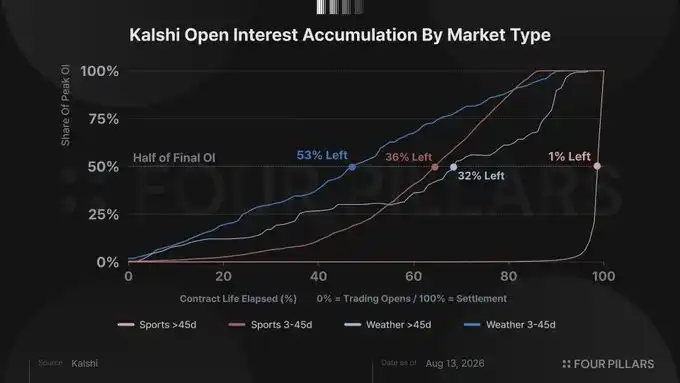
For weather contracts trading for 3 to 45 days, they had already reached half their peak open interest when their lifecycle was at 47%, leaving 53% of the time until expiration. Sports contracts in the same interval didn't reach half until 65%, with only 36% of the time remaining.

For contracts over 45 days, the difference is even more astonishing. Weather contracts reached half when there was still 32% until expiration, while sports contracts had only 1.3% left. Regardless of the interval, weather positions were established much earlier than sports positions.
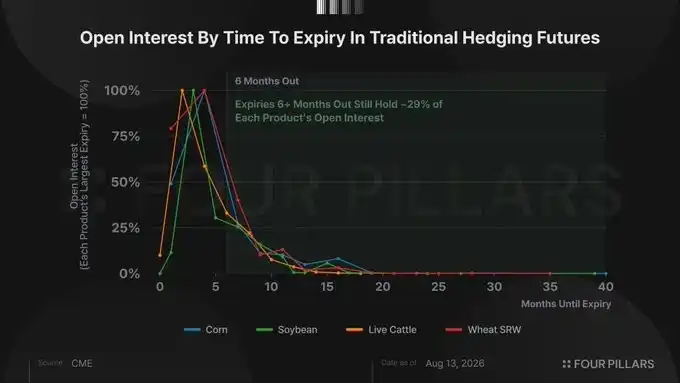
This behavior of "early positioning" is precisely a typical characteristic of traditional hedging markets. As of August 11, 2026, CME grain and livestock futures contracts expiring in six months had already accumulated massive open interest. Corn futures even held 65,127 positions on contracts expiring 16 months later.

This reflects the tendency to act well before the risk actually materializes. And the behavioral pattern of Kalshi weather contracts is clearly closer to traditional hedging markets than to sports markets.

VI. Hedging Relies on Liquidity Built by Speculation

Conclusion first: The Kalshi weather market is neither a purely hedging market nor a purely speculative one like sports. Speculative demand still contributes a significant portion of the liquidity, but on top of that, hedging demand has also emerged relatively clearly.

The three indicators point in the same direction: weather contracts trade less frequently, retain more positions at settlement, and positions are established earlier. No single indicator can confirm trading intent with 100% certainty, but the high consistency of these behaviors collectively supports a judgment — there indeed exists a holding demand in the Kalshi weather market distinct from sports, and a considerable part of it is likely real hedging demand.

More importantly, speculative demand is not so much a weakness of predictive markets as it is a prerequisite for the hedging function to exist. A market with only hedgers and no speculators would struggle to find sufficient counterparties and continuous liquidity.

In predictive markets, speculators are responsible for pricing and providing liquidity, while hedgers transfer the risks they do not wish to bear on this foundation. The risk is no longer directly underwritten by an insurance company but is naturally dispersed among market participants through trading.

Therefore, the next phase of growth for predictive markets is not about "squeezing out" speculation and shifting entirely to hedging. What truly matters is: How much real corporate hedging demand can be layered on top of the liquidity base already built by speculation? This is the core variable that determines whether it can upgrade from an "interesting speculative tool" to a "usable risk management infrastructure."


Criptos en tendencia

Preguntas relacionadas

QWhat is the main difference between using a prediction market and traditional insurance for business risk management?

AThe main difference is that in prediction markets, the insurance premium (price of the contract) is determined collectively by market participants based on their assessment of the event's probability, whereas in traditional insurance, the premium is calculated by the insurer's actuaries.

QWhat are the three data points used to analyze whether the Kalshi weather market is used for hedging?

AThe three data points are: 1) Average daily turnover rate, 2) Hold-to-expiration ratio, and 3) The timing of when positions are established (measured by the time it takes to reach 50% of peak open interest).

QAccording to the analysis, how does the trading behavior of Kalshi weather contracts compare to its sports contracts?

AThe analysis shows that Kalshi weather contracts have a lower turnover rate, a significantly higher hold-to-expiration ratio, and positions are established much earlier compared to Kalshi sports contracts. This suggests behavior more consistent with hedging.

QWhat is the primary role of speculators in a prediction market that aims to serve hedging purposes?

ASpeculators provide the necessary liquidity and price discovery in the prediction market, which creates a functional trading environment that allows hedgers to enter and exit positions to transfer their risks.

QWhat example is given to illustrate how a business could use a prediction market contract to hedge against operational risk?

AThe example given is an ice cream shop that could hedge against a cool summer. It could buy 20,000 temperature contracts at $0.30 each (total cost $6,000). If the summer is cool and average temperature falls below a threshold, each contract pays $1, offsetting the estimated $20,000 revenue loss, thereby locking the net loss at the initial $6,000 cost. If the summer is hot, the contracts expire worthless, and the shop loses the $6,000 premium but enjoys full revenue.

Lecturas Relacionadas

Tiger Research: How Far Can the On-Chain Foreign Exchange Settlement Layer Go?

"Tiger Research: How Far Can On-Chain FX Settlement Layers Go?" The article examines KiiChain, a startup aiming to create an on-chain foreign exchange settlement layer, focusing on its potential to address inefficiencies in cross-border payments, especially for emerging markets. The core problem is the slow, costly, and fragmented traditional FX infrastructure, where bank hours, regulations, and thin liquidity for local currencies create delays. KiiChain, founded by OTC veterans, proposes aggregating USD and local currency stablecoin liquidity on one chain to enable 24/7 settlement. The platform consists of four components: 1) The KiiChain App uses an Atomic Quote Network (RFQ-style price discovery with on-chain settlement) to tackle settlement delays, but not underlying liquidity scarcity. 2) The RWA Protocol tokenizes collateral using compliant standards (like ERC-3643), shifting trust from bank relationships to coded rules, though regulatory anchors remain. 3) Kii Oracle uses a decentralized validator network to create consensus pricing from fragmented data, improving transparency but not market depth. 4) KiiChain Pay bundles fiat on/off-ramps and swap services; only the DEX swap bypasses banking bottlenecks, while others still rely on licensed operators. The analysis concludes KiiChain doesn't eliminate intermediaries but creates a unified settlement layer where they can interact without geographic or time constraints. It streamlines the process—three of eight traditional steps are removed—by moving infrastructure on-chain, improving speed and accessibility for digital asset swaps. However, fiat entry/exit points remain subject to off-chain service limitations. Current metrics show over $500M in transaction volume. The future depends on ecosystem growth—attracting liquidity partners and users—to evolve beyond settlement into a broader financial hub. Ultimately, the on-chain structure currently solves settlement friction and time, not liquidity depth. Success will be determined by execution in building partnerships and market presence, not by architectural design alone.

marsbitHace 33 min(s)

Tiger Research: How Far Can the On-Chain Foreign Exchange Settlement Layer Go?

marsbitHace 33 min(s)

Trading

Spot

Artículos destacados

Qué es G$

Entendiendo GoodDollar ($G$): Un Plano para Ingresos Básicos Universales Descentralizados Introducción En el panorama en constante evolución de las criptomonedas y la tecnología blockchain, las iniciativas que buscan abordar problemas sociales apremiantes han ganado una atención creciente. Uno de estos proyectos es GoodDollar ($G$), una solución de ingreso básico universal (UBI) basada en Web3. GoodDollar se esfuerza por abordar la desigualdad y cerrar la brecha de riqueza al crear y distribuir recursos económicos accesibles a aquellos que más los necesitan. A través de su innovador uso de las finanzas descentralizadas (DeFi), GoodDollar presenta un modelo único que podría reformar la forma en que se percibe y se entrega la asistencia financiera a nivel global. ¿Qué es GoodDollar ($G$)? GoodDollar es un protocolo de criptomonedas que facilita la emisión y distribución de tokens digitales, conocidos como $G$, a sus usuarios registrados a diario. Estos tokens funcionan como una forma de ingreso básico universal, promoviendo el empoderamiento financiero para individuos de diversos trasfondos, especialmente aquellos tradicionalmente excluidos del sistema financiero. Operando en la blockchain, GoodDollar utiliza múltiples cadenas, incluyendo Ethereum, Celo y Fuse, asegurando un acceso y una usabilidad amplios. El objetivo fundamental de GoodDollar es hacer que la criptomoneda sea accesible y beneficiosa para todos, independientemente de su punto de partida económico. El Creador de GoodDollar ($G$) Los detalles sobre el creador de GoodDollar permanecen algo oscuros. Sin embargo, se destaca notablemente que el proyecto cuenta con un fuerte respaldo de eToro, una plataforma de inversión ampliamente reconocida que proporcionó la financiación inicial y el apoyo fundamental para el desarrollo de GoodDollar. La visión detrás del proyecto no se basa únicamente en el lucro, sino que se inclina fuertemente hacia el emprendimiento social, buscando un cambio sistémico en la accesibilidad económica. Inversores de GoodDollar ($G$) GoodDollar disfruta del respaldo financiero y apoyo operativo de eToro. Esta asociación ha jugado un papel significativo en el lanzamiento del protocolo y sus desarrollos posteriores. Si bien eToro fue fundamental en el establecimiento de la base del proyecto, GoodDollar visualiza una transición hacia un modelo financiado por su comunidad a largo plazo. Este cambio hacia la financiación comunitaria está en línea con el compromiso de GoodDollar con la descentralización, permitiendo que sus usuarios tengan una participación directa en el futuro del proyecto. ¿Cómo Funciona GoodDollar ($G$)? El marco operativo de GoodDollar se basa en gran medida en los principios de DeFi para generar interés a partir de criptomonedas en staking. Este mecanismo permite al proyecto acuñar y distribuir tokens $G$ como un ingreso básico digital para usuarios en todo el mundo. Varios características clave contribuyen a la unicidad e innovación de GoodDollar: Ingreso Básico Universal (UBI): Cada día, los usuarios registrados reciben tokens gratuitos, estableciendo un flujo de ingresos automático destinado a aliviar las presiones financieras. Modelo Económico Sostenible: La tokenómica del proyecto busca equilibrar la oferta y la demanda de tokens $G$, asegurando que el valor permanezca estable a lo largo del tiempo. Tokens Respaladados por Reservas: Cada token $G$ está respaldado por una reserva de criptomonedas, proporcionándole un valor inherente y confiabilidad, un aspecto crucial para mantener la confianza de los usuarios. Gobernanza Descentralizada: GoodDollar incorpora un enfoque democrático para la toma de decisiones a través de una gobernanza descentralizada impulsada por tokens. Esto permite que los miembros de la comunidad participen activamente en la conformación de la trayectoria del proyecto, haciéndolo verdaderamente impulsado por la comunidad. Accesibilidad Global: GoodDollar ha establecido una considerable huella comunitaria, contando con más de 640,000 miembros en 181 países. Tal alcance generalizado es instrumental para facilitar UBI a escala global. Línea de Tiempo de GoodDollar ($G$) La evolución de GoodDollar está marcada por varios hitos significativos a lo largo de su historia: 2019: El lanzamiento de la billetera GoodDollar marcó el primer paso en la operacionalización de su visión de entregar UBI a través de criptomonedas. 2020: Tras el exitoso lanzamiento de la billetera, el protocolo GoodDollar se presentó oficialmente. Esto marcó una fase crucial en su misión de proporcionar ingresos distribuidos diariamente. 2021: El proyecto avanzó aún más con la introducción de su Organización Autónoma Descentralizada (DAO), fomentando un mayor nivel de participación y gobernanza comunitaria. 2022: GoodDollar presentó su versión 2 (V2) amigable con DeFi, esforzándose por una mayor participación del usuario y eficiencia operativa. El mismo año también se vio el cambio a una estructura de gobernanza descentralizada a través de GoodDAO. 2022: Se conceptualizó una nueva hoja de ruta, enfocándose en iniciativas como un programa de subvenciones diseñado para promover emprendimientos relacionados con $G$ y un Mercado GoodDollar mejorado. Características Clave de GoodDollar ($G$) El proyecto GoodDollar introduce numerosas características críticas destinadas a redefinir el panorama del ingreso básico: Ingreso Básico Universal: Entregar tokens gratuitos diarios a sus usuarios resalta fundamentalmente su misión de eliminar la precariedad económica. Operación Multi-Cadena: Aprovechar múltiples redes de blockchain mejora la accesibilidad y escalabilidad, asegurando una participación más amplia. Compromiso con las Finanzas Descentralizadas: El uso de DeFi permite la financiación sostenible del modelo UBI, reforzando su viabilidad como solución económica. Compromiso y Gobernanza Comunitaria: GoodDollar visualiza un modelo en el que la comunidad influencia las operaciones a través de la participación democrática, fomentando la transparencia y la rendición de cuentas. Comunidad Global: Contar con una comunidad global diversa permite al proyecto implementar soluciones UBI adaptadas a diversos contextos culturales y económicos. Conclusión GoodDollar representa un salto transformador hacia la incorporación de los principios de ingreso básico universal a través del innovador lente de la tecnología blockchain. Al aprovechar las finanzas descentralizadas, el proyecto no solo proporciona una solución a la desigualdad financiera sino que también involucra activamente a los usuarios en su gobernanza y operaciones. Con una comunidad en crecimiento y una hoja de ruta en evolución, GoodDollar se posiciona como un actor significativo en la intersección de las criptomonedas y el bien social, allanando el camino hacia un futuro financiero más equitativo. A medida que continúa evolucionando, el viaje de GoodDollar podría, en última instancia, inspirar otras iniciativas a considerar modelos similares, promoviendo así la causa del empoderamiento económico para todos.

214 Vistas totalesPublicado en 2024.04.05Actualizado en 2024.12.03

Qué es G$

Cómo comprar G

¡Bienvenido a HTX.com! Hemos hecho que comprar Gravity (G) sea simple y conveniente. Sigue nuestra guía paso a paso para iniciar tu viaje de criptos.Paso 1: crea tu cuenta HTXUtiliza tu correo electrónico o número de teléfono para registrarte y obtener una cuenta gratuita en HTX. Experimenta un proceso de registro sin complicaciones y desbloquea todas las funciones.Obtener mi cuentaPaso 2: ve a Comprar cripto y elige tu método de pagoTarjeta de crédito/débito: usa tu Visa o Mastercard para comprar Gravity (G) al instante.Saldo: utiliza fondos del saldo de tu cuenta HTX para tradear sin problemas.Terceros: hemos agregado métodos de pago populares como Google Pay y Apple Pay para mejorar la comodidad.P2P: tradear directamente con otros usuarios en HTX.Over-the-Counter (OTC): ofrecemos servicios personalizados y tipos de cambio competitivos para los traders.Paso 3: guarda tu Gravity (G)Después de comprar tu Gravity (G), guárdalo en tu cuenta HTX. Alternativamente, puedes enviarlo a otro lugar mediante transferencia blockchain o utilizarlo para tradear otras criptomonedas.Paso 4: tradear Gravity (G)Tradear fácilmente con Gravity (G) en HTX's mercado spot. Simplemente accede a tu cuenta, selecciona tu par de trading, ejecuta tus trades y monitorea en tiempo real. Ofrecemos una experiencia fácil de usar tanto para principiantes como para traders experimentados.

217 Vistas totalesPublicado en 2024.12.10Actualizado en 2026.06.02

Cómo comprar G

Qué es @G

Graphite Network, $@G: Conectando TradFi y Web3 Introducción a Graphite Network, $@G En el vibrante mundo de las criptomonedas y los proyectos web3, Graphite Network emerge como un faro de innovación. Con su token nativo, $@G, esta blockchain de Capa-1, Prueba de Autoridad (PoA) está diseñada para cerrar la brecha entre las finanzas tradicionales (TradFi) y el ecosistema Web3 en rápida evolución. A medida que las monedas digitales ganan tracción, Graphite Network se esfuerza por ofrecer una plataforma blockchain que prioriza la seguridad, el cumplimiento y la velocidad, presentándose como un facilitador de confianza y responsabilidad. ¿Qué es Graphite Network, $@G? Graphite Network no es simplemente otro proyecto de blockchain; busca redefinir cómo se perciben la descentralización, la seguridad y la responsabilidad del usuario en el ámbito de las finanzas digitales. El proyecto cuenta con una serie de características distintivas: Blockchain Basada en Reputación: En su núcleo, Graphite Network implementa una política de un usuario, una cuenta, reforzada con mecanismos integrados de Conozca a su Cliente (KYC) y verificación de puntuación. Este diseño asegura un equilibrio entre la privacidad del usuario y la transparencia, un aspecto crítico de las operaciones financieras en el mundo digital actual. Ingreso por Nodos de Punto de Entrada: La red incentiva a los usuarios a establecer nodos de punto de entrada, permitiendo a los operadores ganar recompensas de las transacciones de la red. Este modelo de generación de ingresos no solo aumenta el compromiso del usuario, sino que también refuerza la salud y descentralización de la red. Compatibilidad con EVM: Con una máquina virtual (VM) compatible con Ethereum, Graphite Network permite la integración fluida de aplicaciones descentralizadas (dApps) y contratos inteligentes existentes en Solidity, invitando a los desarrolladores a aprovechar sus capacidades sin modificaciones extensas. Integración de KYC: En una era donde el cumplimiento es primordial, el marco KYC integrado con múltiples niveles de verificación mejora el control sobre las operaciones financieras sin participación obligatoria, estableciendo un precedente para la autonomía del usuario. ¿Quién es el Creador de Graphite Network, $@G? Graphite Network nace de los esfuerzos de la Fundación Graphite, una organización sin fines de lucro dedicada al desarrollo, mantenimiento y evolución de Graphite Network. El compromiso de la fundación subraya la visión del proyecto de crear un entorno blockchain seguro y sostenible enfocado en un compromiso genuino del usuario y el cumplimiento. ¿Quiénes son los Inversores de Graphite Network, $@G? Actualmente, hay información limitada disponible sobre los inversores específicos que respaldan la iniciativa Graphite Network. La organización fundadora, la Fundación Graphite, funciona de manera independiente en la promoción del crecimiento del proyecto mientras busca asociaciones que resuenen con su visión de una plataforma blockchain accesible y en cumplimiento. ¿Cómo Funciona Graphite Network, $@G? La operación de Graphite Network se basa en su único mecanismo de consenso de Prueba de Autoridad, que logra un impresionante equilibrio entre un alto rendimiento y la descentralización. Vamos a profundizar en los diversos componentes que definen su operación: Nodos de Transporte: Sirviendo como nodos de punto de entrada, estos son críticos para el ecosistema. Los operadores pueden ganar ingresos de las transacciones que atraviesan la red, lo que no solo empodera a los usuarios individuales, sino que también refuerza la descentralización de la red. Nodos Autorizados: En el corazón de Graphite Network se encuentran los validadores centrales que se someten a rigurosas pruebas de cumplimiento, que abarcan una sólida verificación KYC junto con evaluaciones técnicas. Este nivel de confianza es esencial para garantizar que las transacciones dentro de la red mantengan un alto nivel de integridad. Sistema de Tickers: Graphite Network emplea un sistema de ticker distintivo para sus tokens envueltos, denotados como @G. Esta característica mejora la claridad en la integración de activos, haciendo que las transacciones de los usuarios sean comprensibles y directas. El enfoque innovador de Graphite Network refleja un paso significativo para abordar los problemas cruciales de las finanzas digitales, posicionándose favorablemente para el futuro a medida que más usuarios transicionan de las formas tradicionales de finanzas al mundo de las aplicaciones descentralizadas. Cronología de Graphite Network, $@G Para entender la progresión y los hitos de Graphite Network, es beneficioso revisar los eventos clave en su cronología: 2021: La creación de Graphite Network por la Fundación Graphite marca el inicio de un nuevo capítulo en el desarrollo de blockchain, centrado en el cumplimiento y el empoderamiento del usuario. Desarrollos Clave: Tras su lanzamiento, la introducción de ingresos por nodos de punto de entrada, el establecimiento de un modelo basado en reputación, la verificación KYC integrada y la provisión de compatibilidad con EVM representan avances significativos en el proyecto. Actividades Recientes: Los esfuerzos continuos de desarrollo y cuidado de la Fundación Graphite se han centrado en aumentar las características de la red mientras fomentan el crecimiento del ecosistema, demostrando un compromiso a largo plazo con la sostenibilidad y la innovación. Puntos Clave Adicionales Más allá de sus componentes fundamentales, Graphite Network abarca varias herramientas y características que refuerzan su usabilidad: Graphite Wallet: Una extensión de Chrome fácil de usar que facilita el acceso a diversas características y aplicaciones de la red a través de cadenas compatibles con Ethereum, mejorando la conveniencia del usuario. Graphite Bridge: Esta utilidad permite transferencias sin problemas de activos de Graphite a través de diferentes redes, fomentando un ecosistema integrado e interoperable. Graphite Explorer: Sirviendo como una herramienta esencial dentro del ecosistema, esta característica permite a los usuarios ver y verificar el código fuente de contratos inteligentes, rastrear transacciones y explorar otra información vital en tiempo real. Graphite Testnet: El proyecto proporciona un entorno de pruebas robusto para los desarrolladores, permitiéndoles asegurar la estabilidad y escalabilidad antes del despliegue en la red principal. Esta iniciativa no solo empodera a los desarrolladores, sino que también mejora la confiabilidad de toda la red. Conclusión Graphite Network, con su token nativo $@G, representa un avance significativo hacia la conexión entre las finanzas tradicionales y la tecnología blockchain de vanguardia. Al centrarse en la seguridad, el cumplimiento y la descentralización, esta plataforma innovadora está lista para liderar la transición hacia la era Web3. A medida que el compromiso del usuario crece y más proyectos aprovechan sus capacidades, Graphite Network está preparada para hacer contribuciones duraderas al paisaje digital en rápida evolución. En conclusión, Graphite Network se erige como un testimonio de lo que se puede lograr cuando el pensamiento innovador se encuentra con las crecientes demandas de las finanzas y la tecnología modernas. A medida que el mundo explora el potencial de las finanzas descentralizadas, Graphite Network sin duda seguirá siendo un jugador notable en este ámbito.

95 Vistas totalesPublicado en 2025.01.06Actualizado en 2025.01.06

Qué es @G

Discusiones

Bienvenido a la comunidad de HTX. Aquí puedes mantenerte informado sobre los últimos desarrollos de la plataforma y acceder a análisis profesionales del mercado. A continuación se presentan las opiniones de los usuarios sobre el precio de G (G).

活动图片