Spain's Stunning Upset: A Sharp Review of World Cup Betting Methods from 'Solid' to 'Meh'

marsbitPublicado a 2026-06-17Actualizado a 2026-06-17

Resumen

"Spain Stunned: A Critical Review of World Cup Betting Methods from 'Awesome' to 'Trash'" The 2026 World Cup has already delivered its first major upset, as tournament favorite Spain was held to a goalless draw by Cape Verde. This shock result highlights the unpredictable nature of sports and the risks involved in betting on favorites. The article critically compares four major channels for World Cup predictions across five key dimensions: market clarity, transaction transparency, variety of bets, user access/compliance, and promotional incentives. Traditional online sportsbooks and China's official sports lottery offer familiar but opaque systems using complex odds. While they provide a vast array of betting options, their market mechanics and liquidity are not transparent to users. In contrast, new crypto prediction markets like Polymarket, Kalshi, Opinion, and Predict.fun present a clearer model. They translate probability directly into a tradable price (e.g., a 16¢ price equals a perceived 16% chance to win), making market sentiment easily visible. These platforms offer full transparency into order books and trading activity. User access varies significantly. China's sports lottery is fully compliant but primarily offline. Crypto markets require digital wallets and carry regulatory uncertainties. Kalshi is US-regulated but geographically restricted. Traditional offshore books pose the highest compliance and fund security risks. For engagement, Predict.fun leads with...

Author: Alan, Biteye Content Team

Today is the fifth day of the 2026 FIFA World Cup in the USA, Canada, and Mexico, and the tournament has witnessed its first major upset. The heavily favored Spanish team, with a squad valued at 500 million euros, was held to a 0-0 draw by the 40-year-old goalkeeper from Cape Verde, whose market value is a mere 50,000 euros. Netizens joked: How can human feet possibly compete with 'Buddha's feet' (a pun on Cape Verde's name in Chinese)?

To the friends who bet on Spain, the championship favorite, we ask: How are your heart and wallet holding up?

Unstable favorites, dark horses emerging, dramatic injury-time goals—the 48-team World Cup has barely begun, yet it has already dealt a resounding slap to the 'on-paper strength' theory. In other words, the true charm of sports competition might just be the possibility of the underdog triumphing over the top dog.
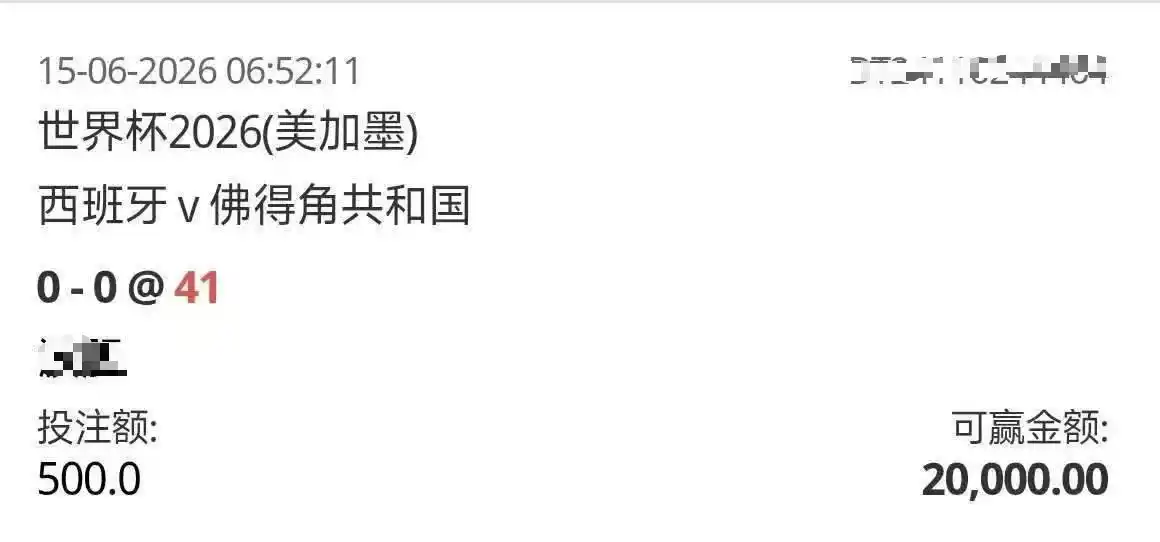
So here's the question: Have you ever supported a team or predicted scores in a group chat with friends? Have you ever participated in predictions, whether offline or on compliant platforms?

In fact, the kickoff of the World Cup isn't just about the battle of 48 teams on the pitch; it's also a face-off between several prediction products.

If you open Polymarket, you'll find it has prominently added a World Cup entry with a golden football icon to its top navigation bar. Click further, and the entire tournament's matches, betting options, brackets, and map are laid out clearly.
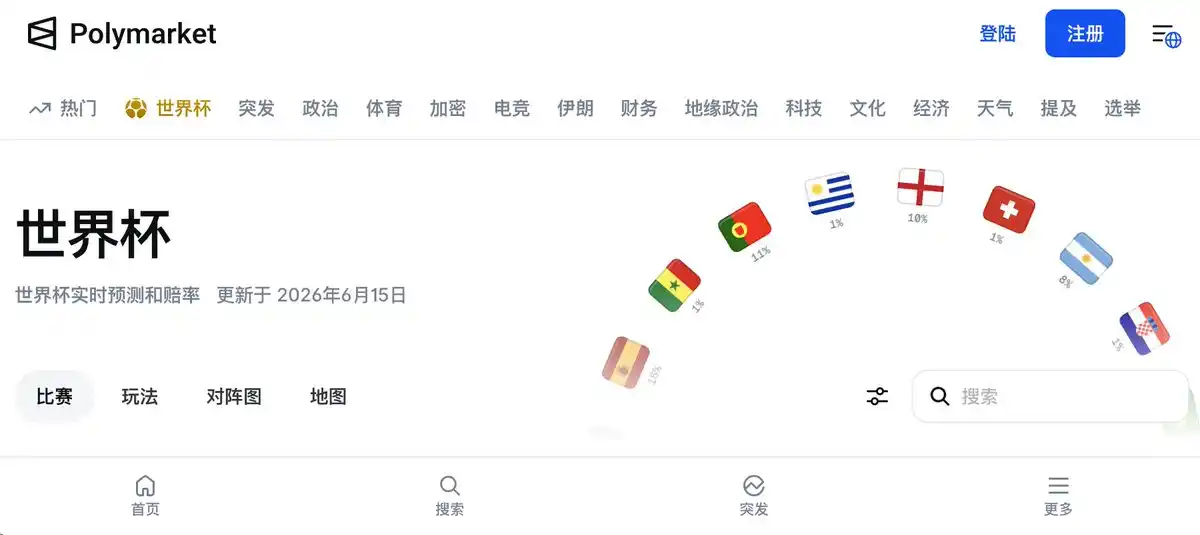
Currently, there are roughly three different categories of prediction methods for the World Cup: first, traditional official sports lotteries; second, traditional online gambling platforms; and third, emerging crypto prediction markets. The latter can be further divided into more established platforms like Polymarket @Polymarket .fun and Kalshi @Kalshi, and new blockchain contenders like Opinion @opinionlabsxyz and Predict.fun @predictdotfun.

On the surface, all of these are answering the same question: Who will win? But the underlying product logic, transparency, compliance paths, and user experience differ significantly and cannot be lumped together.

Next, Biteye will provide a sharp review, ranking from 'Solid' to 'Meh', of the overall betting experience across four different channels and multiple platforms for the 2026 World Cup.

First, the 'From Solid to Meh' Table

To prevent everyone from getting lost in jargon like odds, contracts, and dividend indices, let's first rank them directly from best to worst across five dimensions:
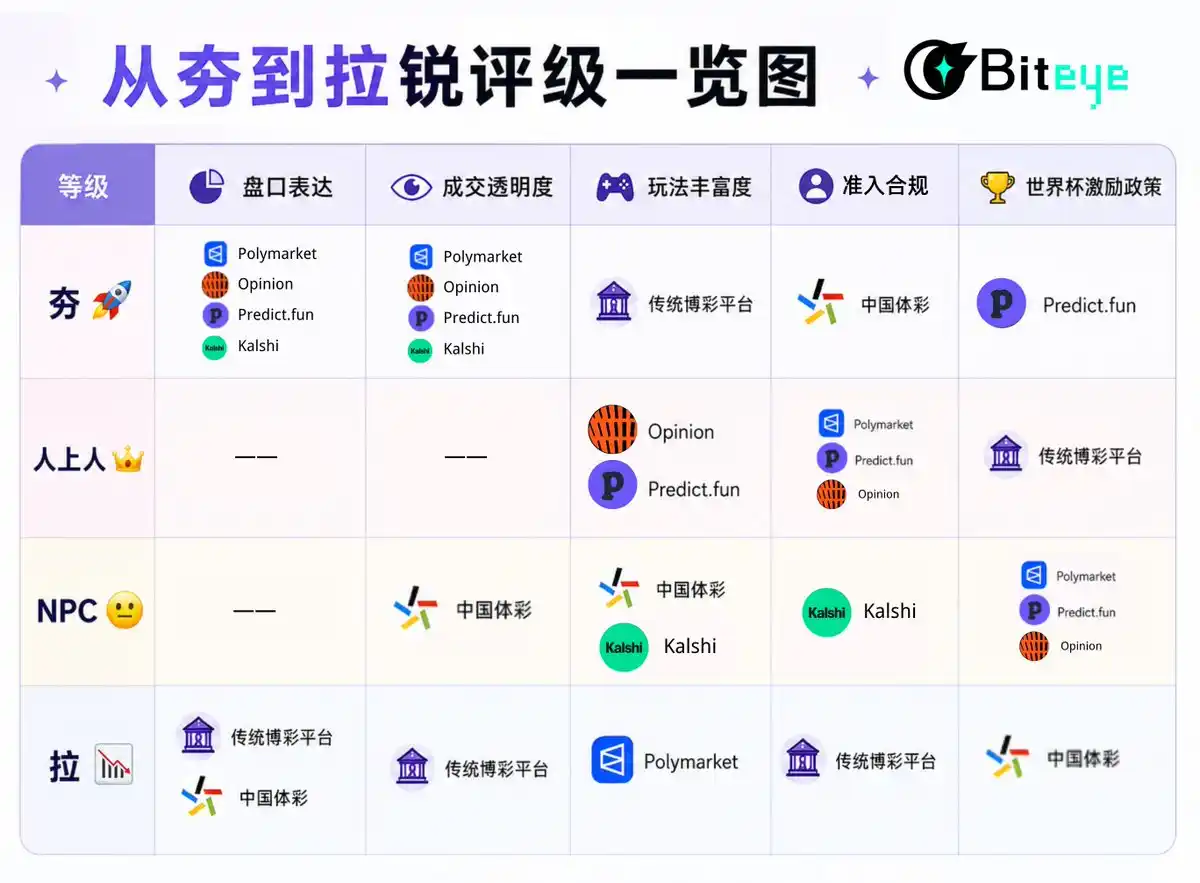
A one-sentence sharp review:

Polymarket is the World Cup betting market trending chart, with Opinion close behind. Predict.fun is the best at throwing money around with World Cup events on BNB Chain. Kalshi is the stock exchange in a suit watching the game. Traditional gambling platforms are feature-packed, enduring gambling supermarkets. The official sports lottery is the officially-sanctioned side dish for watching matches.

Market Expression: Do I Understand What It's Selling?

If you're new to World Cup betting, the odds on traditional gambling platforms might be confusing.

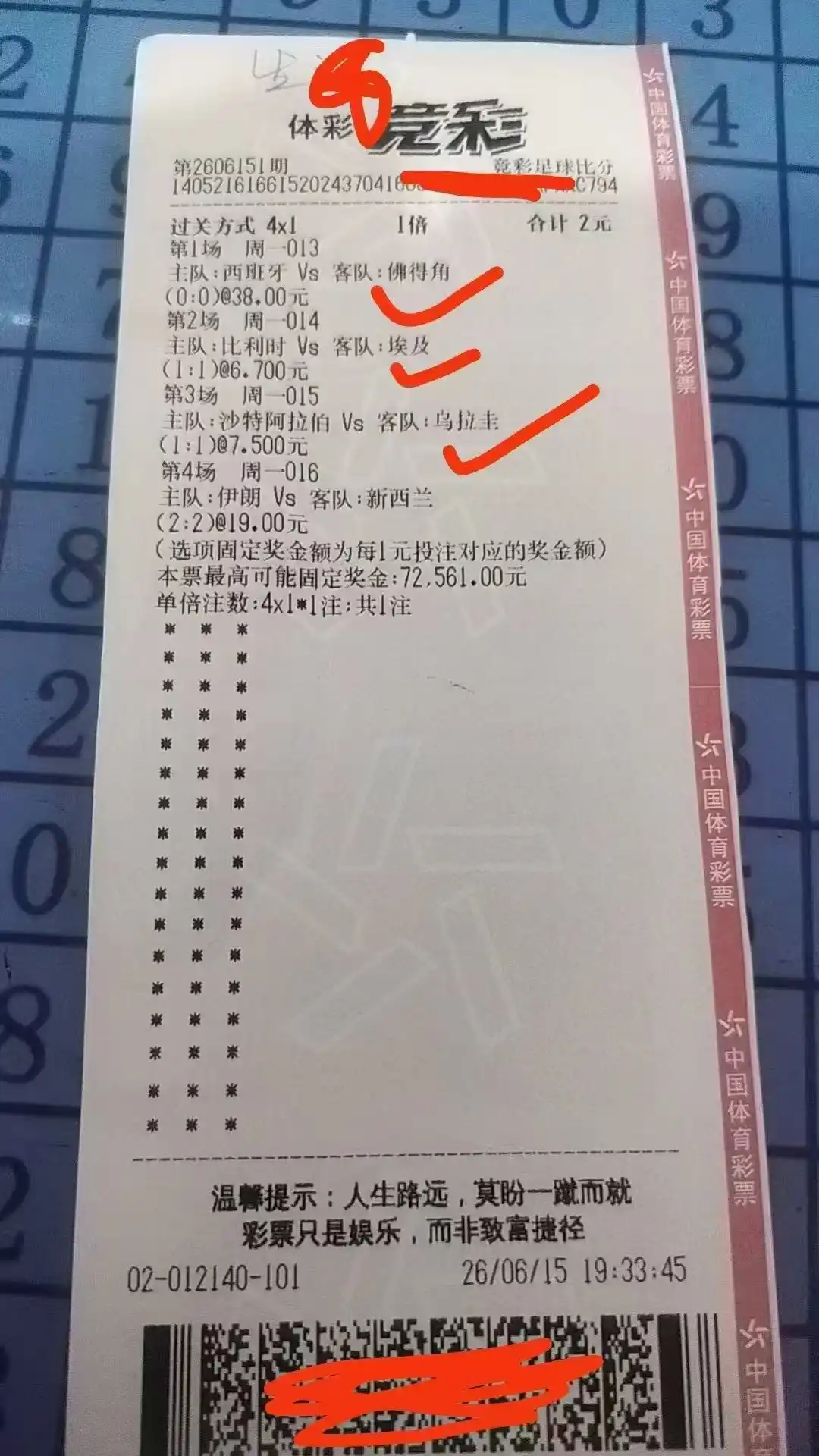
Traditional platforms use the classic language of odds, like +450, +850, +1000. Veterans might understand instantly, but newcomers might stare blankly for three seconds. The numbers look tempting, but why the complicated math? Similarly, the payout calculations for China's sports lottery are essentially odds-based menus that require conversion, rather than an easily understandable market price.

In contrast, whether it's the veteran prediction platforms Polymarket and self-styled event contract exchange Kalshi, or the newcomers Opinion and Predict.fun, the communicative advantage of prediction markets lies in not needing to convert odds or understand a bunch of betting terminology. They turn the World Cup into a visible, real-time probability curve.
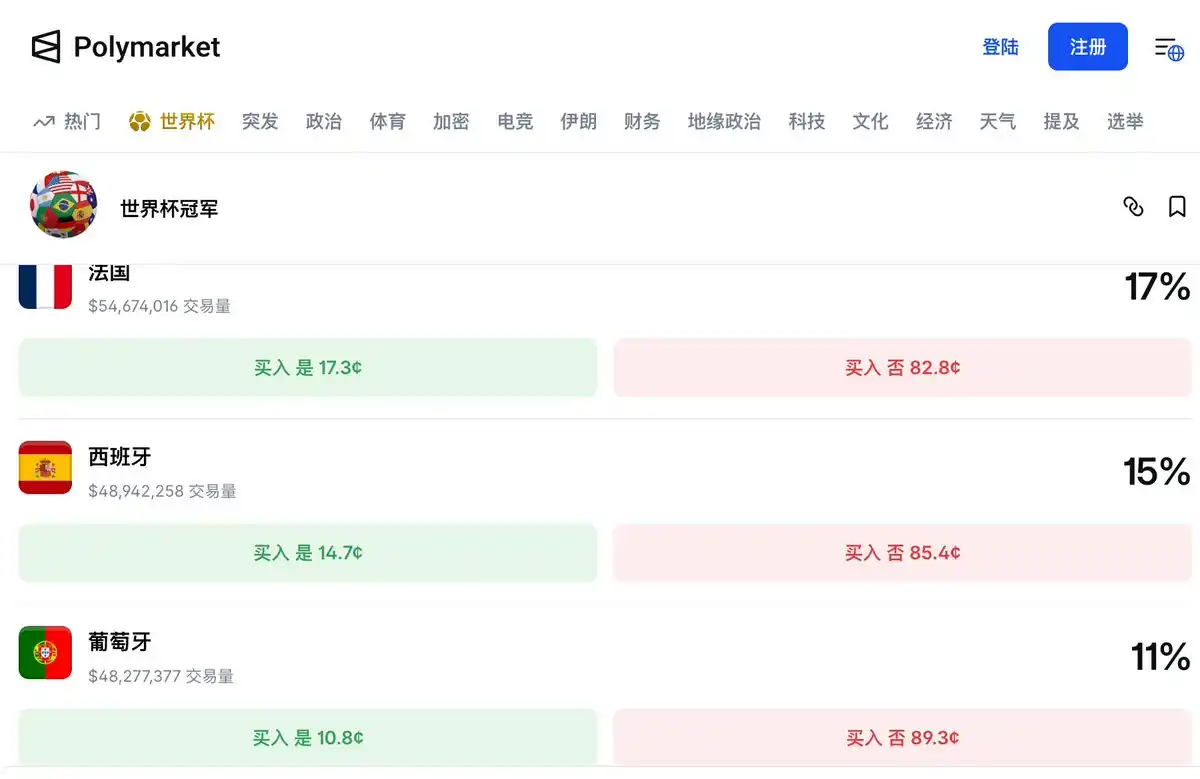
For example, Spain at 16¢, France at 16¢, Portugal at 11¢ corresponds to the market estimating their championship probability at roughly 16%, 16%, and 11%. If your supported Spain wins, you'll capture the multiple increase from 16% to 100%, about a 6.17x return.

This market language is very friendly for newcomers wanting to participate in World Cup predictions. It's not necessarily about making betting easier, but about making it easier to gauge the direction of market sentiment.

Simultaneously, such prediction market data is naturally suitable for media citation because it turns the subjective judgment of 'which team is stronger' into a real-time price voted on with money.

This round is more complex and heavily depends on user habits. Ranking based on communicative properties:

  • Solid: Polymarket / Kalshi/Opinion/Predict.fun. Probability is price, most suitable for communication.
  • Upper Class:/
  • NPC:/
  • Meh: Traditional gambling platforms / Sports lottery. Odds menus are not friendly to newcomers.

Transaction Transparency: Can I See How Others Are Betting?

Understanding the price is just the first step. The real key is: How is this price determined?

This is also the most fatal blow that emerging prediction markets deliver to the traditional bookmaker model. While prediction market data doesn't necessarily represent the 'truth', at least we can intuitively see how the market is trading.

Polymarket discloses price, trading volume, order book, liquidity, price curves, and market heat. Kalshi, Opinion, and Predict.fun are similar, displaying market data, trades, and price changes. In comparison, Kalshi's data, due to compliance requirements, resembles formal financial reports, while Opinion and Predict.fun resemble complete event-focused pages within new blockchain projects.
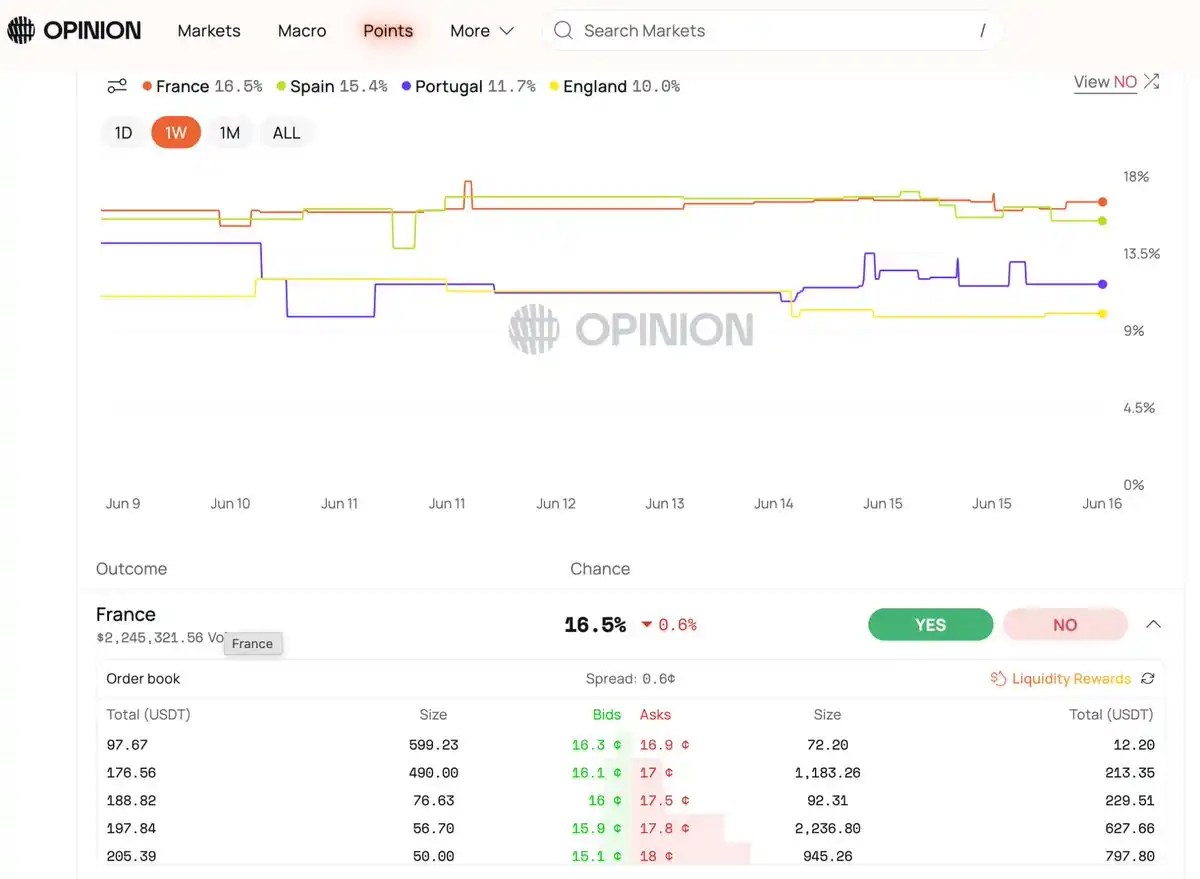
Traditional gambling platforms are different. Bettors can see the payout index or odds, but it's difficult to see the real volume behind a specific market, how funds flow, or the actual market depth. Traders primarily bet by trusting the platform's reputation. This isn't to say they lack liquidity, but the real issue is: this liquidity isn't transparent to ordinary users. It's like enjoying delicious braised chicken but worrying if it's frozen pre-made food.

China's sports lottery, under macro-level regulation, generally doesn't see extreme market manipulation, but behind each set of odds, there's an opaque, uncertain black box.

So this round's review is simple:

  • Solid: Polymarket / Kalshi/Opinion/Predict.fun. The foundation of prediction markets.
  • Upper Class:/
  • NPC: China Sports Lottery. Officially endorsed, large scale, but the process is invisible.
  • Meh: Traditional gambling platforms. Complete black box.

Variety of Betting Options: Can I Choose to Bet on Details I Like?

When it comes to who's best at creating diverse options, traditional gambling platforms are the seasoned veterans.

Outright winner, handicap, over/under, correct score, half-time/full-time, corners, yellow cards, player to score, golden boot, accumulators, same-match combos, live betting, cash-out... Traditional platforms have turned almost every detail of a World Cup match into products on the shelves of a gambling supermarket, dazzling to the eye.

This is also the strongest and most dangerous aspect of traditional platforms: the more options, the easier it is for users to think 'there must be one angle I understand'. But for the platform, the more detailed the options, the longer users stay, the higher the trading frequency, and the greater the profit.

China's sports lottery also offers a fair variety. During the World Cup, options like outright winner, finalists, win/draw/loss, correct score, total goals, and half-time/full-time basically cover the most familiar betting needs for Chinese users.

In comparison, Kalshi is catching up in this direction, starting to offer more single-match, over/under, both teams to score, and other event contracts.

Polymarket is more restrained, focusing on core markets like outright winner, advancement, and match winner. For instance, as of June 15th, trading volume for the World Cup winner prediction on Polymarket has exceeded $20 billion. In contrast, liquidity for split markets like over/under or handicap for individual matches is generally lower, and there are rarely corresponding markets for the traditional accumulator bets involving multiple matches.

Opinion and Predict.fun are more aggressive among new blockchain platforms, both offering markets for champion, group stage, knockout stage, golden boot, top assist provider, etc.

So this round:

  • Solid: Traditional gambling platforms. The gambling buffet.
  • Upper Class: Opinion / Predict.fun. Actively capturing the market.
  • NPC: Kalshi, adding more dishes / Sports Lottery, the official menu is sufficient.
  • Meh: Polymarket. The signature dishes are strong, but the menu isn't extensive.

User Access & Compliance: How Do I Get In & Can I Get Out?

This point is especially important for users in Chinese-speaking regions.

The advantage of the sports lottery is its clear legal status and familiarity within the Chinese context—you often see stores with 'Sports Lottery' signs just a few steps from your daily life. But its drawback is also obvious: it's not something you can participate in by casually opening a webpage; formal channels still emphasize offline physical outlets.

Polymarket, Opinion, and Predict.fun operate on a more Web3 access logic. Wallets, stablecoins, on-chain assets—these are relatively straightforward for those with a crypto background; but for average soccer fans, wallets, private keys, USDC, and regional restrictions are all barriers. Simultaneously, all three face the challenge of compliance for crypto prediction markets.

In contrast, Kalshi leans more towards a US-compliant financial account logic. Its rules are clear, positioning itself on the regulated event contract path, but KYC, regional, and account requirements mean it's not a product for all global users.

Traditional gambling platforms may seem to have many entry points in many regions, but they also have the most issues: regional restrictions, deposit/withdrawal risks, account risk controls, and inconsistent platform compliance. Even though some European and American markets have mature licensing systems, users in Chinese-speaking regions need to be cautious.

Therefore, the most important question isn't which platform offers the most exciting bets, but:

Where does the money go in? How are results settled? Can the money come out? Who do you turn to if the platform has a problem?

This round:

  • Solid: China Sports Lottery. The most legitimate and familiar in Chinese-speaking regions, but requires offline channels.
  • Upper Class: Polymarket/Opinion/Predict.fun. Friendly for crypto users, with barriers for average users, but compliance needs testing.
  • NPC: Kalshi. Access limited primarily to US users, compliance is clear.
  • Meh: Traditional gambling platforms. Deposit/withdrawal and compliance risks require the most vigilance.

Incentive Activities: Should I Bet More for the Rewards?

As a new contender in on-chain prediction markets, Predict.fun has launched a $2 million special incentive campaign for the World Cup. It has created the Predict Cup on BNB Chain, offering a rich prize pool, and built a series of on-chain World Cup activities with Fan Points, team lineups, leaderboards, and round rewards.
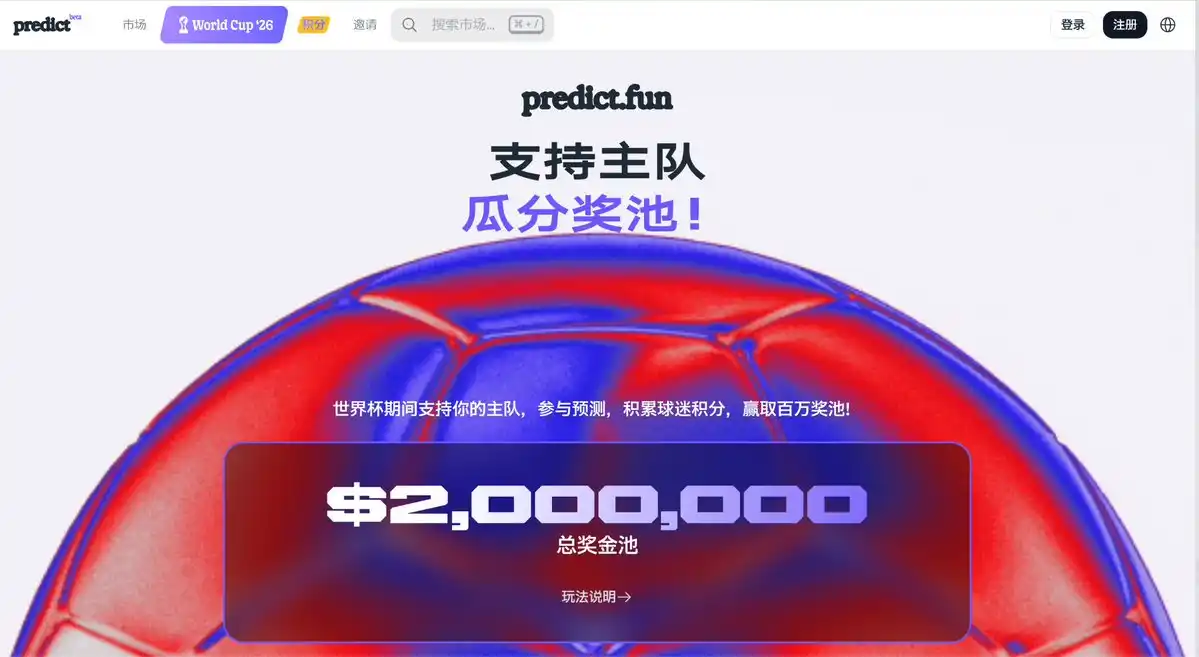
This is very attractive to users: you're not just predicting match outcomes; you're also competing for points, climbing the rankings, and earning rewards.

Traditional gambling platforms are also going all out for the World Cup; after all, this is the quadrennial fan frenzy, and traffic almost equals revenue.

Polymarket, Kalshi, and Opinion, however, still focus on the markets themselves: price, volume, market depth, communication—they haven't created separate incentive schemes for the World Cup.

The sports lottery emphasizes public welfare and rational purchasing; while it often has promotions, in the Chinese context, it's not appropriate to expand on them as traffic-driving introductions.

But amidst the excitement, it's also worth asking: Am I enjoying the match, or am I trading for points? Am I looking at odds, or am I being pushed along by the leaderboard?

This round:

  • Solid: Predict.fun. The most aggressive with World Cup-specific operations.
  • Upper Class: Traditional gambling platforms. The golden period of the World Cup.
  • NPC: Polymarket / Kalshi/Opinion. Incentives are not the main selling point.
  • Meh: Sports Lottery. Emphasizes rationality and public welfare attributes.

Conclusion

The 2026 World Cup has placed several product logics on the same table.

  • China's Sports Lottery says: The match can be a viewing interaction within the framework of an official public welfare lottery.
  • Traditional gambling platforms say: The match is a highly mature entertainment product.
  • Polymarket says: The match is a real-time, fluctuating probability market.
  • Kalshi says: The match is a regulatable event contract.
  • Opinion says: On-chain prediction markets can also be built like complete event-focused pages.
  • Predict.fun says: The World Cup isn't just about markets; it can also be an on-chain points game.

But perhaps what's truly worth noting is not who can replace whom, but how World Cup betting markets are shifting from closed, odds-based products into open, real-time, communicable information markets.

Sports are just the stage. The bigger business is humanity's eternal desire to price the future, to price its own judgment.
Preguntas relacionadas

QWhat was the major upset mentioned in the article regarding the 2026 FIFA World Cup?

AThe major upset was that the highly favored Spanish team, valued at 500 million euros, was held to a 0-0 draw by Cape Verde's 40-year-old goalkeeper, who has a market value of only 50,000 euros.

QAccording to the article, what are the three main categories of World Cup prediction methods discussed?

AThe three main categories are: 1) Traditional official sports lottery, 2) Traditional online betting platforms, and 3) Emerging crypto prediction markets, which include more established platforms like Polymarket and Kalshi, as well as newer chain-based platforms like Opinion and Predict.fun.

QWhat key advantage do prediction markets like Polymarket offer over traditional betting platforms in terms of information presentation?

APrediction markets offer the advantage of presenting information as real-time probability curves and prices (e.g., Spain 16¢ for a 16% chance), which are more intuitive and easier for传播 (dissemination) than the complex odds calculations required by traditional betting platforms.

QWhich platform received the lowest ranking ('拉') for 'User Access & Compliance' for Chinese-speaking users, and why?

ATraditional online betting platforms received the lowest ranking ('拉'). This is because they pose the highest risks regarding geographical restrictions, fund deposit/withdrawal issues, account risk control, and inconsistent platform compliance, making them particularly risky for Chinese-speaking users.

QWhich platform was highlighted for having the most aggressive and specialized incentive activities during the World Cup?

APredict.fun was highlighted for having the most aggressive specialized incentives, running a 'Predict Cup' on BNB Chain with a $2 million prize pool, featuring Fan Points, team lineups, leaderboards, and round rewards to engage users.

Lecturas Relacionadas

In the Name of Charity, For the Benefit of the Family: How the Trump Family Turns Philanthropy into Profit?

Charity for Profit: How the Trump Family Turned Philanthropy into Personal Gain Amid a recent controversy over misleading claims about his cryptocurrency company American Bitcoin, Eric Trump invoked his children's cancer charity as evidence of his good intentions. While his Curetivity foundation (formerly the Eric Trump Foundation) has donated over $25 million to St. Jude Children's Research Hospital, an investigation reveals a pattern of self-dealing and opaque practices that benefited the Trump family business. Internal documents show that from 2011 to 2016, over $500,000 from the charity was funneled back to Trump-owned properties for event costs, transactions often omitted from tax filings. This created clear conflicts of interest, with figures like former club manager and current White House aide Dan Scavino involved on both sides. Public claims of "one of the lowest expense ratios" were contradicted by records showing significant spending on entertainment, auctions, and transportation. Facing scrutiny in 2017, Eric Trump distanced himself from the board and rebranded the foundation. After a state investigation shifted focus to compliance rather than enforcement, he returned as the public face. Fundraising events, now less transparent, continue at Trump venues. Estimates suggest these events have directed over $1 million to the Trump Organization over two decades. The same playbook of optimistic claims and obscured financial realities is now evident in Eric Trump's role at American Bitcoin. He promoted it as a highly profitable venture with low mining costs, but reports indicate most Bitcoin was purchased with funds from constant stock issuance, not mined, with actual costs far higher than claimed. While the company's stock has crashed nearly 90% from its peak, Eric Trump's personal stake remains valuable. The recurring pattern involves aggressive public defense, legal maneuvering to bury records, making minimal changes to satisfy regulators, and eventually repackaging the venture to regain trust, often successfully.

marsbitHace 6 min(s)

In the Name of Charity, For the Benefit of the Family: How the Trump Family Turns Philanthropy into Profit?

marsbitHace 6 min(s)

Bernstein Report: Agentic AI Will Transform CPU from Supporting Role to Leading Role, Bullish on Hygon Information

Bernstein research report: Agentic AI will turn CPUs from supporting players to leading roles, bullish on Hygon Information. Analysts led by David Dai argue that AI is transitioning from the chatbot era to the agentic AI era. Unlike simple query-response models, agentic AI involves complex workflows including retrieval, planning, tool calling, and multi-step reasoning. This shift dramatically increases the demand for CPU compute to orchestrate these tasks, manage memory, and prevent expensive GPU idling. The report forecasts that the GPU-to-CPU ratio in inference clusters will reverse from 8:1 in 2025 to 1:1 by 2029. In agentic AI workloads, CPUs could account for 50% of the compute, on par with GPUs. Consequently, the server CPU Total Addressable Market (TAM) is projected to surge from $37 billion in 2025 to $223 billion by 2030, representing a 6x expansion. Arm is identified as a key beneficiary due to its superior performance-per-watt and a strategic shift from IP licensing to designing its own chips, targeting $15 billion in chip revenue by 2030. Bernstein raises Arm's price target to $500. For x86 vendors, the report is Overweight on AMD (target $600) and Hygon Information (target CNY 450), citing leadership and strong growth in the Chinese market respectively. Intel's target is raised to $100, reflecting upgraded earnings assumptions. The analysis acknowledges significant supply-side risks, questioning whether foundry and memory capacity can support such rapid CPU growth. The optimistic demand forecast also heavily relies on Nvidia's guidance for over $1 trillion in annual AI infrastructure spend by 2027.

marsbitHace 14 min(s)

Bernstein Report: Agentic AI Will Transform CPU from Supporting Role to Leading Role, Bullish on Hygon Information

marsbitHace 14 min(s)

Will UNI Reach $100 in Four Years? Can Standard Chartered's Prediction Come True?

TL;DR: Standard Chartered Bank predicts UNI token will reach $100 by 2030, based on the growth of tokenized assets fueling demand for open DeFi liquidity and Uniswap's potential to capture fees from that trading. However, institutional tokenized products like BlackRock's BUIDL fund show that strict access controls and permissioned systems remain major barriers. Standard Chartered's $100 price target for Uniswap's (UNI) governance token by 2030 projects massive growth from current levels. The bank's thesis hinges on tokenized real-world assets (RWA) reaching trillions in value and a significant portion flowing into open, decentralized markets for trading and liquidity, rather than remaining in closed, permissioned systems. Uniswap's position as a leading decentralized exchange (DEX) infrastructure could allow it to capture a major share of this future trading activity. A key challenge is whether tokenized assets like bonds, funds, and stocks will trade openly on DEXs or be restricted to controlled, institutional platforms. The case of BlackRock's BUIDL fund exemplifies this tension: while it uses Uniswap's technology for settlements, trading is strictly limited to pre-approved, whitelisted institutional participants. This hybrid model provides DeFi efficiency but maintains traditional access barriers. For UNI to achieve such a high valuation, Uniswap must not only see increased trading volume from tokenized assets but also implement effective value-capture mechanisms for token holders. Recent governance proposals aim to direct protocol fees to UNI stakers, creating a clearer link between platform usage and token value. Ultimately, the realization of Standard Chartered's prediction depends on the future structure of the tokenized asset market. If open liquidity pools and reduced restrictions prevail, Uniswap's role could expand far beyond crypto-native trading. If permissioned, walled-garden systems dominate, its growth from institutional tokenization may be limited. The prediction itself signals growing institutional recognition of DeFi's potential role in the future of finance.

marsbitHace 22 min(s)

Will UNI Reach $100 in Four Years? Can Standard Chartered's Prediction Come True?

marsbitHace 22 min(s)

Trading

Spot
Futuros

Artículos destacados

Qué es $S$

Entendiendo SPERO: Una Visión General Completa Introducción a SPERO A medida que el panorama de la innovación continúa evolucionando, la aparición de tecnologías web3 y proyectos de criptomonedas juega un papel fundamental en la configuración del futuro digital. Un proyecto que ha atraído la atención en este campo dinámico es SPERO, denotado como SPERO,$$s$. Este artículo tiene como objetivo reunir y presentar información detallada sobre SPERO, para ayudar a entusiastas e inversores a comprender sus fundamentos, objetivos e innovaciones dentro de los dominios web3 y cripto. ¿Qué es SPERO,$$s$? SPERO,$$s$ es un proyecto único dentro del espacio cripto que busca aprovechar los principios de descentralización y tecnología blockchain para crear un ecosistema que promueva la participación, la utilidad y la inclusión financiera. El proyecto está diseñado para facilitar interacciones de igual a igual de nuevas maneras, proporcionando a los usuarios soluciones y servicios financieros innovadores. En su esencia, SPERO,$$s$ tiene como objetivo empoderar a los individuos al proporcionar herramientas y plataformas que mejoren la experiencia del usuario en el espacio de las criptomonedas. Esto incluye habilitar métodos de transacción más flexibles, fomentar iniciativas impulsadas por la comunidad y crear caminos para oportunidades financieras a través de aplicaciones descentralizadas (dApps). La visión subyacente de SPERO,$$s$ gira en torno a la inclusividad, buscando cerrar brechas dentro de las finanzas tradicionales mientras aprovecha los beneficios de la tecnología blockchain. ¿Quién es el Creador de SPERO,$$s$? La identidad del creador de SPERO,$$s$ sigue siendo algo oscura, ya que hay recursos públicos limitados que proporcionan información de fondo detallada sobre su(s) fundador(es). Esta falta de transparencia puede derivarse del compromiso del proyecto con la descentralización, una ética que muchos proyectos web3 comparten, priorizando las contribuciones colectivas sobre el reconocimiento individual. Al centrar las discusiones en torno a la comunidad y sus objetivos colectivos, SPERO,$$s$ encarna la esencia del empoderamiento sin señalar a individuos específicos. Como tal, comprender la ética y la misión de SPERO sigue siendo más importante que identificar a un creador singular. ¿Quiénes son los Inversores de SPERO,$$s$? SPERO,$$s$ cuenta con el apoyo de una diversa gama de inversores que van desde capitalistas de riesgo hasta inversores ángeles dedicados a fomentar la innovación en el sector cripto. El enfoque de estos inversores generalmente se alinea con la misión de SPERO, priorizando proyectos que prometen avances tecnológicos sociales, inclusión financiera y gobernanza descentralizada. Estas fundaciones de inversores suelen estar interesadas en proyectos que no solo ofrecen productos innovadores, sino que también contribuyen positivamente a la comunidad blockchain y sus ecosistemas. El respaldo de estos inversores refuerza a SPERO,$$s$ como un contendiente notable en el dominio de proyectos cripto que evoluciona rápidamente. ¿Cómo Funciona SPERO,$$s$? SPERO,$$s$ emplea un marco multifacético que lo distingue de los proyectos de criptomonedas convencionales. Aquí hay algunas de las características clave que subrayan su singularidad e innovación: Gobernanza Descentralizada: SPERO,$$s$ integra modelos de gobernanza descentralizada, empoderando a los usuarios para participar activamente en los procesos de toma de decisiones sobre el futuro del proyecto. Este enfoque fomenta un sentido de propiedad y responsabilidad entre los miembros de la comunidad. Utilidad del Token: SPERO,$$s$ utiliza su propio token de criptomoneda, diseñado para servir diversas funciones dentro del ecosistema. Estos tokens permiten transacciones, recompensas y la facilitación de servicios ofrecidos en la plataforma, mejorando la participación y la utilidad general. Arquitectura en Capas: La arquitectura técnica de SPERO,$$s$ apoya la modularidad y escalabilidad, permitiendo la integración fluida de características y aplicaciones adicionales a medida que el proyecto evoluciona. Esta adaptabilidad es fundamental para mantener la relevancia en el cambiante paisaje cripto. Participación de la Comunidad: El proyecto enfatiza iniciativas impulsadas por la comunidad, empleando mecanismos que incentivan la colaboración y la retroalimentación. Al nutrir una comunidad sólida, SPERO,$$s$ puede abordar mejor las necesidades de los usuarios y adaptarse a las tendencias del mercado. Enfoque en la Inclusión: Al ofrecer tarifas de transacción bajas e interfaces amigables para el usuario, SPERO,$$s$ busca atraer a una base de usuarios diversa, incluyendo a individuos que anteriormente pueden no haber participado en el espacio cripto. Este compromiso con la inclusión se alinea con su misión general de empoderamiento a través de la accesibilidad. Cronología de SPERO,$$s$ Entender la historia de un proyecto proporciona información crucial sobre su trayectoria de desarrollo y hitos. A continuación se presenta una cronología sugerida que mapea eventos significativos en la evolución de SPERO,$$s$: Fase de Conceptualización e Ideación: Las ideas iniciales que forman la base de SPERO,$$s$ fueron concebidas, alineándose estrechamente con los principios de descentralización y enfoque comunitario dentro de la industria blockchain. Lanzamiento del Whitepaper del Proyecto: Tras la fase conceptual, se lanzó un whitepaper completo que detalla la visión, los objetivos y la infraestructura tecnológica de SPERO,$$s$ para generar interés y retroalimentación de la comunidad. Construcción de Comunidad y Primeras Interacciones: Se realizaron esfuerzos de divulgación activa para construir una comunidad de primeros adoptantes y posibles inversores, facilitando discusiones en torno a los objetivos del proyecto y obteniendo apoyo. Evento de Generación de Tokens: SPERO,$$s$ llevó a cabo un evento de generación de tokens (TGE) para distribuir sus tokens nativos a los primeros seguidores y establecer liquidez inicial dentro del ecosistema. Lanzamiento de la dApp Inicial: La primera aplicación descentralizada (dApp) asociada con SPERO,$$s$ se puso en marcha, permitiendo a los usuarios interactuar con las funcionalidades centrales de la plataforma. Desarrollo Continuo y Alianzas: Actualizaciones y mejoras continuas a las ofertas del proyecto, incluyendo alianzas estratégicas con otros actores en el espacio blockchain, han moldeado a SPERO,$$s$ en un jugador competitivo y en evolución en el mercado cripto. Conclusión SPERO,$$s$ se erige como un testimonio del potencial de web3 y las criptomonedas para revolucionar los sistemas financieros y empoderar a los individuos. Con un compromiso con la gobernanza descentralizada, la participación comunitaria y funcionalidades diseñadas de manera innovadora, allana el camino hacia un paisaje financiero más inclusivo. Como con cualquier inversión en el espacio cripto que evoluciona rápidamente, se anima a los posibles inversores y usuarios a investigar a fondo y participar de manera reflexiva con los desarrollos en curso dentro de SPERO,$$s$. El proyecto muestra el espíritu innovador de la industria cripto, invitando a una mayor exploración de sus innumerables posibilidades. Mientras el viaje de SPERO,$$s$ aún se desarrolla, sus principios fundamentales pueden, de hecho, influir en el futuro de cómo interactuamos con la tecnología, las finanzas y entre nosotros en ecosistemas digitales interconectados.

75 Vistas totalesPublicado en 2024.12.17Actualizado en 2024.12.17

Qué es $S$

Qué es AGENT S

Agent S: El Futuro de la Interacción Autónoma en Web3 Introducción En el paisaje en constante evolución de Web3 y las criptomonedas, las innovaciones están redefiniendo constantemente cómo los individuos interactúan con las plataformas digitales. Uno de estos proyectos pioneros, Agent S, promete revolucionar la interacción humano-computadora a través de su marco agente abierto. Al allanar el camino para interacciones autónomas, Agent S busca simplificar tareas complejas, ofreciendo aplicaciones transformadoras en inteligencia artificial (IA). Esta exploración detallada profundizará en las complejidades del proyecto, sus características únicas y las implicaciones para el dominio de las criptomonedas. ¿Qué es Agent S? Agent S se presenta como un marco agente abierto innovador, diseñado específicamente para abordar tres desafíos fundamentales en la automatización de tareas informáticas: Adquisición de Conocimiento Específico del Dominio: El marco aprende inteligentemente de diversas fuentes de conocimiento externas y experiencias internas. Este enfoque dual le permite construir un rico repositorio de conocimiento específico del dominio, mejorando su rendimiento en la ejecución de tareas. Planificación a Largo Plazo de Tareas: Agent S emplea planificación jerárquica aumentada por la experiencia, un enfoque estratégico que facilita la descomposición y ejecución eficiente de tareas complejas. Esta característica mejora significativamente su capacidad para gestionar múltiples subtareas de manera eficiente y efectiva. Manejo de Interfaces Dinámicas y No Uniformes: El proyecto introduce la Interfaz Agente-Computadora (ACI), una solución innovadora que mejora la interacción entre agentes y usuarios. Utilizando Modelos de Lenguaje Multimodal de Gran Escala (MLLMs), Agent S puede navegar y manipular diversas interfaces gráficas de usuario sin problemas. A través de estas características pioneras, Agent S proporciona un marco robusto que aborda las complejidades involucradas en la automatización de la interacción humana con las máquinas, preparando el terreno para una multitud de aplicaciones en IA y más allá. ¿Quién es el Creador de Agent S? Si bien el concepto de Agent S es fundamentalmente innovador, la información específica sobre su creador sigue siendo elusiva. El creador es actualmente desconocido, lo que resalta ya sea la etapa incipiente del proyecto o la elección estratégica de mantener a los miembros fundadores en el anonimato. Independientemente de la anonimidad, el enfoque sigue siendo en las capacidades y el potencial del marco. ¿Quiénes son los Inversores de Agent S? Dado que Agent S es relativamente nuevo en el ecosistema criptográfico, la información detallada sobre sus inversores y patrocinadores financieros no está documentada explícitamente. La falta de información disponible públicamente sobre las bases de inversión u organizaciones que apoyan el proyecto plantea preguntas sobre su estructura de financiamiento y hoja de ruta de desarrollo. Comprender el respaldo es crucial para evaluar la sostenibilidad del proyecto y su posible impacto en el mercado. ¿Cómo Funciona Agent S? En el núcleo de Agent S se encuentra una tecnología de vanguardia que le permite funcionar de manera efectiva en diversos entornos. Su modelo operativo se basa en varias características clave: Interacción Humano-Computadora Similar a la Humana: El marco ofrece planificación avanzada de IA, esforzándose por hacer que las interacciones con las computadoras sean más intuitivas. Al imitar el comportamiento humano en la ejecución de tareas, promete elevar las experiencias de los usuarios. Memoria Narrativa: Empleada para aprovechar experiencias de alto nivel, Agent S utiliza memoria narrativa para hacer un seguimiento de las historias de tareas, mejorando así sus procesos de toma de decisiones. Memoria Episódica: Esta característica proporciona a los usuarios una guía paso a paso, permitiendo que el marco ofrezca apoyo contextual a medida que se desarrollan las tareas. Soporte para OpenACI: Con la capacidad de ejecutarse localmente, Agent S permite a los usuarios mantener el control sobre sus interacciones y flujos de trabajo, alineándose con la ética descentralizada de Web3. Fácil Integración con APIs Externas: Su versatilidad y compatibilidad con varias plataformas de IA aseguran que Agent S pueda encajar sin problemas en ecosistemas tecnológicos existentes, convirtiéndolo en una opción atractiva para desarrolladores y organizaciones. Estas funcionalidades contribuyen colectivamente a la posición única de Agent S dentro del espacio cripto, ya que automatiza tareas complejas y de múltiples pasos con una intervención humana mínima. A medida que el proyecto evoluciona, sus posibles aplicaciones en Web3 podrían redefinir cómo se desarrollan las interacciones digitales. Cronología de Agent S El desarrollo y los hitos de Agent S pueden encapsularse en una cronología que resalta sus eventos significativos: 27 de septiembre de 2024: El concepto de Agent S fue lanzado en un documento de investigación integral titulado “Un Marco Agente Abierto que Usa Computadoras Como un Humano”, mostrando las bases del proyecto. 10 de octubre de 2024: El documento de investigación fue puesto a disposición del público en arXiv, ofreciendo una exploración profunda del marco y su evaluación de rendimiento basada en el benchmark OSWorld. 12 de octubre de 2024: Se lanzó una presentación en video, proporcionando una visión visual de las capacidades y características de Agent S, involucrando aún más a posibles usuarios e inversores. Estos marcadores en la cronología no solo ilustran el progreso de Agent S, sino que también indican su compromiso con la transparencia y la participación comunitaria. Puntos Clave Sobre Agent S A medida que el marco Agent S continúa evolucionando, varios atributos clave destacan, subrayando su naturaleza innovadora y potencial: Marco Innovador: Diseñado para proporcionar un uso intuitivo de las computadoras similar a la interacción humana, Agent S aporta un enfoque novedoso a la automatización de tareas. Interacción Autónoma: La capacidad de interactuar de manera autónoma con las computadoras a través de GUI significa un salto hacia soluciones informáticas más inteligentes y eficientes. Automatización de Tareas Complejas: Con su metodología robusta, puede automatizar tareas complejas y de múltiples pasos, haciendo que los procesos sean más rápidos y menos propensos a errores. Mejora Continua: Los mecanismos de aprendizaje permiten a Agent S mejorar a partir de experiencias pasadas, mejorando continuamente su rendimiento y eficacia. Versatilidad: Su adaptabilidad en diferentes entornos operativos como OSWorld y WindowsAgentArena asegura que pueda servir a una amplia gama de aplicaciones. A medida que Agent S se posiciona en el paisaje de Web3 y criptomonedas, su potencial para mejorar las capacidades de interacción y automatizar procesos significa un avance significativo en las tecnologías de IA. A través de su marco innovador, Agent S ejemplifica el futuro de las interacciones digitales, prometiendo una experiencia más fluida y eficiente para los usuarios en diversas industrias. Conclusión Agent S representa un audaz avance en la unión de la IA y Web3, con la capacidad de redefinir cómo interactuamos con la tecnología. Aunque aún se encuentra en sus primeras etapas, las posibilidades para su aplicación son vastas y atractivas. A través de su marco integral que aborda desafíos críticos, Agent S busca llevar las interacciones autónomas al primer plano de la experiencia digital. A medida que nos adentramos más en los reinos de las criptomonedas y la descentralización, proyectos como Agent S sin duda desempeñarán un papel crucial en la configuración del futuro de la tecnología y la colaboración humano-computadora.

487 Vistas totalesPublicado en 2025.01.14Actualizado en 2025.01.14

Qué es AGENT S

Cómo comprar S

¡Bienvenido a HTX.com! Hemos hecho que comprar Sonic (S) sea simple y conveniente. Sigue nuestra guía paso a paso para iniciar tu viaje de criptos.Paso 1: crea tu cuenta HTXUtiliza tu correo electrónico o número de teléfono para registrarte y obtener una cuenta gratuita en HTX. Experimenta un proceso de registro sin complicaciones y desbloquea todas las funciones.Obtener mi cuentaPaso 2: ve a Comprar cripto y elige tu método de pagoTarjeta de crédito/débito: usa tu Visa o Mastercard para comprar Sonic (S) al instante.Saldo: utiliza fondos del saldo de tu cuenta HTX para tradear sin problemas.Terceros: hemos agregado métodos de pago populares como Google Pay y Apple Pay para mejorar la comodidad.P2P: tradear directamente con otros usuarios en HTX.Over-the-Counter (OTC): ofrecemos servicios personalizados y tipos de cambio competitivos para los traders.Paso 3: guarda tu Sonic (S)Después de comprar tu Sonic (S), guárdalo en tu cuenta HTX. Alternativamente, puedes enviarlo a otro lugar mediante transferencia blockchain o utilizarlo para tradear otras criptomonedas.Paso 4: tradear Sonic (S)Tradear fácilmente con Sonic (S) en HTX's mercado spot. Simplemente accede a tu cuenta, selecciona tu par de trading, ejecuta tus trades y monitorea en tiempo real. Ofrecemos una experiencia fácil de usar tanto para principiantes como para traders experimentados.

1.0k Vistas totalesPublicado en 2025.01.15Actualizado en 2026.06.02

Cómo comprar S

Discusiones

Bienvenido a la comunidad de HTX. Aquí puedes mantenerte informado sobre los últimos desarrollos de la plataforma y acceder a análisis profesionales del mercado. A continuación se presentan las opiniones de los usuarios sobre el precio de S (S).

活动图片