TON Enters the Telegram Era: The On-Chain Experiment of Super Apps is Unfolding

marsbitPublicado a 2026-05-08Actualizado a 2026-05-08

Resumen

The TON token recently surged nearly 120% in 4 days, approaching $3. This rally is primarily driven by Telegram founder Pavel Durov's announcement that Telegram will become the core driver of the TON network, replacing the TON Foundation and serving as its largest validator. This move signals a fundamental shift: Telegram is no longer just supporting TON from a distance but is formally taking over its governance and operations. This changes TON's valuation narrative from being a crypto project with Telegram's user base to becoming the foundational blockchain infrastructure for Telegram's future commercial ecosystem—transitioning from a crypto narrative to an internet-platform-level story. TON's recent technical upgrades focus on 10x faster speeds, 6x lower fees, and near-instant confirmations. These optimizations target Telegram's internal high-frequency, micro-transaction scenarios like tipping, bot services, and Mini App purchases. The goal is to enable seamless, near-zero-cost transactions for its nearly 1 billion users, making blockchain usage almost invisible—akin to platforms like WeChat Pay. TON's path is unique: it already has a massive user base and is building the blockchain system to serve it, aiming to onboard users into Web3 without them realizing it. The vision is to integrate wallet, payment, bot, and Mini App functionalities into a closed loop within Telegram, positioning TON as the value-exchange infrastructure for a super-app. In essence, this surge refl...

Author: Climber, CryptoPulse Labs

Recently, the TON token has experienced consecutive increases, rising approximately 120% over 4 days and approaching the $3 mark. The primary reason behind this surge is the public endorsement by Pavel Durov, the founder of Telegram.

He stated that Telegram will replace the TON Foundation, becoming the core driving force behind TON, and will serve as the largest validator for the TON network. Meanwhile, the TON network has also been continuously advancing technical upgrades, such as announcing a 10x increase in network speed performance and a 6x reduction in transaction fees.

On the surface, this appears to be a round of technical upgrades and narrative revival for TON. However, what the market is truly reassessing is not TON itself, but the fact that Telegram has begun, for the first time, to fully embark on a comprehensive on-chain transformation in a real sense.

I. Telegram Takes the Helm: TON's Valuation Logic Begins to Shift

Over the past few years, TON has occupied a very unique position. It is deeply intertwined with Telegram, yet the two have always maintained a certain distance.

The reason is quite simple. Early on, Telegram launched the Gram fundraising plan, which ultimately faced regulatory intervention from the U.S. SEC, forcing the project to be terminated. The community subsequently took over the project, gradually evolving into the current TON ecosystem.

Therefore, for a long time, although Telegram continued to support TON—including gradually integrating its wallet, bots, mini-apps, and advertising system with TON—it never truly assumed the role of the official driver of TON publicly.
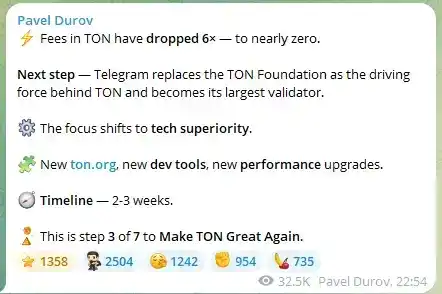
Pavel Durov's recent statements fundamentally alter market expectations. Particularly, the key points of Telegram replacing the TON Foundation and becoming the largest validator directly clarify that Telegram is now beginning to participate directly in the underlying governance and network operation of TON.

This is no longer just ecosystem support; it signifies Telegram formally reclaiming dominant control over TON's roadmap.

This shift is crucial because, in the past, the biggest question the market had about TON was not its technical capability but whether Telegram would truly go all-in on TON. Now, this question has a clear answer.

Simultaneously, this also means TON's valuation logic is changing. Previously, the market priced TON essentially as a public chain with Telegram's traffic support. But now, the market is beginning to reassess TON, as it is likely becoming the on-chain infrastructure within Telegram's future commercial ecosystem.

The difference between the two is significant. The former still belongs to the Crypto narrative, while the latter is beginning to enter the narrative of an internet-platform scale. This is also why TON's recent rise is not merely driven by sentiment but resembles a round of long-term expectation restructuring.

II. TON Reconstructs the Internet Payment Structure

Examining TON's recent rounds of upgrades closely reveals that its optimization direction is actually very clear: faster speed, lower fees, shorter confirmation times, and transaction fees approaching zero.

On the surface, these upgrades are optimizing chain performance, but what they are truly serving is not traditional DeFi but the large-scale payment application scenarios within Telegram.

Because Telegram itself has nearly 1 billion users, it inherently generates a vast amount of high-frequency, small-value transaction demand. Examples include content tipping, bot services, mini-app purchases, cross-border transfers, and digital goods consumption, among others.

These scenarios share a common need: users require extremely low costs and prioritize high speed.

If a payment takes tens of seconds to wait or incurs fees of several dollars, the entire user experience deteriorates significantly. Traditional blockchains have been particularly ill-suited for this type of scenario in the past.
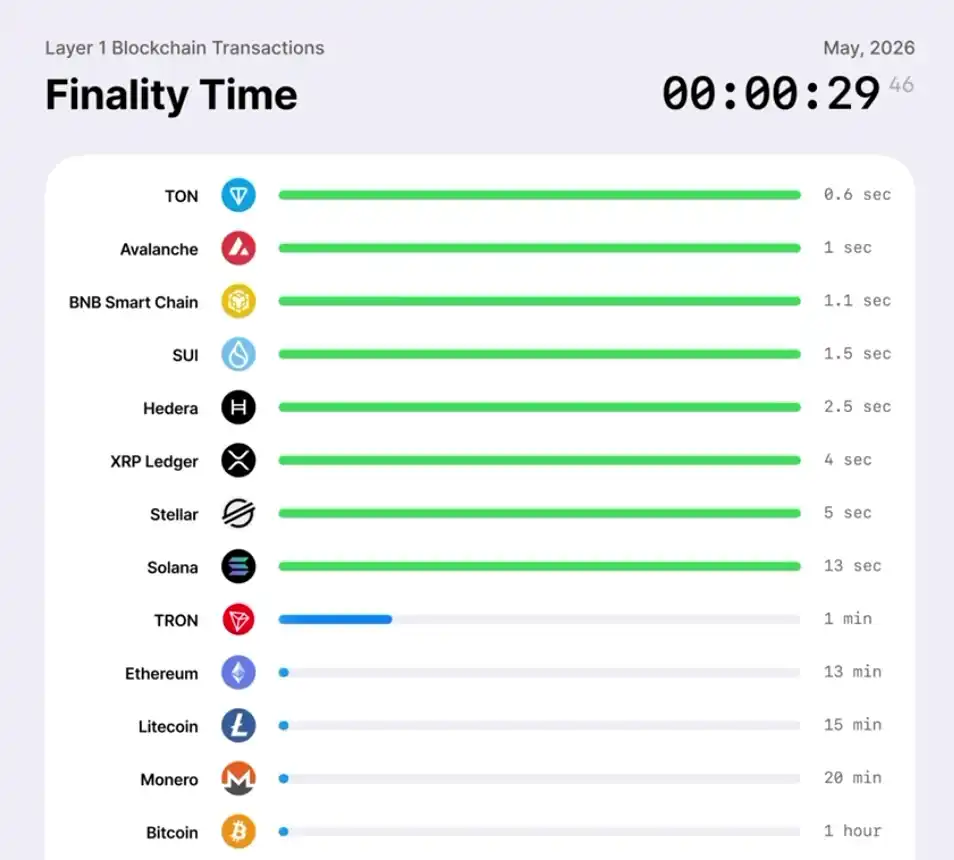
Therefore, TON's recent emphasis on fixed low fees and sub-second confirmations essentially revolves around redesigning blockchain for internet product experience. In other words, TON is attempting to solve a problem that Crypto has long failed to address: how to enable ordinary users to utilize on-chain systems almost imperceptibly.

This shift in logic is actually increasingly approaching the model of WeChat Pay.

Users don't need to understand blockchain, nor do they need to understand wallets, gas, or validation mechanisms. They only need to complete tipping, payments, purchases, transfers, and subscriptions, with all underlying settlements handled by TON.

This suggests that what TON truly aims to achieve may not be competition in the traditional L1 sense. What it is genuinely competing for is the global internet payment gateway.

Additionally, there is another crucial change. The logic of many public chains in the past has been: first build the infrastructure, then find users. But TON is the complete opposite. It first possesses a massive user base and then begins constructing the on-chain system.

Therefore, TON's challenge has never been how to get users into Web3, but rather how to enable users to complete on-chain actions without even realizing they are entering Web3. This represents a completely different development path.

III. TON's Future Blueprint: The On-Chain Transformation of Super Apps

Looking at all of TON's recent actions together, it becomes apparent that Telegram is gradually forming a complete closed loop. Functions that were originally separate—such as wallet, payments, bots, mini-apps, and on-chain settlements—are now gradually being integrated by TON.
This also signifies that TON is no longer just an independent public chain; it is becoming the infrastructure for value circulation within Telegram. The true significance of this lies in the fact that, for the first time, the crypto industry is approaching the on-chain transformation of super applications.

Because over the past decade, the crypto industry has always lacked a genuine mass-market entry point. Most public chains have been striving to attract users into the crypto world, but Telegram itself already possesses global-scale traffic.

Especially in markets like the Middle East, Russia, Eastern Europe, Southeast Asia, and Latin America, Telegram often functions not merely as a messaging tool but also as a community platform, commercial platform, payment tool, and more.

Therefore, TON's true strategic focus is not DeFi but rather global digital commercial scenarios.

Areas such as low-cost cross-border payments, the creator economy, on-chain micro-payments, and similar directions are likely the true sources of large-scale growth for TON in the future.

Of course, this path is not easy. TON's ecosystem remains in its early stages, with many applications still lingering in phases like mini-games, airdrops, and short-term traffic acquisition. Additionally, after Telegram's renewed deep involvement with TON, it may once again face regulatory pressure in the future.

Nevertheless, the market has now begun to realize one thing: TON's competitors may never have been traditional L1s, but rather the global internet payment systems.

Conclusion

This round of TON's rise is not essentially the market speculating on a simple upgrade. What truly drives the repricing of capital is the growing awareness that the world's first on-chain ecosystem with a genuine super-app entry point may have already begun to take shape.

And this time, Pavel Durov is no longer just an observer. Telegram is finally preparing to take the field itself.

Preguntas relacionadas

QAccording to the article, what was the main reason for the recent significant price surge of the TON token?

AThe primary reason for TON's recent price surge was Telegram founder Pavel Durov's public announcement that Telegram will become the core driver behind the TON network, replacing the TON Foundation and becoming its largest validator.

QHow has Pavel Durov's statement fundamentally changed the market's perception of TON's valuation logic?

AHis statement shifted TON's valuation logic from being a crypto-native public chain with Telegram's traffic support to potentially becoming the on-chain infrastructure for Telegram's future commercial ecosystem, moving from a crypto narrative to an internet platform-level narrative.

QWhat specific user needs is TON's recent technical optimization targeting, and what payment system is this approach compared to?

ATON's recent optimizations (faster speeds, lower fees, sub-second confirmation, near-zero costs) target the need for low-cost, high-speed, small-value transactions within Telegram (e.g., tipping, Bot services). This approach is compared to systems like WeChat Pay, aiming for users to use the on-chain system almost without awareness.

QWhat key advantage does TON possess compared to many other public blockchains regarding its development path?

AUnlike other blockchains that build infrastructure first and then seek users, TON already possesses a massive user base (Telegram's near 1 billion users) first, and is now building the on-chain system around that existing traffic.

QWhat does the article suggest is the true long-term competitor for TON, and what is its ultimate envisioned role?

AThe article suggests TON's true competitor is not traditional Layer 1 blockchains, but the global internet payment system. Its ultimate envisioned role is to become the on-chain value circulation infrastructure for the Telegram super-app, enabling global digital commercial scenarios like low-cost cross-border payments and the creator economy.

Lecturas Relacionadas

The Company That Makes Glass for iPhones Sees Its Stock Price Soar 500% Because of AI

The iPhone screen glass supplier Corning, known for Gorilla Glass, is experiencing a meteoric rise driven by the AI boom, with its stock price increasing fivefold over two years. The catalyst is a dramatic shift in its core business. While historically reliant on telecom and display glass, its optical communications division—inventor of low-loss fiber optics—has become the growth engine, fueled by massive AI data center demand. AI training requires vastly denser "east-west" data traffic between thousands of GPUs, making traditional copper cables inadequate and creating an urgent need for high-bandwidth, low-latency fiber optics. Corning has secured at least four multi-year contracts worth tens of billions of dollars in recent months, including deals with Meta and two unnamed companies. Its optical communications revenue surged 35% in 2025. A key factor is Corning's "Springboard" plan, which boosted profits faster than sales through premium pricing, product upgrades for AI clusters, and utilizing idle capacity. Its innovations, like rollable ribbon fiber that triples capacity within existing conduits and cuts installation time, command a significant premium as they save critical months in AI factory construction. NVIDIA's recent $5 billion investment in Corning (with an option to increase to $32 billion), including nearly free shares, signals a strategic partnership. This is part of NVIDIA's broader move beyond chips to becoming an "AI factory" systems integrator, securing a trusted, high-capacity fiber optics supplier for its blueprint. Corning, once seen as a mature manufacturer, is now central to building the AI infrastructure's nervous system.

marsbitHace 6 min(s)

The Company That Makes Glass for iPhones Sees Its Stock Price Soar 500% Because of AI

marsbitHace 6 min(s)

MSTR Earnings Review: The 'Flywheel' Now Has a 'Safety Valve', Arbitrage Opportunity Emerges

MicroStrategy's recent earnings call has fundamentally changed its strategy. Management has explicitly stated a key metric: a 1.22x premium to its mNAV (adjusted net asset value). This acts as a trigger for the company's actions regarding its Bitcoin holdings. If MicroStrategy's stock trades at a premium **above** 1.22x mNAV, the company will continue its established playbook: issuing equity to raise capital and buying more Bitcoin. However, if the premium falls **below** 1.22x, the strategy reverses. Management committed to selling Bitcoin to generate cash, which would then be used for debt management, dividends, or stock buybacks. This clear threshold creates a potential arbitrage opportunity. Should the premium dip below 1.22x, a trade involving going long MSTR stock while shorting an equivalent value of Bitcoin could profit. The logic is that the company's promised actions (selling BTC, buying back stock) would directly work to close that valuation gap, providing a catalyst for the trade. For holders of MicroStrategy's high-yield preferred stock (STRC), this policy introduces a significant safety net. The commitment to sell BTC to protect the balance sheet and meet obligations reduces the prior risk of the company facing a liquidity crisis during a deep Bitcoin downturn, making STRC resemble a more traditional corporate bond. Regarding Bitcoin's market impact, the announcement has mixed implications. In the short term, it is sentimentally bearish as it ends the narrative of MicroStrategy as a perpetual "diamond hands" buyer. Long-term, however, it is structurally bullish. By establishing a proactive de-leveraging mechanism, MicroStrategy removes the risk of a future forced, cascading liquidation during a severe bear market, making the overall crypto ecosystem more resilient.

marsbitHace 19 min(s)

MSTR Earnings Review: The 'Flywheel' Now Has a 'Safety Valve', Arbitrage Opportunity Emerges

marsbitHace 19 min(s)

Banking's Breaking Point: Structural Reshaping of Global Bitcoin Adoption from Michael Saylor's Prophecy

Banking's Breaking Point: Structural Reshaping of Global Bitcoin Adoption Through Michael Saylor's Lens In a recent statement, MicroStrategy founder Michael Saylor predicted a wave of imminent adoption announcements regarding Bitcoin from major traditional banks. This forecast is seen as a recognition of the deep, structural shifts occurring within global financial plumbing, rather than mere market hype. The long-standing barriers between crypto and traditional finance are rapidly eroding, propelled initially by the approval of US spot Bitcoin ETFs, which unleashed hundreds of billions in institutional capital. This movement is now spreading globally from North America to Europe, the Middle East, and Asia. In the US, the catalyst is an "assets under management" anxiety. Giants like BlackRock and Fidelity, via their ETFs, have made crypto accessible to traditional brokerage accounts, forcing major banks to build behind-the-scenes infrastructure—as authorized participants, prime brokers, and OTC liquidity providers—or risk losing high-net-worth clients and AUM. Europe's adoption, driven by the clarity of the Markets in Crypto-Assets (MiCA) regulation, focuses on compliance and infrastructure building. Banks like Standard Chartered (with Zodia Custody), BNP Paribas, and Societe Generale are moving into custody, trading, and tokenization, aiming to leverage their established trust and settlement networks for the coming tokenized era. In the Middle East, adoption carries geopolitical and strategic hedging motives. Sovereign wealth funds and local banks in jurisdictions like the UAE are building integrated ecosystems, using Bitcoin as "digital gold" to diversify away from traditional dollar-centric systems amid de-globalization trends. Asia is undergoing a top-down institutional overhaul. Hong Kong approved the region's first spot crypto ETFs, with banks like ZA Bank facilitating fiat rails. Singapore's DBS Bank runs a digital exchange attracting institutional funds, while Japanese giants like SBI Holdings expand through mergers, responding to high retail crypto penetration. Saylor's prediction reflects an irreversible, structural convergence. Global banking's embrace of Bitcoin is being driven by a combination of competitive pressure in the US, regulatory clarity in Europe, sovereign strategy in the Middle East, and institutionalization in Asia, painting a clear picture of widespread, imminent adoption.

marsbitHace 37 min(s)

Banking's Breaking Point: Structural Reshaping of Global Bitcoin Adoption from Michael Saylor's Prophecy

marsbitHace 37 min(s)

Trading

Spot
Futuros

Artículos destacados

Cómo comprar TON

¡Bienvenido a HTX.com! Hemos hecho que comprar The Open Network (TON) sea simple y conveniente. Sigue nuestra guía paso a paso para iniciar tu viaje de criptos.Paso 1: crea tu cuenta HTXUtiliza tu correo electrónico o número de teléfono para registrarte y obtener una cuenta gratuita en HTX. Experimenta un proceso de registro sin complicaciones y desbloquea todas las funciones.Obtener mi cuentaPaso 2: ve a Comprar cripto y elige tu método de pagoTarjeta de crédito/débito: usa tu Visa o Mastercard para comprar The Open Network (TON) al instante.Saldo: utiliza fondos del saldo de tu cuenta HTX para tradear sin problemas.Terceros: hemos agregado métodos de pago populares como Google Pay y Apple Pay para mejorar la comodidad.P2P: tradear directamente con otros usuarios en HTX.Over-the-Counter (OTC): ofrecemos servicios personalizados y tipos de cambio competitivos para los traders.Paso 3: guarda tu The Open Network (TON)Después de comprar tu The Open Network (TON), guárdalo en tu cuenta HTX. Alternativamente, puedes enviarlo a otro lugar mediante transferencia blockchain o utilizarlo para tradear otras criptomonedas.Paso 4: tradear The Open Network (TON)Tradear fácilmente con The Open Network (TON) en HTX's mercado spot. Simplemente accede a tu cuenta, selecciona tu par de trading, ejecuta tus trades y monitorea en tiempo real. Ofrecemos una experiencia fácil de usar tanto para principiantes como para traders experimentados.

456 Vistas totalesPublicado en 2024.12.10Actualizado en 2025.03.21

Cómo comprar TON

Discusiones

Bienvenido a la comunidad de HTX. Aquí puedes mantenerte informado sobre los últimos desarrollos de la plataforma y acceder a análisis profesionales del mercado. A continuación se presentan las opiniones de los usuarios sobre el precio de TON (TON).

活动图片