"Injective Nova Program" Final Demo Day Summit Finals Successfully Concluded: TOP3 Teams Announced, Co-creating a New Paradigm of AI × Web3

marsbitPublicado a 2026-07-27Actualizado a 2026-07-27

Resumen

"Injective Nova Program" Final Demo Day Successfully Concludes in Hangzhou: Top 3 Teams Announced, Shaping the New Paradigm of AI × Web3 On July 25, 2026, the Final Demo Day of the "Injective Nova Program," jointly launched by Injective, Microsoft, and Web3Labs, was successfully held in Hangzhou. The event gathered global blockchain experts, AI developers, top VC representatives, and ecosystem partners to witness innovations at the intersection of AI and decentralized networks. The program generated significant global interest, receiving 89 applications from over 10 countries and achieving over 1,000,000 ecosystem impressions. After a rigorous review, a global Top 10 was announced on July 10. These teams participated in an exclusive visit to Microsoft's Beijing headquarters for deep technical exchanges on July 16. At the final demo day, the Top 10 teams delivered live presentations. The jury evaluated projects based on technological innovation, commercial potential, and synergy with the Injective ecosystem, ultimately awarding the top three positions. All winning and shortlisted projects will receive comprehensive incubation support, technical resources, and capital access from Injective, Microsoft, and Web3Labs. The successful conclusion of the Final Demo Day marks a significant milestone for the first phase of the Injective Nova Program. The organizers plan to continue supporting global builders and exploring the limitless possibilities of AI and decentralized technolog...

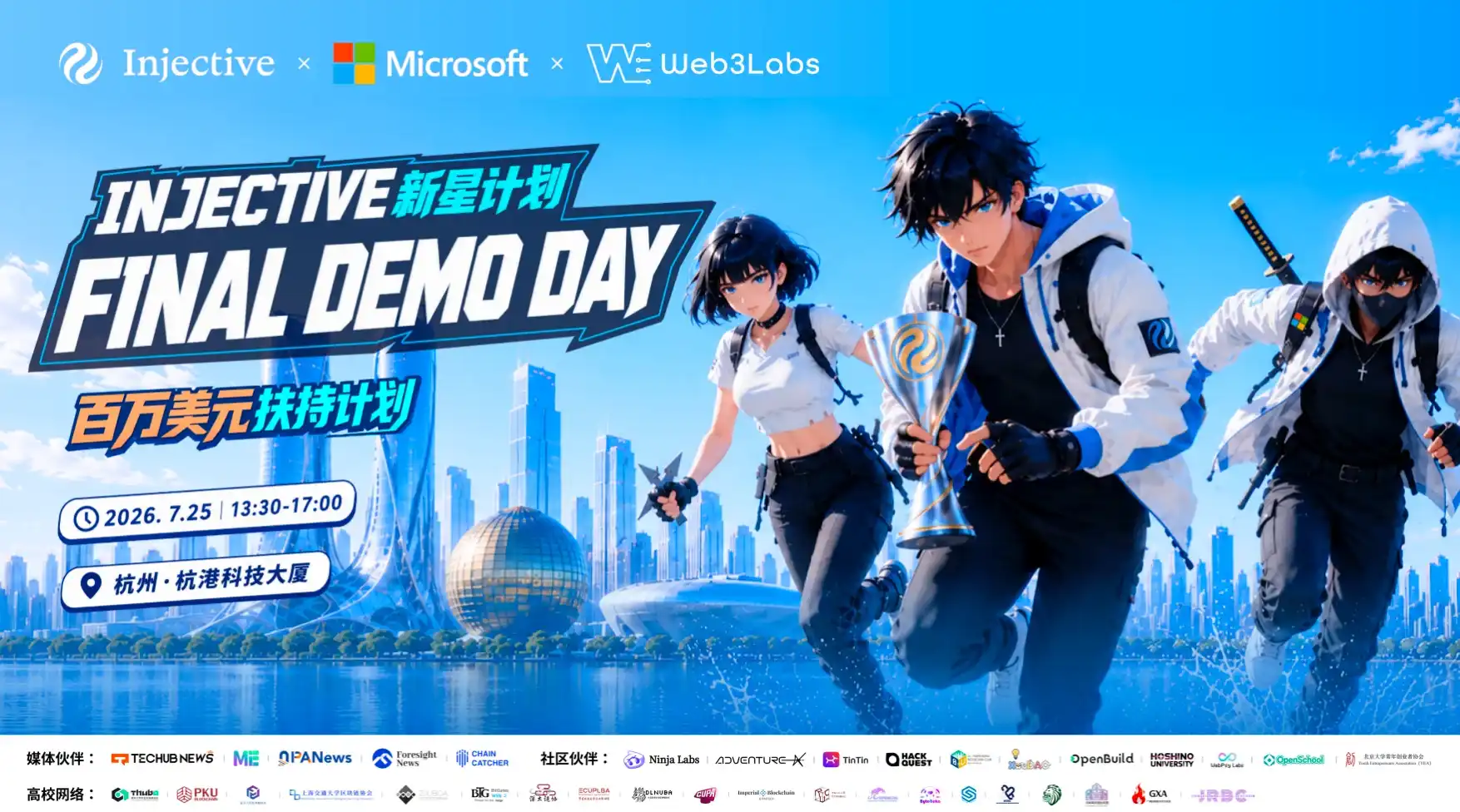
July 25, 2026| The Final Demo Day Summit Finals of the "Injective Nova Program," jointly launched by Injective × Microsoft × Web3Labs, was successfully held at the Hangzhou Hong Kong Technology Building. This event attracted blockchain technology experts, AI developers, representatives from top VC investment institutions, and ecosystem partners from around the globe, gathering on-site to witness the release of innovative achievements in the integration of AI and decentralized networks.

Global Collaboration: Months of Intensive Incubation, Creating a Premier Hub for AI × Web3

Since its official launch and announcement, the "Injective Nova Program" has garnered extremely high attention and enthusiastic responses from numerous global developer communities and the Web3 ecosystem:

Recruitment Boom: As of the recruitment closing on June 30, the program accumulated 89 hardcore developer project applications from over 10 countries and regions, including China, the United States, Singapore, and India. Total ecosystem exposure broke through the 1,000,000+ mark, receiving full support from 30+ top-tier ecosystem partners.

Rigorous Screening: After multiple rounds of hardcore scoring and comprehensive evaluation by the judging panel, the global Top 10 shortlist was officially announced on July 10.

Exclusive Corporate Empowerment: On July 16, the Top 10 shortlisted teams were invited to the Microsoft Headquarters in Beijing for an in-depth, closed-door visit and technical exchange. This opened a dialogue channel between traditional corporate technology foundations and the decentralized application ecosystem, laying a solid groundwork for the final pitch event.

The Pinnacle Showdown: Top 10 Projects Compete On-site to Determine the Top Three

At the Final Demo Day on July 25, the judging panel conducted a comprehensive evaluation based on multiple dimensions including technological innovation, commercial viability, and synergy with the Injective ecosystem. The championship, runner-up, and third-place honors of this Nova Program were officially announced and awarded on-site. The shortlisted and winning projects will gain deep access to comprehensive incubation support, foundational technical infrastructure, and capital resource connections provided by Injective, Microsoft, and Web3Labs.

With the successful conclusion of the Final Demo Day, the first phase of the "Injective Nova Program" has achieved fruitful interim results. In the future, Web3Labs will continue to collaborate with ecosystem partners such as Injective and Microsoft to persistently provide global high-quality builders with infrastructure and acceleration incubation support, jointly exploring the infinite possibilities of integrating AI intelligence with decentralized technology.


Preguntas relacionadas

QWhat was the name of the program and who were the main organizers of the event described in the article?

AThe program was the 'Injective Nova Program'. It was jointly initiated by Injective, Microsoft, and Web3Labs.

QWhen and where did the 'Injective Nova Program' Final Demo Day take place?

AThe Final Demo Day took place on July 25, 2026, at the Hangzhou Hanggang Technology Building in Hangzhou.

QHow many developer projects applied for the 'Injective Nova Program', and from how many countries?

AThe program received 89 applications from hardcore developer projects across more than 10 countries and regions, including China, the United States, Singapore, and India.

QWhat significant activity did the top 10 teams participate in before the final demo day, and where was it held?

AThe top 10 teams participated in a deep, closed-door visit and technical exchange at the Microsoft headquarters in Beijing on July 16, 2026.

QWhat kind of support will the winning and shortlisted projects of the 'Injective Nova Program' receive?

AThey will receive comprehensive incubation support, technical infrastructure backing, and capital resource connections provided by Injective, Microsoft, and Web3Labs.

Lecturas Relacionadas

Take a Calm Look at Domestic Lithography Machines: 5 Units Delivered, How Far Are We from Challenging ASML?

This article analyzes recent news about China's domestic DUV lithography machines, advising a measured perspective. A state-backed enterprise plans to deliver about 5 immersion DUV systems this year, with a 2027 target of 20 units, aimed at 28nm processes. While this marks a step from R&D into initial customer validation, the author cautions against over-optimism. The piece clarifies this is DUV, not EUV technology. DUV is crucial but cannot economically solve challenges for advanced nodes like 5nm or below, where EUV is key. The 5-unit volume is minimal compared to ASML's annual output of over 130 such machines. The author highlights unverified claims regarding specs like 90% yield and warns against conflating this news with unconfirmed reports about Shanghai Micro Electronics' production. China's EUV efforts, while progressing with a prototype, remain in early testing, facing significant hurdles in core components like high-precision optics. The analogy of a "DeepSeek moment" is deemed misleading, as lithography involves slow, iterative precision engineering, not rapid software-like breakthroughs. Current progress represents establishing a potential second supply source and gaining vital engineering experience rather than an imminent industry disruption. For investors, the key indicators to watch are formal customer acceptance, stable operational performance, repeat orders, and growth in production volume and component localization. The conclusion is that this is a positive but early-stage development, far from altering the global competitive landscape.

marsbitHace 22 min(s)

Take a Calm Look at Domestic Lithography Machines: 5 Units Delivered, How Far Are We from Challenging ASML?

marsbitHace 22 min(s)

The 800x Golden Dog, "Gacha" Saves NFT Trading

Title: 800x Golden Dog: How 'Gacha' Mechanics Are Rescuing NFT Trading In the past month, the on-chain TCG (Trading Card Game) narrative, centered around "gacha" or loot box mechanics, has emerged as a major crypto-native revenue generator, second only to platforms like Hyperliquid and pump.fun. Recently, this trend hit Ethereum with Fake World Assets (FWA). Within just over a week, FWA generated approximately $1.3 million in revenue, ranking 15th in the past week's crypto app earnings. Its token, $FWA, surged from an initial market cap of ~$47,550 to a peak of ~$38.8 million—an 800x gain. Meanwhile, Collector Cards' token $CARDS declined significantly from its previous highs. FWA, developed by the team behind "PunkStrategy," operates as an NFT gacha system with a built-in token flywheel. Users deposit NFTs paired with ETH as liquidity into pools. Each deposit creates a personal pool; more ETH deposited lowers the chance of the NFT being "won" in a draw. Players spend ETH to "draw" (gacha). If they get an undesirable NFT, they can instantly sell it back to the original depositor at an 85% discount, generating income for the depositor. A 1% fee is taken on each draw and on depositor earnings when an NFT is kept. The key to FWA's momentum is its token $FWA. It cannot be bought directly externally. The primary way to acquire it is by playing the gacha and choosing to receive $FWA (instead of ETH) when selling back an unwanted NFT. This mechanism creates constant buy pressure for $FWA as players engage, especially during its price ascent. Early participants who held $FWA benefited massively from subsequent inflows. This contrasts with projects like Collector Cards, which, despite strong revenues, suffer from perceived low token utility beyond buybacks. In conclusion, while FWA's flywheel design—linking speculative token gains directly to NFT trading activity—has driven rapid growth, its sustainability is questionable. The model relies heavily on continuous $FWA price appreciation to offset the inherent negative expectancy of each draw. When price momentum stalls, activity will likely decline. The case highlights that in crypto markets, pure profitability narratives can be fleeting; understanding the relationship between attention, token buy pressure, and sustainable mechanics is crucial to avoid speculative pitfalls.

marsbitHace 46 min(s)

The 800x Golden Dog, "Gacha" Saves NFT Trading

marsbitHace 46 min(s)

The Quantum Computing Threat Approaches, Cryptocurrency May Be Exposed to Risks Before Banks

Quantum computing poses a significant threat to all cryptographic systems, including banks and governments, but decentralized cryptocurrencies with public ledgers like Bitcoin are likely the first practical target. Experts warn that a cryptographically relevant quantum computer (CRQC), capable of running Shor's algorithm to break the elliptic curve cryptography securing most crypto wallets, could emerge around 2029. Recent research shows the required quantum resources for such attacks are shrinking dramatically, potentially enabling key extraction in minutes. The core vulnerability for cryptocurrencies is not the cryptography itself—post-quantum standards are being developed—but the slow, decentralized governance required to implement upgrades. Unlike centralized banks that can swiftly transition, Bitcoin needs near-unanimous consensus among its global network, a historically difficult process as seen in past upgrades. Estimates suggest migrating all vulnerable Bitcoin funds could take at least 76 days of dedicated network time, and it must be completed before a CRQC exists to prevent "now-or-never" attacks on exposed keys. The threat is not binary; it begins when a quantum computer can decrypt data before it loses value, not necessarily in real-time. A significant portion of Bitcoin (estimated at millions of coins) already has public keys permanently exposed on-chain, making them vulnerable to eventual "static attacks." While technical solutions exist, the race is against time for decentralized networks to coordinate a defensive transition, serving as an early warning for the broader financial system.

marsbitHace 57 min(s)

The Quantum Computing Threat Approaches, Cryptocurrency May Be Exposed to Risks Before Banks

marsbitHace 57 min(s)

Trading

Spot
活动图片