Strategy Opens Path to Bitcoin Sale — Michael Saylor Explains Why It Makes Sense

cryptonews.ruPublicado a 2026-07-28Actualizado a 2026-07-28

Resumen

Michael Saylor, Executive Chairman of Strategy Inc. (NASDAQ: MSTR), outlined the company's potential funding sources for future buybacks of its Series A Variable Rate Perpetual Preferred Stock (STRC). These buybacks could be financed through the sale of Bitcoin or MSTR shares, depending on market conditions. This strategy is seen as attractive when STRC trades significantly below its $100 par value, allowing the company to repurchase shares at a discount and reduce future dividend obligations. Strategy aims to maintain STRC trading near its $100 par value with high liquidity and low volatility. The company, adhering to its digital credit capital concept, will not issue new STRC shares below par. In the week ending July 26, Strategy repurchased approximately $25 million worth of STRC shares at an average price of $86.52 per share, taking advantage of the discount. Strategy has increased its USD reserve to a record $3.75 billion, but this reserve is reserved exclusively for preferred stock dividends and debt repayment. Therefore, future STRC buybacks will be funded separately, primarily through the issuance of MSTR common stock or the sale of Bitcoin when deemed economically justified by management. This approach provides flexibility to execute discounted buybacks without impacting funds earmarked for dividends and debt.

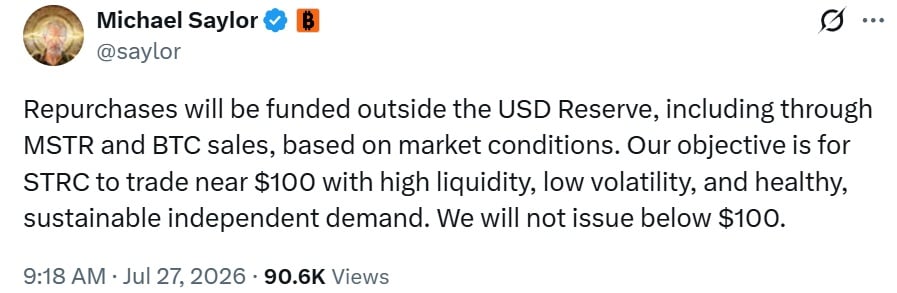
Michael Saylor, Executive Chairman of Strategy Inc. (Nasdaq: MSTR), stated in a July 27th post on X that future share repurchases of STRC could be funded through sales of Bitcoin or MSTR shares, depending on market conditions. STRC are Strategy's Series A Variable-Rate Perpetual Preferred Shares with a $100 liquidation preference, whose dividend rate is reviewed monthly by management.

Selling Bitcoin could become an attractive financing option when the price of STRC is trading significantly below $100, allowing the company to repurchase the preferred shares at a discount.

Saylor stated that the company aims to maintain STRC trading at a level close to its $100 liquidation preference, with high liquidity, low volatility, and stable independent demand. As part of Strategy's digital hybrid capital concept, the company does not intend to issue additional STRC shares below $100.
Discount Repurchases Dictate Purchase Pace

During the week ended July 26, the company repurchased 288,930 STRC shares for approximately $25 million at an average price of $86.52 per share, as reported by the company on July 27.

Saylor presented Strategy as a regular and disciplined buyer when the price is below $100, with repurchase volumes increasing at larger discounts and tapering as STRC approaches its stated preference. Under the repurchase authorization for preferred securities, approximately $975 million remains available, providing management with significant capacity for future transactions. At the latest average purchase price, the company acquired each STRC share at a $13.48 discount to its stated preference before accounting for future dividend savings.

Strategy's President & CEO, Phong Le, explained:

"At prices below $100 per share, repurchasing STRC shares represents an attractive capital investment as it allows for the reduction of future preferred dividend obligations at a discount."

"We intend to adjust purchase volumes based on both price and liquidity — increasing them at larger discounts and decreasing them as the market price of STRC shares approaches the $100 per share mark — while allowing independent market demand to form a healthy and sustainable market," he added.

In the terms of the STRC shares and the dividend policy, the current annualized dividend rate is stated as 12%, along with factors management considers during monthly assessments.

U.S. Dollar Reserve Remains Separate from Repurchase Program

Additionally, Strategy increased its U.S. dollar reserve by $525 million through the sale of MSTR common shares, bringing its balance to a record $3.75 billion. This reserve covers approximately 25 months of expected preferred dividend payments and, per a policy approved by Strategy's board of directors, remains designated exclusively for preferred dividend payments and debt obligations.

This restriction means future STRC repurchases will be funded from other sources, including the sale of MSTR shares and, as noted by Saylor, the sale of Bitcoin when justified by market conditions.

Instead of using the U.S. dollar reserve, Strategy now has two primary channels to fund STRC share repurchases: issuance of MSTR shares and sale of Bitcoin when management deems it economically sensible. This flexibility allows the company to repurchase preferred shares at a discount without impacting funds reserved for dividend payments and debt obligations.

end-content

Preguntas relacionadas

QWhat two primary funding sources can Strategy Inc. use for future STRC share buybacks, according to Michael Saylor?

AAccording to Michael Saylor, the two primary funding sources for future STRC share buybacks are the sale of MSTR common stock and the sale of Bitcoin, when deemed economically justified by management.

QWhat is the stated goal of Strategy Inc. regarding the trading price of its STRC preferred shares?

AThe stated goal is for the STRC preferred shares to trade close to their $100 par value, with high liquidity, low volatility, and sustained independent demand.

QHow does Strategy Inc. plan to adjust its STRC buyback volume in relation to the share price?

AStrategy plans to adjust buyback volumes based on price and liquidity: increasing purchases when the discount to the $100 par value is significant and scaling back as the market price approaches the $100 per share mark.

QWhat is the purpose of Strategy's separate USD reserve, and how much does it currently hold?

AThe separate USD reserve is intended exclusively for paying dividends on the preferred shares and repaying debt obligations. As reported, it currently holds a record $3.75 billion.

QWhy does buying back STRC shares at a discount below $100 represent an attractive capital investment for Strategy?

ABuying back STRC shares below $100 is attractive because it allows the company to retire preferred shares at a discount, thereby reducing future dividend payment obligations.

Lecturas Relacionadas

Why P2P and Exchangers Are Becoming Obsolete, and What Will Replace Them

Titled "Why P2P and Exchanges Are Becoming Obsolete, and What Will Replace Them," this article discusses the evolution of stablecoins, particularly USDT, from a trading tool to a global payment method. However, converting crypto back to fiat for daily expenses remains a challenge. The process of using P2P platforms or crypto exchanges has become increasingly risky and complex due to stricter banking anti-fraud measures, new legislation in Russia, and rampant fraud schemes like "triangles," where sellers can inadvertently receive stolen funds. The article highlights that while P2P was convenient, banks now scrutinize frequent peer-to-peer transfers, often freezing accounts. Exchanges also pose risks like unfavorable rates and unclear compliance. The market is therefore shifting towards integrated services that eliminate the manual conversion step. It cites OneSix as an example—a crypto wallet accessible via Telegram and web that embeds currency conversion directly into payment and withdrawal scenarios. Users can pay bills or send money as if using a bank app, with the crypto-to-fiat exchange happening seamlessly in the background. It also offers invoicing for freelancers and conducts AML checks, returning suspicious transactions instantly instead of freezing them. In conclusion, as crypto integrates into everyday finance, the demand for manual, risky exchange methods is declining. The future lies in unified platforms that combine storage, compliance, conversion, and payments into a single, secure user experience.

cryptonews.ruHace 40 min(s)

Why P2P and Exchangers Are Becoming Obsolete, and What Will Replace Them

cryptonews.ruHace 40 min(s)

The CEO of MARA Holdings Compares AI Operations to Bitcoin Mining! Which is More Profitable?

Fred Thiel, CEO of MARA Holdings (a major Bitcoin mining company), states that the rapid growth of the artificial intelligence (AI) sector is transforming mining companies' business models. He claims that powering data centers for AI is significantly more profitable than Bitcoin mining. In a recent interview, Thiel explained why many mining firms are diversifying into AI infrastructure. According to Thiel, the energy demands of data centers are surging, especially due to the spread of generative AI applications. This creates new revenue opportunities for Bitcoin mining companies with robust power infrastructure. MARA Holdings is among those monitoring this shift and aims to develop its energy and infrastructure services for AI data centers. Thiel emphasized that this move toward AI does not mean the end of Bitcoin mining. He stated that Bitcoin mining remains a sustainable business model, especially for miners in regions with low electricity costs, and it is still a crucial field for utilizing excess or idle power capacity. In recent years, many Bitcoin mining companies have begun using their energy-intensive infrastructure not just for block production but also for high-performance computing (HPC) and AI applications. This strategy aims to diversify revenue sources and increase resilience against cryptocurrency market volatility. Analysts note that the growing energy demand in the AI sector presents significant transformation opportunities for mining companies. The need for high-power, uninterrupted electricity supply, particularly for large data centers, gives Bitcoin miners with existing energy infrastructure expertise a considerable advantage.

cryptonews.ruHace 50 min(s)

The CEO of MARA Holdings Compares AI Operations to Bitcoin Mining! Which is More Profitable?

cryptonews.ruHace 50 min(s)

Ratio's CEO Says Multi-Currency Stablecoins Could Eliminate Costly FX Conversions in Asia

The CEO of Ratio, John Cho, argues that multi-currency stablecoins could save Asia billions by eliminating costly foreign exchange conversions in regional trade. While USD stablecoins like USDT and USDC work for global settlements, local Asian trade is conducted in local currencies like the Korean won or Singapore dollar. Forcing these transactions through USD intermediaries creates unnecessary costs and currency risk. Cho envisions a complementary ecosystem where local-currency stablecoins work alongside USD stablecoins, enabling seamless cross-border settlements without conversion friction. A key pain point in traditional banking is the need for pre-funded Nostro and Vostro accounts, which lock up vast amounts of working capital. Blockchain-based settlement layers like Ratio offer a 24/7 alternative, using on-chain liquidity to enable instant execution even when traditional channels are closed. Modern Web3 infrastructure providers are focusing on pragmatic integration with existing corporate systems like ERPs, allowing businesses to gradually shift volumes to digital channels for better speed, cost, and reduced slippage. Clear regulation is cited as the critical catalyst for widespread institutional adoption. As jurisdictions like the U.S. advance legislation (e.g., the CLARITY Act) and Asian countries are expected to pass their own stablecoin laws within 12-24 months, regulatory uncertainty is receding. The ultimate vision is for regulated stablecoins to become an invisible settlement layer integrated into national payment systems, where payments simply happen on-chain, erasing the boundary between traditional banking and digital assets.

cryptonews.ruHace 1 hora(s)

Ratio's CEO Says Multi-Currency Stablecoins Could Eliminate Costly FX Conversions in Asia

cryptonews.ruHace 1 hora(s)

Huang Xiaoming, Li Bin, Lei Jun, Liang Wenfeng... Who Are the Biggest Winners in the CXMT IPO Feast?

Changxin Technology, a leading Chinese memory chip manufacturer, successfully listed on the Shanghai Stock Exchange's STAR Market (科创板) on July 8, 2026. Its share price surged from the IPO price of 8.66 yuan to close at 49 yuan on the first day, catapulting its market capitalization to 3.28 trillion yuan, making it the most valuable A-share company and triggering a massive wealth creation event. The biggest winners were the company's founder, Zhu Yiming, and its employees. Zhu Yiming's family wealth skyrocketed nearly 300% to approximately $13.9 billion, with his direct stake in Changxin valued at around 80 billion yuan. Additionally, over 6700 employees benefited from stock ownership plans, creating at least 237 new millionaires (in CNY). Zhu also pledged to donate 768 million shares, worth over 37.6 billion yuan, for future employee incentives over a ten-year period. Several prominent investors and corporate clients also reaped significant paper gains from the IPO. Notable figures include: * **Liang Wenfeng**, founder of DeepSeek, whose funds netted a paper profit of approximately 827 million yuan. * **Kong Jianping**, founder of Nano Labs, saw his indirect holdings valued at roughly 940 million yuan. * **Li Bin**, founder of Nio, whose company's strategic investment of 158 million yuan is now worth about 740 million yuan. * **Lei Jun**, founder of Xiaomi, whose subsidiary holds shares currently showing a paper gain of over 736 million yuan. Xiaomi clarified this is a corporate investment, not direct personal wealth. The article notes that while this IPO created immense wealth for insiders and large investors, retail investors who were lucky enough to win an allotment in the lottery typically profited by around 20,000 yuan. The listing solidifies Changxin's position as China's premier domestic memory chipmaker.

marsbitHace 1 hora(s)

Huang Xiaoming, Li Bin, Lei Jun, Liang Wenfeng... Who Are the Biggest Winners in the CXMT IPO Feast?

marsbitHace 1 hora(s)

Trading

Spot
活动图片