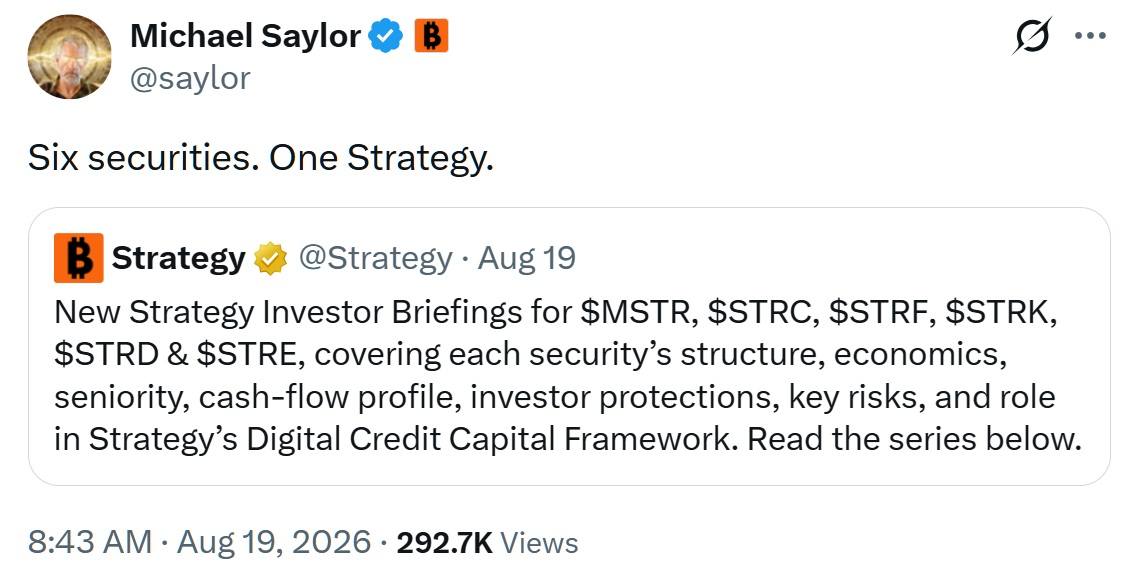
Strategy Inc. (Nasdaq: MSTR) announced on August 19 the publication of investor informational materials dedicated to its common stock and five preferred securities. Executive Chairman Michael Saylor supplemented this announcement on X, reposting the company's statement with a four-word comment: "Six securities. One Strategy." Each instrument is tailored to a specific investor goal, although all still depend on Strategy's financial health and capital management decisions.
Corporate bitcoin strategies typically finance purchases through common stock, convertible bonds, and preferred shares, creating various claims and periodic obligations. Companies can raise capital by issuing preferred shares without immediately diluting common shareholders' ownership stake, although such a structure entails regular dividend payments and priority claims on corporate assets. Strategy's securities apply this structure to several risk tiers, rather than providing direct one-to-one bitcoin ownership.
MSTR occupies the bottom of the capital structure and absorbs the profit or loss remaining after debt repayment and satisfaction of priority claims. The MSTR common stock structure provides shareholders with a residual stake in the net reserves, as well as in Strategy's software and capital markets business segments. Holders have no claim to specific bitcoins, while share dilution, financing costs, bitcoin volatility, and changes in valuation premiums can amplify results in either direction.
Five types of preferred securities with different cash flow distributions and priority
STRC offers variable cumulative dividends, currently set at 12% per annum of the $100 par amount, with cash payments twice a month after declaration. The terms of the STRC preferred shares allow Strategy to revise the rate monthly, aiming to achieve a target trading range between $99 and $100. STRC shares are perpetual, have no common maturity date for the $100 par value, and are not secured by a lien on the company's bitcoins.
STRF holds a higher position compared to other preferred issues, paying fixed cumulative annual dividends of 10% of the $100 par value with declared quarterly cash payments. $STRK occupies a lower position and combines cumulative dividends of 8% with the right to convert each share into 0.1 MSTR share, subject to possible adjustments. Neither instrument has a scheduled maturity date, and both remain junior in priority to creditors and subsidiary obligations.
STRD provides for an annual dividend rate of 10% but offers the weakest preferred claim in the lineup. Its quarterly cash dividends are non-cumulative, so a missed payment does not become a debt. In contrast, euro-denominated STRE offers 10% cumulative dividends on the set amount of 100 euros, paid quarterly in cash after declaration, while holding higher priority compared to $STRK and STRD, but lower than STRF and STRC.
High yields come with corporate and bitcoin-related risks
The broader "Digital Credit Capital Concept" of Strategy involves creating a dollar reserve intended for paying dividends on preferred shares and interest on debt, as well as authorizing the repurchase of preferred and common shares. The June 29 policy also permits limited bitcoin sales to fund the reserve, meet obligations, and execute permissible repurchases. These measures provide liquidity support tools but do not turn the preferred securities into secured claims on Strategy's bitcoin assets.
The broader four-part digital money structure proposed by Saylor places bitcoin at the equity level and STRC at the digital credit level, separating ownership of volatile assets from income-oriented corporate securities. This classification reflects Strategy's concept and is not a legal guarantee. Each preferred share depends on board decisions, legally available funds, market liquidity, and the issuer's ability to manage its obligations.
Previously, Strategy presented STRC as a mechanism for distributing bitcoin-related corporate economics between residual capital-focused investors and income-seeking investors. In his arguments for expanding the STRC market, Saylor emphasized scale, liquidity, and enterprise-level overcollateralization. However, the preferred shares themselves represent unsecured equity, and the company's bitcoins remain available to satisfy claims across its entire balance sheet, not specifically pledged in favor of the holders.
Investors face a range of risks beyond the market price of bitcoin, including issuer credit risk, interest rate changes, dividend payment decisions, liquidity, and priority within the capital structure. Unlike bonds or dividend-paying stocks, bitcoin does not generate cash flow. Strategy's preferred securities add potential dividend income to this underlying exposure, resulting in returns depending on the company's financial health, bitcoin dynamics, and management's capital allocation decisions.