Major VCs Back Zcash Developers With $25 Million After ECC Split

bitcoinistPublicado a 2026-03-10Actualizado a 2026-03-10

Resumen

Zcash Open Development Lab (ZODL), formed by the team formerly known as Electric Coin Company, has raised over $25 million from major investors including a16z, Paradigm, and Coinbase Ventures. The funding will support the development of Zcash-focused wallets and protocol work without relying on the network’s development fund. According to ZODL, its wallet has driven a 400% increase in shielded pool adoption and facilitated over $600 million in ZEC swaps since October 2025. The team emphasizes continuity, with the full ECC engineering team moving to ZODL. Zcash founder Zooko Wilcox highlighted that the investment involves no new token and no control over the Zcash protocol, suggesting backers are betting on Zcash's broader adoption and long-term importance.

Zcash Open Development Lab, the company formed by the team formerly known as Electric Coin Company, has raised more than $25 million from a roster of heavyweight crypto investors including a16z, Paradigm, Winklevoss Capital, Coinbase Ventures, Cypherpunk Technologies, Maelstrom (family office of Arthur Hayes), Chapter One, David Friedberg, Haseeb Qureshi, Mert, Balaji and others.

What This Means For Zcash

The round lands just months after the ECC team regrouped under a new name, and gives the Zcash-focused builder fresh capital to expand its wallet and protocol work without leaning on the network’s development fund.
Josh Swihart, who now leads ZODL after previously serving as CEO of ECC, framed the raise as a bet on product traction rather than a brand reset. “The name is new, but our team has been building Zcash for a decade,” he wrote. “A couple of years ago, my team and I set out to change the trajectory of Zcash with an uncompromising focus on the user experience for shielded ZEC. We released Zodl (then called Zashi) and have never looked back.”

That pitch is backed by a set of numbers the team clearly wants the market to notice. According to ZODL, its wallet has helped drive adoption of the Zcash shielded pool by more than 400% since launch, while facilitating over $600 million in ZEC swaps since October 2025. Swihart said the company first shipped what he called a “normie-friendly wallet,” then layered in integrations with Flexa for retail spending, Keystone for cold storage and, more recently, NEAR-powered intents for ZEC swaps.

The capital raise is also meant to change how that work gets funded. “This funding allows us to bring these ambitions to life, without relying on Zcash dev fund grants to get there,” Swihart wrote. Alongside Zodl, the company said it is building Zallet, a full-node wallet that will serve as the foundation for new desktop software, with the longer-term goal of creating “a private, decentralized financial system as an alternative to legacy institutions.”

ZODL’s own announcement leaned heavily on continuity. The company said the full ECC team, including the engineers responsible for designing and maintaining some of Zcash’s core systems, moved over earlier this year. It added that protocol development remains central to the company’s work, but argued that future upgrades should stay tied to usability and product-market fit rather than protocol design in isolation.

Zcash founder Zooko Wilcox read the raise as something larger than a routine venture financing. “Twenty-five million dollars is a big investment! For a company that makes a wallet!?” he wrote in a thread reacting to the news. “This set of investors is a signal. They are big, sophisticated, long-standing, and reputable.”

He focused on what the deal does not appear to offer. There is no new token for investors to capture, he noted, and no control over the Zcash protocol itself. “There is no new token that the investors can get a cut of! The ZEC supply is locked in, with a 21M total supply cap, like Bitcoin,” Wilcox wrote. “The investors don’t get control of the protocol! Zcash is permissionless, open-source, and has a huge number and variety of stakeholders.”

From there, Wilcox sketched out a theory of the round: investors may see the wallet business as a monetizable entry point, but just as importantly, some may be underwriting broader ZEC adoption itself. He pointed to public disclosures from Cypherpunk Technologies, which he said already holds more than 1% of ZEC’s eventual supply, and argued that its equity stake in ZODL is smaller than its exposure to the coin.

His conclusion was blunt. “These people are betting that Zcash — not crypto, not privacy, not Bitcoin, not zero-knowledge-proofs — Zcash will be critically important for our civilization,” he wrote.

At press time, Zcash traded at $221.95.
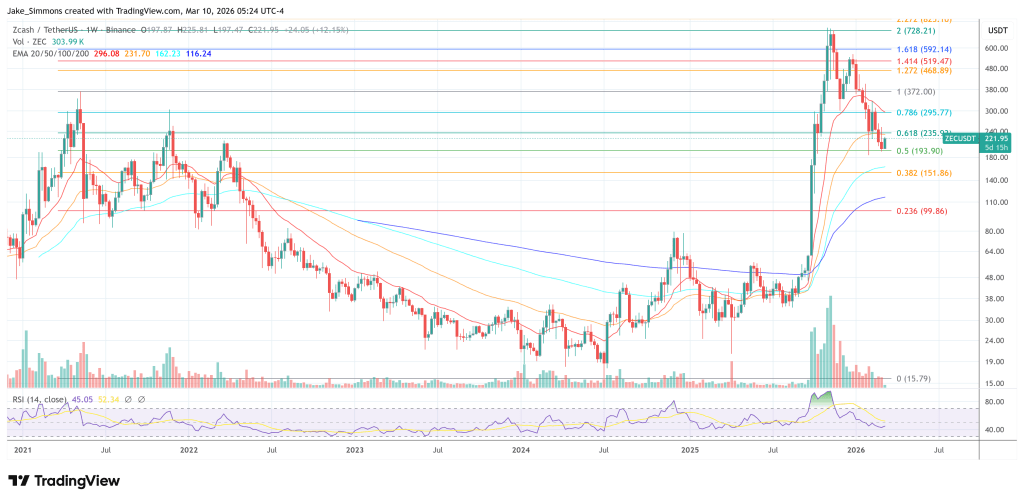
ZEC bounces from the 0.5 Fib, 1-week chart | Source: ZECUSDT on TradingView.com

Lecturas Relacionadas

Buy BTC or MSTR? Analyzing the Capital Flywheel of MicroStrategy

MicroStrategy's mNAV (market cap to Bitcoin holdings ratio) has compressed to near parity, sparking debate about whether the premium will re-expand. The core argument centers on the company's ATM equity issuance strategy. Critics view it as shareholder dilution, while supporters see it as rational Bitcoin accumulation. However, both miss the deeper strategic shift: MicroStrategy is building a layered capital structure that operates differently across mNAV regimes. At ~1x mNAV (current phase), equity issuance is used to buy Bitcoin directly, justified by long-term undervaluation. In high mNAV regimes (3-4x+), equity becomes a tool to repay debt from preferred securities, not just acquire Bitcoin. The introduction of preferred stock attracts yield-seeking investors, creating a continuous funding source for Bitcoin purchases but also dividend obligations. The ATM acts as a proactive de-leveraging tool, building equity ahead of future payment needs. mNAV expansion may return not only from Bitcoin price appreciation but also from the market valuing MicroStrategy as a scalable Bitcoin capital markets platform. The company is evolving from a Bitcoin treasury into a financial engine with distinct investor segments: yield investors in preferred securities and growth investors in equity. This could form a self-reinforcing "capital flywheel": preferred demand funds Bitcoin buys, equity demand values platform growth, and Bitcoin appreciation strengthens the balance sheet. The discussion may shift from *if* mNAV premium returns to *how large* this financial platform can become.

marsbitHace 13 min(s)

Buy BTC or MSTR? Analyzing the Capital Flywheel of MicroStrategy

marsbitHace 13 min(s)

U.S. Crypto Regulatory 'Civil War' Ceasefire: A Turning Point in the Decade-Long Power Struggle Between SEC and CFTC

For over a decade, the U.S. cryptocurrency industry has operated under regulatory uncertainty, with two key questions unresolved: what exactly are crypto assets, and which agency should regulate them? The Securities and Exchange Commission (SEC) and the Commodity Futures Trading Commission (CFTC) have long held overlapping and conflicting claims over crypto oversight, creating a "regulatory fog" that hindered innovation and pushed businesses to more predictable jurisdictions. Recently, signs of change have emerged. The SEC introduced a new classification framework in November 2025, categorizing digital assets into four types—digital commodities, digital collectibles, digital tools, and tokenized securities—acknowledging that not all crypto assets are securities. More significantly, the SEC and CFTC signed a Memorandum of Understanding (MOU) to enhance coordination in areas like crypto regulation, investor protection, and federal policy. Although non-binding, the MOU signals a move toward resolving jurisdictional conflicts and creating an "adaptive regulatory framework" tailored to digital assets. This shift is partly a response to global competition, as other financial centers develop clearer crypto regulations. Additionally, the growing integration of crypto with traditional finance—through stablecoins and real-world asset tokenization—demands a more structured regulatory approach. If successful, these efforts may lead to a unified federal framework, ending long-standing ambiguities and positioning the U.S. to better compete in the evolving digital financial landscape.

marsbitHace 26 min(s)

U.S. Crypto Regulatory 'Civil War' Ceasefire: A Turning Point in the Decade-Long Power Struggle Between SEC and CFTC

marsbitHace 26 min(s)

Matrixport Research: After Five Consecutive Months of Bitcoin Decline, Conditions for a Market Rebound Are Gradually Forming

Matrixport Research: Conditions for a Market Rebound Gradually Forming After Bitcoin's Consecutive Five-Month Decline Amid low trading volumes and weak market sentiment, with many investors shifting focus to traditional assets like gold and oil, underlying market conditions are quietly improving. Bitcoin has declined for five consecutive months—a historically rare occurrence—which has often preceded阶段性反弹 (stage-wise rebounds) in the past. Similarly, the total market cap of altcoins has fallen to a range that has historically triggered multiple rebound initiations. Although the overall altcoin model has not yet turned bullish, the number of altcoins reclaiming their 30-day moving average and showing improved momentum through quantitative screening has significantly increased. With stablecoin funds flowing back into the market, overall liquidity conditions are also improving, pointing to a potential market inflection window. From a historical perspective, Bitcoin often experiences阶段性反弹 (stage-wise rebounds) after three consecutive months of decline in a bear market. A sustained decline of four to six months with little recovery is relatively rare. The market is currently in such an extreme sequence, increasing the probability of a short-term counter-trend recovery. Simultaneously, the valuation of the altcoin sector has entered a range where周期性反弹 (cyclical rebounds) have historically been more likely. When the total altcoin market cap deviates approximately 30% from its 90-day moving average, the market is often in a bottom-building phase, followed by sustained recovery in Bitcoin and altcoins. Although trading volume remains low, the price structure of some altcoins has begun to improve, and Bitcoin is potentially building a阶段性底部 (stage-wise bottom) near $66,000. If prices hold the current support zone and gradually break through key resistance levels, the recovery process is expected to continue. Despite the overall weak performance of altcoins this cycle, some structural changes are emerging. More altcoins are reclaiming their 30-day moving average and beginning to outperform Bitcoin—often an early signal of improved market momentum. The number of altcoins selected through quantitative momentum screening has also increased significantly, with some tokens simultaneously exhibiting improved momentum and fundamental catalysts. More importantly, the market funding environment is changing. The previous dynamic dominated by liquidations and capital outflows is gradually shifting towards capital回流 (inflows). The re-expansion of stablecoin liquidity is a key signal; in the past month, Circle's USDC alone recorded approximately $8 billion in net inflows, indicating that capital is re-entering the crypto market. As liquidity gradually improves, the probability of capital being reallocated to Bitcoin and Ethereum is also rising, which will provide support for a broader market. Overall, while crypto market sentiment remains subdued, multiple key conditions are gradually forming. After a historically rare streak of monthly declines, Bitcoin appears to be building a potential bottom; stablecoin funds are回流 (flowing back), improving market liquidity. Simultaneously, the altcoin market breadth is expanding, with more tokens reclaiming their 30-day momentum threshold. Although the altcoin model has not yet officially turned bullish, trading setups meeting screening conditions have risen to their highest level in months. If Bitcoin confirms a trend breakout above key points, the probability of a broader阶段性反弹 (stage-wise rebound) will further increase.

MatrixportHace 1 hora(s)

Matrixport Research: After Five Consecutive Months of Bitcoin Decline, Conditions for a Market Rebound Are Gradually Forming

MatrixportHace 1 hora(s)

Trading

Spot
Futuros
活动图片