A Major XRP Ledger Win That Most Investors Might Have Missed

bitcoinistPublicado a 2026-02-06Actualizado a 2026-02-06

Resumen

The XRP Ledger has activated the Permissioned Domains amendment after it achieved 91.19% validator approval and a mandatory two-week consensus period. This upgrade, introduced in v2.4.0, enables institutions, enterprises, and regulated entities to operate in controlled environments on the same public blockchain. It allows for known and compliant participants within defined domains while maintaining the ledger's core benefits of speed, low cost, and finality. This addresses a key limitation for banks and governments that require regulatory compliance, identity checks, and accountability, which are difficult on fully open networks. By allowing both permissioned and permissionless use, the upgrade removes a significant barrier to institutional adoption, positioning XRPL as shared financial infrastructure that meets regulatory expectations. Its impact may grow gradually as organizations begin utilizing these new capabilities.

The XRP Ledger quietly crossed an important milestone this week. After weeks of waiting, the Permissioned Domains amendment has finally gone live. Validators reached the required 80% yes vote back in January, but as protocol rules demand, that consensus had to hold for two consecutive weeks before activation.

On February 4, the waiting period ended, and the amendment officially became part of the XRP Ledger with a 91.19% approval. The moment passed with little noise, but investors might have missed its implications, which extend far deeper than a routine technical update.

Quiet Upgrade Changes How Institutions Can Use The XRP Ledger

Permissioned domains were introduced to the XRP Ledger on the v2.4.0 update. The rollout followed the standard governance process on the Ledger, which requires both a supermajority vote and sustained agreement over time to prevent rushed or unstable changes. In this case, validators voted yes early, locking in more than 80% approval in January.

According to Stern Drew, an XRP analyst on the social media platform X, the importance of Permissioned Domains lies in how they reshape what is possible on a public ledger. In simple terms, it makes the Ledger far more usable for institutions, enterprises, and regulated applications.

The upgrade allows controlled environments to exist on the same shared blockchain. Institutions can now operate inside clearly defined domains where participants are known, approved, and compliant, without giving up the speed, finality, and low-cost settlement XRPL is known for.
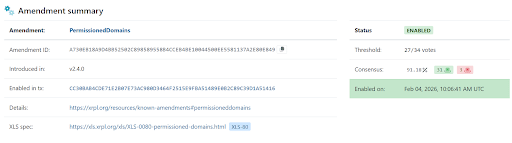
Source: Chart from XRPScan

This addresses a limitation in public blockchains, which are known for their openness. Public blockchains like the Ledger are great for openness, but the openness is unrealistic for banks, governments, and enterprises that must enforce rules, accountability, and identity checks.

Permissioned Domains resolve that tension by letting both models coexist. Sensitive or regulated activity can happen inside restricted domains, while the broader ledger is open and permissionless for everyone else.

Why This Matters For The Altcoin Going Forward

The most favorable outcome for XRP is the broad adoption of the Ledger by banks and financial institutions in their day-to-day operations. Therefore, the activation of permissioned domains on the Ledger removes one of the last structural barriers to real-world adoption.

XRPL can now serve as shared financial infrastructure, offering the guardrails regulators expect without sacrificing the benefits of a global public ledger. A bank can settle payments, a government can run regulated flows, and an enterprise can move large value, all without exposing sensitive operations to the entire public network.

This is why the Permissioned Domains upgrade carries more weight than its quiet rollout. It might be overlooked for now, but this kind of change tends to show its impact gradually, especially when institutions start creating domains on the Ledger.

Permissioned Domains is one of several amendments introduced by developers to strengthen the overall utility of the Ledger ecosystem. Another notable example is the lending feature, which is currently in the validator voting phase.

XRP trading at $1.29 on the 1D chart | Source: XRPUSDT on Tradingview.com

Preguntas relacionadas

QWhat is the Permissioned Domains amendment and why is it significant for the XRP Ledger?

AThe Permissioned Domains amendment is an upgrade that allows controlled environments to exist on the XRP Ledger, enabling institutions to operate in defined domains with known and compliant participants. Its significance lies in removing a key structural barrier to adoption by banks and financial institutions, as it provides the regulatory guardrails they require while maintaining the speed, finality, and low-cost settlement of the public ledger.

QWhat was the final approval percentage for the Permissioned Domains amendment and when did it go live?

AThe Permissioned Domains amendment received a 91.19% approval from validators and officially went live on February 4, after a mandatory two-week waiting period following the achievement of the required 80% consensus in January.

QHow does the Permissioned Domains feature address a key limitation of public blockchains for enterprise use?

AIt addresses the limitation of excessive openness in public blockchains by allowing both permissioned and permissionless models to coexist. Sensitive or regulated activities can occur within restricted domains where participants are known and approved, while the broader ledger remains open to everyone else.

QAccording to the article, what is the most favorable outcome for XRP and how does this upgrade contribute to it?

AThe most favorable outcome for XRP is the broad adoption of the XRP Ledger by banks and financial institutions in their day-to-day operations. This upgrade contributes directly to that outcome by making the ledger far more usable for institutions, enterprises, and regulated applications that require enforced rules, accountability, and identity checks.

QBesides Permissioned Domains, what is another notable amendment mentioned that is currently in development for the XRP Ledger?

AAnother notable amendment mentioned is a lending feature, which is currently in the validator voting phase and is being developed to further strengthen the overall utility of the XRP Ledger ecosystem.

Lecturas Relacionadas

Research Status Report on AI Payment Protocols: The New Paradigm of Payment in the Agent Economy

AI Payment Protocol Research Status Report: A New Paradigm for Agent Economy Payments This report analyzes the rapid evolution of payment infrastructure designed for AI agents, driven by major industry moves from OpenAI, Google, Visa, Mastercard, Coinbase, and Stripe between late 2025 and early 2026. The core challenge is that traditional payment systems, built for human interaction, are incompatible with AI agents that require machine-readable interfaces, millisecond authorizations, and support for high-frequency micro-transactions. The emerging infrastructure is forming a two-layer architecture: 1. **Intent Orchestration Layer:** Translates agent intent into executable transactions. Two key segments exist: * **Agent Shopping for Humans:** Focuses on enabling agents to shop on human-centric e-commerce platforms. Protocols include OpenAI & Stripe's closed **Agentic Commerce Protocol (ACP)** and Google's open **Universal Commerce Protocol (UCP)** for standardized merchant interfaces. * **Agent-to-Agent (A2A) Transactions:** Solves trust issues in environments without human merchants, using blockchain-based smart contracts like **ERC-8183** for task execution and payment escrow. 2. **Settlement Layer:** Handles the actual movement of funds. Key competing protocols include: * **Stripe's SPT & Card Network Upgrades (Visa/Mastercard):** Extend existing card payments with delegated authorization tokens, ideal for standard retail but unsuitable for micro-payments. * **Coinbase's x402:** Uses the HTTP 402 status code for on-chain atomic swaps with stablecoins (e.g., USDC), enabling low-fee, account-less payments. * **Circle's Nanopayments:** An x402 enhancement for extreme micro-payments using off-chain batch processing. * **MPP (Stripe & Tempo):** A unified, pluggable framework supporting multiple payment rails (stablecoins, fiat, card tokens, Lightning Network) within a single "payment session." **Current State & Opportunities:** While core protocols are live, commercial adoption lags due to fragmentation in the intent layer. The key opportunities are: * **Settlement Layer:** Building multi-rail Agent wallets that abstract complexity and can route transactions across different payment protocols is a definitive, high-value opportunity. * **A2A Economy:** A significant blue-ocean opportunity exists in creating API services for agents to consume (e.g., data analysis, content creation) on a pay-per-use model (e.g., via HTTP 402), moving beyond subscription models. The future will see a dual-track evolution: consumer-facing agent commerce relying on card rails, and A2A transactions thriving on stablecoin rails. The inflection point will be when enterprises delegate spending authority to agents, making multi-rail wallets and service directories critical, unclaimed infrastructure.

marsbitHace 1 hora(s)

Research Status Report on AI Payment Protocols: The New Paradigm of Payment in the Agent Economy

marsbitHace 1 hora(s)

Trading

Spot
Futuros

Artículos destacados

Qué es XRP 2.0

XRP 2.0: Una Nueva Frontera en el Panorama de las Criptomonedas Introducción a XRP 2.0 En el siempre cambiante ámbito de las criptomonedas, nuevos proyectos surgen continuamente, compitiendo por atención y adopción. Una de estas iniciativas prometedoras es XRP 2.0, un nuevo proyecto de criptomoneda diseñado para aprovechar la tecnología blockchain avanzada y metodologías de encriptación robustas. Aunque el nombre establece paralelismos con el XRP de Ripple, es crucial señalar que XRP 2.0 opera de manera independiente, enfocándose en mejorar la seguridad de las transacciones, la privacidad y la escalabilidad. A medida que el panorama financiero digital abraza cada vez más soluciones descentralizadas, XRP 2.0 busca contribuir de manera significativa a web3 y a la expansión general de los proyectos de criptomonedas. ¿Qué es XRP 2.0? En esencia, XRP 2.0 es un proyecto de criptomoneda que busca crear un ecosistema de moneda digital seguro y descentralizado. Su tecnología fundamental integra principios avanzados de blockchain con técnicas de encriptación de vanguardia. El objetivo principal de XRP 2.0 es establecerse como una plataforma confiable y eficiente que permita la ejecución rápida de transacciones mientras prioriza la protección de la privacidad de sus usuarios. El proyecto se promociona como una solución a muchas limitaciones enfrentadas por las criptomonedas existentes, proponiendo un sistema que puede manejar un mayor volumen de transacciones con mejor velocidad y privacidad. Esta versatilidad posiciona a XRP 2.0 como un competidor significativo en un mercado plagado de diversas monedas digitales. ¿Quién es el Creador de XRP 2.0? La identidad del creador detrás de XRP 2.0 ha sido señalada como 'Wilbur.' Sin embargo, los detalles completos sobre Wilbur o su entidad asociada siguen siendo elusivos. La anonimidad de muchos creadores de criptomonedas no es un fenómeno poco común en la industria, a menudo diseñado para mantener un grado de privacidad y seguridad. ¿Quiénes son los Inversores de XRP 2.0? Hasta ahora, la información específica relacionada con las fundaciones o organizaciones de inversión que apoyan a XRP 2.0 no está disponible públicamente. En el sector de las criptomonedas, el respaldo de inversores respetables puede influir significativamente en la credibilidad y el éxito de un proyecto, sin embargo, la transparencia sobre los patrocinadores financieros de XRP 2.0 no se ha establecido. ¿Cómo Funciona XRP 2.0? XRP 2.0 se destaca al emplear una combinación de tecnología blockchain y algoritmos de encriptación avanzados que aseguran transacciones seguras y descentralizadas. Su estructura innovadora incluye características únicas diseñadas para fomentar el compromiso del usuario y ampliar las funcionalidades más allá de las transacciones convencionales de criptomonedas. Entre estas características, XRP 2.0 incorpora capacidades impulsadas por IA, como funcionalidades de texto a imagen y de texto a voz. Estas adiciones están diseñadas para mejorar la experiencia interactiva de los usuarios, promoviendo una mayor aplicabilidad en diversos sectores. Al unir avances tecnológicos con un diseño centrado en el usuario, XRP 2.0 busca captar la atención de una amplia gama de individuos y empresas que buscan integrar soluciones de criptomonedas en sus marcos operativos. Cronología de XRP 2.0 Entender XRP 2.0 requiere examinar los hitos que han definido su viaje hasta ahora: 23 de julio de 2023: Se presenta XRP 2.0 como un nuevo proyecto de criptomonedas, con el objetivo de revolucionar las capacidades de transacciones seguras y descentralizadas en el ámbito de blockchain. 8 de septiembre de 2023: Se lanza otro proyecto, XRP20, marcando la aparición de un token ERC-20 en la blockchain de Ethereum que no guarda relación con XRP 2.0. 13 de noviembre de 2023: El Libro Mayor de XRP experimenta una actualización significativa con el lanzamiento de la versión 2.0.0 del software del servidor rippled. Es esencial señalar que este desarrollo está desconectado del proyecto de criptomonedas XRP 2.0. Puntos Clave sobre XRP 2.0 Para destilar la esencia de XRP 2.0, surgen varios factores críticos: Características Únicas: La inclusión de características como texto a imagen y texto a voz impulsadas por IA diversifica aún más las aplicaciones potenciales de XRP 2.0. Tecnología Blockchain: El marco utiliza mecanismos avanzados de blockchain y protocolos de encriptación, asegurando un entorno seguro y descentralizado para las transacciones. Escalabilidad y Privacidad: XRP 2.0 prioriza la protección mejorada de la privacidad en los procesos de transacción y la escalabilidad necesaria para acomodar una base de usuarios creciente. No Afiliación con Ripple: Es importante destacar que, a pesar de su nombre, XRP 2.0 no tiene ninguna lealtad ni colaboración con el XRP de Ripple, diferenciando su marco operativo y objetivos dentro del ecosistema de criptomonedas. Conclusión XRP 2.0 representa una ambiciosa aventura en la esfera de las criptomonedas, buscando ofrecer una combinación de seguridad, privacidad y eficiencia en las transacciones digitales. Al integrar tecnologías sofisticadas y características amigables para el usuario, el proyecto se propone ampliar los horizontes de lo que la criptomoneda puede lograr en la economía digital de hoy. Si bien la anonimidad de su creador y la falta de inversores revelados pueden generar cuestionamientos para algunos, el enfoque de XRP 2.0 en funcionalidades avanzadas y descentralización realza su atractivo en un mercado de criptomonedas cada vez más abarrotado. A medida que el paisaje de las criptomonedas sigue evolucionando, XRP 2.0 podría emerger como un jugador crucial en la expansión de soluciones blockchain seguras y escalables.

174 Vistas totalesPublicado en 2024.04.05Actualizado en 2024.12.03

Qué es XRP 2.0

Cómo comprar XRP

¡Bienvenido a HTX.com! Hemos hecho que comprar XRP (XRP) sea simple y conveniente. Sigue nuestra guía paso a paso para iniciar tu viaje de criptos.Paso 1: crea tu cuenta HTXUtiliza tu correo electrónico o número de teléfono para registrarte y obtener una cuenta gratuita en HTX. Experimenta un proceso de registro sin complicaciones y desbloquea todas las funciones.Obtener mi cuentaPaso 2: ve a Comprar cripto y elige tu método de pagoTarjeta de crédito/débito: usa tu Visa o Mastercard para comprar XRP (XRP) al instante.Saldo: utiliza fondos del saldo de tu cuenta HTX para tradear sin problemas.Terceros: hemos agregado métodos de pago populares como Google Pay y Apple Pay para mejorar la comodidad.P2P: tradear directamente con otros usuarios en HTX.Over-the-Counter (OTC): ofrecemos servicios personalizados y tipos de cambio competitivos para los traders.Paso 3: guarda tu XRP (XRP)Después de comprar tu XRP (XRP), guárdalo en tu cuenta HTX. Alternativamente, puedes enviarlo a otro lugar mediante transferencia blockchain o utilizarlo para tradear otras criptomonedas.Paso 4: tradear XRP (XRP)Tradear fácilmente con XRP (XRP) en HTX's mercado spot. Simplemente accede a tu cuenta, selecciona tu par de trading, ejecuta tus trades y monitorea en tiempo real. Ofrecemos una experiencia fácil de usar tanto para principiantes como para traders experimentados.

826 Vistas totalesPublicado en 2024.12.10Actualizado en 2025.03.21

Cómo comprar XRP

Discusiones

Bienvenido a la comunidad de HTX. Aquí puedes mantenerte informado sobre los últimos desarrollos de la plataforma y acceder a análisis profesionales del mercado. A continuación se presentan las opiniones de los usuarios sobre el precio de XRP (XRP).

活动图片