A $50 Million Funding Round Ignites Airdrop Expectations, Making Variational the New Focus in Perp DEX

marsbitPublicado a 2026-05-21Actualizado a 2026-05-21

Resumen

Perp DEX Variational has become a focal point in the airdrop community following its announcement of a $50 million Series A funding round led by Dragonfly Capital, with participation from Bain Capital Crypto and CoinBase Ventures. The news caused a significant pre-market price surge. Variational is a zero-fee perpetual decentralized exchange built on Arbitrum, notable for its "brokerage-style" model that aggregates liquidity from various sources. It currently ranks fourth in open interest among Perp DEXs and is the only top-five platform yet to issue a token. The primary way for users to participate is through its "Trade to Earn" points program, designed to reward organic trading activity. The system includes benefits for early users, a tiered rewards structure based on trading volume, and a referral program. The platform has committed to allocating approximately 50% of its token supply to the community. While an exact Token Generation Event (TGE) date has not been announced, official documentation indicates the points program will run at least until the end of Q3 2026. Prediction markets currently suggest a TGE is more likely in Q4 2026.

Author | Asher(@Asher_ 0210)
A funding announcement has made the Perp DEX Variational the hottest topic in the airdrop hunting community.

Last night, Variational announced the completion of a $50 million Series A funding round, led by Dragonfly Capital, with participation from Bain Capital Crypto and Coinbase Ventures. Following the news, Variational's pre-market price surged over 36% in a short period, once touching $6.9 (corresponding to an FDV of $690 million), and has since retraced, currently quoted at $6.1 (corresponding to an FDV of $610 million).
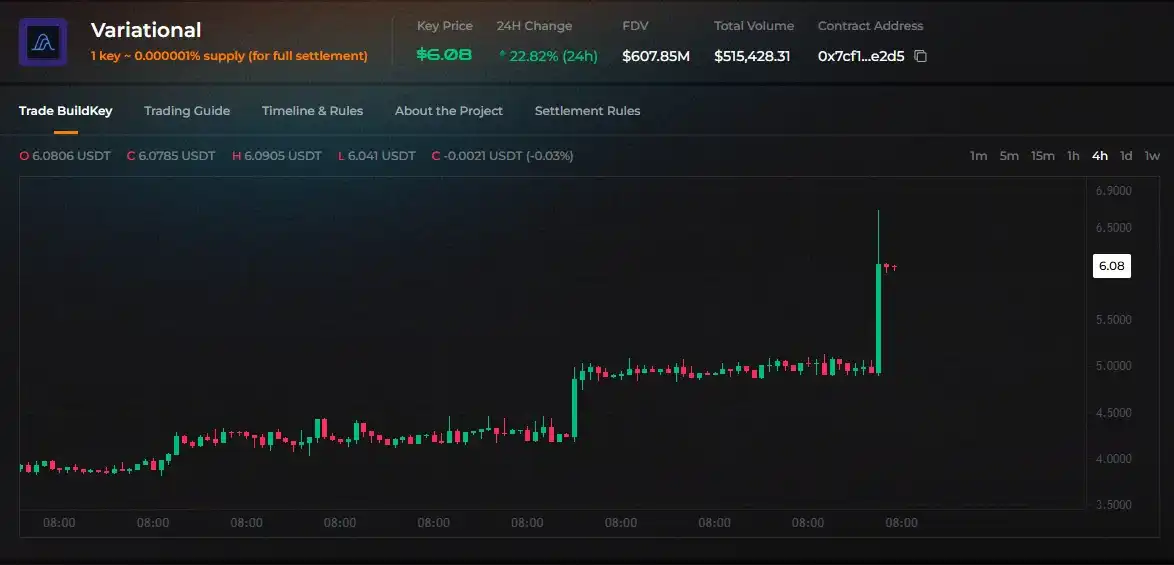
Variational Pre-market Price Movement

Furthermore, the probability of the event "Variational's FDV exceeds $500 million one day after listing" on the prediction platform predict.fun has risen to 57%; the probability for "Variational's FDV exceeds $1 billion one day after listing" has risen to 27%.
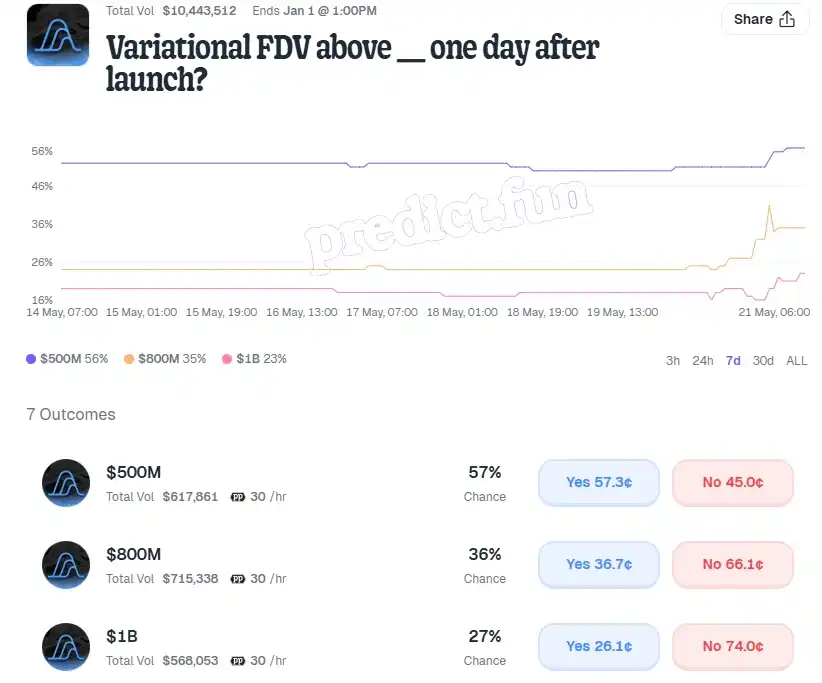
"Variational FDV After One Day of Listing" Prediction Event on predict.fun

Next, Odaily Planet Daily takes you to understand Variational, the rules for trading to earn points, and when the TGE will occur.

Variational: A Zero-Fee Perp DEX Deployed on Arbitrum
Variational is a Perp DEX platform deployed on Arbitrum, with its company headquartered in the Cayman Islands. Its core product is Omni. Simply put, users can trade perpetual contracts for mainstream crypto assets like BTC, ETH, and SOL on Variational, as well as long-tail assets, stocks, commodities, volatility indices, and more types of markets.

Compared to most Perp DEXs, the most intuitive feature of Variational is its zero trading fees. When trading on Omni, the platform does not charge regular transaction fees; the main costs come from spreads, slippage, funding rates, and deposit/withdrawal fees.

Additionally, the underlying design of Variational differs from traditional Perp DEXs. It does not rely solely on internal platform matching or a single liquidity pool to handle trades. Instead, it operates on a "brokerage-like" model connecting to multi-source liquidity, including traditional financial market makers, crypto-native market makers, and major trading platforms, aiming to solve the "cold start liquidity" problem in on-chain markets.

According to DefiLlama data, Variational's trading volume over the past month has exceeded $16 billion, with current open interest exceeding $800 million, ranking fourth in the Perp DEX sector. Notably, among the top five Perp DEXs by open interest, Variational is the only one that has not yet issued a token.
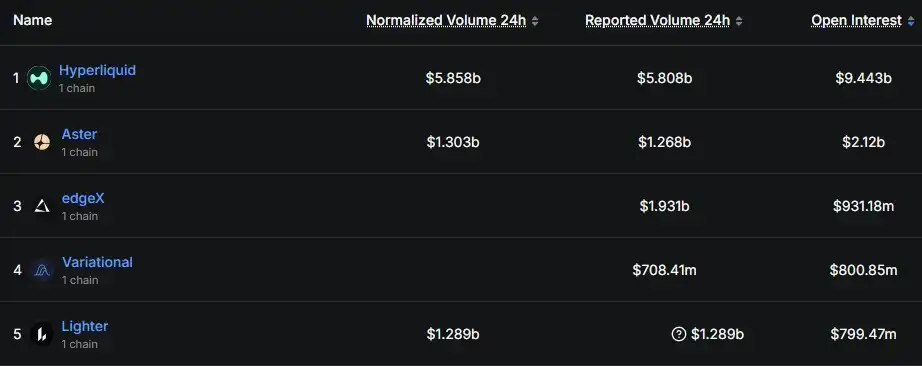
Open Interest Ranking for Perp DEXs

Trading to Earn Points: Detailed Rules for Variational

For regular users, the most direct way to participate in Variational currently is still trading to earn points.

Variational officially launched the Omni Points Program on December 17, 2025, and issued a one-time retrospective airdrop of 3 million points to historical trading users at launch, covering activity up to December 11, 2025. Since then, points are distributed every Friday at 00:00 UTC, counting platform activity from the previous cycle ending at 00:00 UTC on Thursday.

Furthermore, according to the documentation, the project promises that approximately 50% of the token supply will be allocated to the community (through various mechanisms like points, revenue sharing, not just a single airdrop), with plans to use at least 30% of protocol revenue for VAR token buybacks and burns.

The core of Variational's points system is not complex: the more active the trading, the more opportunities to earn points. However, Variational does not simply distribute based on trading volume; it incorporates designs that favor trading quality, specifically including:

  • Points are directly related to user trading activity: The platform rewards page indicates that the points program is designed to reward protocol users, who can earn points through platform activity. The official team reserves the right to adjust points and handle inorganic behavior, meaning that obvious meaningless volume trading or arbitrage-like point farming may be penalized or excluded later;
  • Extra bonus for early users: Accounts that traded before the points program launch enjoy a 10% points boost for points earned subsequently;
  • Introduction of the Reward Tiers system: A user's total trading volume over the past 30 days affects their tier, calculated as personal volume plus 0.2 times the volume from invited users. Different tiers correspond to different point multipliers: Iron at 0%, Bronze at 0.5%, Silver at 1%, Gold at 2%, Platinum at 3%, Diamond at 4%, Infinity at 5%. Among them, Bronze requires a past 30-day Total Volume of $1 million, Silver $5 million, Gold $25 million, Platinum $100 million, Diamond $750 million, Infinity $2.5 billion;
  • Inviting others also brings points and USDC rewards: Inviters receive 5% of the spreads paid by their invitees as USDC rewards. Additionally, every time an invitee earns 10 points, the inviter receives 1 point.

Judging from the rules, Variational's points design leans more towards organic trading rather than pure volume farming. For airdrop hunters, the focus isn't just on completing a single trade, but also on considering whether their trading frequency, capital efficiency, position risk, and point acquisition costs are well-matched.

When Will Variational Conduct Its TGE?

Currently, Variational has not announced a specific TGE date for VAR. However, based on information disclosed in the official documentation, points distribution will continue at least until the end of Q3 2026. Therefore, the community generally expects the TGE to occur in Q3 to Q4 of this year.

Data Source: Variational Official Documentation

Additionally, prediction market pricing leans more towards Q4. Polymarket data shows the probability of the event "Variational will launch its token before September 30th this year" is only 26%, while the probability for "Variational will launch its token before December 31st this year" is 78%.
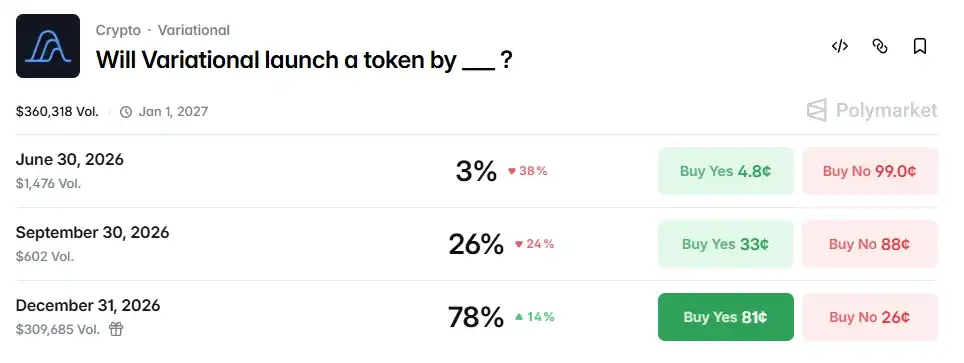
"When Will Variational TGE" Prediction Event on Polymarket

Preguntas relacionadas

QWhat is the key news about the Perp DEX platform Variational discussed in the article?

AThe article discusses that Variational announced the completion of a $50 million Series A funding round, led by Dragonfly Capital, with participation from Bain Capital Crypto and CoinBase Ventures.

QWhat is the most direct way for ordinary users to participate in Variational according to the article?

AAccording to the article, the most direct way for ordinary users to participate in Variational is through its 'Trade-to-Earn' points program.

QWhat is a distinctive feature of Variational's Omni platform compared to most other Perp DEXs?

AA distinctive feature of Variational's Omni platform is zero trading fees for users. The main costs come from the bid-ask spread, slippage, funding rates, and deposit/withdrawal fees.

QWhat is the community's general expectation for Variational's TGE (Token Generation Event) date based on the article?

ABased on the article, the community generally expects the TGE to occur in Q3 to Q4 of this year, as points distribution is scheduled to last until at least the end of Q3 2026. Prediction markets also lean towards a Q4 date.

QHow does Variational's points system differ from a simple volume-based reward model?

AVariational's points system incorporates elements that reward trading quality, not just volume. It includes a Reward Tiers system based on 30-day trading volume (with referral volume factored in), which grants bonus multipliers. It also penalizes inorganic behavior like meaningless wash trading and offers a 10% bonus for early users who traded before the points program launch.

Lecturas Relacionadas

New Paradigms and Investment Logic in the Era of AI+Web3

In the era of AI+Web3, a venture capital firm shares insights from reviewing numerous projects. The AI industry is seen as still early-stage, structured in a "seven-layer matrix" from power infrastructure to AI agents. Investment timing is crucial, especially in cyclical sectors like AI data centers. The integration of AI and Crypto is deemed essential for two reasons: 1) AI agents require "financial sovereignty" for micro, high-frequency, machine-to-machine transactions, and 2) blockchain provides trust and auditability to address AI "hallucinations" and ensure transparency. The core investment principle is "honesty." Teams must be genuine, not hastily assembled, and products must be substantiated by real metrics, not just flashy demos. Projects built on honesty are valued for long-term success over short-term hype. Looking ahead, the most underestimated opportunity for 2026 is the deep fusion of AI, blockchain, and entertainment. While most investment focuses on B2B infrastructure like payments and decentralized computing (DePIN), the future lies in consumer applications. As AI automates most human labor, society will shift towards leisure, creating massive demand for high-quality entertainment. AI can power immersive experiences (e.g., NPCs with autonomous consciousness in games), while blockchain secures digital ownership and economic systems. This convergence could unlock tremendous value in user time and capital within virtual worlds. *Disclaimer: The content represents the author's views for discussion only and does not constitute investment advice.*

marsbitHace 22 min(s)

New Paradigms and Investment Logic in the Era of AI+Web3

marsbitHace 22 min(s)

Fantasy's Closing Notes: After Two and a Half Years of Trial and Error in SocialFi, What Have We Learned?

"Fantasy Shutdown Notes: Two and a Half Years of SocialFi Trial, What Have We Learned?" Fantasy, a SocialFi/crypto card game, is shutting down. The team is refunding 100% of investments to angel/seed round backers, as operational costs were fully covered by revenue. Over 2.5 years, the project returned approximately $20M to its community. The core reason for failure was building crypto economics on a foundation not designed for it. Traditional card games (Magic, Pokémon) succeed by prioritizing gameplay; financial value is a secondary outcome. Crypto card games invert this, attracting speculators first, not genuine players. This financialization trapped the team into managing a financial instrument instead of developing a game. This is a sector-wide issue. Embedding tokenomics into social products or creator-fan relationships often attracts short-term traders over genuine users, undermining the core value. The article also critiques premature token launches. Most tokens fail because they're issued before product-market fit is proven, diverting team and community focus to price speculation instead of building. Successful examples like Hyperliquid or Jupiter built sustainable businesses first. Fantasy's journey highlights key crypto pitfalls: the distorting effect of upfront financialization in gaming/social apps, and the dangers of launching tokens too early. The team hopes sharing these lessons helps future builders avoid the same traps.

marsbitHace 1 hora(s)

Fantasy's Closing Notes: After Two and a Half Years of Trial and Error in SocialFi, What Have We Learned?

marsbitHace 1 hora(s)

Trading

Spot
Futuros
活动图片