Pharos Establishes RealFi Alliance to Promote Institutional-Grade On-Chain Execution Standardization for RWA

marsbitPublicado a 2026-02-23Actualizado a 2026-02-23

Resumen

Pharos Network has launched the RealFi Alliance, a strategic ecosystem initiative aimed at unifying institutional asset issuers, financial infrastructure providers, and on-chain builders. The alliance seeks to standardize and scale the execution framework for real-world assets (RWA), moving beyond isolated pilots. Founding members include Chainlink, Asseto Finance, Ember, Faroo, LayerZero, R25, Re7 Labs, TopNod, and Centrifuge. The alliance addresses systemic issues like fragmented liquidity, inconsistent infrastructure standards, and regulatory disconnects by creating a unified operational layer where RWAs remain active, composable, and capable of supporting institutional workflows. It operates on four core pillars: Asset Enablement (bringing real-world value on-chain securely), Infrastructure & Compliance (leveraging Pharos’s parallel execution and built-in compliance modules), Liquidity & Utility (designing clear functional use cases like staking and yield mechanisms), and Market Transparency (establishing trust through clear risk and return benchmarks). Pharos CEO Wish Wu emphasized that the goal is to create a unified environment for assets to operate at scale with institutional reliability. The upcoming Pharos mainnet will launch as a ready-to-use financial environment with integrated liquidity and compliance standards. The alliance plans to expand in structured batches, selecting new members based on asset quality, technical maturity, and ecosystem synergy. Pharos i...

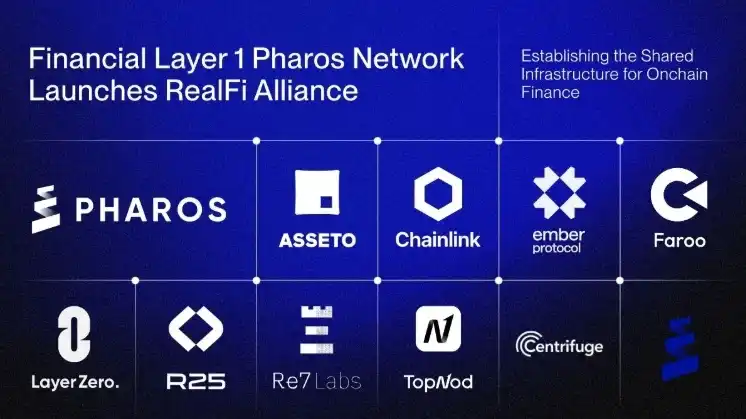
Pharos Network, a financial-grade Layer 1 public chain, today announced the establishment of the RealFi Alliance, a strategic ecosystem initiative aimed at uniting institutional-grade asset issuers, financial infrastructure providers, and on-chain builders. The alliance's goal is to advance the real-world asset (RWA) market from isolated pilot phases to a standardized, scalable, and executable operational framework. The inaugural members of the RealFi Alliance include: Chainlink, Asseto Finance, Ember, Faroo, LayerZero, R25, Re7 Labs, TopNod, and Centrifuge.

The RealFi Alliance aims to address systemic friction issues such as liquidity fragmentation, inconsistent infrastructure standards, and regulatory disconnects by coordinating assets and capital under a unified framework. Rather than viewing real-world assets (RWA) as static tokens, the alliance sees RealFi as a foundational financial infrastructure layer that keeps assets active, composable on-chain, and capable of supporting institutional-grade business processes at any time. The inaugural members form the core foundation of RealFi on Pharos, ensuring that the network has real-world partners building and implementing on it from the moment it enters the market.

The alliance operates under a framework of four core pillars designed to ensure long-term adoption and systemic robustness. Central to this initiative is Asset Enablement, focusing on bringing real-world value on-chain in a secure and composable form and optimizing its capacity for continuous participation. This foundation is further strengthened by rigorous infrastructure and compliance alignment, leveraging Pharos's deep parallel execution architecture and built-in compliance modules to meet the highest institutional security standards. To bridge the gap between asset issuance and practical use, the alliance prioritizes liquidity and utility design, creating clear functional pathways for assets through mechanisms like staking, yield, and application integration. The collaboration between Ember and Re7 Labs exemplifies this philosophy—embedding institutional-grade risk management and vault curation capabilities directly into the asset lifecycle. Finally, by establishing market transparency and clear benchmarks for risk and return sources, the alliance builds the necessary foundation of trust for sophisticated capital allocators to participate at scale within the ecosystem.

Wish Wu, Co-founder and CEO of Pharos Network, stated: "The core challenge in today's on-chain finance is not a lack of assets, but the absence of a unified environment where these assets can operate at scale. The RealFi Alliance is our commitment to building that environment. By aligning with industry-standard oracle platforms like Chainlink and specialized asset operators, we ensure that real value can flow on-chain with institutional-grade reliability."

This strategic synergy ensures that the upcoming Pharos mainnet will launch as a 'ready-to-use' financial environment with integrated liquidity and compliance standards. Moving forward, the RealFi Alliance will expand in structured batches, with new members selected based on asset quality, technical maturity, and ecosystem synergy. This long-term development path ensures that as the Pharos ecosystem matures, the quality and utility of its underlying assets remain industry-leading.

About Pharos Network

Pharos is an inclusive financial Layer 1 for RealFi, where real value and institutional-grade assets circulate on-chain and can be composably integrated with decentralized assets, serving as the next generation of financial-grade infrastructure for global finance. Pharos combines a modular architecture, deep parallel execution mechanism, and built-in compliance modules to power an asset-native ecosystem. The project is built by a team of management and engineering veterans from Ant Group and is backed by global investment firms such as Hack VC and Faction VC.


Preguntas relacionadas

QWhat is the main goal of the RealFi Alliance announced by Pharos Network?

AThe main goal of the RealFi Alliance is to advance the real-world asset (RWA) market from isolated pilot phases to a standardized, scalable, and executable operational framework by uniting institutional-grade asset issuers, financial infrastructure providers, and on-chain builders.

QWhich companies are among the founding members of the RealFi Alliance?

AThe founding members of the RealFi Alliance include Chainlink, Asseto Finance, Ember, Faroo, LayerZero, R25, Re7 Labs, TopNod, and Centrifuge.

QWhat are the four core pillars that the RealFi Alliance operates on?

AThe four core pillars are: Asset Enablement (bringing real-world assets on-chain), Infrastructure & Compliance Alignment (leveraging Pharos's architecture for institutional security), Liquidity & Utility Design (creating functional pathways for assets), and Market Transparency & Trust (building a foundation for mature capital allocators).

QAccording to Wish Wu, what is the core challenge facing on-chain finance today?

AWish Wu stated that the core challenge is not a lack of assets, but the absence of a unified environment that allows these assets to operate at scale.

QWhat is the background of the team behind Pharos Network, and which investors support it?

AThe project is built by a team of management and engineers from Ant Group and is backed by global investment firms such as Hack VC and Faction VC.

Lecturas Relacionadas

Research Status Report on AI Payment Protocols: The New Paradigm of Payment in the Agent Economy

AI Payment Protocol Research Status Report: A New Paradigm for Agent Economy Payments This report analyzes the rapid evolution of payment infrastructure designed for AI agents, driven by major industry moves from OpenAI, Google, Visa, Mastercard, Coinbase, and Stripe between late 2025 and early 2026. The core challenge is that traditional payment systems, built for human interaction, are incompatible with AI agents that require machine-readable interfaces, millisecond authorizations, and support for high-frequency micro-transactions. The emerging infrastructure is forming a two-layer architecture: 1. **Intent Orchestration Layer:** Translates agent intent into executable transactions. Two key segments exist: * **Agent Shopping for Humans:** Focuses on enabling agents to shop on human-centric e-commerce platforms. Protocols include OpenAI & Stripe's closed **Agentic Commerce Protocol (ACP)** and Google's open **Universal Commerce Protocol (UCP)** for standardized merchant interfaces. * **Agent-to-Agent (A2A) Transactions:** Solves trust issues in environments without human merchants, using blockchain-based smart contracts like **ERC-8183** for task execution and payment escrow. 2. **Settlement Layer:** Handles the actual movement of funds. Key competing protocols include: * **Stripe's SPT & Card Network Upgrades (Visa/Mastercard):** Extend existing card payments with delegated authorization tokens, ideal for standard retail but unsuitable for micro-payments. * **Coinbase's x402:** Uses the HTTP 402 status code for on-chain atomic swaps with stablecoins (e.g., USDC), enabling low-fee, account-less payments. * **Circle's Nanopayments:** An x402 enhancement for extreme micro-payments using off-chain batch processing. * **MPP (Stripe & Tempo):** A unified, pluggable framework supporting multiple payment rails (stablecoins, fiat, card tokens, Lightning Network) within a single "payment session." **Current State & Opportunities:** While core protocols are live, commercial adoption lags due to fragmentation in the intent layer. The key opportunities are: * **Settlement Layer:** Building multi-rail Agent wallets that abstract complexity and can route transactions across different payment protocols is a definitive, high-value opportunity. * **A2A Economy:** A significant blue-ocean opportunity exists in creating API services for agents to consume (e.g., data analysis, content creation) on a pay-per-use model (e.g., via HTTP 402), moving beyond subscription models. The future will see a dual-track evolution: consumer-facing agent commerce relying on card rails, and A2A transactions thriving on stablecoin rails. The inflection point will be when enterprises delegate spending authority to agents, making multi-rail wallets and service directories critical, unclaimed infrastructure.

marsbitHace 1 hora(s)

Research Status Report on AI Payment Protocols: The New Paradigm of Payment in the Agent Economy

marsbitHace 1 hora(s)

Trading

Spot
Futuros

Artículos destacados

Cómo comprar LAYER

¡Bienvenido a HTX.com! Hemos hecho que comprar Solayer (LAYER) sea simple y conveniente. Sigue nuestra guía paso a paso para iniciar tu viaje de criptos.Paso 1: crea tu cuenta HTXUtiliza tu correo electrónico o número de teléfono para registrarte y obtener una cuenta gratuita en HTX. Experimenta un proceso de registro sin complicaciones y desbloquea todas las funciones.Obtener mi cuentaPaso 2: ve a Comprar cripto y elige tu método de pagoTarjeta de crédito/débito: usa tu Visa o Mastercard para comprar Solayer (LAYER) al instante.Saldo: utiliza fondos del saldo de tu cuenta HTX para tradear sin problemas.Terceros: hemos agregado métodos de pago populares como Google Pay y Apple Pay para mejorar la comodidad.P2P: tradear directamente con otros usuarios en HTX.Over-the-Counter (OTC): ofrecemos servicios personalizados y tipos de cambio competitivos para los traders.Paso 3: guarda tu Solayer (LAYER)Después de comprar tu Solayer (LAYER), guárdalo en tu cuenta HTX. Alternativamente, puedes enviarlo a otro lugar mediante transferencia blockchain o utilizarlo para tradear otras criptomonedas.Paso 4: tradear Solayer (LAYER)Tradear fácilmente con Solayer (LAYER) en HTX's mercado spot. Simplemente accede a tu cuenta, selecciona tu par de trading, ejecuta tus trades y monitorea en tiempo real. Ofrecemos una experiencia fácil de usar tanto para principiantes como para traders experimentados.

218 Vistas totalesPublicado en 2025.02.11Actualizado en 2025.03.21

Cómo comprar LAYER

Discusiones

Bienvenido a la comunidad de HTX. Aquí puedes mantenerte informado sobre los últimos desarrollos de la plataforma y acceder a análisis profesionales del mercado. A continuación se presentan las opiniones de los usuarios sobre el precio de LAYER (LAYER).

活动图片