CryptoQuant Founder: The Cost to Double BTC Has Increased by 20,000 Times, Where Will the $100 Billion Buying Power Come From?

marsbitPublicado a 2026-07-07Actualizado a 2026-07-07

Resumen

CryptoQuant founder Ki Young Ju analyzes Bitcoin's current capital challenge. He notes that the cryptocurrency market has grown too large for retail-driven momentum alone to generate massive price increases as in past cycles. His calculations show that in 2011, approximately $2.7 million in capital inflow could push BTC's price up by 550x, whereas the current cycle requires an estimated $101 billion in new capital just for a 100% price increase. This shift underscores that sustaining a bull run now depends on attracting large-scale, long-term institutional capital rather than short-term speculative trading. Recent outflows from US spot Bitcoin ETFs, totaling nearly $10 billion since May, highlight the fragility of current demand and challenge the narrative of deep institutional support. While surveys indicate continued institutional interest, these entities prioritize regulated products, risk management, and portfolio integration over speculative gains. For the next significant bull market, Bitcoin must transition to being a core macro asset. The key drivers are no longer just more buyers, but capital allocation from larger, slower-moving entities like wealth advisors, corporate treasuries, banks, and sovereign wealth funds. This new phase pits Bitcoin against other major asset classes like AI for a share of institutional capital, making its growth trajectory dependent on sustained, high-quality inflows from diversified financial balance sheets.

Author: CryptoSlate

Compiled by: Deep Tide TechFlow

Deep Tide Introduction: ETF outflows, institutional wait-and-see, AI capturing investor attention... Bitcoin has grown too large to be moved by retail investors alone. CryptoQuant founder Ki Young Ju did the math: In 2011, $2.7 million could push BTC up 550 times; now, it takes $101 billion to double it. Whether the next bull market arrives depends on whether wealth advisors, corporate treasuries, banks, and sovereign funds are willing to treat BTC as a long-term allocation rather than a short-term trade.

Bitcoin's next major rally may no longer depend on whether investors believe in the asset, but on how much major capital is willing to participate with real money.

The latest analysis from CryptoQuant CEO Ki Young Ju shows that the world's largest cryptocurrency has matured into a market too large to be easily propelled as it was in early cycles. According to him, each bull cycle requires more capital to produce smaller percentage gains, a shift that raises the threshold for another parabolic rally.

This is particularly relevant now as BTC is in a prolonged bear market, having fallen to around $63,000, down 50% from the peak above $126,000 recorded last October.

This pullback tests the institutional adoption that helped push the asset into mainstream portfolios. The core question now is whether Bitcoin can attract enough persistent capital to offset its declining price sensitivity.

A Larger Market Changes the Cycle Math

Bitcoin's early rallies were built on a much smaller base, allowing small amounts of new money to produce massive price changes. This relationship has diminished as the asset has matured.

Ju's analysis compares the growth in Bitcoin's realized capitalization across several bull cycles with the subsequent price gains. Realized capitalization calculates coins at their last on-chain move price, making it a common proxy for the amount of capital absorbed by the network.

Ju said that in the 2011 cycle, roughly $27 million in net capital inflow was associated with a roughly 55,000% price gain.

The current cycle has absorbed about $697 billion, producing about a 689% gain, highlighting how much more capital is needed to generate smaller gains as the asset scales.
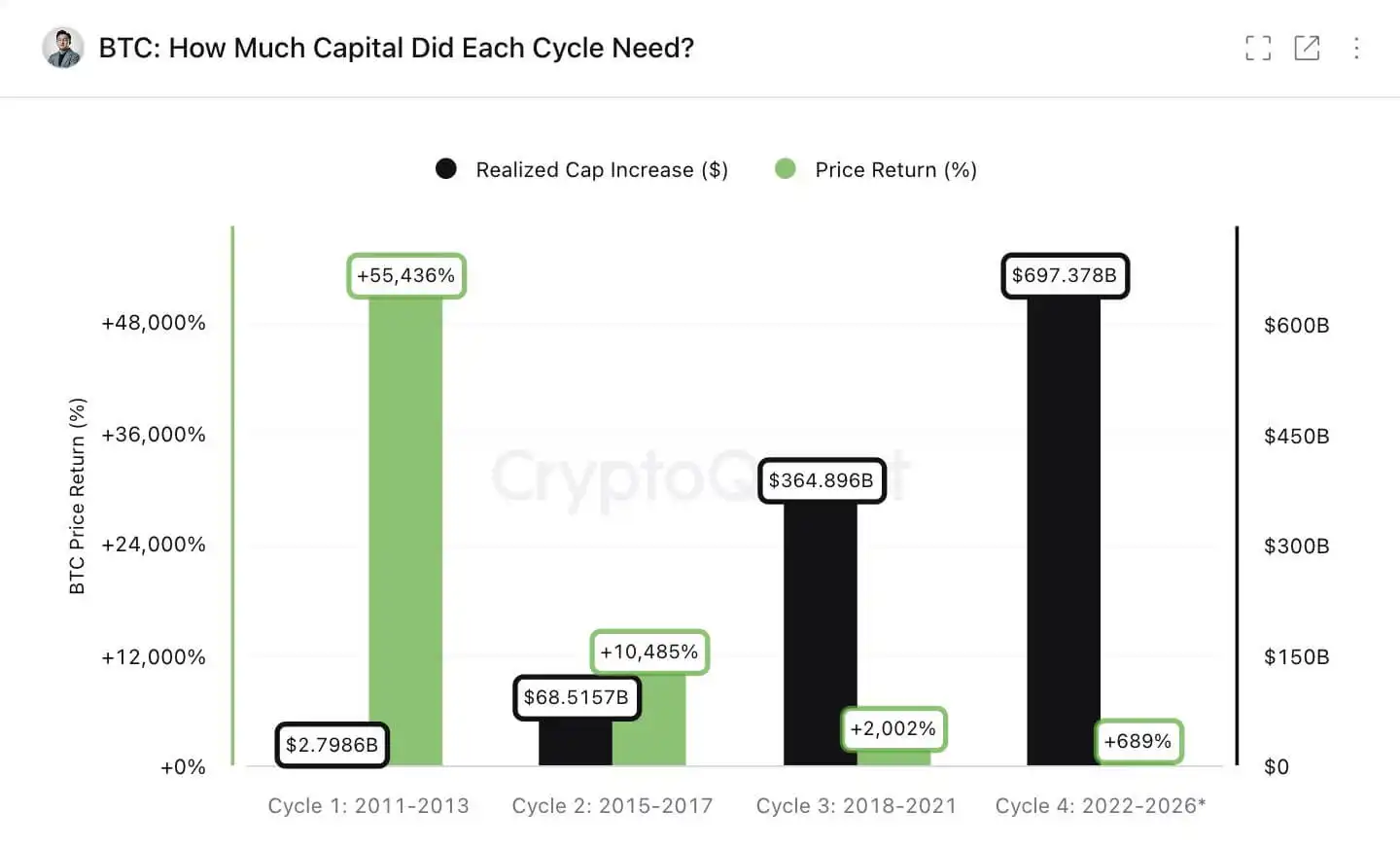
Figure: Bitcoin Price Returns vs Realized Cap Gains

Source: CryptoQuant

The same pattern appears in smaller increments. Ju said that around $5 million in new money was enough to double the Bitcoin price in 2011. In the current cycle, that figure is around $101 billion.

While this doesn't end the bullish thesis around BTC, it changes the type of demand needed to sustain it.

Ju argues another major rally is still possible if Bitcoin becomes a deeper macro allocation. "Bitcoin needs to become a core macro asset," he wrote, adding that the market can no longer rely solely on retail-dominated ETF trading.

This perspective frames Bitcoin's next cycle as a test of financial market integration. Supply shocks from halvings still reduce new issuance, but the growth trajectory increasingly depends on whether capital allocators treat Bitcoin as a recurring portfolio position rather than a tactical trade.

ETF Outflows Weaken the Near-Term Setup

This test arrives as the market's most visible institutional vehicle hits a rough patch.

U.S. spot Bitcoin ETFs helped broaden access following their 2024 launch, offering advisors, hedge funds, and traditional investors a regulated path to the asset. But recent flows have turned negative, undercutting the argument that institutional demand is already deep enough to support another major rally.

Data from Santiment shows nearly $10 billion in outflows from Bitcoin ETFs since early May, with the 12 products currently on an eight-week streak of outflows.

Addressing these numbers, the BTC-focused analytics platform Ecoinometrics said:

"The pattern since May has been very one-sided. Every attempt to rebuild buying momentum almost immediately stalls. Bitcoin ETFs have failed to achieve more than a single day of inflows, while outflow streaks repeatedly last for days, culminating in the longest outflow streak since the ETFs launched."
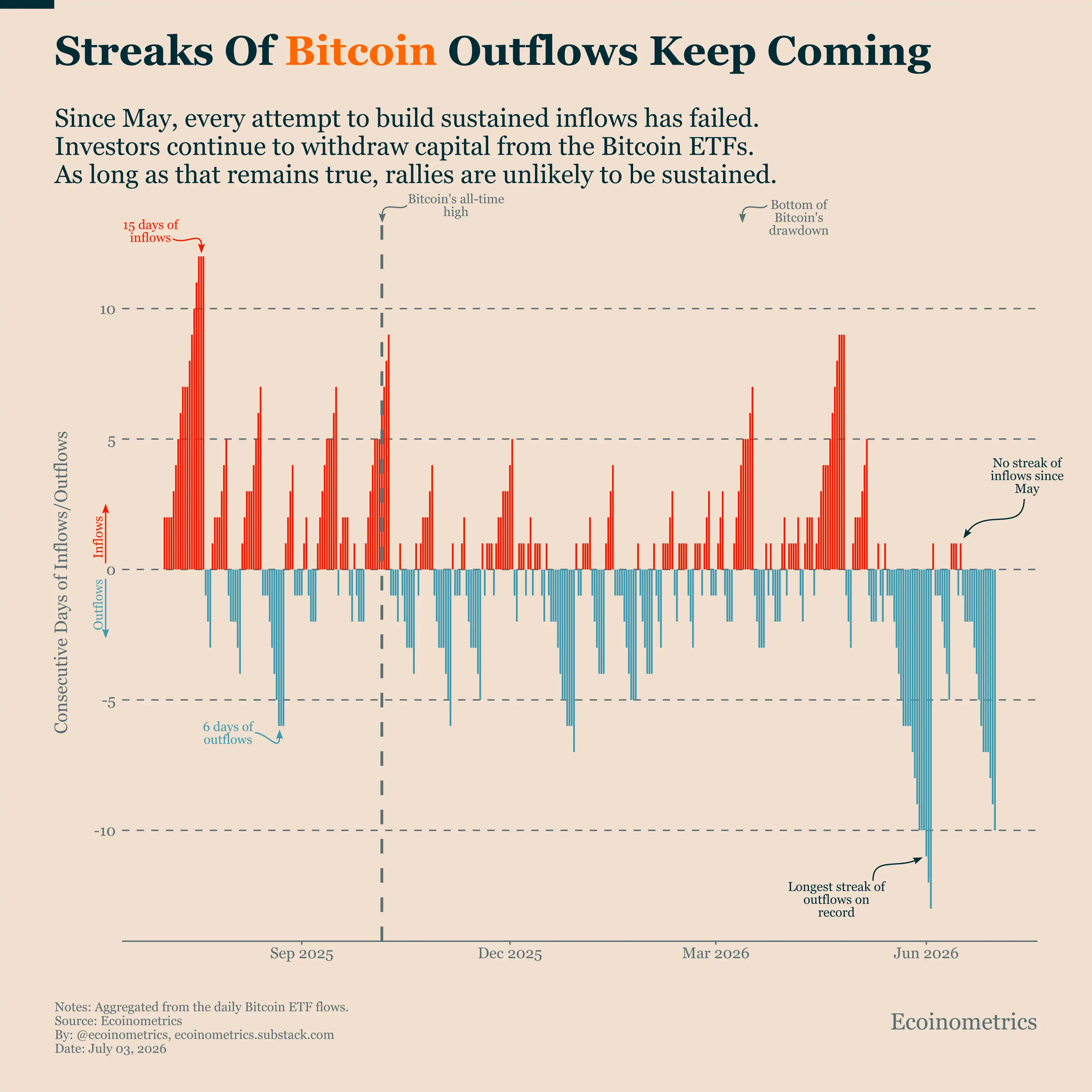
Figure: Bitcoin ETF Outflows

Source: Ecoinometrics

These outflows complicate a rapid return to highs. Bitcoin's October record came during a period when investors were still rewarding ETF access and treating the asset as a beneficiary of friendlier policies, institutional participation, and broader links to global markets.

Now, the ETF weakness suggests access alone is insufficient. The next phase of adoption requires steadier allocations across wealth platforms, model portfolios, corporate balance sheets, and other capital pools that move more slowly than retail traders but can deploy at larger scale.

For Bitcoin, this creates a demand landscape that is higher quality but harder to win. Institutions may bring bigger checks, but they also require liquidity, risk controls, custody standards, portfolio mandates, and compliance approval before allocations become durable.

Institutions Are Still Engaging, But With Stricter Standards

Despite these substantial outflows, survey data from Coinbase suggests institutional interest hasn't vanished.

A January 2026 survey of 351 institutional decision-makers by Coinbase and EY-Parthenon found nearly three-quarters plan to increase crypto allocations, while 74% expect crypto prices to rise in the next 12 months.

The same survey found 49% are placing more emphasis on risk management, liquidity, and position sizing.

This combination matters for Bitcoin's capital problem. Institutions don't approach crypto with the same behaviors that defined early retail-led cycles.

They are more likely to demand regulated products, clear governance, operational resilience, and defined exposure limits.

The survey found 66% of respondents already have exposure through spot crypto ETFs or exchange-traded products, while 81% prefer spot exposure through registered vehicles.

These findings support the view that regulated wrapper products remain central to the next adoption phase.

However, they also show why the recent ETF outflows are a pressure point. If ETFs are the primary institutional on-ramp, sustained weakness in these products could slow the broader allocation process.

Thus, Bitcoin's capital-efficiency problem cuts both ways. Its larger scale may make the asset more acceptable to traditional finance.

But that scale also means marginal buyers must be larger, more consistent, and less speculative than those driving early cycles.

Bitcoin's Next Buyers Must Compete With the Rest of Wall Street

This makes Bitcoin's next cycle dependent on a broader set of investors than the retail traders and crypto-native funds that powered early rallies.

Michael Saylor, executive chairman of MicroStrategy, argues Bitcoin's next decade will be less driven by miner issuance and more by capital flows across financial markets. MicroStrategy is the largest corporate holder of Bitcoin, making Saylor one of the most visible advocates for treating the asset as a balance-sheet tool rather than a speculative trade.

According to him:

"Over the next decade, Bitcoin's trajectory will be less driven by miner issuance and more by capital flows. ETF flows. Corporate treasury flows. Sovereign reserve flows. Banking credit flows. Derivative flows. Insurance flows. Collateral flows. Structured credit flows. Global savings flows. Halvings tighten supply. Capital flows set the growth trajectory. This is the next phase of Bitcoin adoption: not just more buyers, but more balance sheets."

The emphasis is that Bitcoin's supply story is no longer novel. Its issuance schedule is known, halving cycles are understood, and the asset already trades at a scale that requires larger pools of capital to move it meaningfully.

Therefore, any new repricing must come from demand channels capable of absorbing a market valued over $1 trillion.

This means ETF demand is only part of the shift. A stronger cycle may require advisors adding Bitcoin to model portfolios, companies using it more aggressively on balance sheets, banks building credit products around it, insurers and asset managers viewing it as a macro allocation, and sovereign entities considering exposure over time.

This shift may be slower than retail momentum cycles. It will also expose Bitcoin more to rate expectations, regulatory delays, liquidity shocks, and competition with other markets chasing the same institutional capital.

Notably, artificial intelligence has emerged as one of those competitors. AI-related assets and infrastructure have absorbed a significant portion of investor attention this year, with spending and investment forecasts reaching trillions.

In earlier crypto cycles, looser speculative capital might have flowed more easily into Bitcoin. In today's market, Bitcoin must compete for the same pool of institutional capital against AI stocks, private infrastructure deals, credit products, commodities, and other macro trades.

That competition is now at the center of the Bitcoin cycle debate. The asset is large enough to enter mainstream allocation conversations, but that also means it gets compared against every other major capital use.

The views expressed in this article are those of the author alone and do not represent the views of CryptoSlate. Nothing you read on CryptoSlate should be taken as investment advice, nor does CryptoSlate endorse any projects mentioned or linked in this article. Buying and trading cryptocurrencies should be considered a high-risk activity. Please conduct your own due diligence before taking any action related to the content of this article. Finally, CryptoSlate assumes no liability for any losses incurred while trading cryptocurrencies. Please refer to our company disclaimer for more information.


Criptos en tendencia

Preguntas relacionadas

QAccording to the CryptoQuant founder, how has the capital required to double Bitcoin's price changed from 2011 to the current cycle?

AIn 2011, approximately $5 million in new capital was enough to double Bitcoin's price. In the current cycle, that number has risen to about $101 billion, representing a roughly 20,000-fold increase in the capital efficiency cost for generating the same percentage gain.

QWhat does the article suggest is the new key factor for Bitcoin's next major bull run, as opposed to earlier cycles?

AThe article suggests that Bitcoin's next major bull run depends less on investor belief and more on whether large, institutional capital (like wealth advisors, corporate treasuries, banks, and sovereign funds) is willing to make Bitcoin a long-term portfolio allocation, rather than engaging in short-term trading.

QWhat recent trend in U.S. Bitcoin ETFs complicates the argument for immediate institutional-driven price appreciation?

ASince early May, U.S. spot Bitcoin ETFs have experienced nearly $10 billion in net outflows, marking their longest streak of consecutive weekly outflows since launch. This sustained weakness suggests that mere access to regulated products is insufficient and that deeper, more stable institutional allocations are needed.

QAccording to Michael Saylor, what will drive Bitcoin's trajectory in the next decade, replacing the previous dominant factor?

AMichael Saylor states that Bitcoin's trajectory in the next decade will be less driven by miner issuance and more driven by capital flows from various sources, including ETF flows, corporate treasury flows, sovereign reserve flows, bank credit flows, and global savings flows.

QWhat new competitive challenge does Bitcoin face in attracting institutional capital, as mentioned in the article?

ABitcoin now faces significant competition for institutional capital from other major sectors, particularly Artificial Intelligence (AI). AI-related assets and infrastructure are absorbing a large portion of investor attention and capital, forcing Bitcoin to compete for the same pool of institutional funds.

Lecturas Relacionadas

Why 2026 could redefine Ethereum, Solana, Base and Avalanche

Blockchain infrastructure is undergoing a major coordinated transformation, driven by institutional demand for reliability, compliance, and predictable settlement. Over $30 billion in Real-World Assets (RWA) on-chain has exposed network weaknesses. Major blockchains are responding with foundational upgrades, moving beyond incremental speed improvements. Ethereum's "Glamsterdam" upgrade, planned for H1 2026, will significantly increase gas limits and introduce features like PBS (pre-blocked state) for enhanced settlement and parallel execution. Solana's "Alpenglow," targeting a mainnet launch in H2 2026, focuses on reducing finality time dramatically and freeing network resources to improve reliability. Beyond speed, compliance is critical. Base's "Beryl" upgrade in Q3 2026 will introduce a standardized, regulatory-compliant token framework (B20). Avalanche's "Octane" upgrade aims to boost transaction processing and reduce costs for enterprise applications. Even Bitcoin is evolving with the potential activation of OP_CAT by late 2026/early 2027. The competition is shifting. While technical upgrades are widespread, institutions will ultimately allocate capital based on proven execution, operational resilience, and regulatory compatibility during market stress. Ethereum currently leads in tokenized assets, while networks like Base and Solana are strengthening their institutional offerings. The blockchain that best delivers reliable, compliant, and uninterrupted service is poised to attract the greatest share of future institutional capital.

ambcryptoHace 12 min(s)

Why 2026 could redefine Ethereum, Solana, Base and Avalanche

ambcryptoHace 12 min(s)

Tiger Research: Take RWA Tokenization Overseas First

This article discusses the strategic choices facing financial institutions in jurisdictions lacking mature regulatory frameworks for Real-World Asset (RWA) tokenization. With the market growing rapidly, institutions must choose between waiting for local legislation, using regulatory sandboxes, or—the recommended priority—expanding into overseas markets to gain early experience. Successfully launching cross-border RWA tokenization requires meticulous preparation across six key areas: establishing an overseas base (e.g., Hong Kong, Singapore, the U.S.), securing necessary licenses, defining the tokenized asset (with bonds being simpler than non-standard assets), defining the target investor scope, deciding on settlement currencies/payment flows, and designing operational requirements like custody and on-chain governance. The article outlines two primary strategic paths: a direct "onshore" path and a "native on-chain" path. The direct path involves setting up a legal entity and obtaining licenses in a mature jurisdiction like Hong Kong, Singapore, or the U.S., leveraging existing platforms (e.g., DigiFT, Securitize) for efficiency. The alternative native on-chain path involves partnering with compliant, decentralized platforms (e.g., Ondo, Plume Nest) that use structures like offshore SPVs to facilitate tokenization and access DeFi liquidity, offering speed and broader reach but with greater structural complexity. The core argument is that institutions should not wait for perfect domestic regulation. A detailed hypothetical case study illustrates the multi-step, 6-12 month process of launching an overseas tokenized bond. The key takeaway is that the essence of a tokenization business lies not in the technology but in successfully executing the entire sales and operational process. The market is moving forward, and the time to act is now.

marsbitHace 23 min(s)

Tiger Research: Take RWA Tokenization Overseas First

marsbitHace 23 min(s)

Trading

Spot

Artículos destacados

Qué es BITCOIN

Entendiendo HarryPotterObamaSonic10Inu (ERC-20) y Su Posición en el Espacio Cripto En los últimos años, el mercado de criptomonedas ha sido testigo de un aumento en la popularidad de las monedas meme, capturando el interés no solo de los comerciantes, sino también de aquellos que buscan compromiso comunitario y valor de entretenimiento. Entre estos tokens únicos se encuentra HarryPotterObamaSonic10Inu (ERC-20), un proyecto intrigante que mezcla referencias culturales en el tejido de las criptomonedas. Este artículo profundiza en los aspectos clave de HarryPotterObamaSonic10Inu, explorando sus mecanismos, ethos impulsado por la comunidad y su relación con el paisaje cripto más amplio. ¿Qué es HarryPotterObamaSonic10Inu (ERC-20)? Como su nombre sugiere, HarryPotterObamaSonic10Inu es una moneda meme construida sobre la blockchain de Ethereum, clasificada bajo el estándar ERC-20. A diferencia de las criptomonedas tradicionales que pueden enfatizar la utilidad práctica o el potencial de inversión, este token prospera en el valor de entretenimiento y la fuerza de su comunidad. El proyecto tiene como objetivo fomentar un entorno donde los usuarios comprometidos puedan reunirse, compartir ideas y participar en actividades inspiradas por diversos fenómenos culturales. Una característica notable de HarryPotterObamaSonic10Inu es su cero impuestos en las transacciones. Este atractivo elemento tiene como objetivo incentivar el comercio y la participación comunitaria, sin cargos adicionales que puedan disuadir a los comerciantes de pequeña escala. El suministro total de la moneda está establecido en mil millones de tokens, una cifra que marca su intención de mantener una circulación sustancial dentro de la comunidad. Creador de HarryPotterObamaSonic10Inu (ERC-20) Los orígenes de HarryPotterObamaSonic10Inu están algo envueltos en misterio; los detalles sobre el creador siguen siendo desconocidos. El desarrollo de este token carece de un equipo identificable o de un plan explícito, lo cual no es inusual dentro del sector de monedas meme. En cambio, el proyecto ha surgido de manera orgánica, con su progreso muy dependiente del entusiasmo y la participación de su comunidad. Inversores de HarryPotterObamaSonic10Inu (ERC-20) En cuanto a inversiones externas y respaldo, HarryPotterObamaSonic10Inu también sigue siendo ambiguo. El token no lista ninguna fundación de inversión conocida o apoyo organizacional significativo. En cambio, la savia del proyecto es su comunidad de base, que informa su crecimiento y sostenibilidad a través de la acción colectiva y el compromiso en el espacio cripto. ¿Cómo Funciona HarryPotterObamaSonic10Inu (ERC-20)? Como una moneda meme, HarryPotterObamaSonic10Inu opera principalmente fuera de los marcos tradicionales que a menudo rigen el valor de los activos. Hay varios aspectos distintivos que definen cómo funciona el proyecto: Transacciones Sin Impuestos: Sin tarifas impositivas en las transacciones, los usuarios pueden comprar y vender el token libremente sin preocuparse por costos ocultos. Compromiso Comunitario: El proyecto prospera en la interacción comunitaria, aprovechando plataformas de redes sociales para crear entusiasmo y facilitar la participación. Las discusiones, el intercambio de contenido y el compromiso son elementos cruciales que ayudan a expandir su alcance y fomentar la lealtad entre los seguidores. Sin Utilidad Práctica: Cabe señalar que HarryPotterObamaSonic10Inu no ofrece utilidad concreta dentro del ecosistema financiero. Más bien, se clasifica como un token principalmente para actividades de entretenimiento y comunitarias. Referencia Cultural: El token incorpora astutamente elementos de la cultura popular para atraer interés, conectando con entusiastas de los memes y seguidores de las criptomonedas por igual. HarryPotterObamaSonic10Inu ejemplifica cómo las monedas meme operan de manera diferente a los proyectos de criptomonedas más tradicionales, ingresando al mercado como construcciones sociales innovadoras en lugar de activos utilitarios. Cronología de HarryPotterObamaSonic10Inu (ERC-20) La historia de HarryPotterObamaSonic10Inu está marcada por varios hitos notables: Creación: El token surgió de un meme viral, capturando la imaginación de muchos entusiastas de las criptomonedas. Las fechas específicas de creación no están disponibles, subrayando su ascenso orgánico. Listado en Exchanges: HarryPotterObamaSonic10Inu ha llegado a varios exchanges, permitiendo un acceso y comercio más fácil por parte de la comunidad. Iniciativas de Compromiso Comunitario: Actividades continuas destinadas a mejorar la interacción comunitaria, incluyendo concursos, campañas en redes sociales y generación de contenido por parte de fanáticos y defensores. Planes de Expansión Futuros: La hoja de ruta del proyecto incluye el lanzamiento de una colección de NFT, mercancía y un sitio de comercio electrónico relacionado con sus temas culturales, involucrando aún más a la comunidad e intentando añadir más dimensiones a su ecosistema. Puntos Clave Sobre HarryPotterObamaSonic10Inu (ERC-20) Naturaleza Impulsada por la Comunidad: El proyecto prioriza la participación colectiva y la creatividad, asegurando que la involucración de los usuarios esté a la vanguardia de su desarrollo. Clasificación como Moneda Meme: Representa la epítome de las criptomonedas basadas en el entretenimiento, diferenciándose de los vehículos de inversión tradicionales. Sin Afiliación Directa con Bitcoin: A pesar de la similitud en el nombre del ticker, HarryPotterObamaSonic10Inu es distinto y no tiene relación con Bitcoin u otras criptomonedas establecidas. Enfoque en la Colaboración: HarryPotterObamaSonic10Inu está diseñado para crear un espacio para la colaboración y el intercambio de historias entre sus poseedores, proporcionando una vía para la creatividad y el vínculo comunitario. Perspectivas Futuras: La ambición de expandirse más allá de su premisa inicial hacia NFTs y mercancías describe un camino para que el proyecto potencialmente ingrese a avenidas más tradicionales dentro de la cultura digital. A medida que las monedas meme continúan capturando la imaginación de la comunidad de criptomonedas, HarryPotterObamaSonic10Inu (ERC-20) se destaca debido a sus lazos culturales y su enfoque centrado en la comunidad. Si bien puede no encajar en el molde típico de un token impulsado por la utilidad, su esencia radica en la alegría y la camaradería fomentadas entre sus seguidores, destacando la naturaleza en evolución de las criptomonedas en una era cada vez más digital. A medida que el proyecto continúa desarrollándose, será importante observar cómo las dinámicas comunitarias influyen en su trayectoria en el cambiante paisaje de la tecnología blockchain.

1.9k Vistas totalesPublicado en 2024.04.01Actualizado en 2024.12.03

Qué es BITCOIN

Cómo comprar BTC

¡Bienvenido a HTX.com! Hemos hecho que comprar Bitcoin (BTC) sea simple y conveniente. Sigue nuestra guía paso a paso para iniciar tu viaje de criptos.Paso 1: crea tu cuenta HTXUtiliza tu correo electrónico o número de teléfono para registrarte y obtener una cuenta gratuita en HTX. Experimenta un proceso de registro sin complicaciones y desbloquea todas las funciones.Obtener mi cuentaPaso 2: ve a Comprar cripto y elige tu método de pagoTarjeta de crédito/débito: usa tu Visa o Mastercard para comprar Bitcoin (BTC) al instante.Saldo: utiliza fondos del saldo de tu cuenta HTX para tradear sin problemas.Terceros: hemos agregado métodos de pago populares como Google Pay y Apple Pay para mejorar la comodidad.P2P: tradear directamente con otros usuarios en HTX.Over-the-Counter (OTC): ofrecemos servicios personalizados y tipos de cambio competitivos para los traders.Paso 3: guarda tu Bitcoin (BTC)Después de comprar tu Bitcoin (BTC), guárdalo en tu cuenta HTX. Alternativamente, puedes enviarlo a otro lugar mediante transferencia blockchain o utilizarlo para tradear otras criptomonedas.Paso 4: tradear Bitcoin (BTC)Tradear fácilmente con Bitcoin (BTC) en HTX's mercado spot. Simplemente accede a tu cuenta, selecciona tu par de trading, ejecuta tus trades y monitorea en tiempo real. Ofrecemos una experiencia fácil de usar tanto para principiantes como para traders experimentados.

5.3k Vistas totalesPublicado en 2024.12.12Actualizado en 2026.06.02

Cómo comprar BTC

Qué es $BITCOIN

ORO DIGITAL ($BITCOIN): Un Análisis Integral Introducción al ORO DIGITAL ($BITCOIN) ORO DIGITAL ($BITCOIN) es un proyecto basado en blockchain que opera en la red Solana, cuyo objetivo es combinar las características de los metales preciosos tradicionales con la innovación de las tecnologías descentralizadas. Aunque comparte un nombre con Bitcoin, a menudo referido como “oro digital” debido a su percepción como un refugio de valor, ORO DIGITAL es un token separado diseñado para crear un ecosistema único dentro del paisaje Web3. Su meta es posicionarse como un activo digital alternativo viable, aunque los detalles sobre sus aplicaciones y funcionalidades aún están en desarrollo. ¿Qué es ORO DIGITAL ($BITCOIN)? ORO DIGITAL ($BITCOIN) es un token de criptomoneda diseñado explícitamente para su uso en la blockchain de Solana. A diferencia de Bitcoin, que proporciona un papel de almacenamiento de valor ampliamente reconocido, este token parece centrarse en aplicaciones y características más amplias. Aspectos notables incluyen: Infraestructura Blockchain: El token está construido sobre la blockchain de Solana, conocida por su capacidad para manejar transacciones de alta velocidad y bajo costo. Dinámicas de Suministro: ORO DIGITAL tiene un suministro máximo limitado a 100 cuatrillones de tokens (100P $BITCOIN), aunque los detalles sobre su suministro circulante no se han divulgado actualmente. Utilidad: Si bien las funcionalidades precisas no están delineadas explícitamente, hay indicios de que el token podría ser utilizado para diversas aplicaciones, potencialmente involucrando aplicaciones descentralizadas (dApps) o estrategias de tokenización de activos. ¿Quién es el Creador de ORO DIGITAL ($BITCOIN)? En la actualidad, la identidad de los creadores y el equipo de desarrollo detrás de ORO DIGITAL ($BITCOIN) sigue siendo desconocida. Esta situación es típica entre muchos proyectos innovadores dentro del espacio blockchain, particularmente aquellos alineados con las finanzas descentralizadas y fenómenos de monedas meme. Si bien tal anonimato puede fomentar una cultura impulsada por la comunidad, intensifica las preocupaciones sobre la gobernanza y la responsabilidad. ¿Quiénes son los Inversores de ORO DIGITAL ($BITCOIN)? La información disponible indica que ORO DIGITAL ($BITCOIN) no tiene patrocinadores institucionales conocidos ni inversiones destacadas de capital de riesgo. El proyecto parece operar en un modelo de peer-to-peer centrado en el apoyo y la adopción de la comunidad en lugar de rutas de financiamiento tradicionales. Su actividad y liquidez se sitúan principalmente en intercambios descentralizados (DEX), como PumpSwap, en lugar de plataformas de trading centralizadas establecidas, lo que resalta aún más su enfoque de base. Cómo Funciona ORO DIGITAL ($BITCOIN) Los mecanismos operativos de ORO DIGITAL ($BITCOIN) pueden elaborarse en función de su diseño blockchain y atributos de red: Mecanismo de Consenso: Al aprovechar el único proof-of-history (PoH) de Solana combinado con un modelo de proof-of-stake (PoS), el proyecto asegura una validación de transacciones eficiente que contribuye al alto rendimiento de la red. Tokenómica: Si bien los mecanismos deflacionarios específicos no se han detallado extensamente, el vasto suministro máximo de tokens implica que podría atender microtransacciones o casos de uso nicho que aún están por definirse. Interoperabilidad: Existe el potencial de integración con el ecosistema más amplio de Solana, incluyendo varias plataformas de finanzas descentralizadas (DeFi). Sin embargo, los detalles sobre integraciones específicas permanecen no especificados. Cronología de Eventos Clave Aquí hay una cronología que destaca hitos significativos relacionados con ORO DIGITAL ($BITCOIN): 2023: El despliegue inicial del token ocurre en la blockchain de Solana, marcado por su dirección de contrato. 2024: ORO DIGITAL gana visibilidad al estar disponible para trading en intercambios descentralizados como PumpSwap, permitiendo a los usuarios comerciar contra SOL. 2025: El proyecto presencia actividad de trading esporádica y potencial interés en compromisos liderados por la comunidad, aunque no se han documentado asociaciones notables o avances técnicos hasta el momento. Análisis Crítico Fortalezas Escalabilidad: La infraestructura subyacente de Solana soporta altos volúmenes de transacciones, lo que podría mejorar la utilidad de $BITCOIN en varios escenarios de transacción. Accesibilidad: El potencial bajo precio de trading por token podría atraer a inversores minoristas, facilitando una participación más amplia debido a oportunidades de propiedad fraccionada. Riesgos Falta de Transparencia: La ausencia de patrocinadores, desarrolladores o un proceso de auditoría conocidos públicamente puede generar escepticismo sobre la sostenibilidad y confiabilidad del proyecto. Volatilidad del Mercado: La actividad de trading depende en gran medida del comportamiento especulativo, lo que puede resultar en una volatilidad de precios significativa y en incertidumbre para los inversores. Conclusión ORO DIGITAL ($BITCOIN) surge como un proyecto intrigante pero ambiguo dentro del ecosistema de Solana en rápida evolución. Si bien intenta aprovechar la narrativa del “oro digital”, su alejamiento del papel establecido de Bitcoin como refugio de valor subraya la necesidad de una diferenciación más clara de su utilidad y estructura de gobernanza previstas. La aceptación y adopción futura dependerán probablemente de abordar la actual opacidad y de definir sus estrategias operativas y económicas de manera más explícita. Nota: Este informe abarca información sintetizada disponible hasta octubre de 2023, y pueden haber ocurrido desarrollos más allá del período de investigación.

110 Vistas totalesPublicado en 2025.05.13Actualizado en 2025.05.13

Qué es $BITCOIN

Discusiones

Bienvenido a la comunidad de HTX. Aquí puedes mantenerte informado sobre los últimos desarrollos de la plataforma y acceder a análisis profesionales del mercado. A continuación se presentan las opiniones de los usuarios sobre el precio de BTC (BTC).

活动图片