‘Quietly rebuilding momentum’ – Scaramucci backs Polkadot despite low network activity

ambcryptoPublicado a 2026-03-22Actualizado a 2026-03-22

Resumen

Anthony Scaramucci, founder of SkyBridge, has turned bullish on Polkadot, citing key catalysts that are "quietly rebuilding momentum" for the blockchain. These include recent regulatory clarity from the SEC, which classified DOT as a digital commodity, and a major tokenomics update that hard-capped the supply at 2.1 billion tokens and cut annual emissions by 53%. The launch of the 21Shares Spot DOT ETF was also noted, though it has seen minimal inflows since debuting. Despite these developments, Polkadot's network activity has declined significantly over the past two years, with weekly active addresses dropping from 16,000 to 5,000. The tokenomics changes briefly boosted trader sentiment, leading to an 18% price rally, but positive momentum faded at the $1.65 resistance level. If macroeconomic uncertainty continues, DOT could retreat to $1.23. While Scaramucci highlights bullish factors, Polkadot's adoption remains weak, and it is unclear how quickly recent upgrades will reignite growth and lift the token's value.

Anthony Scaramucci, founder of venture capital firm SkiBridge, has flipped bullish on Polkadot.

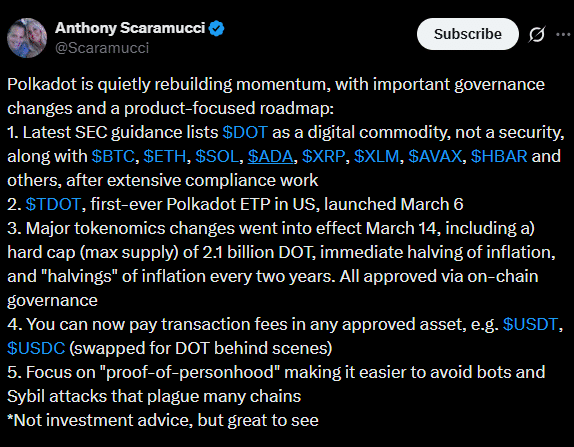
According to the crypto investor, the latest regulatory update and major tokenomics were some of the bullish catalysts that are ‘quietly rebuilding momentum’ for the chain.
Source: X

In the latest SEC guidance, DOT was categorized as a digital commodity like Bitcoin and Ethereum.

Beyond regulatory clarity, the recent tokenomics overhaul has hard-capped DOT supply at 2.1 billion. Additionally, the annual emissions were cut from 120 million DOT to 55 million DOT, marking a 53% cut.

The 21Shares Spot DOT ETF was another key catalyst, according to Scaramucci.

However, since the product debuted, it has only seen one day of inflow of $544.5K. For the rest of March, the Spot DOT ETF has seen zero flows, suggesting that the demand is not as strong as the analyst projected.

But the ETF demand isn’t the only thing lagging for DOT.

Polkadot network activity declining

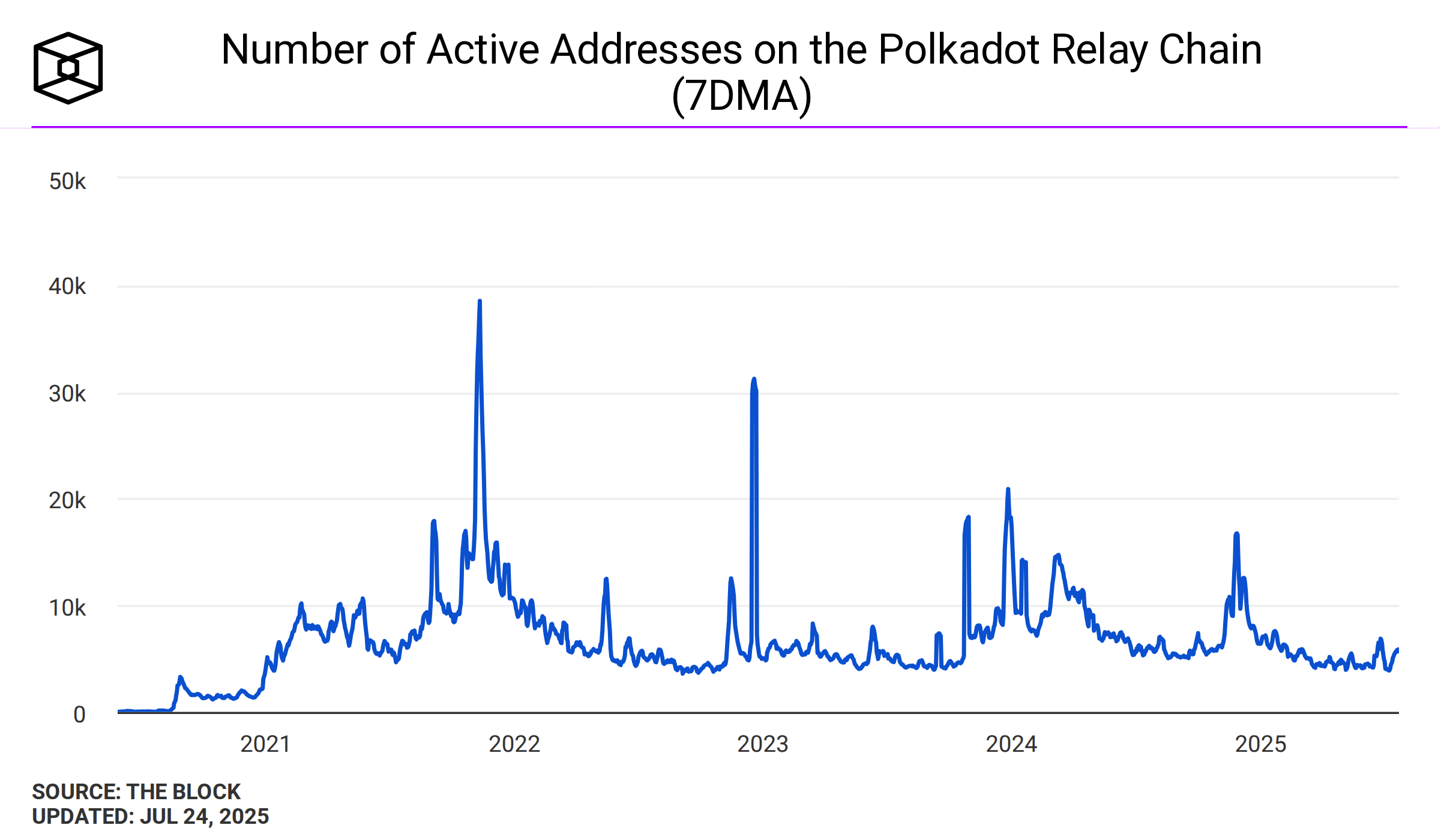
On the network activity and adoption, Polkadot has seen a significant loss in traction. Apart from the initial broader market hype and rally in late 2024, the chain’s adoption has been in a free fall.

This was illustrated by the drop in weekly average active addresses, slipping from 16K to 5K in the past two years.
Source: The Block

It remains to be seen whether the recent tokenomics overhaul will attract users again.

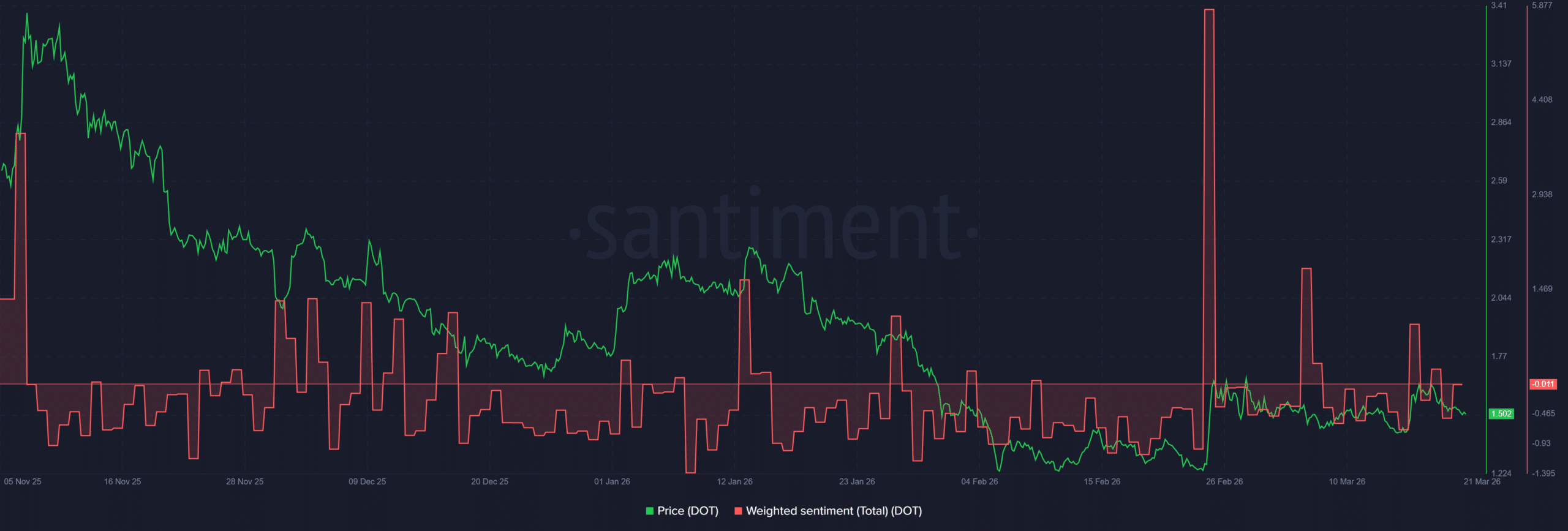
On market dynamics, DOT’s tokenomics and deflation push saw sentiment briefly flip positive before reverting to negative.
Source: Santiment

In other words, the changes temporarily tipped traders to go bullish on the altcoin. In fact, during the spike in positive sentiment, the altcoin rallied 18%. Put differently, the market welcomed the recent upgrades.

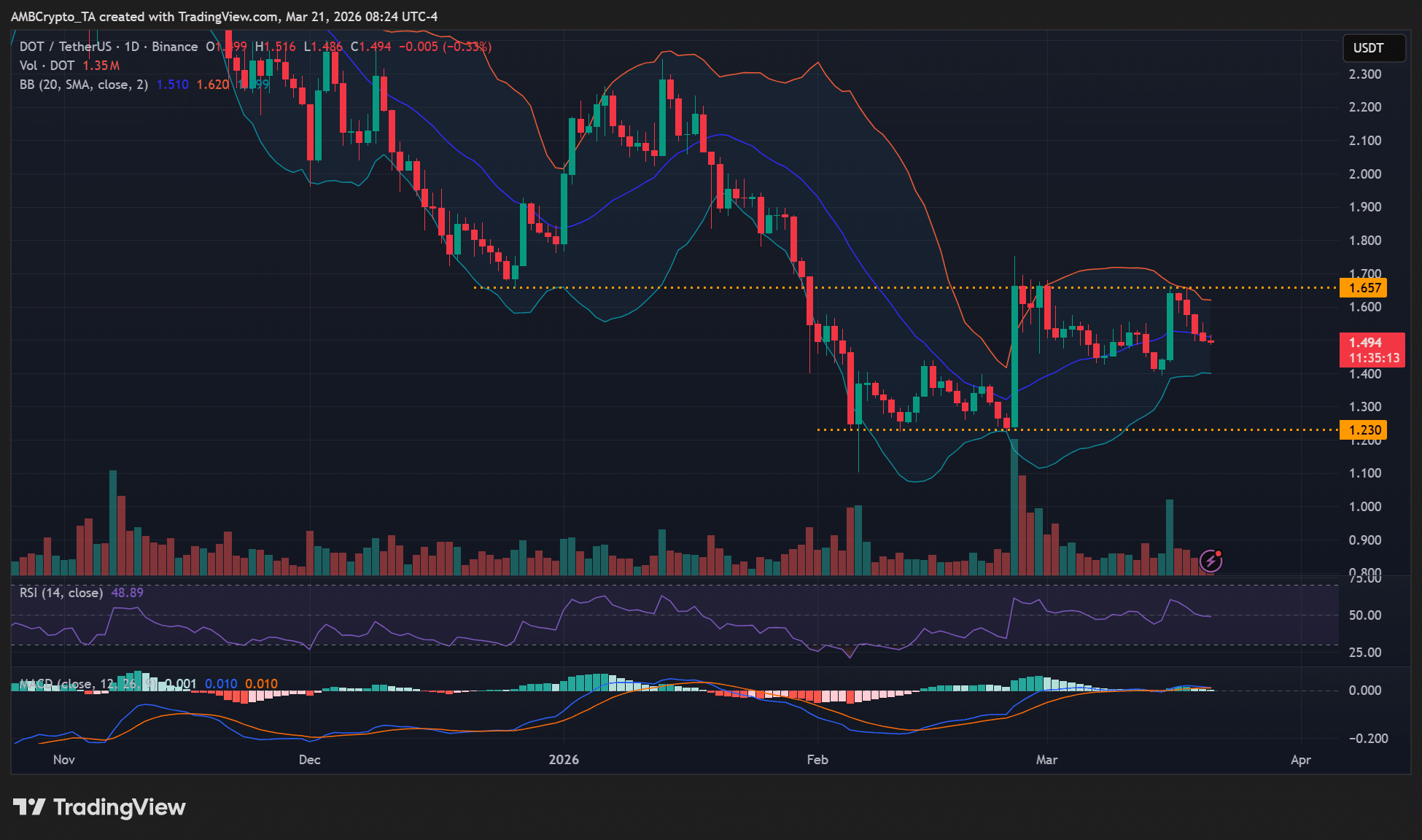
Meanwhile, the DOT rally faded at $1.65, a key roadblock in Q1 2026. If the ongoing macro uncertainty persists, DOT may extend the pullback to $1.23.
Source: DOT/USDT, TradingView

Overall, Scaramucci highlighted key bullish catalysts for the Polkadot chain and its native token. Even so, the chain’s traction has worsened in the past two years. It was unclear how fast the recent changes would reignite momentum and eventually lift DOT.


Final Summary

  • For SkiBridge’s Scaramucci, Polkadot’s bullish case was ‘quietly rebuilding momentum’ after recent upgrades.
  • The chain’s traction has declined in the past two years, but whether recent updates will help revive it remains to be seen.


Preguntas relacionadas

QWhat are the key bullish catalysts for Polkadot mentioned by Anthony Scaramucci?

AThe key bullish catalysts mentioned are the latest SEC guidance categorizing DOT as a digital commodity, the tokenomics overhaul that hard-capped DOT supply at 2.1 billion and cut annual emissions by 53%, and the launch of the 21Shares Spot DOT ETF.

QHow has Polkadot's network activity changed in the past two years according to the article?

APolkadot's network activity has significantly declined, with weekly average active addresses dropping from 16K to 5K over the past two years.

QWhat was the market reaction to Polkadot's recent tokenomics changes?

AThe tokenomics changes temporarily flipped market sentiment positive, resulting in an 18% price rally for DOT, though the positive sentiment eventually reverted to negative.

QWhat does the article say about the performance of the 21Shares Spot DOT ETF?

AThe ETF saw only one day of inflows totaling $544.5K since its debut and recorded zero flows for the rest of March, indicating weaker demand than projected.

QWhat are the key resistance and support levels mentioned for DOT's price?

AThe rally faded at the key resistance level of $1.65, and if macro uncertainty persists, DOT could extend its pullback to the support level of $1.23.

Lecturas Relacionadas

70-Page Confidential Document's First Allegation: 'Lying', Altman Told the Board 'I Can't Change My Character'

In a major investigation, Pulitzer winner Ronan Farrow and Andrew Marantz reveal two previously undisclosed documents: a ~70-page confidential file compiled by former OpenAI chief scientist Ilya Sutskever and over 200 pages of internal notes by Anthropic CEO Dario Amodei from his time at OpenAI. Sutskever’s file, which opens with the accusation that Sam Altman exhibited a "pattern of lying," alleges he misled executives and the board on safety protocols and corporate matters. Amodei’s notes similarly claim “the problem at OpenAI is Sam himself,” citing instances like Altman denying agreed-upon terms in Microsoft’s $1 billion deal. Key revelations include: - No written report was produced from the post-reinstatement independent investigation into Altman. - OpenAI’s superalignment team received only 1-2% of the promised computing resources, mostly on outdated clusters. - In 2018, executives considered a "National Plan" to auction AI tech to nations including China and Russia. - Microsoft executives expressed strong distrust toward Altman, with one comparing his risk profile to figures like Bernie Madoff. During a board call after his firing, Altman reportedly said, "I can’t change my personality," which a director interpreted as an admission of persistent dishonesty. Altman denies intentional deception, attributing his behavior to "well-intentioned adaptation" and conflict avoidance.

marsbitHace 29 min(s)

70-Page Confidential Document's First Allegation: 'Lying', Altman Told the Board 'I Can't Change My Character'

marsbitHace 29 min(s)

Trading

Spot
Futuros
活动图片