SEC Pushes for All-Day Trading in US Stocks, Will RWA's Biggest Advantage Disappear?

Foresight NewsPublicado a 2026-07-27Actualizado a 2026-07-27

Resumen

**Summary: SEC Advances Towards 24-Hour U.S. Stock Trading, Impact on Crypto RWA Tokens** The U.S. Securities and Exchange Commission (SEC) has announced a public roundtable for September 17th to discuss preparations for moving the U.S. equity markets towards 24-hour trading. This signals a potential substantive shift from the traditional 9:30 AM to 4:00 PM ET trading day to a near 24/5 model (23 hours a day, 5 days a week) by late 2026 or early 2027, pending regulatory approval and infrastructure alignment. Key exchanges like NYSE Arca and Nasdaq are planning extended hours, and critical clearing infrastructure from DTCC already supports 24/5 operations. For the crypto industry, particularly the Real World Asset (RWA) tokenization sector, this development directly challenges a core narrative: that tokenized assets offer superior, round-the-clock trading access compared to traditional markets. As U.S. stocks become tradable for most of the global day, the simple advantage of "24/7 availability" for tokenized equities diminishes. This may pressure RWA platforms that relied heavily on this differentiation. However, the shift also presents opportunities for deeper integration. True 7x24 trading including weekends, near-instant atomic settlement on-chain, and programmable features like automated dividends remain inherent blockchain advantages. The regulatory environment is evolving in parallel, with the SEC including tokenized securities in its agenda, potentially creating cle...


Author: Ma He, Foresight News


On July 23, the U.S. Securities and Exchange Commission (SEC) announced it will host a public roundtable on September 17 at its Washington, D.C. headquarters, focusing on preparations for moving towards 24-hour trading in the U.S. stock market. The meeting will discuss infrastructure supporting overnight trading, operations and resilience under a 24-hour market, as well as opportunities and challenges associated with expanding trading hours.



SEC Chairman Paul S. Atkins stated in the announcement: "We are stepping into a new day—and a new night—for the U.S. stock market. As overnight trading expands, I look forward to aligning the U.S. stock market with those markets that have already achieved continuous trading, while also anticipating striking a balance between all-day trading and crucial investor and customer protection."


This roundtable may represent a critical juncture in the substantive transition of U.S. stocks from traditional trading hours to a near-continuous (23x5) model. For the crypto industry, especially the RWA (Real World Asset) tokenization sector, this change both compresses some of its differentiation narratives and opens up deeper avenues for integration.


U.S. Stock Trading Embraces Change


Since 1985, the regular trading hours for major exchanges like the New York Stock Exchange and Nasdaq have been fixed at 9:30 AM to 4:00 PM Eastern Time, Monday through Friday. This arrangement has persisted for over forty years.


While the long-standing maintenance of regular trading hours for U.S. stocks is conducive to centralized price discovery and lower operational costs, in today's era of highly electronic global capital flows, this setup is outdated. Investors in Asia and Europe who wish to trade U.S. stocks during their local daytime often have to rely on futures or the illiquid pre-market and after-hours sessions, an experience far less smooth than trading crypto assets. Simultaneously, retail investors, accustomed to placing orders anytime via mobile apps, are growing increasingly impatient with the "waiting period" after major news announcements when they cannot trade immediately.


Outside regular hours, limited extended trading windows exist. Pre-market trading typically runs from early morning until 9:30 AM; after-hours trading extends from 4:00 PM to around 8:00 PM. These extended sessions are provided by various exchanges, alternative trading systems (ATS), and brokerage platforms, but liquidity is significantly lower than during regular hours, with wider spreads and less efficient price discovery. Regulatory bodies like FINRA have repeatedly warned investors of higher volatility and execution risks during extended hours.


In recent years, some brokers and ATS have further extended trading into overnight hours. For instance, platforms like Interactive Brokers offer overnight trading from Sunday 8:00 PM to approximately 3:50 AM Friday (with brief maintenance windows in between), covering select S&P 500, Nasdaq 100 components, and ETFs. However, according to public market observations, genuine overnight trading volume has long constituted a tiny fraction of the total market, making it difficult to establish deep price discovery.


Overall, U.S. stocks remain characterized by a core of "concentrated trading on weekday days," with markets completely closed on weekends and most holidays. This stands in stark contrast to the crypto asset market's 7x24, year-round operational model, a contrast often emphasized as a point of differentiation in RWA tokenization narratives.


23/5 Trading?


Since 2024, several exchanges and market infrastructure institutions have accelerated efforts towards near-continuous trading.


24X National Exchange is the first SEC-approved national securities exchange authorized to conduct 23-hour trading (23x5), planning to formally launch a complete 23/5 night session in the second half of 2026. NYSE Arca plans to extend trading hours to approximately 22 hours, also targeting the end of 2026. Nasdaq has publicly proposed a "Global Trading Hours" plan, intending to add a night session from 9:00 PM to 4:00 AM the next day, combined with existing hours to create a nearly 23-hour trading day, also targeting the second half of 2026, contingent on regulatory approval and alignment of industry infrastructure. Cboe is also advancing its 23x5 plans for platforms like EDGX.


Progress at the infrastructure level is even more crucial. DTCC's National Securities Clearing Corporation (NSCC) launched its 24x5 clearing service on June 28, 2026, covering trading activities from Sunday 8:00 PM to Friday 8:00 PM, providing immediate central counterparty guarantees for overnight trades and significantly reducing counterparty risk.


These developments suggest that by late 2026 to early 2027, U.S. stocks may achieve near-continuous trading on weekdays within the regulatory framework. True 7x24 trading (including weekends) still faces higher barriers, but the direction towards "money never sleeps" has moved from discussion to implementation. The September 17 roundtable is precisely the SEC's initiative to publicly align exchanges, market makers, clearing agencies, brokers, and investor representatives on core issues such as operational resilience, liquidity management, and investor protection before formally scaling up these changes.


Crypto RWA Platforms


The shift of U.S. stocks towards near-continuous trading directly impacts one of the most commonly used selling points by RWA tokenization platforms in the past—"traditional markets only trade during the day, but on-chain you can trade 7x24."
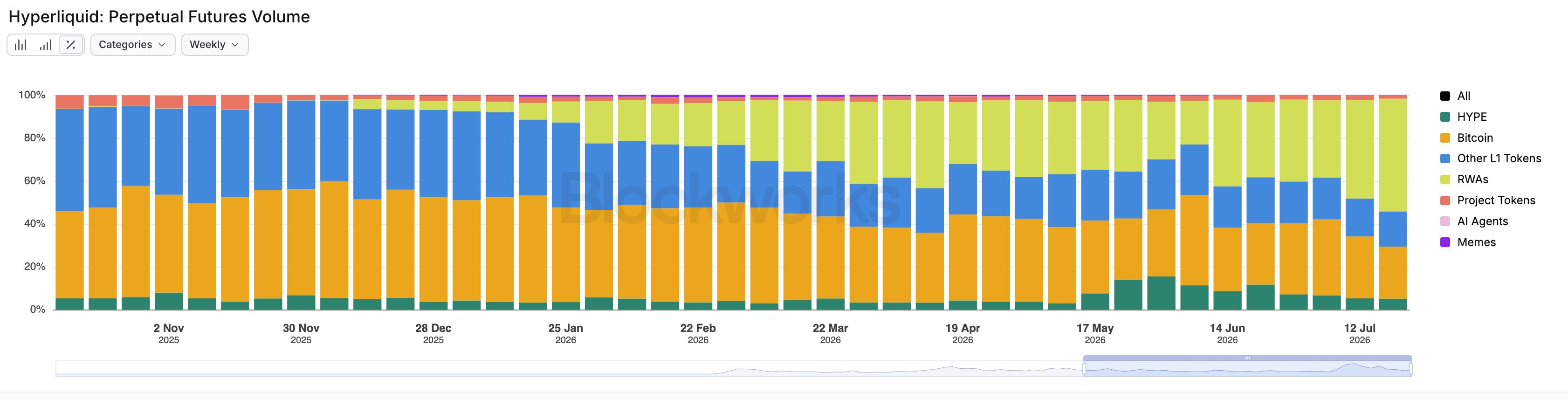


The current RWA market has reached a certain scale, especially in perpetual futures trading volume. According to the latest data from Blockworks, last week, RWA trading volume on the Hyperliquid platform surpassed crypto asset trading volume for the first time, accounting for 54% of the platform's total trading volume. Among these, single-stock trading has become the fastest-growing category. Since June, individual stock trading volume has exceeded that of indices and commodities, now constituting about 61% of Hyperliquid's total RWA trading volume, indicating that on-chain financial markets are expanding from pure crypto asset trading towards traditional assets.


Once U.S. stock trading hours are extended, the mere appeal of "being able to trade real stocks during Asian hours or at night" will be diluted. Institutions and cross-border investors will be able to execute near-continuous trades more directly on regulated traditional exchanges and ATS, without having to rely entirely on tokenized channels. For many large funds, the traditional path remains more attractive in terms of compliance costs, custody, and settlement certainty.


However, the impact is not entirely negative.


True 7x24 trading and instant atomic settlement remain on-chain advantages. Even if U.S. stocks achieve 23x5, gaps on weekends and holidays will persist, and clearing and settlement will still rely on the DTCC system, making it difficult to completely eliminate T+0 and T+1 frictions. RWA tokens can achieve near-instant ownership transfer and settlement on public blockchains and naturally support programmable logic, including automated dividends, collateralization, and composability.


The regulatory environment is evolving simultaneously. Under the leadership of Paul Atkins, the SEC has explicitly included "facilitating on-chain trading of tokenized securities" in its 2026 regulatory agenda and is advancing a token classification framework. Tokenized securities are still defined as securities subject to federal securities laws, but innovative exemptions and related rule adjustments are under discussion. DTCC is also progressing with tokenized settlement pilots. The experience accumulated in managing overnight liquidity, price protection, and system resilience during the extension of U.S. stock trading hours actually provides a reference for regulated RWA secondary markets.


Some crypto platforms have already explored collaborations, such as integrating tokenized U.S. stocks with traditional account systems and global liquidity. On July 10 this year, Backpack launched the world's first 7x24 real U.S. stock trading market for international investors, allowing users to buy, sell, and hold real U.S. stocks around the clock, not synthetic derivatives.


Ondo's tokenized stocks are backed 1:1 by underlying securities and are linked to traditional market liquidity through minting and redemption mechanisms. Users can trade these tokens directly on crypto exchanges, while non-U.S. users gain more convenient exposure to U.S. stocks.


For RWA platforms, the true moat is shifting from "trading time differentiation" to "settlement finality, cross-border accessibility, DeFi composability, and interoperability with traditional infrastructure." The tokenization of private credit, real estate, alternative assets, and other non-public market assets will be less impacted by changes in U.S. stock trading hours and may even benefit from the overall increased acceptance of tokenization.


Risks also need to be acknowledged. Liquidity during overnight hours will inevitably be thin initially, making prices more susceptible to moves. If RWA platforms open trading during low-liquidity windows, they must simultaneously strengthen risk controls, circuit breakers, and market-making mechanisms; otherwise, they risk amplifying volatility and damaging industry credibility. The regulatory pressure on purely permissionless, synthetic products may also increase further as traditional markets extend trading hours, thereby enhancing the value of compliant issuance and ATS/exchange pathways.


Preguntas relacionadas

QWhat key development announced by the SEC could accelerate the transition of U.S. stock markets towards near-24/5 trading, and what is its purpose?

AThe SEC announced a public roundtable to be held on September 17th, focusing on the preparations for moving towards 24-hour trading in U.S. equity markets. Its purpose is to discuss the supporting infrastructure, operational resilience, and the opportunities and challenges of extending trading hours, serving as a key alignment point before a large-scale rollout.

QAccording to the article, what is one of the most frequently highlighted selling points for RWA (Real World Asset) tokenization platforms that is now being challenged by the move towards extended U.S. stock trading hours?

AOne of the most frequently highlighted selling points for RWA platforms that is being challenged is the argument that 'traditional markets can only trade during the day, while on-chain trading can be 7x24.' As U.S. markets move to nearly 24/5 operation, this time-based advantage is being diluted.

QWhat are some of the core advantages of on-chain RWA tokenization that are expected to remain significant even if U.S. stocks achieve 23/5 trading?

AEven with 23/5 trading, core on-chain advantages include: 1) True 7x24 operation (including weekends and holidays). 2) Near-instant atomic settlement/finality, eliminating T+0/T+1 friction. 3) Programmable logic (e.g., automatic dividends, collateralization, composability). 4) Cross-border accessibility and interoperability with DeFi.

QName one platform where RWA trading volume recently exceeded its crypto-native asset trading volume, and what was the fastest-growing category within its RWA segment?

AAccording to the article, on the Hyperliquid platform, RWA trading volume recently exceeded crypto asset trading volume, making up 54% of total platform volume. The fastest-growing category within its RWA segment is single-stock trading, which accounted for about 61% of its RWA volume since June.

QWhat potential risk for RWA platforms is highlighted in the article regarding trading during low-liquidity periods like extended or overnight hours?

AThe article highlights that if RWA platforms operate during low-liquidity windows (like initial overnight periods), they must strengthen risk controls, circuit breakers, and market-making mechanisms. Otherwise, they risk amplifying price volatility and damaging the industry's credibility due to easier market manipulation or poor execution.

Lecturas Relacionadas

The 800x Golden Dog, "Gacha" Saves NFT Trading

Title: 800x Golden Dog: How 'Gacha' Mechanics Are Rescuing NFT Trading In the past month, the on-chain TCG (Trading Card Game) narrative, centered around "gacha" or loot box mechanics, has emerged as a major crypto-native revenue generator, second only to platforms like Hyperliquid and pump.fun. Recently, this trend hit Ethereum with Fake World Assets (FWA). Within just over a week, FWA generated approximately $1.3 million in revenue, ranking 15th in the past week's crypto app earnings. Its token, $FWA, surged from an initial market cap of ~$47,550 to a peak of ~$38.8 million—an 800x gain. Meanwhile, Collector Cards' token $CARDS declined significantly from its previous highs. FWA, developed by the team behind "PunkStrategy," operates as an NFT gacha system with a built-in token flywheel. Users deposit NFTs paired with ETH as liquidity into pools. Each deposit creates a personal pool; more ETH deposited lowers the chance of the NFT being "won" in a draw. Players spend ETH to "draw" (gacha). If they get an undesirable NFT, they can instantly sell it back to the original depositor at an 85% discount, generating income for the depositor. A 1% fee is taken on each draw and on depositor earnings when an NFT is kept. The key to FWA's momentum is its token $FWA. It cannot be bought directly externally. The primary way to acquire it is by playing the gacha and choosing to receive $FWA (instead of ETH) when selling back an unwanted NFT. This mechanism creates constant buy pressure for $FWA as players engage, especially during its price ascent. Early participants who held $FWA benefited massively from subsequent inflows. This contrasts with projects like Collector Cards, which, despite strong revenues, suffer from perceived low token utility beyond buybacks. In conclusion, while FWA's flywheel design—linking speculative token gains directly to NFT trading activity—has driven rapid growth, its sustainability is questionable. The model relies heavily on continuous $FWA price appreciation to offset the inherent negative expectancy of each draw. When price momentum stalls, activity will likely decline. The case highlights that in crypto markets, pure profitability narratives can be fleeting; understanding the relationship between attention, token buy pressure, and sustainable mechanics is crucial to avoid speculative pitfalls.

marsbitHace 20 min(s)

The 800x Golden Dog, "Gacha" Saves NFT Trading

marsbitHace 20 min(s)

The Quantum Computing Threat Approaches, Cryptocurrency May Be Exposed to Risks Before Banks

Quantum computing poses a significant threat to all cryptographic systems, including banks and governments, but decentralized cryptocurrencies with public ledgers like Bitcoin are likely the first practical target. Experts warn that a cryptographically relevant quantum computer (CRQC), capable of running Shor's algorithm to break the elliptic curve cryptography securing most crypto wallets, could emerge around 2029. Recent research shows the required quantum resources for such attacks are shrinking dramatically, potentially enabling key extraction in minutes. The core vulnerability for cryptocurrencies is not the cryptography itself—post-quantum standards are being developed—but the slow, decentralized governance required to implement upgrades. Unlike centralized banks that can swiftly transition, Bitcoin needs near-unanimous consensus among its global network, a historically difficult process as seen in past upgrades. Estimates suggest migrating all vulnerable Bitcoin funds could take at least 76 days of dedicated network time, and it must be completed before a CRQC exists to prevent "now-or-never" attacks on exposed keys. The threat is not binary; it begins when a quantum computer can decrypt data before it loses value, not necessarily in real-time. A significant portion of Bitcoin (estimated at millions of coins) already has public keys permanently exposed on-chain, making them vulnerable to eventual "static attacks." While technical solutions exist, the race is against time for decentralized networks to coordinate a defensive transition, serving as an early warning for the broader financial system.

marsbitHace 31 min(s)

The Quantum Computing Threat Approaches, Cryptocurrency May Be Exposed to Risks Before Banks

marsbitHace 31 min(s)

On the First Day of Listing, Changxin Technology's Market Value Exceeds 3 Trillion Yuan, Which Securities Firm Has the Largest Floating Profit?

On July 27th, Changxin Technology, the largest-ever IPO on China's STAR Market, debuted with its share price soaring 465.82% to close at 49 yuan. Its market capitalization reached 3.28 trillion yuan, instantly making it the most valuable A-share company. The stellar performance delivered substantial gains for involved securities firms, primarily through equity investments rather than underwriting fees. China Merchants Securities emerged as the biggest winner. Its direct investment subsidiary, Zhaozheng Investment, alone holds a 0.54% pre-issue stake, translating to a paper profit exceeding 155 billion yuan based on the first-day closing price—surpassing the firm's entire 2025 net profit of 123.5 billion yuan. Other major beneficiaries include Huaan Securities, with an estimated profit of around 123 billion yuan from its 0.44% stake, and the lead underwriters, CICC and CITIC Securities, which each gained approximately 46 billion yuan from mandatory follow-on investments. Firms like Founder Securities, Haitong Securities, and GF Securities also reported significant holdings valued in the billions. Despite these paper gains, shares of some brokerages like Huaan and China Merchants fell on the listing day, reflecting broader market pressures. Analysts remain bullish on Changxin's long-term prospects, citing the AI-driven demand surge for DRAM (Dynamic Random-Access Memory) and a supportive supply-demand dynamic with projected shortages through 2028. As China's largest and most advanced integrated DRAM designer and manufacturer, Changxin is poised to capture growth from domestic substitution and global market shifts, potentially challenging the current "big three" oligopoly (Samsung, SK Hynix, Micron). The IPO proceeds, focused on capacity upgrades and R&D, are expected to accelerate China's semiconductor self-sufficiency.

marsbitHace 1 hora(s)

On the First Day of Listing, Changxin Technology's Market Value Exceeds 3 Trillion Yuan, Which Securities Firm Has the Largest Floating Profit?

marsbitHace 1 hora(s)

Will Changxin Technology Continue to Rise Today?

Changxin Technology made a historic debut on the stock market, with its share price soaring 465.82% to close at 49 yuan. Its market capitalization reached 3.28 trillion yuan, surpassing Industrial and Commercial Bank of China to become the largest company by market cap on the A-share market. Daily trading volume exceeded 140 billion yuan, a first in A-share history. This created a moment of realization for 7.7 million investors who won the lottery for its shares. On the first day, investor strategies varied: some sold immediately and later regretted missing intraday highs, others secured profits to avoid future volatility, while a third group held or even bought more shares, betting on long-term growth. The staggering IPO, massive public enthusiasm, and debut during a peak industry cycle led some to compare Changxin to PetroChina's 2007 listing, which was followed by a long decline. Key similarities noted include comparable fundraising scales (approx. 666 billion yuan for Changxin vs. 668 billion for PetroChina) and both companies listing at a perceived high point in their respective commodity cycles (oil then, memory chips now). However, analysts caution against over-simplifying the comparison. They highlight core differences: Changxin operates in the high-growth semiconductor sector with strong "domestic substitution" tailwinds. Brokerages like Huaxi Securities project significant revenue and profit growth from 2026 to 2028, driven by DDR5 adoption, product mix optimization, and economies of scale. Nomura Securities issued a "buy" rating with a 116 yuan target price, citing AI-driven demand for DRAM, tight supply as major players shift to HBM production, and Changxin's vast room for market share growth. Some analysts position the current memory cycle, fueled by AI, as just beginning, contrasting with the mature energy cycle PetroChina entered. The article concludes that for investors, monitoring the memory cycle's progression and Changxin's breakthroughs in high-end technologies like HBM will be crucial, rather than relying on superficial historical parallels.

marsbitHace 1 hora(s)

Will Changxin Technology Continue to Rise Today?

marsbitHace 1 hora(s)

Trading

Spot
活动图片