GTreasury unveils ‘Ripple Treasury’ – Is TradFi about to get disrupted?

ambcryptoPublicado a 2026-01-29Actualizado a 2026-01-29

Resumen

Ripple and GTreasury have launched "Ripple Treasury," a product integrating XRPL blockchain rails with GTreasury's enterprise treasury software. This partnership aims to streamline financial operations for GTreasury's network of 13,000 banks, targeting faster, cheaper cross-border payments and offering full cash visibility for flows up to $12.5 trillion. Ripple's native stablecoin, RLUSD, which has seen significant growth and dominates XRPL's stablecoin market, provides the on-chain liquidity. This move positions XRPL as a bridge into traditional finance (TradFi), using blockchain to enhance efficiency, liquidity management, and risk oversight in banking operations.

What started as tech to support “decentralization” has now found its footing in the financial world. With how things are shaping up, the future looks bright for decentralized finance (DeFi) and the way we handle money.

Payments are naturally the ground most L1 blockchains are now targeting as a bridge from TradFi to DeFi. Ripple’s [XRP] $1 billion acquisition of GTreasury last year, for instance, was a major step in line with this strategy.

Building on that move, Ripple and GTreasury have now teamed up to launch Ripple Treasury, aiming for faster cross-border payments by plugging XRPL rails into GTreasury’s enterprise-grade treasury software.

As noted on Ripple’s official website, the goal of the treasury is to streamline financial operations for GTreasury’s network of 13,000 banks, offering 100% cash visibility and supporting flows of up to $12.5 trillion.

At the macro level, this move is another major boost for XRPL’s real-world adoption. Its native stablecoin, RLUSD, powers these payments by providing on-chain liquidity, faster settlement, and a seamless experience.

In short, this partnership shows how blockchain can do what traditional banks do, but faster, cheaper, and more efficiently. Naturally, it raises a key question: Is this Ripple’s first “real” step toward outpacing TradFi?

Ripple brings blockchain speed to banks

Ripple’s RLUSD is showing its growing impact in the market.

According to DeFiLlama, its circulating supply on XRPL has jumped 15.36% over the past 30 days, bringing the total to 388 million. That’s 60 million added in on-chain liquidity, ready as dry powder for real-world use.

And it’s not stopping there. The total stablecoin market on XRPL hit a $400 million ATH, with $100 million added so far in 2026. RLUSD makes up 83% of that, cementing its role as the backbone of the network’s liquidity.

In this context, Ripple’s push into TradFi isn’t random.

Instead, its growing stablecoin presence is positioning XRPL as a bridge. Think of it this way: RLUSD acts like a digital highway, letting banks move money instantly while still connecting to the systems they already use.

However, with Ripple Treasury now in place, the system adds a full suite of enterprise-grade treasury tools like liquidity management, risk oversight, and payments, bringing blockchain speed straight into traditional finance.

Against this backdrop, the Ripple–GTreasury partnership isn’t just another move to support banks. Instead, it’s a strategic push into the heart of TradFi, using stablecoins to make banking operations more efficient.


Final Thoughts

  • Ripple and GTreasury have launched a Ripple Treasury to integrate XRPL rails with GTreasury’s enterprise-grade tools.
  • Ripple is positioning XRPL as a bridge for traditional finance, using stablecoins to make banking faster, cheaper, and more efficient.

Preguntas relacionadas

QWhat is the main goal of the newly launched 'Ripple Treasury' by GTreasury and Ripple?

AThe main goal of Ripple Treasury is to streamline financial operations for GTreasury's network of 13,000 banks by offering 100% cash visibility, supporting massive payment flows, and enabling faster cross-border payments by integrating XRPL's blockchain rails with GTreasury's enterprise-grade treasury software.

QHow does Ripple's stablecoin, RLUSD, contribute to the XRPL ecosystem according to the article?

ARLUSD provides on-chain liquidity, enables faster settlement, and offers a seamless payment experience. It acts as the backbone of the network's liquidity, making up 83% of the total stablecoin market on XRPL, which recently hit a $400 million all-time high.

QWhat was the strategic significance of Ripple's $1 billion acquisition of GTreasury last year?

AThe acquisition was a major strategic step to bridge TradFi and DeFi, specifically targeting the payments sector. It laid the foundation for integrating Ripple's blockchain technology with GTreasury's established treasury management tools for traditional financial institutions.

QWhat specific advantages does the article claim blockchain technology has over traditional banking (TradFi)?

AThe article states that blockchain can perform the same functions as traditional banks but with greater speed, lower cost, and higher efficiency. It highlights faster cross-border payments, improved liquidity management, and enhanced risk oversight as key advantages.

QHow much has the circulating supply of RLUSD on XRPL increased in the past 30 days, and what does this signify?

AThe circulating supply of RLUSD on XRPL has jumped 15.36% in the past 30 days, adding 60 million in on-chain liquidity. This growth signifies increasing market adoption and readiness of 'dry powder' for real-world financial use cases.

Lecturas Relacionadas

Embodied Intelligence Breakthrough: Amap Fully Open-Sources Universal Robot Base Model ABot-M0

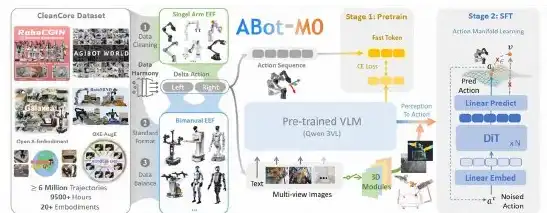
Embodied Intelligence Breakthrough: AutoNavi Open-Sources Universal Robot Base Model ABot-M0 AutoNavi has announced the full open-source release of ABot-M0, the world's first unified architecture-based embodied manipulation base model. This model is designed to enable "one general brain to adapt to multiple forms of robots," aiming to break down barriers between heterogeneous hardware and accelerate the adoption of embodied intelligence in industrial and household settings. ABot-M0 demonstrated exceptional performance in industry tests, achieving a task success rate of 80.5% on the Libero-Plus benchmark—a nearly 30% improvement over the previous benchmark, Pi0. It also set new state-of-the-art records on benchmarks like Libero and RoboCasa. The open-source release addresses long-standing challenges in the field, such as data isolation and deployment difficulties, by providing resources across three key dimensions: - **Data:** The UniACT dataset, the largest of its kind, with over 6 million real operation trajectories and full data pipeline tools. - **Algorithm:** The model architecture and training framework, featuring innovative components like Action Manifold Learning (AML) and a dual-stream perception architecture. - **Model:** End-to-end pre-trained models and a complete toolchain for out-of-the-box deployment, significantly lowering the barrier to adaptation. According to AutoNavi's ABot-M0 technical lead, this open-source initiative aims to build a bridge between academic research and industrial application, enabling robots of various forms to possess a smart, reliable, and universal "brain."

marsbitHace 14 min(s)

Embodied Intelligence Breakthrough: Amap Fully Open-Sources Universal Robot Base Model ABot-M0

marsbitHace 14 min(s)

Will Middle Management Be Replaced by AI? What Will the Future Company Structure Look Like

The article explores whether AI will eliminate middle management and reshape future corporate structures. It traces the historical evolution of organizations—from Roman military units to modern corporations—showing how hierarchical systems emerged to manage information flow under the constraint of limited "span of control." Middle management, matrix structures, and bureaucratic systems were all solutions to coordination challenges in information-scarce environments. AI, however, challenges this foundational premise. By enabling real-time modeling, understanding, and distribution of information, AI could replace human-centric coordination mechanisms. Examples like the AI firm "Moon Dark Side" illustrate radical experiments: no departments, titles, or traditional KPIs, with co-founders directly managing large teams and AI agents handling tasks from data processing to code generation. Block (founded by Jack Dorsey) is presented as a case study in building an "intelligent company." This model relies on two core components: a "company world model" (a real-time understanding of internal operations via digital traces) and a "customer world model" (built from real behavioral data, especially financial transactions). An intelligence layer uses these models to dynamically combine capabilities (e.g., payments, lending) to serve customers proactively, without pre-defined product roadmaps. In this structure, traditional roles shift. Middle managers are replaced by a system that handles coordination, while humans focus on individual contributions (ICs), direct responsibility (DRIs), or player-coach roles. The organization becomes flatter, faster, and more adaptive. The article concludes that AI is not just a tool for efficiency but a transformative force that could redefine organizational design, moving companies from human-led hierarchies to system-driven intelligence.

marsbitHace 23 min(s)

Will Middle Management Be Replaced by AI? What Will the Future Company Structure Look Like

marsbitHace 23 min(s)

Trading

Spot
Futuros
活动图片