‘Disappointing’ — crypto advocates react to delay in CLARITY vote

cointelegraphPublicado a 2026-08-10Actualizado a 2026-08-10

Resumen

The Digital Asset Market Clarity (CLARITY) Act's Senate cloture vote has been delayed until September, disappointing crypto industry advocates who see the postponement as reducing the bill's chances of passing before the 2026 midterm elections. The Senate's inaction before its recess frustrated supporters like Senator Cynthia Lummis. While figures such as Coinbase's CEO remain hopeful for September, banking critics argue the bill creates unfair advantages. Despite the setback, prediction markets still show some users betting on the legislation passing this year, though it would require further votes in the House and the President's signature to become law.

With the Digital Asset Market Clarity (CLARITY) Act now set for a cloture vote in September, many advocates and industry leaders are frustrated and disappointed at lawmakers’ failure to act before the US Senate broke for a month-long recess.

On Saturday, the Senate Daily Press reported that Majority Leader John Thune filed cloture on a motion for the CLARITY Act to go to the chamber floor for consideration, ending speculation that lawmakers would address the bill more than a year after it was passed by the House of Representatives. The CLARITY vote is now expected when the Senate reconvenes in mid-September, and would require support from 60 senators to pass.

Across the crypto industry, many executives and advocates expressed their disappointment with the Senate’s inaction, as the push to September will happen with just 50 days before the 2026 midterm elections, likely reducing the odds of CLARITY passing.

“[Y]ou can imagine how frustrated I am,” said Senator Cythnia Lummis on Friday after the chamber did not schedule a vote on CLARITY, adding: “I will continue working with my colleagues to get this done — this fight is far from over.”
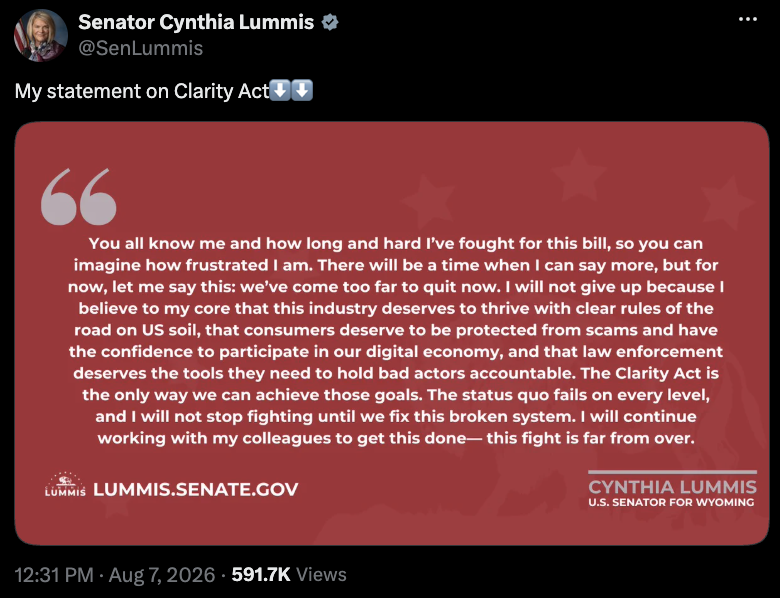
Source: Cynthia Lummis

Others, including Coinbase CEO Brian Armstrong and the exchange’s chief policy officer Faryar Shirzad, called the Senate’s action “disappointing” but said that September would be the time to “finish the job.” Bitmine Chair Tom Lee noted in the company’s weekly report that “financial markets seem more focused on the recent softer inflation and jobs data” rather than any potential impact of CLARITY not passing.

While there were reports of progress in bipartisan talks on the crypto market structure bill, lawmakers in the Senate didn’t announce solutions in response to pushes from many Democrats for stricter ethics provisions, in particular for rules affecting US President Donald Trump’s crypto investments. Trump continues to face scrutiny from many in Congress over his family’s crypto business, World Liberty Financial, and his own projects, including the memecoin launched days before he took office.

Some banking advocates, in contrast, have been pushing lawmakers to address how CLARITY could still allow companies to pay interest to stablecoin holders in certain situations, challenging the industry. In a Thursday Wall Street Journal op-ed published before Thune’s cloture motion, the publication’s editorial board said that, under CLARITY, small banks would miss out “because they rely on interest payments to attract deposits.“ The editorial continued:

“The Clarity Act can serve a useful purpose with some language changes,“ said the editorial board. “The crypto industry and its friends in Washington portray themselves as defenders of free markets. What they really want is to be quasi-banks without abiding by the same regulations.“

Related: CLARITY Act delay gives Asian financial hubs an opening: First Digital CEO

Prediction market users still anticipating CLARITY by 2027

Despite the setback for the bill in Congress, some event contracts on prediction market platforms are still offering users favorable odds on CLARITY passing by the end of the year.

On Kalshi, an event contract with $1.23 million wagered gave users an 88% chance of the Senate voting on the legislation before Oct. 1, while a similar one on Polymarket gave a 26% chance of the bill being signed into law this year. That contract had total wagers topping $5.79 million. If passed by the Senate, CLARITY would need to return to the House for a vote before potentially going to Trump’s desk.

Magazine: BIP-110 ends with a whimper, CLARITY vote punted: Hodler’s Digest, Aug. 9

Preguntas relacionadas

QWhat is the main reason for the disappointment among crypto advocates regarding the CLARITY Act, according to the article?

AThe main reason for disappointment is the Senate's failure to hold a vote on the CLARITY Act before going on a month-long recess, pushing the critical cloture vote to September and likely reducing its chances of passing so close to the midterm elections.

QWho filed the cloture motion to bring the CLARITY Act to the Senate floor for consideration, and when is the vote now expected?

AMajority Leader John Thune filed the cloture motion. The vote is now expected when the Senate reconvenes in mid-September.

QWhat specific concern from some banking advocates is mentioned as a challenge to the CLARITY Act?

ASome banking advocates are concerned that the CLARITY Act could still allow companies to pay interest to stablecoin holders in certain situations, arguing that this would put small banks at a disadvantage as they rely on interest payments to attract deposits.

QAccording to prediction markets mentioned in the article, what are the odds given for the CLARITY Act being signed into law by the end of the year?

AOn Polymarket, a prediction market contract gives a 26% chance of the CLARITY Act being signed into law by the end of the year.

QWhat is one political issue that reportedly delayed Senate progress on the crypto market structure bill, as mentioned in the article?

AProgress was delayed due to pushes from many Democrats for stricter ethics provisions, particularly rules affecting former President Donald Trump's crypto investments, with lawmakers not announcing solutions in response.

Lecturas Relacionadas

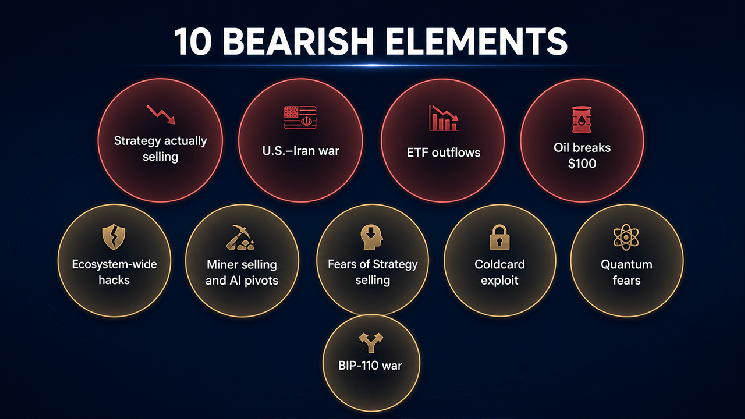
Bitcoin Withstood 10 Bearish Blows in 2026, Yet Experienced Its Mildest Bear Market

Bitcoin, the leading cryptocurrency by market cap, peaked above $126,000 in early October before entering a prolonged decline. By August, it was mainly trading between $63,000 and $65,400, inflicting losses on late buyers but resulting in what is, historically for Bitcoin, an unusually shallow bear market—down about 49% from its peak, compared to typical 75-80% plunges. Throughout 2026, Bitcoin faced multiple headwinds yet demonstrated notable resilience. Geopolitical tensions in the Middle East and volatile oil prices revived inflation concerns but failed to trigger the panic-driven sell-offs seen in prior cycles. A significant psychological blow came from corporate seller MicroStrategy, a longtime accumulator, which began strategic sales to bolster its cash position, reducing its holdings. U.S. spot Bitcoin ETFs also faced sustained outflows, though a late-week inflow hinted at potential relief. Pressure also came from within the ecosystem. A contentious blockchain proposal, BIP-110, failed after a minority chain stalled. Miners, facing tighter economics, sold reserves and pivoted infrastructure toward AI. A major security breach involving Coldcard hardware wallets saw an estimated 2,000 BTC stolen, shaking confidence in self-custody. Long-term threats like quantum computing resurfaced in discussions. Despite this confluence of corporate selling, ETF outflows, miner capitulation, geopolitical shocks, internal conflict, and security issues—any one of which could historically cause sharp declines—Bitcoin stubbornly held above a key $60,000 support level. Deeper market liquidity, regulated products, and long-term holders appear to be absorbing selling pressure that once would have caused deeper crashes. This resilience suggests a maturing market structure, though risks remain. Another shock could still push Bitcoin toward $50,000. For now, its 49% decline, severe for most assets, is relatively moderate by Bitcoin's own volatile standards. The remaining months of 2026 will test whether $60,000 is a durable floor or merely the next major line of defense.

cryptonews.ruHace 30 min(s)

Bitcoin Withstood 10 Bearish Blows in 2026, Yet Experienced Its Mildest Bear Market

cryptonews.ruHace 30 min(s)

Korean Financial Supervisory Service to Revise Compensation System for Phishing Losses Involving Crypto Transfer

The South Korean Financial Supervisory Service (FSS) is overhauling its system for reimbursing victims of voice phishing scams. Starting in October, the new system will be able to calculate and compensate losses held in cryptocurrency, not just in Korean won. Previously, the reimbursement system assumed stolen funds were in won, failing to fully compensate victims whose money was converted into digital assets. The upgraded software will apply a recovery ratio to determine the specific type and quantity of tokens owed to each victim, based on the token's value at the time the payment was frozen. It will also better track cases where fraud proceeds are split across multiple accounts and later consolidated. These changes follow March 31st amendments to the Act on Reimbursement of Losses from Telecommunications Fraud, which now classify virtual assets as both damaged and recoverable property. Major Korean crypto exchanges like Upbit and Bithumb must now comply with the same anti-phishing obligations as banks, including verifying transaction purposes and tracking suspicious funds. The revised law takes effect October 1st, with the FSS allocating a three-month period and a budget of 118.53 million won for system implementation and troubleshooting. The update addresses schemes where stolen money is intentionally laundered through cryptocurrency for overseas transfer. Notably, telecom fraud losses in South Korea rose 14.1% to 433.8 billion won in 2025, a five-year high.

cryptonews.ruHace 40 min(s)

Korean Financial Supervisory Service to Revise Compensation System for Phishing Losses Involving Crypto Transfer

cryptonews.ruHace 40 min(s)

Trading

Spot
活动图片