Near Returns to the AI Stage: Transformation into a Public Chain Due to 'Payroll Difficulties,' Agent and Privacy Emerge as New Growth Narratives

marsbitPublicado a 2026-06-05Actualizado a 2026-06-05

Resumen

NEAR Returns to AI Origins: From Payroll Struggles to Blockchain, Now Focusing on AI Agents and Privacy NEAR Protocol's journey began not with grand blockchain ambitions, but from a practical hurdle: its AI startup founders, including Transformer paper co-author Illia Polosukhin, couldn't efficiently pay international developers in 2017. This led them to pivot and build a high-performance, scalable blockchain. After years navigating various crypto narratives like sharding and cross-chain interoperability, NEAR is now leveraging its AI roots to re-enter the AI arena. A key driver is its "NEAR Intents" layer, which abstracts complex cross-chain transactions. Users simply state their goal (e.g., swap BTC for ETH), and a solver network finds the optimal route. This system has processed over $20B in cross-chain volume, generating significant fee revenue. A major growth area is private transactions via "Confidential Intents/Swaps," which hide trade details until settlement to protect against MEV and front-running. Remarkably, private swaps recently accounted for over 40% of NEAR's transaction volume, highlighting strong demand but also potential regulatory scrutiny. With its AI-founder pedigree, NEAR is positioning itself at the intersection of blockchain, AI agents, and privacy, aiming to become infrastructure for the emerging agent economy while navigating the challenges of its rapid adoption.

Author: Jae, PANews

Flowing narratives, steadfast Near. From a high-performance public chain and sharding for scalability, to chain abstraction and Intents, and now to the hottest topic of AI Agent, Near has hardly missed any major narrative throughout several past crypto cycles.

Backed by Illia Polosukhin, co-author of the classic Transformer AI paper and hailed as "the one who understands AI best in Web3," Near has delivered surprisingly impressive results even during the bear market. Today, Near is a cross-chain infrastructure giant that has processed over $20 billion in cumulative cross-chain transaction volume and generated over $34 million in fee revenue.

However, few know that Near's birth wasn't born from a grand blockchain ideal, but rather from a somewhat awkward practical dilemma: the inability to pay cross-border salaries. Eight years ago, to solve the problem of paying its global developers, the AI startup co-founded by Illia Polosukhin was forced to pause its AI dream and pivot to building a public chain.

Now, as the AI wave sweeps the globe, this public chain, born from AI and once sidetracked for AI, has returned to where the story began.

Payroll Problem Unexpectedly Gives Birth to a Public Chain, Now Returning to the AI Track

History sometimes comes full circle in a remarkable way. Nine years ago, Illia Polosukhin was not yet one of the crypto founders most associated with AI.

Near was founded in 2017 by Illia Polosukhin, co-author of the Transformer paper and former Google machine learning researcher, and Alexander Skidanov, a distributed systems expert.
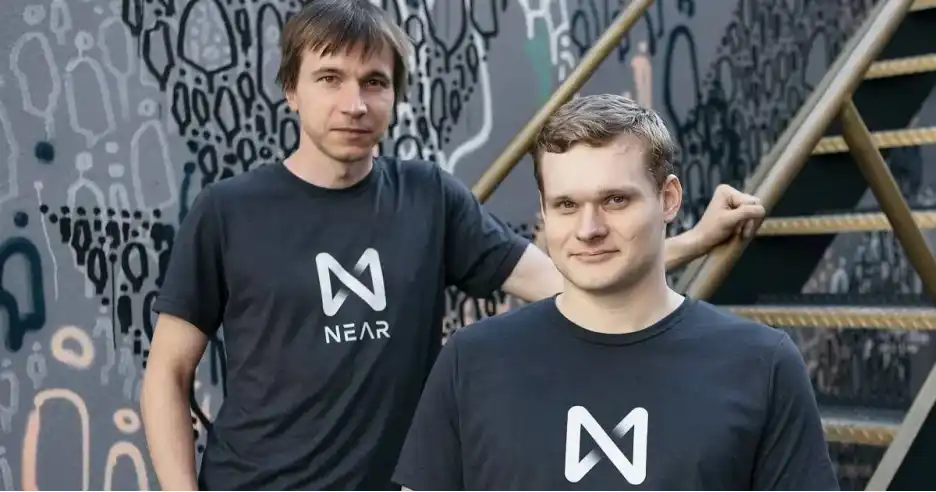
Near was initially an artificial intelligence startup focused on the field of "Program Synthesis," essentially "teaching machines to write code" to automate software development. Its concept was similar to later projects like OpenAI's CodeX, Anthropic's Claude Code, and Cursor.

To train algorithms and models, the team recruited computer science students worldwide to remotely write code snippets. However, how to pay developers distributed across the globe became a major hurdle.

Cross-border payment systems at the time were far less mature than today. Mainstream tools like PayPal and Wise faced severe limitations in Eastern Europe and the Asia-Pacific region, plagued by delayed settlements and exchange rate losses. Interestingly, when the two founders tried using early public chains for cross-border payments, they found that high Gas fees and low settlement efficiency made it impossible to distribute payments cost-effectively in batches.

For a resource-limited AI startup, this was almost an unsolvable problem. Ultimately, the two founders, with backgrounds in large-scale distributed systems, made a surprising decision: to shelve AI model development and instead build a highly scalable, low-fee, and user-friendly public chain themselves.

This passive pivot, triggered by the inability to "pay salaries," led to the birth of the "Near Protocol" in 2018.

However, the early transition path was not smooth. After leaving the AI track, Near shifted to developing a high-performance public chain focused on sharding technology to solve blockchain's scalability challenges.

With solid technical prowess, the Near Protocol secured over $500 million in cumulative funding during this period. Yet, in the fierce competition of the public chain arena, Near neither formed a landmark application nor managed to attract large-scale developer adoption. Sparse ecosystem applications, stagnant user growth, and low market attention meant that even with an advanced sharding architecture, Near's attention was often diverted by other hot public chains in the crowded "Ethereum killer" environment. The protocol once fell into a quiet period of "critical acclaim but poor sales."

During the 2020-2021 bull market, Near caught the cross-chain trend, with the launch of the Rainbow Bridge becoming a key catalyst for its ecosystem explosion and token price surge.

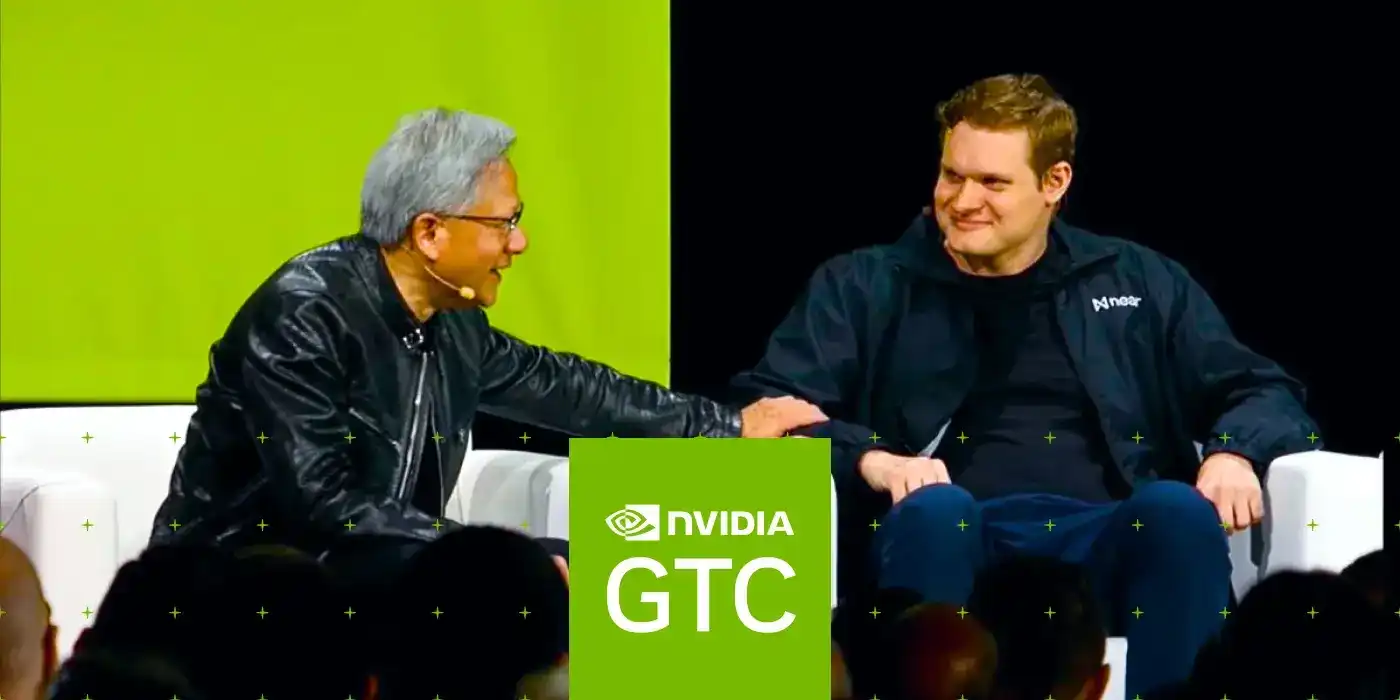
The outbreak of the AI boom brought a turning point for Near's destiny. In March 2024, at the GTC global developer conference, NVIDIA founder and CEO Jensen Huang invited Illia Polosukhin and six other co-authors of the Transformer paper for a stage discussion.

Jensen Huang praised the paper as having "changed the world," emphasizing that the Transformer architecture is the foundation of all AI industry achievements, reshaping the global technology, content, and financial landscape. This spotlight moment allowed Illia Polosukhin, as a co-creator, and Near, with its interrupted AI dream, to once again attract the crypto market's attention with the legitimate status of "AI lineage."
Returning to the battlefield with a new posture, Near's unique "technical core" was further activated. Seizing this opportunity, the protocol pivoted towards Near Intents and confidential transactions, laying a solid foundation amid the trend of multi-chain intent and Agent Economy convergence.

The intent transaction layer significantly lowered the interaction barrier for AI Agents, enabling Agents like Venice AI deployed in confidential hardware TEEs (Trusted Execution Environments) to autonomously, securely, and cost-effectively transfer funds across multiple chains.

Near Intents Becomes New Growth Line, Amassing $20 Billion in Trading Volume

Near Intents redefines the cross-chain trading experience. In the traditional multi-chain environment, users need to manually operate cross-chain bridges, prepare different Gas tokens on source and destination chains, and constantly watch out for slippage and friction costs for a single cross-chain asset swap.

Near uses an intent mechanism to abstract the entire process. Users only need to express their trading needs, such as "swap BTC on the source chain for ETH on the destination chain," without understanding the cross-chain path and Gas costs. This is the interaction experience ordinary users, and even future AI Agents, seek.

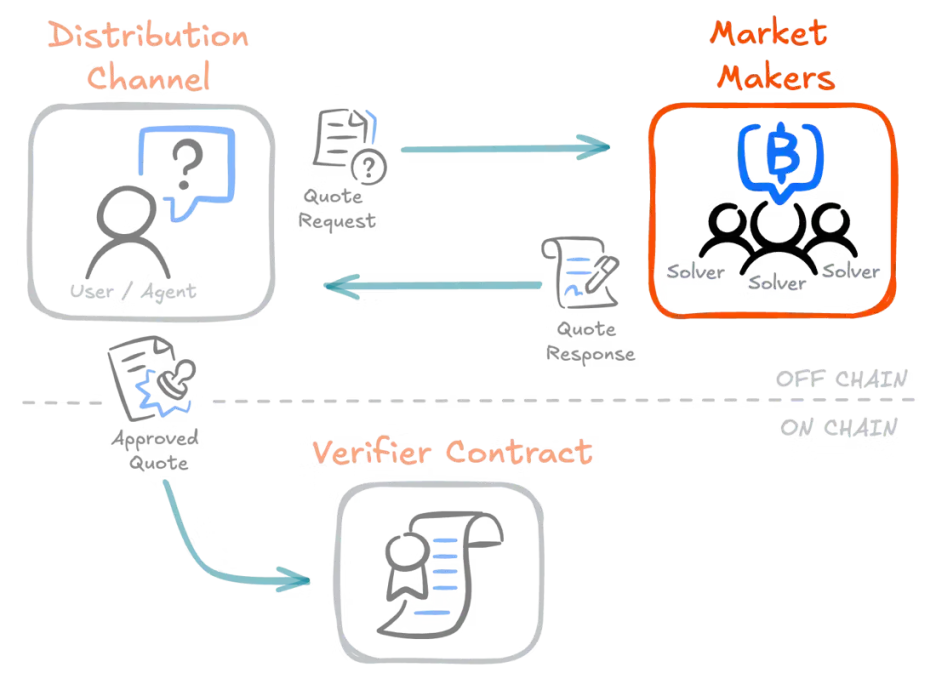
The execution of cross-chain transactions relies on an off-chain Solver network's bidding mechanism.

  • When a user submits an intent request, the Solver network bids via the Solver Bus, automatically finding and calculating the optimal execution route and quote.

  • Once the user signs the quote, the intent is submitted to the Verifier smart contract on the Near chain for final settlement.

Throughout this process, Gas fees are deducted seamlessly in the background, allowing users to pay without noticing, effectively unleashing the vitality of DeFi cross-chain trading. The significant optimization of user experience led to widespread integration of Near by traffic gateways like Ledger.

However, the potential centralization of the Solver network is a significant risk. As solvers require ample liquidity for market-making and complex algorithm optimization, trading APIs like 1Click typically rely on trusted swap aggregators and leading market makers. This could lead to oligopoly in the solver market, weakening the price advantages originally brought by the bidding mechanism.
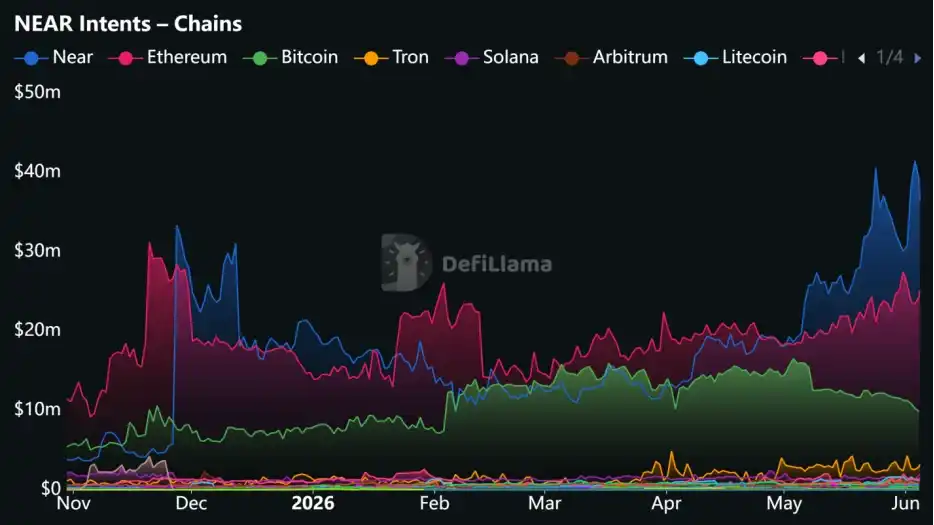
Data from DeFi Llama shows Near Intents is deployed across 25 public chains, covering the major settlement networks of the crypto market.

The protocol's TVL (Total Value Locked) exceeds $85 million. It not only retains $36.5 million in funds on the Near chain but also establishes deep liquidity on chains like Ethereum, Bitcoin, and Tron through chain abstraction mechanisms. This breadth of the cross-chain ecosystem is key to Near Intents surpassing the $20 billion mark in cumulative trading volume.
From a profitability perspective, since the launch of Near Intents, the protocol has generated over $33 million in fees. More than 70% of this revenue came from the last two quarters. This indicates that as the multi-chain ecosystem continues to expand, the protocol's profitability is also showing a growth trend.
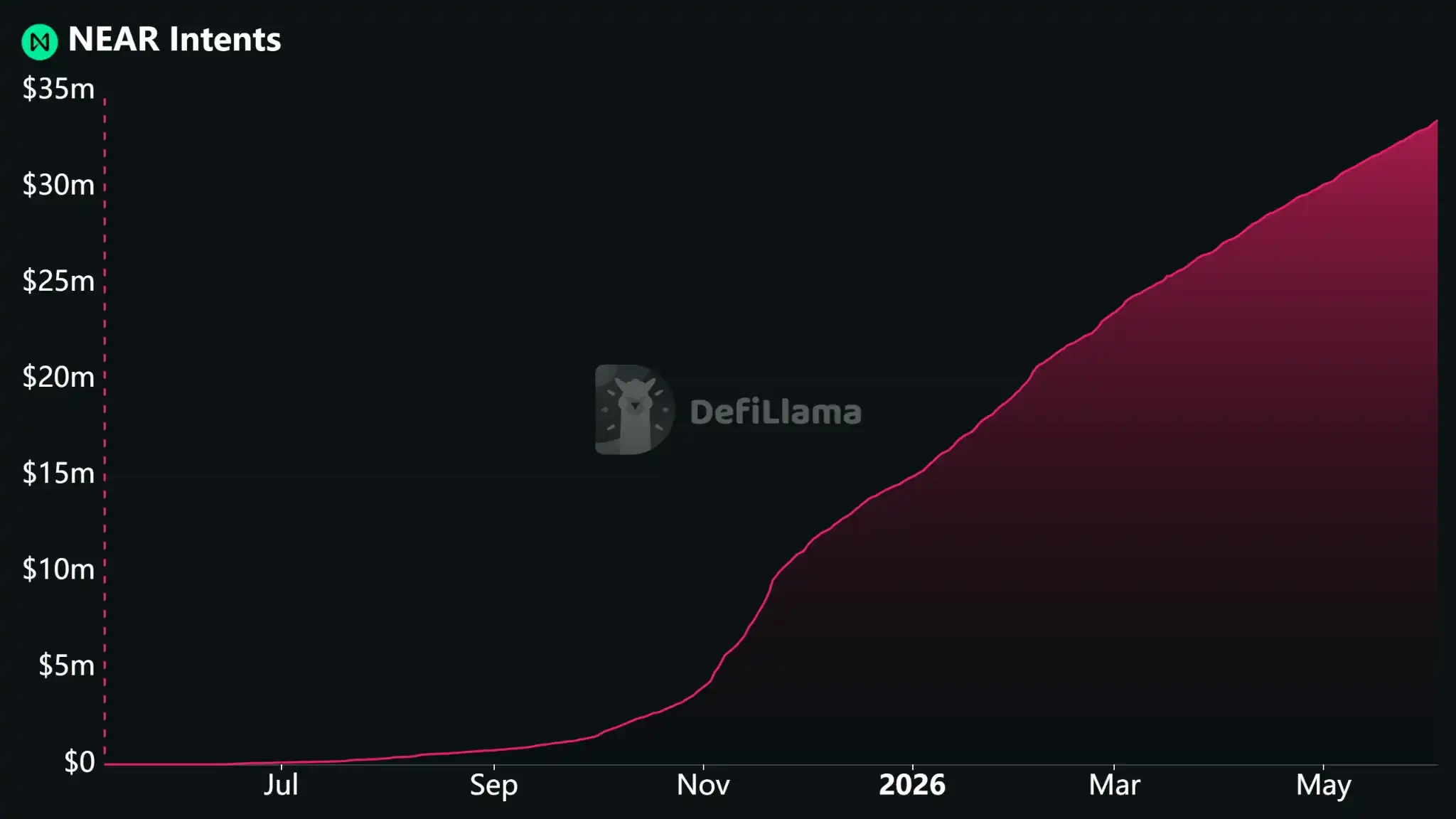
The gradually increasing fee revenue will establish a positive feedback mechanism for NEAR at the economic level. The vast majority of network fees are burned, injecting deflationary pressure into the NEAR token and further enhancing its value capture capability.

Confidential Transactions Swallow 40% of Volume: Growth Engine or Regulatory Hazard?

Currently, as on-chain activity grows, privacy needs are no longer a niche demand in the crypto market, and this has become Near's differentiating advantage.

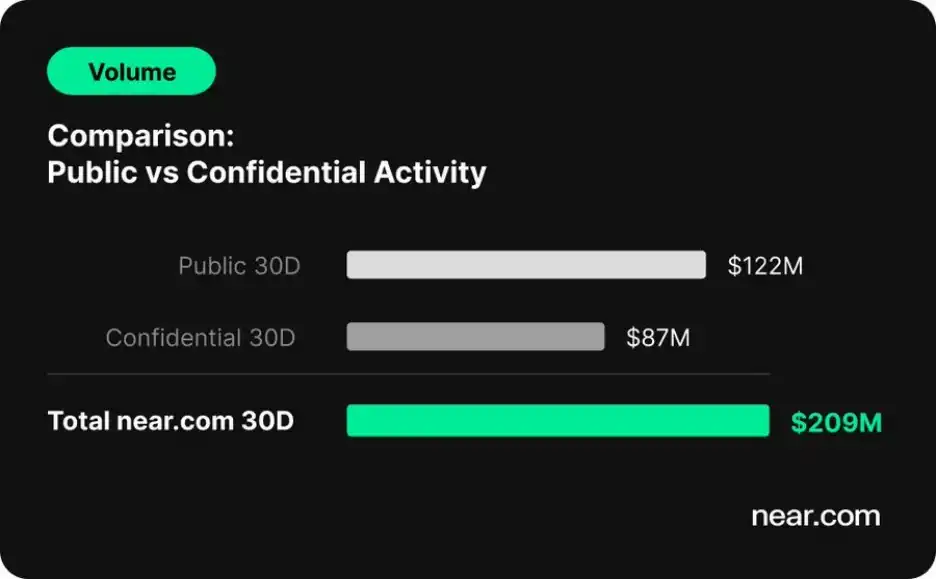
Since launching "Confidential Intents" and "Confidential Swaps" features in the first quarter of this year, their adoption rate has risen rapidly. Over the past 30 days, the total trading volume on the Near chain was $209 million, with confidential swap volume reaching $87 million, accounting for 41.63%. This data reflects not just product adoption but the genuine existence of market demand.
Behind this business explosion is Near addressing a long-standing structural pain point in the DeFi market: the highly transparent on-chain ledger exposes the positions and intentions of large traders. This leads to severe sandwich attacks (MEV), significant slippage, and strategy leakage when institutions or whales execute large trades.

The Confidential Intents feature, by introducing programmable privacy technology, allows users to seamlessly switch to "confidential mode" on the frontend interface. In this mode: the transaction amount, direction, and position are completely hidden from the outside world during execution, with only verifiable encrypted accounting performed on-chain at settlement.

Bots' sandwich attacks fail, and traders' business secrets are protected. The Confidential Swaps feature will open a relatively safe DeFi channel for institutional capital, reducing trading friction and facilitating the integration of on-chain ecosystems with mainstream finance.

However, the other side of the coin cannot be ignored. A privacy transaction share exceeding 40% proves the existence of real demand but may also attract regulatory scrutiny. Global regulatory pressure on privacy protocols like Tornado Cash has never eased. Anonymous large-scale fund flows are more likely to trigger regulatory enforcement. If regulators deem the "Confidential Swaps" model to pose money laundering risks, Near may inevitably fall under regulatory scrutiny, potentially becoming its biggest future uncertainty.

Looking back on its nine-year journey, Near's growth script shows a highly dramatic trajectory. Despite experiencing public chain competition, market cycles, and narrative shifts, it has continuously adjusted its development direction.

Today, chain abstraction, Intents, and confidential transactions have become Near's new exploration focus. The AI boom has prompted the market to re-examine this public chain's unique background. However, whether these attempts can help Near build a more solid ecosystem moat still requires more time to observe.


Preguntas relacionadas

QWhat was the original motivation behind the creation of the NEAR blockchain, and what problem was it trying to solve?

AThe NEAR blockchain was created to solve a practical problem: an AI startup founded by Illia Polosukhin and Alexander Skidanov couldn't efficiently pay its globally distributed team of developers due to high costs and inefficiencies in existing cross-border payment systems and early blockchains.

QHow has the NEAR protocol's 'Intents' mechanism improved the user experience for cross-chain transactions?

ANEAR's 'Intents' mechanism abstracts the complexity of cross-chain transactions. Users simply state their desired outcome (e.g., 'swap BTC for ETH'), and a network of solvers automatically finds and executes the optimal route, handling gas fees in the background, making the process seamless and user-friendly.

QWhat is a key risk associated with the solver network that powers the NEAR Intents system?

AA key risk is potential centralization and oligopoly within the solver network. As solvers require significant liquidity and complex algorithms, major market makers and trusted exchange APIs could dominate, potentially undermining the price competition the bidding mechanism is designed to foster.

QWhat does the significant adoption of NEAR's 'Confidential Swaps' feature indicate about the current DeFi market?

AThe high adoption rate of 'Confidential Swaps' (over 40% of recent NEAR transaction volume) indicates a strong and growing market demand for on-chain privacy, particularly among institutional and large traders seeking to protect their strategies from MEV attacks, front-running, and slippage.

QWhat is the potential regulatory challenge highlighted for NEAR's private transaction features?

AThe regulatory challenge is that the high volume of private transactions could attract scrutiny from global financial watchdogs. Regulators may view features like 'Confidential Swaps' as potential tools for money laundering, similar to their stance on other privacy protocols, which could pose a significant future risk for NEAR.

Lecturas Relacionadas

A 'Difficult Midsummer' for Stock Market Bulls: $100 Oil, AI Backlash, and Tariff Resumption

Global equities face a triple threat this summer: surging oil prices, a burgeoning AI capex crisis, and resurgent tariffs, pressuring the core pillars of the current bull market. Brent crude topped $100/barrel amid Middle East and Red Sea supply disruptions, while proposed U.S. tariffs fueled inflation fears, pushing the 10-year Treasury yield to 4.66%. Simultaneously, the tech rally faltered as Alphabet's steep AI capex hike sparked concerns over returns, dragging down mega-caps and contributing to a weekly S&P 500 decline. The "Goldilocks" narrative of resilient profits, controlled inflation, and endless AI expansion is cracking. Rising oil prices threaten to reignite persistent inflation, forcing a repricing of interest rate risks. In tech, massive debt-fueled AI investments are facing investor scrutiny as higher rates raise the required return threshold. Fears are growing that the AI spending boom may be unsustainable, especially with moves toward cheaper, open-source models. Next week brings a crucial test with key central bank meetings and earnings from major tech firms like Microsoft and Apple. Technical indicators are deteriorating, with selling pressure mounting and assets like gold and the dollar gaining on避险 sentiment. Analysts warn that elevated valuations and compressed risk premiums leave markets vulnerable, with significant potential downside if the current headwinds persist.

链捕手Hace 3 min(s)

A 'Difficult Midsummer' for Stock Market Bulls: $100 Oil, AI Backlash, and Tariff Resumption

链捕手Hace 3 min(s)

Three 'Reflexivity' Shadows Hang Over the Market

Global markets are currently enveloped by three mutually reinforcing "reflexive" loops: oil price politics, outsized capital expenditure by hyperscale cloud providers, and AI debt risks. According to Goldman Sachs, the combined negative feedback from these factors places the market in a fragile and precarious state. The first loop involves the two-way feedback between surging oil prices and rising interest rates. Brent crude's brief breach of $100 per barrel tests expectations of a U.S. policy response to curb prices and inflation. However, the delay in such intervention forces markets to increasingly price in the risks themselves. Higher energy costs are already impacting corporate earnings, as seen with an airline's profit warning, and threaten to fuel broader inflation. The second loop concerns the massive, escalating capital expenditure (capex) by major tech firms like Google, which recently raised its 2026 capex forecast significantly. The market's tolerance for viewing such spending as a cost-free growth signal is waning, shifting focus to investment returns. This competitive capex spiral pressures the entire cloud and semiconductor sector. Furthermore, the competitive gap in AI between leading closed-source and Chinese open-source models is narrowing rapidly, threatening the economic rationale behind massive investments. The third reflexive danger lies in the financing structures supporting this expansion. Bond prices for entities funding AI infrastructure, such as a Meta financing vehicle, have fallen sharply from issue price. While hyperscale balance sheets remain strong, soaring capex is eroding free cash flow conversion. There is a growing risk that today's capacity build-out leads to future oversupply and significant depreciation charges. Key near-term tests for these dynamics include Microsoft's upcoming earnings, which will scrutinize its balance of growth, spending, and cash flow, and the IPO of Chinese memory chipmaker CXMT, a major new competitor. The current environment is characterized by reflexivity, where each variable is both a cause and an effect, creating a self-reinforcing cycle of uncertainty.

链捕手Hace 9 min(s)

Three 'Reflexivity' Shadows Hang Over the Market

链捕手Hace 9 min(s)

Claude Doesn't Submit Code Directly After Writing It: Runs 4 Skills for Self-Check, Fixes Issues, Then Comes Back to You

Claude No Longer Submits Code Directly: 4 Self-Check Skills to Run Before Coming Back to You AI already writes code, but the burden of reviewing it still falls on you. To address this, Anthropic has built a "verification loop" into Claude Code. After writing code, Claude now runs four self-check skills before delivering the work: * `/code-review`: Finds potential bugs and provides review feedback. * `/simplify`: Cleans up the diff, removing redundant or over-complex implementations to reduce future maintenance costs. * `/verify`: Performs end-to-end validation, actually running the application to confirm the feature works, not just appears to. * `/design`: Used only for UI changes; cross-references the implementation against the project's DESIGN.md file. This loop extends the AI agent's workflow from "gather context → execute" to "gather context → execute → auto-verify → fix → re-verify." It tackles the new bottleneck in AI-assisted development: the speed of verifying code now outpaces human review. These skills are built on Claude Code's existing verification foundation (like running apps and using linters). Teams can create their own custom verification skills by documenting their repetitive manual checks in plain language as Markdown files. Verification can be triggered at four levels: manually (Standalone), embedded in a task, chained with other skills, or automatically on every PR (On every PR). The shift signifies that competition in AI programming is moving from code generation to robust verification and self-correction. Well-built verification loops allow AI agents to run longer and more autonomously with less human supervision. Skills, which encapsulate team knowledge and workflows, are becoming a cross-vendor standard, meaning a team's efficiency gap will depend less on the AI model and more on their investment in these automated workflows and verification mechanisms.

marsbitHace 15 min(s)

Claude Doesn't Submit Code Directly After Writing It: Runs 4 Skills for Self-Check, Fixes Issues, Then Comes Back to You

marsbitHace 15 min(s)

How Has Beijing Become a 'Global High Ground'?

How did Beijing become a "global highland"? In the first half of the year, Beijing's GDP grew by 5.4%, with growth in Q1 reaching 5.9%. Key drivers were not consumption or real estate, but hardcore sectors like chips, robotics, computing power, and large AI models. Investment concentrated sharply in tech, with high-tech manufacturing investment up 36% and technology services investment up 87.2%. Nearly 90% of venture capital flowed into hard tech. Output figures were strong: integrated circuit production rose 17.8%, industrial robots 75.5%, and service robots surged 230%. Companies like Qianxun AI and Galaxy General Robotics are deploying robots in real-world logistics and manufacturing, moving beyond demonstrations. The services sector is also being reshaped by tech, with software, IT, and finance growing faster than the sector average. Beijing leads in AI and embodied intelligence. Galaxy General Robotics secured significant funding, including from state-backed funds. The city released foundational AI models and its independent AI ecosystem, FlagOS, is expanding. Companies like Jiuzhang Yunjie provide neutral computing power and base models, supporting the broader ecosystem. Infrastructure is expanding, with Beijing aiming to add over 70,000 Petaflops of intelligent computing power annually. A "Beijing R&D, surrounding training" model is emerging, with computing resources being allocated to regions like Hebei and Tianjin. Efforts to deepen integration within the Beijing-Tianjin-Hebei region include industrial relocation and improved transport links. To bridge the gap between lab and market, Beijing is establishing pilot-scale production platforms. The underlying trend is the convergence of computing power, capital, talent, and real-world applications. While challenges remain in commercialization and regional integration, Beijing's focus on strengthening these interconnected elements is building the foundation for its claim as a global innovation hub.

marsbitHace 15 min(s)

How Has Beijing Become a 'Global High Ground'?

marsbitHace 15 min(s)

How Did the Target Price of 116 Yuan and a Market Cap of 7.9 Trillion for CXMT Come About?

Nomura's inaugural coverage report on ChangXin Memory Technologies (CXMT) gives a 'Buy' rating with a highly aggressive target price of 116 RMB, implying a 1239.5% upside from the IPO price of 8.66 RMB. The valuation is derived by applying a 20x P/E multiple to projected 2028 EPS of 5.79 RMB. The 20x multiple combines Micron's historical valuation with a premium for Chinese A-shares. The report's financial forecasts are exceptionally bullish. It projects revenue to soar from 62B RMB in 2025 to 773B RMB in 2028, with net profit surging to 393B RMB. A key, and arguably unsustainable, assumption is gross margin expanding to over 90% by 2028, driven almost entirely by price increases with minimal cost growth. This optimism is rooted in a forecast that global DRAM demand will grow over 7x from 2026 to 2030 (CAGR >60%), fueled by agentic AI. Nomura argues that supply growth (30-40% CAGR) will lag far behind demand, creating a persistent shortage. Bottlenecks in cleanroom space, equipment, materials, and skilled engineers will constrain rapid industry expansion. For CXMT, Nomura expects capacity to reach 550k wafers/month by 2028. The company's bit output is forecast to grow 40-45% annually, allowing its global market share to rise from ~10% to ~18%. While CXMT's technology lags leaders by about five years, limiting its wafer ASP, it benefits from supportive domestic procurement policies. Key risks include the cyclicality of memory pricing, with the 90% margin assumption representing a peak-cycle scenario rather than a sustainable norm.

链捕手Hace 24 min(s)

How Did the Target Price of 116 Yuan and a Market Cap of 7.9 Trillion for CXMT Come About?

链捕手Hace 24 min(s)

Trading

Spot
活动图片