How Does Backpack's Staking Token-to-Equity Conversion Work?

marsbitPublicado a 2026-02-25Actualizado a 2026-02-25

Resumen

Backpack, a Solana-based wallet and exchange platform founded by ex-FTX members, has announced a novel staking-to-equity conversion plan. Users who stake its native token for at least one year can convert those tokens into real company equity at a fixed ratio, with 20% of equity reserved for this purpose. The platform emerged after FTX’s collapse, having lost 80% of its operational funds, and gradually built its user base through its Mad Lads NFT community and a compliant exchange. It recently acquired FTX Europe and secured regulatory licenses. Backpack’s tokenomics include a 1 billion total supply, with 62.5% pre-IPO allocation. The TGE will release 25% of tokens, entirely to users. The model ties token distribution to IPO milestones—a rare hybrid approach in crypto. This move aims to transform users from token holders into legal company owners. However, it faces significant regulatory challenges, particularly from the SEC, which may view the token as a security. The dual-structure of token and equity could also complicate IPO investor relations. While innovative, the plan operates in a regulatory grey area—attempting to bridge decentralized tokenomics with traditional equity financing.

Original | Odaily Planet Daily (@OdailyChina)

Author | DingDang (@XiaMiPP)
On February 24, Backpack CEO Armani Ferrante announced a staking-to-equity conversion plan, allowing users who stake Backpack's native token for at least one year to exchange these tokens for real company equity at a fixed ratio. The company has reserved 20% of its equity for this plan.

This brief statement conveys far more information than a conventional TGE narrative.

In traditional TGE narratives, users are seen as traffic and community token holders; in this design, Backpack attempts to elevate users from product users to legal company owners.

The question is: Can it really work? Is this a financial innovation or a high-risk experiment dancing on the edge of regulation? Does it change the power structure, or is it just a more advanced form of chip management? To understand this, we must look back at Backpack's own history.

Backpack: A Company Rising from the Ruins

Backpack is a "wallet + exchange" integrated platform centered on the Solana ecosystem, founded by Armani Ferrante, a former member of FTX and Alameda Research. It was established after the collapse of FTX, emphasizing compliance and user custody.

However, unlike the "trading first, ecosystem later" development path of centralized exchanges like Binance, Backpack's path is the reverse. It started with a wallet and NFTs, gradually accumulating users, community, and technical foundations, and eventually launched an exchange.

Looking back at Backpack's history. In 2022, the collapse of FTX not only tore apart the credit structure of the entire crypto industry but also directly impacted projects associated with it. Backpack had just completed a $20 million funding round led by FTX Ventures and Jump Crypto before FTX's collapse. But as the empire crumbled, about 80% of Backpack's operating funds evaporated. At that time, Backpack was positioned as a "wallet + xNFT operating system," aiming to provide Solana users with a safer, integrated entry point, avoiding reliance on centralized platforms.

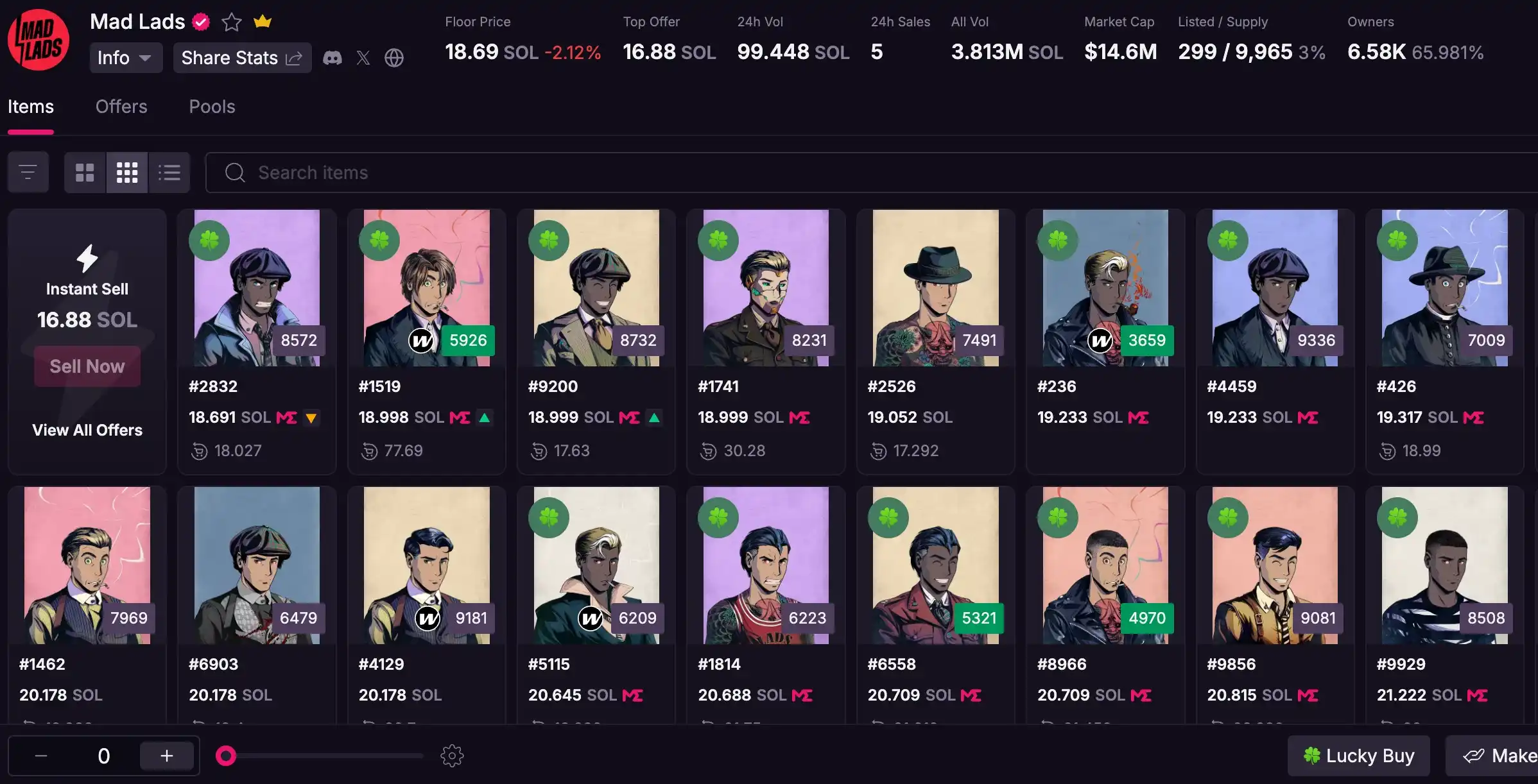
In April 2023, during the bear market trough, Backpack quietly launched the Mad Lads NFT series, with a minting price of 6.9 SOL. It quickly became one of the top NFT communities on Solana, with the floor price once reaching 229.4 SOL. Today, despite the overall decline of NFTs, the Mad Lads floor price remains at 18.8 SOL, more than double the original minting price.
In November of the same year, Backpack obtained a Dubai VARA license and launched Backpack Exchange, though it was only in a limited testing phase at the time. By then, it had accumulated user trust through its wallet and NFTs, leveraging the exchange to monetize traffic. In February 2024, Backpack completed a $17 million Series A funding round, valuing the company at $120 million. In January 2025, it acquired FTX Europe's assets for $32.7 million, obtaining a European MiFID II license, further strengthening its compliance foundation and committing to handle FTX EU customer claims.

Backpack was born with a silver spoon but rebuilt from the ruins. After nearly three years, Backpack has accumulated a trading volume of over $400 billion and user assets exceeding $350 million.

Now, it is poised for a greater leap.

Token Issuance Plan and Equity Linkage

On February 17, Backpack announced the start of identity verification before TGE, the first step for users to claim tokens.

According to Backpack's token economic model, the total token supply is 1 billion. The pre-IPO total supply is 625 million tokens (62.5%), released in three phases:

  • Phase 1 (TGE): Releases 25% of the total supply, or 250 million tokens. Of these, 240 million (24%) are allocated to points holders, and 10 million (1%) to Mad Lads holders. This phase is 100% allocated to users, with no internal team share.
  • Phase 2 (Pre-IPO): Accounts for 37.5%, or 375 million tokens, as "growth-triggered unlocks," released gradually based on key milestones (such as regulatory approvals, new product launches, and geographic expansion).
  • Phase 3 (Post-IPO): Also accounts for 37.5%, or 375 million tokens, deposited into company treasury, locked for one year after IPO, for the team and investors.

From its token distribution plan, we can already see that token issuance is closely tied to an IPO. Backpack is currently negotiating terms for a new $50 million funding round at a valuation of $1 billion. At this valuation, the 20% equity reserved is worth $200 million.

In the short history of the cryptocurrency industry, token issuance has quietly evolved from an optional financing tool to an almost "instinctive choice" and default path for nearly all projects. As users, we are familiar with this method, but Backpack's approach goes beyond what we know.

From an industry perspective, this model fills a gap. Coinbase successfully IPOed in 2021 but never issued a native token; DeFi projects like Uniswap issued governance tokens but did not pursue an equity listing. Backpack is attempting a "dual-track" system: tokens for community incentives and equity for long-term ownership, which is unprecedented in the crypto industry.

Is Token Issuance + IPO Feasible?

Although this plan is bold and innovative, it faces regulatory challenges.

Under U.S. regulatory context, most tokens could be considered securities by the SEC. If so, companies must comply with registration, disclosure, and anti-fraud rules. If an IPO is pursued in the future, the SEC will review the history of token issuance, structural design, and potential compliance violations.

More complex is the potential "ownership conflict" between equity and tokens: IPO investors worry about dilution of rights (such as voting rights and dividends), while token holders expect value capture, which could be seen as "dual financing" or misleading behavior. Especially during the Gensler era (2022-2024), enforcement tightened, and many projects abandoned IPOs altogether.

In short, token issuance takes the "decentralized/on-chain financing" fast lane, while an IPO takes the "centralized/compliant/equity financing" slow lane. Backpack is trying to drive both vehicles simultaneously, which requires极强的 structural design and regulatory communication skills. Otherwise, it could face delays in listing or regulatory fines.

While there is no complete precedent in the crypto industry, there are partial ones. Coinbase, also a centralized exchange, completed its IPO in 2021, but it had considered issuing a token. Backpack co-founder Can Sun revealed in a podcast two years ago that he participated in Coinbase's上市 work, helping design its token economic model. Although Coinbase ultimately chose a pure equity listing, this experience provided valuable reference for Backpack. At that time, he already planned to realize this unfulfilled ambition at Backpack.

Can It Change the Industry?

Today, the reality of the crypto industry is that many tokens lose over 80% of their value within a year of listing. "Peak at issuance" has almost become a curse. Backpack seems to be寻找 another path: giving tokens the possibility of converting to equity,推动 incentive methods to change.

In the past, the familiar model was "earn tokens with product," where projects first build a good product, and users earn token rewards through usage, such as fee sharing, liquidity mining, airdrops, etc. Token value comes from the product's actual performance. Backpack's approach更像 using token expectations to feed company valuation, i.e., equity binding, IPO narrative, using the expected value of tokens to quickly gather funds, community, and attention, thereby raising the company's valuation and accelerating financing and product iteration. Tokens are no longer just reward tools but valuation engines.

Of course, this transformation is full of uncertainty. How will regulators define it? How to balance rights between equity and tokens? Will the market really buy into the narrative of future shareholders? These questions have no ready answers. But in a pessimistic moment for the crypto industry, Backpack is at least trying to provide a new tension.

Backpack once rebuilt from the ruins; this time, it is building a bridge in the cracks of the system.

Preguntas relacionadas

QWhat is the core mechanism of Backpack's staking-to-equity conversion plan?

AUsers who stake Backpack's native token for at least one year have the opportunity to convert these tokens into real company equity at a fixed ratio, with 20% of the company's equity reserved for this plan.

QHow did Backpack's development path differ from traditional centralized exchanges like Binance?

ABackpack started with a wallet and NFT ecosystem (e.g., Mad Lads NFT) to build user trust and community, then launched its exchange, whereas traditional exchanges like Binance typically prioritize trading services first before expanding into ecosystems.

QWhat are the three phases of Backpack's token economic model?

APhase 1 (TGE): 25% of total supply allocated to users; Phase 2 (Pre-IPO): 37.5% unlocked based on milestones like regulatory approvals; Phase 3 (Post-IPO): 37.5% reserved for team and investors, locked for one year after IPO.

QWhat regulatory challenges does Backpack face with its dual-token and equity model?

AThe SEC may classify the token as a security, requiring compliance with registration and disclosure rules. The dual structure could also create ownership conflicts between equity investors and token holders, potentially leading to regulatory scrutiny or delays in IPO.

QHow does Backpack's approach aim to change the typical 'peak at launch' token trend?

ABy linking token staking to real equity ownership and an IPO narrative, Backpack uses token expectations to boost company valuation, attract funding, and shift incentives from short-term rewards to long-term ownership, potentially breaking the cycle of post-launch token depreciation.

Lecturas Relacionadas

Same Case, Different Verdicts: Why Was Uniswap Acquitted While Tornado Cash Was Not?

In a landmark ruling, the New York Southern District Court dismissed a class-action lawsuit against Uniswap and its founder, Hayden Adams, holding them not liable for scam tokens traded on the platform. The court, presided over by Judge Katherine Polk Failla, compared the case to holding a self-driving car developer responsible for crimes committed using the vehicle, emphasizing that open-source developers should not bear responsibility for misuse by third parties. This decision contrasts sharply with the legal outcome for Tornado Cash developers. Despite the same judge being involved, Tornado Cash co-developer Roman Storm was convicted for operating an unlicensed money-transmitting business, while another developer, Alexey Pertsev, received a prison sentence in the Netherlands for money laundering. The U.S. Treasury had previously sanctioned Tornado Cash for allegedly facilitating over $7 billion in money laundering, including for North Korean hackers. The divergent rulings highlight a key regulatory stance: decentralization is permissible, but privacy tools enabling illicit activities face strict scrutiny. The author suggests that while Uniswap’s legal victory aligns with principles of developer immunity for open-source code, Tornado Cash’s case underscores that protocols knowingly aiding crime, especially at a state level, won’t be tolerated. The piece concludes by questioning if Uniswap, despite its legal win, should take more proactive steps to screen for scams to protect users, reflecting a broader responsibility within the DeFi ecosystem.

marsbitHace 26 min(s)

Same Case, Different Verdicts: Why Was Uniswap Acquitted While Tornado Cash Was Not?

marsbitHace 26 min(s)

Currency and Stock Barometer丨Strategy Invested $204 Million to Purchase 3,015 Bitcoins Last Week; US-Listed Company GD Culture Board Approved Sale of 7,500 Bitcoins Last Week (March 3)

Crypto Market Weekly Roundup: Strategy Invests $204M in Bitcoin, GD Culture to Sell Holdings Last week saw significant activity among crypto treasury companies amid ongoing market volatility. Strategy (formerly MicroStrategy) led Bitcoin acquisitions, purchasing 3,015 BTC for $204.1 million—a 412.8% increase from the previous week—bringing its total holdings to 720,737 BTC. In contrast, NASDAQ-listed GD Culture approved the sale of its entire 7,500 BTC reserve to fund a stock repurchase plan, reflecting the financial pressure some firms face. Meanwhile, Ethereum treasury company FG Nexus sold 7,550 ETH (worth $14.06 million), accumulating an unrealized loss of approximately $82.8 million. ETHZilla rebranded to Forum Markets and pivoted to RWA tokenization, while Bitmine added 50,928 ETH ($98.53 million) to its holdings. Other notable updates include American Bitcoin reporting over 6,000 BTC in reserves and $185.2 million in annual revenue, and Solana treasury firm DeFi Development making a strategic investment in stablecoin protocol Apyx. Global public companies (excluding miners) now hold 981,150 BTC, accounting for 4.9% of the circulating supply. Market analysts suggest a potential consolidation trend among crypto treasury companies in 2026, especially for those trading below net asset value.

marsbitHace 59 min(s)

Currency and Stock Barometer丨Strategy Invested $204 Million to Purchase 3,015 Bitcoins Last Week; US-Listed Company GD Culture Board Approved Sale of 7,500 Bitcoins Last Week (March 3)

marsbitHace 59 min(s)

Trading

Spot
Futuros

Artículos destacados

Cómo comprar F

¡Bienvenido a HTX.com! Hemos hecho que comprar Synfutures (F) sea simple y conveniente. Sigue nuestra guía paso a paso para iniciar tu viaje de criptos.Paso 1: crea tu cuenta HTXUtiliza tu correo electrónico o número de teléfono para registrarte y obtener una cuenta gratuita en HTX. Experimenta un proceso de registro sin complicaciones y desbloquea todas las funciones.Obtener mi cuentaPaso 2: ve a Comprar cripto y elige tu método de pagoTarjeta de crédito/débito: usa tu Visa o Mastercard para comprar Synfutures (F) al instante.Saldo: utiliza fondos del saldo de tu cuenta HTX para tradear sin problemas.Terceros: hemos agregado métodos de pago populares como Google Pay y Apple Pay para mejorar la comodidad.P2P: tradear directamente con otros usuarios en HTX.Over-the-Counter (OTC): ofrecemos servicios personalizados y tipos de cambio competitivos para los traders.Paso 3: guarda tu Synfutures (F)Después de comprar tu Synfutures (F), guárdalo en tu cuenta HTX. Alternativamente, puedes enviarlo a otro lugar mediante transferencia blockchain o utilizarlo para tradear otras criptomonedas.Paso 4: tradear Synfutures (F)Tradear fácilmente con Synfutures (F) en HTX's mercado spot. Simplemente accede a tu cuenta, selecciona tu par de trading, ejecuta tus trades y monitorea en tiempo real. Ofrecemos una experiencia fácil de usar tanto para principiantes como para traders experimentados.

148 Vistas totalesPublicado en 2024.12.21Actualizado en 2025.03.21

Cómo comprar F

Discusiones

Bienvenido a la comunidad de HTX. Aquí puedes mantenerte informado sobre los últimos desarrollos de la plataforma y acceder a análisis profesionales del mercado. A continuación se presentan las opiniones de los usuarios sobre el precio de F (F).

活动图片