If we were to vote for the most anticipated TGE in the crypto space in early 2026, the prediction market Opinion (OPN) would likely be a top contender.
This project has almost all the elements to become a market sensation: top-tier VC backing, a hot sector, strong ties to the Binance ecosystem, and the prediction market narrative, which has been one of the hottest trends in recent years, attracting immense attention even before its launch.
The funding lineup is nothing short of stellar. Opinion Labs has raised a total of $25 million across three rounds: an initial angel round in August 2024, a $5 million Seed round led by YZi Labs (formerly Binance Labs) in March 2025, and a $20 million Pre-Series A round in February this year, attracting top-tier institutions like Hack VC, Jump Crypto, and Primitive Ventures.
Hack VC is a well-known fund in the crypto space focused on AI and DeFi, having early investments in Anthropic; Jump Crypto is a key pillar of the Solana ecosystem with assets under management in the tens of billions. The simultaneous backing from these two institutions is itself a strong market signal. Meanwhile, YZi Labs (formerly Binance Labs) participated in both the angel and Seed rounds without missing a beat, directly paving the way for Opinion's listing within the Binance ecosystem.
The timing of the sector choice is impeccable. Continuous funding for Polymarket and Kalshi, partnerships with mainstream media, and soaring trading volumes have made prediction markets one of the hottest crypto narratives since 2025. Opinion, deeply entrenched in the BSC ecosystem, has long ranked among the top three prediction markets by TVL, emerging as an early leader in this wave.
The market's high expectations for prediction markets are also evident in the resource allocation. Binance set up a dedicated Launchpool for OPN, allocating 2% of the supply for BNB/USDC staking mining. Pre-market trading saw prices surge over 30%, hitting a high of $0.57. Binance's endorsement solidified OPN's market position even before its official launch.
With all these positive factors combined, Opinion was listed by many as a must-farm project for Season 1 airdrops, with numerous users investing real money in hopes of a substantial return from this highly anticipated project.
However, when the airdrop query page went live, community expectations turned to disappointment, which quickly escalated into anger.
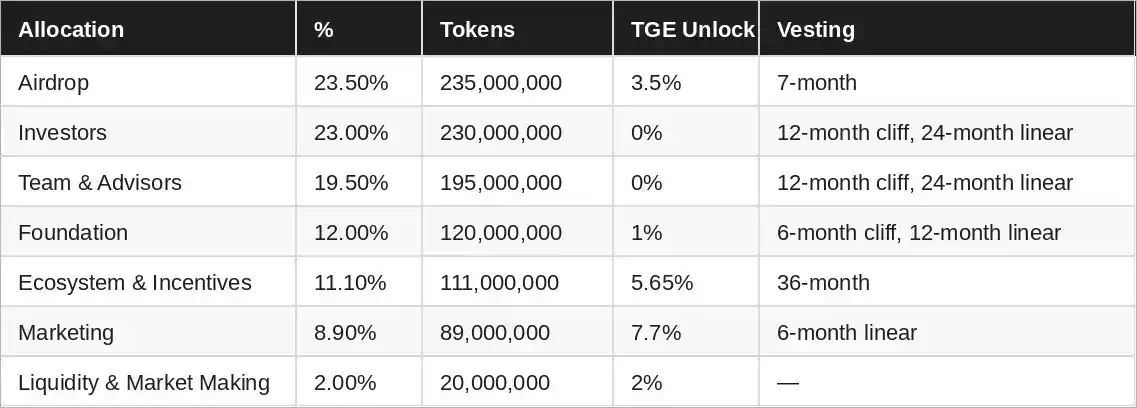
OPN has a total supply of 1 billion tokens. On the surface, the airdrop allocation of 23.5% (235 million tokens) doesn’t seem low. The problem, however, is that only 3.5% (35 million tokens) were unlocked on TGE day, with the remainder to be released over 7 months linearly. For the vast majority of farming users, the immediate rewards were far less than expected.
Meanwhile, another set of data pushed community sentiment over the edge: the team and advisors hold a combined 19.5%, investors hold 23%, and the foundation holds 12%—insiders collectively hold over 54% of the tokens, while all the hardworking community users only get 3.5% on TGE day.
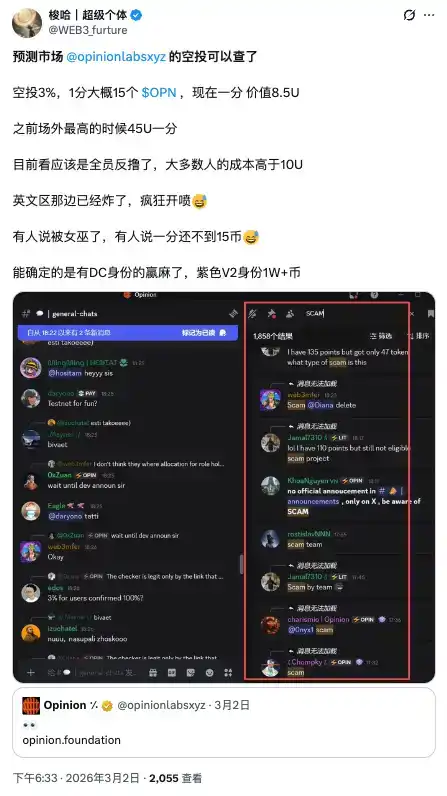
Actual user returns were dismal. Multiple participants publicly shared their scores and earnings. Influencer Suoha (@WEB3_furture) summarized: "Airdrop 3%, one point is about 15 OPN, now worth $8.5 per point. At its peak OTC, it was $45 per point. It looks like everyone got rugged; most people's costs were above $10 per point."
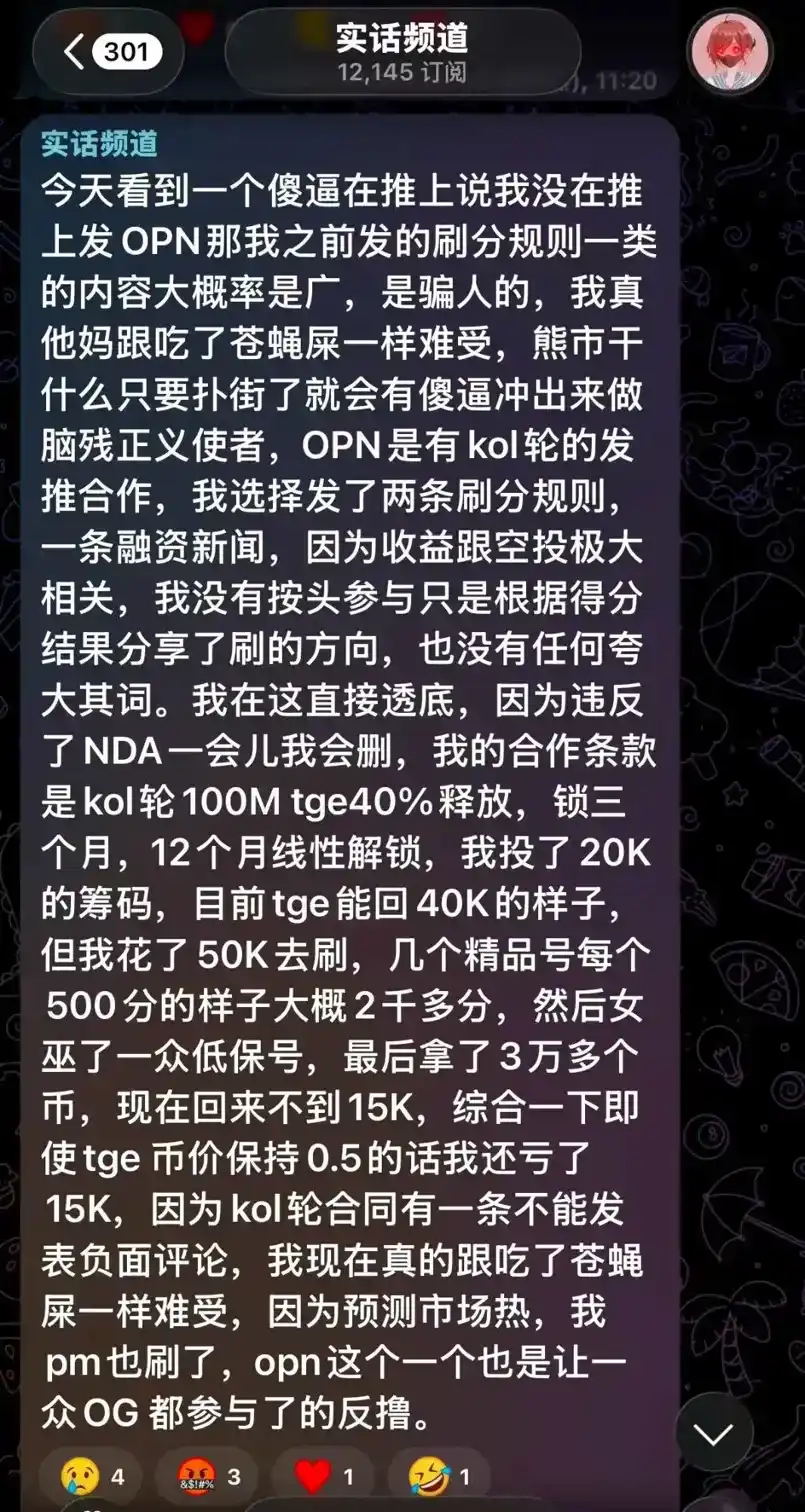
HongKongDoll, who has participated in many crypto projects, complained about her Telegram channel regarding her KOL round cooperation terms and farming data. Although the KOL round cooperation yielded definite returns, she invested $50,000 in farming. Each premium account had about 500 points, and she ultimately received just over 30,000 OPN. Calculated at the TGE price of $0.5, she recouped less than $15,000. Even including the unlocked returns from the investment, she overall lost $15,000. She bluntly stated: "I feel as disgusted as if I’d eaten fly droppings."
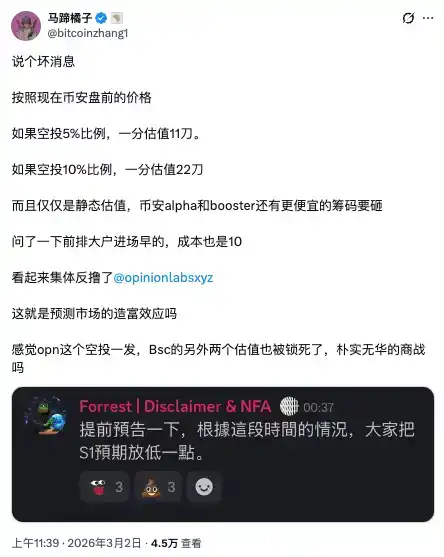
Another KOL, Mati Orange (@bitcoinzhang1), pointed out: "Based on Binance’s pre-listing price, if the airdrop ratio were 5%, one point would be valued at $11; if it were 10%, one point would be $22. And that’s just the static valuation; Binance alpha and booster have even cheaper筹码 to dump...... It seems like a collective rug."
Sybil attacks sparked a new wave of controversy. Beyond the allocation ratio itself, the project team’s large-scale crackdown on Sybil accounts and multi-account operations just before TGE led to many farming users having their points slashed or disqualified. While this move is justified in principle, the execution method and timing left the community feeling dissatisfied: during the farming period, the project team tacitly allowed or even encouraged high-frequency participation, only to start a concentrated crackdown on the eve of TGE. This was interpreted by many as a "use and discard" strategy, further deepening the impression of a "rug pull."
Binance’s allocation became a major point of criticism. Compared to the community’s mere 3.5% unlocked at TGE, the Binance Launchpool directly received 2% of the supply, with the marketing portion having a 7.7% TGE unlock ratio, and the liquidity portion being 100% unlocked. This contrast led many to conclude directly: "Opinion only airdropped 3% to users but gave a huge amount of筹码 to Binance." The community widely perceives this as a typical allocation method that "favors the exchange at the expense of the community."
On Discord and Twitter, discussions about Opinion were quickly filled with intense words like "scam" and "rug." The English-speaking community also erupted. KOLs publicly shared their loss statements, and negative sentiment continued to ferment.
It is worth noting that the project’s fundamentals are not fundamentally problematic—$25 million in funding, backing from Hack VC and Jump Crypto, and a leading position in the BSC prediction market are all objective advantages. However, even the strongest funding lineup can hardly弥补 the damage once community trust collapses.
When "welcoming data farming initially, then pulling the rug after launch" becomes the community consensus, the biggest challenge Opinion faces may no longer be market cap management, but how to rebuild basic trust with its users.