You may have heard of Claude Science.
That research Agent from Anthropic that can search literature, write code, run analyses, and generate charts and reports on its own once made people exclaim, “This is what AI for Science should be like.”
But it is closed-source.
Now, someone has replicated it—open-source, MIT license, core with zero dependencies.
The project is called OpenAI4S (Open AI for Scientist), an officially open-sourced research Agent project from the Peking University & YuanKong AI Agent Joint Laboratory.
Key point: It doesn't just “look like” Claude Science. Instead, following the Code-as-Action approach, it independently reproduced the engine, persistent kernel, host-RPC protocol, and security layer in an open-source manner.

The project was open-sourced on GitHub on July 6, 2026, under the MIT license.
Currently, OpenAI4S provides a complete research web application, dozens of built-in Skills, self-hosted computing access capabilities, and versioned research outputs.
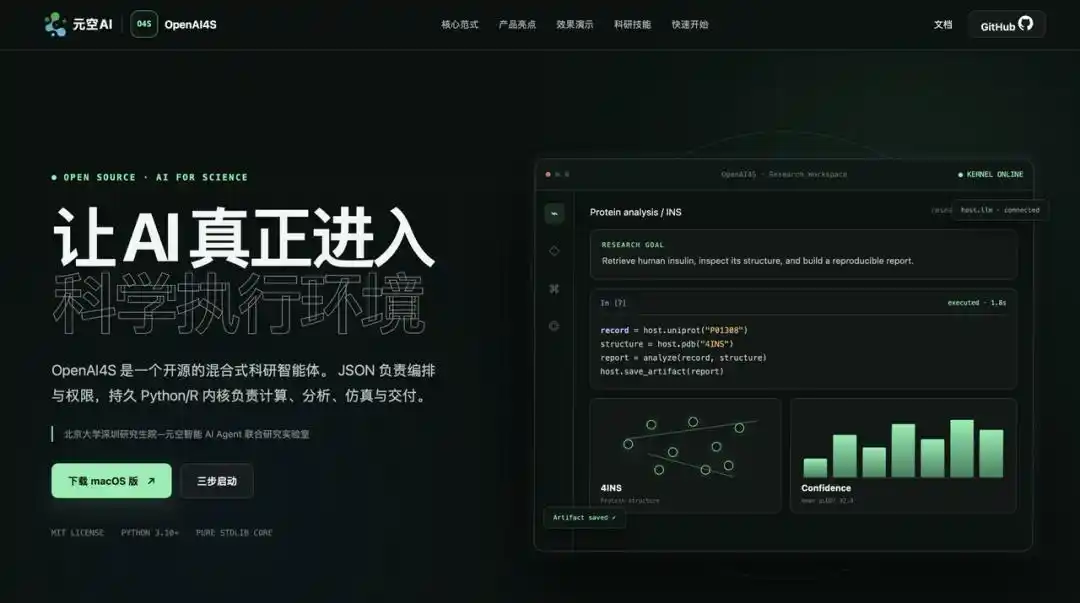
YuanKong AI Science: https://www.chatexcel.com/homesite/openAI4S
It doesn't aim to just provide an answer that looks correct; it aims to have AI truly enter the research workflow, pushing a question from “proposed” to “done.”
Not just chatting more rounds, but making AI truly take action
Many current AI Agents essentially do the same thing: the model faces a pre-prepared “tool menu,” decides which tool to call, and then proceeds step by step. For simple tasks, this method suffices.
But research isn't something that can be completed in three to five steps.
Querying multiple databases, downloading data, cleaning data, repeatedly modifying code, calling specialized algorithms, requesting GPU computing power, generating charts, compiling reports... Any step going wrong may require starting over.
The answer OpenAI4S provides is Code-as-Action, which is “code as action.”
It allows the agent to directly generate Python or R code and execute it in a continuously running kernel environment.
Loops, conditional judgments, batch data processing, and plotting can be combined into a single execution; data and intermediate results don't need to be handed back to the model at every step but remain preserved in the working environment.
For users, the most direct change isn't just an extra technical term, but that AI can string together longer, more complex tasks:
Data downloaded in the previous step can be directly handed to the next step for analysis;
Generated images, tables, and reports are automatically saved;
Researchers can also open the Notebook anytime to inspect code, take over analysis, or modify results.
“Code is action, kernel is environment.”
Completing the research workflow from data to conclusion within one interface
OpenAI4S is more like a shared research workbench for humans and AI.
You give it a task, and it can search public research data sources, write and run analysis code, call specialized computing capabilities, and then organize the results into images, tables, 3D structures, or Markdown reports.
The entire process doesn't just end and disappear. Every piece of research output is recorded, saved, and versioned, facilitating subsequent inspection, modification, and reuse.
For example, ask it to analyze a protein.
It can first retrieve real protein sequence and structure data, then perform feature calculation and visualization, and finally write the analysis process, data sources, and results into a paper.
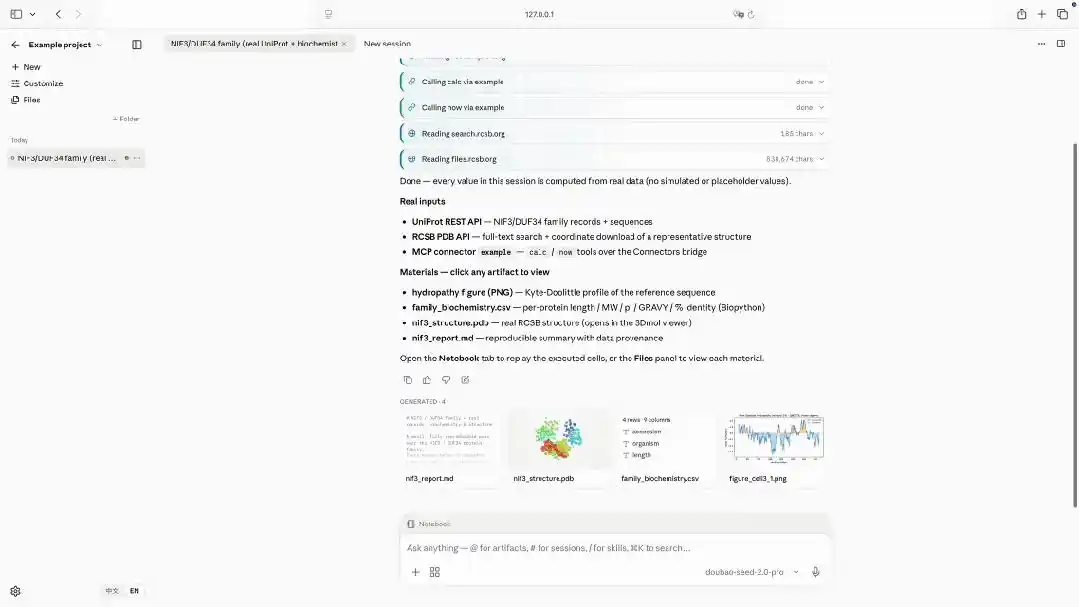
The key point: The data is real, and the calculations are real.
If external services can't connect or computational conditions aren't met, it will clearly tell you what can't be done. It won't secretly insert simulated data, nor will it fabricate results to forcibly complete the paper.
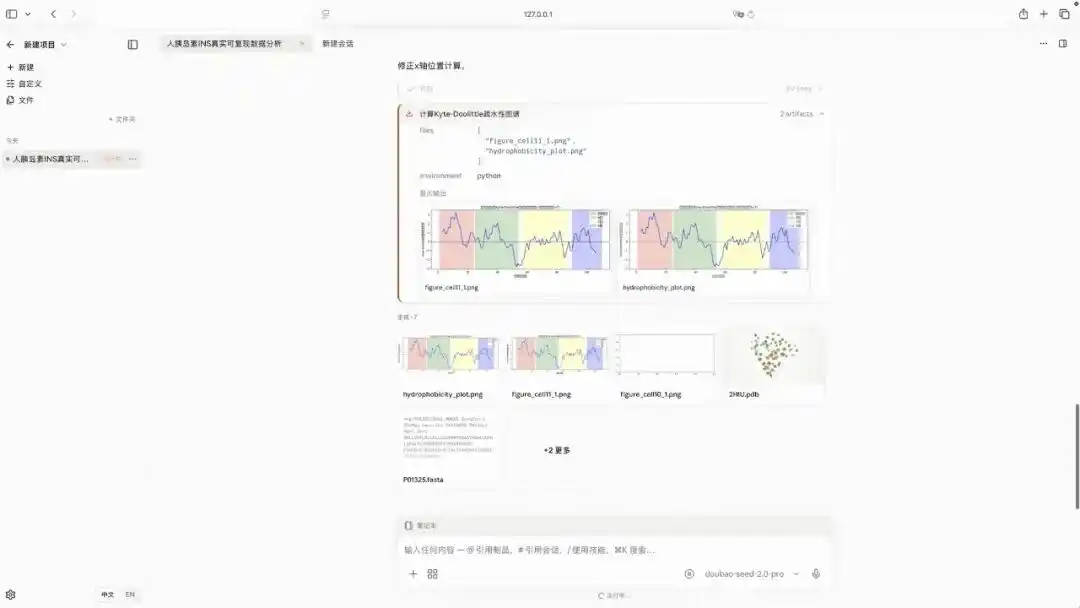
△
Research work often requires repeated revisions.
In traditional workflows, researchers might need to find the plotting script again, modify parameters, run it again, and export files;
In OpenAI4S, you can directly make adjustment requests in natural language. The agent will regenerate outputs based on existing data and code, while preserving version history.
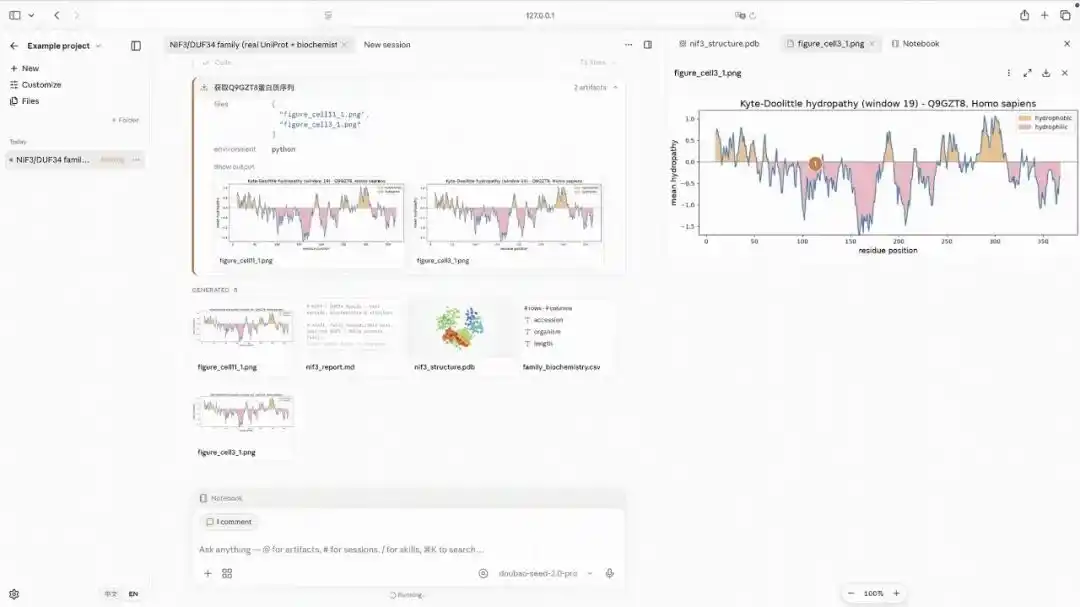
△
Dozens of research Skills, packing professional capabilities into the agent
For a general model to become a research assistant, being “smart” isn't enough.
It needs to know where to find professional data, how to use professional tools, and how to run complex algorithms.
OpenAI4S comes with over 30 built-in research Skills.
Protein structure, sequence analysis, protein design, molecular docking, single-cell analysis, literature retrieval, open data retrieval... covering a range of common computational research scenarios.
Among them, 14 Skills encapsulate scientific computing capabilities that require GPU or specialized models.
These Skills are not just a static list of tool parameters. They are more like a set of “code recipes” that the agent can read, understand, and execute.
What data is needed, which service to call, how to write the code, and how to check results can all be embedded in a Skill.
In the future, with new databases, algorithms, or experimental workflows, developers can continue to integrate them.
This means these capabilities are not permanently sealed. As research demands evolve, Skills can grow accordingly.
Need to connect research data to real computing environments? Send tasks to your own GPU
There's another very practical issue in research computing: computing power.
Tasks like protein folding, mutation scoring, and molecular simulation aren't something an ordinary laptop can casually run.
Moreover, many specialized calculations rely on specific models, complex software environments, and GPU resources.
OpenAI4S supports connecting to self-hosted computing environments. Interaction and task organization happen locally, while specialized computations requiring GPU can be dispatched to your own servers for execution. After results are computed, they return to the same research workflow.
For example, protein structure prediction and mutation effect scoring—the real difficulty often isn't generating the calling code, but feeding the input into the correct computing environment and bringing the complete results back into the workflow.
You don't need to cram everything onto one computer, nor rewrite the entire process just to connect to a computing server. This is particularly important for labs and research teams.
Data, models, and computing power can all stay in your own environment, with the agent responsible for linking them together.
Real data, real calculations—it truly doesn't fabricate
What's the biggest fear when using cheap models for research? Fear that they fabricate with a straight face.
OpenAI4S has established a hard rule called the no-fabrication policy: Using np.random to fake experimental results, fabricating “conservativeness,” substituting BLOSUM with ESM, using simulated datasets as real data... all prohibited.
Either provide real service or honestly report an error.
So, looking back at that INS case—the sequence was truly pulled from UniProt, the structure was truly downloaded from RCSB. If the network connection failed, it honestly skipped, never giving you a fake one.
If it really needs to calculate a protein structure, it truly calls the GPU: host.fold will SSH to a machine with 8×A100s, run single-sequence Protenix (AlphaFold3-level) inference, and return the structure with pLDDT; host.score_mutations runs real ESM scoring to select mutations.
No GPU configured? Then it directly reports an error, never fabricating a fake structure for you.
It would rather tell you “cannot compute” than fabricate a seemingly plausible fake structure.
For a research Agent, this might be more important than “being able to do everything.”
Open-source is a practice by the PKU & YuanKong AI Joint Lab to promote industry-academia collaboration
The release of OpenAI4S is not just adding an open-source project; it's also a practice by Peking University and YuanKong AI to advance industry-academia collaboration.
As a milestone achievement from the joint laboratory, the development and open-sourcing of OpenAI4S owe much to the continuous dedication and drive of Zhang Gongbo, a student from the joint lab.
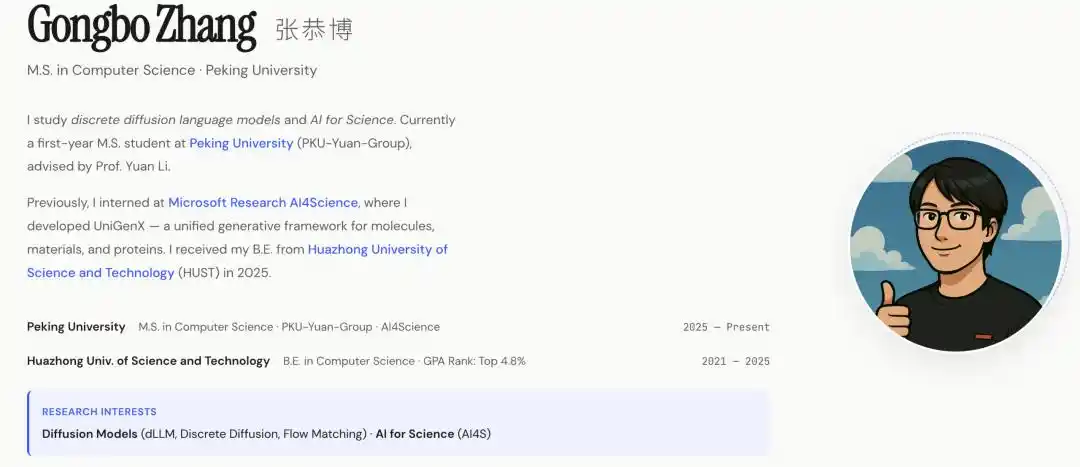
Zhang Gongbo's research focuses on AI for Science. As co-first author of UniGenX, which explores general scientific foundation models for molecules, materials, and proteins, these research accumulations around scientific intelligence further extended into the development and implementation of OpenAI4S.
Meanwhile, OpenAI4S also embodies the joint efforts of team members Li Hao, Wang Yu, Liu Yuyang, Lü-Liu Zhenghao, Mao Yicheng, Lin Mujie, Peng Xinyao, Jiang Zhengxiang, Wang Yimi, and others. From framework design and feature development to open-source release, every step involved collaboration and contribution.
YuanKong AI is an on-device AI company focused on enabling AI to perform complex tasks in local and offline environments through model post-training, Agent Runtime, long-term memory, and on-device inference technologies.
Currently, the company has formed two product lines: YuanKong AI Work and YuanKong AI Science, entering intelligent office and scientific discovery fields, respectively.
This open-sourcing of OpenAI4S also reflects the joint laboratory and YuanKong AI's shared judgment on research Agents:
Research Agents shouldn't remain just as demos; they should become truly executable, inspectable, and extensible research infrastructure.
Therefore, what's being opened includes not just examples, but also the core architecture, research Skills, and complete applications.
Universities, research institutions, developers, and industry partners can build upon this to integrate data sources, algorithms, tools, and research workflows, collectively advancing research Agents into more real-world tasks.
Welcome to run it, and also to help build it further
To get involved with OpenAI4S, you can start by running it.
Installation isn't complicated; it starts with three lines:
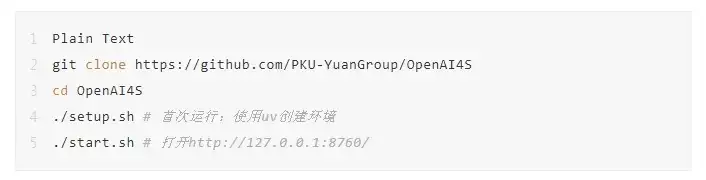
Starting the project itself doesn't require configuring a model key first.
After entering the interface, fill it in under Customize → Models.
The project also comes with a complete set of real cases you can directly run: Live API workflow, real data analysis of human insulin INS, modifying charts with one sentence, and solubility prediction of artemisinin and paclitaxel in planning mode, protein engineering...
But running the project is just the first step.
Real research spans numerous fields like life sciences, chemistry, materials, medicine, earth sciences, etc.
Each direction has its own databases, professional models, and computational workflows. Such a vast landscape of capabilities cannot be completed by one team alone in one go.
Therefore, OpenAI4S officially issues a Call for Contributors to universities, research institutions, developers, and industry teams.
Currently, the Skills UI from Tuzhan Intelligence has provided partial support for this open-source project.
If you are familiar with a particular research direction, you can develop new research Skills for it, integrating professional databases, algorithm models, and computing platforms;
If you are skilled in Agent or software engineering, you can participate in improving the core architecture, remote computing, security mechanisms, testing, and documentation.
You can participate without writing code.
Submitting an Issue, adding a reproducible case, reporting a failed task, or telling the community what a particular discipline truly needs are all valuable contributions.
If you also believe that research Agents shouldn't remain just as demos, welcome to run it, and also welcome to help build it further together.
Gateways
https://github.com/PKU-YuanGroup/OpenAI4S
https://www.chatexcel.com/homesite/openAI4S
This article is from the WeChat public account “QbitAI”, author: Focus on Frontier Technology