Ethena price prediction: Will the $0.08 zone keep ENA’s recovery alive?

ambcryptoPublicado a 2026-07-12Actualizado a 2026-07-12

Resumen

The Ethena (ENA) price has risen 14.11% from its July 8 low, recovering the $0.08 resistance zone to trade at $0.082. Despite this recent gain, the overall trend remains bearish, with the token down 94% from its all-time high. Positive developments include the launch of the Robinhood Earn feature, where ENA represented over 70% of user asset allocations, significantly boosting the Robinhood Chain's TVL. However, a large transfer of 1.231 billion ENA ($94 million) between unknown wallets created mixed signals. Technical analysis shows long-term bearish dominance, with price action below key former support. The ongoing bounce from $0.08 requires sustained buying pressure to continue. Key resistance is seen at the $0.105-$0.125 zone. Analysts suggest a potential bounce to that zone could present a selling opportunity, while current price levels offer unclear risk-reward for swing traders. The $0.08 level is crucial for keeping the recovery alive.

Ethena [ENA] has been moving upward since the 8th of July. The altcoin has made a 14.11% move from the $0.072 low on that day to the current market prices of $0.082 after reclaiming the short-term resistance zone at $0.08. However, the token has been falling lower since the attempted rally beyond $0.10 in early June. Despite the recent gains, the downtrend has yet to be broken.

The Robinhood Earn feature, launched on the 1st of July, has also been a big plus for Ethena. The network observed in a post on X that Ethena represented over 70% of the asset allocation from Robinhood user deposits. Ethena seeded $50 million into a USDG vault on Morpho, chosen by Steakhouse Financial. This inflow pushed the Robinhood Chain’s TVL up by 160%.

Contrasted against this positive news for the synthetic dollar protocol was the Whale Alerts post on X that showed a 1.231 billion ENA transfer, worth $94 million, between two unknown wallets.

Using ENA price action to sort out the upcoming trends
Source: ENA/USDT on TradingView

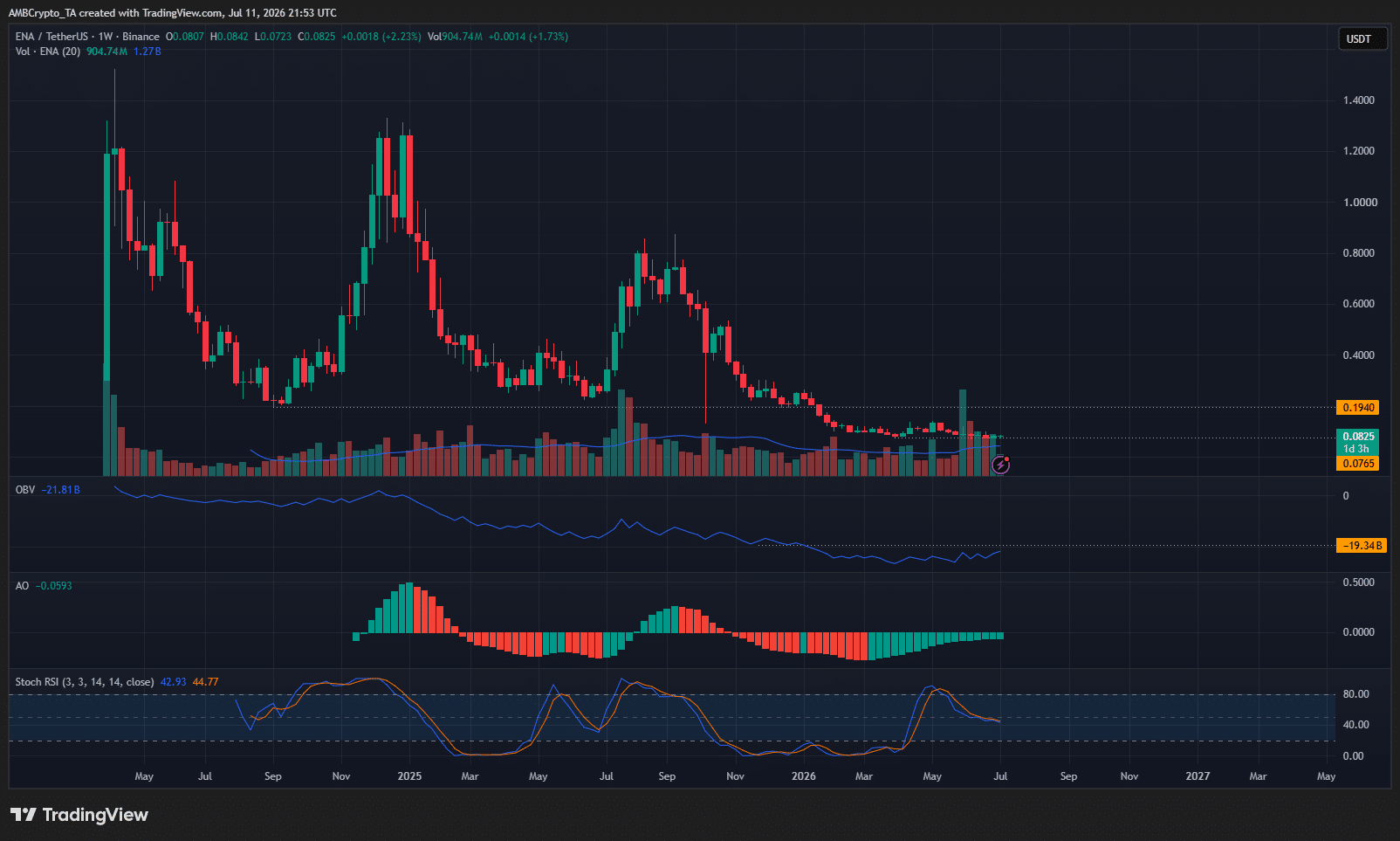
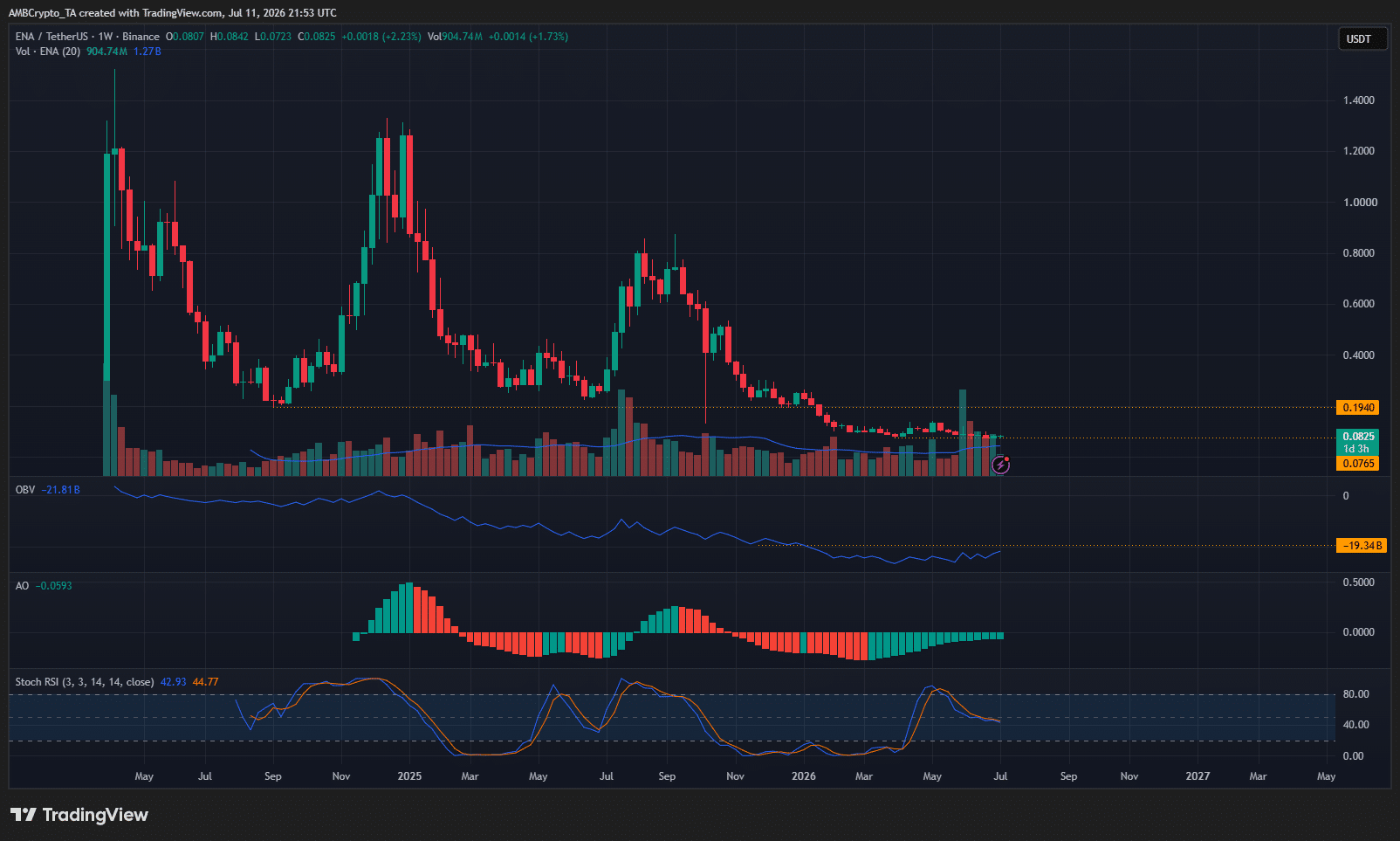
For an altcoin that is down 94% from its all-time high, the weekly chart is expected to be bearish. The OBV has been making new lows for over two years. The ENA price fell below the $0.19-$0.20 support zone at the start of the year. This support level had been defended since September 2024.

Other momentum indicators were neutral or bearish on this timeframe, and the OBV signaled overall bearish dominance. However, a lower timeframe resistance zone has been breached.

Should ENA traders wait before selling?
Source: ENA/USDT on TradingView

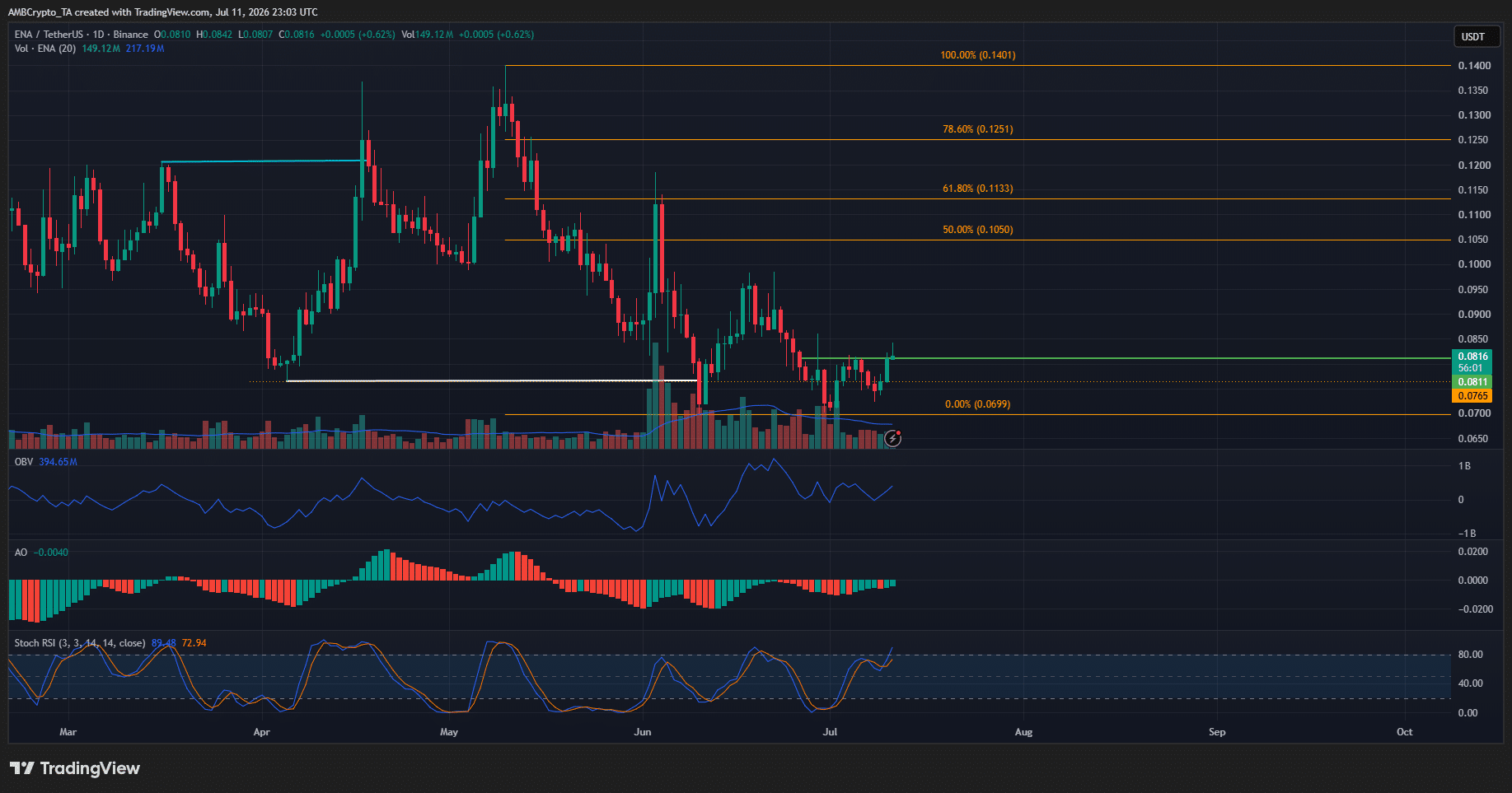
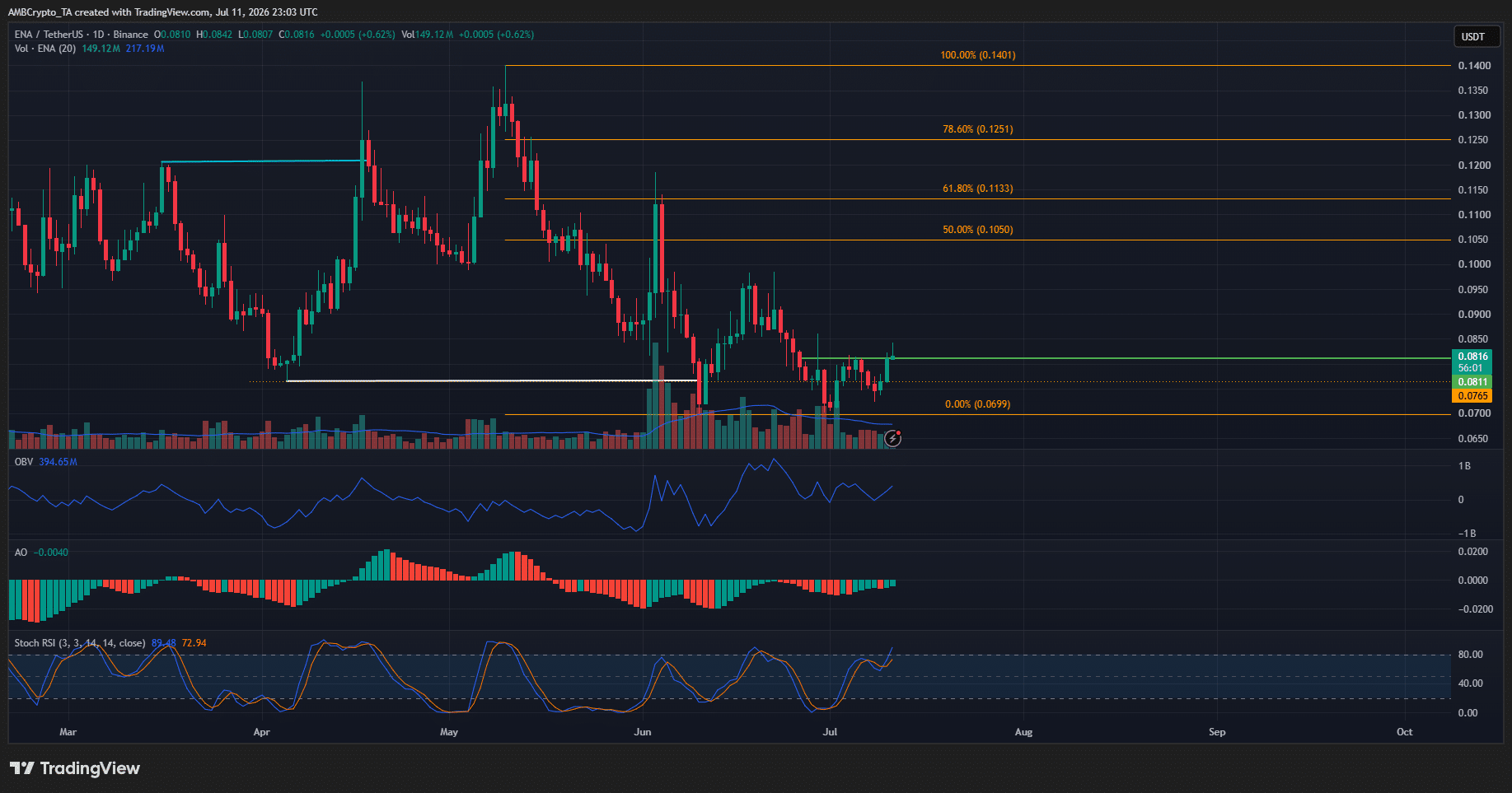
The 1-day swing structure broke bearishly at the start of June (white). The ongoing price bounce from the 0.08 zone requires the OBV to continue going higher to signal steady buying pressure.

Such a bounce is technically possible, but the broader market sentiment needs to support ENA’s bullish shift, if it comes. Even then, the $0.105 round number and 50% retracement level would be a key resistance zone to overcome.

A bounce to $0.105-$0.125 could be sold with conviction. At current prices, neither buying in expectation of a bounce nor selling ahead of a price slide had a good enough risk-to-reward for swing traders.


Final Summary

  • A $94 million ENA token worth alongside the bullishness around the Robinhood Earn news presented mixed signals for market participants.
  • The long-term price action was bearish, and the $0.105-$0.125 pivotal resistance zone was one to watch.


Criptos en tendencia

Preguntas relacionadas

QAccording to the article, what is the key resistance zone that ENA needs to overcome for a potential recovery?

AThe key resistance zone that ENA needs to overcome for a potential recovery is the $0.105-$0.125 level, with the $0.105 round number and 50% retracement level being particularly pivotal.

QWhat recent development involving Robinhood has provided a positive signal for Ethena (ENA)?

AThe Robinhood Earn feature launched on July 1st has been a big plus, with Ethena representing over 70% of the asset allocation from Robinhood user deposits. This influx also pushed the Robinhood Chain’s TVL up by 160%.

QWhat bearish signal was highlighted from the longer-term weekly chart analysis of ENA?

AThe weekly chart is bearish, with the On-Balance Volume (OBV) indicator making new lows for over two years. Furthermore, the ENA price fell below the long-held $0.19-$0.20 support zone at the start of the year, signaling bearish dominance.

QWhat event related to large-scale token movement created a contrasting or potentially negative signal alongside the positive Robinhood news?

AA Whale Alerts post showed a transfer of 1.231 billion ENA tokens (worth $94 million) between two unknown wallets, which presented a mixed or potentially concerning signal for market participants.

QFrom a swing trader's perspective, what does the article suggest about buying or selling ENA at its current price level of around $0.082?

AThe article suggests that at current prices, neither buying in expectation of a bounce nor selling ahead of a potential price slide had a good enough risk-to-reward ratio for swing traders.

Lecturas Relacionadas

Circle Secures a 'Federal Infrastructure License' for Stablecoins: The Deep Implications of Circle National Trust Receiving Final Approval from the OCC

Circle announced on July 10, 2026, that it has received final approval from the U.S. Office of the Comptroller of the Currency (OCC) to establish Circle National Trust, a federally chartered national trust bank. This landmark event marks the first time a stablecoin issuer has formally entered the U.S. federal regulatory system as a trust bank, signifying a major shift in competition from simply issuing tokens to controlling regulated infrastructure for issuance, custody, reserve management, and settlement. Initially, Circle National Trust will focus on providing digital asset custody services for Circle and its affiliates, with plans to potentially extend services to institutional clients later. While reserve management for USDC is planned as a future capability, the approval of the trust charter creates a federal pathway for it. This grants Circle significant federal regulatory credibility, a crucial factor for institutional adoption of USDC. The move positions USDC to evolve from a crypto-company stablecoin toward a federally supervised dollar settlement infrastructure. The approval underscores a strategic focus on building vertical integration for stablecoins—encompassing issuance, custody, and settlement—within a specialized trust bank model rather than a traditional commercial bank. This model aligns with the full-reserve, payment-oriented nature of stablecoins while leveraging federal oversight. For the broader payments industry, this development strengthens the stablecoin settlement rail for use cases like cross-border payments and real-time settlement, complementing rather than replacing existing systems like Visa or Mastercard. The move reshapes the competitive landscape, as other players like Coinbase and Paxos also seek similar trust charters. Circle has now established a significant regulatory moat. Overall, this approval represents a pivotal step for stablecoins, transitioning them from innovative tools to core financial infrastructure governed by the highest levels of U.S. banking regulation.

marsbitHace 21 min(s)

Circle Secures a 'Federal Infrastructure License' for Stablecoins: The Deep Implications of Circle National Trust Receiving Final Approval from the OCC

marsbitHace 21 min(s)

Claude Accused of Becoming Dumber by the Entire Internet, Anthropic Steps In to Reveal: It’s Not the Model That’s Tricking You

When users complained that Claude was "getting dumber," the root cause wasn't the AI model itself. In an official blog post, Anthropic clarified the critical difference between two key settings in Claude Code: Model and Effort. Model refers to the core "brain"—the fixed, trained weights of a specific AI (like Sonnet, Opus, or Fable). Changing the Model addresses *capability* ("can it do this?"), but its knowledge is static post-training. Effort, however, controls the AI's *approach and thoroughness* for a specific task. A higher Effort level instructs Claude to read more files, run tests, perform verification, and complete multi-step reasoning before responding, significantly increasing its "work output" for that job. Conversely, low Effort leads to quicker, less thorough replies. This distinction explains the March 2024 uproar where users experienced a sudden drop in Claude's performance. The cause was not a model change but Anthropic quietly lowering the *default* Effort setting from "high" to "medium" to reduce latency, which was later reverted. The key insight is that a smaller, capable model (like Sonnet) on high Effort can often outperform a larger, more powerful model (like Opus) on low Effort for many tasks. The article provides a practical troubleshooting framework: if Claude makes an error, first check the context and instructions. If it seems to skip necessary steps or validations, increase Effort. If it diligently attempts the task but fails conceptually or makes consistent factual errors despite good context, then consider switching to a more capable Model. The takeaway is a shift in focus: effective AI programming is less about always choosing the "strongest" model and more about intelligently *orchestrating* models and effort levels—acting like a project manager to assign the right "brain" with the right level of diligence for each job, optimizing both results and cost.

marsbitHace 1 hora(s)

Claude Accused of Becoming Dumber by the Entire Internet, Anthropic Steps In to Reveal: It’s Not the Model That’s Tricking You

marsbitHace 1 hora(s)

Will the Ethereum Foundation Evolve into a 'Mascot'? Diversified Organizations Are Fragmenting Its Functions

The Ethereum Foundation (EF) is undergoing significant internal turmoil and functional erosion. Following its largest-ever layoff of 54 staff (20% of its workforce) and a major organizational restructuring announced in June, its Protocol Support Team has been officially dissolved. This comes alongside the high-profile resignation of key figures like co-executive director Xiaowei Wang, bringing senior departures this year to at least eight. Criticism of EF's rigid structure, opaque decision-making, and perceived lack of a clear value narrative for ETH has intensified within the community. The layoffs have catalyzed the emergence of independent, non-profit organizations like Ethlabs and Ethereum Institutional, founded by former EF researchers and members. These entities are now taking on core functions such as protocol research/development and institutional adoption, effectively fragmenting the EF's traditional leadership role. Concurrently, EF's security team is adapting to technological change, deploying specialized AI agents to audit Ethereum's codebase, which successfully discovered a critical vulnerability (CVE-2026-34219). While EF states AI complements rather than replaces researchers, it signals a potential future shift in its operational model. Faced with these challenges—internal restructuring, talent drain, the rise of competing organizations, and AI integration—the Ethereum Foundation appears to be stepping back from a central commanding role. Analysts and community observers speculate it may increasingly transition towards a symbolic "ecosystem mascot" function, while decentralized initiatives drive Ethereum's future growth and institutional adoption.

marsbitHace 2 hora(s)

Will the Ethereum Foundation Evolve into a 'Mascot'? Diversified Organizations Are Fragmenting Its Functions

marsbitHace 2 hora(s)

Trading

Spot

Artículos destacados

Cómo comprar ENA

¡Bienvenido a HTX.com! Hemos hecho que comprar Ethena (ENA) sea simple y conveniente. Sigue nuestra guía paso a paso para iniciar tu viaje de criptos.Paso 1: crea tu cuenta HTXUtiliza tu correo electrónico o número de teléfono para registrarte y obtener una cuenta gratuita en HTX. Experimenta un proceso de registro sin complicaciones y desbloquea todas las funciones.Obtener mi cuentaPaso 2: ve a Comprar cripto y elige tu método de pagoTarjeta de crédito/débito: usa tu Visa o Mastercard para comprar Ethena (ENA) al instante.Saldo: utiliza fondos del saldo de tu cuenta HTX para tradear sin problemas.Terceros: hemos agregado métodos de pago populares como Google Pay y Apple Pay para mejorar la comodidad.P2P: tradear directamente con otros usuarios en HTX.Over-the-Counter (OTC): ofrecemos servicios personalizados y tipos de cambio competitivos para los traders.Paso 3: guarda tu Ethena (ENA)Después de comprar tu Ethena (ENA), guárdalo en tu cuenta HTX. Alternativamente, puedes enviarlo a otro lugar mediante transferencia blockchain o utilizarlo para tradear otras criptomonedas.Paso 4: tradear Ethena (ENA)Tradear fácilmente con Ethena (ENA) en HTX's mercado spot. Simplemente accede a tu cuenta, selecciona tu par de trading, ejecuta tus trades y monitorea en tiempo real. Ofrecemos una experiencia fácil de usar tanto para principiantes como para traders experimentados.

220 Vistas totalesPublicado en 2024.12.10Actualizado en 2026.06.02

Cómo comprar ENA

Discusiones

Bienvenido a la comunidad de HTX. Aquí puedes mantenerte informado sobre los últimos desarrollos de la plataforma y acceder a análisis profesionales del mercado. A continuación se presentan las opiniones de los usuarios sobre el precio de ENA (ENA).

活动图片