Editor's Note: If you naively believe the panic on social media, you might think 'all jobs are about to be replaced by AI.' Many people, as a result, label themselves as 'anti-AI,' trying to use online anger to mask their own unwillingness to change and refusal to grow.
However, AI is not the greatest threat. The real crisis lies in entrusting one's survival and happiness entirely to others. When technological change comes, if you still naively believe that others are responsible for your future, you are destined for disappointment.
Crying and complaining won't control this behemoth called AI. Posting complaints on social media about how much you hate AI won't stop jobs from being replaced, and it absolutely won't stop the core skills required for success from changing in this era of relentless technological advancement. This article explores how to escape the fate of the 'wage slave' and find meaningful ways to work. Below is the original article:
One: How to Escape the Fate of the Wage Slave
Put simply, so-called 'wage slavery' (the fate of the wage slave) is being forced to do meaningless drudgery for someone else, work you don't want to do at all, just to put food on the table.
Don't get me wrong, I'm not against working a job.
I think a job is a great springboard. It lets you accumulate real-world experience and learn tangible skills.
But every time I say anything 'bad' about jobs, a certain crowd jumps out to criticize me: 'You have no idea! I actually like my job!'
That's awesome. I'm not talking to you (and deep down, I kind of think you're probably lying to yourself just to avoid digging into your own potential, and you haven't realized it yet).
I'm talking to those who truly understand 'enjoyment psychology.' Because they simply can't stand this life script: one-third of their life spent doing work they didn't choose, one-third of their life mentally exhausted and unable to do anything meaningful, and the remaining third spent sleeping... and doing it for over 40 years.
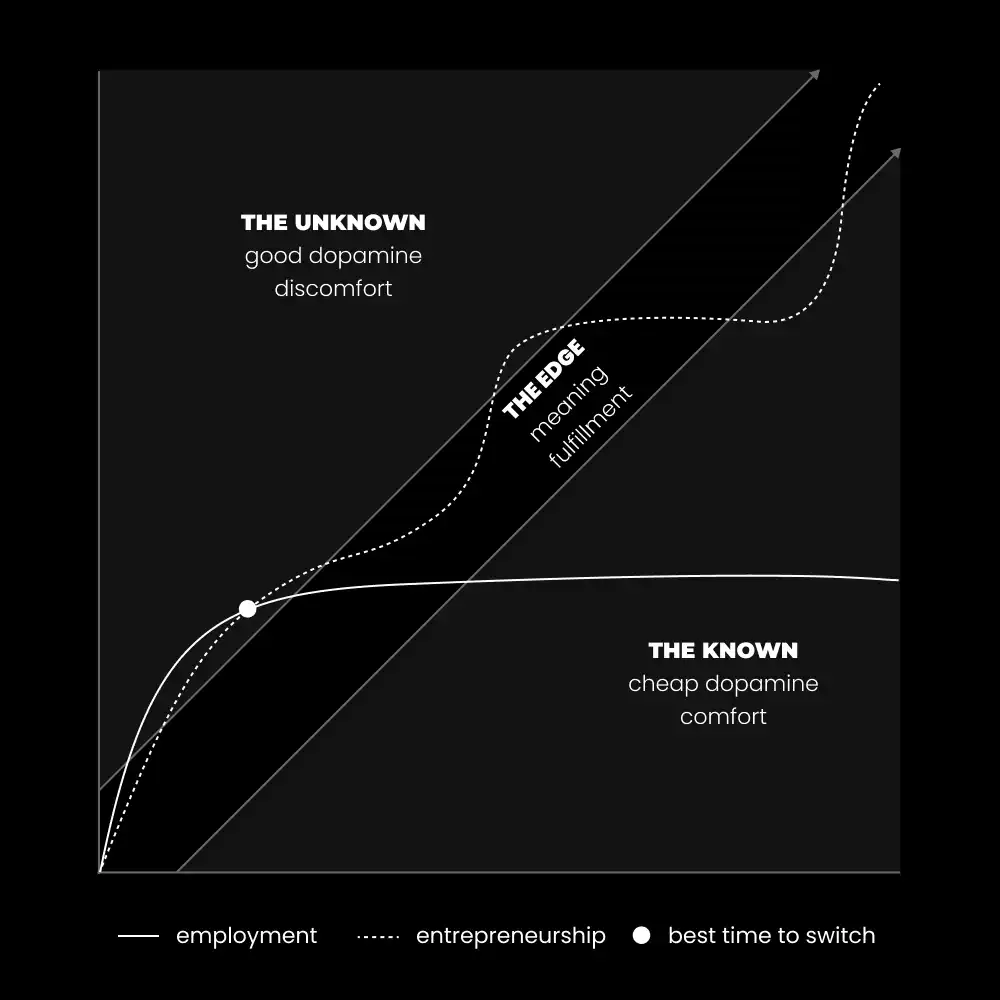
You see, real fun, meaning, and fulfillment actually lie at the edges of your competence. There's science behind this. Don't expect me to cite sources here. Enjoyment comes from grappling with challenges that are just slightly above your current skill level. Not too hard, or you'll get anxious; not too easy, or you'll get bored. Video games have this down perfectly. The quests you get are always 'just the right difficulty,' because if a level 1 newbie fights a level 100 boss and gets one-shotted, they'd delete the game. This is the strongest driver for getting you into a flow state. If you can design your life in a way that easily triggers flow, fun will naturally be plentiful.
But the problem with a job is that, after a few months, you've learned all there is to learn. Every day is clock in, work, clock out. You start feeling utterly bored. This goes against your nature, and you feel it inside. Your attention is no longer on the work, but starts wondering: 'What else can I do?' For the vast majority of people, this 'what else' is definitely not some meaningful grand goal, but pulling out their phone and rotting their brain with short videos. Very few jobs require you to constantly level up and take on bigger challenges.
Career advancement is beneficial, but again, you can't control the challenge level. After all, you're not working on your own project. Curiosity, passion, purpose, autonomy, and mastery—these five engines that drive flow—are destined to be starved of fuel.
So how is this related to wage slavery?
At its core, human civilization is built on tribes enslaving other tribes. This underlying logic has never disappeared; it's just changed its costume to today's employment relationships, laws, and culture. Today's society is, frankly, a giant pyramid scheme. There are always more people at the bottom than at the top, and mathematically, not everyone can be the boss. One boss leads a group of employees, and employees, to survive, have no choice but to cling tightly to the boss.
Our generation was mostly mass-produced by an assembly-line education: you need to become an expert, you need to master a craft, you need to find a high-paying job, so your parents can have face in front of relatives and friends. Precisely because you obeyed, you are clueless about how the whole business system operates. You only mastered the craft of tightening screws, but never understood the system that pays your salary. You didn't spend time in other areas, so you have no idea how to start your own thing. The only thing you know how to do is play the role of an employee in someone else's business.
Unconsciously, your ability to think independently is crippled, even if you're considered 'smart' in your field. You have a decent salary, but feel insecure and financially unfree, so you get sucked into a stressful, frantic loop. Stress narrows your vision, making you increasingly afraid to imagine a life of independence.
You have no starting capital to pursue dreams, no time for self-improvement. You're probably already exhausted (mentally, not physically), with no energy left to re-educate yourself, because for most of your waking hours, you're helping someone else realize their dreams.
By the way, the only way to survive the wave of full AI replacement is: to do your own thing.
The sad thing is, slaves often don't know they are slaves. This goes far beyond just wage slavery. We are all slaves in some way, usually trapped by various belief systems and ideologies.
When talking about slavery, people always think of being forced at gunpoint. But the slavery of the wage slave is financial. If the sky falls when you miss a day of work, and you have no other means of income, then no matter how 'good' you feel, you perfectly fit the definition of a slave.
Even worse, if 'I am an employee' is etched into your DNA, you might even feel like I'm insulting you. You'll get defensive, you'll want to argue, that's fine, but it just proves my point is right.
I think you get my point. It's really painful to think about; it makes me sick. So let's talk about what solutions exist now and what you can do.
Two: The Five Core Elements of Success
If you don't set the rhythm of your own life, someone else will impose their rhythm on you.
Most people, for the majority of their lives, are forced to learn things they don't want to learn, to get a job they don't care about at all, and have to work daily with people they wouldn't associate with privately.
While I think AI, technology, and social media have indeed accelerated our awakening, making us realize that school and a job aren't the only ways to live, I also think people are simply worn out by the overwhelming sense of meaninglessness in the surrounding world.
For those already tired of the routine, to make yourself 'antifragile'—able to keep doing meaningful things even if all jobs disappear—you need to master these five core ingredients:
1. Agency: The ability to 'just do it' without asking for permission. That is, when an opportunity appears, even without orders, you can seize it.
2. Taste: The intuitive sense of 'I can tell at a glance if this is worth putting out or if it's embarrassing.'
3. Persuasion: The ability to get others to willingly buy into what you're doing, not through trickery.
4. Persistence: Understanding that making a mistake isn't the end of the world, and that trial and error is a necessary process.
5. Iteration: The process of constantly correcting course based on feedback to move towards a goal (if it doesn't work, learn and adjust direction until it does).
Now everyone is obsessed with being 'high-agency.' I get it, it's important. All the tech gurus are mimicking each other, talking about how important high agency is, which ironically reveals their lack of agency.
Yes, you do need the guts to take initiative for your goals. This is also one of the most fundamental differences between a boss and an employee. So-called entrepreneurs are those who create things nobody asked them to create.
But this is just one piece of the entrepreneurial puzzle.
The above 5 elements can actually be boiled down to two skills: problem-solving ability, and the accumulation of experience that tells you what to do.
So far, AI has been excellent at asset creation, but creating a hit is not the same as asset creation. Asset creation is a necessary but insufficient condition for creating a hit.
'Just like 5 years ago, anyone could make a video game last week. The technology is there, it's completely commoditized. Do you know how many mobile games are released each year? Tens of thousands. Do you know how many hits come out each year? 0 to 5.'
– Strauss Zelnick
Now anyone can build anything, which means the barrier to entrepreneurship (the antidote to escaping the wage trap) is dropping like crazy, but so what:
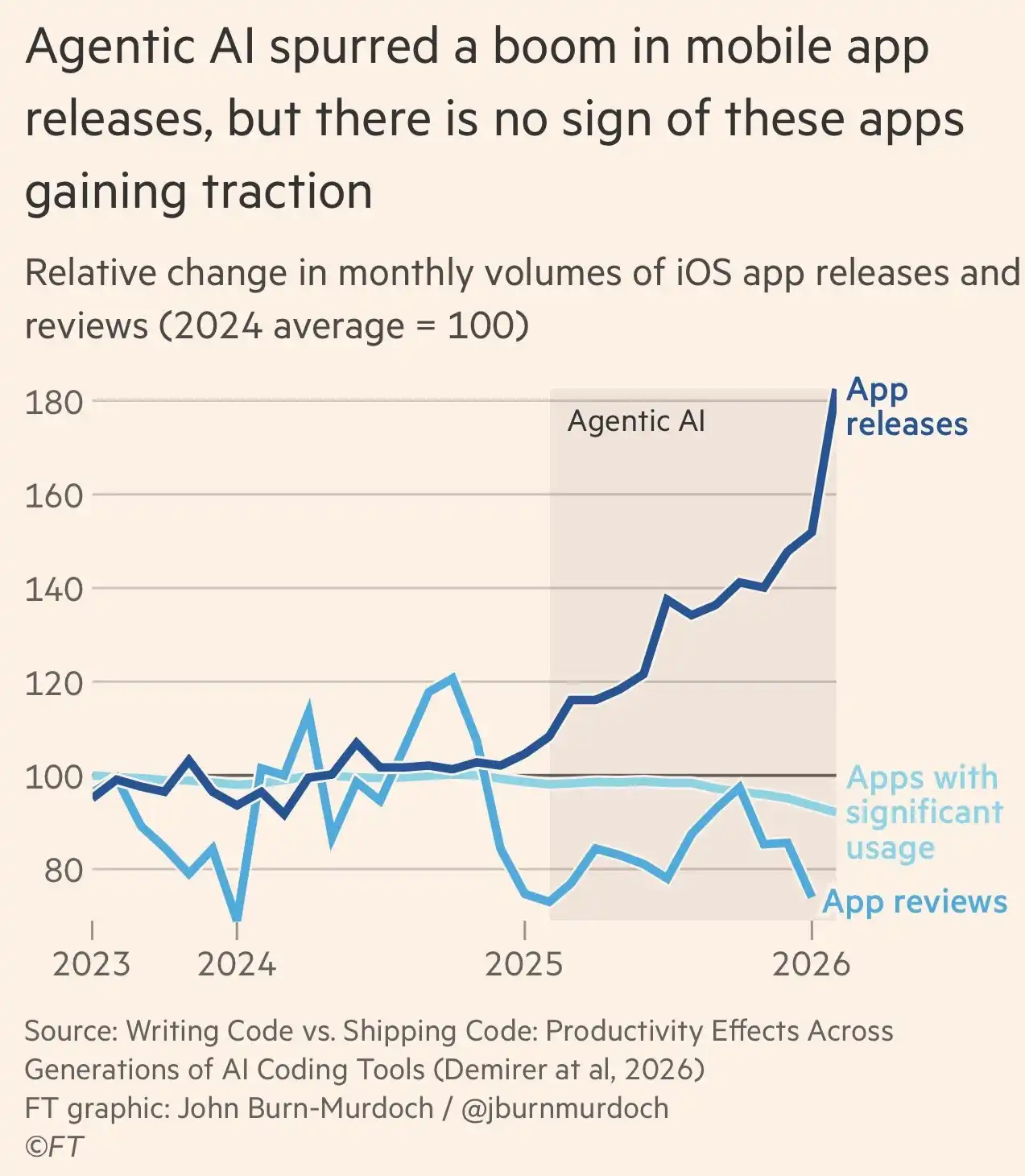
You can go develop an App right now. Not to build the next Notion, but to develop a manageable-scale app or tool focused on a real outcome people benefit from. Something that doesn't necessarily have to be a hit to be valuable.
I actually highly recommend this; I think software is the next era's 'digital product.' What I mean is, developing software will become the default choice for creators, solo entrepreneurs, and other one-person businesses. Digital products lasted so long precisely because the barrier was low; anyone could do it, but that doesn't mean anyone could make money doing it.
The chart above illustrates the first problem.
You can build anything, but that doesn't mean (1) it's worth building; (2) people will care; (3) you have the ability to persist, iterate, and refine it based on market feedback into something worth building that people care about.
If you truly understand this sentence, you will absolutely thrive.
The second problem is: Agency, taste, persuasion, persistence, and iteration are not 'high-value skills' you can learn by watching a few YouTube tutorials. Watching motivational posts online about how to increase agency every day won't give you a single ounce more agency.
The only way to practice is to start doing your own thing right now.
Three: The Antidote to Being an Employee is to Make Yourself 'Unemployable'
I still remember the day I took on my first freelance web design job.
I remember they gave me $300 to hand-code a simple, ugly website. The client sold mattresses, and they just wanted a place online where people could see their mattresses.
That was it.
$300.
That was the moment of enlightenment. I knew very clearly that if I could repeat, optimize, and iterate this process to make money, I could definitely grasp control of my lifestyle and future direction. It completely turned me into an 'unemployable' person. A conviction was planted in my heart: I could never work for someone else again in this lifetime, I'm going to make it on my own—even if it sounds a bit cringey.
But that $300 didn't cover all the groundwork leading to that moment—like the shift in my identity, and how I initially tricked myself into believing it was possible. It certainly didn't represent what I learned in the 7 years of struggle that followed.
I want to give you two things: one is to guide you through a shift in identity perspective, to make you an 'unemployable' person from the core, not just think it sounds cool; the other is an actionable plan everyone can implement in their own way.
1) Throw Yourself into an Environment That Forces You to Grow
The fastest shortcut to changing your life is to uproot yourself from your current environment (whether real life or online). Overnight, complete transformation. Change where you go, who you follow, what you watch... change everything. It's uncomfortable, but absolutely effective.
Change behavior = Change identity.
It's like saying you want to diet and lose 30 pounds, but if deep down you don't care about health and can't stand that bland life, you'll always feel like you're swimming upstream. In the end, you'll be like most people, gaining back all the weight you lost, unless you fundamentally become a new person.
So how do you do it?
First, it helps to understand how you became who you are today.
· You were born into a family and culture with specific values.
· You were subtly indoctrinated with these values, even if your parents didn't force you at gunpoint.
· You went to schools with specific values, brainwashed by teachers with specific values.
· You are bombarded daily with information that might push you into rebellion, apathy, or victim mentality.
· Once you got a phone, this indoctrination process accelerated due to social media algorithms and our primitive, uncontrollable brains.
Of course, there's more to it, but you get the idea.
This isn't all bad; sometimes it's necessary. I've heard plenty of gurus who constantly say 'be authentic' talk about how much they hate 'copying' and imitation, yet what do they do? They still walk on two legs, speak English, why? Because that's human society. That's imitation. That's learning.
But it becomes problematic when your behavior contradicts the life you truly desire deep down. There's always a voice whispering: 'I was born for something greater.'
To reformat yourself, you must start with your environment.
You must be absolutely vigilant about all the stimuli around you, because they are shaping you every moment.
What you need to do is: Sleep tonight, and flip the switch completely tomorrow.
Wake up tomorrow morning and don't repeat yesterday's routine, even for just one day. Set your alarm for a different time. Plan every single thing you'll do after waking up. Eat something different. Talk to people you normally ignore. Watch content you'd never watch. Overhaul everything.
As you learn more, you'll slowly figure out which direction to tailor your new environment towards.
2) Choose a Vehicle That Gives You the Most Honest Feedback
The most dangerous way to live is to hide in a greenhouse where you don't have to experiment.
Once you stop going through the process of making mistakes, you detach from challenges, exploration, and the hard-won wisdom that are the necessary paths to growth and fulfillment.
This doesn't just apply to jobs where the challenge level plateaus after you become familiar with the tasks. It equally applies to business and entrepreneurship, and to people who, even as bosses, can't shake the employee mindset: always needing someone to tell them what to do, or always needing a manual to feel confident in their steps.
Let me ask you a question:
Before the internet, before endless 'how-to' guides and step-by-step processes, how did people figure things out? How was the first rocket built?
They experimented. They failed. They didn't let failure convince them it was impossible, nor did they give up and scroll for entertainment when they hit a wall. They set a new direction based on the feedback reality gave them. Eventually, they found the needle in the haystack.
They were the truly intelligent ones.
Because the most distinguishing feature of an intelligent system is: the ability to correct course based on feedback. They had a lighthouse in their hearts; when blown off course, they didn't choose to abandon ship.
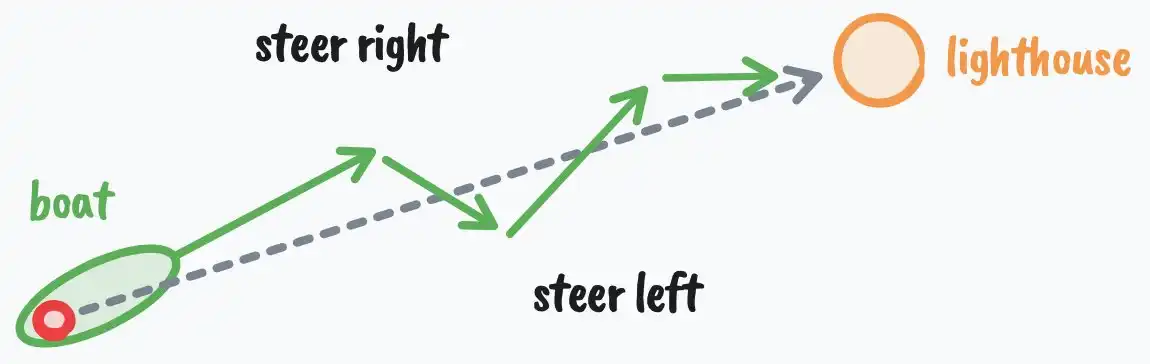
When I talk to you about entrepreneurship, this is what I mean.
I mean embracing your most primal nature. To create. To chase unknown goals that you absolutely cannot achieve without falling flat on your face a few times.
This is the only common trait among almost all remarkable people.
For them, failure isn't a negative word at all; it's a necessary staple for living an exciting life.
It sounds inspiring, but in today's society, how do you actually implement it?
3) If You Want to Thrive in the Future, You Must Master One of These Two Crafts
'Code and media are leverage that don't require anyone's permission. They are also the secret weapons behind new wealth. You write software, you create content, and they work for you in the background while you sleep.'
– Naval
As a beginner, as an individual, you have no idea how terrifying the leverage resources you hold are, especially with AI today.
And I'm not talking about low-level players using ChatGPT like Google, or artists who complain because AI 'copied' their work.
I'm talking about the state of enlightenment: you realize you can build anything, because AI has forcibly pushed you onto the fast track of experimentation. Yes, the initial output will be ugly, but if you have agency, can iterate, understand persistence, and nurture taste along the way, then you are truly limitless, and this trend will only intensify in the future. Then, if you have some persuasion skills, the things you build can make money for you while you dream.
Of course, this was possible even before AI. The core problem is that most people don't understand this principle: as long as you gather the five ingredients for success and extend the timeline long enough, there is nothing in this world you cannot achieve. AI just gives you an accelerator, letting you do more, faster, and granting you privileges you never dared to imagine before—like the superpower of coding, and turbocharged efficiency in learning and research.
Having said that, I genuinely believe that understanding media (content) is more valuable than understanding code.
When talking about media, it essentially means creating content.
Once you publish a piece of text, video, podcast, or article, it can be seen by thousands, even millions of people. In my view, this is the most valuable iron rice bowl for the future, especially when the entire internet is hoping for one-click AI generation.
Because creating content requires the discernment to know what 'good stuff' is.
You still need to accumulate the kind of insight AI can't give you, because you haven't even started experiencing the baptism of trial and error. You don't even know what prompts to feed the AI.
The value of content is highly subjective. Beauty is in the eye of the beholder. In other words, there is no 'standard answer' for creating content.
In contrast, the value of code is too objective. As long as the program runs, nobody cares how you wrote it. As we discussed earlier, there are more apps in app stores than ever before, but downloads and usage rates are plummeting.
Why?
Because they have no idea how to do distribution! They know nothing about media and content. They can't even convince people to download, let alone make them feel the app is good enough to pay for.
By the way, when I say creating content, I'm not talking about what those hype people on Instagram promote: 'I threw my account to Claude, woke up with 100k followers.' That kind of traffic, besides looking cool, is worthless unless you build connections by storytelling and establishing authority. Of course, you can use Eden for this, but only if you know what game you're really playing.
As JK Molina says: Likes don't pay the bills.
Advanced content creation is absolutely not about posting thirst traps or rage bait for attention.
Oh, and if you haven't realized yet: the new environment you force yourself into to reshape your identity should be filled with people, communities, and habit triggers related to your ideal life. Creating content is also a piece of this puzzle.
Four: How to Start: Spend 15 Minutes a Day to Rewrite Your Life Trajectory
You've already taken drastic action on your environment. You've also chosen the vehicle you want to master. You understand that content is more valuable than code because its value lies entirely in the eye of the beholder. This subjectivity will quickly saturate the market with generic AI articles, leaving a vast space for genuine creators—whether you use AI assistance or not, because once again, AI is never the core issue.
Now, you only have one most critical question left to answer: What do you want to achieve in your life? (i.e., your life's work)
This is the stage we're going to build together. We're aiming for a life's work, not a flashy 'personal brand.'
Peterson, Huberman, Watts—these big names certainly have 'personal brands,' but these labels are tightly bound to their ultimate goals. They know what they want, and then incidentally use social media as a tool to get it done. Because this approach, combined with AI, is currently the biggest move you can make solo. After all, if you're starting from zero, you're unlikely to get far with television, radio, or traditional publishing.
Their personal brand is themselves.
It's their identity marker.
If you want to see what your own identity marker looks like, go through Eden's onboarding process. It will directly generate a navigable map of connections for you.
Most people love this concept but quickly get stuck. They all chase dopamine hits, searching for 'which short video niche is easiest to make 10k a month,' but stubbornly refuse to dig into the experiences and stories they've accumulated over years—simply because they think these things are too mundane to them, surely nobody would watch.
The raw material for building your life's work is already buried in your mind. It's just been filled in over the years by teachings of 'specialize,' 'be realistic,' and 'stop asking so many whys.' This process isn't about feeding you novel ideas. On the contrary, it's to show you everything you already possess.
Take this seriously.
Close those messy browser tabs. Open a blank document. Set a 15-minute timer. Honestly write down the answers to each question below. Don't skip any question that makes you uncomfortable.
Step One: Unearth Your Raw Material
The things that could have made you shine were smoothed down by later rules. Your curiosity was labeled as not focusing. Your desire to dabble in everything was criticized as being scattered. Because the system only needs an obedient employee.
Your content will only be worth watching if it's extracted from your own flesh and blood.
Answer the following questions. If you can't think of an answer, skip it and let the question simmer in your subconscious:
· What do you know so deeply about that it couldn't possibly be an accident? What topics would you research for years, digging through dozens of sources, even if you earned not a single cent?
· What problems have you solved that you thought others had already solved? What innate abilities do you have that seem to stump everyone else?
· What did you get in trouble for as a kid, but it was actually just expressing your interests too early? What were you obsessed with before you were told it was impractical?
Now, circle one answer. The one that resonates with you. This is your raw material. Forget about niches, content pillars, and the like. Focus on the quality of your thinking, because that's what ultimately wins.
Step Two: Find Your 'Contrarian' Hard Truth
No one needs another person repackaging common sense. Your content needs a unique perspective only you can see. This perspective comes from what you firmly believe that the mainstream has gotten wrong. Taste isn't just about knowing what's good. It's also about seeing what's broken and being unable to ignore it. Answer these questions:
· Which mainstream advice actually made your life worse? What old beliefs did you have to discard to get your life back on track?
· What do you firmly believe about your field, even if experts would call you naive, and you won't budge?
· In your industry, what is everyone pretending not to see?
Look at the answers from Step One and Step Two together. Where they overlap is your direction. Your answers to these questions are your first batch of posts. The best brands are the public publication of that person's inner world for people to explore.
Step Three: Publish Your First Idea Tomorrow
This is a letter, not a course. I really wish I could fit 20 modules here, but I can't; that's what bootcamps are for. The final step to escaping financial dependence on others is to actually take action, and real action starts with publishing that first post.
From the previous step, you've written down your post ideas. Pick one.
Think about how to grab attention with the opening.
Think about how to phrase the body for impact.
Embrace the reality that the first version will absolutely suck, but you can't improve what doesn't exist.
If you want a little help, here's a prompt/technique to help you brainstorm different angles and draft different versions, giving you an intuitive feel for 'good' content. These are based on proven methods. We discussed this earlier in the 'Growing on social media is simple' letter.
Your task is very simple.
Pick one answer from Step One and one from Step Two. Combine them into a sentence only you could write. Then publish it as your first piece of content tomorrow. One post, one video, one newsletter. The format isn't important right now.
Now, you finally have real feedback from reality.
If it doesn't perform well, great, you have something to learn. You must research, find a persuasion technique you can try in the next post, and then the next, until you master the skill, because skill acquisition is the process of stacking techniques when you encounter problems.
If you're the type still saying 'I wish this were more practical,' you are being utterly blind. I've given you the formula to do anything. And you just received feedback from your own brain, but you didn't recognize it as an error that needs correcting.