BREAKING: Mastercard Just Opened Its Global Payment Network To Crypto — Which Altcoins Made The Cut?

bitcoinistPublicado a 2026-06-03Actualizado a 2026-06-03

Resumen

Mastercard announced the expansion of its global settlement infrastructure to support on-chain settlement using regulated stablecoins. This enables card transactions to settle 24/7, eliminating delays from traditional banking hours. The initial rollout supports six stablecoins—USDC, PYUSD, USDG, USDP, RLUSD, and SoFiUSD—across eight blockchains, including Ethereum, Solana, and the XRP Ledger. The service is launching with partners in the U.S. and Latin America. This is a back-end settlement upgrade, not a consumer-facing change, allowing network partners to optionally use blockchain rails while traditional fiat settlement remains available.

Mastercard announced on June 3 that it will expand its global settlement infrastructure to support on-chain settlement using crypto via regulated stablecoins — enabling card transactions to settle 24 hours a day, seven days a week, across weekends and holidays for the first time in the network’s history, per the company’s official press release.

Six regulated crypto and stable coins are supported in the initial rollout: Circle’s USDC, PayPal’s PYUSD, Paxos-issued USDG and USDP, Ripple’s RLUSD, and SoFi’s SoFiUSD. Settlement will operate across eight blockchain networks — Ethereum, Solana, Polygon, Base, Arbitrum, the XRP Ledger, Canton, and Tempo — per the official announcement.

ARQ (formerly DolarApp), CBW Bank, Cross River, Lead Bank, and Nuvei are among the first partners to support stablecoin settlement optionality, with the initial rollout targeting the United States and Latin America before broader expansion through 2026.
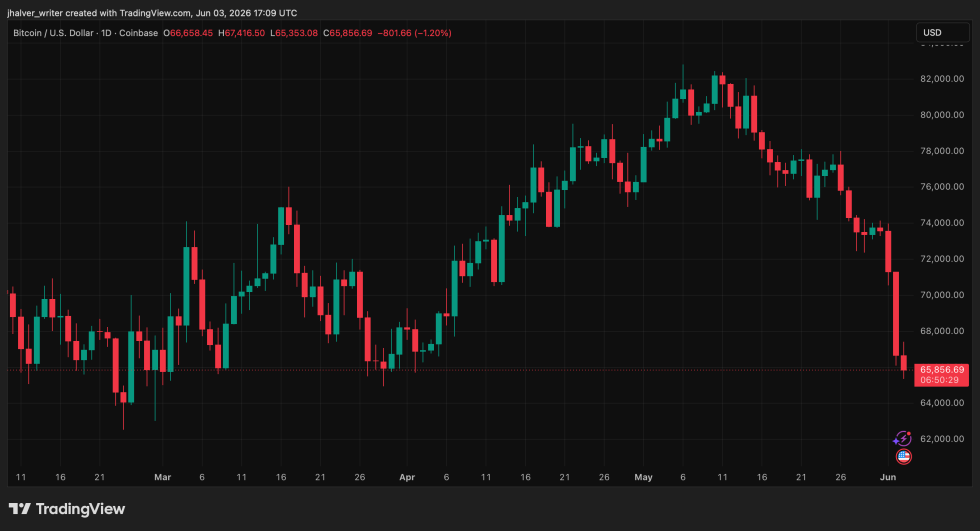
BTC's price trends to the downside on the daily chart. Source: BTCUSD on Tradingview

What Changes For Crypto — And What Doesn’t

The announcement is a settlement-layer development, not a consumer-facing product shift. Issuers and acquirers on Mastercard’s network can now choose to settle card-based transactions using regulated stablecoins on-chain rather than through traditional banking rails — or continue using existing fiat processes. Both options run in parallel. No cardholder needs to change how they pay.

What changes is the back-end infrastructure that clears and finalizes transactions between merchants, banks, and payment processors. That infrastructure can now operate on blockchain networks around the clock — removing the dead zones created by banking hours, weekend closures, and public holidays that have been a structural friction point in global payments for decades, per Mastercard’s press release.

Raj Dhamodharan, Mastercard’s Executive Vice President for Blockchain and Digital Assets, described the enhancement as expanding how partners manage liquidity while operating in an always-on digital economy, per the announcement. Ripple SVP Jack McDonald called it a landmark validation that blockchain technology is ready for the world’s most critical payment infrastructure, per Benzinga’s reporting of his statement.

This development marks a pivotal and historic moment for the nascent sector. The world’s second-largest card network opening its global settlement rails to six regulated stablecoins across eight blockchains — not as a pilot, not as a proof of concept, but as a live network-level enhancement — is the clearest institutional validation the stablecoin economy has received to date.

Cover image from Grok, BTCUSD chart from Tradingview

Preguntas relacionadas

QWhat major announcement did Mastercard make on June 3 regarding its payment network?

AMastercard announced it is expanding its global settlement infrastructure to support on-chain settlement using regulated stablecoins, enabling card transactions to be settled 24/7 for the first time in the network's history.

QWhich six regulated stablecoins are supported in the initial rollout of Mastercard's new settlement system?

AThe six supported stablecoins are Circle's USDC, PayPal's PYUSD, Paxos-issued USDG and USDP, Ripple's RLUSD, and SoFi's SoFiUSD.

QHow many and which blockchain networks will this settlement system operate across according to the announcement?

ASettlement will operate across eight blockchain networks: Ethereum, Solana, Polygon, Base, Arbitrum, the XRP Ledger, Canton, and Tempo.

QWho are among the first partners to support stablecoin settlement optionality with Mastercard?

AThe first partners include ARQ (formerly DolarApp), CBW Bank, Cross River, Lead Bank, and Nuvei.

QWhat is the key difference this announcement makes for crypto transactions on Mastercard's network?

AThe announcement is a settlement-layer development, not a consumer-facing change. Issuers and acquirers can now choose to settle card transactions using regulated stablecoins on-chain, operating 24/7, instead of or alongside traditional banking rails. Cardholders' payment methods do not change.

Lecturas Relacionadas

The Truth Behind Digital Banking: The Fragile Ecosystem Supporting 1.46 Billion Users

The article "The Truth About Digital Banks: The Fragile Ecosystem Behind 1.46 Billion Users" provides a data-driven analysis of the digital banking sector based on a verified list of 368 active neobanks as of July 2026. While these platforms collectively serve 1.46 billion users, with Asia (817 million users) and institutions like WeBank and Nubank dominating the landscape, the sector faces significant structural vulnerabilities. A key finding is that only 127 of the 368 neobanks hold full banking licenses. The majority operate atop third-party infrastructure providers like Banking-as-a-Service (BaaS) platforms, creating systemic risk where the failure of a single provider, as seen in past cases like Wirecard and Synapse, can jeopardize multiple consumer brands. Furthermore, the industry experiences a steady, quiet stream of failures, mergers, and shutdowns that often go unreported. The analysis also examines the adoption of artificial intelligence (AI), finding only 67 platforms (18%) have deployed AI at scale, with many innovators based in emerging markets like Nigeria and the Philippines. The infrastructure layer is highly concentrated, with 106 providers supporting the entire ecosystem of 368 consumer-facing brands. The article concludes with three predictions: the unlicensed gap will close through acquisitions or exits; an AI credit model is likely to fail in the next economic downturn; and a nascent but significant trend is the emergence of financial services designed for AI agents rather than humans.

marsbitHace 5 min(s)

The Truth Behind Digital Banking: The Fragile Ecosystem Supporting 1.46 Billion Users

marsbitHace 5 min(s)

Digital Asset Trading Platform Uphold Cuts 17% of Global Workforce Amid 'Crypto Winter'

Cryptocurrency trading platform Uphold has laid off approximately 17% of its global workforce, affecting 85 full-time employees and contractors. The cuts are part of a strategic shift to reallocate resources towards its rapidly growing corporate services business, as retail cryptocurrency trading activity has declined amid the ongoing market downturn. CEO Simon McLaughlin stated the company is restructuring after years of significant growth and remains confident in the long-term prospects of digital assets and blockchain technology. Founded in 2015, Uphold offers trading and custody services for cryptocurrencies, fiat, stocks, and precious metals. It has recently expanded to provide infrastructure for banks, fintech firms, and broker-dealers to integrate crypto services. The layoffs occur against a backdrop of a prolonged crypto market slump, with total market capitalization falling to around $2.1 trillion by Q2 2024. Factors include weakened trading volumes, reduced retail participation, interest rate hikes, geopolitical uncertainty, and net outflows from U.S. spot Bitcoin ETFs. Uphold clarified it is not shutting down its UK operations or any international offices. The company highlighted strong growth in its corporate platform and announced plans to evolve its consumer app into a broader blockchain-based financial assistant by 2026, offering U.S. stocks, tokenized securities, lending, credit cards, and DeFi yield opportunities.

cryptonews.ruHace 5 min(s)

Digital Asset Trading Platform Uphold Cuts 17% of Global Workforce Amid 'Crypto Winter'

cryptonews.ruHace 5 min(s)

Has the Crypto Utopia Collapsed? The Industry Reaches an Inflection Point After the Frenzy Subsides

Has the crypto utopia collapsed? The industry is at an inflection point as the hype fades. The prevailing view is that crypto has become an outlet for excess liquidity, with many participants leaving as financial returns have fallen short of past-decade expectations. The 2021 boom has been revealed as an illusion, placing the industry in the "trough of disillusionment" on Gartner's Hype Cycle. This forces a return to first principles: re-evaluating token value, securing DeFi protocols, and finding real-world applications. The core failure is a repetitive cycle of reflexive speculation, driven by the premature liquidity of tokens. The industry's incentives prioritized short-term gains over genuine innovation. While curiosity drives invention, recent DeFi hacks signal a need for engineering and iteration, including token models. The culture is shifting; the industry is no longer in its early stages. Positioned at a turning point on the technology adoption curve, crypto faces the immense challenge of rebuilding finance from scratch, a process of inevitable iteration and failure. Regarding crypto VC, claims of its death are overstated. The exceptional returns of 2016-2021 were an anomaly. The initial crypto-anarchist ethos has largely been co-opted by Wall Street and regulators. The utopian vision is over; the industry is being assimilated into the existing system, becoming a business. Current viable project categories include stablecoins, prediction markets, tokenized assets/RWA, perpetual contracts, and AI/agent integration. Crypto is converging with fintech, far from the envisioned DeFi revolution, and must find killer apps within regulatory boundaries. A reconciliation is possible: cryptocurrency may change value storage and transfer in subtle, imperceptible ways that integrate into existing systems, rather than through revolutionary fanfare. True creativity often emerges from adversity. There remains much to build for those driven by genuine curiosity.

marsbitHace 19 min(s)

Has the Crypto Utopia Collapsed? The Industry Reaches an Inflection Point After the Frenzy Subsides

marsbitHace 19 min(s)

Lei Jun Earns 7 Billion in One Day from CXMT's IPO? Xiaomi Executive Responds

On July 28th, Changxin Technology's stock price on the Sci-Tech Innovation Board experienced minor fluctuations. The company had made a historic market debut the previous day, becoming the first A-share stock to record a single-day trading volume exceeding 1 trillion yuan. This led to significant paper gains for its strategic investors. Among them, Xiaomi's wholly-owned subsidiary was allocated 18.24 million shares with an initial investment of approximately 158 million yuan. Reports estimated a paper profit of 717 million yuan for Xiaomi founder Lei Jun based on his shareholding structure. However, a Xiaomi executive clarified that this was a corporate investment and should not be conflated with personal wealth. Other major beneficiaries included Alibaba and Nio. Alibaba, an early investor, held nearly a 5% stake through two entities, with an estimated paper gain exceeding 160 billion yuan. Nio, participating in the strategic placement, also saw substantial paper returns. Additionally, state-owned banks and insurance institutions that invested in Changxin recorded potential gains in the hundreds of billions. Conversely, companies like Country Garden reportedly missed out on nearly 50 billion yuan in potential gains after divesting their stakes before the IPO due to liquidity pressures. The article notes that these are paper profits based on the listing price, as the allocated shares are subject to lock-up periods, and final realized gains will depend on future stock performance. An employee from Changxin Technology commented that ordinary staff remain focused on their salaries and benefits rather than the market hype.

marsbitHace 29 min(s)

Lei Jun Earns 7 Billion in One Day from CXMT's IPO? Xiaomi Executive Responds

marsbitHace 29 min(s)

Trading

Spot
活动图片