Saylor Categorizes Digital Assets into Four Categories on the Monetary Spectrum

cryptonews.ruPublicado a 2026-08-13Actualizado a 2026-08-13

Resumen

MicroStrategy Chairman Michael Saylor has categorized digital assets on a monetary spectrum from most volatile to most stable. In an August 13th post, he identified Bitcoin as "digital capital," his company's MicroStrategy equity (STRC) as "digital credit," the token SR-strcUSX as "digital money," and Tether's USDT as "digital currency." He positioned Bitcoin as the ideal store of value and stablecoins like USDT as the ideal medium of exchange, with MicroStrategy's products bridging the gap. Saylor described STRC, variable-rate perpetual preferred shares paying 12% annual cash dividends, as a semi-stable, high-yield store of value or "digital credit." He stated financial engineering transforms this credit into "digital money," exemplified by the SR-strcUSX token on Solana, which offers targeted 7% yields from STRC exposure. Separately, he highlighted the launch of a Brazilian ETF (DIGY11) providing access to STRC with monthly real-denominated payments. Saylor's framework suggests assets on the left (like Bitcoin) are for growth, while those on the right (like stablecoins) are for stability and utility.

Michael Saylor, Chairman of the Board of MicroStrategy (NASDAQ: MSTR), placed Bitcoin, two of his company's income products, and Tether on a unified monetary scale.

Observers claim that Saylor is trying to hint to investors which digital assets to hold for growth and which for stability; however, he has not confirmed this.

Four Labels, One Sliding Scale

Saylor shared his thoughts in an X post on August 13, where he classified assets from the most volatile to the most stable.

Bitcoin was one of the assets Saylor calls "digital capital." Saylor classified MicroStrategy's STRC as "digital debt," the SR-strcUSX token as "digital money," and Tether's $USDT as "digital currency."
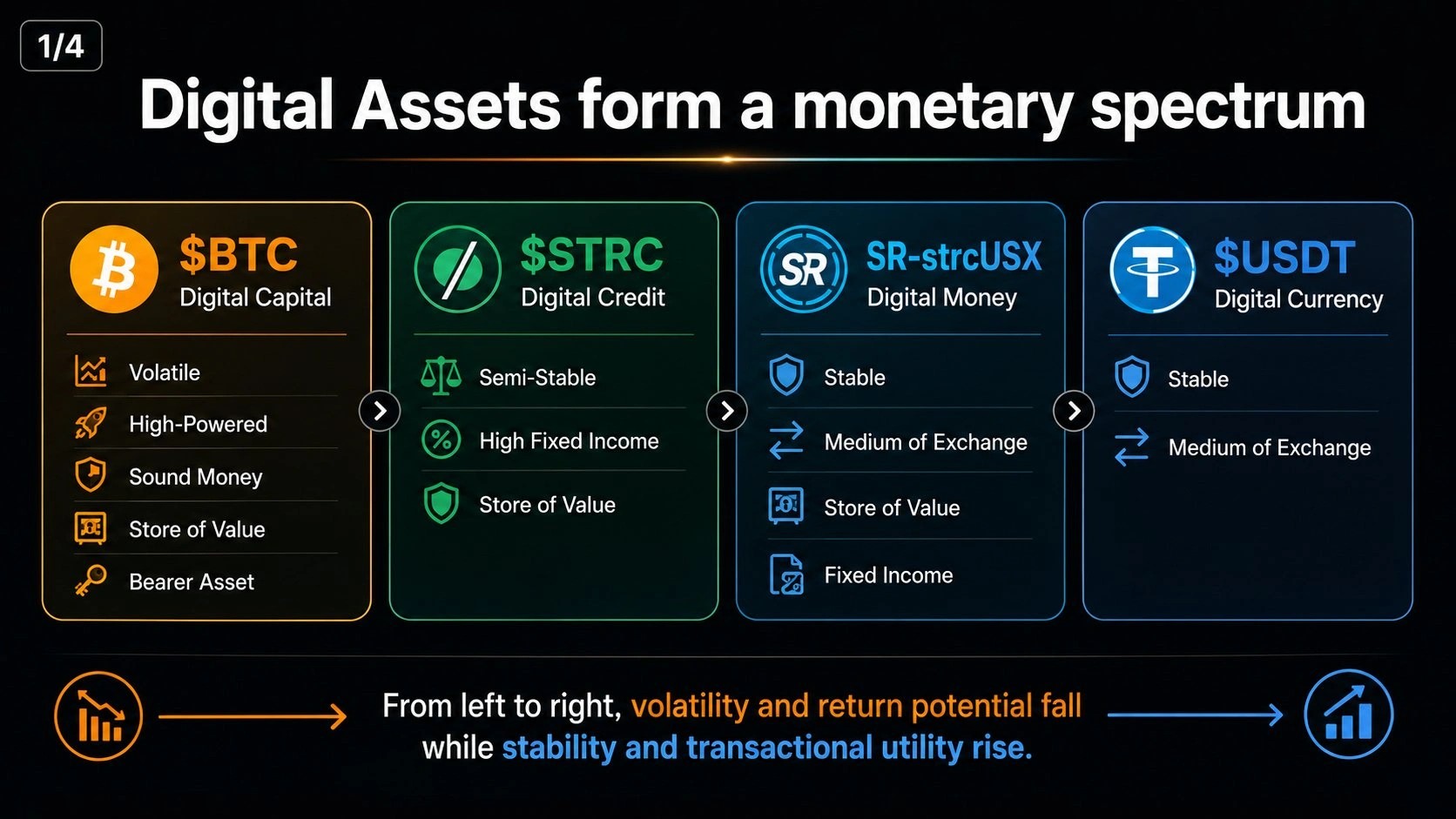
The volatility spectrum of digital assets. Source: Michael Saylor via X/Twitter.

The assets were arranged in a table, starting on the left with Bitcoin, followed by STRC, SR-strcUSX, and $USDT. Saylor noted that volatility and potential return decrease moving to the right, while stability and utility in everyday life increase.

According to Saylor, Bitcoin is the perfect store of value, while a stablecoin like $USDT is the perfect medium of exchange in the digital economy. The two MicroStrategy-linked instruments filled the gap between them.

What's STRC's Place in All This?

STRC, nicknamed "Stretch," is the element doing the main work in the middle tier of Saylor's composition.

It is a variable-rate perpetual preferred stock from MicroStrategy, currently paying 12% annual cash dividends twice a month. MicroStrategy's board sets this rate and must announce each payment, and the shares can continue paying cash even if their market price declines.

Saylor now calls this digital debt and claims it is a semi-stable, high-yield store of value. He stated that it is financial engineering production that transforms digital debt into digital money.

Saylor wrote: "Digital money combines digital currency technology with digital capital economics: stability, yield, transactional utility, and store-of-value function."

However, this is not the first time Saylor has mentioned digital debt. On August 7, he told his followers that anyone looking for "the next billion-dollar fintech unicorn" should "study digital debt."

MicroStrategy, which holds corporate Bitcoin, reinvests $BTC into the preferred shares. On August 10, the company sold 1,690 Bitcoin for $108.6 million and used that cash to redeem approximately 1.15 million shares of STRC, leaving it with 840,447 $BTC.

A Bridge to Solana

For the "digital money" tier, Saylor points to strcUSX, a product that Solstice Finance launched on Solana this week. Solstice Finance, which describes STRC as a bridge between Bitcoin and stablecoins, created a vault that gives users exposure to STRC's dividend yield and price risk without actually passing the shares to them.

Depositors contribute Solstice's USX settlement token and receive one of two tranches. The first tranche pays out to the senior token, SR-strcUSX, with a target annual yield of 7%. Solstice calls it the first STRC-linked instrument on Solana.

Digital Debt Heads to Brazil

Hours before posting the digital asset monetary article, Saylor wrote about digital debt coming to Brazil. He reacted to an announcement by OranjeBTC about the launch of DIGY11, which the company calls "the first Bitcoin ecosystem preferred equity ETF with monthly payments."

Saylor stated that DIGY11, a B3-category exchange-traded fund, will provide access to STRC in the Brazilian market with monthly payouts in reais, daily liquidity, and currency hedging.

Preguntas relacionadas

QWhat are the four categories of digital assets on the money spectrum as presented by Michael Saylor?

AMichael Saylor categorized digital assets into four categories on a money spectrum: Digital Capital (Bitcoin), Digital Credit (Strategy's STRC), Digital Money (SR-strcUSX), and Digital Currency (Tether's USDT).

QAccording to the article, what is the primary characteristic and purpose of Bitcoin and Tether (USDT) respectively on this spectrum?

AOn the money spectrum, Bitcoin is characterized as the ideal store of value, while Tether's USDT is characterized as the ideal medium of exchange in the digital economy.

QWhat is STRC, and what role does it play in Michael Saylor's composition?

ASTRC (nicknamed 'Stretch') is Strategy's variable rate perpetual preferred stock. Saylor classifies it as 'Digital Credit.' It acts as the main workhorse in the middle tier of his composition, being a semi-stable, high-yield store of value that bridges Bitcoin and stablecoins.

QWhat is the 'Digital Money' layer in Saylor's framework, and what product is cited as an example?

AThe 'Digital Money' layer combines the technology of digital currency with the economics of digital capital. The product cited as an example is 'strcUSX,' a tokenized offering by Solstice Finance on the Solana blockchain, specifically the senior tranche 'SR-strcUSX' which offers a target 7% annual yield.

QHow is Saylor's concept of 'Digital Credit' being expanded into the Brazilian market according to the article?

AThe 'Digital Credit' concept, represented by STRC, is being expanded into Brazil through a new ETF called DIGY11. Launched by OranjeBTC, it is described as the first ETF of Bitcoin ecosystem preferred stocks in Brazil, offering monthly payments in Reals, daily liquidity, and currency hedging.

Lecturas Relacionadas

Trezor Customer Data Leak: Coins Are Safe, But Phishing Is Inevitable

Trezor, a hardware cryptocurrency wallet manufacturer, reported a data breach at its logistics partner, ShipMonk, affecting around 13,689 customers. The incident, confirmed on August 13, 2026, involved unauthorized access to ShipMonk's systems, which stored order information from May 10 to August 8, 2026. Trezor's own systems and user crypto assets were not compromised. The leaked data varies: for 11,742 customers, full names, email addresses, phone numbers, and delivery addresses were exposed. For 1,947 others, only name, city, and email were leaked. The breach was limited to customers in the US, UK, Sweden, Colombia, Brazil, Italy, and Portugal. Trezor warns affected users of an increased risk of phishing attacks, where malicious actors may use the stolen contact details to impersonate Trezor, banks, or exchanges to steal wallet recovery phrases. All impacted customers have been notified via email. In response, Trezor announced a planned "Anonymous Delivery" feature for the EU (September 2026) and the US (end of 2026), aiming to anonymize logistics data. ShipMonk has not yet issued a public statement on its official website. The analysis highlights this as a recurring industry pattern where third-party logistics vendors become weak links in the supply chain, storing data longer than necessary. Similar incidents, like the 2020 Ledger breach, led to prolonged phishing campaigns. A key question remains whether hardware wallets can ever fully decouple from external logistics risks.

cryptonews.ruHace 36 min(s)

Trezor Customer Data Leak: Coins Are Safe, But Phishing Is Inevitable

cryptonews.ruHace 36 min(s)

Trading

Spot
活动图片