Ether ETFs break outflow streak while XRP products hit multi-week highs

cointelegraphPublicado a 2025-12-23Actualizado a 2025-12-23

Resumen

US spot Ether ETFs broke a seven-day outflow streak with $84.6 million in net inflows on Monday, reversing a trend that saw over $700 million exit the previous week. Cumulative net inflows for Ether products now stand at approximately $12.5 billion. Meanwhile, XRP ETFs extended their uninterrupted inflow streak, recording $43.9 million in net inflows—their strongest day since early December—bringing cumulative inflows to over $1.1 billion. Solana and Chainlink ETFs also saw steady inflows, reaching about $750 million and $58 million cumulatively, respectively. In contrast, Dogecoin ETF demand cooled further. Despite these gains, global crypto ETPs faced nearly $1 billion in outflows last week, largely due to spot Bitcoin and Ether fund withdrawals amid regulatory uncertainty.

Spot Ether exchange-traded funds (ETFs) in the US recorded $84.6 million in net inflows on Monday, breaking a seven-day outflow streak in one of the biggest single-day reversals this month.

The shift came after over $700 million exited spot Ether (ETH) products last week, highlighting a pause in selling pressure. According to SoSoValue data, the rebound lifted cumulative net inflows to about $12.5 billion.

At the same time, XRP (XRP) ETFs extended their uninterrupted inflow streak, recording $43.9 million in net inflows on Monday, their strongest daily showing since early December. XRP ETFs have not experienced a single net outflow day since their launch, resulting in cumulative net inflows exceeding $1.1 billion.

While XRP ETF volumes remain modest compared to Ether products, the consistency of the inflows stands out. Instead of the rapid in-and-out rotation, the data suggested that early allocators are gradually building exposure, treating the asset as a positioning tool rather than a short-term trade.
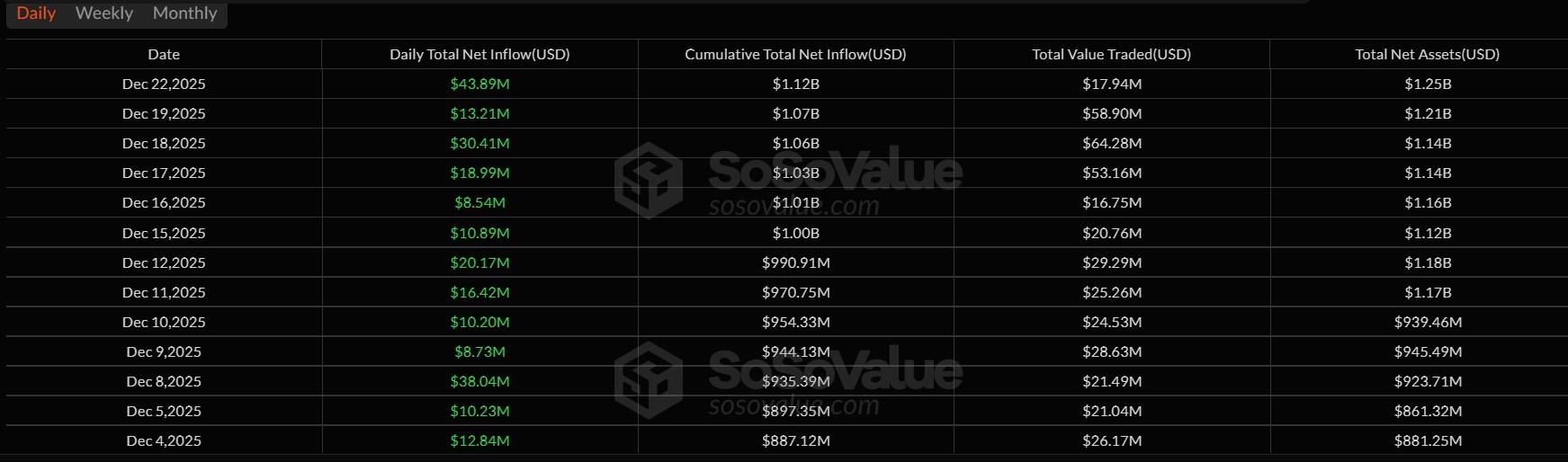
Daily inflow data for XRP ETFs. Source: SoSoValue

US altcoin ETF flows diverge

Beyond Ether and XRP, flows across other altcoin ETFs point to increasing differentiation within the crypto exchange-traded products (ETPs) space.

Solana (SOL) ETFs continued to attract steady capital, lifting cumulative net inflows to about $750 million. After a net negative on Dec. 3, Solana products returned to consistent positive flows, but on smaller levels compared to XRP. In total, Solana ETF products have had only three outflow days since launch.

Chainlink ETFs showed a similar pattern of incremental accumulation throughout December. Chainlink (LINK) products added nearly $2 million in inflows on Monday, bringing its cumulative net inflows to about $58 million.

Several flat-flow days point to muted trading activity, with inflows appearing steadier rather than driven by short-term speculation.

Meanwhile, Dogecoin (DOGE) ETFs, which showed early signs of cooling demand in December, continued the downtrend.

SoSoValue data showed that cumulative net inflow remained stuck at $2 million, while its total value traded fell to $67,000 on Monday, its second-lowest day in December.

Related: Crypto ETPs could see a flood of liquidations by 2027: Analyst

Global crypto ETF outflows neared $1 billion last week

While several altcoin ETFs continue to attract steady inflows, their volumes remain too small to offset broader market trends. Last week, global crypto ETPs recorded roughly $952 million in net outflows, driven primarily by spot Bitcoin and Ether funds.

Asset manager CoinShares attributed the pullback to delays surrounding the Digital Asset Market Clarity Act, which prolonged regulatory uncertainty and coincided with increased selling pressure from large holders.

Magazine: Ethereum’s Fusaka fork explained for dummies: What the hell is PeerDAS?

Criptos en tendencia

Preguntas relacionadas

QWhat was the net inflow for US spot Ether ETFs on Monday, and why was it significant?

AUS spot Ether ETFs recorded $84.6 million in net inflows on Monday, breaking a seven-day outflow streak in one of the biggest single-day reversals this month.

QHow have XRP ETF inflows performed since their launch, and what does the data suggest about investor behavior?

AXRP ETFs have not experienced a single net outflow day since their launch, with cumulative net inflows exceeding $1.1 billion. The data suggests that early allocators are gradually building exposure, treating the asset as a positioning tool rather than a short-term trade.

QWhich altcoin ETFs showed steady inflows in December besides Ether and XRP?

ASolana (SOL) ETFs continued to attract steady capital, lifting cumulative net inflows to about $750 million, and Chainlink (LINK) ETFs showed a pattern of incremental accumulation, bringing its cumulative net inflows to about $58 million.

QWhat was the trend for Dogecoin (DOGE) ETFs in December, according to SoSoValue data?

ADogecoin ETFs showed early signs of cooling demand in December, with cumulative net inflow stuck at $2 million and total value traded falling to $67,000 on Monday, its second-lowest day in December.

QWhat was the main reason for the $952 million in net outflows from global crypto ETPs last week, as attributed by CoinShares?

AAsset manager CoinShares attributed the pullback to delays surrounding the Digital Asset Market Clarity Act, which prolonged regulatory uncertainty and coincided with increased selling pressure from large holders.

Lecturas Relacionadas

Wang Xing Is Happy, Wang Xingxing Is Not Necessarily

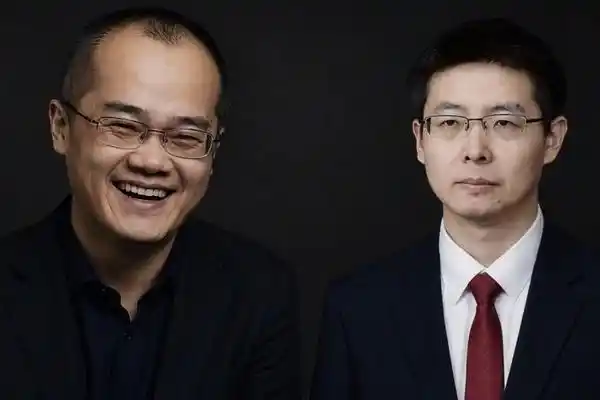
Yu Shu Technology's (Unitree) IPO on the STAR Market sparked discussions centered on wealth creation: the surge in founder Wang Xingxing's net worth, the substantial gains for early investors like Meituan's Wang Xing, and employee stock wealth. Yet, a key observation from the listing ceremony was the founder's calm demeanor, contrasting with the celebratory atmosphere. The article explores this divergence. For investor Wang Xing, the IPO represents a successful bet on embodied AI and robotics as the next foundational tech wave, with Meituan's stake now highly valuable. For founder Wang Xingxing, the milestone brings a new set of pressures. His company, now valued at ~341.8 billion yuan, must transition from proving technological feasibility (which it has done with its quadruped and humanoid robots) to delivering scalable commercial success. The market's high valuation is an advance payment for a future that Yu Shu must now build. Post-IPO, Yu Shu faces the critical challenge of moving beyond impressive demos to creating sustainable businesses. This means making robots reliable, affordable, and indispensable for both consumers and industrial clients, proving their real-world economic value. As the "first stock" in embodied AI on the STAR Market, Yu Shu also becomes a public benchmark for the entire industry, its performance influencing sector-wide expectations. Ultimately, while investors can celebrate realized gains, Wang Xingxing's work is just beginning. He must now manage a public company, meet heightened market expectations, and navigate the complex journey from innovative engineering to large-scale commercial execution. The IPO is a starting line, not a finish line.

marsbitHace 6 min(s)

Wang Xing Is Happy, Wang Xingxing Is Not Necessarily

marsbitHace 6 min(s)

U.S. Market Trend (August 20): U.S. Treasury Intervention Halts Stock Decline; Moderna's Cancer Vaccine Breakthrough Sparks 180% Surge

U.S. Stocks Rebound on Treasury Intervention; Moderna Soars 180% on Cancer Vaccine Breakthrough Key Points: • U.S. stocks ended a three-day decline, with the rebound driven primarily by the U.S. Treasury Department's move to significantly increase its long-term bond repurchase ceiling. This action briefly pushed the 30-year Treasury yield down by about 10 basis points, easing long-term interest rate pressures. • Despite this, the market faced a countervailing force from the hawkish July FOMC meeting minutes, which revealed broader support for potential rate hikes among officials due to lingering inflation concerns. • Moderna shares skyrocketed nearly 180% after announcing positive Phase 3 trial results for its personalized mRNA cancer vaccine in partnership with Merck, which also rose nearly 13%. This fueled a major rally in the healthcare sector. • Contrary to the broader market, the Philadelphia Semiconductor Index fell over 2%, highlighting persistent pressure on the AI hardware chain. Concerns include AI's potential inflationary impact and questions about application-side cash flows supporting high capital expenditures. • Commodities and cryptocurrencies rallied alongside the equity rebound, supported by a weaker dollar and lower long-term yields. Geopolitical risks continued to underpin oil prices. Outlook: Market focus shifts to whether long-term bond yields stabilize post-intervention, upcoming U.S. economic data (jobless claims, Philly Fed index), and the impact of SK Hynix's massive share buyback plan on the memory chip sector. The tech sector's full recovery remains contingent on the semiconductor index's performance.

marsbitHace 15 min(s)

U.S. Market Trend (August 20): U.S. Treasury Intervention Halts Stock Decline; Moderna's Cancer Vaccine Breakthrough Sparks 180% Surge

marsbitHace 15 min(s)

The 19 Must-Know Top Chinese and American Entrepreneurs Born After 2000 • The 21st-Century Successors Have Arrived

The 21st century's first generation of entrepreneurs, born in the 2000s, are already taking center stage. This analysis of publicly prominent founders reveals distinct trends between China and the U.S., shaped by their respective ecosystems. In China, young founders are heavily focused on giving AI a physical presence, tackling challenges in robotics and hardware. Examples include Huang Yi (RoboParty, humanoid robots), Qin Shentao (Yuanchen Taichu, embodied AI data infrastructure), and founders working on robotic hands, home cleaning robots, and computing power networks. Their paths often emerge from university labs and robotics competitions, prioritizing prototype demonstration, cost control, and manufacturing delivery. In contrast, their U.S. counterparts frequently leverage software, AI, and capital networks to rapidly reorganize digital services and information flows. Startups like Mercor (AI talent/data, reaching $10B revenue), Etched (AI chips), and various AI-powered SaaS tools for consumers and SMBs demonstrate a focus on user growth, subscription models, and global scalability. However, this velocity has also led to high-profile cases questioning business practices and credibility. The key differentiator for this generation is not merely youth, but the compressed early stage of venture creation. Access to open-source tools, AI models, mature supply chains, and willing venture capital allows them to bypass traditional career ladders. Yet, while technology lowers the barrier to product creation, it does not reduce the challenges of building a sustainable company—managing teams, ensuring reliable delivery, and establishing trust remain hard-earned skills. The article concludes that the true test for these founders will be the "second growth": evolving from product creators into responsible company leaders capable of sustained execution and organizational building. For established businesses, the rise of these fast-moving, technologically adept teams necessitates new strategies for collaboration, competition, and investment.

marsbitHace 20 min(s)

The 19 Must-Know Top Chinese and American Entrepreneurs Born After 2000 • The 21st-Century Successors Have Arrived

marsbitHace 20 min(s)

A Trillion-Dollar Consumer Credit Market Lacks Key Players

The trillion-dollar global consumer credit market remains largely untapped by blockchain technology. While projects like Pharos have rapidly attracted millions in stablecoin deposits for short-term consumer loans in emerging markets, they represent early attempts to bring this massive asset class on-chain. The core challenge isn't technical tokenization, but the "repackaging" of countless small, heterogeneous loans into standardized, investable products that digital asset funds can understand and price. Current approaches primarily change the *distribution* of capital—using stablecoins for settlement and smart contracts for transparency—but do not eliminate underlying credit risk. Several models are emerging: Pharos and Huma Finance/Tala focus on connecting high-yield emerging market loans to global crypto capital. Figure stands out by building full-stack, regulated infrastructure, securing AAA ratings for its securitizations and proving blockchain assets can meet traditional institutional standards. Conversely, Goldfinch's difficulties highlight that on-chain transparency cannot replace offline credit underwriting and collection capabilities. The article identifies a four-layer value chain: 1) loan origination, 2) credit structuring & securitization, 3) on-chain infrastructure, and 4) capital. The current gap is in the second layer—the mature capital markets expertise for structuring, rating, credit enhancement, and institutional distribution. This is the critical link needed to transform scattered loans into large-scale, trustworthy on-chain credit assets, bridging traditional finance's rigor with blockchain's new capital pools.

marsbitHace 55 min(s)

A Trillion-Dollar Consumer Credit Market Lacks Key Players

marsbitHace 55 min(s)

Trading

Spot

Artículos destacados

Qué es XRP 2.0

XRP 2.0: Una Nueva Frontera en el Panorama de las Criptomonedas Introducción a XRP 2.0 En el siempre cambiante ámbito de las criptomonedas, nuevos proyectos surgen continuamente, compitiendo por atención y adopción. Una de estas iniciativas prometedoras es XRP 2.0, un nuevo proyecto de criptomoneda diseñado para aprovechar la tecnología blockchain avanzada y metodologías de encriptación robustas. Aunque el nombre establece paralelismos con el XRP de Ripple, es crucial señalar que XRP 2.0 opera de manera independiente, enfocándose en mejorar la seguridad de las transacciones, la privacidad y la escalabilidad. A medida que el panorama financiero digital abraza cada vez más soluciones descentralizadas, XRP 2.0 busca contribuir de manera significativa a web3 y a la expansión general de los proyectos de criptomonedas. ¿Qué es XRP 2.0? En esencia, XRP 2.0 es un proyecto de criptomoneda que busca crear un ecosistema de moneda digital seguro y descentralizado. Su tecnología fundamental integra principios avanzados de blockchain con técnicas de encriptación de vanguardia. El objetivo principal de XRP 2.0 es establecerse como una plataforma confiable y eficiente que permita la ejecución rápida de transacciones mientras prioriza la protección de la privacidad de sus usuarios. El proyecto se promociona como una solución a muchas limitaciones enfrentadas por las criptomonedas existentes, proponiendo un sistema que puede manejar un mayor volumen de transacciones con mejor velocidad y privacidad. Esta versatilidad posiciona a XRP 2.0 como un competidor significativo en un mercado plagado de diversas monedas digitales. ¿Quién es el Creador de XRP 2.0? La identidad del creador detrás de XRP 2.0 ha sido señalada como 'Wilbur.' Sin embargo, los detalles completos sobre Wilbur o su entidad asociada siguen siendo elusivos. La anonimidad de muchos creadores de criptomonedas no es un fenómeno poco común en la industria, a menudo diseñado para mantener un grado de privacidad y seguridad. ¿Quiénes son los Inversores de XRP 2.0? Hasta ahora, la información específica relacionada con las fundaciones o organizaciones de inversión que apoyan a XRP 2.0 no está disponible públicamente. En el sector de las criptomonedas, el respaldo de inversores respetables puede influir significativamente en la credibilidad y el éxito de un proyecto, sin embargo, la transparencia sobre los patrocinadores financieros de XRP 2.0 no se ha establecido. ¿Cómo Funciona XRP 2.0? XRP 2.0 se destaca al emplear una combinación de tecnología blockchain y algoritmos de encriptación avanzados que aseguran transacciones seguras y descentralizadas. Su estructura innovadora incluye características únicas diseñadas para fomentar el compromiso del usuario y ampliar las funcionalidades más allá de las transacciones convencionales de criptomonedas. Entre estas características, XRP 2.0 incorpora capacidades impulsadas por IA, como funcionalidades de texto a imagen y de texto a voz. Estas adiciones están diseñadas para mejorar la experiencia interactiva de los usuarios, promoviendo una mayor aplicabilidad en diversos sectores. Al unir avances tecnológicos con un diseño centrado en el usuario, XRP 2.0 busca captar la atención de una amplia gama de individuos y empresas que buscan integrar soluciones de criptomonedas en sus marcos operativos. Cronología de XRP 2.0 Entender XRP 2.0 requiere examinar los hitos que han definido su viaje hasta ahora: 23 de julio de 2023: Se presenta XRP 2.0 como un nuevo proyecto de criptomonedas, con el objetivo de revolucionar las capacidades de transacciones seguras y descentralizadas en el ámbito de blockchain. 8 de septiembre de 2023: Se lanza otro proyecto, XRP20, marcando la aparición de un token ERC-20 en la blockchain de Ethereum que no guarda relación con XRP 2.0. 13 de noviembre de 2023: El Libro Mayor de XRP experimenta una actualización significativa con el lanzamiento de la versión 2.0.0 del software del servidor rippled. Es esencial señalar que este desarrollo está desconectado del proyecto de criptomonedas XRP 2.0. Puntos Clave sobre XRP 2.0 Para destilar la esencia de XRP 2.0, surgen varios factores críticos: Características Únicas: La inclusión de características como texto a imagen y texto a voz impulsadas por IA diversifica aún más las aplicaciones potenciales de XRP 2.0. Tecnología Blockchain: El marco utiliza mecanismos avanzados de blockchain y protocolos de encriptación, asegurando un entorno seguro y descentralizado para las transacciones. Escalabilidad y Privacidad: XRP 2.0 prioriza la protección mejorada de la privacidad en los procesos de transacción y la escalabilidad necesaria para acomodar una base de usuarios creciente. No Afiliación con Ripple: Es importante destacar que, a pesar de su nombre, XRP 2.0 no tiene ninguna lealtad ni colaboración con el XRP de Ripple, diferenciando su marco operativo y objetivos dentro del ecosistema de criptomonedas. Conclusión XRP 2.0 representa una ambiciosa aventura en la esfera de las criptomonedas, buscando ofrecer una combinación de seguridad, privacidad y eficiencia en las transacciones digitales. Al integrar tecnologías sofisticadas y características amigables para el usuario, el proyecto se propone ampliar los horizontes de lo que la criptomoneda puede lograr en la economía digital de hoy. Si bien la anonimidad de su creador y la falta de inversores revelados pueden generar cuestionamientos para algunos, el enfoque de XRP 2.0 en funcionalidades avanzadas y descentralización realza su atractivo en un mercado de criptomonedas cada vez más abarrotado. A medida que el paisaje de las criptomonedas sigue evolucionando, XRP 2.0 podría emerger como un jugador crucial en la expansión de soluciones blockchain seguras y escalables.

327 Vistas totalesPublicado en 2024.04.05Actualizado en 2024.12.03

Qué es XRP 2.0

Cómo comprar XRP

¡Bienvenido a HTX.com! Hemos hecho que comprar XRP (XRP) sea simple y conveniente. Sigue nuestra guía paso a paso para iniciar tu viaje de criptos.Paso 1: crea tu cuenta HTXUtiliza tu correo electrónico o número de teléfono para registrarte y obtener una cuenta gratuita en HTX. Experimenta un proceso de registro sin complicaciones y desbloquea todas las funciones.Obtener mi cuentaPaso 2: ve a Comprar cripto y elige tu método de pagoTarjeta de crédito/débito: usa tu Visa o Mastercard para comprar XRP (XRP) al instante.Saldo: utiliza fondos del saldo de tu cuenta HTX para tradear sin problemas.Terceros: hemos agregado métodos de pago populares como Google Pay y Apple Pay para mejorar la comodidad.P2P: tradear directamente con otros usuarios en HTX.Over-the-Counter (OTC): ofrecemos servicios personalizados y tipos de cambio competitivos para los traders.Paso 3: guarda tu XRP (XRP)Después de comprar tu XRP (XRP), guárdalo en tu cuenta HTX. Alternativamente, puedes enviarlo a otro lugar mediante transferencia blockchain o utilizarlo para tradear otras criptomonedas.Paso 4: tradear XRP (XRP)Tradear fácilmente con XRP (XRP) en HTX's mercado spot. Simplemente accede a tu cuenta, selecciona tu par de trading, ejecuta tus trades y monitorea en tiempo real. Ofrecemos una experiencia fácil de usar tanto para principiantes como para traders experimentados.

1.7k Vistas totalesPublicado en 2024.12.10Actualizado en 2026.06.02

Cómo comprar XRP

Discusiones

Bienvenido a la comunidad de HTX. Aquí puedes mantenerte informado sobre los últimos desarrollos de la plataforma y acceder a análisis profesionales del mercado. A continuación se presentan las opiniones de los usuarios sobre el precio de XRP (XRP).

活动图片