AC Exits Sonic Board, 'DeFi Godfather' Pulls Off Another Strategic Retreat

marsbitPublicado a 2026-06-22Actualizado a 2026-06-22

Resumen

Andre Cronje, known as the "DeFi Godfather," and two other founding directors have stepped down from the Sonic Labs board. The S token, once valued at $1.03, has plummeted 97% to $0.028, and the chain's TVL has evaporated 98% from its peak. In his exit statement, Cronje clarified he was a technical architect, not a founder, and distanced himself from token economics and migration decisions behind the token's crash. Cronje revealed his focus for the past 18 months has been his new project, Flying Tulip. This project raised $200 million privately last year at a $10 billion valuation. Its token design includes a perpetual put option (ftPUT NFT) for early investors, allowing them to redeem their initial investment at any time—a protection not extended to public market buyers. This pattern mirrors Cronje's past exits from projects like Yearn Finance and Fantom, where he departed near peak hype, leaving later holders to bear significant losses. Sonic itself has seen a complete management overhaul in recent months. The article frames this as a microcosm of the broader crypto bear market, where Layer-1 chains are bleeding value. It highlights a harsh reality: a project's valuation is often tied to a founder's reputation rather than fundamentals. Ironically, Flying Tulip is set to launch first on the Sonic chain Cronje just left, underscoring a disconnect between the person and the platform.

Author: Kuli, Deep Chao TechFlow

My feeling about crypto this year is probably this: watching the U.S. stock market hitting new highs every day, then opening my own portfolio, staying silent for three seconds, and closing it.

BTC has fallen by nearly 20% year-to-date, ETH has performed even worse, and altcoins—let's not even mention them. In such a market, it wouldn't be news if any public chain's token dropped 90%. But even colder than the prices is the feeling of abandonment.

On June 19, DeFi Godfather AC, along with two other founding directors, exited the Sonic Labs board. The S token was trading at $0.028 at the time, just a fraction of its peak of $1.03 at the beginning of the year. On-chain TVL had plummeted from a high of $1.14 billion last May to $20 million. According to DefiLlama data, that's a 98% evaporation.

The industry's reaction to AC's departure was muted. After all, he quit the space once in 2022, only to return later. This exit statement was also standard, saying he "remains bullish on Sonic" but will no longer be involved in business decisions.

But the next part was the real sting.

He said his primary focus for the past 18 months has been on Flying Tulip. This project raised a $200 million private placement last August at a $1 billion valuation, and opened a public sale on CoinList this February. The investors include names like Brevan Howard, DWF Labs, and Susquehanna.

In other words, during the exact period S was dropping from $1.03 to $0.028, AC was busy setting the stage for a brand-new billion-dollar project.

The real kicker is Flying Tulip's token design.

Primary subscription investors receive an NFT called ftPUT, which is essentially a perpetual put option. If they incur losses, they can burn the token at any time and redeem their principal at the original price. The CoinList public sale page clearly states, in bold, that the FT tokens (the tradable tokens, i.e., the normal coins) bought on the open market do not carry this right—only primary participants have it.

In contrast, S holders who bought on the secondary market are stuck with $0.028 being $0.028. No floor, no redemption, no safety net written by anyone...

Not My Fault

AC posted his exit statement on X. It was short, but every sentence seemed carefully measured.

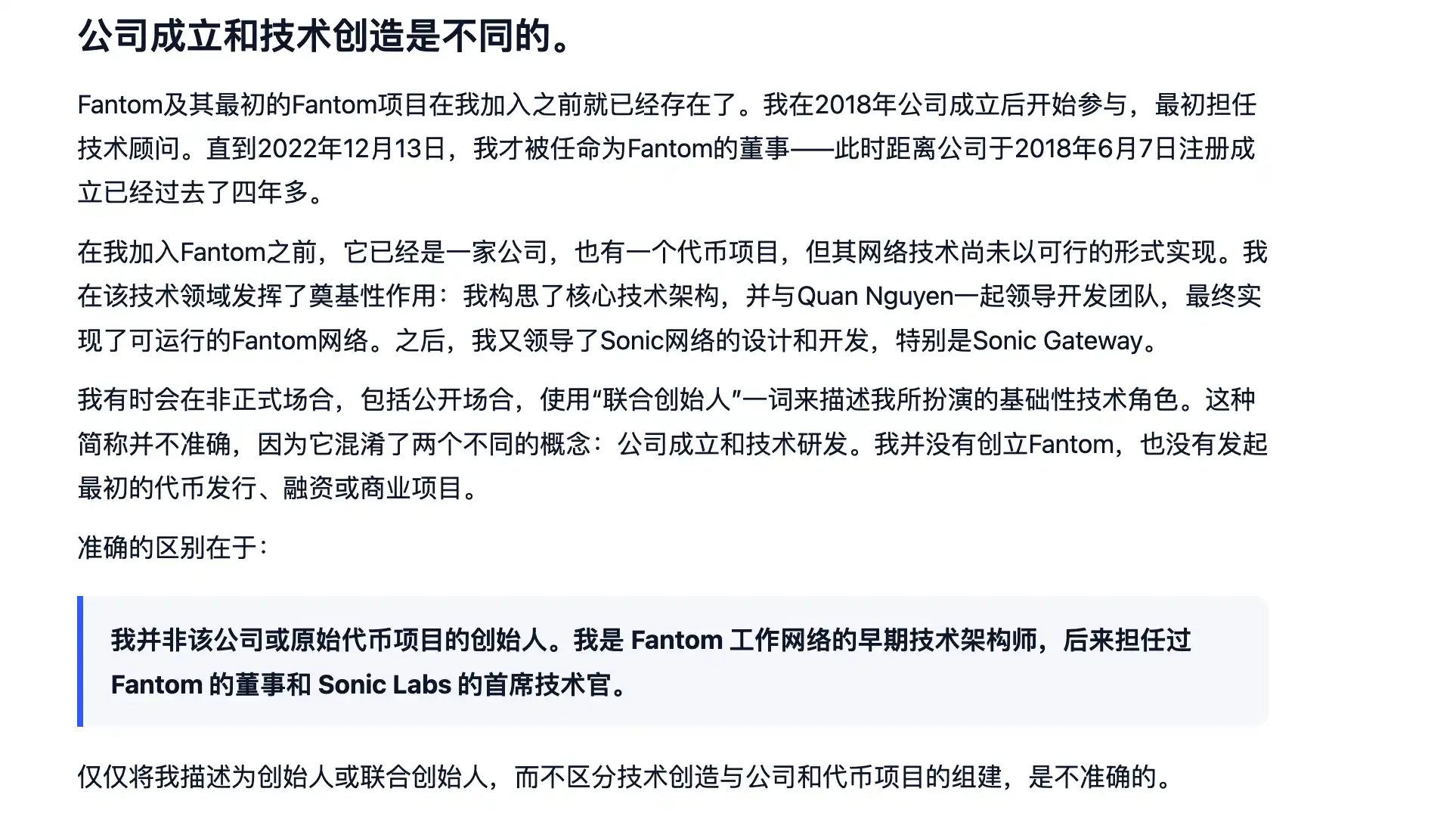
He said he joined Fantom as a technical advisor in 2018 and only formally became a director in December 2022. He was not Fantom's founder, never was, just the earliest technical architect. He was responsible for the underlying technology, including Sonic's core system and cross-chain gateway.

Then came the key paragraph, which roughly translates to:

"I am responsible for the technical decisions I led, but decisions regarding the migration, airdrop, tokenomics, and disposition of the old network—I was not the initiator, nor the final decision-maker."

With one sentence, he absolved himself from the S token's 97% drop. I built the tech, the tech is fine. As for why the coin you bought fell from a dollar to three cents, those were someone else's decisions.
The author won't comment on whether this claim holds water, but one must admit this separation is impressively clean.

When most project founders abandon ship, they either go silent or issue vague statements full of "we" and "the team," diluting responsibility into a murky soup. AC is different. He draws his responsibility boundaries with extreme precision, so precise it's hard to argue, because he indeed didn't manage tokenomics.

And this wasn't a spur-of-the-moment idea.

In March 2022, AC announced his exit from the crypto industry, citing regulatory pressure and burnout. At the time, Fantom's TVL evaporated nearly a third within a week, drawing a torrent of community criticism. He quietly returned a few months later, returning to work on Sonic's technical overhaul.

He left saying he was tired, returned without fanfare, and now leaves again saying, "I've actually been busy with other things for the past 18 months."

As for Sonic? In the half-year before his departure, its executive team was completely overhauled. CEO Mitchell Demeter, hired just last September, resigned in February, along with the head of business. After the CEO left, the board stepped in to manage for a few months. Now the board has also stepped down, replaced by a new CEO, Matt Visser, who has never managed a public chain operation at the front lines.

In five months, the entire management team from top to bottom has been replaced. Sonic's official statement didn't sugarcoat it either, directly stating, "The token price dropped, community sentiment dropped, we're not going to pretend it didn't happen."

This kind of "hands-up honesty" is rare in the crypto industry. But the problem is, the ones telling the truth are the new team, while the one leaving is the one whose name carries value.

The Script for a Strategic Retreat

Looking back at AC's trajectory over the past few years reveals a pattern.

2020: Wrote Yearn Finance, the iconic product of DeFi Summer, with TVL once soaring to tens of billions of dollars. He essentially let it go not long after, and Yearn ran on its own. It ran okay, but it had little to do with him anymore.

Next, he worked on Fantom's technical architecture. Fantom rallied for a while. In March 2022, he announced his exit. Fantom subsequently entered a long, slow decline, later rebranding as Sonic and relaunching. He returned with a CTO title. Sonic's TVL initially broke through a billion but then collapsed all the way down to its current state.

Every time, he disengaged at the peak of hype or just as it started cooling, moving on to the next thing. Every time, holders of the old project bore most of the decline after his departure.

Flying Tulip is his fourth project to date. The author thinks this time, he might have truly absorbed the lessons from previous experiences and baked them into the token design.
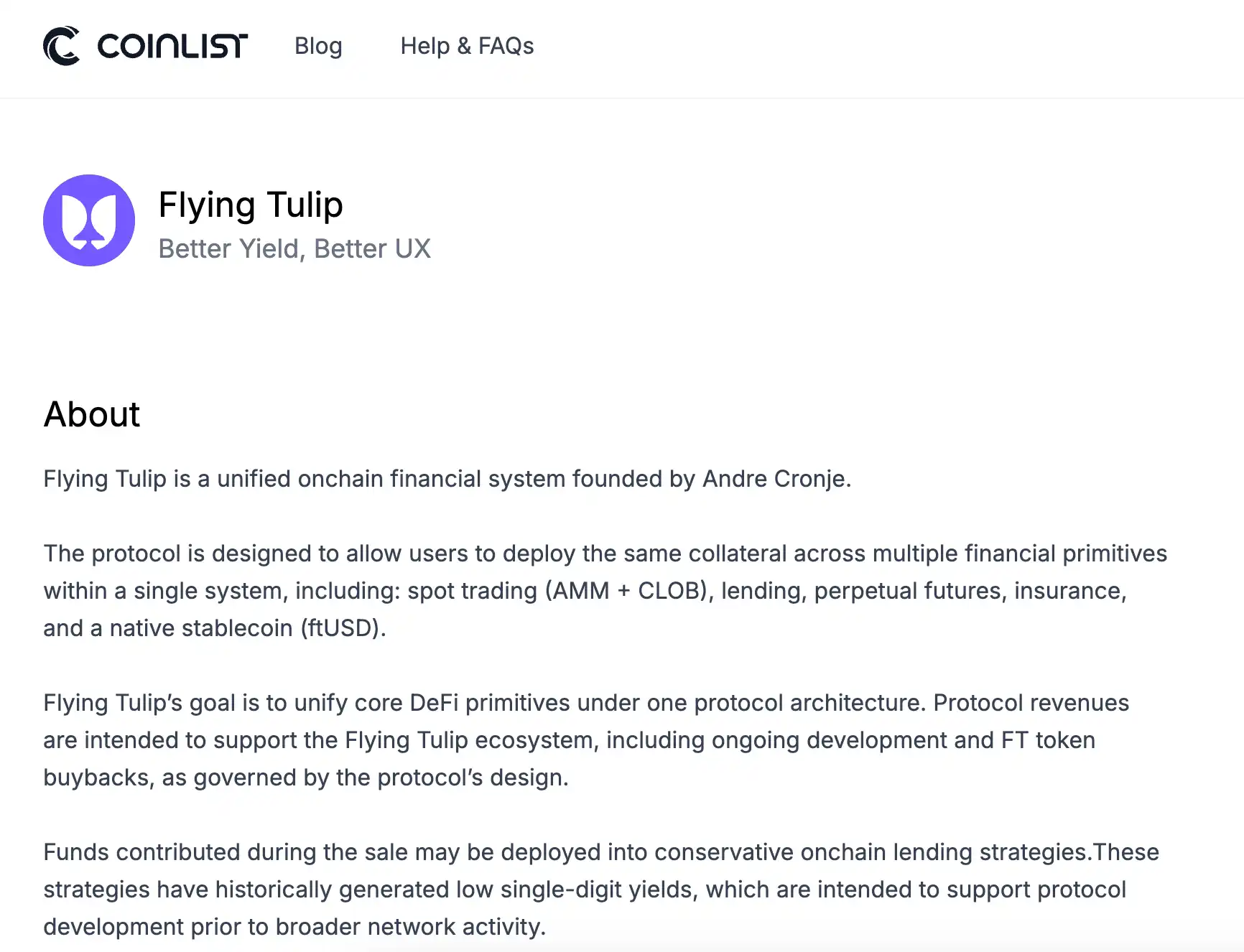
When you participate in Flying Tulip's public sale on CoinList, spending $0.10 to buy an FT, you don't receive the token directly. Instead, you get an NFT called ftPUT, with the token locked inside. This NFT is that perpetual put option. You have three choices.

First, do nothing. The token remains in the NFT, non-tradable, but the redemption right persists. Whenever you want to leave, burn the token and get your USDC or ETH back at the original price. Regardless of how low the FT price falls on the secondary market, your principal has a floor.

Second, extract the tokens from the NFT to trade freely. But the moment you extract them, the redemption right is permanently forfeited. The principal corresponding to the extracted tokens is released to the protocol for buyback and burn.

Third, extract some, keep some. The portion kept in the NFT continues to have protection; the extracted portion goes naked.

AC himself said something very interesting in an interview with The Block, the gist being that because of the perpetual PUT's existence, the funds raised essentially cannot be spent at all.

The net funds raised are zero. So where does operating capital come from?

All raised capital is placed into lending protocols like Aave and Ethena for conservative strategies, targeting around 4% annual yield. Based on a full raise of $1 billion, this would generate approximately $40 million in interest annually. This money funds the team, development, and buybacks. The team has no initial token allocation; all FT tokens must be bought back by the protocol from the open market using protocol revenue.

The author must admit, this design is quite ingenious within DeFi. It addresses the foulest problem in the crypto industry in recent years: project founders taking the money and running, or spending it recklessly, leaving investors with nothing. AC's solution essentially ties his own hands: the money can't be touched, the team gets no pre-allocated tokens, and investors can exit at any time.

But ingenious as it is, this protection exists only in the primary market. Once FT is listed on exchanges, tokens bought on the secondary market do not come with ftPUT. This sentence is written in bold on CoinList's page.

Buyers on the open market see the same token but receive completely different treatment.

A Microcosm of the Industry

Money is flowing out of the crypto market this year—that's no secret.

BTC has fallen nearly 20% year-to-date, and the median drop for altcoins far exceeds that. People in the circle look at the Nasdaq hitting new highs, then switch back to their own holdings—the feeling needs no description.

Many people's real strategy this year has been slowly shifting their positions into U.S. stocks and stablecoin yield products. On-chain activity is visibly shrinking.

In this environment, AC's exit from Sonic is just the tip of the iceberg. The entire L1 sector is experiencing the same story: TVL contraction, user attrition, founding team changes, or direct disappearances. Sonic just gets highlighted as a case study because of its fame and extreme decline.

But AC's case has a layer other projects lack.

Flying Tulip's current valuation is about $1 billion. Sonic's current market cap is about $100 million. The same person, the same period, one at $1 billion, the other at $100 million—a tenfold difference. What's the distinction? The distinction lies in which project AC's name is attached to.

This is a fact few in the DeFi industry are willing to voice openly.

The valuation of many projects isn't built on revenue, users, or technological moats—it's built on a person's name. The name stays, the money stays. The name leaves, the money follows.

The bear market ripped off this fig leaf. In a bull market, all L1s rise, making it hard to distinguish whether fundamentals or a name is propping it up. When the tide recedes, what remains becomes clear.

There's one more detail the author finds most interesting.

Flying Tulip's primary deployment chain is Sonic. AC exited Sonic's board, no longer involved in any business decisions, but his new project's first stop is on Sonic. He's gone, but his business remains.

The captain has disembarked, but opened a new shop on the dock, selling things more expensive than what was on the ship.


Preguntas relacionadas

QWho is AC and what is his recent major action mentioned in the article?

AAC, known as the 'DeFi Godfather,' is a prominent figure in the decentralized finance space. According to the article, his recent major action is stepping down from the Sonic Labs (formerly Fantom) board of directors on June 19, along with two other founding directors.

QWhat is the main difference in token design between AC's previous project Sonic (S) and his new project Flying Tulip (FT)?

AThe key difference lies in the investor protection mechanism. Flying Tulip's private investors receive an ftPUT NFT, which is a perpetual put option allowing them to redeem their principal at the original price. Secondary market buyers of FT tokens on platforms like CoinList do not have this right. In contrast, Sonic's S token had no such protection mechanism for secondary market holders.

QHow does AC explain his role and responsibilities regarding Sonic's decline in his exit statement?

AIn his exit statement, AC clearly delineates his responsibilities. He states he was responsible for the core technical architecture and decisions but explicitly distances himself from decisions related to the token migration, airdrop, tokenomics, and handling of the old network. He implies he is not responsible for the S token's 97% price drop, attributing it to others' decisions.

QWhat pattern does the article suggest exists in AC's involvement with past projects like Yearn Finance and Fantom/Sonic?

AThe article suggests a recurring pattern where AC is heavily involved during a project's initial hype or peak phase, then steps away or reduces involvement just before or during a significant decline. This was observed with Yearn Finance, Fantom, and now Sonic, leaving token holders to bear the brunt of the subsequent price drops.

QAccording to the article, what broader industry trend does AC's exit from Sonic represent in the current crypto market?

AAC's exit from Sonic is presented as a symptom of a broader trend in the Layer-1 (L1) blockchain sector during the bear market. The article highlights that many L1 projects are experiencing collapsing Total Value Locked (TVL), user exodus, and founder/team departures. It underscores the reality that many project valuations are heavily reliant on founder reputation ('the name') rather than fundamentals, a weakness exposed when market conditions deteriorate.

Lecturas Relacionadas

Report Interpretation: J.P. Morgan Details Micron's Pre-Earnings Sentiment, Current Hardware Sector Dynamics

Morgan Stanley analyst Joshua Meyers' report (June 21, 2026) highlights key trends in the hardware and semiconductor sector ahead of Micron's earnings. The core takeaways are: 1. **Micron & Memory:** Memory remains a high-conviction long theme, driven by strong AI demand and rising ASPs. However, investor focus is shifting to the sustainability of Micron's >80% gross margins and the specifics of potential new long-term supply agreements (SCAs). 2. **Hardware Supply Chain:** AI-related demand for servers, networking, and storage remains robust, but company performance is diverging. Celestica (CLS) shows improved margin confidence, Western Digital and Seagate benefit from pricing, Fabrinet (FN) sees predictable AI optics growth, and Teradyne (TER) anticipates a new Google customer. 3. **AI Capex & WFE Forecasts:** JPMorgan increased its Wafer Fab Equipment (WFE) market growth forecasts to 28% in 2026 and 29% in 2027. AI infrastructure financing is evolving, with higher project-level debt reducing constraints on capex expansion. The report signals that while the AI-driven hardware cycle is strong, the market is entering a phase focused on execution verification (e.g., Micron's SCA details, Fabrinet's ramp with Amazon) and valuation sustainability. Key near-term signals include Micron's guidance, Arista Networks' outlook, and the pace of demand normalization post potential tariff-related pull-ins.

marsbitHace 3 hora(s)

Report Interpretation: J.P. Morgan Details Micron's Pre-Earnings Sentiment, Current Hardware Sector Dynamics

marsbitHace 3 hora(s)

Research Report Analysis: The Fed's New Chair's Debut – New Leader, But Same Script?

Report Analysis: Federal Reserve's New Chair Debut – A New Captain, But the Same Script? Morgan Stanley's chief global economist Seth B. Carpenter analyzes the first FOMC meeting under new Fed Chair Kevin Warsh in a June 21 report. Warsh deliberately avoided providing forward guidance on interest rates, aligning with his philosophy. However, market expectations for a rate hike this year were reinforced. Key signals lie elsewhere: inflation may fall more than expected, and quantitative tightening (QT) could be more aggressive than anticipated. The FOMC's "dot plot" suggests only one rate hike in 2026. Carpenter argues that if inflation undershoots forecasts, the logic for even a single hike weakens, especially as projections indicate potential rate cuts in 2027. On QT, Warsh's stance is clear. Carpenter notes that measures like halving the Treasury's account balance could shrink the Fed's balance sheet by around $500 billion with minimal market impact. Combined with adjustments to reserve interest and liquidity rules, the ultimate QT scale may exceed expectations, though its market effect might be less disruptive unless the Fed actively sells Mortgage-Backed Securities (MBS). While Warsh initiated a review of the Fed's policy framework, the 2% inflation target remains intact for now. The report concludes that the market may be overestimating the significance of reduced forward guidance and the near-term rate hike risk, while potentially underestimating the scope and manageable nature of the coming balance sheet reduction. The key debates will hinge on upcoming core PCE data, the specifics of the QT path, and the framework review's findings.

marsbitHace 3 hora(s)

Research Report Analysis: The Fed's New Chair's Debut – New Leader, But Same Script?

marsbitHace 3 hora(s)

Critical Game Week: BTC Retracement Confirmation vs. HYPE Support Battle | Guest Analysis

This weekly analysis outlines a critical juncture for BTC and HYPE markets, focusing on key price level confirmations. **BTC Analysis:** BTC is at a pivotal point after a five-wave rally from the June 5th low of $59,100. The price has broken below a short-term rising channel's lower boundary, with the current move seen as a pullback to test this breakdown. Failure to reclaim this level could lead to a retest of the $59,000-$60,000 support zone. The core scenario hinges on this channel retest outcome. * **Key Levels:** Resistance at $64,500-$65,000 (channel boundary) and $69,500-$70,500. Support at $59,000-$60,000 and $55,000. * **Strategy:** A core bearish stance is maintained (20% short from last week), with short-term plans for tactical trades. Three detailed contingency plans (A/B/C) are provided for short positions on resistance tests or breakdowns, emphasizing strict stop-loss discipline. **HYPE Analysis:** HYPE shows strong momentum but is currently in a corrective phase after hitting a new high of $76.94. The price is retesting the crucial $64-$66 support area. * **Key Levels:** Resistance near $77 and $80-$82. Support at $64-$66 and $52-$54. * **Strategy:** The short-term approach is "buy on dips, avoid chasing rallies." A long position is considered only if clear stabilization signals appear at the $64-$66 or deeper $52-$54 support zones, with tight risk controls. **General Risk Management:** A standardized trailing stop-loss protocol is emphasized: set initial stop, breakeven at +1% profit, then trail stops upward to lock in gains. *Disclaimer: All analysis is presented as a personal trading framework, not investment advice. Market conditions are complex and require dynamic adjustment.*

marsbitHace 3 hora(s)

Critical Game Week: BTC Retracement Confirmation vs. HYPE Support Battle | Guest Analysis

marsbitHace 3 hora(s)

Research Report Interpretation: Citi Attends AWS Summit, Bullish on Cloud Business Acceleration but Data Governance Remains Key Variable

Citi analyst Tyler Radke's team attended the AWS New York Summit (June 17-18), engaging with over 10 clients and partners. In a June 19 report, they highlighted the summit's focus on scaling agent AI for enterprise deployment. Citi maintains a "Buy" rating on Amazon, forecasting AWS revenue growth to accelerate to 37% in FY27 from 30% in FY26, noting this estimate may be conservative. Key takeaways: 1. **AWS Strategy Shift:** AWS is moving from proof-of-concepts to scalable deployment. New offerings like AWS Context (building enterprise knowledge graphs), Amazon Quick (cross-application AI assistant), and security tool Continuum address core enterprise pain points for AI adoption. 2. **Data Infrastructure Beneficiaries:** Data infrastructure companies like Snowflake, Elastic, Oracle, and ClickHouse are seen as direct beneficiaries of scaling AI workloads, as evidenced by strong growth and use cases presented. 3. **Critical Role of Data Governance:** As AI agents scale from hundreds to thousands, effective data governance becomes the key variable for deploying AI in core business processes. AWS Context represents AWS's strategic extension from providing compute/models to offering a data governance infrastructure layer. The report emphasizes that without solving data governance, AI will remain confined to pilot projects. The investment thesis focuses on AWS revenue acceleration and data infrastructure vendors' growth, while monitoring signals like AWS's quarterly revenue growth, Bedrock AgentCore task volume, and pricing impacts on companies like Elastic.

marsbitHace 3 hora(s)

Research Report Interpretation: Citi Attends AWS Summit, Bullish on Cloud Business Acceleration but Data Governance Remains Key Variable

marsbitHace 3 hora(s)

Trading

Spot
Futuros
活动图片