Strategy Watch: February

insights.glassnodePublicado a 2026-03-03Actualizado a 2026-03-03

Resumen

Glassnode launches Strategy Watch, a monthly newsletter analyzing fund performance and allocation trends in digital assets. The February 2026 edition reports a sharp negative shift in capital flows for Bitcoin, Ethereum, and stablecoins since late October 2025, signaling weakening institutional demand and a defensive market regime. ETF and Digital Asset Trust (DAT) net flows have also softened, indicating slowing institutional interest. Additionally, Ethereum's DeFi Total Value Locked (TVL) has been declining since August 2025, reflecting reduced conviction in DeFi yields. The CME basis yield for both Bitcoin and Ethereum has compressed significantly, suggesting a pullback in institutional leverage and market-neutral strategies.

The full report is available in PDF format.

Access PDF version

Welcome to Strategy Watch

In a rapidly evolving market, where traders and funds chase returns amid volatility, while asset allocators seek data-driven conviction for long-term positioning, Glassnode occupies a unique vantage point. Our on-chain and wider market intelligence has served as a cornerstone for both groups since 2018, earning their trust through consistent, impartial data, analytics and research.

A core Glassnode belief is that genuine insight in digital assets comes from neutrality and depth, unbiased data that empowers decisions across the ecosystem. That is why we are thrilled to launch Strategy Watch, a new monthly newsletter dedicated to the analysis of fund-level performance and allocation trends in digital assets.

We hope to bring value by regularly delivering clear, high-signal analysis of capital flows, head-to-head strategy performance benchmarks, and the most important allocation moves actually being made by institutions and funds. But this is just the beginning. We are actively exploring ways to bridge these worlds further, and would love your feedback as Strategy Watch evolves.

Inside the Latest Strategy Watch

You'll find a wealth of insides spread across 6 sections:

  • Institutional Flow Monitor
  • Fund and SMA Performance
  • On-chain Vault Performance
  • Manager Monitor
  • Allocation Updates
in partnership with

The Premier Digital Assets Allocator Platform. Learn more


Institutional Flow Monitor

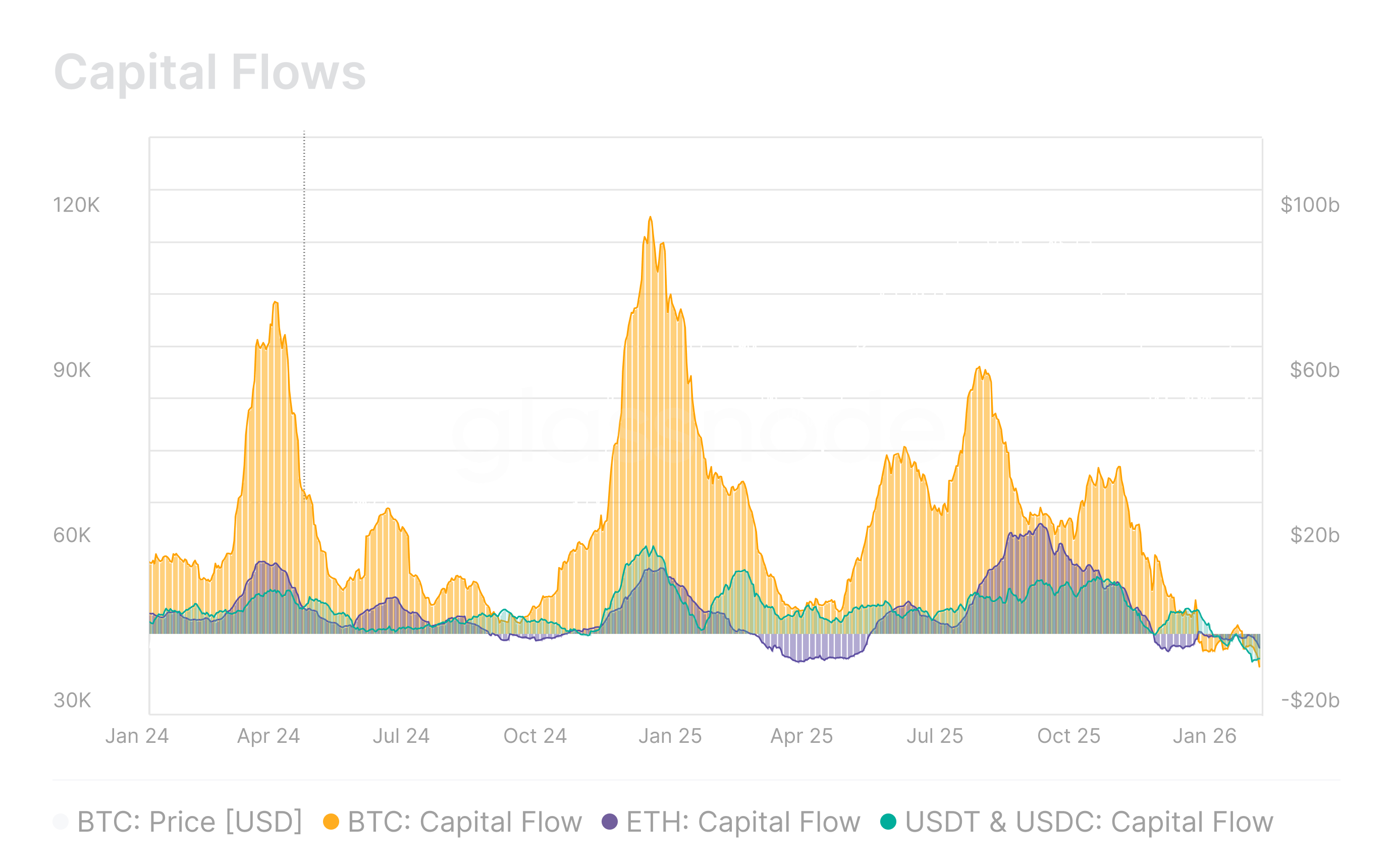
Since late October 2025, capital flows to BTC, ETH and Stablecoins have turned negative sharply.

Bitcoin, Ethereum, and Stablecoins have seen a clear slowdown in capital inflows, signalling weakening demand and a structural contraction in liquidity. All three assets have now shifted into net outflow, with Bitcoin at –$8.4B per month, Ethereum at –$3.8B, and stablecoins at –$6.4B. This broad-based drawdown across core crypto assets reflects a defensive regime, where institutional capital is de-risking rather than re-entering risk positions. This negative trend has further accelerated as of January 2026.
ETF & DAT Net Flows

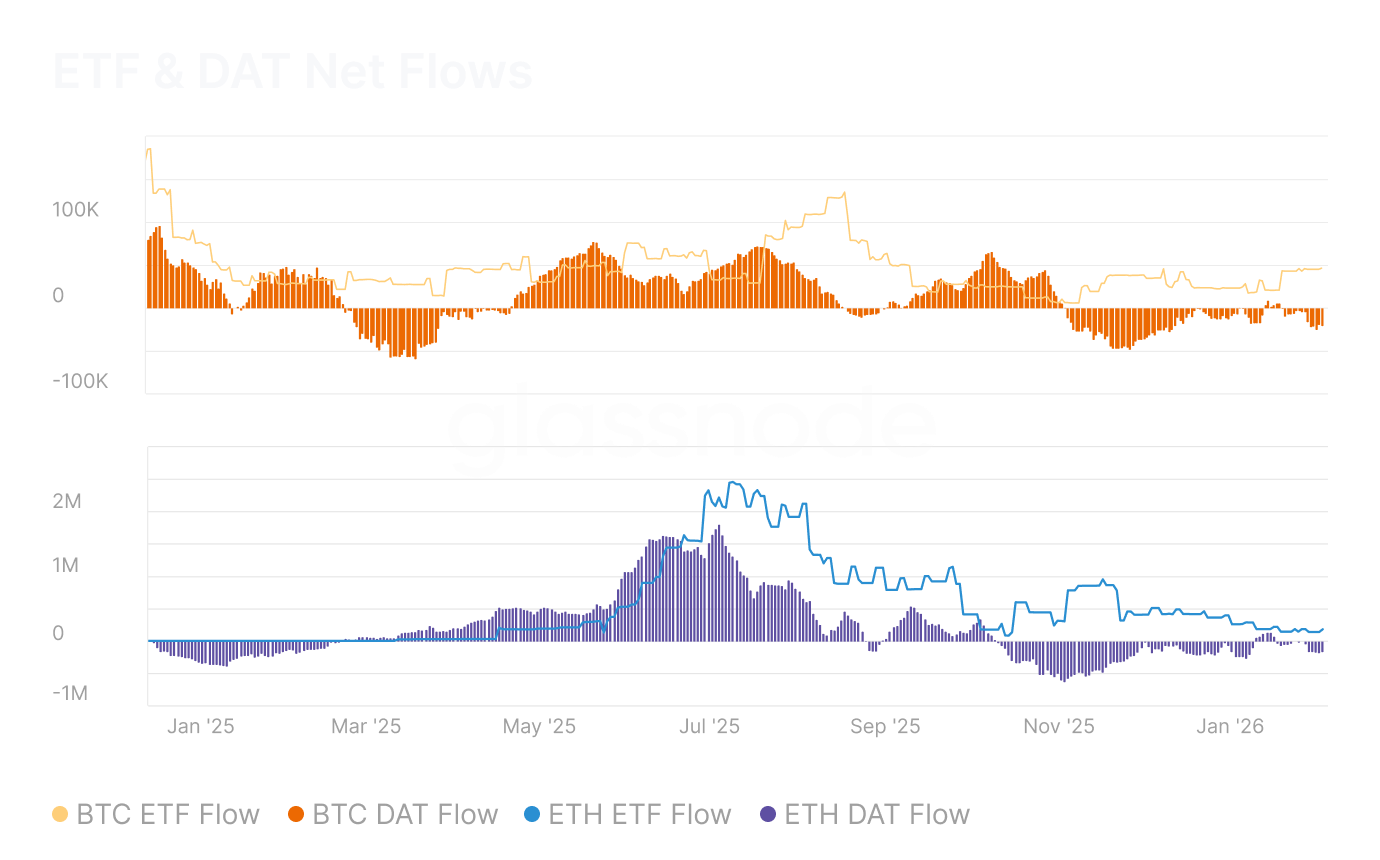
ETF & DAT net flows remain positive, but weakened, signalling slowing institutional demand.

Net flows into these vehicles act as a proxy for institutional demand. In Q4 2025 and early January, institutions were net sellers through the ETF channel, with Bitcoin ETF outflows approximating –35.8k BTC per month and Ethereum ETF flows around –257.6k ETH per month. Over the same period, DATs saw strong inflows in August 2025 driven by new product launches, but buy pressure has since softened; nonetheless, flows into DATs remain positive, indicating ongoing, albeit weaker, institutional interest via balance-sheet exposure.
DeFi TVL & Stablecoin Cap

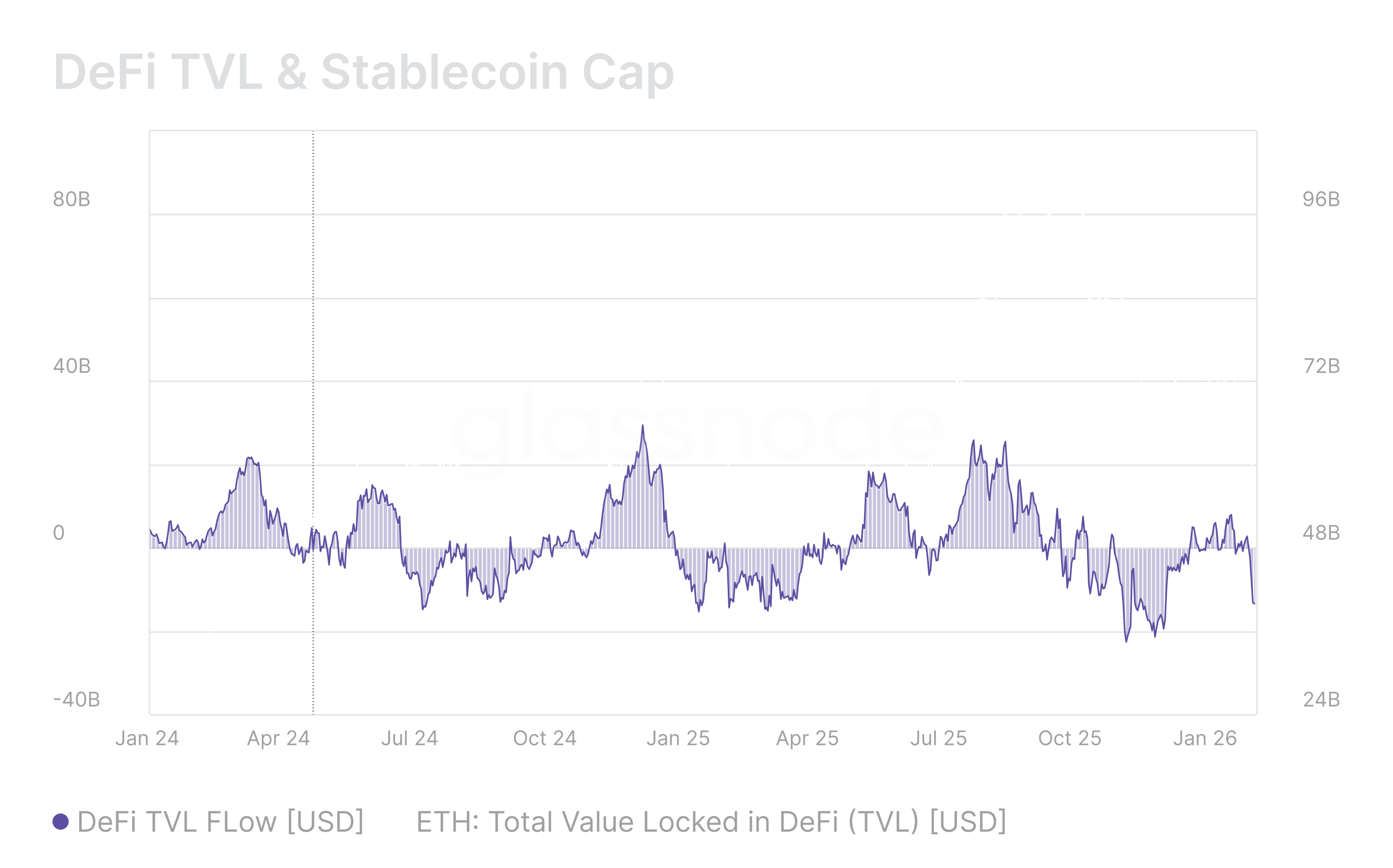
TVL on Ethereum has been declining since August 2025, signalling softer conviction in DeFi yield curves.

DeFi has served as another active playground for institutional capital through strategies such as liquidity provisioning, collateralized lending, and structured yield harvesting. Total Value Locked (TVL) on Ethereum, began to shrink from August 2025 onward, and is now declining at approximately –$15.3M per month. A contraction in TVL implies that larger allocators are withdrawing from on-chain financial services, reducing liquidity depth and signalling softer conviction in DeFi yield and risk-adjusted returns relative to alternative venues.
CME Basis Yield

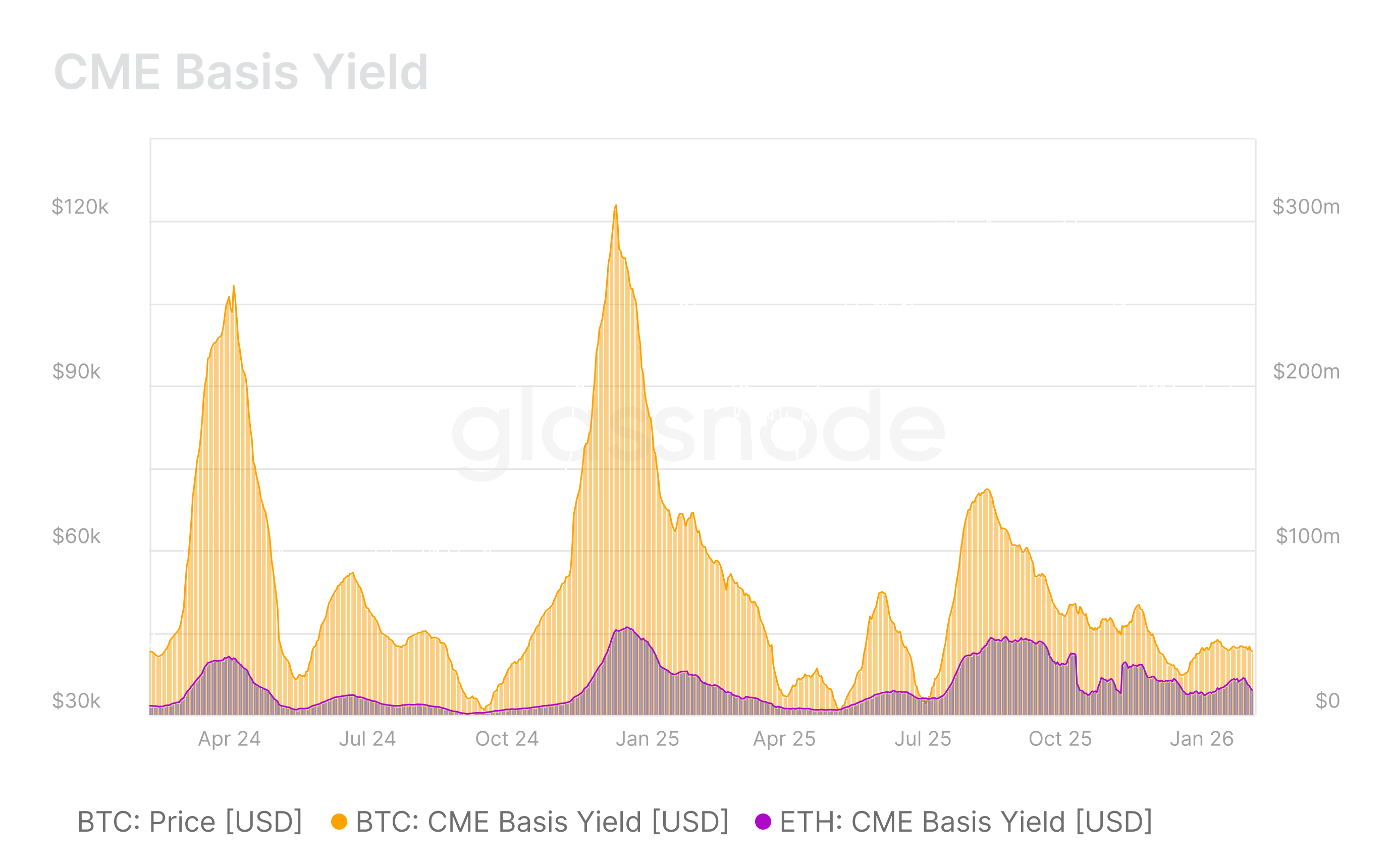
Contraction signals are waning incentive for market-neutral strategies.

Another key dimension of institutional engagement is the CME Basis Yield, which estimates the monthly dollar value earned by institutions from cash-and-carry strategies, capturing the premium between spot prices and CME calendar futures. Since August 2025, both Bitcoin and Ethereum have seen a sharp compression in this yield, with Bitcoin declining from approximately $136.6M to $38.6M per month, and Ethereum from $47.5M to $14.8M per month. This contraction rreflects reduced leverage deployment, softer futures demand, and a broader pullback in balance-sheet commitment amid tightening liquidity conditions.

Want to feature in the next edition of Strategy Watch? Share your updates on recent launches or milestones.

Submit an update

Disclaimer: This report does not provide any investment advice. All data is provided for information and educational purposes only. No investment decision shall be based on the information provided here and you are solely responsible for your own investment decisions.
Exchange balances presented are derived from Glassnode’s comprehensive database of address labels, which are amassed through both officially published exchange information and proprietary clustering algorithms. While we strive to ensure the utmost accuracy in representing exchange balances, it is important to note that these figures might not always encapsulate the entirety of an exchange’s reserves, particularly when exchanges refrain from disclosing their official addresses. We urge users to exercise caution and discretion when utilizing these metrics. Glassnode shall not be held responsible for any discrepancies or potential inaccuracies. Please read our Transparency Notice when using exchange data.

Preguntas relacionadas

QWhat is the main purpose of Glassnode's new Strategy Watch newsletter?

AStrategy Watch is a monthly newsletter dedicated to the analysis of fund-level performance and allocation trends in digital assets, providing clear analysis of capital flows, strategy performance benchmarks, and institutional allocation moves.

QWhich three core crypto assets have experienced a shift into net capital outflows according to the report?

ABitcoin, Ethereum, and Stablecoins have all shifted into net outflow, with Bitcoin at -$8.4B per month, Ethereum at -$3.8B, and stablecoins at -$6.4B.

QWhat does the contraction in CME Basis Yield for Bitcoin and Ethereum indicate about institutional activity?

AThe contraction in CME Basis Yield indicates reduced leverage deployment, softer futures demand, and a broader pullback in balance-sheet commitment amid tightening liquidity conditions, showing waning incentive for market-neutral strategies.

QHow many sections is the Strategy Watch report organized into, and what are two of them?

AThe report is organized into 6 sections, including Institutional Flow Monitor, Fund and SMA Performance, On-chain Vault Performance, Manager Monitor, and Allocation Updates.

QWhat trend does the declining Total Value Locked (TVL) on Ethereum signal about institutional behavior in DeFi?

AThe declining TVL on Ethereum signals that larger allocators are withdrawing from on-chain financial services, reducing liquidity depth and showing softer conviction in DeFi yield and risk-adjusted returns relative to alternative venues.

Lecturas Relacionadas

Microsoft is Afraid of Being Marginalized by AI Giants

Microsoft, once the defining force of the PC era, now faces a familiar challenge in the AI age: the risk of being relegated to a profitable but invisible infrastructure provider. This anxiety was laid bare at Build 2026, where CEO Satya Nadella unveiled a major strategic pivot. The catalyst was a quiet April agreement that dissolved Microsoft's exclusive licensing and cloud-hosting deal with OpenAI, its once-vital partner. This erased Microsoft's key AI moat. With OpenAI and Anthropic defining AI applications and gaining enterprise traction—even within Microsoft's own ranks—Nadella had to answer: without exclusivity, what is Microsoft's role? The answer was a suite of seven in-house AI models, a developer-focused AI workstation (Surface RTX Spark Dev Box), and, most crucially, the Agent 365 platform for enterprise AI governance. The models, notably targeting Anthropic's strengths in coding and enterprise, signal a defensive move. However, the broader strategy is to make the models themselves less decisive. Financially, Microsoft's AI revenue is strong, driven largely by Azure running others' models. Yet its user-facing products like Copilot show weak penetration and engagement. Microsoft earns infrastructure money but lacks direct user mindshare. Nadella's core fear is being "hollowed out." As OpenAI and Anthropic prepare for IPOs and gain financial independence, they may build their own infrastructure, threatening Azure's lucrative AI revenue stream. Microsoft's window is to entrench itself deeper: not as the model creator, but as the indispensable platform for securely deploying, managing, and governing all AI models within the enterprise through Agent 365. Build 2026 revealed Microsoft's bet: in the AI era, the ultimate power lies not in any single model, but in the enterprise "operating system" that controls them. Nadella is determined to ensure Microsoft is the driver of this new era, not just a passenger.

marsbitHace 8 min(s)

Microsoft is Afraid of Being Marginalized by AI Giants

marsbitHace 8 min(s)

CPU, Quietly Returning to the Center of the AI Computing Power Stage

Over the past three years, AI computing power narratives have been dominated by GPUs. However, starting in 2026, this story began to shift. While training large models remains GPU-intensive, the rapid growth of inference and AI agent workloads, which require high levels of task orchestration, concurrency, and data flow management, has highlighted a renewed critical role for CPUs. These are tasks GPUs are not designed to handle. Intel's recent launch of the Xeon 6+ processor, built on its Intel 18A process and featuring up to 288 efficiency cores (E-cores), exemplifies this strategic pivot. It is positioned not as a mere companion to GPUs but as the essential "control plane" for AI infrastructure, optimized for high-density, energy-efficient, and high-throughput workloads characteristic of AI agents and inference. This "CPU resurgence" is not about CPUs outperforming GPUs in raw computation. It reflects a systemic bottleneck: as AI scales from training single models to deploying countless intelligent agents, the demand for coordination and data handling surges. Major cloud providers are also developing their own high-density ARM-based server CPUs for similar workloads. However, Intel's success with this strategy faces significant challenges. Competition includes NVIDIA's integrated CPU-GPU solutions, the expanding adoption of cloud vendors' in-house ARM CPUs, and the crucial market test of Intel's 18A manufacturing process against rivals like TSMC's N2. In conclusion, CPUs are indeed reclaiming a central, though redefined, role in AI compute—managing the complex orchestration that enables massive-scale AI deployment. While the trend is clear, which company will ultimately lead this CPU resurgence remains an open question to be decided in the data centers of 2027 and beyond.

marsbitHace 29 min(s)

CPU, Quietly Returning to the Center of the AI Computing Power Stage

marsbitHace 29 min(s)

Trading

Spot
Futuros
活动图片