The Value Distribution of Stablecoins

marsbitPublicado a 2026-06-15Actualizado a 2026-06-15

Resumen

**Summary: The Value Distribution of Stablecoins** The article argues that stablecoins are evolving from mere trading tools into broader channels for dollar access. It divides the stablecoin ecosystem into four layers to analyze how value is distributed: 1. **Issuance Layer:** Mints stablecoins, holds reserve assets, and captures the spread between reserve yield and user costs (e.g., Tether, Circle). This layer currently earns the largest profit margin. 2. **Infrastructure Layer:** Connects stablecoins to the traditional financial system, handling fiat on/off-ramps, banking integration, compliance (KYC/AML), and asset management (e.g., Bridge, BVNK). This is the "unglamorous" but critical work, building the essential bridges between crypto and real-world finance. 3. **Acquiring/Distribution Layer:** Integrates stablecoins into merchant systems, manages payment flows, and provides enterprise financial software (e.g., Stripe, Coinbase). They act as the access point for businesses. 4. **Application Layer:** The end-users and businesses that ultimately use stablecoins for payments, settlements, or as a store of value. They benefit from convenience but have little pricing power. The core thesis is that while the issuance layer currently dominates profits, the often-overlooked **infrastructure layer holds significant long-term potential**. The real challenge and barrier to mass adoption is not the on-chain transfer of stablecoins (which is simple), but the complex "last mile...

Author: @0xjiawei

Previous chapters discussed the broad direction: stablecoins are evolving from mere trading tools into a general-purpose dollar channel.

This chapter examines how the stablecoin "pie" is divided.
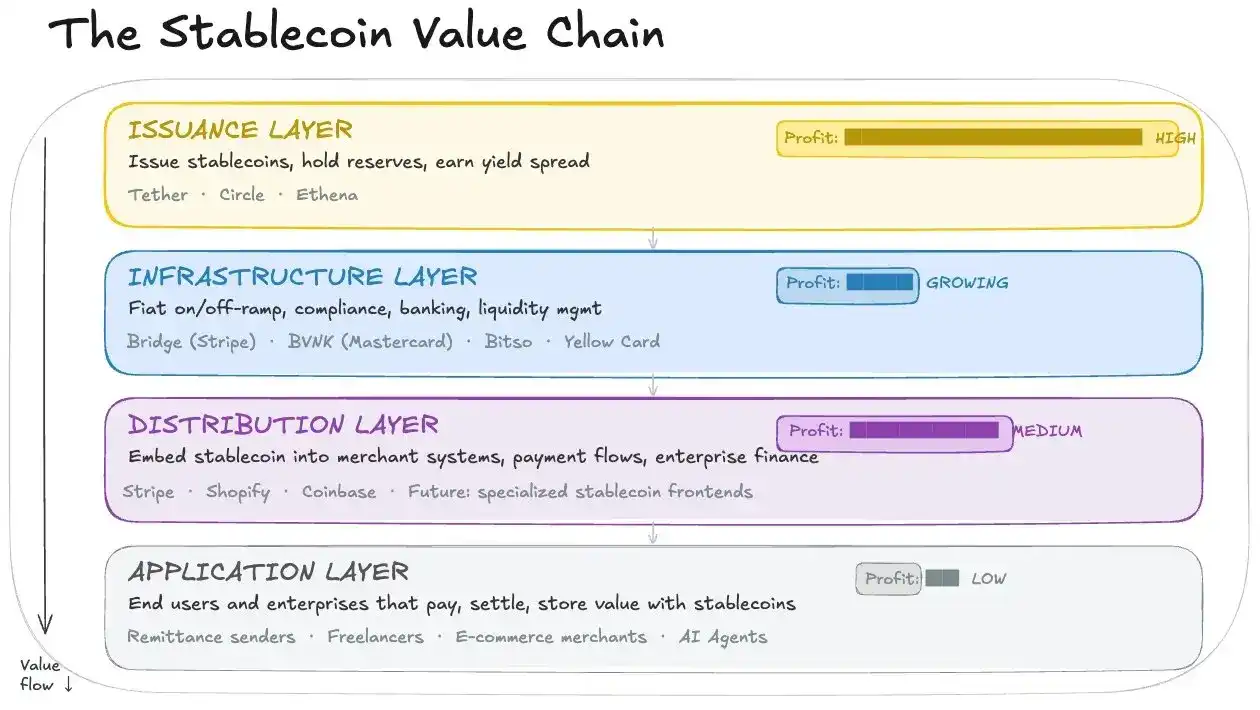
I categorize stablecoins into four layers:

  1. Issuance Layer: Mints stablecoins, holds reserve assets, captures the interest rate spread. Representatives: Tether and Circle.
  2. Infrastructure Layer: Connects stablecoins to the real-world financial system – fiat on/off-ramps, bank integrations, asset management, compliance. Representatives: Bridge (acquired by Stripe), BVNK (acquired by Mastercard), Bitso, Yellow Card, etc.
  3. Acquiring/Distribution Layer: Embeds stablecoins into merchant systems, manages payment flows, enterprise financial software. Representatives: Stripe, Infini, Coinbase.
  4. Application Layer: End users and businesses that ultimately use stablecoins for payments, settlement, or as a store of value.

The issuance layer captures user funds and earns the thickest interest spread; the middle two layers profit from traffic, distribution fees, and foundational infrastructure; the application layer enjoys convenience but lacks pricing power.

I believe the infrastructure layer is currently undervalued by the market.

It does the gritty, thankless work: integrating with banks, handling KYC/AML, managing local fiat on/off-ramps, connecting merchants and APIs, interfacing with card networks, and solving settlement and regulatory issues across different countries.

But conversely, this is precisely where its moat lies. Because the technology behind stablecoins is straightforward—transferring USDC on-chain isn't the hard part. The real challenge is penetrating the real world, convincing a Latin American company, an African payment provider, or a cross-border e-commerce platform to incorporate stablecoins into their daily cash flows. This gritty work is essential and must be done by someone.

The On-Chain Part is Easiest; The Bridge to Reality is Hardest

At first glance, stablecoin payments seem simple: on-chain transfers are fast, confirm quickly, have low fees. The rest is just distributing the product to users, right?

But the real difficulty with stablecoins lies in the vast gap between the blockchain and the traditional financial system. Businesses have decision-making and switching costs; they won't overhaul a perfectly functional workflow just because they heard stablecoins settle in one second.

This raises a cascade of questions: How do I convert fiat to stablecoins? And back again? How do I handle reconciliation and taxes? Will my bank block me later? Do users still need to learn how to use a wallet?

The core task of the infrastructure layer is bridging these two worlds: connecting to blockchains and wallets on one side, and to banks, local payment networks, enterprise systems, and compliance on the other.

Stripe's acquisition of Bridge in 2025 brought Bridge's "stablecoin orchestration" system—helping businesses integrate stablecoin capabilities into their operations. Mastercard's announcement in March 2026 to acquire BVNK followed a similar logic.

In other words, traditional payment companies are competing to become the default gateway for enterprises using stablecoins.

The key to scaling stablecoin payments lies precisely here.

The Road Builders

Looking closer at the infrastructure layer, its functions include:

  1. On/Off-Ramps + FX: Most enterprise use cases involve a "local currency → stablecoin → local currency" flow. This touches on banking relationships, compliance, liquidity, and other issues.
  2. >API + Account Layer: Businesses need a set of financial capabilities embedded into their workflows—account opening, sending/receiving payments, fund splitting, clearing, reconciliation. This resembles financial SaaS, similar to the concept of Neobanks.
  3. Payment Network Connectivity: The more payment rails, banks, and regions connected, the greater the customer dependency and switching costs become over time.
  4. Capital Efficiency: Helping businesses reduce idle funds, wait times, and FX losses.

I believe this layer has three defining characteristics that ensure its path is arduous before it becomes rewarding.

  • It's gritty, thankless work. Requires integrating with banks, achieving compliance, obtaining licenses, and building local teams, country by country.
  • It requires upfront investment to capture the gateway. Enterprises won't easily switch their payment infrastructure. Whoever first secures large clients, banking relationships, compliant pathways, and local fiat rails will later benefit from network effects. Companies at this stage are more in a "land grab" phase, far from reaping the harvest.
  • It's squeezed between upstream and downstream players. Upstream issuers capture the interest spread first, while downstream platforms want to control the user gateway. Infrastructure sits in the middle, in an awkward position, easily becoming "everyone needs you, but no one wants you to earn too much."

Right now, it's in an intermediate stage moving towards "forming pricing power."

If we look only at today, the issuance layer takes the largest profits, while the infrastructure layer is thinner and more burdensome.

But if we're talking about how to invest in the stablecoin space, the seigniorage logic of the issuance layer is already well-understood by the market, and its valuation will increasingly revolve around interest rates, regulation, and profit-sharing. The infrastructure layer is less conspicuous today, largely because it's still in the heavy-investment phase; pricing power and solidified user habits haven't fully formed yet.

Once stablecoins further become the default rails for enterprise finance, the true beneficiaries will be those who spent years building the bridges between stablecoins and the real-world commercial system.


Preguntas relacionadas

QAccording to the article, what are the four layers of the stablecoin value stack?

AThe four layers are: 1) The Issuance Layer (e.g., Tether, Circle), which mints stablecoins, holds reserve assets, and earns the spread. 2) The Infrastructure Layer (e.g., Bridge, BVNK, Bitso, Yellow Card), which connects stablecoins to the real-world financial system (fiat on/off-ramps, bank integration, compliance). 3) The Acquirer/Distribution Layer (e.g., Stripe, Infini, Coinbase), which embeds stablecoins into merchant systems and manages payment flows. 4) The Application Layer, comprising the end-users and enterprises that use stablecoins for payments, settlements, and storing value.

QWhy does the author believe the Infrastructure Layer is currently underappreciated?

AThe author believes the Infrastructure Layer is underappreciated because it handles the 'dirty work' or heavy lifting: integrating with banks, performing KYC/AML, managing local fiat on/off-ramps, connecting to merchants and APIs, interfacing with card networks, and navigating the complex compliance and regulatory issues across different countries. This work, while not glamorous, builds a significant moat and is essential for stablecoins to penetrate real-world business operations.

QWhat is the most difficult part of enabling stablecoin payments, according to the article?

AAccording to the article, the most difficult part is not the on-chain transfer itself, which is simple, fast, and cheap. The true challenge lies in the vast middle ground 'between the blockchain and the real-world financial system.' This involves solving problems like converting fiat to/from stablecoins, handling reconciliation and taxation, managing banking relationships, and ensuring user-friendliness for businesses with high switching costs and decision-making inertia.

QWhat examples does the article provide of traditional payment companies acquiring infrastructure layer firms, and why?

AThe article cites Stripe's 2025 acquisition of Bridge and Mastercard's 2026 announcement to acquire BVNK. These acquisitions were made to obtain these firms' 'stablecoin orchestration' systems. The goal is to become the default gateway for businesses to integrate stablecoin capabilities into their operations, indicating that traditional payment giants are competing to control this crucial entry point for enterprise stablecoin adoption.

QWhat are the three characteristics of the Infrastructure Layer that suggest its path will be 'hard work first, rewards later'?

AThe three characteristics are: 1) It involves labor-intensive 'dirty work' requiring country-by-country integration with banks, compliance, licensing, and local team building. 2) It requires significant upfront investment to capture key entry points (major clients, banking relationships, regulatory pathways, local fiat rails) to build network effects for the future. 3) It is squeezed between the upstream Issuance Layer, which takes the thickest profits, and the downstream platforms that want to control user access, putting it in a vulnerable position where 'everyone needs you, but no one wants you to earn too much.'

Lecturas Relacionadas

ChatGPT Loses Half Its Market: From Monopoly to Shared Market in Three and a Half Years

In a landmark shift three and a half years after its debut, ChatGPT's global market share in the AI assistant market has fallen below 50% for the first time, dropping to 46.4% as of May 2026. This signals the end of its initial dominance, with the market now diversifying among competitors like Gemini (27.7%) and Claude (10.3%). The report from Sensor Tower indicates the AI assistant landscape has matured from a phase of awe and experimentation into one of product comparison, ecosystem integration, and monetization. Users are increasingly pragmatic, readily switching between assistants based on specific use cases, brand trust, and value propositions. The industry is moving past the "free lunch" era, with users demonstrating a willingness to pay for premium features, driving significant in-app expenditure. Major players are adopting varied monetization strategies: Claude boasts a high subscription conversion rate, while ChatGPT is increasingly testing ads and shopping integrations to complement its subscription revenue. However, this growth comes with immense costs, as exemplified by OpenAI's soaring cash burn for model training and infrastructure. While ChatGPT remains the largest single player, its declining share symbolizes a broader normalization of AI. The technology is no longer a novelty but an integral, scrutinized part of daily digital life, judged on practical utility, price, and seamless integration. The battle has shifted from proving AI's potential to competing in a crowded field where no single product holds a permanent monopoly.

marsbitHace 5 min(s)

ChatGPT Loses Half Its Market: From Monopoly to Shared Market in Three and a Half Years

marsbitHace 5 min(s)

a16z: The Crypto Industry Enters the 'Show Me' Era

The crypto industry is entering a "show me" era, shifting from a focus on vision and promises to demanding hard evidence of execution and traction. This change is driven by heightened skepticism, regulatory scrutiny, and the serious entry of traditional finance institutions (like BlackRock, Fidelity, JPMorgan) with real, scaled products. Previously, a whitepaper and a token could capture attention. Now, credible projects must demonstrate a "proof stack": verifiable mainnet data (transactions, active users, revenue), real partnerships with tangible integrations, organic user adoption and retention metrics, and third-party validation (audits, independent analysis). Announcements alone are insufficient without underlying substance. For startups, this means narratives must be built from proven facts upwards—starting with concrete evidence points (e.g., "we reduced cross-border settlement from three days to four minutes with live corporate users") rather than leading with abstract vision. While vision remains important, the evidence-to-vision ratio has inverted; substance now must constitute the majority of the narrative. This higher bar presents an opportunity for projects with genuine product-market fit, as it filters out noise and allows their real progress to stand out. The core question for projects is whether their communication strategy is designed to showcase existing evidence or is still stuck in the phase of promising it.

marsbitHace 1 hora(s)

a16z: The Crypto Industry Enters the 'Show Me' Era

marsbitHace 1 hora(s)

Trading

Spot
Futuros
活动图片