Who Will Take Over After SpaceX's IPO?

marsbitPublicado a 2026-06-12Actualizado a 2026-06-12

Resumen

SpaceX is set to go public on June 12 with a $1.8 trillion valuation, but only about 5.56 billion shares (4.2% of the total) will be initially available for trading. Buy-side pressure is expected in three distinct waves. First, the IPO subscription at a fixed $135 per share, which is oversubscribed by nearly 4 times. Second, immediate secondary market trading post-listing. Third, and most significant, the forced buying by passive index funds. The Nasdaq 100 index has modified its rules to include SpaceX just 15 trading days after its IPO, despite its small float, which will compel hundreds of tracking funds to buy large quantities of stock. However, this initial supply shortage will not last. A staged lock-up release is designed for the approximately 54% of shares held by VCs, early employees, and other insiders (excluding Elon Musk's 42%, which is locked for 366 days). Releases begin after the Q2 earnings report, with subsequent unlocks at multiple intervals up to 180 days post-IPO. This means selling pressure from insiders will gradually increase throughout the latter half of the year. A key counterbalance is scheduled for mid-December during the Nasdaq 100's annual rebalancing. By then, the public float will have expanded significantly, forcing index funds to buy more shares, potentially providing institutional support after months of insider selling.

Author: BitalkNews

On June 12, SpaceX will go public with a valuation of $1.8 trillion, but only about 556 million shares will actually enter circulation, corresponding to a float market cap of approximately $75 billion, which is about 4.2% of the total valuation.

In the initial phase of listing, the free float will be extremely small, but buying demand will arrive in three consecutive waves.

The first wave is the IPO subscription on June 12. Institutions and retail investors will buy the newly issued 556 million shares at a fixed price of $135. About 70% will be allocated to institutional investors, and 30% will be reserved for retail investors—a retail allocation three times higher than in a typical large IPO. Ordinary investors can subscribe through platforms like Robinhood and Fidelity. Current subscription demand has already exceeded $250 billion, nearly 4 times oversubscribed.

The second wave is trading in the secondary market after the opening. After the IPO subscription is completed, the stock will start trading on NASDAQ. The opening price is highly likely to be above $135. Prices during this phase will be determined by market supply and demand.

The third wave is the forced buying by passive funds, which is the most noteworthy aspect. The Nasdaq 100 is one of the most important stock indices in the U.S., containing the 100 largest non-financial stocks, including Apple, Nvidia, and Microsoft. Globally, over $600 billion in funds track this index, and they are required to hold each stock according to its weight in the index.

Normally, a newly listed company must wait several months to qualify for inclusion, but NASDAQ has specifically modified its rules for SpaceX, allowing fast-track inclusion just 15 trading days after listing. It has also removed the original 10% minimum free-float requirement and introduced a new weighting rule: even though SpaceX's actual free float is only 5%, the index will calculate its weight as up to 3 times that, or 15%. Once the inclusion takes effect, hundreds of funds tracking the index will need to buy SpaceX shares within a few days. With a float of only $75 billion, the concentrated influx of buying demand in a short period can easily drive up the price. These funds do not consider valuation or make judgments; they buy when the rules dictate.

These three waves of buying demand will occur almost seamlessly within the first month after listing.

However, this supply-demand imbalance will not last forever.

SpaceX has not adopted the traditional 180-day lock-up period common in IPOs. Instead, it has designed a phased release mechanism.

To understand this mechanism, we first need to grasp the post-IPO shareholding structure: The newly issued IPO shares account for about 4.2% of the total shares. Elon Musk personally holds about 42%, while the remaining approximately 54% is held by VCs, early employees, and other internal shareholders. The newly issued portion becomes tradable upon listing. Musk's shares are fully locked for 366 days and will not move. The phased unlocking applies only to the middle 54%.

Specific timeline:

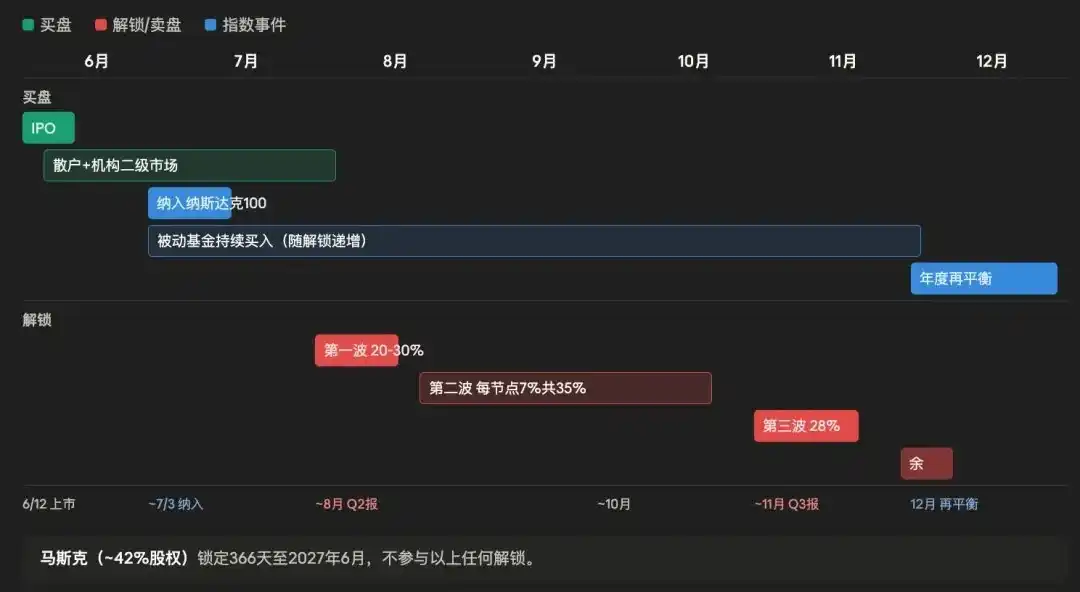
  • First wave, two days after the Q2 earnings release: Locked-up shareholders can sell up to 20% of their locked shares. If the stock price stays 30% above the IPO price and meets the threshold for 5 out of 10 trading days at this point, an additional 10% will be unlocked. This means the earliest group of insiders may start selling as soon as early August.
  • Second wave, on days 70, 90, 105, 120, and 135 after the IPO: 7% will be unlocked at each milestone, totaling 35% across the five milestones.
  • Third wave, after the Q3 earnings release, another 28% is unlocked, with the remainder released upon the expiration of the 180-day lock-up.

Elon Musk's shares are locked for 366 days, and he does not participate in any early releases. He controls over 85% of the voting rights, and this commitment is a crucial pillar of short-term market confidence in SpaceX.

From listing until the end of the year, the market will experience a six-month transformation in supply and demand dynamics. In the first half, the free float is locked up, and buying demand is highly predictable. In the second half, shares are gradually released, and each earnings milestone becomes a test of selling pressure.

The timing design is particularly noteworthy: By the time of the Nasdaq 100 annual rebalancing in mid-December, most insider shares will have been unlocked through the earlier phases. With the free float significantly increased, NASDAQ will correspondingly raise SpaceX's index weight, prompting passive funds to purchase additional shares again. This essentially provides institutional, mandatory buying support to cushion the market several months after insiders have sold substantial amounts.
Preguntas relacionadas

QAccording to the article, what is the special arrangement made by NASDAQ to include SpaceX in the NASDAQ-100 index, and what is its potential impact?

ANASDAQ specially modified its rules for SpaceX, allowing it to be eligible for inclusion in the NASDAQ-100 just 15 trading days after its IPO. This move removed the previous 10% minimum free float requirement and introduced a new weighting rule: even though SpaceX's actual free float is only about 5%, the index will calculate its weight based on a cap of up to three times that, or 15%. This means that upon inclusion, passive funds tracking the index will be forced to buy a significant amount of SpaceX stock relative to its small float, potentially pushing up the price sharply in a short period.

QDescribe the three waves of buying pressure for SpaceX stock mentioned in the article and the sequence in which they occur.

AThe three waves of buying pressure are: 1) The IPO subscription on June 12th, where institutions and retail investors purchase the newly issued shares at a fixed price of $135. 2) Secondary market trading after the stock begins trading on NASDAQ, where the price is set by market supply and demand. 3) The mandatory buying by passive index funds after SpaceX is included in the NASDAQ-100 index. These three waves of buying pressure are described as occurring almost seamlessly within the first month after the listing.

QHow does SpaceX's lock-up release mechanism for insiders differ from a traditional 180-day lock-up, and what is its schedule?

ASpaceX does not use a traditional 180-day uniform lock-up expiration. Instead, it has a staged release mechanism for the approximately 54% of shares held by VCs, early employees, and other insiders. The schedule is: The first wave allows locked-up shareholders to sell up to 20% of their holdings two days after the Q2 earnings report, with an extra 10% unlocked if the stock price meets certain conditions. The second wave involves unlocks of 7% each on days 70, 90, 105, 120, and 135 post-IPO, totaling 35%. The third wave unlocks 28% after the Q3 earnings report, with the remainder released at the 180-day mark. Elon Musk's 42% stake is locked for 366 days and is not part of this staged release.

QWhat role does the NASDAQ-100 annual rebalancing in mid-December play according to the article's analysis of the supply and demand dynamics for SpaceX stock?

AThe article suggests that by the time of the NASDAQ-100's annual rebalancing in mid-December, most of the insider shares will have been unlocked through the earlier staged releases. With the free float significantly increased by then, NASDAQ will correspondingly raise SpaceX's weighting in the index. This forces the passive funds tracking the index to buy additional shares again. This institutional, forced buying is seen as providing a market floor several months after the period of heavy potential selling by insiders.

QWhat is the estimated total valuation of SpaceX at its IPO, and what is the size and percentage of the initial free float being offered?

ASpaceX is going public with an estimated total valuation of $1.8 trillion. The actual number of shares entering circulation at the IPO is about 556 million, corresponding to a free-float market capitalization of approximately $75 billion, which represents about 4.2% of the total valuation.

Lecturas Relacionadas

a16z Crypto Partner: Cash Flow is the Moat

Cash Flow as the Moat: A Playbook for Crypto Founders Historically, the most enduring businesses have been built by positioning themselves within the "flow of funds"—facilitating the creation and transfer of value in a network and extracting a portion of it. Cryptocurrency is the first modern technology natively built for this purpose. For startups, failing to architect products and businesses to leverage these principles means missing a major opportunity. Blockchains are inherently network businesses. Each transaction settles on a shared ledger, and every new participant strengthens the underlying network for all. Well-designed network tokens amplify this by aligning users, developers, and validators around growing the network, with value flowing back to contributors in a transparent feedback loop. This model is not new; companies from railroads and Standard Oil to Google, Meta, and AWS have thrived by inserting themselves into critical flows of value (goods, attention, compute). Financial markets make it even clearer: firms like Visa and major market makers generate immense revenue not by predicting markets but by being in the path of transactions. The combination of fund flow and network effects creates one of the most durable business structures. The high margins in traditional finance (payments, custody, lending, FX) represent prime targets. Crypto founders have the opportunity to build the next version—programmable, instant, global, and natively in the flow of funds. The frontier extends beyond finance to areas like computing/GPUs, AI training data, energy, robotics, and space—markets without entrenched intermediaries, ripe for building new, efficient value rails on programmable infrastructure. Founders should ask: Are you in the flow of funds today? Does your revenue scale 10x with the value of activity on your platform? Where in your target market are profit margins highest relative to value created? The opportunity is clear: embed your startup into the new flows of value and let the network effects accumulate.

marsbitHace 3 min(s)

a16z Crypto Partner: Cash Flow is the Moat

marsbitHace 3 min(s)

a16z Crypto Partner: Cash Flow is the Moat

Title: a16z Crypto Partner: Cash Flow Is the Moat Summary: Historically, many of the best businesses were built by positioning themselves within the "flow of funds"—facilitating the creation and transfer of value within a network and taking a cut. The more value flows through, the larger the business grows. Cryptocurrency is the first modern technology natively built for this purpose. If a startup hasn't architected its product and business to benefit from these principles, it's missing a major opportunity. Thanks to stablecoins, capital and value now move at internet speed—globally settled, 24/7, with end-to-end programmability. Blockchains are inherently network businesses. Each transaction settles on a shared ledger, and every new participant strengthens the same underlying network. Network tokens amplify this effect. A well-designed token aligns all participants—users, developers, suppliers, validators, the protocol—around a single goal: growing the network. Participants are paid proportionally to their contributions, creating a transparent feedback loop between value flowing in the system and value accumulating to those building it. This model isn't new; crypto simply makes it more accessible and scalable for startups. The pattern is consistent: find where value flows and position yourself in the middle. Examples range from railroads (earning from freight) and Standard Oil to Google, Meta, and AWS (earning from attention, commerce, and compute flows, respectively). Financial markets make this even clearer. Visa's net income stems from its position in the $15.7 trillion payment flow. Major market makers profit from being in the flow of every order. This combination of fund flow and network effects creates one of the most durable business structures. Jeff Bezos's adage "your margin is my opportunity" applies perfectly here, especially to traditional finance—a massive pool of profit extraction. Crypto founders have the chance to build the next version: programmable, instant, global, and natively in the flow of funds. The frontier extends beyond finance to areas like compute/GPUs, memory chips, AI training data, energy, robotics, space, and rare earth metals—all domains where global value can flow at unprecedented scale on new, programmable infrastructure. Founders should ask: Are you currently in the flow of funds? Does your revenue scale 10x if the value of activity on your product grows 10x? Where in your target market is profit extraction highest relative to value created? The opportunity is there. Seize it, integrate into the new flow, and let the network effects accumulate.

链捕手Hace 8 min(s)

a16z Crypto Partner: Cash Flow is the Moat

链捕手Hace 8 min(s)

RWA First Stock's Major Acquisition: Why Buy a 'Traditional' Mortgage Company?

On June 10th, Figure Technology Solutions (Nasdaq: FIGR), a blockchain-native capital markets firm, announced a $717 million acquisition of Kiavi, a leading non-bank lender for residential real estate investors. The deal involves Figure acquiring Kiavi's technology and operations for approximately $538 million, while forming a joint venture with alternative asset manager Sixth Street to purchase Kiavi's existing loan portfolio. Sixth Street also provided a $3 billion forward purchase commitment. This acquisition marks a strategic shift for Figure, known as the "RWA (Real World Asset) first stock," allowing it to expand significantly into the larger market of first-lien mortgages. Kiavi specializes in non-qualified mortgage (Non-QM) loans, such as short-term fix-and-flip (RTL) and rental property (DSCR) loans—a segment traditionally underserved by major banks. The move is expected to increase Figure's first-lien loan origination to over $7 billion annually, aiming for these to constitute about 40% of its business by 2027. Both companies leverage AI for underwriting: Kiavi uses proprietary models to value renovated properties and automate document processing, dominating the fix-and-flip lending space. Figure plans to integrate these assets onto its blockchain platform, Provenance, using its new 'Adaptor' product to standardize and tokenize the loans for institutional investors on its Democratized Prime marketplace. While the integration poses challenges—including merging different asset types, interest rate sensitivity of Kiavi's loans, and post-IPO execution risks—Figure projects the deal to be accretive to earnings with a cash payback period under four years. The transaction is seen as a major step in scaling blockchain-based capital markets, moving RWA tokenization from concept validation toward large-scale operation.

Foresight NewsHace 36 min(s)

RWA First Stock's Major Acquisition: Why Buy a 'Traditional' Mortgage Company?

Foresight NewsHace 36 min(s)

Trading

Spot
Futuros

Artículos destacados

Qué es $S$

Entendiendo SPERO: Una Visión General Completa Introducción a SPERO A medida que el panorama de la innovación continúa evolucionando, la aparición de tecnologías web3 y proyectos de criptomonedas juega un papel fundamental en la configuración del futuro digital. Un proyecto que ha atraído la atención en este campo dinámico es SPERO, denotado como SPERO,$$s$. Este artículo tiene como objetivo reunir y presentar información detallada sobre SPERO, para ayudar a entusiastas e inversores a comprender sus fundamentos, objetivos e innovaciones dentro de los dominios web3 y cripto. ¿Qué es SPERO,$$s$? SPERO,$$s$ es un proyecto único dentro del espacio cripto que busca aprovechar los principios de descentralización y tecnología blockchain para crear un ecosistema que promueva la participación, la utilidad y la inclusión financiera. El proyecto está diseñado para facilitar interacciones de igual a igual de nuevas maneras, proporcionando a los usuarios soluciones y servicios financieros innovadores. En su esencia, SPERO,$$s$ tiene como objetivo empoderar a los individuos al proporcionar herramientas y plataformas que mejoren la experiencia del usuario en el espacio de las criptomonedas. Esto incluye habilitar métodos de transacción más flexibles, fomentar iniciativas impulsadas por la comunidad y crear caminos para oportunidades financieras a través de aplicaciones descentralizadas (dApps). La visión subyacente de SPERO,$$s$ gira en torno a la inclusividad, buscando cerrar brechas dentro de las finanzas tradicionales mientras aprovecha los beneficios de la tecnología blockchain. ¿Quién es el Creador de SPERO,$$s$? La identidad del creador de SPERO,$$s$ sigue siendo algo oscura, ya que hay recursos públicos limitados que proporcionan información de fondo detallada sobre su(s) fundador(es). Esta falta de transparencia puede derivarse del compromiso del proyecto con la descentralización, una ética que muchos proyectos web3 comparten, priorizando las contribuciones colectivas sobre el reconocimiento individual. Al centrar las discusiones en torno a la comunidad y sus objetivos colectivos, SPERO,$$s$ encarna la esencia del empoderamiento sin señalar a individuos específicos. Como tal, comprender la ética y la misión de SPERO sigue siendo más importante que identificar a un creador singular. ¿Quiénes son los Inversores de SPERO,$$s$? SPERO,$$s$ cuenta con el apoyo de una diversa gama de inversores que van desde capitalistas de riesgo hasta inversores ángeles dedicados a fomentar la innovación en el sector cripto. El enfoque de estos inversores generalmente se alinea con la misión de SPERO, priorizando proyectos que prometen avances tecnológicos sociales, inclusión financiera y gobernanza descentralizada. Estas fundaciones de inversores suelen estar interesadas en proyectos que no solo ofrecen productos innovadores, sino que también contribuyen positivamente a la comunidad blockchain y sus ecosistemas. El respaldo de estos inversores refuerza a SPERO,$$s$ como un contendiente notable en el dominio de proyectos cripto que evoluciona rápidamente. ¿Cómo Funciona SPERO,$$s$? SPERO,$$s$ emplea un marco multifacético que lo distingue de los proyectos de criptomonedas convencionales. Aquí hay algunas de las características clave que subrayan su singularidad e innovación: Gobernanza Descentralizada: SPERO,$$s$ integra modelos de gobernanza descentralizada, empoderando a los usuarios para participar activamente en los procesos de toma de decisiones sobre el futuro del proyecto. Este enfoque fomenta un sentido de propiedad y responsabilidad entre los miembros de la comunidad. Utilidad del Token: SPERO,$$s$ utiliza su propio token de criptomoneda, diseñado para servir diversas funciones dentro del ecosistema. Estos tokens permiten transacciones, recompensas y la facilitación de servicios ofrecidos en la plataforma, mejorando la participación y la utilidad general. Arquitectura en Capas: La arquitectura técnica de SPERO,$$s$ apoya la modularidad y escalabilidad, permitiendo la integración fluida de características y aplicaciones adicionales a medida que el proyecto evoluciona. Esta adaptabilidad es fundamental para mantener la relevancia en el cambiante paisaje cripto. Participación de la Comunidad: El proyecto enfatiza iniciativas impulsadas por la comunidad, empleando mecanismos que incentivan la colaboración y la retroalimentación. Al nutrir una comunidad sólida, SPERO,$$s$ puede abordar mejor las necesidades de los usuarios y adaptarse a las tendencias del mercado. Enfoque en la Inclusión: Al ofrecer tarifas de transacción bajas e interfaces amigables para el usuario, SPERO,$$s$ busca atraer a una base de usuarios diversa, incluyendo a individuos que anteriormente pueden no haber participado en el espacio cripto. Este compromiso con la inclusión se alinea con su misión general de empoderamiento a través de la accesibilidad. Cronología de SPERO,$$s$ Entender la historia de un proyecto proporciona información crucial sobre su trayectoria de desarrollo y hitos. A continuación se presenta una cronología sugerida que mapea eventos significativos en la evolución de SPERO,$$s$: Fase de Conceptualización e Ideación: Las ideas iniciales que forman la base de SPERO,$$s$ fueron concebidas, alineándose estrechamente con los principios de descentralización y enfoque comunitario dentro de la industria blockchain. Lanzamiento del Whitepaper del Proyecto: Tras la fase conceptual, se lanzó un whitepaper completo que detalla la visión, los objetivos y la infraestructura tecnológica de SPERO,$$s$ para generar interés y retroalimentación de la comunidad. Construcción de Comunidad y Primeras Interacciones: Se realizaron esfuerzos de divulgación activa para construir una comunidad de primeros adoptantes y posibles inversores, facilitando discusiones en torno a los objetivos del proyecto y obteniendo apoyo. Evento de Generación de Tokens: SPERO,$$s$ llevó a cabo un evento de generación de tokens (TGE) para distribuir sus tokens nativos a los primeros seguidores y establecer liquidez inicial dentro del ecosistema. Lanzamiento de la dApp Inicial: La primera aplicación descentralizada (dApp) asociada con SPERO,$$s$ se puso en marcha, permitiendo a los usuarios interactuar con las funcionalidades centrales de la plataforma. Desarrollo Continuo y Alianzas: Actualizaciones y mejoras continuas a las ofertas del proyecto, incluyendo alianzas estratégicas con otros actores en el espacio blockchain, han moldeado a SPERO,$$s$ en un jugador competitivo y en evolución en el mercado cripto. Conclusión SPERO,$$s$ se erige como un testimonio del potencial de web3 y las criptomonedas para revolucionar los sistemas financieros y empoderar a los individuos. Con un compromiso con la gobernanza descentralizada, la participación comunitaria y funcionalidades diseñadas de manera innovadora, allana el camino hacia un paisaje financiero más inclusivo. Como con cualquier inversión en el espacio cripto que evoluciona rápidamente, se anima a los posibles inversores y usuarios a investigar a fondo y participar de manera reflexiva con los desarrollos en curso dentro de SPERO,$$s$. El proyecto muestra el espíritu innovador de la industria cripto, invitando a una mayor exploración de sus innumerables posibilidades. Mientras el viaje de SPERO,$$s$ aún se desarrolla, sus principios fundamentales pueden, de hecho, influir en el futuro de cómo interactuamos con la tecnología, las finanzas y entre nosotros en ecosistemas digitales interconectados.

72 Vistas totalesPublicado en 2024.12.17Actualizado en 2024.12.17

Qué es $S$

Qué es AGENT S

Agent S: El Futuro de la Interacción Autónoma en Web3 Introducción En el paisaje en constante evolución de Web3 y las criptomonedas, las innovaciones están redefiniendo constantemente cómo los individuos interactúan con las plataformas digitales. Uno de estos proyectos pioneros, Agent S, promete revolucionar la interacción humano-computadora a través de su marco agente abierto. Al allanar el camino para interacciones autónomas, Agent S busca simplificar tareas complejas, ofreciendo aplicaciones transformadoras en inteligencia artificial (IA). Esta exploración detallada profundizará en las complejidades del proyecto, sus características únicas y las implicaciones para el dominio de las criptomonedas. ¿Qué es Agent S? Agent S se presenta como un marco agente abierto innovador, diseñado específicamente para abordar tres desafíos fundamentales en la automatización de tareas informáticas: Adquisición de Conocimiento Específico del Dominio: El marco aprende inteligentemente de diversas fuentes de conocimiento externas y experiencias internas. Este enfoque dual le permite construir un rico repositorio de conocimiento específico del dominio, mejorando su rendimiento en la ejecución de tareas. Planificación a Largo Plazo de Tareas: Agent S emplea planificación jerárquica aumentada por la experiencia, un enfoque estratégico que facilita la descomposición y ejecución eficiente de tareas complejas. Esta característica mejora significativamente su capacidad para gestionar múltiples subtareas de manera eficiente y efectiva. Manejo de Interfaces Dinámicas y No Uniformes: El proyecto introduce la Interfaz Agente-Computadora (ACI), una solución innovadora que mejora la interacción entre agentes y usuarios. Utilizando Modelos de Lenguaje Multimodal de Gran Escala (MLLMs), Agent S puede navegar y manipular diversas interfaces gráficas de usuario sin problemas. A través de estas características pioneras, Agent S proporciona un marco robusto que aborda las complejidades involucradas en la automatización de la interacción humana con las máquinas, preparando el terreno para una multitud de aplicaciones en IA y más allá. ¿Quién es el Creador de Agent S? Si bien el concepto de Agent S es fundamentalmente innovador, la información específica sobre su creador sigue siendo elusiva. El creador es actualmente desconocido, lo que resalta ya sea la etapa incipiente del proyecto o la elección estratégica de mantener a los miembros fundadores en el anonimato. Independientemente de la anonimidad, el enfoque sigue siendo en las capacidades y el potencial del marco. ¿Quiénes son los Inversores de Agent S? Dado que Agent S es relativamente nuevo en el ecosistema criptográfico, la información detallada sobre sus inversores y patrocinadores financieros no está documentada explícitamente. La falta de información disponible públicamente sobre las bases de inversión u organizaciones que apoyan el proyecto plantea preguntas sobre su estructura de financiamiento y hoja de ruta de desarrollo. Comprender el respaldo es crucial para evaluar la sostenibilidad del proyecto y su posible impacto en el mercado. ¿Cómo Funciona Agent S? En el núcleo de Agent S se encuentra una tecnología de vanguardia que le permite funcionar de manera efectiva en diversos entornos. Su modelo operativo se basa en varias características clave: Interacción Humano-Computadora Similar a la Humana: El marco ofrece planificación avanzada de IA, esforzándose por hacer que las interacciones con las computadoras sean más intuitivas. Al imitar el comportamiento humano en la ejecución de tareas, promete elevar las experiencias de los usuarios. Memoria Narrativa: Empleada para aprovechar experiencias de alto nivel, Agent S utiliza memoria narrativa para hacer un seguimiento de las historias de tareas, mejorando así sus procesos de toma de decisiones. Memoria Episódica: Esta característica proporciona a los usuarios una guía paso a paso, permitiendo que el marco ofrezca apoyo contextual a medida que se desarrollan las tareas. Soporte para OpenACI: Con la capacidad de ejecutarse localmente, Agent S permite a los usuarios mantener el control sobre sus interacciones y flujos de trabajo, alineándose con la ética descentralizada de Web3. Fácil Integración con APIs Externas: Su versatilidad y compatibilidad con varias plataformas de IA aseguran que Agent S pueda encajar sin problemas en ecosistemas tecnológicos existentes, convirtiéndolo en una opción atractiva para desarrolladores y organizaciones. Estas funcionalidades contribuyen colectivamente a la posición única de Agent S dentro del espacio cripto, ya que automatiza tareas complejas y de múltiples pasos con una intervención humana mínima. A medida que el proyecto evoluciona, sus posibles aplicaciones en Web3 podrían redefinir cómo se desarrollan las interacciones digitales. Cronología de Agent S El desarrollo y los hitos de Agent S pueden encapsularse en una cronología que resalta sus eventos significativos: 27 de septiembre de 2024: El concepto de Agent S fue lanzado en un documento de investigación integral titulado “Un Marco Agente Abierto que Usa Computadoras Como un Humano”, mostrando las bases del proyecto. 10 de octubre de 2024: El documento de investigación fue puesto a disposición del público en arXiv, ofreciendo una exploración profunda del marco y su evaluación de rendimiento basada en el benchmark OSWorld. 12 de octubre de 2024: Se lanzó una presentación en video, proporcionando una visión visual de las capacidades y características de Agent S, involucrando aún más a posibles usuarios e inversores. Estos marcadores en la cronología no solo ilustran el progreso de Agent S, sino que también indican su compromiso con la transparencia y la participación comunitaria. Puntos Clave Sobre Agent S A medida que el marco Agent S continúa evolucionando, varios atributos clave destacan, subrayando su naturaleza innovadora y potencial: Marco Innovador: Diseñado para proporcionar un uso intuitivo de las computadoras similar a la interacción humana, Agent S aporta un enfoque novedoso a la automatización de tareas. Interacción Autónoma: La capacidad de interactuar de manera autónoma con las computadoras a través de GUI significa un salto hacia soluciones informáticas más inteligentes y eficientes. Automatización de Tareas Complejas: Con su metodología robusta, puede automatizar tareas complejas y de múltiples pasos, haciendo que los procesos sean más rápidos y menos propensos a errores. Mejora Continua: Los mecanismos de aprendizaje permiten a Agent S mejorar a partir de experiencias pasadas, mejorando continuamente su rendimiento y eficacia. Versatilidad: Su adaptabilidad en diferentes entornos operativos como OSWorld y WindowsAgentArena asegura que pueda servir a una amplia gama de aplicaciones. A medida que Agent S se posiciona en el paisaje de Web3 y criptomonedas, su potencial para mejorar las capacidades de interacción y automatizar procesos significa un avance significativo en las tecnologías de IA. A través de su marco innovador, Agent S ejemplifica el futuro de las interacciones digitales, prometiendo una experiencia más fluida y eficiente para los usuarios en diversas industrias. Conclusión Agent S representa un audaz avance en la unión de la IA y Web3, con la capacidad de redefinir cómo interactuamos con la tecnología. Aunque aún se encuentra en sus primeras etapas, las posibilidades para su aplicación son vastas y atractivas. A través de su marco integral que aborda desafíos críticos, Agent S busca llevar las interacciones autónomas al primer plano de la experiencia digital. A medida que nos adentramos más en los reinos de las criptomonedas y la descentralización, proyectos como Agent S sin duda desempeñarán un papel crucial en la configuración del futuro de la tecnología y la colaboración humano-computadora.

483 Vistas totalesPublicado en 2025.01.14Actualizado en 2025.01.14

Qué es AGENT S

Cómo comprar S

¡Bienvenido a HTX.com! Hemos hecho que comprar Sonic (S) sea simple y conveniente. Sigue nuestra guía paso a paso para iniciar tu viaje de criptos.Paso 1: crea tu cuenta HTXUtiliza tu correo electrónico o número de teléfono para registrarte y obtener una cuenta gratuita en HTX. Experimenta un proceso de registro sin complicaciones y desbloquea todas las funciones.Obtener mi cuentaPaso 2: ve a Comprar cripto y elige tu método de pagoTarjeta de crédito/débito: usa tu Visa o Mastercard para comprar Sonic (S) al instante.Saldo: utiliza fondos del saldo de tu cuenta HTX para tradear sin problemas.Terceros: hemos agregado métodos de pago populares como Google Pay y Apple Pay para mejorar la comodidad.P2P: tradear directamente con otros usuarios en HTX.Over-the-Counter (OTC): ofrecemos servicios personalizados y tipos de cambio competitivos para los traders.Paso 3: guarda tu Sonic (S)Después de comprar tu Sonic (S), guárdalo en tu cuenta HTX. Alternativamente, puedes enviarlo a otro lugar mediante transferencia blockchain o utilizarlo para tradear otras criptomonedas.Paso 4: tradear Sonic (S)Tradear fácilmente con Sonic (S) en HTX's mercado spot. Simplemente accede a tu cuenta, selecciona tu par de trading, ejecuta tus trades y monitorea en tiempo real. Ofrecemos una experiencia fácil de usar tanto para principiantes como para traders experimentados.

976 Vistas totalesPublicado en 2025.01.15Actualizado en 2026.06.02

Cómo comprar S

Discusiones

Bienvenido a la comunidad de HTX. Aquí puedes mantenerte informado sobre los últimos desarrollos de la plataforma y acceder a análisis profesionales del mercado. A continuación se presentan las opiniones de los usuarios sobre el precio de S (S).

活动图片