SpaceX, AI, and XRP: Why the Next Wealth Transfer Might Be Different?

marsbitPublicado a 2026-06-21Actualizado a 2026-06-21

Resumen

The article posits that the global economy is transitioning into a new phase of infrastructure investment. Capital, facing slowing traditional growth engines, is flowing towards emerging foundational systems. This includes space infrastructure (exemplified by SpaceX), AI computing power, satellite networks, data centers, and global payment systems. A key driver is a potential new commodity supercycle fueled by industrial demand from these sectors. Concurrently, the role of blockchain is evolving from speculative assets to a critical settlement layer for the future economy. Digital assets like XRP and XLM, focused on payments and interoperability, are highlighted as potential rails for cross-border settlement, tokenized assets, and machine-to-machine (AI Agent) transactions. The narrative connects figures like Ripple's Jed McCaleb to space ventures, suggesting convergence. The argument emphasizes a shift from speculative narratives to utility-driven value. As AI and space commerce generate new economic activity, and regulatory clarity improves, blockchain networks may underpin real-time value transfer. The conclusion urges investors to consider which networks will form the backbone of this integrated next-generation economic infrastructure.

Editor's Note: This article attempts to understand SpaceX's IPO expectations, AI Agents, blockchain settlement networks, commodity demand, and digital asset regulation within the same overarching narrative: global capital may be shifting from purely chasing speculative growth to betting on the next generation of economic infrastructure.

The author's core argument is that as traditional growth engines slow, capital requires new vessels. Space infrastructure, AI computing power, satellite networks, data centers, and cross-border payment systems may collectively constitute the next cycle of infrastructure investment. Within this framework, commodities are no longer just cyclical goods but become the foundational inputs for AI, communications, orbital manufacturing, and energy systems; blockchain is not merely about trading assets but could become the financial rails for tokenized assets, AI Agent payments, and global real-time settlement.

The article particularly emphasizes the potential role of payment-oriented digital assets like XRP and XLM in cross-border settlement, interoperability, and machine-to-machine payments. It connects threads such as Ripple, Jed McCaleb, Vast, and SpaceX to paint a picture of a converging landscape of "space commerce + AI + blockchain settlement layer".

It is important to note that such narratives still carry a strong speculative element, especially when tying specific digital assets to future infrastructure cycles. The distance between long-term trends, commercial implementation, and market pricing must still be distinguished. However, the question it raises is worth attention: If AI is creating new economic actors, and space and data centers are creating new capital expenditure cycles, who will handle value transfer, identity management, and instant settlement between these systems? This may be the key for digital assets to move from a speculative narrative to an infrastructure narrative.

Below is the original article:

The financial world may be entering a new phase. This phase is not merely a continuation of traditional market cycles but a progression towards the construction of a completely new set of economic infrastructure. Recent developments around SpaceX, artificial intelligence, blockchain technology, and the clarification of digital asset regulations suggest that capital is starting to flow towards systems that could define the next generation of global commerce.

Behind the SpaceX IPO Expectations: Capital is Searching for New Infrastructure

The highly anticipated IPO of SpaceX has garnered immense attention, not just because of SpaceX itself, but because it represents a broader trend. As debt markets tighten and economic growth slows, governments and financial institutions are seeking new frontiers that can both absorb capital and justify sustained investment.

Space infrastructure, orbital manufacturing, satellite networks, data centers, and advanced communications systems are increasingly being viewed as trillion-dollar opportunities. These fields require massive physical capital, commodities, financing support, and technological synergy.

The logic is simple: when traditional growth engines mature, capital seeks new domains to support further expansion. Space might become one such frontier, even if the narrative itself is built on lies and deception.

A New Commodity Cycle: Both AI and Space Depend on Raw Materials

Large-scale infrastructure projects are inseparable from raw materials.

The expansion of data centers, satellite networks, AI computing facilities, and future space infrastructure will generate enormous demand for key commodities. Metals like gold, silver, platinum, copper, and rare earths will become indispensable inputs in the next generation of technological systems.

The world may be in the early stages of a structural commodity supercycle. This means demand will rise consistently over a longer period, driven by infrastructure investment and technological change.

Unlike previous cycles centered primarily on consumer demand, this one will be driven by industrial and technological needs.

Blockchain's New Role: Not Just Tokens, But a Real-Time Settlement Layer

As new industries emerge, capital must be able to flow efficiently within global markets.

The traditional banking system was designed for a slower world. The infrastructure of the future will involve tokenized assets, AI-driven transactions, international payments, and even potential space commerce, all requiring settlement systems that operate continuously and process at high speed.

This is where blockchain technology enters the conversation.

As highlighted in our podcast yesterday, as financial infrastructure evolves, digital assets focused on payments and interoperability may become increasingly important. Networks capable of settling transactions quickly and efficiently will benefit from the growing need for real-time value transfer.

Digital assets like XRP and XLM are notable in this context, as they focus on payments, interoperability, and cross-border settlement.

It is worth noting the existing connections between Ripple co-founder and XRP Ledger architect Jed McCaleb and commercial space projects. His company, Vast, has partnership connections to SpaceX and Starlink-related plans.
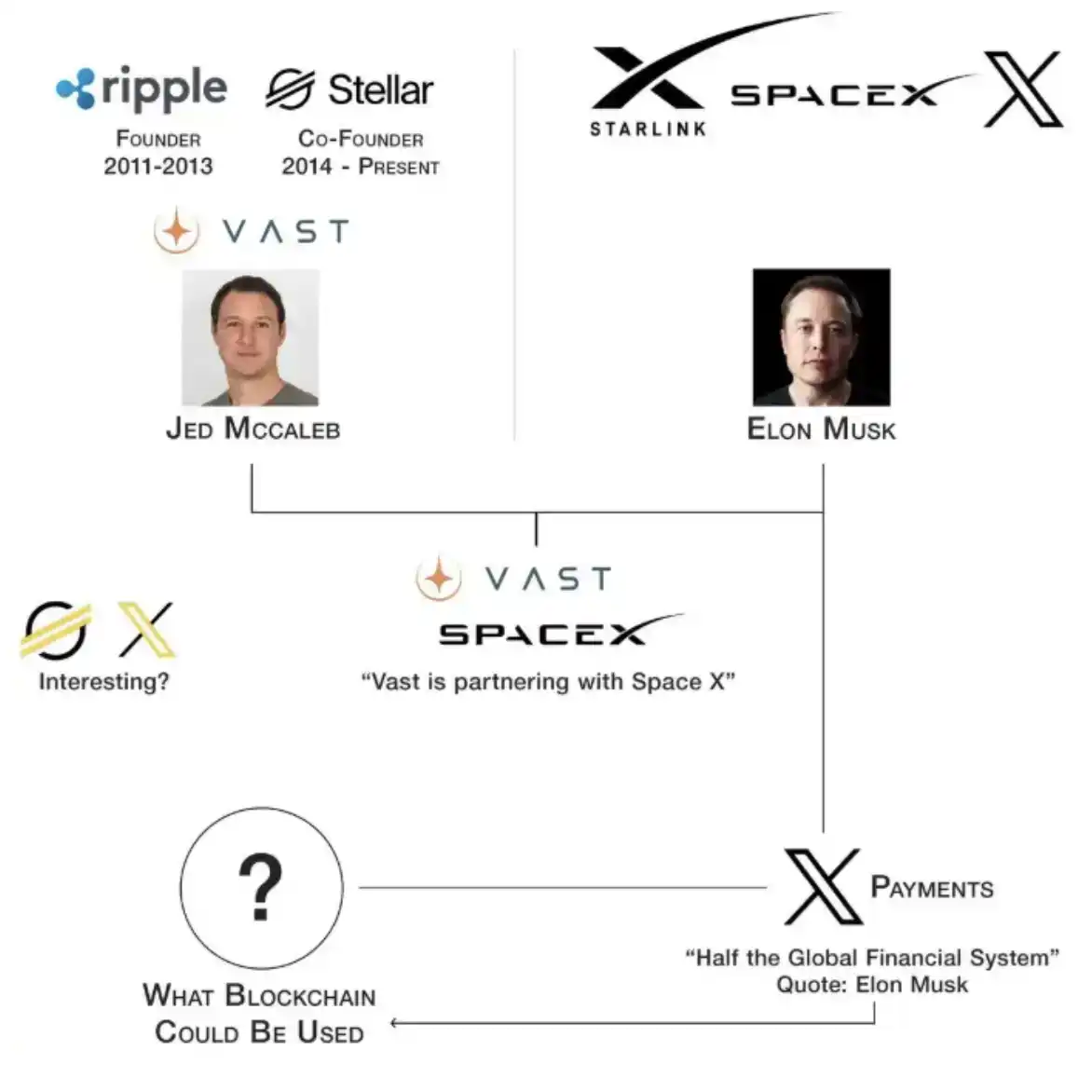
This suggests that blockchain and emerging infrastructure industries may see increasing intersections in the future.

The Convergence of Artificial Intelligence and Blockchain

One of the most overlooked points in current technological innovation might be the convergence of artificial intelligence and blockchain technology.

Ripple CEO Brad Garlinghouse recently mentioned that the company is advancing AI-related initiatives and developing tools to allow AI Agents to interact with the XRP Ledger. This reflects a broader trend taking shape across the tech industry.

AI systems are rapidly evolving from information-processing tools into autonomous agents capable of making decisions, executing transactions, and interacting with digital services.

For these agents to operate meaningfully in an economic sense, they require infrastructure that can support functions such as: sending payments; settling transactions instantly; managing digital identity; executing agreements; transferring value across different networks.

Blockchain technology provides many of these capabilities. As AI adoption accelerates, demand for payment rails capable of supporting large-scale machine-to-machine transactions may grow. This creates a potential fusion: AI generates economic activity, and blockchain networks provide the settlement layer that supports it.

Regulatory Clarity and Institutional Adoption

Another crucial topic is the increasing momentum towards digital asset regulation in the United States. Ripple's management has consistently argued that regulatory clarity is the single most important factor holding back broader institutional adoption. Banks, payment providers, corporate treasuries, and financial institutions typically require clear legal frameworks before committing significant capital to new technologies.

As regulatory certainty improves, institutions may become more willing to integrate blockchain-based systems into their existing business processes.

According to Garlinghouse, Ripple is expected to reach a revenue run-rate in the billions of dollars annually while continuing its global expansion. This indicates that demand for enterprise blockchain solutions continues to grow.

The importance of regulation is not merely legal. It reduces uncertainty and allows businesses and financial institutions to plan long-term.

From Speculative Narrative to Infrastructure Narrative

One of the strongest conclusions this month is that markets might be shifting from a speculative cycle to an infrastructure cycle. Historically, the crypto market has been largely driven by retail speculation and narrative-fueled investment. The next phase could be different.

If AI, tokenization, digital payments, commodity infrastructure, and global settlement systems continue to mature, the value of digital assets may increasingly come from actual utility, not just speculation.

This would represent a significant shift in how investors evaluate blockchain networks.

Market focus will shift away from being solely concentrated on price action, moving increasingly towards metrics like transaction volume, settlement activity, institutional adoption, growth in tokenization, and integration with emerging technologies.

Conclusion

The convergence of SpaceX, artificial intelligence, blockchain infrastructure, commodities, and regulatory clarity paints a picture of an economy undergoing structural transformation.

Space infrastructure is attracting capital, artificial intelligence is rapidly accelerating, and regulators are moving towards clearer digital asset frameworks.

Simultaneously, blockchain networks are increasingly being positioned as the settlement layer connecting these emerging systems.

For investors, the question may no longer be whether these technologies will converge, but how quickly this convergence will happen, and which networks will ultimately become the foundational backbone of the global economy's next phase.

Those who truly accumulate wealth have never been the late adopters. You must position yourself as an early investor in tomorrow's economic infrastructure, before mass adoption arrives.


Criptos en tendencia

Preguntas relacionadas

QAccording to the article, what is the core shift in the global capital investment trend?

AThe core shift is from chasing speculative growth to investing in the next generation of economic infrastructure, including space infrastructure, AI computing power, satellite networks, data centers, and cross-border payment systems.

QWhat role does the article suggest for specific digital assets like XRP and XLM in the emerging economic framework?

AThe article suggests they could play a crucial role as payment-focused digital assets for facilitating cross-border settlement, interoperability, and machine-to-machine payments, potentially forming the settlement layer for new economic activities driven by AI and space commerce.

QHow does the article connect the rise of AI Agents to blockchain technology?

AIt connects them by stating that as AI Agents evolve to make decisions and execute transactions, they will need an infrastructure for payments, instant settlement, and value transfer. Blockchain technology is positioned to provide this essential settlement layer for large-scale machine-to-machine economic activity.

QWhat is identified as a key factor for broader institutional adoption of blockchain-based systems?

ARegulatory clarity is identified as the most important factor. Clear legal frameworks reduce uncertainty and allow institutions like banks and payment providers to confidently integrate blockchain solutions into their long-term business planning.

QWhat major transition in market narrative does the article predict for the digital asset space?

AThe article predicts a transition from a speculative narrative, driven by retail investment and hype, to an infrastructure narrative, where the value of digital assets is increasingly derived from practical utility, transaction volume, institutional adoption, and integration with other emerging technologies like AI.

Lecturas Relacionadas

TechFlow Intelligence Bureau: Anthropic IPO Odds Exceed 80%, Iran Closes Strait of Hormuz Again, Triggering Oil Price Volatility

**Market Digest** **AI & Tech:** Anthropic is widely expected to announce an IPO before November 2026, raising questions about balancing its trillion-dollar valuation ambitions with its core "AI safety" mission. Brands are increasingly adopting AI-generated virtual influencers for marketing. Cloudflare introduced temporary accounts for AI agents to ease automation workflows. **Infrastructure & Hardware:** Google's IPv6 traffic surpassed 50%, marking a major internet milestone. Goldman Sachs warned that massive projected AI capital expenditure ($5.3T) is approaching credit saturation limits, potentially curbing the "AI arms race." **Space & Robotics:** SpaceX's IPO saw a historic $370M retail buying frenzy in three days. Hyundai Motor Group plans to acquire full ownership of Boston Dynamics. Elon Musk speculated about future "septillion-dollar" investments in antimatter for interstellar travel. **Energy & Geopolitics:** Iran's military announced another closure of the strategic Strait of Hormuz, accusing Israel of violating a ceasefire, causing oil market volatility. However, ship-tracking data indicated some traffic continued. Concurrently, Iran resumed crude loadings at Kharg Island, potentially releasing up to 20 million barrels to the market. **Finance & Macro:** A European CLO (collateralized loan obligation) experienced its first post-2008-crisis-era equity tranche default, raising alarms in credit markets. Nomura warned that new Federal Reserve Chair Wash's perceived hawkish debut speech could signal a significant policy shift. **The Undercurrent:** Seemingly disparate events—the Strait of Hormuz tension, the European CLO default, and warnings on AI spending—point to a tightening of global liquidity and rising marginal costs across energy, credit, and tech investment. Meanwhile, capital continues chasing grand narratives like space exploration and advanced AI, highlighting a divergence where old-world leverage frays as new-world stories grow more ambitious.

marsbitHace 4 hora(s)

TechFlow Intelligence Bureau: Anthropic IPO Odds Exceed 80%, Iran Closes Strait of Hormuz Again, Triggering Oil Price Volatility

marsbitHace 4 hora(s)

Trading

Spot
Futuros

Artículos destacados

Qué es XRP 2.0

XRP 2.0: Una Nueva Frontera en el Panorama de las Criptomonedas Introducción a XRP 2.0 En el siempre cambiante ámbito de las criptomonedas, nuevos proyectos surgen continuamente, compitiendo por atención y adopción. Una de estas iniciativas prometedoras es XRP 2.0, un nuevo proyecto de criptomoneda diseñado para aprovechar la tecnología blockchain avanzada y metodologías de encriptación robustas. Aunque el nombre establece paralelismos con el XRP de Ripple, es crucial señalar que XRP 2.0 opera de manera independiente, enfocándose en mejorar la seguridad de las transacciones, la privacidad y la escalabilidad. A medida que el panorama financiero digital abraza cada vez más soluciones descentralizadas, XRP 2.0 busca contribuir de manera significativa a web3 y a la expansión general de los proyectos de criptomonedas. ¿Qué es XRP 2.0? En esencia, XRP 2.0 es un proyecto de criptomoneda que busca crear un ecosistema de moneda digital seguro y descentralizado. Su tecnología fundamental integra principios avanzados de blockchain con técnicas de encriptación de vanguardia. El objetivo principal de XRP 2.0 es establecerse como una plataforma confiable y eficiente que permita la ejecución rápida de transacciones mientras prioriza la protección de la privacidad de sus usuarios. El proyecto se promociona como una solución a muchas limitaciones enfrentadas por las criptomonedas existentes, proponiendo un sistema que puede manejar un mayor volumen de transacciones con mejor velocidad y privacidad. Esta versatilidad posiciona a XRP 2.0 como un competidor significativo en un mercado plagado de diversas monedas digitales. ¿Quién es el Creador de XRP 2.0? La identidad del creador detrás de XRP 2.0 ha sido señalada como 'Wilbur.' Sin embargo, los detalles completos sobre Wilbur o su entidad asociada siguen siendo elusivos. La anonimidad de muchos creadores de criptomonedas no es un fenómeno poco común en la industria, a menudo diseñado para mantener un grado de privacidad y seguridad. ¿Quiénes son los Inversores de XRP 2.0? Hasta ahora, la información específica relacionada con las fundaciones o organizaciones de inversión que apoyan a XRP 2.0 no está disponible públicamente. En el sector de las criptomonedas, el respaldo de inversores respetables puede influir significativamente en la credibilidad y el éxito de un proyecto, sin embargo, la transparencia sobre los patrocinadores financieros de XRP 2.0 no se ha establecido. ¿Cómo Funciona XRP 2.0? XRP 2.0 se destaca al emplear una combinación de tecnología blockchain y algoritmos de encriptación avanzados que aseguran transacciones seguras y descentralizadas. Su estructura innovadora incluye características únicas diseñadas para fomentar el compromiso del usuario y ampliar las funcionalidades más allá de las transacciones convencionales de criptomonedas. Entre estas características, XRP 2.0 incorpora capacidades impulsadas por IA, como funcionalidades de texto a imagen y de texto a voz. Estas adiciones están diseñadas para mejorar la experiencia interactiva de los usuarios, promoviendo una mayor aplicabilidad en diversos sectores. Al unir avances tecnológicos con un diseño centrado en el usuario, XRP 2.0 busca captar la atención de una amplia gama de individuos y empresas que buscan integrar soluciones de criptomonedas en sus marcos operativos. Cronología de XRP 2.0 Entender XRP 2.0 requiere examinar los hitos que han definido su viaje hasta ahora: 23 de julio de 2023: Se presenta XRP 2.0 como un nuevo proyecto de criptomonedas, con el objetivo de revolucionar las capacidades de transacciones seguras y descentralizadas en el ámbito de blockchain. 8 de septiembre de 2023: Se lanza otro proyecto, XRP20, marcando la aparición de un token ERC-20 en la blockchain de Ethereum que no guarda relación con XRP 2.0. 13 de noviembre de 2023: El Libro Mayor de XRP experimenta una actualización significativa con el lanzamiento de la versión 2.0.0 del software del servidor rippled. Es esencial señalar que este desarrollo está desconectado del proyecto de criptomonedas XRP 2.0. Puntos Clave sobre XRP 2.0 Para destilar la esencia de XRP 2.0, surgen varios factores críticos: Características Únicas: La inclusión de características como texto a imagen y texto a voz impulsadas por IA diversifica aún más las aplicaciones potenciales de XRP 2.0. Tecnología Blockchain: El marco utiliza mecanismos avanzados de blockchain y protocolos de encriptación, asegurando un entorno seguro y descentralizado para las transacciones. Escalabilidad y Privacidad: XRP 2.0 prioriza la protección mejorada de la privacidad en los procesos de transacción y la escalabilidad necesaria para acomodar una base de usuarios creciente. No Afiliación con Ripple: Es importante destacar que, a pesar de su nombre, XRP 2.0 no tiene ninguna lealtad ni colaboración con el XRP de Ripple, diferenciando su marco operativo y objetivos dentro del ecosistema de criptomonedas. Conclusión XRP 2.0 representa una ambiciosa aventura en la esfera de las criptomonedas, buscando ofrecer una combinación de seguridad, privacidad y eficiencia en las transacciones digitales. Al integrar tecnologías sofisticadas y características amigables para el usuario, el proyecto se propone ampliar los horizontes de lo que la criptomoneda puede lograr en la economía digital de hoy. Si bien la anonimidad de su creador y la falta de inversores revelados pueden generar cuestionamientos para algunos, el enfoque de XRP 2.0 en funcionalidades avanzadas y descentralización realza su atractivo en un mercado de criptomonedas cada vez más abarrotado. A medida que el paisaje de las criptomonedas sigue evolucionando, XRP 2.0 podría emerger como un jugador crucial en la expansión de soluciones blockchain seguras y escalables.

182 Vistas totalesPublicado en 2024.04.05Actualizado en 2024.12.03

Qué es XRP 2.0

Cómo comprar XRP

¡Bienvenido a HTX.com! Hemos hecho que comprar XRP (XRP) sea simple y conveniente. Sigue nuestra guía paso a paso para iniciar tu viaje de criptos.Paso 1: crea tu cuenta HTXUtiliza tu correo electrónico o número de teléfono para registrarte y obtener una cuenta gratuita en HTX. Experimenta un proceso de registro sin complicaciones y desbloquea todas las funciones.Obtener mi cuentaPaso 2: ve a Comprar cripto y elige tu método de pagoTarjeta de crédito/débito: usa tu Visa o Mastercard para comprar XRP (XRP) al instante.Saldo: utiliza fondos del saldo de tu cuenta HTX para tradear sin problemas.Terceros: hemos agregado métodos de pago populares como Google Pay y Apple Pay para mejorar la comodidad.P2P: tradear directamente con otros usuarios en HTX.Over-the-Counter (OTC): ofrecemos servicios personalizados y tipos de cambio competitivos para los traders.Paso 3: guarda tu XRP (XRP)Después de comprar tu XRP (XRP), guárdalo en tu cuenta HTX. Alternativamente, puedes enviarlo a otro lugar mediante transferencia blockchain o utilizarlo para tradear otras criptomonedas.Paso 4: tradear XRP (XRP)Tradear fácilmente con XRP (XRP) en HTX's mercado spot. Simplemente accede a tu cuenta, selecciona tu par de trading, ejecuta tus trades y monitorea en tiempo real. Ofrecemos una experiencia fácil de usar tanto para principiantes como para traders experimentados.

1.4k Vistas totalesPublicado en 2024.12.10Actualizado en 2026.06.02

Cómo comprar XRP

Discusiones

Bienvenido a la comunidad de HTX. Aquí puedes mantenerte informado sobre los últimos desarrollos de la plataforma y acceder a análisis profesionales del mercado. A continuación se presentan las opiniones de los usuarios sobre el precio de XRP (XRP).

活动图片