More Popular Than SpaceX, Oversubscribed Over 6,586 Times, What's the Meme Power Behind Liuliu Mei (06658.HK)?

marsbitPublicado a 2026-06-15Actualizado a 2026-06-15

Resumen

Liumeimei, a popular Chinese snack brand known as "Liuliumei" in China, listed on the Hong Kong Stock Exchange (stock code: 06658.HK). On its debut, the stock price surged dramatically, opening 116% above the issue price and peaking with gains over 190%. This surge is widely attributed not to its traditional consumer goods business, but to a "Meme stock" phenomenon. Its stock ticker abbreviation "LLM" coincidentally matches the acronym for "Large Language Model," the core technology of the ongoing AI boom. This association, coupled with a strong same-day performance by another AI-related stock, triggered a massive wave of speculative retail investment. The IPO itself saw extreme oversubscription in the public offering segment, exceeding 6,586 times, though retail investors were allocated only 10% of shares. Analysts and the article frame this event as part of a broader "stock Meme-ification" trend in global markets, where stocks can experience volatile price movements based on viral narratives, wordplay (like homophones or abbreviations), celebrity mentions, or fleeting social media attention—similar to dynamics seen in the cryptocurrency meme coin sector. Examples cited include the 2021 GameStop saga, stocks linked to political figures like Donald Trump, and other companies benefiting from AI hype or谐音梗 (homophone puns). While such trends can create significant short-term wealth for some, the article notes they also carry risks of market manipulation, "pump and dump" schem...

Original|Odaily Planet Daily(@OdailyChina)

Author|Wenser(@wenser2010 )
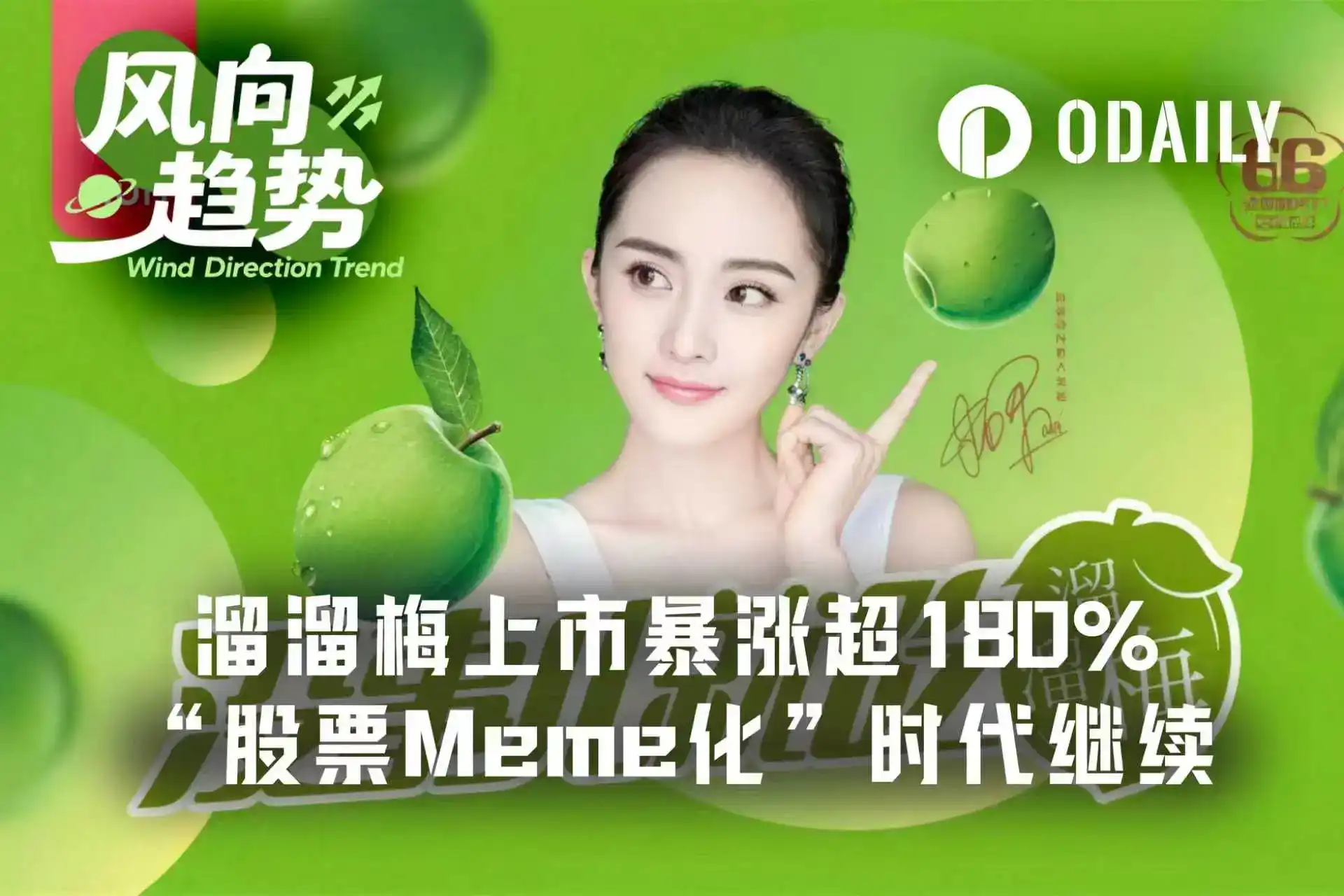
"Are you okay? Are you okay? If you're okay, have some Liuliu Mei!"

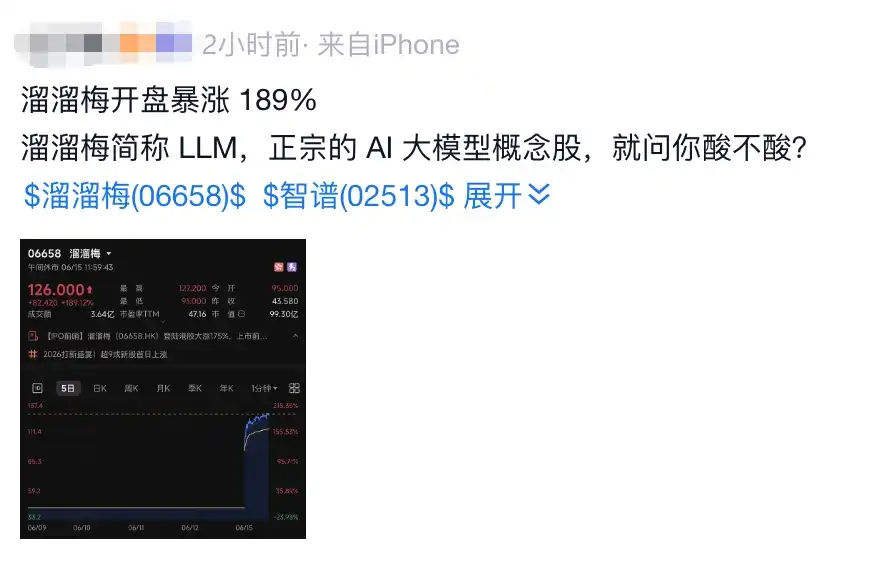
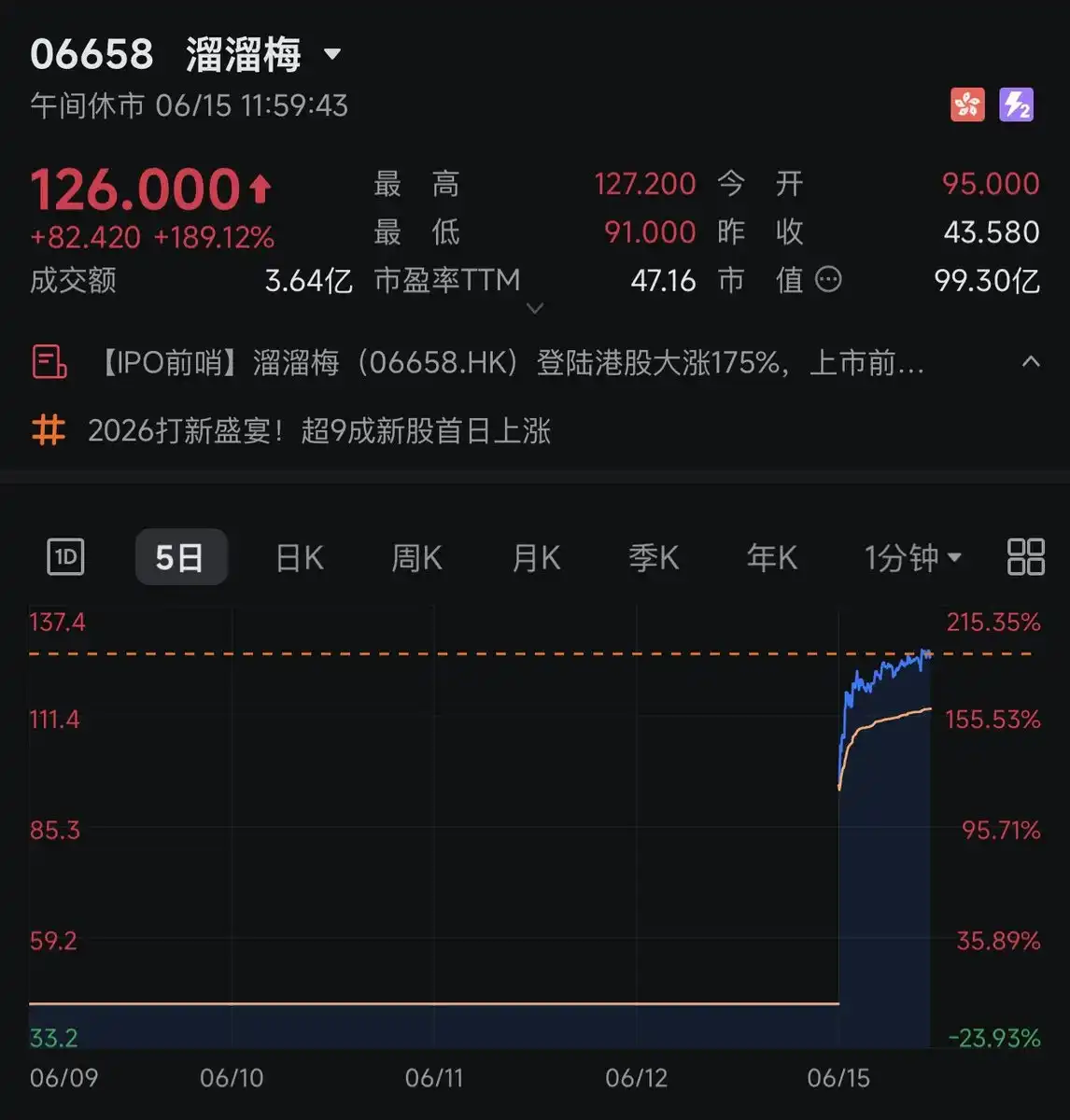
Once upon a time, a catchy slogan from actress Yang Mi brought Liuliu Mei into countless households. Now, after decades of accumulation, the company behind it has officially listed on the Hong Kong Stock Exchange today, becoming the "first plum snack stock" on the market. It is reported that its issue price was 43.58 HKD, opening at 95 HKD, a surge of about 116% from the offering price of 42 HKD; it reached an intraday high of 127.50 HKD, a gain of over 190%; it has since retreated to 125 HKD, still up over 186%.

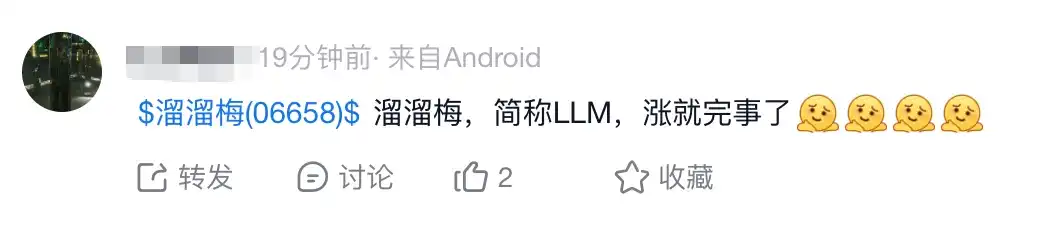
Contrary to what many expected, the sharp rise in Liuliu Mei's (06658.HK) stock price is not a revival of "new consumption, new retail, new snacks" concepts. Instead, it's because its initials coincidentally match "LLM" (Large Language Model), riding the wave of today's 45% surge by Zhipu AI (02513.HK).

Many have dubbed it the "authentic AI Large Language Model stock," attracting a flood of hot money and capital. Whether acknowledged or not, perhaps global stock markets are entering the "Stock Meme-fication Era."

A New Era for Global Stock Markets: When Stocks Collide with Memes

First, let's look at the basics of Liuliu Mei's IPO: This marks its fourth attempt to enter the capital market.

In 2019, its attempt to list on the A-share market was unsuccessful; in 2025, its two applications to the Hong Kong Stock Exchange lapsed; it wasn't until May 21 this year, after updating its filing for the third time and changing its entity name from "Liuliu Mei Group Co., Ltd." to "Liuliu Mei Co., Ltd.," that it succeeded in listing in less than a month. It must be said, sometimes a name can indeed seem like a mystical force.

According to the company's allocation results, the public offering portion of this IPO recorded approximately 6,586.73 times oversubscription. The final number of public offering shares was 1.1465 million, accounting for about 10% of the total global offering. It received approximately 180,500 valid applications, with about 11,465 applications accepted. The ratio for allocating one board lot was only 1.5%, meaning the probability of getting one lot was as low as 1.5%, indicating extremely fierce competition. For the international placement, Liuliu Mei received 2.64 times subscription. The final number of international offering shares was 10.3176 million, accounting for 90% of the total offering shares. Comparing this data, the heat of Liuliu Mei's IPO has surpassed that of Mixue Bingcheng, the "first bubble tea store chain stock" listed in Hong Kong last March, whose Hong Kong public offering was oversubscribed 5,258.21 times.

In other words, institutions were not optimistic but held 90% of the shares; retail investors were optimistic but only held 10% of the shares. The main driving force behind the opening surge came more from the open market's "dance between retail investors and market makers." And this is precisely the power of a "Meme stock"—converting the attention attracted by the meme into buying pressure in the capital market.

Some netizens even compared Liuliu Mei's opening performance to SpaceX's, finding its market gains far more dazzling.
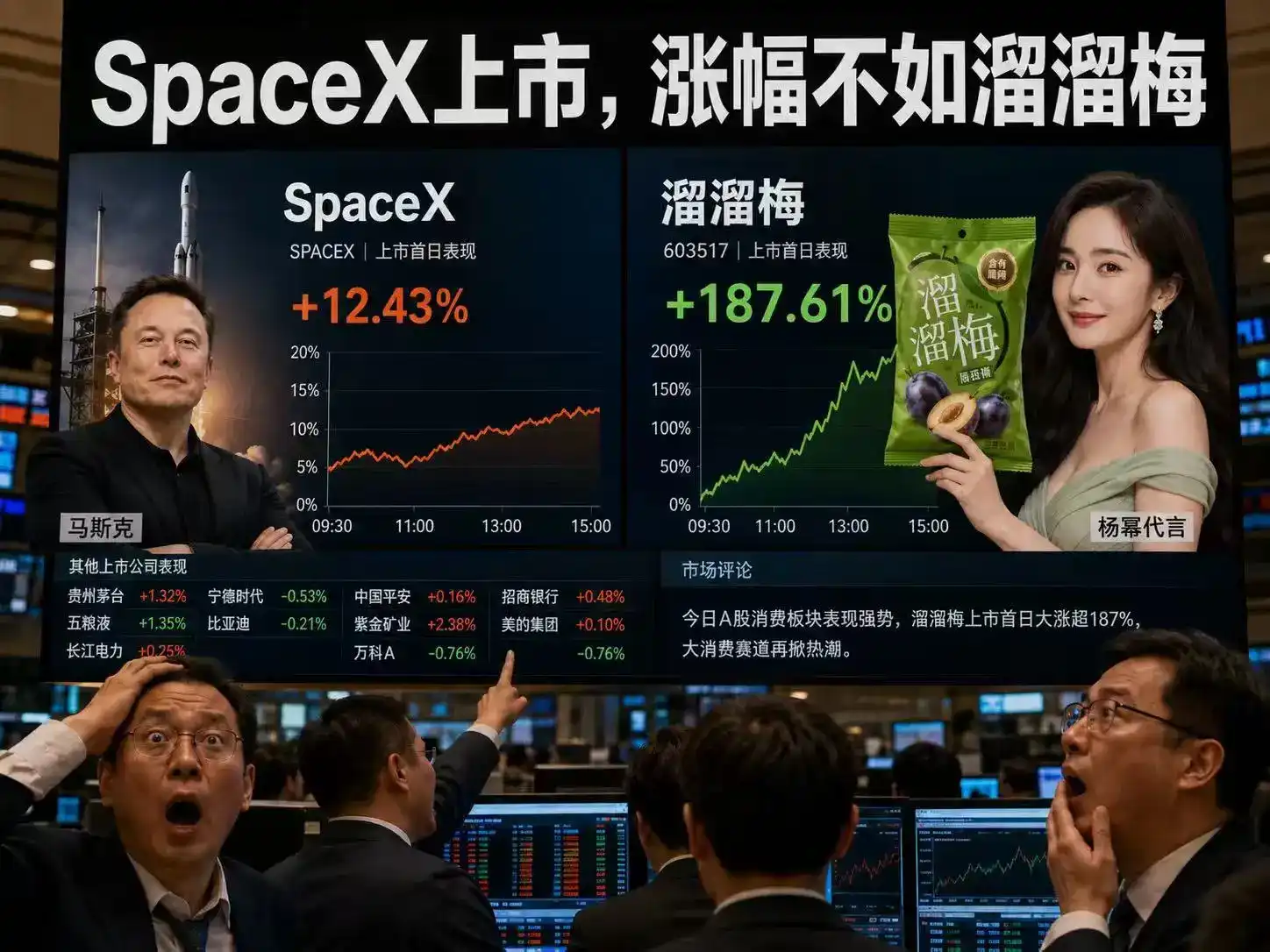
It's worth noting that "Meme stocks" are not a new term but an objectively existing category in major capital markets like the US, Hong Kong, and A-shares. However, the "Stock Meme-fication Era" is undoubtedly the latest trend emerging in the last 1-2 years, driven in part by factors also related to the crypto market.
The earliest Meme stocks are lost to history, so let's discuss some representative individual stocks from recent years.

2021's Gamestop might be the starting point for many people's Meme stock enlightenment in the US market. Led by figures like Roaring Kitty, retail investors worldwide united against Wall Street institutions, forcing a short squeeze that led many brokerages and exchanges to halt trading to avoid the storm. Recently, news of Gamestop's potential acquisition of eBay also caused market fluctuations and a brief price spike.

Tesla and the recently IPOed SpaceX have also been viewed as a type of Meme stock, as these companies and their stocks are deeply tied to the highly topical "world's first trillionaire," Elon Musk. Before their businesses could provide strong performance proof, they were seen as "narrative-driven companies with sky-high price-to-dream ratios."

Before Donald Trump won the US presidential election in 2024, the A-share market showed early anomalies. "Chuanda Zhisheng" frequently topped trending lists, even hitting the daily limit up multiple times. That same year, when Trump was shot during his campaign, with his ear injured by shattered glass from a stray bullet, Goertek (whose Chinese name sounds like "cut ear") also saw its stock price surge during the session.

Last year, when Sino-Japanese relations deteriorated, defense stock Furihong briefly soared due to a patriotic pun where its name sounds like "capture Japan," pulling eight consecutive daily limit-ups and accumulating over 100% gains, becoming one of the short-term "hot stocks" in the A-share market.

Today's capital market, much like the crypto market with its fragmented attention and concentrated emotions, sees individual stocks and sectors that can trigger the widest discussion and attention becoming the "attention focal points" that stir funds and liquidity.
Liuliu Mei's surge is another example of the "Stock Meme-fication" era.

The Dawn of the Stock Meme-fication Era: Puns, Abbreviations, and the AI Era Dividend

With OpenAI and Anthropic's valuations nearing the trillion-dollar mark, companies and stocks closely related to the AI industry chain—including optics, communications, materials, and computing power—have entered an explosive phase:

  • NVIDIA became the first listed company with a market cap exceeding $5 trillion.
  • Micron, SanDisk, etc., saw their stock prices break new highs consecutively, with institutions raising their target prices.
  • SK Hynix and Samsung Electronics' price fluctuations dictate the rise and fall of South Korea's KOSPI index.
  • NVIDIA founder's comment about "seeing Marvell as a future trillion-dollar giant" caused Marvell (MRVL) stock to rise accordingly.
  • Innolight (Zhongji Xuchuang) mentioned by the new stock god Serenity was misread due to translation as Inno Laser, causing the latter's stock price to surge 10% after 300 million in hot money flooded in.

In the great tide of "Stock Meme-fication," being related to AI,蹭上 (riding on) "large language model"热度 (heat), having homophones with popular stocks, or getting mentions from celebrities have all become reasons for market attention and the perfect stage for synchronized attention and capital influx.
"Trump concept stocks," "U.S. stock government concept stocks," "TACO-style trading beneficiary targets," etc., are also连带表现 (associated manifestations) of this industry trend. And this is precisely the common玩法 (playbook) of the "attention-intensive industry" highly推崇 (advocated) by the crypto market—the Meme coin赛道 (track).

However, the capital markets are different now, the rules are different, and the scale of funds and liquidity is also incomparable to the crypto market. After all, compared to the trading scales of the US, Hong Kong, A-share, Japanese, and Korean markets, the crypto market's overall size of less than $3 trillion seems somewhat pitiful.

SpaceX一跃成为 (leapt to become) a top 10 global asset upon its IPO, while相对地 (in contrast), BTC has fallen to the 17th position on that list. It must be said,数字层面 (on a numerical level)的对比 (comparisons) always look so残酷 (harsh)—over a decade of diligent development in the crypto industry couldn't match the市值体量 (market cap scale) of a single company's IPO.

Now, the emergence and increase of Meme stocks might have become an industry trend. Earlier, when Joyoung Company produced对应产品 (corresponding products) and saw its stock price rise due to the hot梗 (meme) "Hakimi North-South Mung Beans," it说明了一件事 (illustrated one thing): for the young demographic and investor群体 (groups) in today's society, investment targets that can trigger emotional波动 (fluctuations), attract market attention, and stir liquidity are more值得买入 (worth buying) objects.

Even if this短暂追逐情绪 (brief chase of emotions) is only temporary火热 (hot), for most people, "if you can't beat them, join them" is the better choice. Of course, objectively speaking, the emergence of Meme stocks does not mean one-sided benefits, like wealth creation effects or industry booms; sometimes, this process is also accompanied by negative phenomena like pump-and-dumps, one-sided harvesting, and emotional marketing.

Just like Liuliu Mei's opening surge, some angrily accuse it of拉高 (pumping the price) to "harvest韭菜 (retail investors)"; others分析认为 (analyze and believe) it might be because Liuliu Mei joined the "Stock Connect," allowing A-share market funds to buy, which pushed up its stock price. The truth, the reasons, are必定是 (certainly) multidimensional and chaotic. For us, perhaps all we can do is顺应 (go with) this trend of the times and寻找 (seek) our own path to致富 (wealth).


Preguntas relacionadas

QAccording to the article, what is the main reason for the surge in Liuliumei's (06658.HK) stock price on its debut?

AThe article states that the main reason for Liuliumei's stock price surge is not a revival of the 'new consumption, new retail, new snacks' concept, but rather its stock ticker abbreviation 'LLM' coincidentally aligning with the popular 'Large Language Model' (AI) theme, riding on the coattails of the strong performance of AI-related stocks like Zhipu AI (02513.HK).

QWhat was the oversubscription rate for Liuliumei's IPO public offering, and how does it compare to Mixue Ice City?

AThe oversubscription rate for Liuliumei's IPO public offering was approximately 6586.73 times. This surpasses the 5258.21 times oversubscription rate recorded by Mixue Ice City for its Hong Kong listing last year.

QWhat does the article suggest is the primary characteristic defining the emerging 'Stock Meme-ification Era'?

AThe article suggests the primary characteristic of the 'Stock Meme-ification Era' is the ability of stocks to attract significant market attention and capital inflows based on factors like catchy memes, attention-grabbing narratives, name abbreviations, homophones, celebrity mentions, or connections to trending themes (like AI), rather than just fundamental business performance.

QBesides Liuliumei, name two other examples of 'Meme stocks' mentioned in the article and the reasons behind their market movements.

A1. GameStop (GME): Its stock movement in 2021 was driven by coordinated retail investor action, famously led by figures like Roaring Kitty, aiming to squeeze short-selling institutions. 2. Geer Stock (Goertek Inc.): In 2024, its stock price surged due to the homophonic pun 'Ge Er' (meaning 'cut ear'), which was associated with an incident where former U.S. President Donald Trump's ear was injured.

QWhat contrasting view does the article present about the rise of 'Meme stocks'?

AThe article presents a contrasting view that while Meme stocks can create wealth effects and industry hype, their rise is also accompanied by negative phenomena such as 'pump and dump' schemes, one-sided harvesting of retail investors, and emotional marketing. It cautions that the reasons behind stock movements like Liuliumei's are complex and multi-dimensional.

Lecturas Relacionadas

Following US Ban on Fable 5, Zhipu AI's Stock Soars 47%

On June 15th, shares of Zhipu AI surged dramatically on the Hong Kong stock market, peaking at a 47.6% gain before closing 32.82% higher. This sharp increase was directly triggered by two recent industry events. On June 12th, Anthropic announced it was suspending global access to its latest flagship models, Claude Fable 5 and Claude Mythos 5, to comply with a U.S. government export control order. The next day, Zhipu AI announced it would open access to its latest open-source flagship model, GLM-5.2, under the permissive MIT license. The Anthropic incident highlighted a critical issue beyond raw model capability: the risk of sudden, unpredictable loss of access to advanced AI models, especially for developers and enterprises deeply integrated with them. This has shifted industry and market focus toward factors like stability, sustainable access, and controllability. Zhipu's move, promoting "frontier intelligence for all," positions its openly available model as a reliable and accessible alternative. The GLM-5.2 model emphasizes "Long Horizon Task" capabilities with a 1M context window, targeting complex, multi-step coding and engineering workflows where maintaining context is crucial. Analysts note this event exposes the risk of dependency on closed-source models subject to single jurisdictional controls, potentially accelerating a shift toward domestic base models and localized deployments. The market's reaction signals a new valuation dimension in AI: providers who can offer stable, long-term, and sustainably accessible AI capabilities are gaining strategic importance.

marsbitHace 21 min(s)

Following US Ban on Fable 5, Zhipu AI's Stock Soars 47%

marsbitHace 21 min(s)

Fully Entering the AI Era: Alipay Bets on Conversation, WeChat Holds Fast to Social

In May 2026, Alipay announced over 300 million AI payment transactions. Shortly after, WeChat opened its mini-programs for AI integration, sparking controversy by requiring developer source code access. This highlights their diverging approaches to AI integration. Alipay is testing "Project Treasure," an optional AI-native interface replacing traditional app grids with a conversational window. Users can command complex tasks (e.g., "book a ride and order coffee") handled end-to-end by AI. This shift follows an abandoned standalone AI app, focusing instead on enhancing its existing user base. For unmodified mini-programs, Alipay's AI uses "screen-reading" to simulate user interactions, bypassing the need for developer overhaul. It also introduced "Token Pay" for micro-transactions and "AI Wallets" for autonomous agent spending. WeChat, prioritizing its core social function, is taking an embedded approach. Its AI agent will operate within existing contexts like group chats and official accounts, assisting without a separate interface. To enable this, WeChat offers developers two paths: granting source code access for direct AI control ("Automatic Mode") or manually encapsulating services into standardized "Skills." Both place significant burden on developers. Key differences emerge in handling legacy services: WeChat demands developer cooperation (code or labor), while Alipay's screen-reading offers immediate, if potentially less stable, compatibility. Alipay's 3 billion AI transactions demonstrate user acceptance of AI-driven commercial actions. The divergent strategies may reshape mini-program ecosystems—Alipay passively "AI-fying" services, WeChat potentially favoring resource-rich developers—and set competing technical standards. Ultimately, the competition centers on where users entrust the command to "help me get things done."

marsbitHace 22 min(s)

Fully Entering the AI Era: Alipay Bets on Conversation, WeChat Holds Fast to Social

marsbitHace 22 min(s)

Trading

Spot
Futuros

Artículos destacados

Qué es MEME 2.0

Memecoin 2.0: El Ascenso de $MEME 2.0 en el Mundo de las Criptomonedas Introducción En el panorama siempre cambiante de las criptomonedas, ha surgido un nuevo contendiente. Memecoin 2.0, simbolizada como $MEME 2.0, lleva el concepto de las monedas meme a un emocionante nuevo nivel. Como un subproducto del Memecoin original, este proyecto ha capturado la atención de la comunidad cripto al cambiar el enfoque de los incentivos financieros típicos a una experiencia comprometida y entretenida. Operando en la blockchain de Ethereum, Memecoin 2.0 redefine audazmente la participación de la comunidad en la esfera cripto. ¿Qué es Memecoin 2.0, $MEME 2.0? En su núcleo, Memecoin 2.0 es un proyecto de criptomoneda que prioriza el espíritu comunitario y la diversión asociada con la cultura meme. A diferencia de las criptomonedas convencionales, que se concentran en casos de uso prácticos y beneficios tangibles, Memecoin 2.0 se distingue al abrazar el lado más liviano de la moneda digital. El proyecto existe sin promesas de utilidad, un mapa estructurado o retornos financieros, enfocándose en cambio en fomentar una comunidad vibrante centrada en memes y en el disfrute compartido. Al hacerlo, aprovecha la creciente tendencia de la cultura meme en el espacio en línea, convirtiéndose en un jugador único en el mundo de los activos digitales. Creador de Memecoin 2.0, $MEME 2.0 A pesar de la extensa investigación sobre los orígenes de Memecoin 2.0, la identidad explícita de su creador sigue siendo desconocida. Esta anonimidad no es inusual en la comunidad cripto, donde muchos proyectos son liderados por individuos o grupos que prefieren permanecer en las sombras. La falta de información disponible públicamente sobre el creador podría verse como un movimiento estratégico, poniendo el foco en la participación comunitaria en lugar de la notoriedad individual dentro del espacio. Inversores de Memecoin 2.0, $MEME 2.0 La información sobre los inversores o el respaldo financiero de Memecoin 2.0 es escasa. Esta ausencia de detalles puede sugerir que el proyecto es autofinanciado o que su enfoque en la comunidad en lugar de las estructuras de inversión tradicionales ha atraído a un tipo diferente de apoyo. Dado que el mundo de las monedas meme generalmente involucra una participación más de base en lugar de inversión institucional, este enfoque está alineado con la ética de los proyectos impulsados por la comunidad. ¿Cómo Funciona Memecoin 2.0, $MEME 2.0? Memecoin 2.0 opera completamente en la blockchain de Ethereum, capitalizando sus robustas características de seguridad y escalabilidad. Al aprovechar las fortalezas de Ethereum, Memecoin 2.0 puede ofrecer un entorno seguro para las interacciones de los usuarios, asegurando que las transacciones sean tanto eficientes como rentables. Uno de los atributos únicos de Memecoin 2.0 radica en su estructura impulsada por la comunidad. El valor y la popularidad del token $MEME 2.0 derivan de la participación activa de sus usuarios, en vez de de una utilidad inherente. Este diseño refuerza el enfoque del proyecto en el aspecto de entretenimiento de las criptomonedas, lo que implica que la risa y la participación comunitaria son las verdaderas monedas que impulsan su éxito. Además, el proyecto encaja dentro del ecosistema más amplio de las monedas meme, donde el valor de cada moneda meme oscila basado en la cultura, tendencias y la participación de la comunidad, en lugar de principios económicos tradicionales. Cronología de Memecoin 2.0, $MEME 2.0 Para entender mejor la evolución y los hitos de Memecoin 2.0, aquí hay una cronología que destaca eventos significativos en su historia: 2024: Se reconoce la creación de Memecoin 2.0 como una ramificación del Memecoin original, estableciéndose dentro del contexto próspero de las monedas meme mientras opera en la blockchain de Ethereum. 13 de julio de 2024: Memecoin 2.0 se posiciona oficialmente como una moneda meme centrada en la comunidad en la red de Ethereum, enfatizando su enfoque centrado en el entretenimiento que invita a los usuarios a participar y crecer. Puntos Clave Sobre Memecoin 2.0, $MEME 2.0 Varios rasgos críticos definen a Memecoin 2.0: Enfoque Centrado en la Comunidad: La misión principal de Memecoin 2.0 es crear una experiencia comunitaria divertida y atractiva, capitalizando en el disfrute colectivo derivado de la cultura memética. Construido sobre Ethereum: Operar en la blockchain de Ethereum proporciona al proyecto una infraestructura esencial que garantiza seguridad y escalabilidad. Falta de Utilidad o Hoja de Ruta: En un notable desvío de las criptomonedas tradicionales, Memecoin 2.0 no promete características utilitarias ni retornos financieros, reafirmando su compromiso con la participación comunitaria y el compromiso social. Enfoque en la Cultura Memética: Al abrazar los aspectos humorísticos y culturales del fenómeno meme, Memecoin 2.0 proporciona una plataforma para que los usuarios interactúen con cripto tanto fuera de línea como en línea. Contexto Adicional: La Importancia de las Monedas Meme Las monedas meme han surgido como una clase distinta de criptomonedas, a menudo impulsadas por el humor y un enfoque desenfadado para el comercio. Estas monedas generalmente carecen de una utilidad significativa o hojas de ruta de desarrollo, atrayendo a los usuarios con la promesa de diversión, interacción comunitaria y relevancia cultural. En el panorama del ecosistema cripto más amplio, las monedas meme reviven la importancia de la participación comunitaria, revirtiendo enfoques únicamente motivados por el lucro. Proyectos como Memecoin 2.0 inauguran una era donde el entretenimiento puede armonizar con las aspiraciones financieras, convirtiendo la blockchain en un parque de diversiones para la creatividad y la interacción social. Conclusión Memecoin 2.0, o $MEME 2.0, encarna una nueva ola de criptomonedas que prioriza la participación comunitaria sobre estructuras financieras rígidas. Con un enfoque en el humor y la interacción social, capitaliza sobre la fascinación que rodea la cultura meme. Al operar en la blockchain de Ethereum, Memecoin 2.0 aprovecha las capacidades de la tecnología mientras se mantiene firme en su compromiso con el valor de entretenimiento de la moneda digital. A medida que el espacio alrededor de las criptomonedas continúa evolucionando, Memecoin 2.0 sirve como un testimonio de la noción de que el futuro de los activos digitales podría depender, en gran medida, de experiencias compartidas, risas y sólidas conexiones comunitarias. En el mundo impredecible de las criptomonedas, quizás la alegría pueda ser tan valiosa como la ganancia financiera tradicional.

96 Vistas totalesPublicado en 2024.04.04Actualizado en 2024.12.03

Qué es MEME 2.0

Cómo comprar MEME

¡Bienvenido a HTX.com! Hemos hecho que comprar Memeland (MEME) sea simple y conveniente. Sigue nuestra guía paso a paso para iniciar tu viaje de criptos.Paso 1: crea tu cuenta HTXUtiliza tu correo electrónico o número de teléfono para registrarte y obtener una cuenta gratuita en HTX. Experimenta un proceso de registro sin complicaciones y desbloquea todas las funciones.Obtener mi cuentaPaso 2: ve a Comprar cripto y elige tu método de pagoTarjeta de crédito/débito: usa tu Visa o Mastercard para comprar Memeland (MEME) al instante.Saldo: utiliza fondos del saldo de tu cuenta HTX para tradear sin problemas.Terceros: hemos agregado métodos de pago populares como Google Pay y Apple Pay para mejorar la comodidad.P2P: tradear directamente con otros usuarios en HTX.Over-the-Counter (OTC): ofrecemos servicios personalizados y tipos de cambio competitivos para los traders.Paso 3: guarda tu Memeland (MEME)Después de comprar tu Memeland (MEME), guárdalo en tu cuenta HTX. Alternativamente, puedes enviarlo a otro lugar mediante transferencia blockchain o utilizarlo para tradear otras criptomonedas.Paso 4: tradear Memeland (MEME)Tradear fácilmente con Memeland (MEME) en HTX's mercado spot. Simplemente accede a tu cuenta, selecciona tu par de trading, ejecuta tus trades y monitorea en tiempo real. Ofrecemos una experiencia fácil de usar tanto para principiantes como para traders experimentados.

217 Vistas totalesPublicado en 2024.12.12Actualizado en 2026.06.02

Cómo comprar MEME

Discusiones

Bienvenido a la comunidad de HTX. Aquí puedes mantenerte informado sobre los últimos desarrollos de la plataforma y acceder a análisis profesionales del mercado. A continuación se presentan las opiniones de los usuarios sobre el precio de MEME (MEME).

活动图片