Author:Castle Labs
Compiled by:Deep Tide TechFlow
Deep Tide Introduction: U.S. SEC Commissioner Hester Peirce warned that the operation of some crypto Vault strategies may trigger investment advisor regulatory red flags. This means Vault managers may need to be licensed, grassroots strategists will be phased out, but traditional financial institutions will accelerate their entry. For investors, the biggest change is: is your money entrusted to code or to people?
Are Vault Managers and Fund Managers the Same Thing?
Over the past year, the Assets Under Management (AUM) of Vault managers have seen substantial growth. The chart below shows the AUM trend of various managers on Morpho V2, clearly illustrating this.
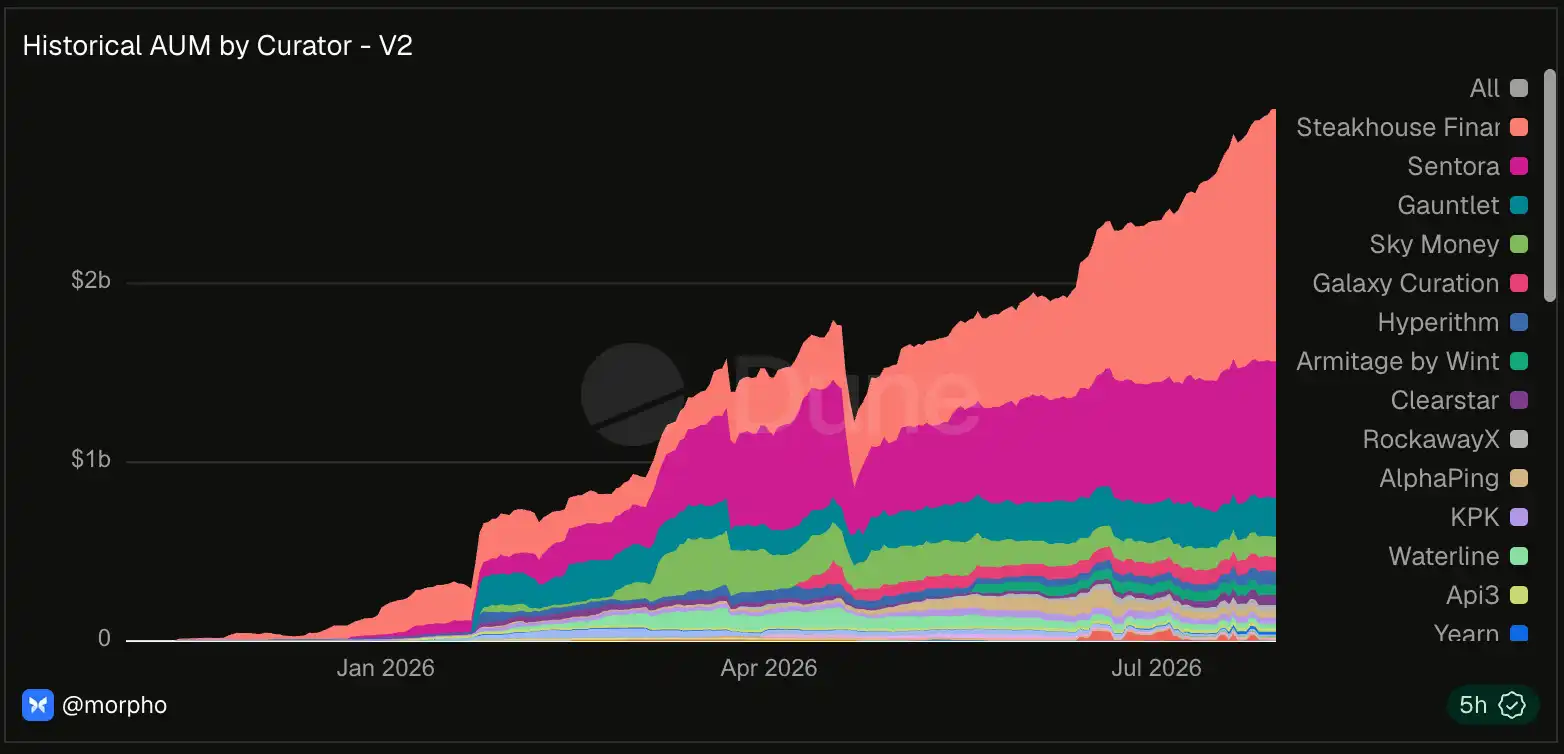
Chart: Historical AUM trend of Vault managers on Morpho V2, showing significant growth over the past year. Source: Castle Labs (Data: Morpho)
One reason for this is that Vault management is, in essence, similar to that of fund managers in traditional finance. As institutions pay increasing attention to on-chain finance and how to use their RWAs, Vault management serves as an ideal vehicle.
However, Vault managers have been operating in an environment with unclear regulations — until now. This is the typical development path for any new thing in the crypto space, especially in asset management: the new thing emerges, grows large enough to catch regulators' attention, and eventually must comply with the law.
This recently happened. Hester Peirce warned that some crypto Vault strategies could trigger regulatory issues typically aimed at portfolio managers or investment advisors, depending on how yield activities are chosen and assets are reallocated.
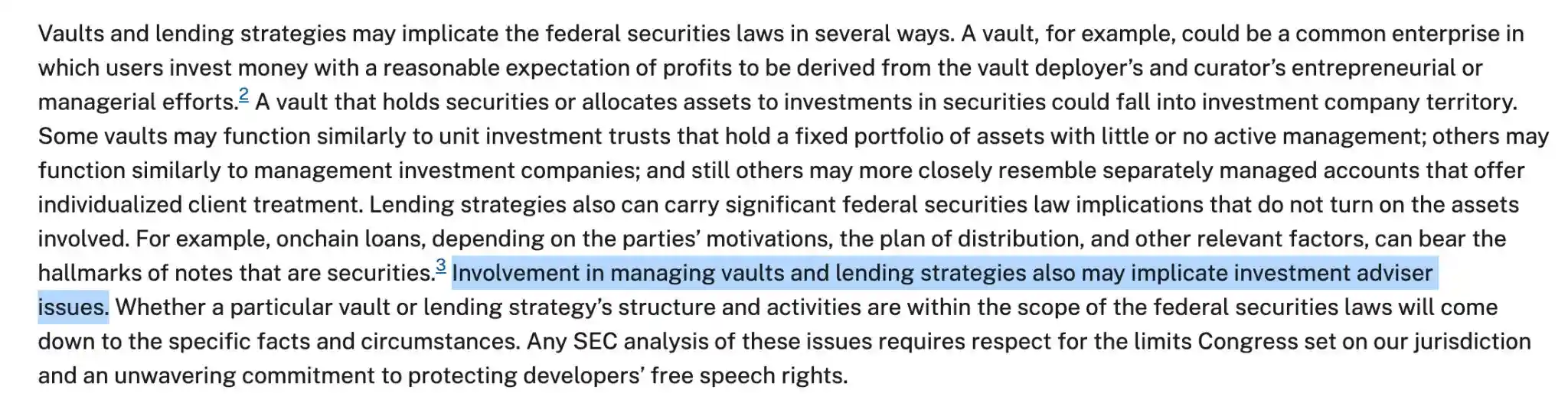
Chart: U.S. SEC Commissioner Hester Peirce warns that some crypto Vault strategies may trigger investment advisor regulations. Source: SEC
Views among industry participants vary:
Togbe, former ACI member, believes some managers' policies and reallocation bots are still too opaque, especially when users cannot easily understand who is making decisions and when.
Steakhouse's adcv argues that Vaults do not unilaterally set yields; their mechanism is not simply "manager chooses yield, user follows."
KPK emphasizes their transparency on this issue, publishing target weights for each market and detailing underlying infrastructure (though not revealing everything).
Tesseract agrees with the SEC. Their stance is that Vaults are not a single thing: "On one end are fixed rules run by immutable code. On the other end are humans choosing strategies, moving capital, and setting risk. The more discretion a manager exercises, the more a Vault resembles portfolio management."
Matthew Graham from TokenLogic holds a similar view: If a manager selects configurations and manages risk on behalf of users, it's hard to avoid comparisons with investment management.
Regardless of which view you agree with, the arrival of regulation is positive, meaning Vault managers will increasingly be positioned as alternatives to traditional investment vehicles.
Regulation can improve transparency for Vault managers, who are sometimes criticized for being too opaque.
Managers can do a better job explaining and documenting:
- Their allocation policies, and who has the authority to change them
- What happens under certain stress conditions
- Who is ultimately responsible for the Vault's configuration
- What underlying off-chain infrastructure is run
- Where off-chain dependencies and permissions lie
On the other hand, the barrier to obtaining a license may be too heavy for small managers, potentially stifling grassroots Vault management.
However, we can expect more regulated traditional finance managers to operate compliant Vault positions on-chain.
Nevertheless, it is still too early to declare what regulatory actions the SEC will take on this matter.
We've seen the Morpho team and other representatives from the Vault space meet with the SEC following the release of this memo.
We expect the SEC to issue more specific documents in the coming months.
Robinhood Chain in Data
Robinhood Chain launched earlier this month and has already captured significant crypto mindshare.
The initial positioning was around tokenized stocks, but over this month they've increasingly leaned into memecoins, with Vlad repeatedly posting about them, several launchpads vying for attention, and a surprisingly methodical approach of pairing memecoins with stock tokens inside an AMM.
This means users wanting to trade memes actually start with ETH or USD, go through tokenized stocks, and end up in memecoin trades.
The chain has seen impressive growth and stability, with Entropy data showing over $800 million in on-chain assets and a stablecoin market cap nearing $500 million. In terms of TVL, Morpho accounts for about $259.9 million, Ethena another $184.7 million, followed by Maple, Uniswap, and Spark.
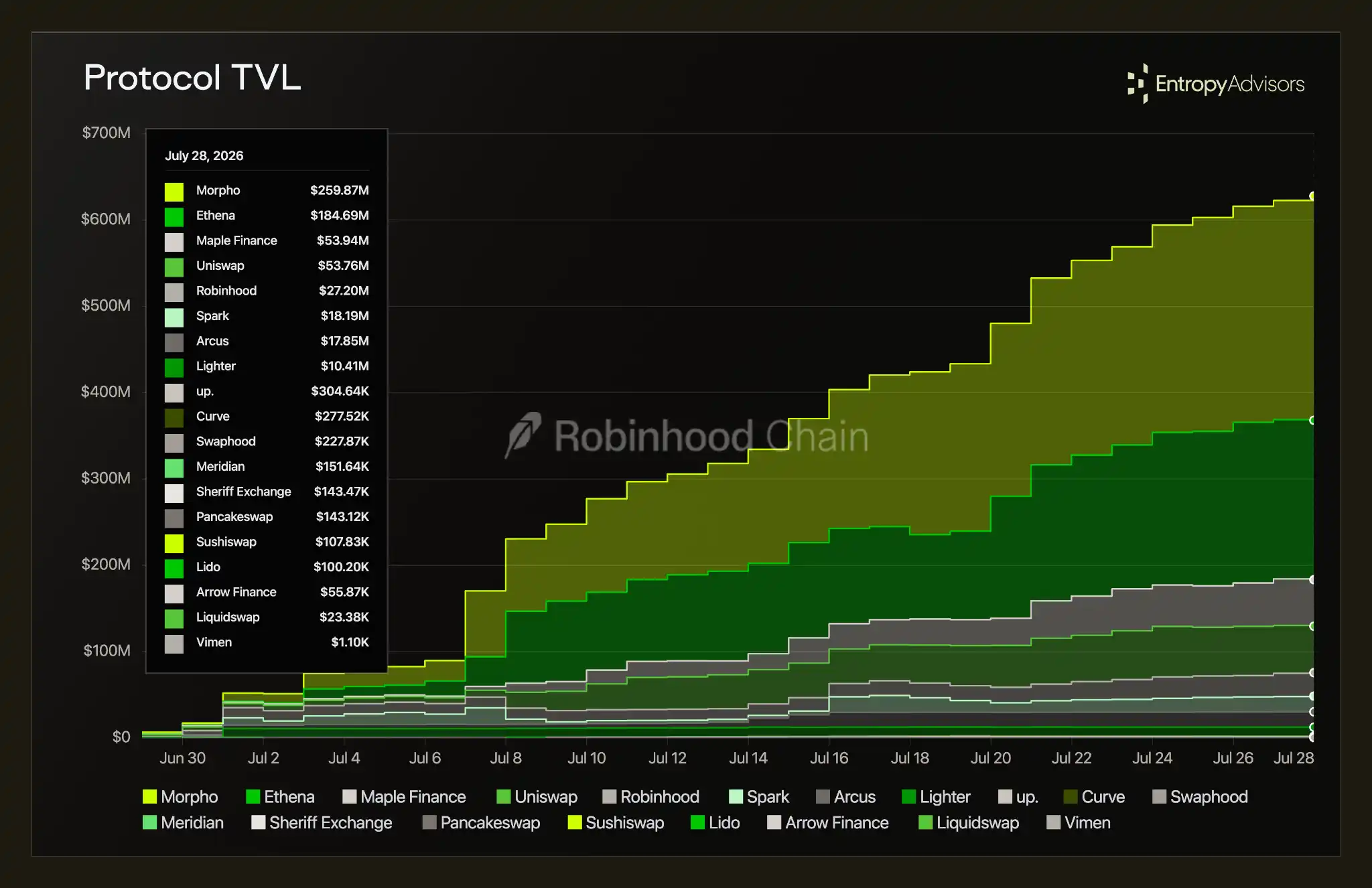
Chart: Robinhood Chain on-chain assets exceed $800 million, stablecoin market cap near $500 million, with Morpho, Ethena leading TVL. Source: Entropy
Daily fee revenue runs between approximately $150k and $350k, with a gross profit margin around 88-89%. The 7-day annualized revenue line is near $66 million, leading the 30-day line of about $41 million, indicating activity is still accelerating, not retreating.
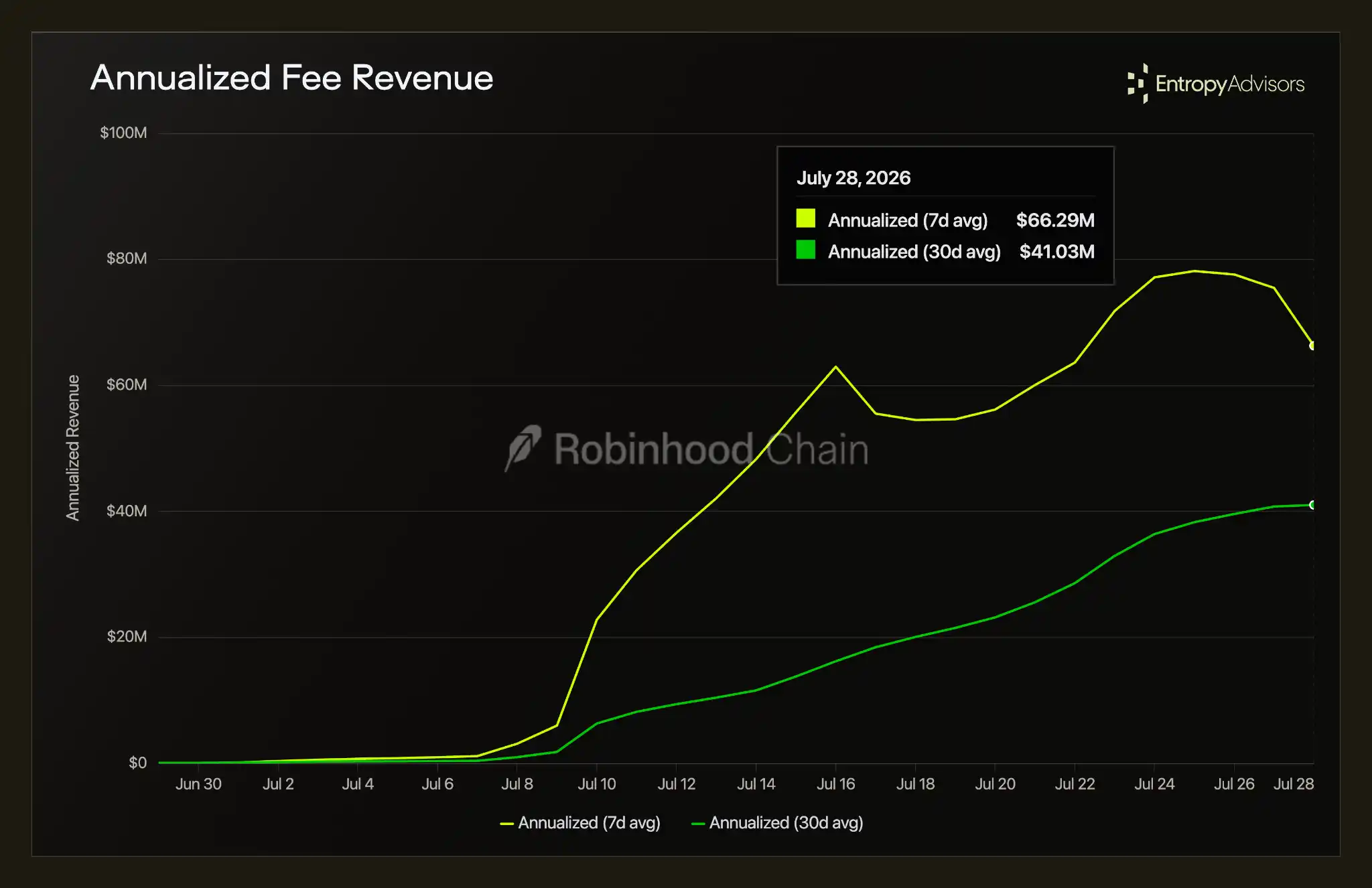
Chart: Robinhood Chain daily fee revenue ~$150k–$350k, 7-day annualized revenue line approaching $66 million. Source: Castle Labs
As mentioned, memecoins dominate daily activity on-chain, with memecoin pairs accounting for 65.9% of spot DEX volume, while ETH-USD is 24.1% and Robinhood stock tokens are only 8.2%. This has happened so fast that the Robinhood launchpad now surpasses pumpfun and pumpswap (pumpfun's DEX) in trading volume.
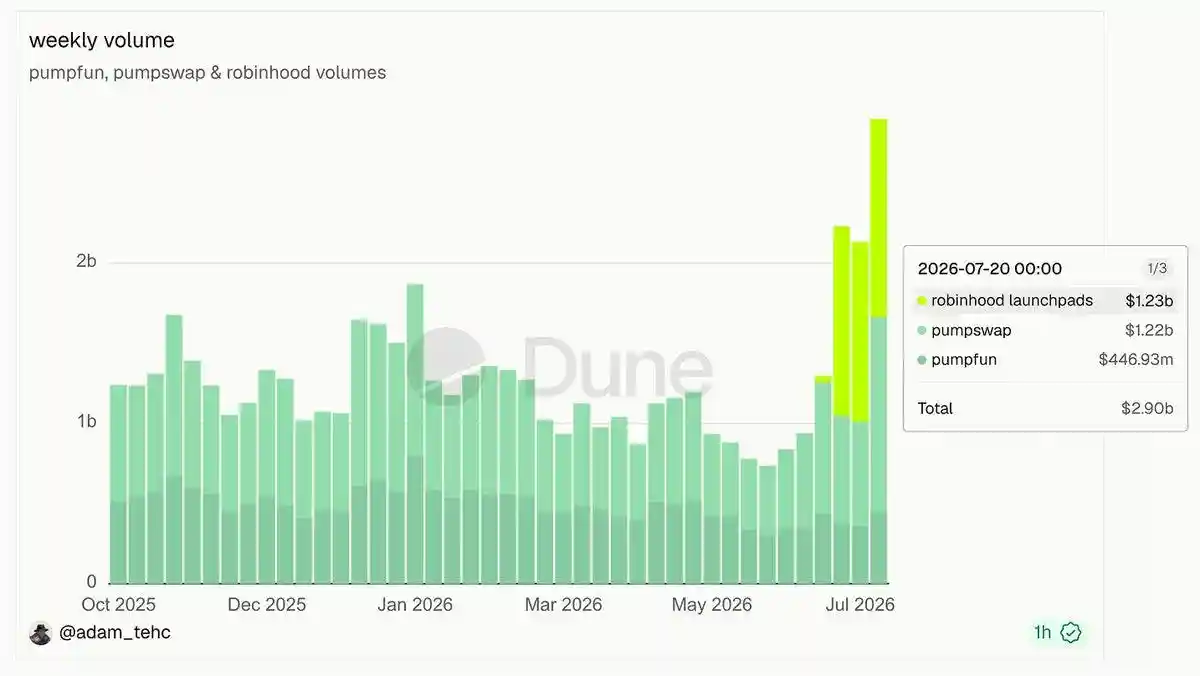
Chart: Memecoin pairs account for 65.9% of Robinhood Chain spot DEX volume, far exceeding stock tokens. Source: Castle Labs
Among these Robinhood launchpads, pons now accounts for about 75% of total on-chain launchpad token volume, with over $2 million in total revenue to date.
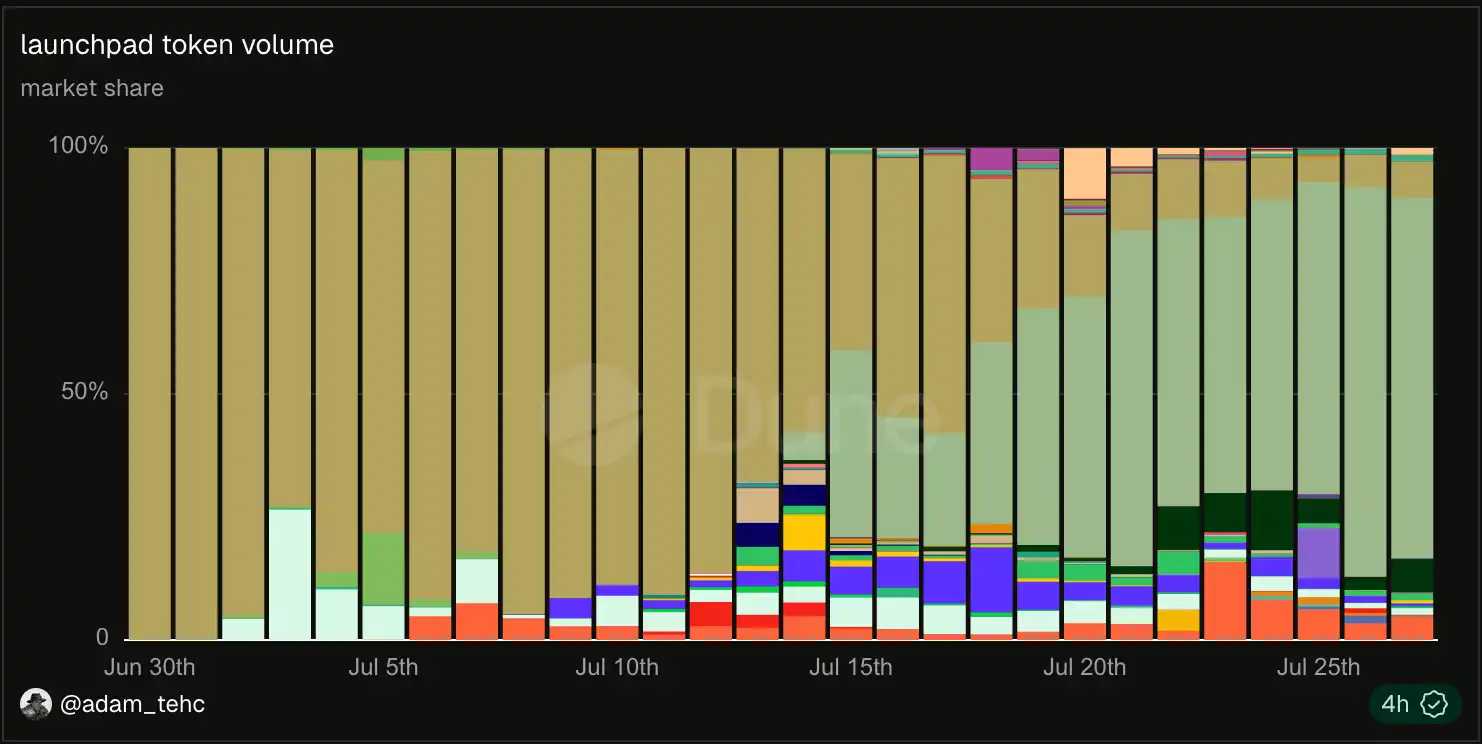
Chart: Launchpad pons accounts for ~75% of Robinhood Chain on-chain launchpad token total trading volume. Source: Castle Labs
The stock side is also growing, with total tokenized value surpassing $25 million yesterday, and rwa.xyz reporting nearly 330k RWA holders across 97 assets.
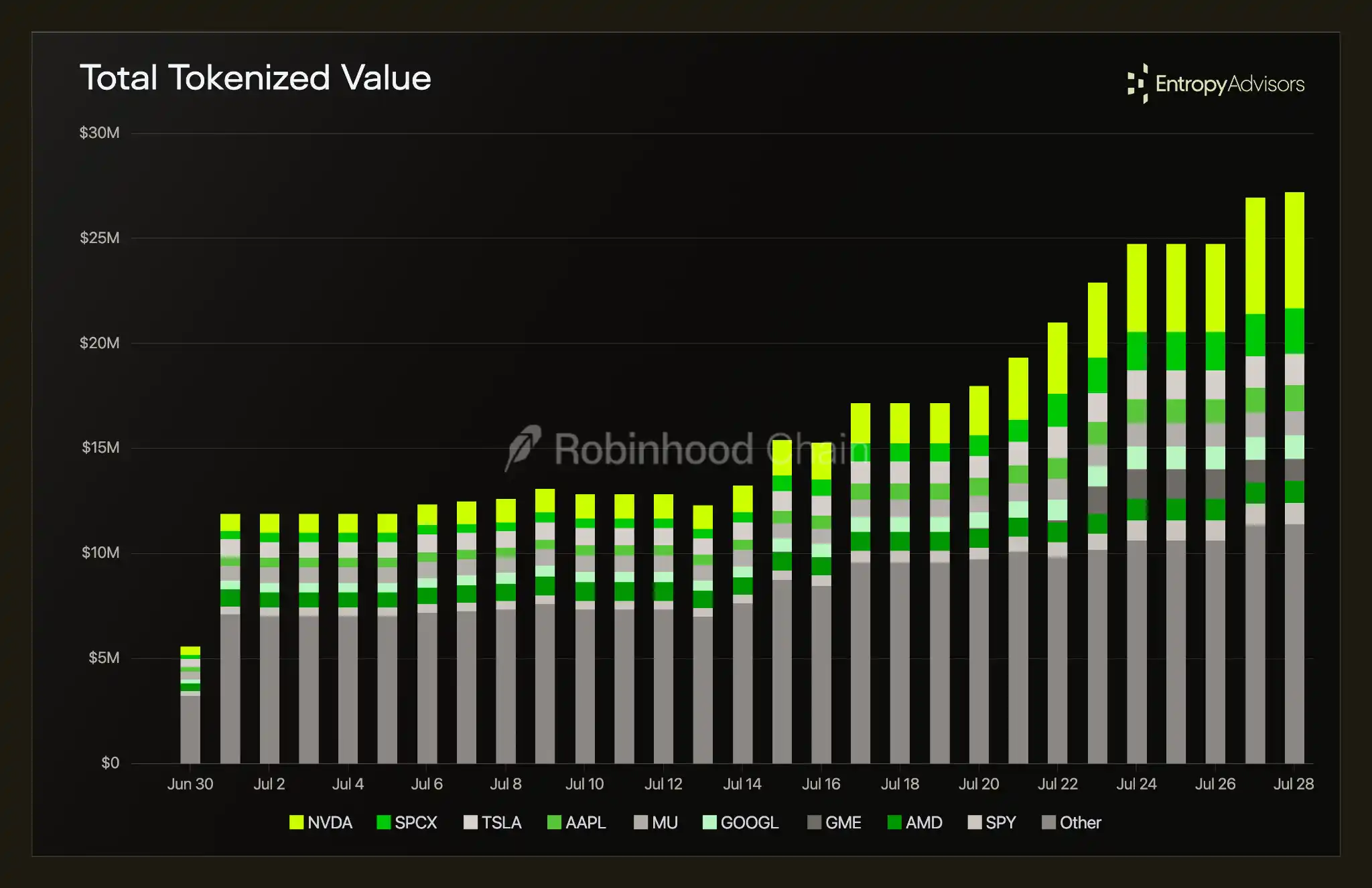
Chart: Robinhood Chain tokenized stock total value breaks $25 million, nearly 330k RWA holders. Source: rwa.xyz
Overall, Robinhood is experiencing strong early growth and can be seen as a consumer trading venue rather than a pure RWA project.
While stock tokens and their underlying representation give the chain legitimacy, it is currently memecoins and launchpads giving it user velocity. By pairing memecoins with stock tokens inside an AMM, they've cleverly found a way to embed a role for stock tokens within the high-volume memecoin trading category.
But can Robinhood Chain retain these memecoin trades and launchpad volumes and gain meaningful share from chains like Solana? Will the tokenized stock deployment continue growing beyond the first wave of stock tickers? To what extent will Robinhood integrate the chain and its assets into the main mobile trading app?
Are NFTs Back?
You run into someone on the street, and the guy says, "NFTs aren't dead!!!"
You give him a pitying look, toss him $5, and head home.
Then you open X and find a new NFT gacha protocol on Ethereum mainnet.
TokenWorks launched Fake World Assets, a protocol whose core resembles some gacha mechanics:

Chart: Fake World Assets (FWA) gacha mechanism – users deposit NFTs, pay, and randomly win. Source: TokenWorks
- NFT owners deposit NFTs into pools, backed by corresponding ETH
- Buyers pay a price specific to each NFT pool, with a random chance to win that NFT on each attempt
Users who win an NFT can choose how to receive payment. Here's some interesting data on outcomes, partially skewed because the FWA token is in an extreme and early stage this week, explaining why users choose FWA payment in most cases.
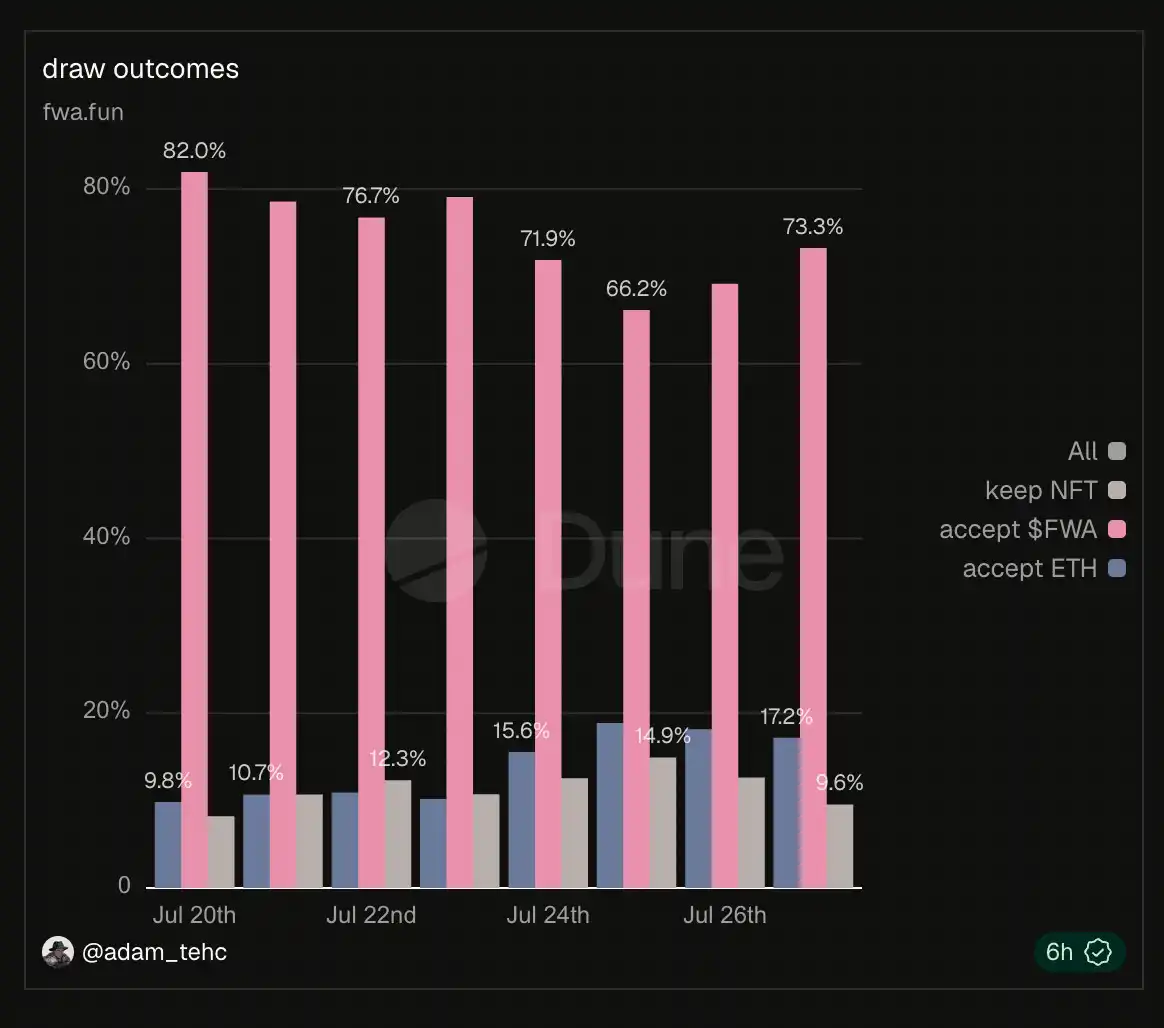
Chart: Distribution of FWA user payment choices, biased towards FWA payment in early stage. Source: Castle Labs
In just 7 days, the protocol now accounts for 10% of Ethereum mainnet gas consumption. These stats give a better sense of activity:
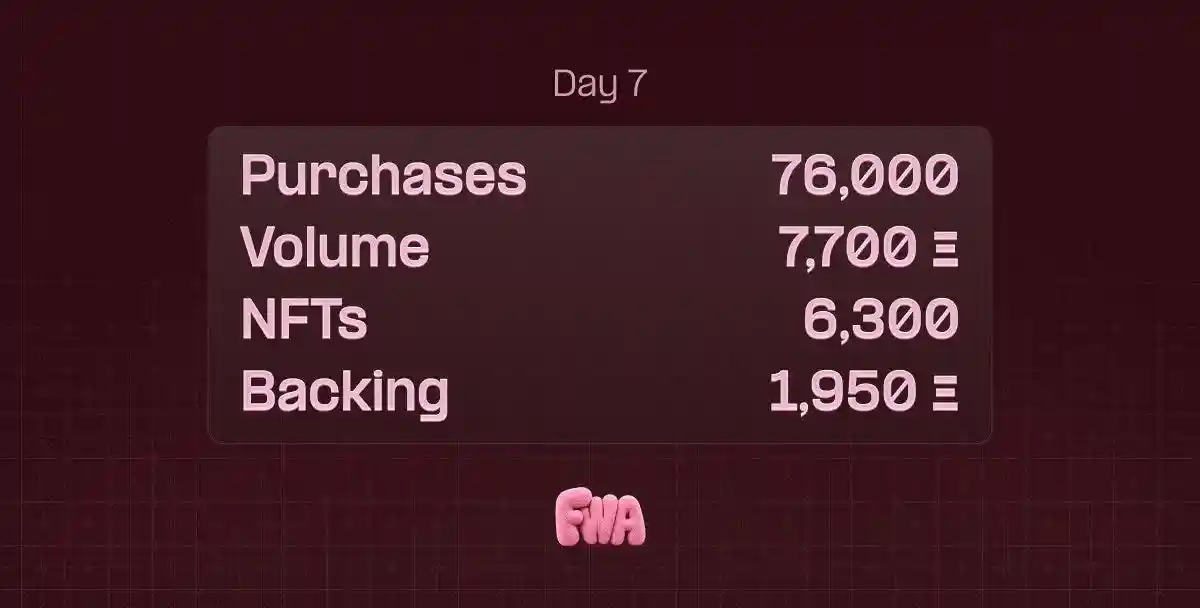
Chart: The FWA protocol alone accounts for 10% of Ethereum mainnet gas consumption. Source: Castle Labs
It's too early to tell if this is a short-term burst or a sustainable dynamic.
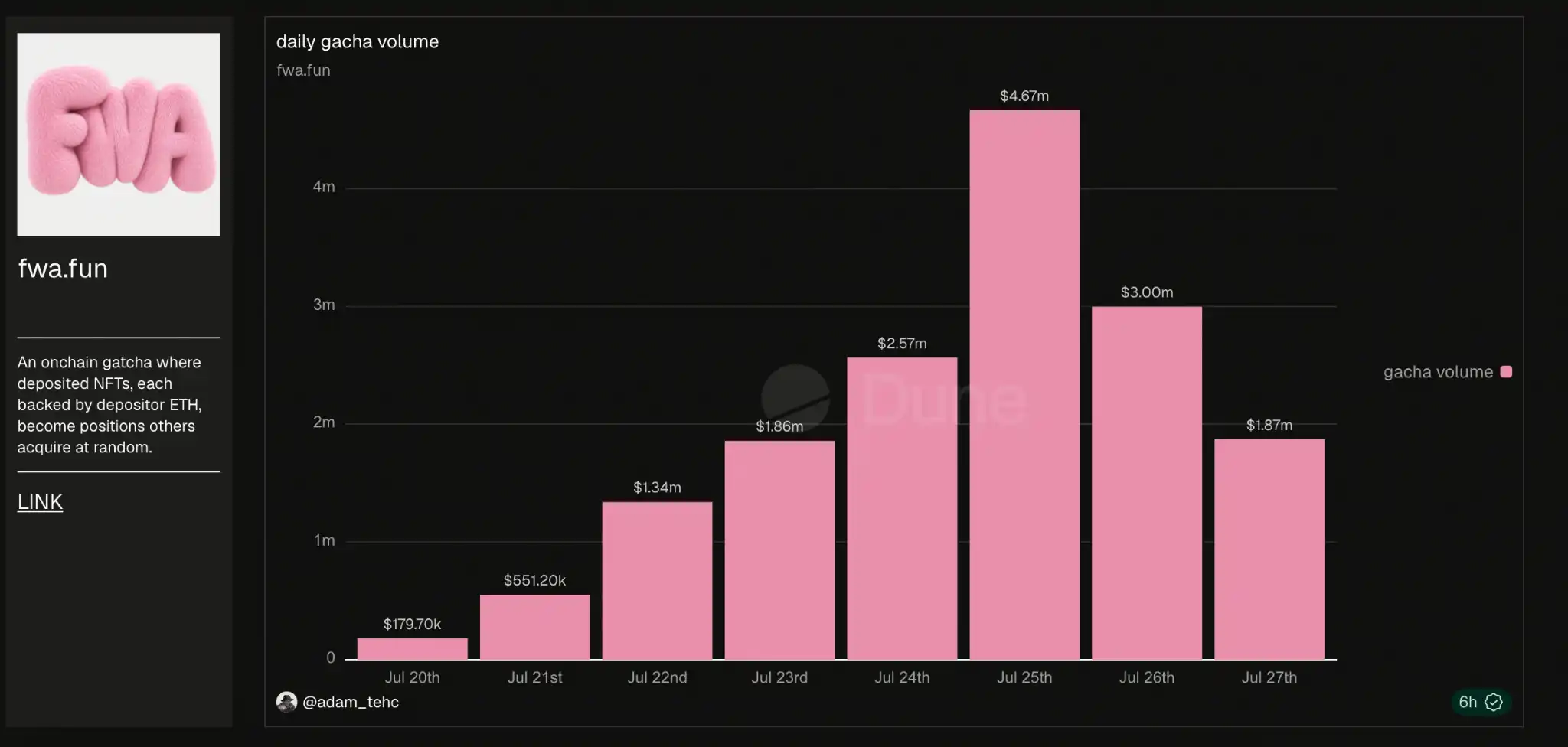
Chart: Overview of FWA protocol activity data over 7 days since launch. Source: Castle Labs
The daily participant trend remains healthy, showing less inflation than volume, meaning fewer hardcore users doing many spins and more casual users doing fewer spins.
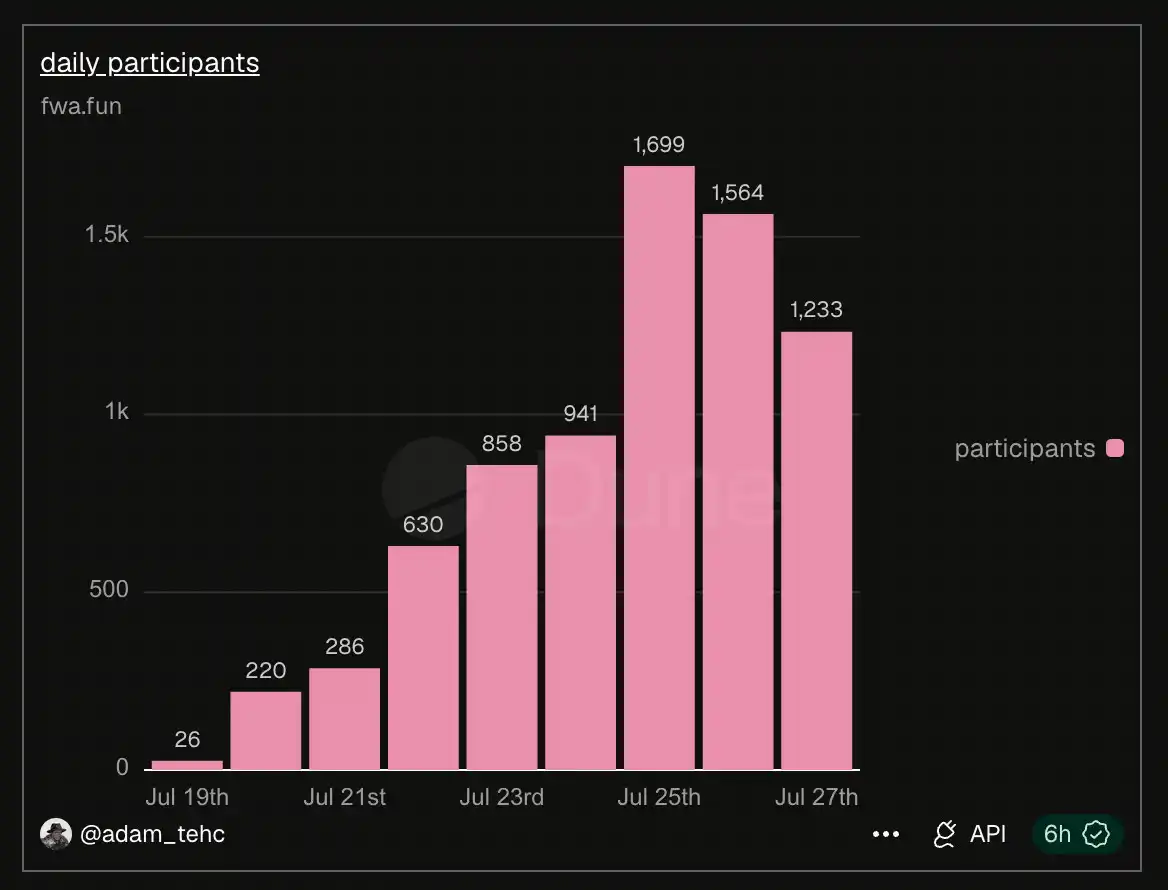
Chart: FWA daily participant trend robust, casual user proportion rising. Source: Castle Labs
While gambling isn't necessarily the only hope for doing new things now, in this case, it shows how a simple consumer-facing protocol can revitalize and attract interest through gacha dynamics.
More builders should take this as an inspiring example and an opportunity to build something people use.
Not another L1, L2, or even a prediction market app.
Just this week, two established CEX representatives shut down: BitMEX, one of the OG CEXs, and BitMart.
What does this indicate? First, the CEX business is exceptionally competitive, dominated by a few incumbents. Depending on the geographic region, this is often a duopoly or complete monopoly.
Furthermore, regulation (e.g., MiCa in Europe) and competition from on-chain trading venues like Hyperliquid, Lighter, Variational, are causing user and volume attrition across the board.
The DEX/CEX spot trading volume ratio reached 24.3% in July, a new all-time high, up from 17.9% in June and mostly 18% to 21% for much of 2026.
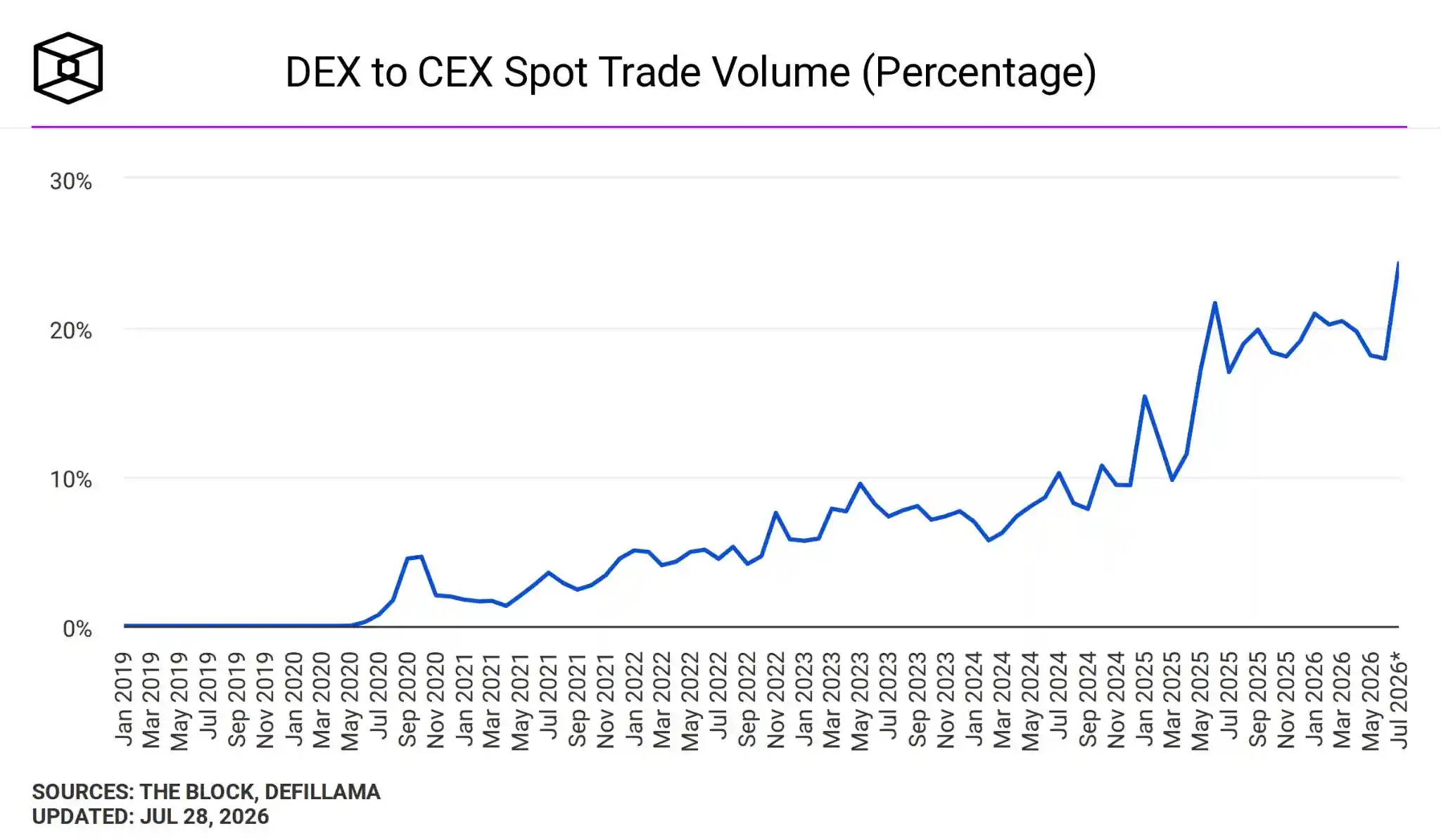
Chart: DEX/CEX spot trading volume ratio reached 24.3% in July, a new all-time high. Source: The Block
Exchange power is consolidating at the top, while the next tier of growth or innovation is shifting on-chain. DEXs may eventually follow the same path, with spot dominated by Robinhood/Uniswap, perpetuals by Hyperliquid, and a few app-layer distributors deciding where flows go.
In the next cycle, we can expect fewer CEXs with consolidation, and more flows controlled by trading venues and frontends that have distribution rights.
However, an important note about recent shutdowns is that they've all proceeded in an orderly manner without affecting user funds, indicating the industry is maturing and perhaps healing.
Mantle's Third Anniversary and Q2 Review
Mantle celebrated its third anniversary last week.

Chart: Mantle celebrates third anniversary, positioning as a full-stack distribution layer for tokenized RWAs. Source: Nansen
The network started as a DAO aimed at supporting open finance growth and developing a decentralized tokenized economy; recent focus has been on DeFi, yield products, and institutional-facing RWA infrastructure.
Nansen recently defined Mantle's Q2 theme as a full-stack distribution layer for tokenized real-world assets. By quarter-end, it had 155 tokenized stocks, over $1 billion in DeFi TVL, and a $955 million stablecoin market cap.
Real-time data from RWA.xyz now shows about $120 million in tokenized active strategies on Mantle. We emphasize active strategies because they more clearly reflect capital actually put to work through managers, products, and platforms, rather than passive tokenized exposures sitting on-chain.
The application layer is also developing in this direction, particularly trading infrastructure built around RWAs:
- Fluxion is Mantle-native RWA-linked asset spot liquidity, employing AMM pools and concentrated liquidity designed around xStock/USDC markets and other asset-backed trading pairs.
- xChange is an atomic RFQ router for xStocks, providing issuer direct quotes for minting and redeeming xStocks for onboarded participants, with both parties settling in a single on-chain transaction or not at all.
It's becoming increasingly clear that Mantle not only aims to host tokenized assets on its chain but is also building the required liquidity and execution stack around those assets, as highlighted by Nansen: a full-stack distribution layer for tokenized real-world assets.