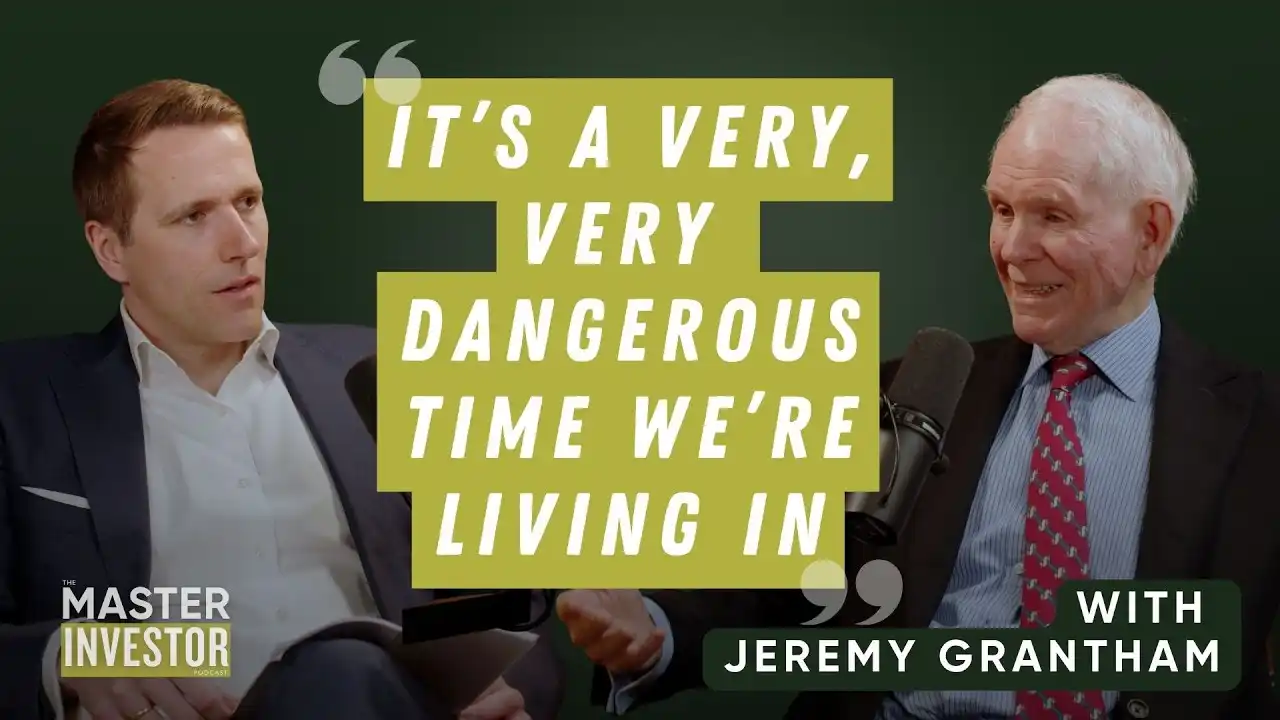
Source:"The Master Investor Podcast with Wilfred Frost" Podcast
Compiled by: Felix, PANews
Jeremy Grantham founded and led the Boston investment firm Grantham Mayo Van Otterloo (GMO) for decades. At the peak of his career, the assets under management reached $150 billion. In his nearly 60-year investment career, Jeremy accurately predicted almost all major stock market bubbles of the past 60 years, along with the subsequent rebounds, achieving long-term excess returns.
Recently, Jeremy was a guest on the "The Master Investor Podcast with Wilfred Frost" podcast. He focused on the current market environment, assessed the impact of the Iran war on oil prices, AI, meme stocks, and the "Magnificent Seven," and compared it to the boom periods of the 1970s, 1999, 2007, and the post-pandemic era. PANews has compiled the highlights of this conversation.
Host: Jeremy, welcome back to the podcast, great to see you in person.
Jeremy: Pleasure to be here. However, I must object to the word "prediction" you mentioned earlier. I am not predicting bubbles; I am merely pointing them out when they arrive. If I could foresee their arrival out of thin air, that would be convenient, but all I can do is wait for them to appear—and they always seem obvious. Then I say, "Look, it's there."
Host: Your book published this January, "The Making of a Permabear," mentions that you are also a Yorkshireman. Every qualified Yorkshireman is born knowing that "cheap is always better than expensive," which gave you a keen eye for finding good value. You also talked about your "butterfly effect" thinking pattern, where ideas and thoughts flit around like butterflies in a garden, seemingly lacking focus. Can you explain why this was important for you to become an investment thinker?
Jeremy: This might be a form of self-justification. I find it hard to stay on one specific topic for too long; I always tend to shift to another, which often annoys my colleagues. But the key is that I am quite persistent. Anyone who has observed gardening will see that this is exactly how butterflies work: you think they've flown away, but they might return to the same flower repeatedly over a day or two. I find brainstorming should work the same way. If you fixate too hard on one topic, you just make your brain rigid, like banging your head against a wall. The best method is to move around and then return to the original topic; then your brain is more open, and perhaps an epiphany will occur.
Host: You also wrote that working very hard can actually hinder thinking because you are too busy receiving new data. You rarely have time to truly think. Do today's investment professionals spend too much time on Excel spreadsheets or AI modeling? What do you mean by "truly thinking"?
Jeremy: Truly thinking is not about typing numbers into a spreadsheet. Truly thinking is taking a walk through Boston Common, or while showering, letting your brain operate at a comfortable walking pace, thinking about where we are now? What's happening? See what it concludes. In the past, when I arrived at the office, I usually already had two or three ideas (though most of my colleagues thought these ideas were stupid). I was lucky to have a colleague named Chris Darnell, the only person in the world who could convince me in 20 seconds that an idea was foolish. You really need such a combination: someone who generates a lot of absurd or superficial ideas, plus an "idea crusher" who can instantly spot fatal flaws and keep you moving forward. We would review 10 to 20 ideas to find one worth further research.
Host: On this point, you said in your book: "Getting the big picture right is everything. One or two good ideas a year is enough." Is this what gave you your legendary investment status?
Jeremy: Yes, there were many years when I didn't even have one good idea. But if your thinking is high-level enough, like "Will small-cap stocks win this year?", you don't need to be right too many times. Just knowing that small-cap stocks are strengthening is enough to support outperforming the market for three or four years. As long as you get the big direction right, it's actually not difficult.
Host: From a micro perspective, if I'm not mistaken, the real winning formula for you is basically the dividend discount model, plus some adjustments you make. This is the core of your focus, right?
Jeremy: Yes, the dividend discount model is just a tool we use to measure the quality of other ideas. It gives the ratio of relative fair value for different stocks, used to test if our intuition is correct. We have a dividend discount ratio for each stock. What is the ratio to fair value? If it's 0.79, it's undervalued by 21%. If it's 1.12, it's overvalued by 12%. Then we add them up and find that the sum of all small-cap stocks is very cheap, and vice versa. It provides us with a measuring tool to test if our intuition is correct. Very convenient.
Host: Here you obviously weigh value more heavily than other factors like growth and momentum. I imagine you also appreciate the importance of those other factors.
Jeremy: No, actually I have a secret respect for anything that works, no matter how absurd. Of course, momentum is a fairly simple inefficiency. It really shouldn't work. But it has been very effective throughout my entire investment career, and for a long time before that. And it still works in many forms today. It just shows that an object in motion tends to stay in motion for a while. Market efficiency scholars like the author of "A Random Walk Down Wall Street" said that price alone provides no information. That is completely wrong. I think the biggest inefficiency has always been the pricing of "quality". High quality means less debt, higher returns, stronger stability, and a smaller chance of bankruptcy. No matter how you torture the data, you cannot convince anyone that "quality" is a risk factor.
From an academic perspective, lower risk should mean lower returns; but in fact, quality stocks always outperform the market. Due to lower risk, they should underperform by about one percentage point per year, right? AAA-rated bonds yield about one percentage point less per year than B-rated bonds. Based on the same low-risk logic, AAA-rated stocks should too. But they don't; they outperform the market by about 0.5% per year. Therefore, due to market inefficiency, there is about 1.5% of free excess return per year. You get the privilege return of holding these high-quality large-cap stocks, and academia hasn't discovered and made a big deal about this for decades.
Host: Has the market become more efficient over time? Has your job become harder?
Jeremy: As my career has progressed, I tend to focus on increasingly grand problems, from individual stocks to sectors to the entire market. To talk about those absurd inefficiencies and bubbles, like those meme stocks that soar 6 times in a year, the market might be a bit worse now than ever before.
Host: Regarding your investment method, you once mentioned: "We could never make big money without first suffering painful losses. You need the confidence to hold positions when they go against you and to add weight when they become more attractive. It is value that gives you this confidence." This must be very difficult.
Jeremy: It is indeed very difficult; you must believe in the data. If you want to capture those once-in-a-century super bubbles, you often have to go through an ordinary bubble that appears every 15 years first. If you want to make big money, you must watch the market go from "overpriced" to "extremely overpriced" to "oh my god, ridiculously overpriced." Only at that turning point can you make big money. But before that, you will endure immense pain. For example, in 2000, the market fell 50%, but our portfolio achieved substantial gains over three years.
Host: Many people say it's impossible to time the market. I think that's true at the individual stock level, but I admire the bold positions you take.
Jeremy: No, I don't think this is timing the market. I think this is just exiting obviously overpriced stocks and always focusing on those that are cheap. Every time you buy a small-cap stock, someone might say, "Oh, you're timing that stock. Is that it? Or is it that if you hold cheaper stocks, you will always win in the long run?" So, don't hold your ground in a severely overpriced stock market unless you eventually want to take a heavy punch. Of course, others will outperform you during this period, but in the long run, you will win.
Host: In the first 9 years after founding GMO, you achieved an excess return of 8% per year, which is amazing performance.
Jeremy: Compared to Buffett achieving 9% excess returns over a longer period, our results only make one realize how incredible Buffett is. Buffett made making money a simple and fun goal. And Jack Bogle (father of index funds) got the medal for "doing the most useful thing in investing" for saving tens of billions of dollars for millions of investors.
Host: Compare the historical bubbles. In 1999, clients complained to you about underperformance. At that time, you said "value is off the charts, TIPS yields are 4%, real estate investment trusts (REITs) are trading at a discount." Can you apply all this to today?
Jeremy: No. The 2000 one was great because it gave you many safe havens. Real estate investment trusts (REITs) were selling for even less than construction costs. Right at the market peak, the S&P 500's yield dropped to 1.6%, a low level not even seen in 1929. That was the situation then. Small-cap stocks were cheap then.
Then you look at other markets, like the 2007 real estate bubble, there was almost nowhere to hide. That was a risk bubble. All risky assets were overpriced. In 2008, there were no obviously cheap assets. The current market is somewhere in between; it's more like 2000. Half the time during bubbles you have excellent alternatives, the other half you don't. For this time, I remember saying on a podcast early last year that we have no bias against non-US stocks. We won't touch the US stock market, but the rest of the world: emerging markets, Europe, Australia, Canada, their stock market valuations are extremely reasonable.
Host: In 1999, many people talked about the productivity and GDP boost from the internet, just like everyone talks about AI today. Why is this bullish logic foolish?
Jeremy: There is no necessary relationship between high market prices in the past and future growth. In every bull market, people say the future must be bright, otherwise market prices wouldn't be so high, but the opposite is true. If you ask what the three or four worst periods in history were, they are not randomly distributed; they came right after huge bubbles. The Great Depression came right after the famous 1929 peak. Japan's "Lost Decade," "Lost Two Decades" came right after the astonishing 65 P/E ratio in 1989. There is no historical example where a high P/E ratio meant higher profits, faster growth, or higher productivity. What they truly预示 (portend) is the arrival of difficult times. If there ever was a possibility of this happening, it is now.
The current situation is that we are doing everything wrong. We are doing our utmost to mess up the beautiful growth of post-war international trade with tariffs and trade wars. We are doing our utmost to破坏 (undermine) geopolitical stability,破坏 (undermine) our relations with countries like Russia and China. I'm sure these relations have been worse at some times and with one side, but getting worse with both sides simultaneously is distinctly unsettling. Billion-dollar losses from floods, droughts, and fires are so frequent that they might shave 0.5% off global GDP annually, and the situation keeps worsening; then population begins to decline, in some countries like Japan, South Korea, China, the population is falling like a stone, and this trend will remain visible. So, the world will have to get used to slowing labor force growth.
Host: With the outbreak of the Iran conflict and its obvious impact on oil prices and inflation, does it remind you of some challenges from the 1970s?
Jeremy: Yes, as a species, humans have a tendency to wishful thinking. We are very good at wishful thinking. If you study the stock market now and in the past, you will conclude that given half a chance, we will interpret the future generously and say how good things will be. If economic data is bad, we say "Great, this gives the Fed an excuse to cut rates," and the market rises. If economic growth is good, we say "Great, profits will be high," and the market rises again. So the market is always looking for optimistic excuses and overinterprets good news.
We tend to extrapolate linearly and persistently. For example, in the summer of 1929, the economic situation was good; if you extrapolated persistently, people would expect an outrageously high P/E ratio. Then in 2000, profit margins reached historical highs, the P/E ratio was 35, and stock prices even rose to four times book value. These phenomena are not complicated, but most people failed to notice them. Why didn't these warnings make front-page news? Because it's not a business strategy. Any large company in the financial领域 (sector) must always tell you everything is fine, then lead everyone off the cliff and make as much money as possible cleaning up the mess. Goldman Sachs, JPMorgan Chase, Morgan Stanley—these companies would never tell you to get out of the market because market pricing is terrifyingly high. And they can all see that the pricing is terrifyingly high. So don't think the market is priced reasonably just because no professionals are telling you to sell; that is not the actual situation.
I often use an analogy: it's like dropping a bag of feathers from a high-rise in Miami on a hurricane day. In the short term, you absolutely don't know where those feathers will be blown. But you can be absolutely sure of one thing: eventually every single feather will fall to the ground. For me, "value" is equivalent to gravity. No matter how high you fly now, sooner or later, being expensive will make you pay the price.
Host: You wrote in your book about the strangest condition for a bubble burst: "When the previous market leaders fall sharply, but the broader market led by blue chips continues to rise." This happened in 1929, 1972, and 2000. Considering the MAG 7 (Magnificent Seven tech giants) have lost upward momentum in the past few months, but the rest of the market remains firm, would you add late 2025, early 2026 to that list?
Jeremy: Perhaps I should add it. Although I haven't added it before, I think I've been busy with the book tour. But I would also add 2021 to that list. Many speculative and unprofitable stocks started falling after their strong performance post the COVID-19 low, while the broader market kept rising, leading to a 25% drop in the S&P 500 in 2022 and a 40% drop in MAG 7 stocks. But then ChatGPT appeared. Without the AI investment frenzy, we might have already fallen into a mild or moderate recession, and the broader market might have fallen 40% or more. AI was like discovering railroads in 1930, forcibly扼杀 (strangling) a real bear market.
Host: In March 2009, you published the famous "Reinvesting in Fear." How did you judge when to enter the market when there was extreme panic?
Jeremy: That's because I was familiar with the panic of 1974, the fear that put the market in "ultimate paralysis." In 2009, I advocated making a plan, even a bad plan is better than paralysis. You must understand: the market's turning point does not appear when people see "light at the end of the tunnel," but when "everything looks pitch black, but just a tiny bit less black than the day before." Although it didn't reach the absolute low valuation of 1974, according to our dividend discount model, it was very cheap, destined to provide丰厚 (rich) returns far exceeding historical averages over the next 7 years (actual return reached 12%).
Related reading:Dialogue with Bitwise Advisor: From K-Shaped Economy to AI Stealing Jobs, How Can Bitcoin Save Young People?