SPCX to Surge to $400? Can Options Propel SpaceX to Become the World's Most Valuable Company?

marsbitPublicado a 2026-06-16Actualizado a 2026-06-16

Resumen

Summary: ZeroHedge posits that SPCX (SpaceX) options trading could trigger a gamma squeeze, potentially driving the share price to an extreme $400. This scenario is based on SPCX's unique post-IPO market structure: a low float, concentrated retail buying, and the imminent introduction of options. While the $400 price is speculative, the analysis highlights the potential for outsized volatility. The core mechanism involves heavy retail buying of out-of-the-money call options, forcing market makers to hedge by purchasing the stock, creating a potential feedback loop that accelerates price gains. Vanda data shows intense retail focus on SPCX specifically, not a broad market risk-on shift. Crucially, this potential volatility stems from short-term trading dynamics and structural factors, distinct from fundamental valuation drivers like those seen in NVDA. Whether the extreme $400 scenario materializes depends on actual options market data post-launch, including open interest in call options, implied volatility, and continued buying support in the underlying stock. The article cautions that while the conditions for heightened volatility are present, the predicted gamma squeeze is not guaranteed.

TL;DR

· ZeroHedge believes that the opening of SPCX options could trigger a gamma squeeze, potentially pushing the stock price to $400 in an extreme scenario.

· Currently, only a volatility channel has been confirmed; $400 should not be considered a market consensus.

· Related tickers: SPCX, NVDA, MSFT, AAPL, SQQQ, SOXS.

ZeroHedge posted on social media suggesting that the opening of SPCX options could trigger a gamma squeeze, potentially driving SpaceX's stock price to $400. It is an influential and aggressive financial media outlet and trading account in the U.S. stock market, known for long-term expertise in discussing macro liquidity, positioning structures, and extreme trading scenarios together. This time, it has directly linked the listing of SPCX options, gamma squeeze, and a $400 stock price.

SPCX surged over 25% on its first trading day, with a valuation exceeding $2 trillion. Overnight and after-hours quotes briefly approached $230, but this is not the official closing price and cannot directly indicate long-term capital's willingness to accept this valuation. For the average reader, the more important point is not how many shares were issued in the IPO, but rather the limited supply of tradeable shares in the early stages of listing, highly concentrated retail buying interest, and the imminent opening of options trading.

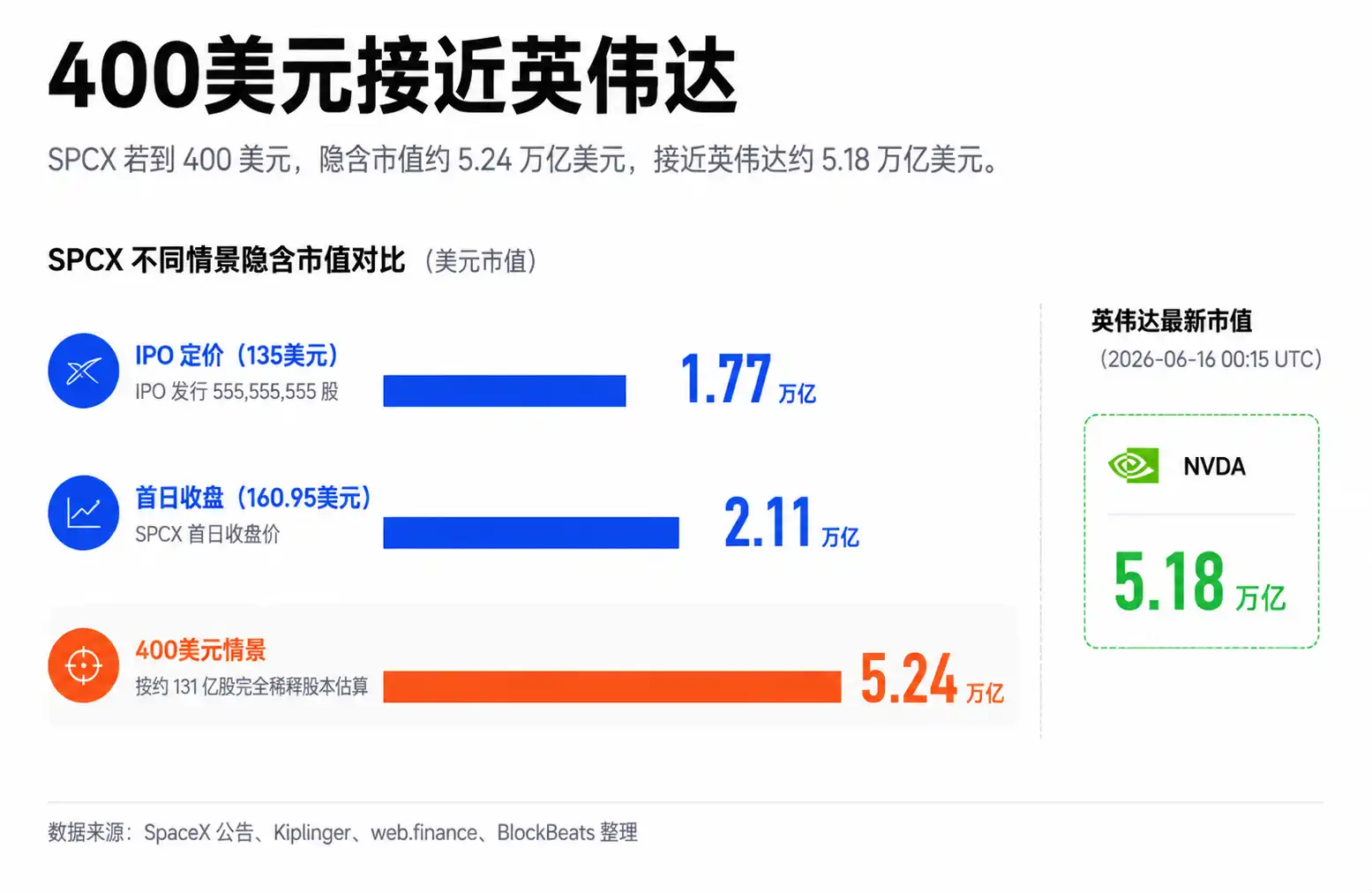
This is where the $400 claim becomes truly worth discussing: the number itself is exaggerated, but it points to a market structure that warrants caution. ZeroHedge believes that the combination of SPCX's low free float, retail buying interest, and options listing could trigger an effective gamma squeeze. Based on an estimated fully diluted share count of approximately 13.1 billion shares, $400 would correspond to a market capitalization of about $5.2 trillion, placing SpaceX very close to, or even briefly surpassing, Nvidia.
Why Can SPCX Fluctuate Like a Small-Cap Stock?

The uniqueness of SPCX lies not in the company's size, but in the limited number of shares available for trading early on.

Low free float refers to a limited proportion of shares available for free trading in the market. Even if a company's total market cap is large, if only a small portion of shares enters the secondary market initially, short-term prices become more sensitive to buying pressure. The pool is large, but the amount of water that can actually be scooped out for trading is small.

This also distinguishes SPCX from Apple, Microsoft, and Nvidia. Mature large-cap stocks have vast free floats, institutional holdings, index funds, market makers, and arbitrage capital. Moving such a stock's market cap by hundreds of billions of dollars in a day requires significant capital and broader consensus.

SPCX is in the early stages of its listing. SpaceX's official announcement confirmed the IPO share count and over-allotment arrangements, but relative to the company's overall valuation, the initial public float proportion remains low. Low free float combined with the Musk narrative could make the stock price behave more like a new issue under concentrated capital pressure in the short term, rather than a mature mega-cap stock.

This also explains why after-hours prices are closely watched by the market. After-hours trading has poorer liquidity and thinner order books. Once capital chases the same stock, price elasticity is amplified. After-hours quotes briefly approaching $230 can indicate tight share supply at that moment, but cannot directly prove long-term capital has accepted that valuation.

The first layer of ZeroHedge's $400 scenario is based on this: If a trillion-dollar company's short-term trading behavior resembles that of a low-float small-cap stock, it may experience price jumps rarely seen in normal large-cap stocks.

Options Open Adds Leverage to Volatility

Options are important because they transform retail directional bets into passive hedging demands for market makers.

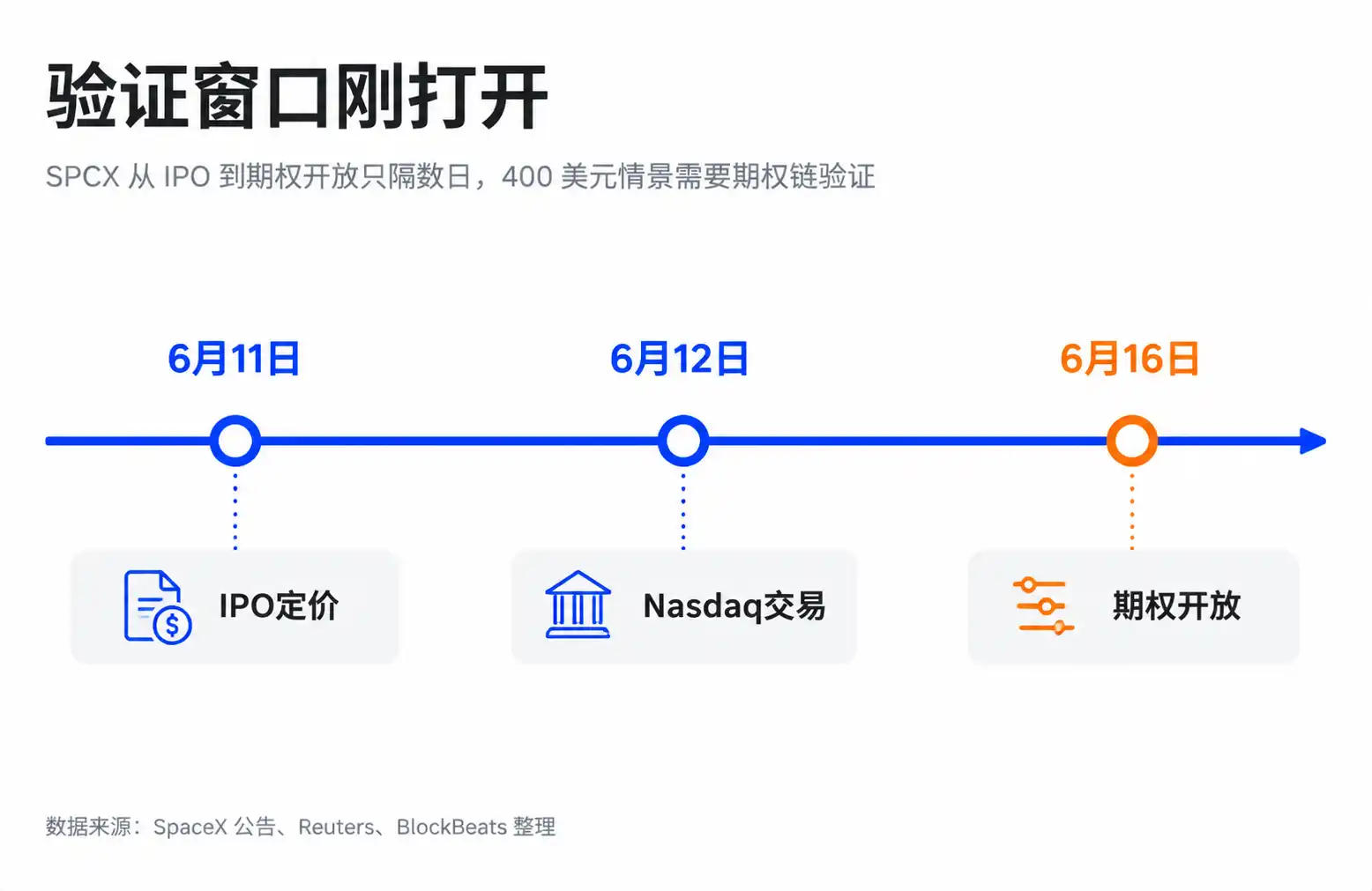
According to Reuters, SPCX options are expected to start trading as early as Tuesday, with Cboe anticipating activation on Tuesday. The report cites market participants expecting heavy and volatile early trading, with expensive premiums.

For the average investor, this means SPCX no longer has only one way to play: buying the stock. After options listing, the market will see many cheaper, higher-leverage, and riskier call options.

The easiest to ignite sentiment are out-of-the-money call options, which are call contracts with strike prices above the current price. They are relatively cheap and more like lottery tickets. If the stock price rallies fast enough, returns could be high. If it doesn't reach the strike, the options can quickly expire worthless. Retail investors in hot stocks typically prefer such contracts because they allow betting on larger gains with smaller capital.

The core mechanism of a gamma squeeze occurs here.

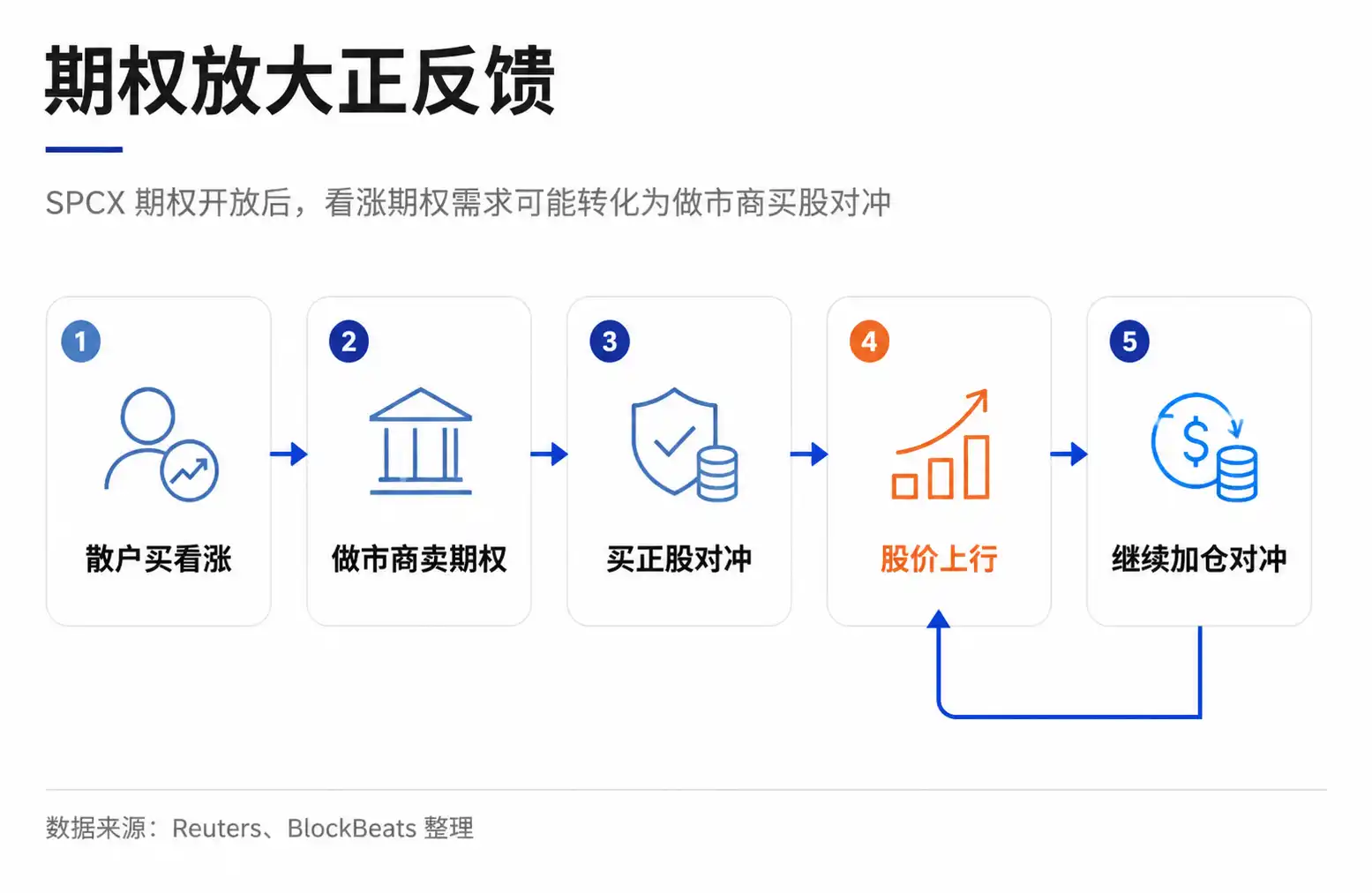
When a large number of investors buy call options, the party selling the options is usually market makers. To manage risk, market makers often need to buy some underlying shares to hedge. As the stock price rises and options move closer to being profitable, market makers may need to buy more shares. This creates a positive feedback loop: retail buys calls, market makers buy stock, rising stock price forces market makers to increase hedges, and the rally attracts more buying.

Applied to SPCX, this mechanism is highly imaginative. It simultaneously possesses low free float, a hot narrative, retail attention, the options listing window, and the sharp price volatility already seen in the early listing period. ZeroHedge believes that if demand for out-of-the-money calls becomes sufficiently concentrated, market maker hedging purchases could push the stock price to $400 in a short period.

Boundaries must also be drawn. $400 is the extreme upside scenario presented by ZeroHedge, not a baseline judgment that current evidence alone can independently derive. The imminent opening of options only indicates a new leverage channel has appeared. To prove a gamma squeeze is forming, we would need to see actual option volume in the first days after listing, open interest in out-of-the-money calls, strike price distribution, implied volatility, and market makers' net gamma exposure.

What can be said now is that the machine has the conditions to start. What cannot be said is that the machine has definitely started.
Vanda Data Supports Crowded Trade, But Does Not Equal Widespread Euphoria

If one only looks at SPCX's price action, it's easy to think retail has fully returned to risk assets. However, Vanda's fund flow data provides another, narrower explanation.

According to ZeroHedge citing Vanda Track data, SPCX ranked first in net retail buying for the second consecutive trading day, with approximately $93.8 million in net daily purchases, accounting for about 73% of the total single-stock retail net buying in U.S. stocks that day. This data point could not be cross-verified in independent public channels this time and is better viewed as a reference for observing retail crowding, rather than a multi-source confirmed market fact.

Even so, this metric still supports part of ZeroHedge's argument: SPCX has indeed seen rare capital concentration. For a low-float stock, concentrated buying alone is enough to significantly impact the price. If options trading further amplifies this directional bet, volatility could continue to expand.

But this data also provides constraints. While there was some moderate inflow into semiconductor stocks during the same period, it did not show a state of indiscriminate, market-wide risk appetite expansion. Inverse or leveraged bearish ETFs like SQQQ and SOXS still saw buying, indicating retail is not rushing en masse into all risk assets but focusing attention on the single narrative of SPCX.

This distinction is important.

If it were broad-based risk appetite expansion, SPCX's rise could be understood as part of overall market sentiment. If it's crowding in a single asset, the faster it rises, the more fragile the positioning structure becomes. The more concentrated the capital, the stronger the short-term upward momentum, but once expectations falter, option premiums decline, or after-hours liquidity worsens, the reverse volatility could also be more severe.

This is also the most easily misunderstood aspect in comparing SPCX's market cap to Nvidia's. Nvidia's valuation stems from continuous validation of AI chip revenue, data center demand, profit margins, and long-term growth expectations. SPCX's current short-term trading is more driven by early-listing liquidity structure, the Musk narrative, and options leverage expectations. Both can command high valuations, but the supporting mechanisms differ.

$400 Awaits Validation from the Options Chain

The most important variable for SPCX moving forward is not whether more people on social media are shouting $400, but what the real options market actually looks like.
For ZeroHedge's extreme scenario to remain plausible, we first need to see sufficiently concentrated volume and open interest in out-of-the-money call options. Simply having options listed with active trading is not enough. The key is whether buying interest is concentrated in call contracts with strikes above the current price, and whether these contracts force market makers to continuously buy shares to hedge.

Implied volatility must also be considered together. When options first list, premiums may be very expensive. For buyers, even if the stock continues to rise, if implied volatility drops quickly, option gains could be erased. For market structure, high premiums can inhibit subsequent chase-buying and may lead early buyers to take profits.

Real underlying share volume and support are equally important. Low free float can amplify gains, but can also amplify losses. The high after-hours price proves tight liquidity but cannot prove long-term capital is willing to continuously absorb supply. If option buying is not as strong as imagined, or if early-stage profit-taking is concentrated, SPCX could also experience a reverse feedback loop.

Finally comes the fundamental anchor. SpaceX's long-term story is not weak; Starlink, launch services, space infrastructure, and potential communication synergies are all reasons the market is willing to assign a high valuation. However, moving from around $3 trillion to over $5 trillion in the short term looks more like an extrapolation of trading structure rather than a completed re-rating validated by financial data.

In the coming days, what investors really need to monitor is the strike price distribution on the options chain, open interest in out-of-the-money calls, changes in implied volatility, and whether the underlying stock still sees genuine volume and support at elevated prices. Only when all these data points point in the same direction will ZeroHedge's $400 scenario transition from an extreme extrapolation to a risk the market must price in.


Preguntas relacionadas

QWhat is ZeroHedge's extreme price target for SPCX, and what market mechanism do they cite as a potential driver?

AZeroHedge's extreme price target for SPCX is $400 per share. They cite the potential for a gamma squeeze following the opening of SPCX options trading as a key mechanism that could drive the price to that level.

QAccording to the article, why is SPCX's price action more sensitive to trading flows compared to mega-cap stocks like Apple or NVIDIA?

ASPCX's price action is more sensitive because of its low float in the early post-IPO stage. Even with a massive total valuation, the limited number of shares available for public trading makes the price more susceptible to concentrated buying or selling pressure, behaving more like a low-float stock rather than an established mega-cap.

QHow could the opening of SPCX options trading potentially lead to a gamma squeeze?

AIf retail investors heavily buy out-of-the-money (OTM) call options, market makers who sell those options will typically hedge their risk by buying the underlying SPCX stock. As the stock price rises and these options move closer to being in-the-money, market makers may need to buy more shares to maintain their hedge. This creates a feedback loop: retail buying calls forces market makers to buy stock, pushing the price up, which then may attract more call buying and further hedging purchases.

QWhat does the Vanda Track data indicate about retail investor behavior towards SPCX, and what important nuance does it reveal about broader market sentiment?

AThe Vanda Track data indicates that SPCX has seen highly concentrated retail buying, topping the list for net retail purchases. However, the nuance is that this buying is focused almost exclusively on SPCX as a single narrative play. The broader market does not show a uniform shift into risk assets, as evidenced by continued buying in inverse/leveraged ETFs like SQQQ and SOXS. This suggests a crowded, potentially fragile trade in SPCX specifically, not a broad risk-on rally.

QWhat key data points should investors monitor to assess whether ZeroHedge's extreme $400 price scenario is becoming a real market risk?

ATo assess the $400 scenario, investors should monitor: 1) The distribution of strikes and open interest in the options chain, particularly in OTM call options. 2) Changes in implied volatility (IV). 3) Whether there is genuine buying volume and price support for the underlying SPCX stock at elevated levels. 4) Evidence that market makers' hedging activity is creating a sustained positive feedback loop. The scenario depends on these factors aligning, not just on speculative social media sentiment.

Lecturas Relacionadas

2029 Finale Prediction: When Cryptocurrency Completely "Vanishes", Who Can Remain in This Financial Upheaval?

By 2029, the crypto industry will have transformed into a largely invisible but foundational layer for traditional finance. This timeline outlines the key shifts from now until then. By mid-2026, the most sought-after assets on-chain will not be traditional tokens, but synthetic perpetual contracts for private, high-growth companies (like SpaceX, OpenAI). These become primary price discovery tools, highlighting the market's craving for real-world asset value. Most altcoins enter a sustained bear market as their fundamental lack of asset-backed value is exposed. In late 2026, the "AI + Crypto" narrative largely fades as AI giants prove they don't need crypto infrastructure, except for prediction markets betting on model performance. Simultaneously, a quiet but significant wave of tokenization for institutional assets (money market funds, private credit) begins. The industry splits into a noisy speculative economy and a silent institutional one. Throughout 2027, major public blockchain foundations pivot decisively to serve institutional clients, building compliance toolkits and sales teams. However, key sectors hit growth ceilings: private perpetual contracts are legally restricted from public promotion, stable币 growth is capped by looming political uncertainty, and tokenization projects remain cautious. In 2028, following a U.S. election assumed to maintain a regulatory (not prohibitive) stance, a pivotal change occurs. After a major liquidation crisis exposes the flaws of synthetic contracts lacking a real-asset anchor, new regulations allow the *public solicitation* of private security sales (secondary market shares) to accredited investors. This creates a legitimate, direct on-ramp for retail capital into previously illiquid private equity. By 2029, the resulting bull market is driven by trading in real, innovative company shares (biotech, robotics, AI labs), not speculative tokens. "Crypto" as a distinct asset class recedes; it becomes the mundane, unseen plumbing for this new global private markets infrastructure. Tokens that survive are those capturing real cash flows from this infrastructure. Speculation persists but is marginalized. The core questions posed at the start are answered: token value is tied to legally enforceable claims on real assets, frontier tech adoption happens via private market channels, and crypto's absorption into traditional finance is marked by its becoming boring and invisible. The key validation for this entire thesis is whether, by late 2028, a legal pathway exists for ordinary accredited investors to access private assets directly.

marsbitHace 27 min(s)

2029 Finale Prediction: When Cryptocurrency Completely "Vanishes", Who Can Remain in This Financial Upheaval?

marsbitHace 27 min(s)

After the U.S. Banned Fable 5, Zhipu's Stock Soared 47%

On June 15, Chinese AI company Zhipu's stock surged up to 47.6% in Hong Kong, closing with a 32.82% gain. This sharp rise followed two key industry events. On June 12, Anthropic was compelled by a U.S. government export control order to suspend global access to its latest flagship models, Claude Fable 5 and Claude Mythos 5, impacting developers and businesses reliant on them. The next day, Zhipu announced it was opening access to its new open-source flagship model, GLM-5.2, for all Coding Plan users, with API and model weights (under the MIT license) to follow. The Anthropic incident highlighted a critical shift in the AI industry: beyond raw capability, the stability, continuous accessibility, and control over AI models are becoming equally vital, especially as AI integrates deeper into business workflows. Zhipu's move, emphasizing that "frontier intelligence should not belong to a few nor be subject to arbitrary revocation," positioned its open, accessible model as an alternative. GLM-5.2 focuses on "Long Horizon Tasks" with a 1M context window, aiming for consistency in complex, extended projects. Market analysts suggest this event exposes the risk of dependency on closed-source models subject to single jurisdiction policies, potentially accelerating a shift toward domestic base models and localized deployments. The investment response indicates a new valuation metric is emerging—prioritizing which companies can provide AI capabilities that are not only advanced but also reliably and sustainably accessible.

marsbitHace 28 min(s)

After the U.S. Banned Fable 5, Zhipu's Stock Soared 47%

marsbitHace 28 min(s)

PANews Column Registration and Article Submission Guide

"PANews Column Registration and Submission Guide" provides instructions for users to register as columnists and publish articles on the PANews platform. Key application requirements are emphasized: content should focus on in-depth analysis within Crypto, Web3, blockchain, data, and viewpoints. Content primarily for brand/product introductions will not be approved, and heavily AI-generated content will be rejected. Promotional (PR/soft) content is directed to the business channel. **Registration Process:** * **Web:** Go to the official website footer, click "Apply for Column," and register with a phone number or email (login via verification code, no password). Fill in the column name, description, upload an avatar, and submit links to previously published work. * **Mobile:** Navigate to "My" -> "Contribute & Create" and complete the form. **Article Submission Tutorial:** 1. Log in to the PANews website. 2. Access the "Creator Center" from your personal homepage. 3. Use the editor to create and publish articles. **Video Upload:** The platform supports embedding videos from third-party sites (e.g., Bilibili). Copy the embed code from the source video, use the editor's "Insert/Edit media" button, paste the code under the "Embed" tab, and adjust the display size (recommended: width 100%, height 560px). **PANews Skills (AI Agent Tool):** PANews offers an official AI Agent skill set called PANews Skills, enabling AI tools to query platform content, track trends, and publish column articles directly. It includes three main skills: 1. `panews`: For tracking daily must-read lists, popular articles, and funding news. 2. `panews-creator`: For managing columns, publishing articles, and uploading images. 3. `panews-web-viewer`: For parsing PANews webpages into Markdown. These skills are compatible with various AI Agent tools (OpenClaw, Cursor, Claude Code, ChatGPT, Gemini, etc.). To use the `panews-creator` skill, users must obtain a specific authentication value from the PANews website after logging into their columnist account.

marsbitHace 39 min(s)

PANews Column Registration and Article Submission Guide

marsbitHace 39 min(s)

I Built Myself an Investment Workbench Using AI

For the past two weeks, I've been immersed in Vibe Coding—using AI to write code from natural language descriptions. This process has enabled me to quickly build functional tools that address long-standing personal ideas. Previously, I had many concepts but found execution too cumbersome. Key ideas included a unified dashboard for assets across US stocks, Crypto, HK stocks, and A-shares; a real-time alert system for price movements; an investment map visualizing sector relationships; and a tool to correlate prediction market bets with news and market data. Traditional development hurdles meant these often remained unrealized. Using AI (Codex, Claude Code, and DeepSeek API), I built four initial tools: 1. A **Cross-Market Asset Dashboard** showing total assets, daily P&L, and holdings by market, with added features for alerts and sector mapping. It's deployed locally for privacy. 2. A **Prediction Market (PM) Monitor** tracking bets on events (e.g., company valuations) and correlating probability shifts with news and market movements. I categorize bets by conviction to filter noise. 3. A **Simple Operations Backend** for managing my writing workflow (topics, progress, publishing). It's cloud-deployed for mobile access. 4. A **One-Click Formatting Tool** that automates converting drafts into various platform-specific formats, saving manual effort. While these tools are basic, they represent a significant shift: AI lowers the barrier to creating personalized systems. I believe individual investors can now feasibly build core systems for: * **Asset Observation** (tracking holdings and changes) * **Signal Monitoring** (watching for key market shifts) * **Sector Mapping** (understanding network relationships within a sector) * **Performance Review** (documenting rationale and outcomes) The power of Vibe Coding is its fast feedback loop. Ideas can be implemented, tested, and iterated on rapidly, turning "want-to-do" into "done." This marks the start of my new phase, where I'll share investment thoughts, tool tests, on-chain operations, and educational Web3 content.

marsbitHace 55 min(s)

I Built Myself an Investment Workbench Using AI

marsbitHace 55 min(s)

Trading

Spot
Futuros
活动图片