The Rise of Prediction Markets: Why Is This Trillion-Dollar Industry Making U.S. Regulators 'Sit on Pins and Needles'?

marsbitPublicado a 2026-06-15Actualizado a 2026-06-15

Resumen

The article, "The Rise of Prediction Markets: Why Is the Trillion-Dollar Trend Making US Regulators Uneasy?", explores the rapid growth of prediction markets and the regulatory pushback they face. It argues that platforms like Polymarket and Kalshi, where users trade contracts on real-world outcomes, create highly efficient information aggregates. Their monthly trading volume has surpassed $24 billion, with projections pointing toward a trillion-dollar annual market by 2030. A core example is the 2026 Iran conflict, where prediction market signals accurately foreshadowed the disruption of the Strait of Hormuz and an oil price spike hours before official announcements, outperforming traditional analysts. The piece contends US regulators' primary motivation is not public protection but self-preservation and control. It cites a court ruling against the CFTC, which found the agency's concerns over market manipulation "speculative" and lacking concrete evidence. At the state level, the driving force is framed as lost tax revenue from traditional gambling, not documented social harm. Citing economist Friedrich Hayek, the article concludes that prediction markets excel by crowdsourcing decentralized, "local knowledge" into a dynamic, continuous price signal, offering a real-time reality check against official narratives and static forecasts.

Author: Long Yue

Source: Wall Street News

When a decentralized crowd can predict wars, policies, and market trends more accurately than U.S. federal agencies, American regulators can no longer sit still.

Prediction markets are experiencing rapid expansion. The Mises Institute recently published a lengthy article by Angelo Monaco, which outlines the operational logic of prediction markets, their explosive growth trajectory, and the reasons behind the U.S. government's urgency to impose controls on them.

The article argues that the underlying motive for U.S. regulators to suppress prediction markets is ostensibly to 'protect the public' but essentially to 'protect themselves.' What regulatory agencies truly fear is not that these markets will fail, but that they function too well—so well that they publicly expose the limitations of the regulators' own predictive capabilities.

The logic of prediction markets is not complex. Platforms like Polymarket and Kalshi are essentially financial exchanges: users buy and sell contracts based on the outcomes of real-world events. Contract prices fluctuate between 1 cent and 99 cents, directly reflecting the market's collective judgment on the probability of an event occurring. If the event happens, the contract settles at $1; accurate predictors profit, while those who are wrong incur losses. This mechanism forces every participant to back their judgment with real money.

Currently, the monthly trading volume of prediction markets has exceeded $24 billion. Analysts predict the overall market size will surpass $240 billion and is poised to achieve an annual trading volume exceeding $1 trillion before 2030. This growth rate is exceptional within the financial industry.

The Iran War: Prediction Markets Were Several Hours Ahead of the Pentagon Press Conference

The article uses the Iran conflict in early 2026 as a core case study to illustrate the practical value of prediction markets.

From late 2025 to January 2026, when local unrest in Iran first began, mainstream analysis institutions and media generally predicted that energy markets would remain stable, with the forecast range for the annual average price of Brent crude oil being $55 to $60 per barrel. However, during the same period, a clear divergence signal emerged in crude oil options markets and decentralized geopolitical event contracts—while analysts on television were telling the public 'not to panic,' traders betting with real money were already significantly increasing the probability priced in for 'worst-case scenarios.'

The market began pricing in the structural vulnerability of the Strait of Hormuz weeks before the U.S.-led coalition launched airstrikes in February.

In March, when Iran blockaded the Strait of Hormuz, disrupting about 20% of global oil supply, prediction markets on platforms like Polymarket and IMF PortWatch had already provided clear judgments hours before the Pentagon held its press conference. They did so by integrating satellite tracking data, signals from surging insurance rates, and data from regional shipping companies.

The article points out that if you relied solely on traditional energy forecasts in January, you would have been told that a sharp rise in oil prices was a 'low-probability event.'

The Court Has Already Said: The U.S. CFTC's Concerns 'Lack Specific Evidence'

Does the regulators' logic hold water? The article suggests the answer is no.

The most representative legal case is Kalshi v. CFTC. The U.S. Commodity Futures Trading Commission (CFTC) had sought to ban contracts related to congressional elections in federal court, but the U.S. Court of Appeals for the District of Columbia Circuit explicitly rejected the government's motion for a stay. The court's wording was direct: the CFTC's concerns about market manipulation and threats to election integrity were 'speculative and lacking in specific evidentiary support.'

The court further found that the CFTC had exceeded its statutory authority and failed to demonstrate that political outcome trading would cause immediate harm to the public interest. This ruling directly paved the way for the legalization of commercial election event contracts in the United States.

The most significant 'national security threat' case cited by the CFTC involved a U.S. Army soldier who, in April 2026, used classified information about operations in Venezuela to profit over $404,000 on a prediction market. This case was heavily promoted by the federal government. However, the article notes that this remains the only major case involving national security to date. Using an isolated incident to argue for systemic harm is logically untenable.

The Real Motive of U.S. States: Not Protecting the Public, But Protecting Tax Revenue

If the federal-level crackdown is more about 'narrative control,' the motives at the state level are more straightforward—money.

The article cites data from the American Gaming Association's commercial gaming revenue tracker: since early 2025, prediction market platforms have cost state governments approximately $950 million in potential gaming tax revenue.

The reason lies in a regulatory arbitrage loophole: traditional sports betting operators must pay high Gross Gaming Revenue (GGR) taxes to state gaming commissions, while prediction market platforms define themselves as 'financial instruments,' thus only paying standard corporate income tax and completely bypassing the state-level gaming tax system.

Taking Minnesota as an example, when the state passed a prediction market ban, the core argument in the legislative debate was not 'social harm' but market share and tax revenue loss. The article's assessment is that the 'harm' pointed to by states is often projected tax losses and threats to traditional gaming monopolies, rather than documented social problems.

Hayek Already Talked About This

In arguing for the informational value of prediction markets, the article cites the classic argument by economist Friedrich Hayek.

Hayek pointed out that the decentralized price mechanism is the only tool capable of coordinating the 'local knowledge' scattered across the globe. No single expert, federal agency, or algorithm can master the fragmented information dispersed worldwide. Prediction markets essentially do one thing: crowdsource global wisdom.

In contrast, public opinion polls and regulatory reports are static snapshots—often outdated by the time they are released. Prediction markets are dynamic and continuous. When a geopolitical event occurs or economic data is leaked, the instantaneous fluctuation in contract prices tells you how important that piece of information is faster than any editor rushing to publish.

The article also mentions an everyday scenario: if a cable TV host is shouting that a certain piece of legislation 'will definitely pass,' but the corresponding prediction market contract price is only 12 cents, you immediately know the gap between rhetoric and reality. It's a real-time 'reality check.'


Preguntas relacionadas

QWhat is the core reason that U.S. regulators feel uneasy about the rise of prediction markets according to the article?

AThe article argues that U.S. regulators are uneasy not because prediction markets are problematic, but because they function too effectively. Their true fear is that these markets can publicly outperform and contradict the predictive abilities and narratives of government agencies.

QHow does the article use the 2026 Iran conflict scenario to illustrate the value of prediction markets?

AThe article uses the 2026 Iran conflict to show a predictive divergence. While mainstream analysts and media predicted stable energy markets, crude oil options and decentralized geopolitical event contracts signaled rising probabilities of a worst-case scenario weeks before the U.S.-led coalition's strike and hours before official Pentagon briefings, by integrating data like satellite tracking and surging insurance rates.

QWhat was a key finding in the Kalshi vs. CFTC legal case mentioned in the article?

AThe U.S. Court of Appeals for the D.C. Circuit rejected the CFTC's attempt to ban election contracts, stating that the CFTC's concerns about market manipulation and threats to election integrity were 'speculative and lacked concrete evidentiary support.' The court found the CFTC had exceeded its statutory authority.

QWhat economic motive do U.S. states have for opposing prediction markets, as per the article?

AThe primary state-level motive is financial. Prediction markets, classified as 'financial instruments,' avoid paying high state gambling taxes (GGR tax) that traditional sports betting operators must pay. The article cites an estimated $950 million in potential gambling tax revenue lost by states since early 2025.

QWhich economic thinker's concept does the article reference to explain the informational value of prediction markets?

AThe article references economist Friedrich Hayek's concept of the price system as a tool for coordinating 'local knowledge' dispersed globally. It argues prediction markets act as a mechanism to crowdsource this global wisdom into a dynamic, continuous price, providing a real-time 'reality check' compared to static reports or rhetoric.

Lecturas Relacionadas

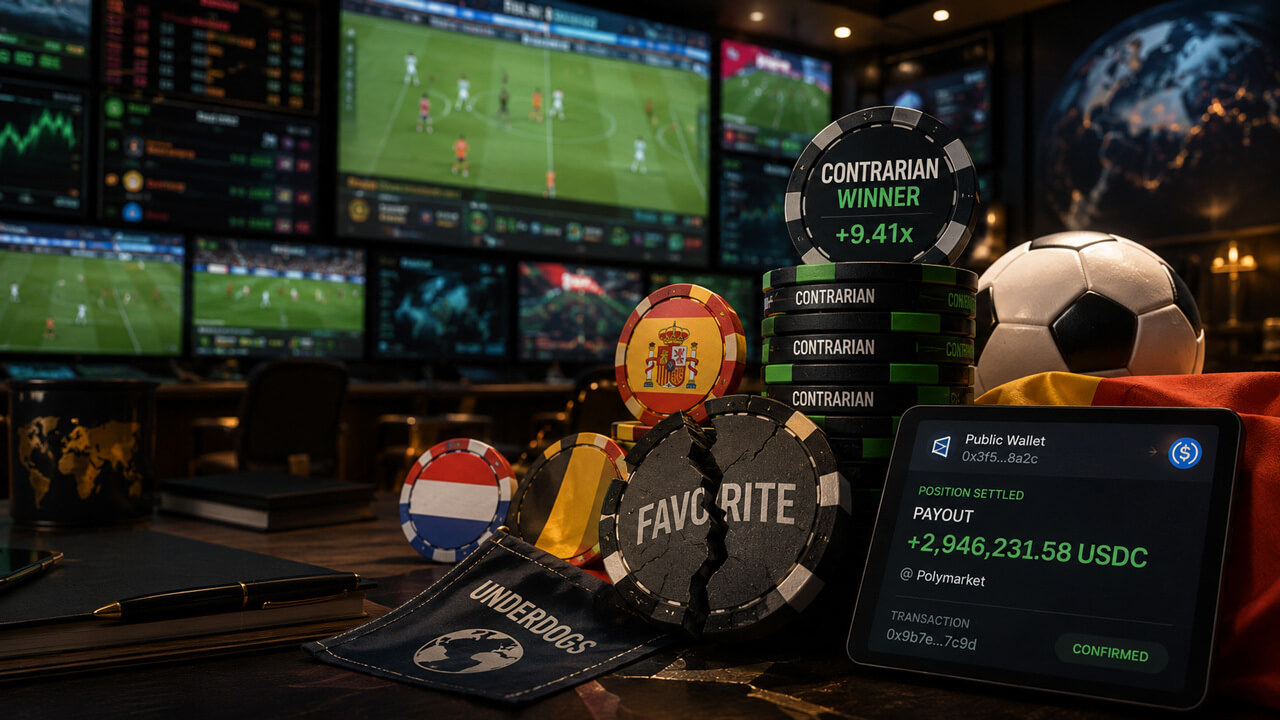
Football Draw Harvests Whales: Extreme Profit-Loss Divergence on Polymarket's World Cup

A bettor known as "fishalive" made a stunning profit of nearly $9 million on the Polymarket prediction platform by correctly wagering against favorites during the 2026 FIFA World Cup group stage. The account, registered just before the tournament, risked roughly $400,000 on two contracts for a Spain vs. Cape Verde match: one that Spain would *not* win, and another on a Cape Verde +2.5 goal handicap. The resulting 0-0 draw triggered both payouts. This single event, with a total market volume of $64 million, highlighted extreme profit-and-loss divergence. Other traders, like "betoor619" and "leeeeroyjenkins," lost millions by betting heavily on favorites Spain and Belgium to win outright—contracts that become worthless in a draw. The article explains that while markets heavily favored strong teams, the "team to win" contracts are binary and do not account for the common outcome of a draw. This creates high-risk, low-reward scenarios for favorite backers, while asymmetric profits flow to those betting on underdogs or against outright wins. The transparency of Polymarket's on-chain ledger publicly documents these massive wins and losses, driving mainstream media coverage. As the tournament progresses, the author suggests traders may shift towards hedging strategies that account for draws. The piece also notes growing regulatory scrutiny in the US and Europe, questioning whether such large-scale, anonymous sports prediction markets should be regulated as gambling or financial derivatives.

Foresight NewsHace 10 min(s)

Football Draw Harvests Whales: Extreme Profit-Loss Divergence on Polymarket's World Cup

Foresight NewsHace 10 min(s)

ChatGPT Loses Half Its Market: From Monopoly to Shared Market in Three and a Half Years

In a landmark shift three and a half years after its debut, ChatGPT's global market share in the AI assistant market has fallen below 50% for the first time, dropping to 46.4% as of May 2026. This signals the end of its initial dominance, with the market now diversifying among competitors like Gemini (27.7%) and Claude (10.3%). The report from Sensor Tower indicates the AI assistant landscape has matured from a phase of awe and experimentation into one of product comparison, ecosystem integration, and monetization. Users are increasingly pragmatic, readily switching between assistants based on specific use cases, brand trust, and value propositions. The industry is moving past the "free lunch" era, with users demonstrating a willingness to pay for premium features, driving significant in-app expenditure. Major players are adopting varied monetization strategies: Claude boasts a high subscription conversion rate, while ChatGPT is increasingly testing ads and shopping integrations to complement its subscription revenue. However, this growth comes with immense costs, as exemplified by OpenAI's soaring cash burn for model training and infrastructure. While ChatGPT remains the largest single player, its declining share symbolizes a broader normalization of AI. The technology is no longer a novelty but an integral, scrutinized part of daily digital life, judged on practical utility, price, and seamless integration. The battle has shifted from proving AI's potential to competing in a crowded field where no single product holds a permanent monopoly.

marsbitHace 21 min(s)

ChatGPT Loses Half Its Market: From Monopoly to Shared Market in Three and a Half Years

marsbitHace 21 min(s)

Trading

Spot
Futuros
活动图片