Analyst Predicts Bitcoin Price Crash To $15,000 Using Gold Chart

bitcoinistPublished on 2025-12-09Last updated on 2025-12-09

Abstract

Analyst The Great Martis predicts a significant Bitcoin price crash to as low as $15,000, using the performance of gold as a key indicator. This forecast follows Bitcoin's recent drop below $100,000, with the analyst suggesting an inverse relationship between the two assets. As gold reaches new all-time highs, driven by Federal Reserve interventions and speculation, Martis expects it could rise to the $12,000 range. Consequently, Bitcoin may face a severe bear market, potentially declining over 70% from current levels and nearly 90% from its $126,000 peak. In 2025, gold has surged 55%, while Bitcoin has fallen 30% from its October high, reinforcing gold's status as a safer investment amid Bitcoin's volatility.

Following the Bitcoin price crash below $100,000 back in November, different bearish predictions have begun to make the rounds in the crypto community. For some, this crash signifies the end of the bull market, ushering in the dreaded bear market. While some of the predictions have been conservative, putting the pioneer cryptocurrency somewhere around $50,000 at the bottom, one analyst in particular has predicted a deeper crash, and this was done using the gold chart.

Why A Crash Could Be Coming For The Bitcoin Price

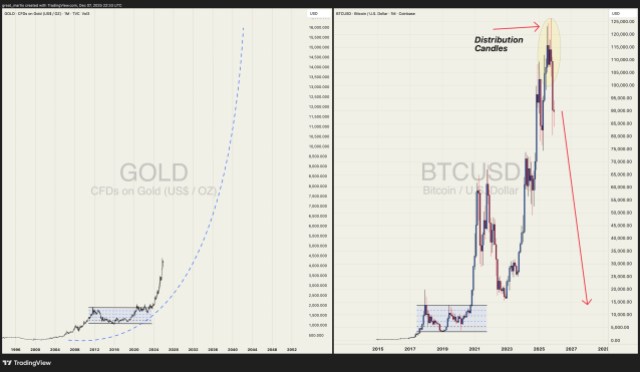
Crypto analyst The Great Martis took to X (formerly Twitter) to share their prediction of where the Bitcoin price is headed next. The chart shows a possible decline that could send Bitcoin moving below $20,000, before eventually reaching a bottom at around $15,000. Although this is not out of the ordinary for analysts to predict such crashes, the reason why Mathis believes this is possible is what is interesting.

The crypto analyst points out that the gold performance, which has seen the asset hitting new all-time highs this year, was being driven by speculation. Martis explains that the Fed’s intervention is something that will continue to drive the price of gold higher, and this could, in turn, continue to push down the Bitcoin price.

Furthermore, the analyst expects that the gold price will rise into the $12,000 territory, putting it in the same region that the Bitcoin price was in back in 2021. The interesting thing to note about Bitcoin in 2021 is that this was the year that the digital asset went on one of its most explosive rallies so far.
Source: X

If Bitcoin continues to perform inversely to gold, then a rise to 5-digits for gold would mean a bearish market for Bitcoin. A crash to $15,000 would translate to a more than 70% decrease in price from the current level, and an almost 90% decline from its $126,000 all-time high.

So far, this year, gold has been the better performer of the two when compared side-by-side. For context, the gold price is already up over 55% in the year 2025; meanwhile, the Bitcoin price suffered a major 30% drop in price after hitting $126,000 back in October.

While both of these assets continue to lead in their respective sectors, gold continues to remain the standard for what investors consider a “safe” investment compared to Bitcoin, which is known for its wild price fluctuations.


BTC retraces weekend gains | Source: BTCUSD on Tradingview.com

Related Reads

Bull vs. Bear Debate: Is the Profit Moat of Stablecoin Leader CRCL Solid?

The article presents a heated debate surrounding Circle (NYSE: CRCL), the issuer of the stablecoin USDC, focusing on the sustainability of its business model following its IPO and Q3 2025 earnings report. Key bearish points, led by figures like Jiang Zhuo'er, argue that CRCL's profits are unsustainable. They compare it to a bank reliant on an interest rate spread, which is highly vulnerable to Federal Reserve rate cuts. Critics highlight that over 60% of profits are paid to distributor Coinbase, leaving CRCL with a thin margin. They warn that competition from traditional financial giants like JPMorgan could easily disrupt its model, and that its regulatory advantage is a temporary benefit, not a permanent moat. Bullish commentators, including @BTCdayu and @qinbafrank, counter that CRCL is a long-term infrastructure play, not a simple bank. They believe current profit-sharing is a strategic cost to achieve market dominance and network effects, similar to companies like Amazon in their early days. They argue that future growth from massive USDC adoption (potentially reaching trillions) will far outweigh the impact of falling interest rates. They see compliance as a powerful, long-term moat that will eliminate smaller competitors. Additional short-term concerns include a significant sell-off pressure from the post-IPO lockup expiration and a structural barrier to USDC's use in U.S. retail payments due to its classification as a taxable asset. In summary, the debate pits short-term cyclical risks (interest rates, high costs, sell pressure) against a long-term structural opportunity (market growth, network effects, compliance as a barrier to entry). The core question remains whether CRCL's current model is a fragile interest-rate play or a foundational bet on the future of digital currency.

比推Hace 25 min(s)

Bull vs. Bear Debate: Is the Profit Moat of Stablecoin Leader CRCL Solid?

比推Hace 25 min(s)

Trading

Spot
Futures
活动图片