Japan's Central Bank on the Verge of Raising Rates, Can the AI Bull Market Still Hold?

marsbitPublicado a 2026-06-15Actualizado a 2026-06-15

Resumen

TL;DR: The impending Bank of Japan (BOJ) interest rate hike is shifting global market focus this week, raising questions about its potential impact on the AI-driven bull market and cryptocurrencies like Bitcoin. For years, the yen has served as a cheap global "funding currency," enabling carry trades where investors borrowed yen at low rates to buy higher-yielding assets. This dynamic amplified liquidity and risk appetite in global markets, benefiting high-beta assets like AI tech stocks and crypto. The BOJ's expected move to raise rates from 0.75% to 1.0% signals a shift away from this era of ultra-low-cost funding. The core concern isn't the 1% rate itself, but the direction of change and its potential to reduce global leverage and risk tolerance. An unwinding of yen carry trades could force investors to sell global assets to buy back yen for repayment, potentially triggering synchronized volatility in overvalued sectors. While AI fundamentals and crypto-specific drivers remain intact, the market impact will depend on whether the BOJ signals a faster-than-expected pace of normalization. Post-decision, watch for correlations between a strengthening yen, rising Japanese bond yields, and simultaneous pressure on tech stocks and cryptocurrencies to gauge if the market is pricing in a broader tightening of cheap global liquidity.

TL;DR

If you regularly follow the price fluctuations of NVIDIA, Microsoft, Bitcoin, or Ethereum, you typically focus on tracking core variables such as U.S. inflation data, the Federal Reserve's interest rate policy path, AI-related revenue realization, and on-chain capital flows. But this week, the market's attention has been captured by what seems like a more distant variable: the direction of the Bank of Japan's interest rates.

The reason is not complicated. For many years, the yen has been one of the cheapest funding currencies in the world. Investors could borrow low-interest yen, convert it into dollars or other currencies, and then buy higher-yielding, faster-appreciating assets. This is the yen carry trade, simply put, borrowing low-interest yen to buy high-yield assets.

It may not directly appear on a particular AI stock or a specific Bitcoin address, but it can affect global risk appetite and leverage costs. Now, the Bank of Japan is exiting its long-term ultra-low interest rate environment, and the market is beginning to recalculate how much longer this 'low-interest credit card' can be swiped.

According to a Reuters report on June 10, 66 out of 70 economists expect the Bank of Japan to raise its policy rate from 0.75% to 1.0% at its June meeting. In another survey, 53 out of 67 economists expect the rate to rise to 1.25% by year-end. This meeting will conclude on June 16th. As of June 15th, 1.0% remains the economists' survey expectation, not an already announced result.
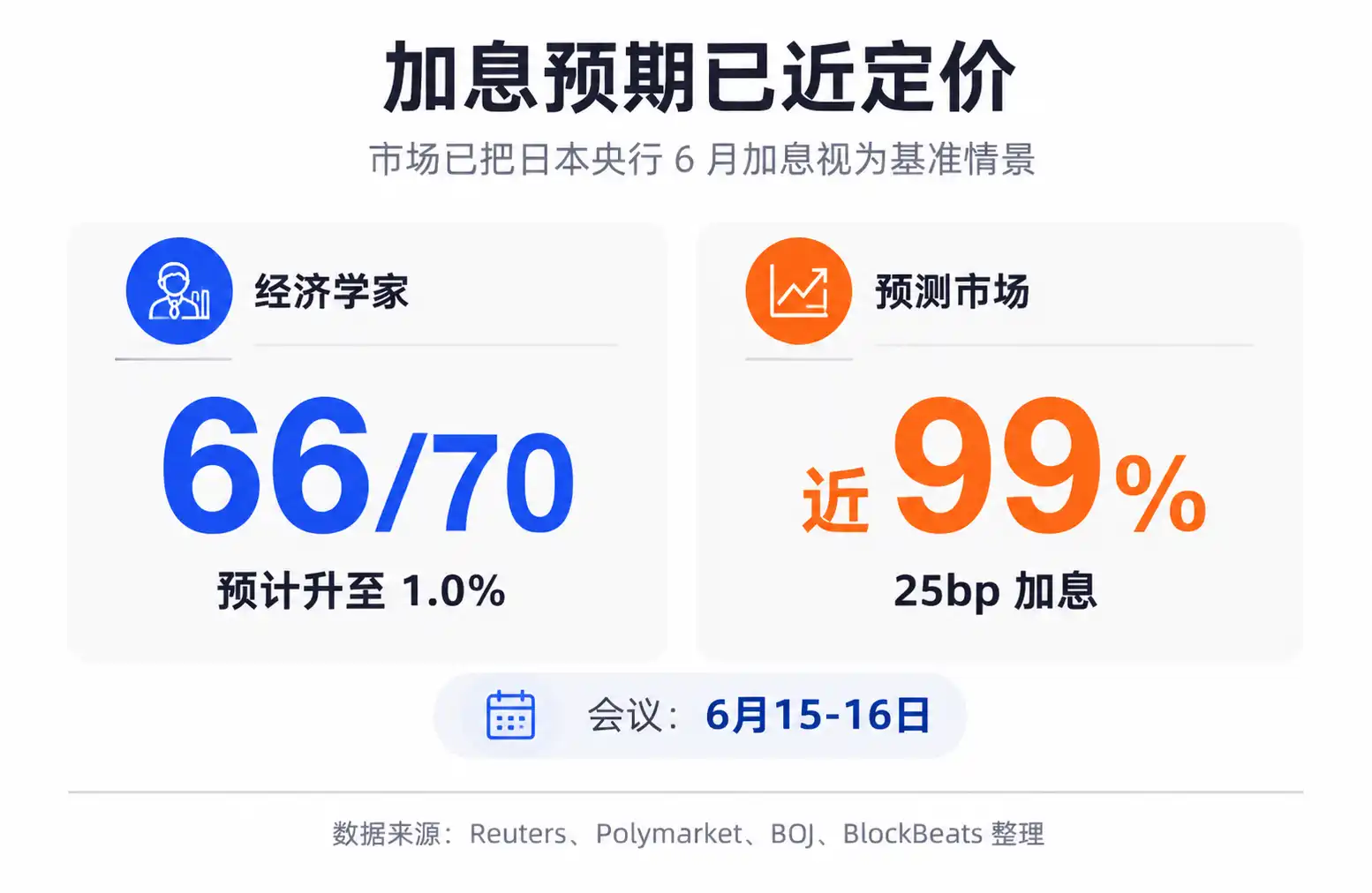
25 basis points may seem small. What the market fears is not the number 'Japanese interest rates reaching 1%', but whether assets that have relied on cheap funding, crowded positions, and high-risk appetites will be repriced after long-term cheap money starts to become more expensive. AI mega-tech and crypto are precisely the most sensitive terminals on this chain.

The Bank of Japan Affects the Global Funding Foundation

Think of the yen carry trade as a low-interest credit card. As long as the borrowing cost is low enough, the exchange rate stable enough, and the target assets rise fast enough, investors are willing to swipe this card to add leverage. The yen has long played the role of this global credit card.

This card is important because it doesn't just serve the Japanese market. Low-interest yen can be converted into dollars, flowing into U.S. stocks, bonds, emerging markets, commodities, and also indirectly affecting the risk appetite in crypto markets. When global asset prices rise, carry trades amplify liquidity. When the yen appreciates or Japanese interest rates rise, this chain works in reverse, forcing some funds to reduce positions, repay loans, and cut leverage.

Therefore, investors cannot judge its market impact solely based on 'the size of the Japanese economy.' The Bank of Japan is changing not the profit outlook of one local industry, but a long-term, low-cost foundation within the global funding map.

The April meeting already signaled this. At that time, the BOJ maintained the uncollateralized overnight call rate at around 0.75%, but the vote was 6 to 3, with 3 members already advocating an immediate hike to around 1.0%. In its Outlook Report that same month, the BOJ lowered its real GDP forecast for fiscal 2026 to 0.5% and raised its core CPI forecast to 2.8%. The policy discussion has shifted from whether to normalize to how fast normalization should be.
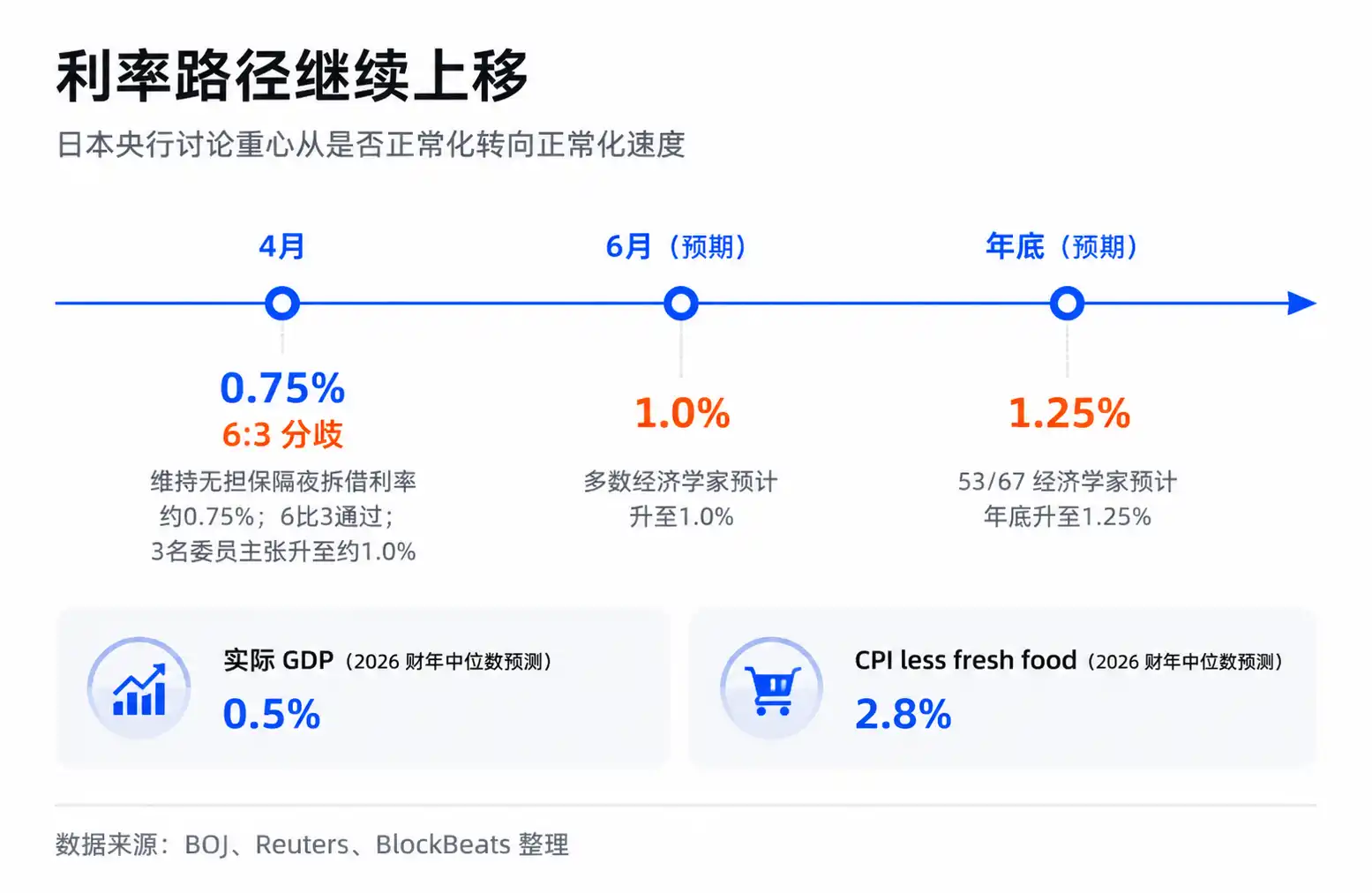
The market consensus remains relatively mild: the BOJ will raise rates gradually, with ample policy communication, and part of the yen carry trade has already been unwound during past bouts of volatility. But the risk framework looks at something else. As long as residual leverage remains, what triggers volatility is often not the absolute level of interest rates, but the speed of change in interest rate differentials and exchange rate expectations.

For AI stocks and crypto, this speed matters. They are both high-beta assets, meaning assets with greater price elasticity. They rise more sharply when liquidity is loose and fall faster when risk appetite declines. AI leaders have real revenue and industry trend support, and Bitcoin also has ETFs, the halving cycle, and on-chain structures, but their marginal pricing still highly depends on global risk appetite.

When cheap money diminishes, the market may not immediately reject the AI or crypto narratives, but it may lower the valuation multiples it is willing to pay for future growth.

25bp Amplified by Leverage and Exchange Rates

Looking solely at 25 basis points, a Japanese rate hike shouldn't seem likely to shock global assets. The problem is that carry trades are not simple comparisons of deposits and loans; they are a system layered with leverage, exchange rates, and crowded positions.

A typical yen carry trade has three sources of return: low borrowing cost in yen, high returns on purchased assets, and a stable or depreciating yen. As long as these three hold, the trade is comfortable. Once Japanese rates rise, the first source of return is compressed. If the market begins to expect yen appreciation, the third source becomes a risk. Investors not only earn less but may also lose money on the exchange rate.

That's why 1% itself isn't necessarily scary, but moving from 0.75% towards 1.0%, with the market expecting 1.25% by year-end, changes the calculus for capital. What carry trades fear most is not a slow rise in cost, but everyone simultaneously realizing the same trade is no longer profitable and then rushing to unwind.

Unwinding transmits local Japanese policy to global risk assets. Investors need to buy back yen to repay debt, potentially selling dollar-denominated assets, tech stocks, crypto, commodities, or emerging market positions. If many funds act similarly at the same time, price declines can trigger more risk controls, margin calls, and volatility model adjustments, creating secondary amplification.

The IMF noted in its April 2026 Global Financial Stability Report that carry trade unwinding could amplify market volatility through channels like capital flows, bond yield volatility, leveraged ETFs, and non-bank financial institution deleveraging. The key point here is not that a particular downturn is solely caused by the BOJ, but that this mechanism exists and can exacerbate shocks when liquidity is tight.
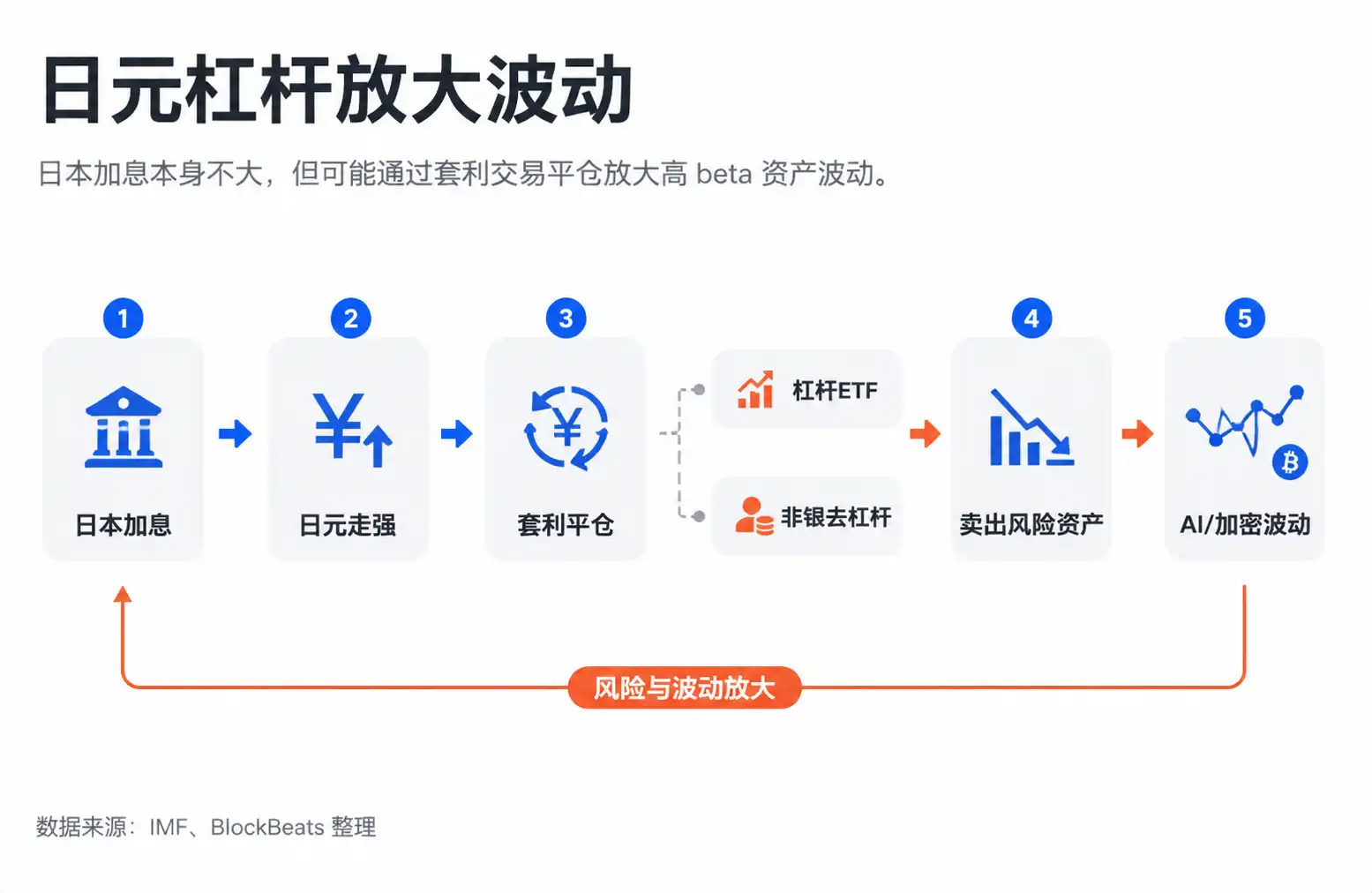
Over the past two years, the market has repeatedly seen similar phenomena: momentum stocks, AI tech stocks, and Bitcoin experiencing synchronized volatility without clear new Fed signals or a sudden deterioration in single-company fundamentals. Institutional analysis often cites yen carry trade unwinding as one explanation. Strictly speaking, this can only prove a high temporal coincidence and a plausible mechanism, not sole causation. But for trading, correlation and transmission mechanisms are sufficient to constitute a risk variable.

The Market Is Trading on Higher Funding Hurdles

More precisely, the market is not trading on 'Japan's rate hike destroying AI,' but on 'higher funding hurdles for global risk assets.' These are two different things.

The AI rally still has its own main drivers. Cloud provider capital expenditures, GPU demand, model application deployment, enterprise software revenue—these are the long-term fundamentals for companies like NVIDIA and Microsoft. Bitcoin also has its own main drivers, including ETF inflows, regulatory frameworks, macro hedging narratives, and on-chain supply structure. The BOJ will not replace these variables.

But at high valuation stages, fundamentals answer whether there is long-term value, while liquidity answers what multiple the market is willing to pay for that future. When global low-cost funding is more abundant, investors are more willing to pay a high price for future growth. When funding costs rise and risk appetite falls, the same growth story may be discounted more heavily.

This is the meaning of implicit funding cost. It may not manifest as a rise in a specific company's loan rate, nor does it necessarily mean a specific fund directly borrowed yen. It's more like the overall leverage temperature of the market: when money is cheap, investors chase high-volatility assets. When money becomes expensive, the market's tolerance for losses, distant profits, and valuation bubbles declines.

Therefore, the market significance of this BOJ meeting does not lie in whether 1% is a high interest rate. In the U.S. or many emerging markets, 1% is certainly not high. But in the history of the yen as a global funding currency, it represents a change in direction. A pipeline of capital that has long provided cheap leverage is moving from extremely low cost towards normal cost.

'Most carry trades have already been unwound' also does not mean the risk disappears. Some trades have indeed been reduced in past volatility, and the market has also digested the June hike expectation in advance. But as long as residual exposure remains within the banking system, offshore yen lending, and non-bank leverage, prices will remain sensitive to the speed of normalization.

More importantly, the yen is just one visible anchor point. Global risk assets in recent years have not relied solely on the Fed but also on various low-cost funding currencies, offshore liquidity, and cross-market leverage. When these funding sources simultaneously become less cheap, a dovish Fed pivot may not fully offset the marginal tightening from other currency systems.

Post-Decision, Watch Linkage Between Yen, JGBs, and High-Beta Assets

The verification point for this narrative is clear: after the Bank of Japan's decision on June 16th, does the market just 'buy the rumor, sell the fact,' or does it begin repricing a faster normalization path?

If the BOJ raises to 1.0% as per the economists' survey expectation, but its tone is dovish, USD/JPY reacts calmly, and U.S. tech stocks and crypto do not come under synchronized pressure, then this looks more like a digested policy event. The market will continue to refocus on AI revenue, the Fed's path, and the U.S. earnings cycle, with Japan being a short-term disturbance.

If the decision or subsequent remarks lead the market to price in a year-end 1.25% or even higher path earlier, with the yen appreciating rapidly and Japanese bond yields rising, while NVIDIA, other momentum tech stocks, BTC, and ETH experience synchronized volatility, it would indicate investors are starting to trade not the 25 basis points, but a renewed contraction in the yen leverage chain.

Next, watch the linkage between prices: does yen strength accompany weakness in high-beta assets, does volatility rise without new U.S. negatives, do leveraged ETFs and crowded momentum stocks bear the brunt first. As long as these signals appear together, the Bank of Japan is no longer just the Bank of Japan—it is reminding the market that the map of global cheap money is becoming more expensive.

Preguntas relacionadas

QWhat is the core market concern behind the Bank of Japan's potential rate hike, beyond the immediate interest rate change?

AThe market is not primarily concerned about Japan's interest rate reaching 1% itself. Instead, the worry is that as a long-term source of cheap money (the 'global credit card') begins to get more expensive, assets that have relied on low-cost financing, crowded positions, and high risk appetite may face repricing. The article highlights that AI stocks and cryptocurrencies are particularly sensitive 'terminal points' on this chain.

QAccording to the article, why is the potential impact of the Bank of Japan's policy greater than Japan's economic size might suggest?

AThe Bank of Japan's policy change is significant because it alters a key piece of low-cost 'foundation' in the global financing map. The Japanese yen has long served as a cheap funding currency for global carry trades. Investors borrow low-interest yen, convert it to dollars, and invest in higher-yielding assets worldwide. A policy shift in Japan thus does not just change a local industry's profit outlook but impacts the global cost of leverage and risk appetite.

QWhat are the three layers of profit in a typical yen carry trade, and how does a Bank of Japan rate hike threaten them?

AA typical yen carry trade has three profit layers: 1) The low cost of borrowing yen. 2) The higher return from the purchased asset. 3) The yen not appreciating (or even depreciating). A Bank of Japan rate hike directly compresses the first layer (higher borrowing cost). Furthermore, if the rate hike leads to market expectations of yen appreciation, the third layer turns into a risk, as investors could lose money on the currency exchange when repaying the loan.

QThe article distinguishes between 'fundamentals' and 'liquidity' for high-beta assets like AI stocks. What is the key difference in their roles?

AFor high-beta assets like AI stocks and Bitcoin, fundamentals answer the question of long-term value (e.g., cloud capital expenditure, GPU demand, ETF inflows, supply structure). Liquidity, on the other hand, answers the question of the valuation multiple the market is willing to pay for that future growth. When global low-cost financing is abundant, investors pay higher prices for future growth stories. When financing costs rise and risk appetite falls, the same growth story may be discounted at a lower multiple.

QWhat key market signals should investors watch after the Bank of Japan's June meeting to assess the impact on global risk assets?

AInvestors should watch for specific inter-market linkages: whether a stronger yen is accompanied by weakness in high-beta assets (like momentum tech stocks, BTC, ETH), whether market volatility rises without new U.S. catalysts, and whether leveraged ETFs and crowded momentum stocks lead the decline. The simultaneous appearance of these signals would indicate the market is trading on the theme of a broader contraction in global cheap funding, beyond just the immediate rate decision.

Lecturas Relacionadas

From a $300 Million Valuation to a 'Fire Sale' at Tens of Millions: What Happened to Messari?

On June 12, leading crypto data and capital markets platform Blockworks announced its acquisition of competitor Messari for over $10 million. This price represents a significant discount from Messari's 2022 valuation peak of approximately $300 million, highlighting the survival pressures faced by high-valuation startups during the bear market and a consolidation wave in data infrastructure. Blockworks, founded in 2018, began as a media and events company but has pivoted to focus on institutional-grade data, investor relations, and compliance tools. Its recent Series A extension round, valuing the company at $192 million, aimed to fund this shift and strategic acquisitions like this one. Messari, also founded in 2018, grew as a go-to platform for professional crypto research and data, raising a $35 million Series B at its $300 million valuation in late 2022. However, the prolonged bear market and subsequent internal changes, including founder Ryan Selkis's departure in 2024, increased operational pressures. The acquisition integrates Messari's extensive data platform and API capabilities with Blockworks's strengths in issuer-side disclosure, investor relations, and compliance workflows. The combined entity aims to build a unified "system of record" for the on-chain market. This reflects a broader industry trend where high-quality, structured data is becoming critical for institutional adoption, AI agents, and creating data moats akin to traditional financial platforms like Bloomberg. The deal exemplifies how market consolidation is reshaping the fragmented crypto data landscape.

marsbitHace 26 min(s)

From a $300 Million Valuation to a 'Fire Sale' at Tens of Millions: What Happened to Messari?

marsbitHace 26 min(s)

If the AI Bubble Is Already Bursting, Who Will Truly Survive?

If the AI Bubble is Bursting, Who Will Remain? The debate over an AI bubble is intensifying, with figures like Ray Dalio warning of high levels and Jensen Huang seeing immense, early-stage opportunity. Both views hold truth: a speculative bubble in capital markets likely exists, mirroring the dot-com era, but the underlying technological shift is real and transformative. History shows that while bubbles burst—wiping out overvalued companies and speculative capital—they often leave behind critical physical and digital infrastructure. The dot-com bust, for instance, eliminated many firms but left the global fiber optic networks and data centers that enabled the rise of Amazon, Netflix, and cloud computing. Today's massive AI infrastructure investments (projected at trillions by 2030) in data centers, power, cooling, and GPUs may follow a similar path, creating the foundation for future applications. A key divergence from past bubbles is the "Jevons Paradox" effect in AI. As the cost of AI inference has plummeted by over 99.7% since 2023, enterprise spending on AI has skyrocketed. Cheap "tokens" have unlocked vast, previously uneconomical use cases, moving AI from simple chatbots into core business workflows—code generation, legal document review, scientific simulation, and financial analysis. The market is now in a phase of self-correction, weeding out superficial "API-wrapper" startups, but this cleansing process strengthens the ecosystem. The long-term trajectory is clear. The value is gradually shifting from capital expenditure (CapEx) on hardware to operational expenditure (OpEx) on transformative applications. As AI becomes a utility, the winners will be firms that deeply integrate it to solve vertical industry problems in law, healthcare, finance, and manufacturing. The泡沫 will recede, but the foundational shift towards an AI-powered era across all sectors is irreversible. The underlying productive force of AI contains no bubble.

marsbitHace 58 min(s)

If the AI Bubble Is Already Bursting, Who Will Truly Survive?

marsbitHace 58 min(s)

If the AI Bubble Is Already Bursting, Who Will Truly Remain?

**Summary: If the AI Bubble is Bursting, What Will Remain?** The debate around an AI bubble is intensifying, with figures like Ray Dalio warning of high valuations while Jensen Huang sees immense opportunity. This echoes the dot-com bubble, which saw massive wealth destruction but ultimately left behind critical infrastructure like undersea cables and broadband, enabling future giants like Amazon and Netflix. Similarly, today's AI boom involves trillions invested in data centers, power, cooling, and GPUs, while application-layer revenue remains comparatively modest. This investment-disparity signals a bubble. However, the core technological progress is real and accelerating. AI inference costs have plummeted by over 99.7% since 2023, making intelligence increasingly cheap and accessible. This cost collapse is unlocking vast new demand. Instead of reducing spending, enterprises are tripling their AI cloud expenditure. Cheap "tokens" enable AI to move beyond simple chatbots into complex workflows—automating code writing, legal document review, financial analysis, and scientific research. This follows "Jevons's paradox": improved efficiency leads to greater total consumption. The market is now undergoing a necessary purification, weeding out "API-wrapper" startups with no real moat. The deeper evolution involves a shift from capital expenditure (CapEx) on infrastructure to operational expenditure (OpEx) on value-creation in applications. While hardware vendors currently profit most, long-term value will migrate to AI-native firms solving vertical industry problems. Ultimately, a market correction will cleanse speculative excess but will not reverse the AI+ trend. The massive physical and algorithmic infrastructure being built will endure, becoming a cheap, utility-like foundation. Just as the internet became indispensable to all industries post-2000, AI is poised to empower and redefine every sector, moving society irreversibly toward an intelligence-augmented era. The bubble may burst, but the underlying productive momentum is solid.

链捕手Hace 1 hora(s)

If the AI Bubble Is Already Bursting, Who Will Truly Remain?

链捕手Hace 1 hora(s)

Trading

Spot
Futuros

Artículos destacados

Qué es $BANK

Banco AI: Un Paso Revolucionario en el Futuro de la Banca Introducción En una era marcada por avances rápidos en tecnología, Banco AI se sitúa en la intersección de la inteligencia artificial (IA) y los servicios bancarios. Este proyecto innovador busca redefinir el panorama financiero, mejorando la eficiencia operativa, las medidas de seguridad y las experiencias del cliente a través del poder de la IA. Al embarcarnos en esta exploración de Banco AI, profundizaremos en lo que implica el proyecto, sus dinámicas operativas, su contexto histórico y hitos significativos. ¿Qué es Banco AI? En su esencia, Banco AI representa una iniciativa transformadora destinada a integrar la inteligencia artificial en varias operaciones bancarias. Este proyecto aprovecha las capacidades de la IA para automatizar procesos, mejorar los protocolos de gestión de riesgos y mejorar la interacción con los clientes a través de servicios personalizados. Los objetivos principales de Banco AI incluyen: Automatización de Funciones Bancarias: Al aprovechar las tecnologías de IA, Banco AI tiene como objetivo automatizar tareas rutinarias, reduciendo la carga sobre los recursos humanos y mejorando la eficiencia. Mejora en la Gestión de Riesgos: El proyecto utiliza algoritmos de IA para predecir e identificar riesgos, fortaleciendo así las medidas de seguridad contra fraudes y otras amenazas. Personalización de Servicios Bancarios: Banco AI se centra en ofrecer productos y servicios financieros a medida al analizar datos y comportamientos de los clientes. Mejoramiento de la Experiencia del Cliente: La implementación de soluciones impulsadas por IA, como chatbots y asistentes virtuales, tiene como objetivo proporcionar a los usuarios interacciones más humanas, revolucionando la forma en que los clientes se relacionan con los bancos. Con estos objetivos, Banco AI se posiciona como un jugador crucial para hacer que la banca sea más eficiente, segura y centrada en el usuario. ¿Quién es el Creador de Banco AI? Los detalles sobre el creador de Banco AI siguen siendo desconocidos. Como tal, no se ha identificado a ninguna persona u organización específica en la información disponible. El anonimato que rodea el inicio del proyecto plantea preguntas, pero no resta valor a su ambiciosa visión y objetivos. ¿Quiénes Son los Inversores de Banco AI? Al igual que con el creador del proyecto, no se ha divulgado información específica sobre los inversores u organizaciones que apoyan a Banco AI. Sin esta información, es un desafío delinear el respaldo financiero y el apoyo institucional que podrían estar impulsando el proyecto hacia adelante. No obstante, la importancia de contar con una sólida base de inversión es fundamental para sostener el desarrollo en un campo tan innovador. ¿Cómo Funciona Banco AI? Banco AI opera en múltiples frentes innovadores, centrándose en factores únicos que lo diferencian de los marcos bancarios tradicionales. A continuación, se presentan las características operativas clave: Automatización: Al aplicar algoritmos de aprendizaje automático, Banco AI automatiza varios procesos manuales dentro de los bancos. Esto resulta en la reducción de costos operativos y permite que los trabajadores humanos redirijan sus esfuerzos hacia actividades más estratégicas. Gestión Avanzada de Riesgos: La integración de la IA en las prácticas de gestión de riesgos equipa a los bancos con herramientas para predecir con precisión amenazas potenciales como el fraude, garantizando que la información y los activos de los clientes permanezcan seguros. Recomendaciones Financieras Personalizadas: A través del aprendizaje continuo a partir de las interacciones con los clientes, los sistemas de IA desarrollan una comprensión matizada de las necesidades del usuario, lo que les permite ofrecer consejos adaptados sobre decisiones financieras. Interacciones Mejoradas con los Clientes: Al utilizar chatbots y asistentes virtuales impulsados por IA, Banco AI permite una experiencia más atractiva para el cliente, permitiendo a los usuarios resolver sus consultas rápidamente, reduciendo así los tiempos de espera y mejorando los niveles de satisfacción. En conjunto, estas características operativas posicionan a Banco AI como un pionero en el sector bancario, estableciendo nuevos parámetros para la entrega de servicios y la excelencia operativa. Línea de Tiempo de Banco AI Entender la trayectoria de Banco AI requiere mirar su contexto histórico. A continuación, se presenta una línea de tiempo que destaca hitos y desarrollos importantes: Inicios de 2010: La conceptualización de la integración de la IA en los servicios bancarios comenzó a ganar atención a medida que las instituciones bancarias reconocieron los posibles beneficios. 2018: Se produjo un aumento notable en la implementación de tecnologías de IA cuando los bancos comenzaron a utilizar herramientas de IA como chatbots para el servicio al cliente básico y sistemas de gestión de riesgos para mejorar la seguridad. 2023: La sofisticación de la IA continuó avanzando, con la introducción de IA generativa para tareas más complejas como el procesamiento de documentos y análisis de inversiones en tiempo real. Este año marcó un salto significativo en las capacidades que la tecnología de IA otorgó a los bancos. 2024-Estatus Actual: A partir de este año, Banco AI se encuentra en una trayectoria ascendente, con investigaciones y desarrollos en curso que pronto mejorarán las capacidades en las operaciones bancarias. La continua exploración de las aplicaciones de IA sugiere emocionantes desarrollos aún por venir. Puntos Clave Sobre Banco AI Integración de la IA en la Banca: Banco AI se centra en adoptar inteligencia artificial para optimizar los procesos bancarios y mejorar la experiencia del usuario. Enfoque en Automatización y Gestión de Riesgos: El proyecto enfatiza fuertemente estas áreas, con el objetivo de desplazar la carga de tareas rutinarias mientras mejora los marcos de seguridad a través de análisis predictivos. Soluciones Bancarias Personalizadas: Al aprovechar los datos de los clientes, Banco AI permite servicios bancarios adaptados a las necesidades individuales de los usuarios. Compromiso con el Desarrollo: Banco AI se mantiene comprometido con esfuerzos de investigación y desarrollo continuos, asegurando su adaptabilidad y relevancia continua a medida que la tecnología sigue evolucionando. Conclusión En resumen, Banco AI ejemplifica un paso crucial hacia adelante en la industria bancaria, aprovechando la inteligencia artificial para redefinir los paradigmas operativos, mejorar la seguridad y promover la satisfacción del cliente. A pesar de las lagunas en la información sobre el creador y los inversores, los objetivos claros y los mecanismos funcionales de Banco AI proporcionan una sólida base para su evolución continua. A medida que la tecnología de IA sigue avanzando y fusionándose con el sector bancario, Banco AI está bien posicionado para impactar significativamente el futuro de los servicios financieros, mejorando la forma en que entendemos e interactuamos con la banca.

143 Vistas totalesPublicado en 2024.04.06Actualizado en 2024.12.03

Qué es $BANK

Cómo comprar BANK

¡Bienvenido a HTX.com! Hemos hecho que comprar Lorenzo Protocol (BANK) sea simple y conveniente. Sigue nuestra guía paso a paso para iniciar tu viaje de criptos.Paso 1: crea tu cuenta HTXUtiliza tu correo electrónico o número de teléfono para registrarte y obtener una cuenta gratuita en HTX. Experimenta un proceso de registro sin complicaciones y desbloquea todas las funciones.Obtener mi cuentaPaso 2: ve a Comprar cripto y elige tu método de pagoTarjeta de crédito/débito: usa tu Visa o Mastercard para comprar Lorenzo Protocol (BANK) al instante.Saldo: utiliza fondos del saldo de tu cuenta HTX para tradear sin problemas.Terceros: hemos agregado métodos de pago populares como Google Pay y Apple Pay para mejorar la comodidad.P2P: tradear directamente con otros usuarios en HTX.Over-the-Counter (OTC): ofrecemos servicios personalizados y tipos de cambio competitivos para los traders.Paso 3: guarda tu Lorenzo Protocol (BANK)Después de comprar tu Lorenzo Protocol (BANK), guárdalo en tu cuenta HTX. Alternativamente, puedes enviarlo a otro lugar mediante transferencia blockchain o utilizarlo para tradear otras criptomonedas.Paso 4: tradear Lorenzo Protocol (BANK)Tradear fácilmente con Lorenzo Protocol (BANK) en HTX's mercado spot. Simplemente accede a tu cuenta, selecciona tu par de trading, ejecuta tus trades y monitorea en tiempo real. Ofrecemos una experiencia fácil de usar tanto para principiantes como para traders experimentados.

779 Vistas totalesPublicado en 2025.05.09Actualizado en 2026.06.02

Cómo comprar BANK

Discusiones

Bienvenido a la comunidad de HTX. Aquí puedes mantenerte informado sobre los últimos desarrollos de la plataforma y acceder a análisis profesionales del mercado. A continuación se presentan las opiniones de los usuarios sobre el precio de BANK (BANK).

活动图片