The Era Where 'Bitcoin Determines Everything' Is Coming to an End

marsbitPublicado a 2026-06-02Actualizado a 2026-06-02

Resumen

The article argues that the era where "Bitcoin decides everything" in the crypto market is ending. It posits a new dichotomy: **endogenous assets**, whose value is tied to crypto market cycles (like Bitcoin and traditional altcoins), and **exogenous assets**, which nominally belong to crypto but derive their value from independent, real-world demand and business fundamentals. Examples of exogenous assets include: * **Hyperliquid**: A hybrid, with growing activity in non-crypto perpetual contracts (HIP-3) and prediction markets (HIP-4). * **Venice**: An AI inference service using tokens primarily as a marketing tool; its revenue comes from user payments, not crypto speculation. * **Figure**: A fintech firm using blockchain to streamline lending; its core value is its credit business. The rise of exogenous assets is significant because it enables true fundamental investing, based on quantifiable demand, sustainable revenue (e.g., Venice's subscriptions, stablecoin company acquisitions), and improved token value accrual mechanisms—factors absent in past cycles. Consequently, analyzing exogenous assets requires traditional business due diligence (assessing user base, unit economics, moats) rather than just tracking Bitcoin's price. The market driver is shifting from a single factor (BTC) to multiple factors. Promising exogenous sectors highlighted include: on-chain exchanges/brokers, tokenization infrastructure, crypto+AI, privacy-focused digital banks, lending (institu...

Written by: Charlie

Compiled by: Luffy, Foresight News

For a long time, the entire crypto market's trends have revolved around Bitcoin. Now, such an era is coming to an end.

The crypto economy is now splitting into two major camps: endogenous assets and exogenous assets.

So-called endogenous assets are the traditional crypto categories familiar to the public: the value of these tokens and projects is entirely dependent on the overall rise and fall of crypto asset prices. Exogenous assets, on the other hand, nominally belong to the crypto track, but their value trends are increasingly independent of the crypto market.
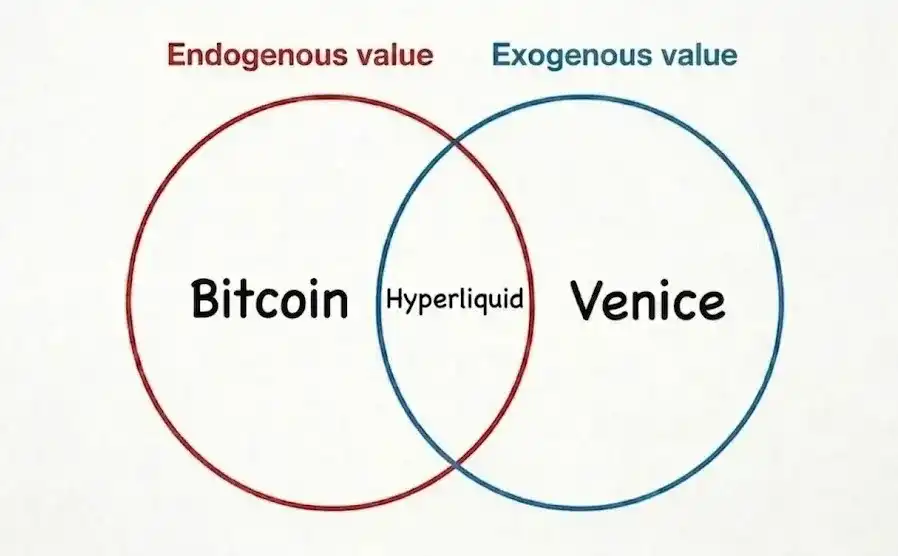
Bitcoin's value stems from its own attributes and is reflected in its price. Price increases further strengthen the market's perception of its value attributes. At the peak of a bull market, Bitcoin is revered as an "interstellar currency," the most scarce digital circulating asset in human hands; at the trough of a bear market, it is denigrated as a digital collectible with no cash flow support.

Hyperliquid falls between these two camps. Most of its business still relies on crypto market trends, but both supply and demand sides are continuously broadening. Many on-chain financial infrastructures fall into this category, with underlying assets gradually shifting towards real-world asset tokenization.
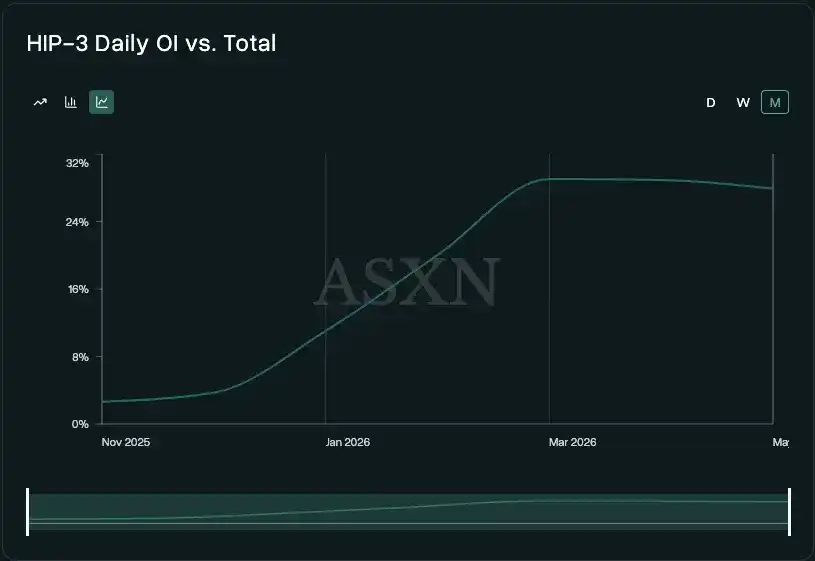
HIP-3 open interest can roughly reflect the activity of non-crypto trades. Currently, HIP-3 contracts account for about 30% of Hyperliquid's total open interest, whereas in November 2025, this proportion was only 4%. The upcoming HIP-4 prediction market will further drive growth, bringing new trading users and trading pairs.

Projects like Venice completely belong to the exogenous camp, with their development logic completely detached from the crypto market. Although there is some user overlap, its business model leans more towards consumer-grade artificial intelligence, rather than native crypto products like Uniswap. Uniswap's core business is still users trading various endogenous assets, so its performance naturally fluctuates with asset prices; Venice packages private multimodal inference services, adopting a "pay-per-use + subscription" fee model.

Venice's only connection to the crypto field is using tokens as a value carrier, and the fact that some of its computing power suppliers have backgrounds in the crypto industry. Project lead Erik Voorhees, a veteran in the crypto industry, believes that when used effectively, tokens can be excellent marketing tools.

Publicly listed company Figure is also a typical case. This fintech lending company developed its own blockchain, reducing the approval time for home equity loans to under 5 minutes. For Figure, blockchain is merely a supporting technology; its core value lies in the credit business itself.

The large-scale rise of exogenous tracks, whether in the token market or the listed company sector, has profound significance. In the past, as most business models were deeply tied to crypto asset prices, purely bottom-up fundamental investing was difficult to implement. The crypto industry has not been without narratives emphasizing "blockchain over Bitcoin," but previous cycles eventually returned to Bitcoin's performance. The reason was that these tracks failed to form stable demand and generate continuous revenue; even with revenue, it couldn't be transmitted to token value. Once token prices stopped rising, projects lost support.

This cycle is fundamentally different. Now we can clearly see paying user groups and payment logic. Demand in most tracks is quantifiable, no longer relying solely on sentiment-driven hype. Simultaneously, the mechanisms for tokens as value carriers are continuously improving. Venice's revenue comes from users genuinely paying for AI inference services. Even if the overall crypto market declines, its business wouldn't be significantly impacted because it doesn't rely on coin price movements. This cycle possesses two core advantages absent in previous ones: sustainable real-world usage demand, and investors starting to invest based on fundamentals rather than pure market narratives.

The stablecoin track in the private market is also like this. In March 2026, Mastercard announced it would acquire BVNK for up to $1.8 billion; this company had a valuation of only $750 million when it completed its Series B round 15 months prior. Another stablecoin-related company, Bridge, was acquired by Stripe for $1.1 billion in February 2025. According to Stripe's annual report, Bridge's current annual business growth is fourfold. The development of these companies is entirely decoupled from the crypto industry's bull and bear cycles.

This is not to say we are bearish on endogenous assets. Just as gold and even small gold mining companies always have their place in an investment portfolio, Bitcoin and a host of endogenous crypto assets also have their raison d'être. However, the performance drivers and market correlations of the two asset classes have fundamentally diverged, a fact confirmed by data.
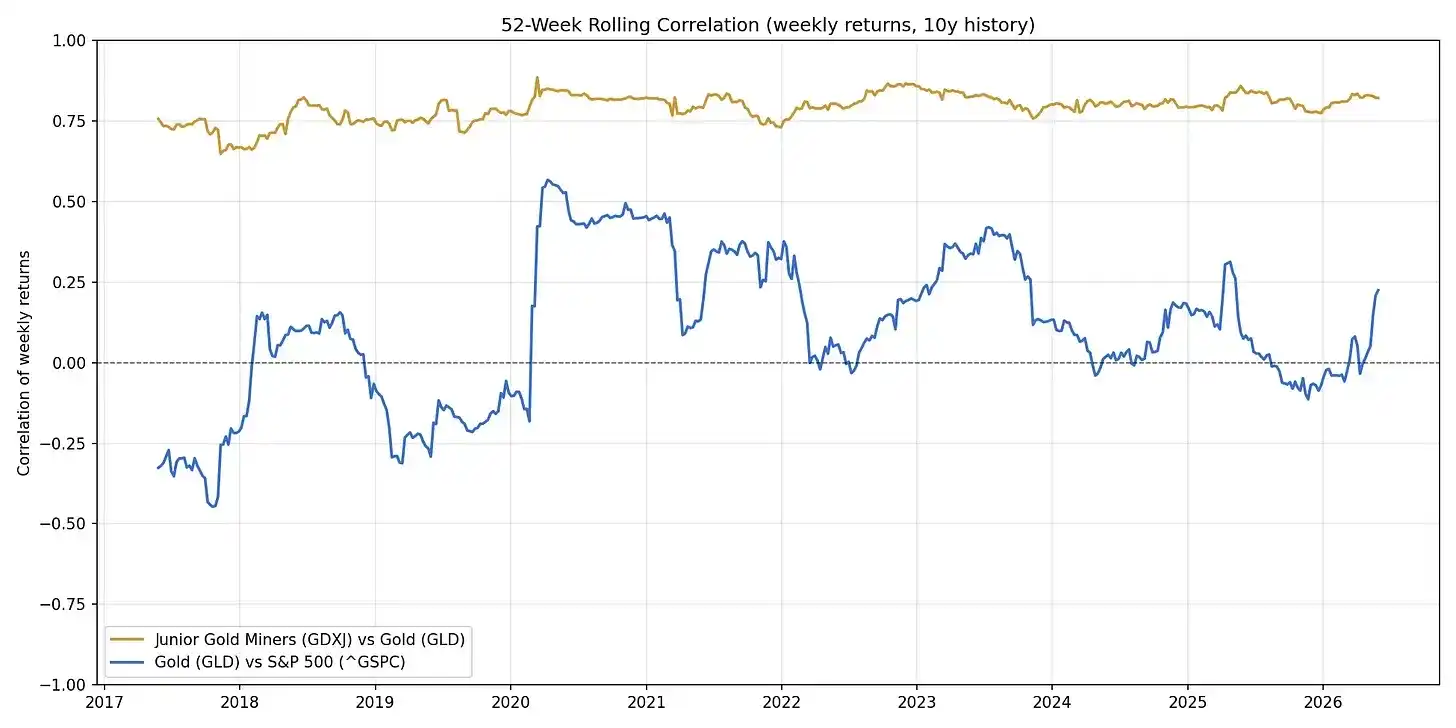
This analogy can be visualized: The correlation coefficient between small gold mining stocks and gold prices consistently remains around 0.75. This is precisely the current state of the traditional crypto market—various crypto assets are like small gold mines, with Bitcoin corresponding to gold; the entire sector represents leveraged investments relative to Bitcoin. The blue curve in the chart represents another relationship: Gold and the S&P 500 Index may show weak联动 due to macroeconomic influences, but each operates on its own independent logic. This is also the future direction for exogenous assets. In the long run, these assets will gradually decouple from the trend of "following Bitcoin's rise and fall."
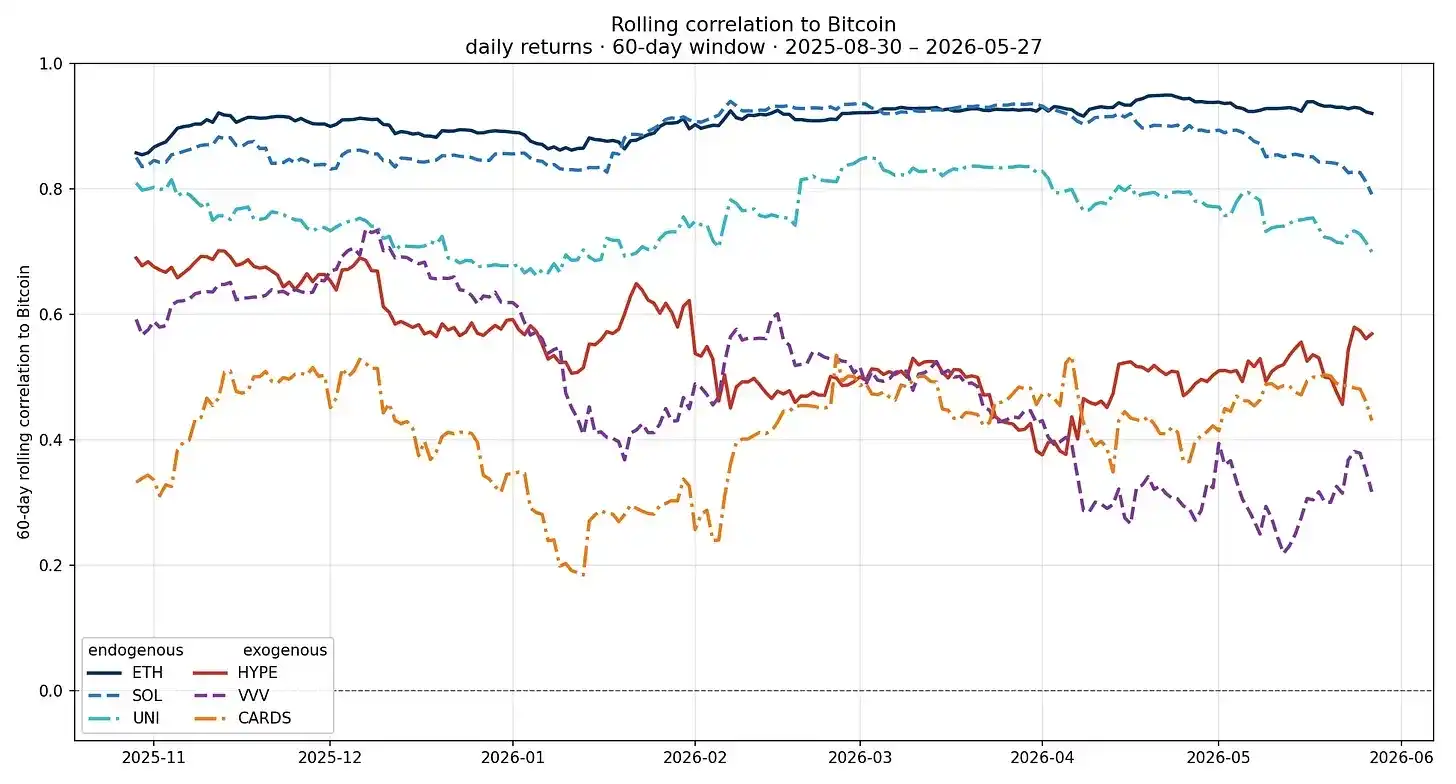
It should be noted that many exogenous assets themselves also issue tokens. This phenomenon both confirms the above trend and represents a special circumstance.

Currently, the vast majority of endogenous assets remain highly synchronized with Bitcoin's price movements. A few exogenous assets show reduced correlation, but due to their short development cycles, they do not yet provide strong reference points. Industry规律 has always been fundamentals first, followed by changes in market correlation.

This change has also completely rewritten industry analysis logic. Researching exogenous assets requires fundamental due diligence like analyzing traditional companies:梳理付费用户群体, measuring unit economics, and assessing industry moats. Bitcoin price is no longer the primary参考指标. Analyzing such projects is more akin to fintech investors making judgments, with the added special环节 of asset custody.

Here are the currently promising exogenous tracks:

  • On-chain exchanges and brokerage service providers
  • Clearing and redemption solutions for long-tail asset tokenization
  • Deep convergence tracks of crypto + AI (private inference, distributed open-source model training like Nous Research's Psyche, etc.)
  • New digital banks (Payy and Raycash, focusing on privacy protection,值得关注; Aztec and Zama providing programmable privacy infrastructure also have potential)
  • Lending track (Morpho has become a mainstream choice for institutional repo markets; smaller projects like Valinor and 3jane focus on private credit细分领域)
  • Stablecoin issuers, real-world asset tokenization service providers
  • Payment channels (in general payments, Stripe and Tempo are industry benchmarks; in agent payments, currently led by Coinbase)
  • Non-financial crypto consumer products (represented by Venice, Collector Crypt; these projects赋予实体业务价值 to tokens, driving product adoption and enabling marketing empowerment)
  • Agent economy (core opportunities lie in the agent接入层, service provider and creator协同生态, where substitutability is low. Cloudflare leads in布局, but whether it will charge traffic fees or merely provide basic services remains unclear)

At this stage, investing in equity of relevant companies remains the safest way to gain exposure to the above tracks, with优质代币标的 being rare exceptions. Only as the value-carrying mechanisms for tokens continue to optimize will their role be further enhanced. This requires joint推进 from regulators and the entire industry. Current work is underway: on the regulatory front, the 《CLARITY Act》 is稳步推进; on the industry front, institutions like Blockworks are推动市场信息透明化. Token mechanisms still have a long optimization journey ahead.

But none of these details change one core trend: the driving force of the crypto market is shifting from a single factor to multiple factors. The focus of industry research is also shifting from interpreting Bitcoin price charts to delving into corporate fundamentals. In the next decade, there will be no need to wonder why the "crypto market" no longer rises and falls in unison, because the industry landscape has been completely transformed.


Preguntas relacionadas

QAccording to the article, what are the two major camps that the crypto economy is now divided into, and what is their main difference?

AThe crypto economy is now divided into endogenous assets and exogenous assets. Endogenous assets are traditional crypto categories whose value is completely dependent on the overall crypto market trends. Exogenous assets nominally belong to the crypto track, but their value trajectory is increasingly independent of the crypto market.

QWhat examples of exogenous assets are mentioned in the article, and how do their business models differ from traditional crypto projects like Uniswap?

AExamples of exogenous assets mentioned are Venice and Figure. Venice operates more like a consumer-grade AI service, using a 'pay-per-use + subscription' model, with its core value not tied to crypto asset prices. Figure uses blockchain as a supporting technology to streamline its core lending business. Unlike Uniswap, whose core business is trading endogenous assets and thus fluctuates with their prices, these exogenous projects have business models independent of crypto market cycles.

QWhat two core advantages does the current market cycle possess that previous ones lacked, according to the author?

AThe current cycle possesses two core advantages: sustainable real usage demand and investors beginning to invest based on fundamentals rather than solely on market narratives.

QWhat is the key difference in how one should analyze exogenous assets compared to endogenous assets, as described in the article?

AAnalyzing exogenous assets requires fundamental due diligence similar to analyzing traditional companies. This includes examining the paying user base, calculating unit economics, and evaluating industry moats. The price of Bitcoin is no longer the primary reference indicator. The analysis is more akin to what a fintech investor would do, with the additional consideration of asset custody.

QWhat is the core trend identified by the article regarding the driving forces of the crypto market and the focus of industry research?

AThe core trend is that the driving force of the crypto market is shifting from a single factor to multiple factors. Consequently, the focus of industry research is changing from interpreting Bitcoin price charts to delving into corporate fundamentals.

Lecturas Relacionadas

Reddit Crypto Discussion: Tech Stocks Surge for 8 Months, Is the Crypto Community Starting to 'Accept Fate'?

Reddit Crypto Discussion: Has the Community 'Given Up' as Tech Stocks Soar? A recent post on Reddit's r/CryptoMarkets asking if the crypto market feels "dead" compared to surging tech stocks has sparked intense debate. The discussion highlights a community grappling with underperformance: Bitcoin is down ~44% from its October 2025 high and ~20% YTD in 2026, while the S&P 500 and Nasdaq 100 have gained significantly. The debate features classic opposing views. Some users, citing Bitcoin's history, are "cycle believers" who anticipate a return to form, arguing it has "died" many times before. Others counter that crypto's narratives keep shifting without delivering a stable, compelling real-world use case beyond speculation. A prevalent third view pinpoints AI as the core issue: the tech sector's transformative boom is absorbing all attention and capital, while crypto lacks a comparable, impactful utility. Data supports the pessimistic mood. Bitcoin spot ETFs saw their largest monthly net outflow in May 2026 (~$2.3B), indicating institutional de-risking. The Crypto Fear & Greed Index has fallen to "Fear" levels. When asked about the timing of a potential market rotation back to crypto, answers are uncertain. A key practical point raised is the current high-interest-rate environment, which makes stable yields from cash and bonds attractive, reducing incentive to move into volatile assets like crypto. The underlying anxiety, as one user summarized, is "opportunity cost"—the worry about missing gains elsewhere while waiting for a crypto revival.

marsbitHace 33 min(s)

Reddit Crypto Discussion: Tech Stocks Surge for 8 Months, Is the Crypto Community Starting to 'Accept Fate'?

marsbitHace 33 min(s)

Chatbot has been burning money for three years, is it still the 'New Continent' of the AI era?

For years, the AI industry has been guided by a singular "map" — the belief that the AI era's "new continent" would be found in the Chatbot, a super-app akin to the mobile internet's super-apps. This belief was fueled by ChatGPT's explosive 2022 debut. However, three years of heavy investment reveal a different reality: the Chatbot-as-ultimate-entry-point model is struggling. The core issue is economic. Chatbots defy traditional internet economics. Unlike apps with near-zero marginal cost, each AI query consumes significant, expensive compute. More users mean higher costs, not profits. OpenAI, despite ~900M weekly active users, reportedly loses money. The expected network effects and data flywheels that power internet giants are weak in Chatbots, as one user's interactions don't improve another's experience. Monetization is a major hurdle. The subscription model faces low conversion rates, especially in China where users expect AI to be free. The "free + ads" model also struggles. Chatbot interactions often lack commercial intent, and inserting ads compromises the trust essential for an answer engine. Perplexity's minimal ad revenue and subsequent pivot away from ads highlight this difficulty. Switching between Chatbots is easy, making user loyalty low and competition a potential race to the bottom on price. Data suggests the standalone Chatbot's growth is slowing, and user engagement (avg. ~6 mins/day) pales compared to apps like TikTok. The product form itself is limiting; studies show nearly half of interactions are simple Q&A, trapping AI's potential in a passive, single-turn "cage." A contrasting, more successful path is emerging, exemplified by Anthropic. With over 85% of its ~$30B annualized revenue from enterprises, it focuses on AI as a productivity tool, not a companion. The rise of AI Agents (like OpenClaw) and the integration of AI into existing workflows (e.g., Google's AI Overviews, Apple Intelligence in OS) signal a shift. The future may not be a dominant Chatbot app, but AI embedded seamlessly into social apps, operating systems, and hardware — a capability-layer revolution, not a new distribution container. The conclusion is clear: the old "map" centered on a standalone Chatbot super-app is leading to a dead end. To find the true valuable "continent" of the AI era, the industry must update its navigation to prioritize deep integration, practical utility, and sustainable economics over a generic conversation window.

marsbitHace 47 min(s)

Chatbot has been burning money for three years, is it still the 'New Continent' of the AI era?

marsbitHace 47 min(s)

Trading

Spot
Futuros

Artículos destacados

Qué es BITCOIN

Entendiendo HarryPotterObamaSonic10Inu (ERC-20) y Su Posición en el Espacio Cripto En los últimos años, el mercado de criptomonedas ha sido testigo de un aumento en la popularidad de las monedas meme, capturando el interés no solo de los comerciantes, sino también de aquellos que buscan compromiso comunitario y valor de entretenimiento. Entre estos tokens únicos se encuentra HarryPotterObamaSonic10Inu (ERC-20), un proyecto intrigante que mezcla referencias culturales en el tejido de las criptomonedas. Este artículo profundiza en los aspectos clave de HarryPotterObamaSonic10Inu, explorando sus mecanismos, ethos impulsado por la comunidad y su relación con el paisaje cripto más amplio. ¿Qué es HarryPotterObamaSonic10Inu (ERC-20)? Como su nombre sugiere, HarryPotterObamaSonic10Inu es una moneda meme construida sobre la blockchain de Ethereum, clasificada bajo el estándar ERC-20. A diferencia de las criptomonedas tradicionales que pueden enfatizar la utilidad práctica o el potencial de inversión, este token prospera en el valor de entretenimiento y la fuerza de su comunidad. El proyecto tiene como objetivo fomentar un entorno donde los usuarios comprometidos puedan reunirse, compartir ideas y participar en actividades inspiradas por diversos fenómenos culturales. Una característica notable de HarryPotterObamaSonic10Inu es su cero impuestos en las transacciones. Este atractivo elemento tiene como objetivo incentivar el comercio y la participación comunitaria, sin cargos adicionales que puedan disuadir a los comerciantes de pequeña escala. El suministro total de la moneda está establecido en mil millones de tokens, una cifra que marca su intención de mantener una circulación sustancial dentro de la comunidad. Creador de HarryPotterObamaSonic10Inu (ERC-20) Los orígenes de HarryPotterObamaSonic10Inu están algo envueltos en misterio; los detalles sobre el creador siguen siendo desconocidos. El desarrollo de este token carece de un equipo identificable o de un plan explícito, lo cual no es inusual dentro del sector de monedas meme. En cambio, el proyecto ha surgido de manera orgánica, con su progreso muy dependiente del entusiasmo y la participación de su comunidad. Inversores de HarryPotterObamaSonic10Inu (ERC-20) En cuanto a inversiones externas y respaldo, HarryPotterObamaSonic10Inu también sigue siendo ambiguo. El token no lista ninguna fundación de inversión conocida o apoyo organizacional significativo. En cambio, la savia del proyecto es su comunidad de base, que informa su crecimiento y sostenibilidad a través de la acción colectiva y el compromiso en el espacio cripto. ¿Cómo Funciona HarryPotterObamaSonic10Inu (ERC-20)? Como una moneda meme, HarryPotterObamaSonic10Inu opera principalmente fuera de los marcos tradicionales que a menudo rigen el valor de los activos. Hay varios aspectos distintivos que definen cómo funciona el proyecto: Transacciones Sin Impuestos: Sin tarifas impositivas en las transacciones, los usuarios pueden comprar y vender el token libremente sin preocuparse por costos ocultos. Compromiso Comunitario: El proyecto prospera en la interacción comunitaria, aprovechando plataformas de redes sociales para crear entusiasmo y facilitar la participación. Las discusiones, el intercambio de contenido y el compromiso son elementos cruciales que ayudan a expandir su alcance y fomentar la lealtad entre los seguidores. Sin Utilidad Práctica: Cabe señalar que HarryPotterObamaSonic10Inu no ofrece utilidad concreta dentro del ecosistema financiero. Más bien, se clasifica como un token principalmente para actividades de entretenimiento y comunitarias. Referencia Cultural: El token incorpora astutamente elementos de la cultura popular para atraer interés, conectando con entusiastas de los memes y seguidores de las criptomonedas por igual. HarryPotterObamaSonic10Inu ejemplifica cómo las monedas meme operan de manera diferente a los proyectos de criptomonedas más tradicionales, ingresando al mercado como construcciones sociales innovadoras en lugar de activos utilitarios. Cronología de HarryPotterObamaSonic10Inu (ERC-20) La historia de HarryPotterObamaSonic10Inu está marcada por varios hitos notables: Creación: El token surgió de un meme viral, capturando la imaginación de muchos entusiastas de las criptomonedas. Las fechas específicas de creación no están disponibles, subrayando su ascenso orgánico. Listado en Exchanges: HarryPotterObamaSonic10Inu ha llegado a varios exchanges, permitiendo un acceso y comercio más fácil por parte de la comunidad. Iniciativas de Compromiso Comunitario: Actividades continuas destinadas a mejorar la interacción comunitaria, incluyendo concursos, campañas en redes sociales y generación de contenido por parte de fanáticos y defensores. Planes de Expansión Futuros: La hoja de ruta del proyecto incluye el lanzamiento de una colección de NFT, mercancía y un sitio de comercio electrónico relacionado con sus temas culturales, involucrando aún más a la comunidad e intentando añadir más dimensiones a su ecosistema. Puntos Clave Sobre HarryPotterObamaSonic10Inu (ERC-20) Naturaleza Impulsada por la Comunidad: El proyecto prioriza la participación colectiva y la creatividad, asegurando que la involucración de los usuarios esté a la vanguardia de su desarrollo. Clasificación como Moneda Meme: Representa la epítome de las criptomonedas basadas en el entretenimiento, diferenciándose de los vehículos de inversión tradicionales. Sin Afiliación Directa con Bitcoin: A pesar de la similitud en el nombre del ticker, HarryPotterObamaSonic10Inu es distinto y no tiene relación con Bitcoin u otras criptomonedas establecidas. Enfoque en la Colaboración: HarryPotterObamaSonic10Inu está diseñado para crear un espacio para la colaboración y el intercambio de historias entre sus poseedores, proporcionando una vía para la creatividad y el vínculo comunitario. Perspectivas Futuras: La ambición de expandirse más allá de su premisa inicial hacia NFTs y mercancías describe un camino para que el proyecto potencialmente ingrese a avenidas más tradicionales dentro de la cultura digital. A medida que las monedas meme continúan capturando la imaginación de la comunidad de criptomonedas, HarryPotterObamaSonic10Inu (ERC-20) se destaca debido a sus lazos culturales y su enfoque centrado en la comunidad. Si bien puede no encajar en el molde típico de un token impulsado por la utilidad, su esencia radica en la alegría y la camaradería fomentadas entre sus seguidores, destacando la naturaleza en evolución de las criptomonedas en una era cada vez más digital. A medida que el proyecto continúa desarrollándose, será importante observar cómo las dinámicas comunitarias influyen en su trayectoria en el cambiante paisaje de la tecnología blockchain.

1.5k Vistas totalesPublicado en 2024.04.01Actualizado en 2024.12.03

Qué es BITCOIN

Cómo comprar BTC

¡Bienvenido a HTX.com! Hemos hecho que comprar Bitcoin (BTC) sea simple y conveniente. Sigue nuestra guía paso a paso para iniciar tu viaje de criptos.Paso 1: crea tu cuenta HTXUtiliza tu correo electrónico o número de teléfono para registrarte y obtener una cuenta gratuita en HTX. Experimenta un proceso de registro sin complicaciones y desbloquea todas las funciones.Obtener mi cuentaPaso 2: ve a Comprar cripto y elige tu método de pagoTarjeta de crédito/débito: usa tu Visa o Mastercard para comprar Bitcoin (BTC) al instante.Saldo: utiliza fondos del saldo de tu cuenta HTX para tradear sin problemas.Terceros: hemos agregado métodos de pago populares como Google Pay y Apple Pay para mejorar la comodidad.P2P: tradear directamente con otros usuarios en HTX.Over-the-Counter (OTC): ofrecemos servicios personalizados y tipos de cambio competitivos para los traders.Paso 3: guarda tu Bitcoin (BTC)Después de comprar tu Bitcoin (BTC), guárdalo en tu cuenta HTX. Alternativamente, puedes enviarlo a otro lugar mediante transferencia blockchain o utilizarlo para tradear otras criptomonedas.Paso 4: tradear Bitcoin (BTC)Tradear fácilmente con Bitcoin (BTC) en HTX's mercado spot. Simplemente accede a tu cuenta, selecciona tu par de trading, ejecuta tus trades y monitorea en tiempo real. Ofrecemos una experiencia fácil de usar tanto para principiantes como para traders experimentados.

4.9k Vistas totalesPublicado en 2024.12.12Actualizado en 2026.06.02

Cómo comprar BTC

Qué es $BITCOIN

ORO DIGITAL ($BITCOIN): Un Análisis Integral Introducción al ORO DIGITAL ($BITCOIN) ORO DIGITAL ($BITCOIN) es un proyecto basado en blockchain que opera en la red Solana, cuyo objetivo es combinar las características de los metales preciosos tradicionales con la innovación de las tecnologías descentralizadas. Aunque comparte un nombre con Bitcoin, a menudo referido como “oro digital” debido a su percepción como un refugio de valor, ORO DIGITAL es un token separado diseñado para crear un ecosistema único dentro del paisaje Web3. Su meta es posicionarse como un activo digital alternativo viable, aunque los detalles sobre sus aplicaciones y funcionalidades aún están en desarrollo. ¿Qué es ORO DIGITAL ($BITCOIN)? ORO DIGITAL ($BITCOIN) es un token de criptomoneda diseñado explícitamente para su uso en la blockchain de Solana. A diferencia de Bitcoin, que proporciona un papel de almacenamiento de valor ampliamente reconocido, este token parece centrarse en aplicaciones y características más amplias. Aspectos notables incluyen: Infraestructura Blockchain: El token está construido sobre la blockchain de Solana, conocida por su capacidad para manejar transacciones de alta velocidad y bajo costo. Dinámicas de Suministro: ORO DIGITAL tiene un suministro máximo limitado a 100 cuatrillones de tokens (100P $BITCOIN), aunque los detalles sobre su suministro circulante no se han divulgado actualmente. Utilidad: Si bien las funcionalidades precisas no están delineadas explícitamente, hay indicios de que el token podría ser utilizado para diversas aplicaciones, potencialmente involucrando aplicaciones descentralizadas (dApps) o estrategias de tokenización de activos. ¿Quién es el Creador de ORO DIGITAL ($BITCOIN)? En la actualidad, la identidad de los creadores y el equipo de desarrollo detrás de ORO DIGITAL ($BITCOIN) sigue siendo desconocida. Esta situación es típica entre muchos proyectos innovadores dentro del espacio blockchain, particularmente aquellos alineados con las finanzas descentralizadas y fenómenos de monedas meme. Si bien tal anonimato puede fomentar una cultura impulsada por la comunidad, intensifica las preocupaciones sobre la gobernanza y la responsabilidad. ¿Quiénes son los Inversores de ORO DIGITAL ($BITCOIN)? La información disponible indica que ORO DIGITAL ($BITCOIN) no tiene patrocinadores institucionales conocidos ni inversiones destacadas de capital de riesgo. El proyecto parece operar en un modelo de peer-to-peer centrado en el apoyo y la adopción de la comunidad en lugar de rutas de financiamiento tradicionales. Su actividad y liquidez se sitúan principalmente en intercambios descentralizados (DEX), como PumpSwap, en lugar de plataformas de trading centralizadas establecidas, lo que resalta aún más su enfoque de base. Cómo Funciona ORO DIGITAL ($BITCOIN) Los mecanismos operativos de ORO DIGITAL ($BITCOIN) pueden elaborarse en función de su diseño blockchain y atributos de red: Mecanismo de Consenso: Al aprovechar el único proof-of-history (PoH) de Solana combinado con un modelo de proof-of-stake (PoS), el proyecto asegura una validación de transacciones eficiente que contribuye al alto rendimiento de la red. Tokenómica: Si bien los mecanismos deflacionarios específicos no se han detallado extensamente, el vasto suministro máximo de tokens implica que podría atender microtransacciones o casos de uso nicho que aún están por definirse. Interoperabilidad: Existe el potencial de integración con el ecosistema más amplio de Solana, incluyendo varias plataformas de finanzas descentralizadas (DeFi). Sin embargo, los detalles sobre integraciones específicas permanecen no especificados. Cronología de Eventos Clave Aquí hay una cronología que destaca hitos significativos relacionados con ORO DIGITAL ($BITCOIN): 2023: El despliegue inicial del token ocurre en la blockchain de Solana, marcado por su dirección de contrato. 2024: ORO DIGITAL gana visibilidad al estar disponible para trading en intercambios descentralizados como PumpSwap, permitiendo a los usuarios comerciar contra SOL. 2025: El proyecto presencia actividad de trading esporádica y potencial interés en compromisos liderados por la comunidad, aunque no se han documentado asociaciones notables o avances técnicos hasta el momento. Análisis Crítico Fortalezas Escalabilidad: La infraestructura subyacente de Solana soporta altos volúmenes de transacciones, lo que podría mejorar la utilidad de $BITCOIN en varios escenarios de transacción. Accesibilidad: El potencial bajo precio de trading por token podría atraer a inversores minoristas, facilitando una participación más amplia debido a oportunidades de propiedad fraccionada. Riesgos Falta de Transparencia: La ausencia de patrocinadores, desarrolladores o un proceso de auditoría conocidos públicamente puede generar escepticismo sobre la sostenibilidad y confiabilidad del proyecto. Volatilidad del Mercado: La actividad de trading depende en gran medida del comportamiento especulativo, lo que puede resultar en una volatilidad de precios significativa y en incertidumbre para los inversores. Conclusión ORO DIGITAL ($BITCOIN) surge como un proyecto intrigante pero ambiguo dentro del ecosistema de Solana en rápida evolución. Si bien intenta aprovechar la narrativa del “oro digital”, su alejamiento del papel establecido de Bitcoin como refugio de valor subraya la necesidad de una diferenciación más clara de su utilidad y estructura de gobernanza previstas. La aceptación y adopción futura dependerán probablemente de abordar la actual opacidad y de definir sus estrategias operativas y económicas de manera más explícita. Nota: Este informe abarca información sintetizada disponible hasta octubre de 2023, y pueden haber ocurrido desarrollos más allá del período de investigación.

83 Vistas totalesPublicado en 2025.05.13Actualizado en 2025.05.13

Qué es $BITCOIN

Discusiones

Bienvenido a la comunidad de HTX. Aquí puedes mantenerte informado sobre los últimos desarrollos de la plataforma y acceder a análisis profesionales del mercado. A continuación se presentan las opiniones de los usuarios sobre el precio de BTC (BTC).

活动图片