a16z: 7 Charts to Understand How Tokenization is Changing the Nature of Assets

链捕手Publicado a 2026-05-24Actualizado a 2026-05-24

Resumen

"a16z: 7 Charts on How Tokenization is Changing the Nature of Assets" Tokenized Assets (or Real-World Assets - RWA) are transforming asset forms, liquidity, and financial system construction. The market recently surpassed $30 billion, stabilizing around $34 billion (excluding stablecoins), representing a tenfold increase in less than two years, driven by clearer regulations, mature institutional infrastructure, and increased financial institution adoption. The primary driver of recent growth is tokenized U.S. Treasury bonds. These offer investors efficient, flexible digital access to yield-bearing assets and improve institutional operations like settlement and collateral management. Other asset classes show varied growth: asset-backed credit leads, followed by niche financial assets (e.g., reinsurance, mining notes), while venture capital took longer to scale. Market segmentation shows high concentration. In commodities, tokenized gold dominates (~$5 billion), as its standardized, storable nature fits tokenization well. Bonds are the largest category ($15.2B), but only ~5% are used in DeFi protocols. Conversely, smaller niches like reinsurance tokens see high (~84%) on-chain utilization, highlighting a core industry divide: most current tokenized assets are merely digitized records for easier holding/transfer, lacking the "composability" (free combination/interaction) that is key to blockchain-native finance. The ecosystem is distributed across multiple blockchains, with ...

Article sourced from: a16z crypto

Compiled by: Moni, Odaily Planet Daily

Tokenized Assets, often referred to as "Real World Assets (RWA)", are altering the form of assets, how they flow, and the way financial systems are constructed.

Just last month, the market size of tokenized assets surpassed $30 billion and is currently stable at around $34 billion (excluding stablecoins). This scale is roughly equivalent to a regional bank or a top-tier university endowment fund. While still minuscule compared to the global financial system, it is substantial enough to have a real-world impact.

Consider that two years ago, the tokenized asset market was less than $3 billion, but then the landscape changed dramatically: the US GENIUS Act brought a clearer regulatory framework for stablecoins, institutional-grade on-chain infrastructure matured, and a large number of financial institutions began deploying blockchain technology almost simultaneously. It was the combined force of these factors that drove the tokenized asset market to grow tenfold in under two years. (Note: Although stablecoins are not included in the above statistics, they have substantively propelled the entire market's growth by significantly simplifying on-chain payments and settlements.)

This article will use 7 charts to analyze the reasons behind the rise of tokenized assets and their future trajectory.

Tokenized Assets Take Off: US Treasuries as the Primary Growth Engine

US Treasuries have been the main driver of recent growth in the tokenized asset market.

The advantages of tokenized US Treasuries are clear and intuitive: investors can hold stable, yield-generating assets in a digital form, enabling more efficient and flexible trading and transfer; financial institutions can achieve improvements in settlement and collateral asset allocation efficiency, seamlessly connecting with digital financial markets.
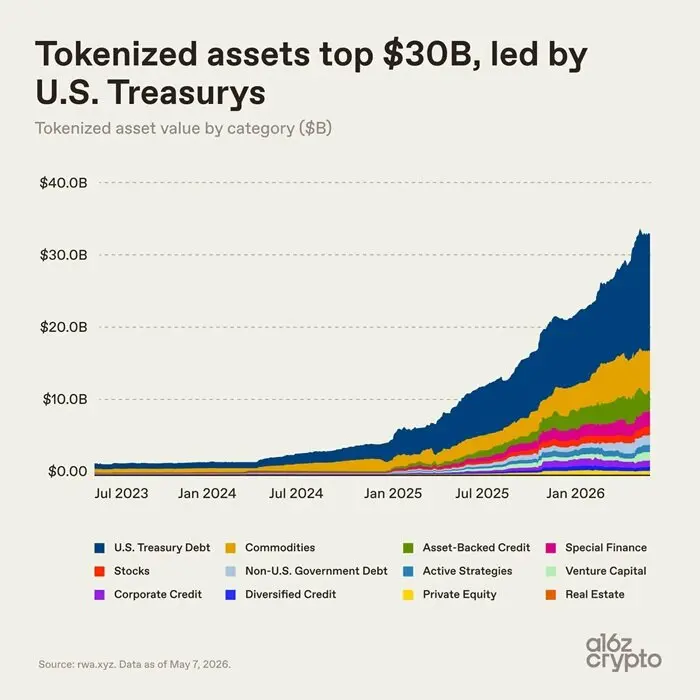
Crypto investors can also leverage tokenized Treasuries to utilize idle stablecoins, gaining access to traditional money market yields. Asset management institutions like BlackRock and Franklin Templeton have followed suit with their deployments, catalyzing a trillion-dollar market.
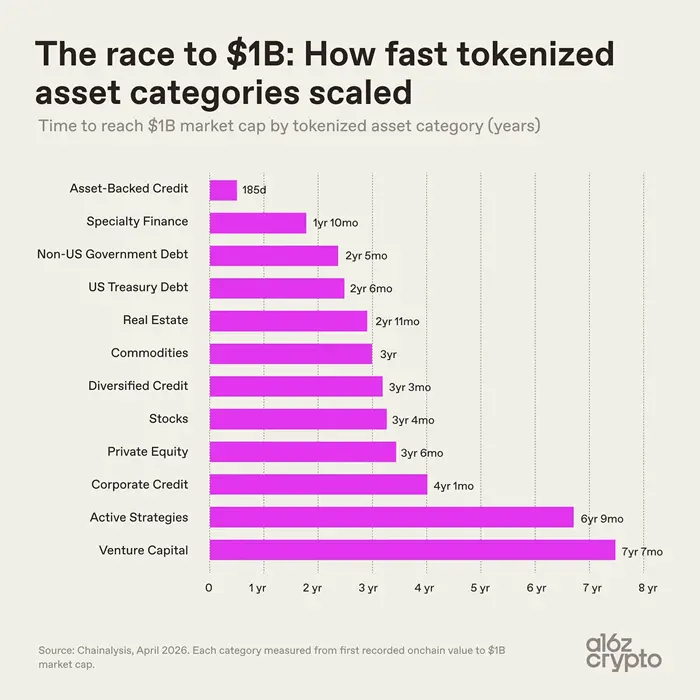
It's important to note that the growth rates vary significantly across different types of tokenized assets, stemming from both the technical and compliance challenges of bringing various assets on-chain, as well as market acceptance after product launch.

  • Asset-backed credit assets lead the growth by a wide margin. These tokenized assets mainly include tokenized home equity lines of credit, lending vault tokens, with reinsurance contracts and Bitcoin mining notes among other niche financial assets following, reaching a market cap of $1 billion within two years.
  • Venture capital assets took over seven years to surpass a $10 billion market cap, with active strategy assets on a similar timeline. These assets have complex structures, long investment cycles, and higher operational and regulatory barriers.
  • Treasuries and commodities took a moderate pace, reaching a $10 billion market cap in 2 to 3 years and are now mainstream categories in the market.

At the beginning of 2024, Treasuries and commodities almost entirely dominated the tokenized asset market share. After 2024, categories like credit, niche finance, and equities steadily increased their shares, but market concentration remains high. Currently, US tokenized Treasuries and commodities collectively account for about two-thirds of the market.
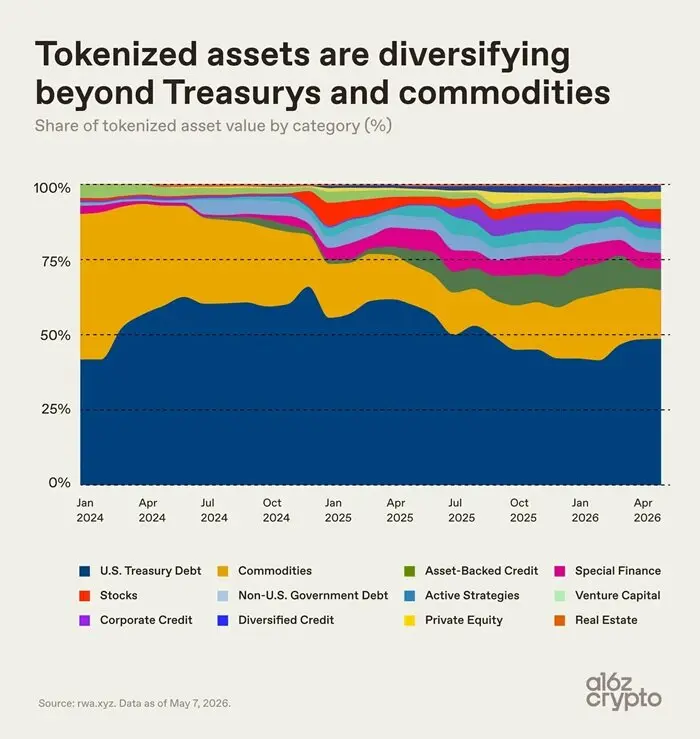
Segmented Landscape of the Tokenized Asset Market

The commodity tokenization sector is highly concentrated internally, with gold tokens dominating the vast majority of the share, totaling about $5.1 billion, of which gold tokens account for $5.0 billion. Silver and other category tokens amount to only $57.6 million, constituting less than 0.01%.

Gold is inherently well-suited for the tokenized asset model. Currently, the commodity token market is essentially led by gold because it has a globally unified standard, is easy to store, not easily perishable, and has long been traded based on entitlement certificates.

Furthermore, crypto market investors have historically favored gold assets, with Bitcoin being hailed as digital gold early on. Products like Tether's gold token XAUT and Paxos' gold token PAXG map ownership of vault gold to the blockchain, converting physical gold entitlements into digital tokens that can be held in on-chain wallets.
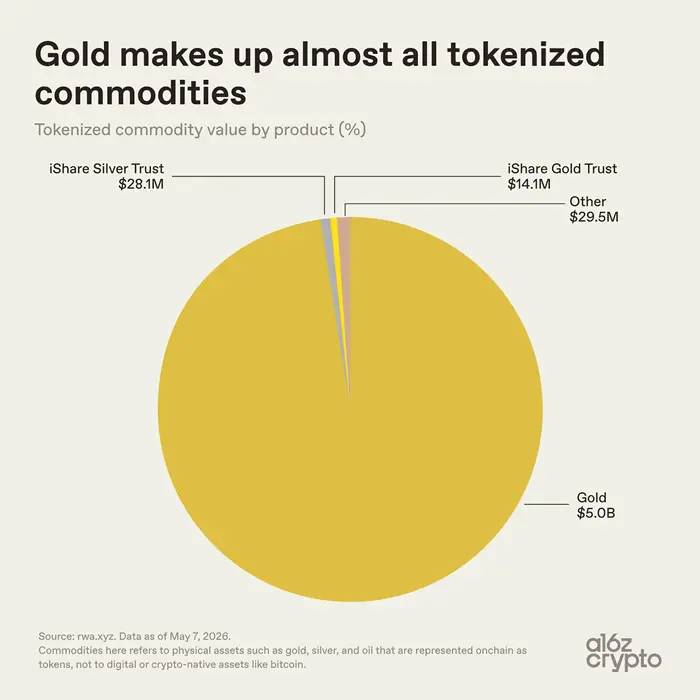
Tokenized assets for crude oil, agricultural products, and emerging categories like energy and computing power have an extremely low market share, with the industry still in its nascent stage.

Looking at the distribution across underlying public chains, the tokenized asset ecosystem is more diverse. Ethereum, leveraging its first-mover advantage in decentralized finance and institutional adoption foundation, still holds the leading position, hosting assets worth $15.7 billion, accounting for over half of the market.

The remaining tokenized asset market is distributed across multiple public chains: BNB Chain's tokenized asset market size is about $4.0 billion, Solana about $2.2 billion, Stellar about $1.7 billion, Bitcoin sidechain Liquid Network about $1.5 billion, while XRP Ledger, ZKsync Era, and Arbitrum each have on-chain tokenized asset sizes close to $1 billion.
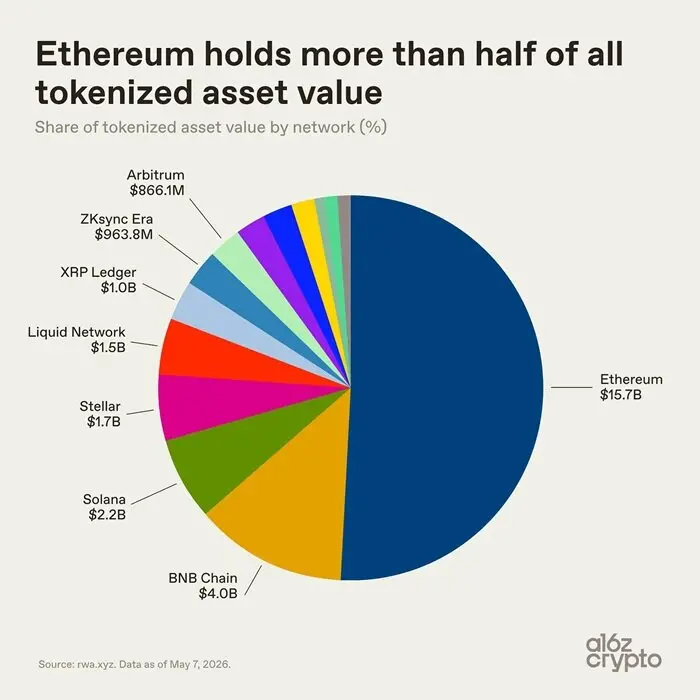
The tokenized asset industry has not consolidated onto a single public chain. Assets are distributed across major blockchain ecosystems based on transaction costs, liquidity, compliance requirements, and business partnerships. However, the most telling data point is not the size of the tokenized asset market... but rather how these assets are being used.

Let's continue the analysis—

Most Tokenized Assets Currently Lack "Composability"

Market size is not the only core metric; the actual application value of assets is more telling.

Bonds are the largest category of tokenized assets by market cap, at $15.2 billion, but only 5% of the circulating supply is utilized in DeFi protocols, amounting to just about $800 million. The utilization rate for precious metal tokenized assets is similarly low, with most tokenized assets only used for on-chain storage, not yet becoming freely composable and interactively reusable financial building blocks.

The performance of niche tokenized asset categories is starkly opposite: reinsurance tokens with a market cap of $362 million have an 84% on-chain protocol usage rate; private credit tokens have a 33% usage rate. These asset types were designed from the outset to fit composable on-chain application scenarios. In contrast, top-tier tokenized assets like Treasuries and gold are primarily positioned to simplify on-chain asset holding and transfer without altering the asset's inherent operational logic. This situation highlights a core divergence in the tokenized asset industry: varying degrees of on-chain nativity among different tokenized assets.
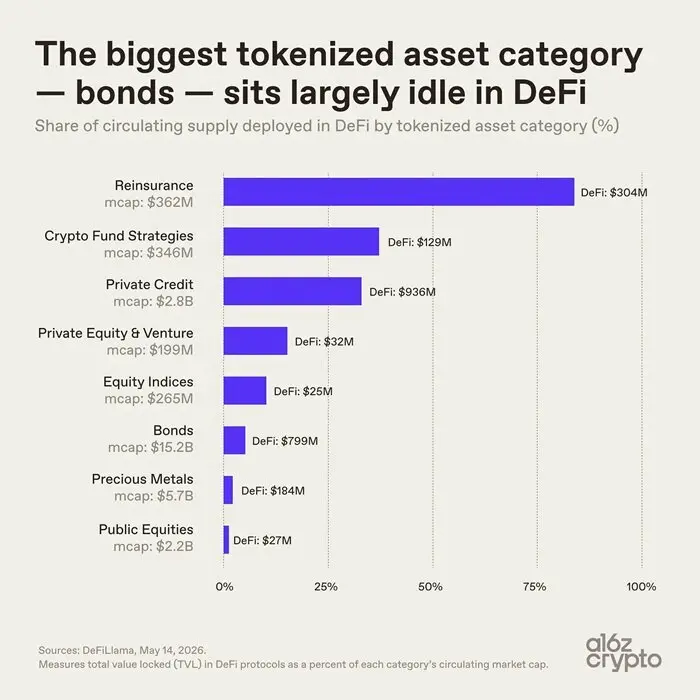
Some assets can flow and be applied freely across chains, while others merely use blockchain as a ledger tool, with limited asset transfer and composability functions. Currently, most tokenized assets are essentially just digitized assets, merely migrating accounts onto the chain without unleashing their composability potential. Composability is the core value of on-chain finance and a key to upgrading the financial system.

Pantera Capital's Token Native Index shows that over 70% of tokenized assets have the lowest level of on-chain nativity. A large number of tokens are merely digital certificates for offline physical assets, with actual asset control still reliant on offline ledgers and intermediary institutions.

The tokenized asset industry is still in its early developmental stage: one category consists of assets that are only formally on-chain digital records, while another comprises assets deeply integrated with blockchain characteristics as native on-chain assets.

On-chain composability technology infrastructure is already in place, and asset categories are gradually enriching, but deep integration applications have only just begun.

Future Trends for Tokenized Assets

Industry predictions for the long-term scale of the tokenized asset market vary, but overall, all indicate sustained market expansion.

  • McKinsey predicts the tokenized asset market will reach $2 to $4 trillion by 2030;
  • Ark Invest estimates the tokenized asset market at $1.1 trillion;
  • Boston Consulting Group, in collaboration with Ripple, calculates that the tokenized asset market will reach $9.4 trillion by 2030, climbing to $18.9 trillion by 2033;
  • Standard Chartered forecasts that the tokenized asset market will exceed $3 trillion by 2034.

Based on the above institutional estimates, compared to the current market size of $34 billion, the tokenized asset market has a potential for hundredfold growth. Of course, the numerical differences do not stem from divergent judgments about industry adoption speed but rather from differing statistical definitions. The scopes used by various institutions vary, encompassing different asset categories, whether stablecoins and deposits are included, and the defined range of tokenization. For example: McKinsey's statistics focus on bonds, credit, funds, and stocks; Standard Chartered adds commodities and trade finance; Boston Consulting Group and Ripple additionally include deposits and stablecoins. However, despite differing statistical scopes, the industry unanimously agrees that the scale of tokenized assets will experience leapfrog expansion.

Looking at the global financial landscape, the current size of tokenized assets remains minuscule.

  • The global bond market exceeds $140 trillion, while tokenized bonds are only $15.2 billion, accounting for 0.01%;
  • The global market value of physical gold is in the trillions of dollars, while tokenized gold is $5 billion, less than 0.02%;
  • The global stock market capitalization exceeds $100 trillion, while tokenized stocks are $1.5 billion, a mere 0.001%.
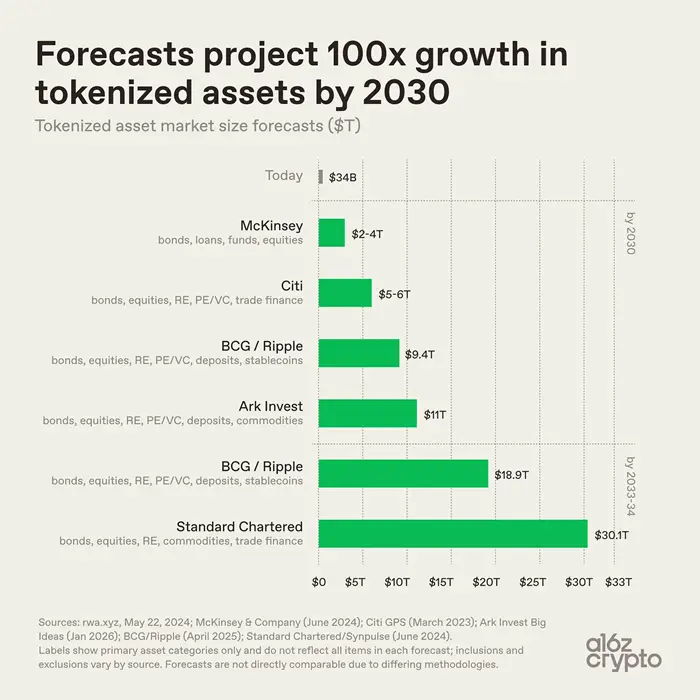
Today, emerging sectors are steadily taking shape. Assets with clear pricing, stable demand, and simple ownership like US Treasuries, gold, and private credit have been the first to achieve on-chain implementation. At this stage, tokenization has not yet overturned the underlying nature of assets; it merely optimizes asset settlement and transfer methods. The deep integration of assets with the digital financial system is still under exploration.

Currently, tokenized assets remain largely at the digitization level, with assets struggling to achieve programmable, composable applications. The industry faces a core challenge in its next phase: bringing more complex parts of the financial system on-chain and integrating tokenized assets more deeply into composable, internet-native financial infrastructure.


Preguntas relacionadas

QWhat are tokenized assets, and how are they currently impacting the financial system according to the a16z article?

ATokenized assets, often referred to as Real World Assets (RWA), are financial assets whose ownership or economic rights are represented and transacted on a blockchain as tokens. The article states they are changing the shape of assets, how they flow, and how financial systems are built. Their market size recently surpassed $34 billion, equivalent to a regional bank, indicating a tangible impact by enabling more efficient settlement, transfer, and integration with digital finance.

QWhat is cited as the primary driver for the recent explosive growth (10x in 2 years) of the tokenized assets market?

AThe primary driver is tokenized U.S. Treasury bonds. They offer crypto investors a way to earn yield on idle stablecoins and provide institutional efficiency benefits. This surge was also supported by clearer regulatory frameworks, maturation of institutional-grade blockchain infrastructure, and increased deployment of blockchain technology by financial institutions.

QBased on the charts and analysis, which major tokenized asset categories currently dominate the market in terms of size and usage?

AU.S. Treasury bonds and commodities dominate in terms of total market size, collectively representing about two-thirds of the market. However, in terms of actual DeFi usage and on-chain 'composability,' private credit and reinsurance tokenized assets show much higher utilization rates. Commodities are highly concentrated, with tokenized gold representing almost the entire sub-sector.

QWhat key limitation does the article identify regarding most of today's largest tokenized assets, such as bonds and gold?

AThe key limitation is their lack of 'composability.' Most large tokenized assets are not actively used in DeFi protocols; they are primarily used for on-chain storage and transfer. They represent a digital record of an off-chain asset without enabling programmable, interoperable financial applications, which is a core value proposition of blockchain-based finance.

QWhat is the predicted long-term growth potential for the tokenized asset market as cited by various institutions in the article?

AInstitutions predict massive growth, from a current base of ~$34 billion to trillions of dollars by 2030. Specific forecasts include McKinsey ($2-4 trillion), Ark Invest ($11 trillion), BCG/Ripple ($9.4 trillion by 2030, $18.9 trillion by 2033), and Standard Chartered ($30 trillion by 2034). This represents potential growth of over 100x, though definitions of what is included in 'tokenized assets' vary between estimates.

Lecturas Relacionadas

Google CEO Admits Lagging Behind in Coding

Google CEO Sundar Pichai acknowledged in a recent interview that Google's Gemini AI models are currently "lagging behind" in coding capabilities, particularly for complex, long-horizon tasks requiring advanced developer expertise. He noted the field is advancing at an "unprecedented" pace, where 30-60 days now brings changes equivalent to five years in the past. Pichai expressed that achieving Artificial General Intelligence (AGI) now seems closer than previously imagined due to rapid progress. While highlighting strengths in text, multimodal, and reasoning tasks, Pichai admitted competitors like Anthropic and OpenAI have focused more intently on coding. He emphasized Google's commitment to catching up, citing internal tools like Antigravity 2.0 and the newly released Gemini 3.5 Flash, which aims to address previous shortcomings. Regarding Google Search's AI-driven overhaul, Pichai stated changes will be gradual to align with user needs, not disrupt the core search experience or its advertising model. He addressed public AI anxiety as understandable, given the technology's potential to reshape jobs and society, but remained optimistic about AI augmenting human capabilities and creating new opportunities. Pichai stressed the need for broad societal dialogue and responsible development as AI approaches more advanced, potentially recursive self-improvement stages. He affirmed Google's long-term commitment to leading in AI while navigating its profound implications responsibly.

marsbitHace 32 min(s)

Google CEO Admits Lagging Behind in Coding

marsbitHace 32 min(s)

The Paradox of Automation: The Stronger the AI, the Busier Humans Become

The Paradox of Automation: The more powerful AI becomes, the more work humans have to do. This article, based on observations from AI-heavy company Every, argues that while AI agents automate tasks like coding, writing, and customer service, they don't eliminate human jobs. Instead, they transform work and create *more* demand for human expertise. AI commoditizes "yesterday's human capabilities" by cheaply generating code, text, and images from past data. This leads to an abundance of similar, generic outputs. Consequently, what becomes scarce and valuable is human judgment in the present moment: knowing *what* is worth doing, *why*, and *how* to do it well. The article identifies two collaboration models: "Agent employees" for delegated tasks and "human-AI collaboration" within tools like Claude Code for complex work. In both cases, humans are essential to set direction, judge quality, and maintain systems. As AI makes execution cheap, human roles shift from executors to designers, reviewers, and meaning-makers. The author addresses "benchmark anxiety" by explaining that AI excels within specific, human-defined problem "frames." As AI masters one frame (e.g., code rewriting), new, more complex frames emerge (e.g., deciding *when* to rewrite). This creates an ongoing cycle where AI chases the frames, but humans remain the "framers." Even with advanced AGI, this dynamic may persist as long as AI lacks true human-like agency and self-directed purpose. The core paradox holds: automation amplifies the need for the very human judgment it seems to replace.

marsbitHace 1 hora(s)

The Paradox of Automation: The Stronger the AI, the Busier Humans Become

marsbitHace 1 hora(s)

a16z: How Tokenization is Transforming the Nature of Assets in 7 Charts

"Tokenized Assets: How Tokenization Changes the Nature of Assets" by a16z Crypto The market for tokenized assets, excluding stablecoins, has grown from under $3 billion two years ago to over $340 billion today. US Treasury bonds are the primary growth driver, allowing investors to hold yield-bearing assets digitally and enabling more efficient settlement. Other key sectors include private credit (growing fastest), commodities (dominated by gold), and niche financial assets. However, the market remains concentrated in tokenized US Treasuries and gold. A critical insight is that most tokenized assets currently lack "composability." While the total market is large, only a small fraction is actively used within DeFi protocols. For instance, only about 5% of tokenized bonds and a low percentage of tokenized gold are utilized on-chain. In contrast, assets like reinsurance and private credit tokens show much higher on-chain usage rates (84% and 33%, respectively). This highlights a divide: many tokenized assets are merely digital records on a blockchain without enabling new, programmable financial applications. The Pantera Capital Token Native Index indicates over 70% of tokenized assets have minimal on-chain native functionality. Ethereum remains the dominant blockchain for tokenized assets (over $150B), but the ecosystem is diversifying across chains like BNB Chain, Solana, and Stellar, based on factors like cost and compliance. Major institutions forecast massive future growth, with predictions for the tokenized asset market ranging from $2 trillion to over $30 trillion by the early 2030s. However, compared to the global financial system (e.g., ~$140T bonds, multi-trillion dollar gold market), tokenized assets currently represent a tiny fraction (0.01% or less). The conclusion is that while tokenization has begun by digitizing and streamlining settlement for simpler assets, the next phase involves bringing more complex financial instruments on-chain and deeply integrating them into composable, internet-native financial infrastructure.

Odaily星球日报Hace 3 hora(s)

a16z: How Tokenization is Transforming the Nature of Assets in 7 Charts

Odaily星球日报Hace 3 hora(s)

The Revived Codex, Carrying OpenAI's Hopes for IPO

This article analyzes the intense recent development of OpenAI's Codex, positioning it as a crucial component for OpenAI's impending IPO. Over the past two months, Codex has seen a rapid series of major updates focused on integrating into real enterprise workflows. Key new features include enhanced context capture (Appshots, file previews, built-in browser), long-running task execution ("Goal Mode"), remote operation (phone control, lock-screen access), and enterprise management tools (plugin sharing, access tokens, automated risk review). These updates aim to make Codex a comprehensive AI workbench that can "see the scene, push tasks, and manage risks." The author argues that while ChatGPT proves OpenAI's massive user base and API provides foundational revenue, Codex represents OpenAI's clearest path to demonstrating tangible, high-value commercial viability. It targets developers and engineering teams—a segment already accustomed to paying for efficiency gains in costly software development cycles. This is critical because, despite higher overall revenue, OpenAI's adjusted operating margins remain deeply negative, highlighting the challenge of outrunning immense compute costs. The pressure is amplified by competitor Anthropic's success with Claude Code, which has shown that a focused approach on high-value enterprise and developer workflows can lead to a path toward profitability. Codex's aggressive evolution is thus seen as OpenAI's strategic move to capture a similar enterprise-ready, revenue-generating narrative essential for its market debut. In essence, "ChatGPT proved OpenAI has users. Codex needs to prove OpenAI is a business that can make money."

marsbitHace 4 hora(s)

The Revived Codex, Carrying OpenAI's Hopes for IPO

marsbitHace 4 hora(s)

a16z: 7 Charts to Understand How Tokenization Is Changing the Nature of Assets

a16z: 7 Charts on How Tokenization is Transforming the Nature of Assets Tokenized Assets, often referred to as "real-world assets" (RWA), are altering the form, flow, and structure of the financial system. The market recently surpassed $30 billion (excluding stablecoins), driven largely by tokenized U.S. Treasuries. These offer investors digital, yield-bearing assets with efficient settlement. Growth varies significantly by asset class. Asset-backed credit leads in speed, followed by niche financial assets, while venture capital and active strategies took longer to scale. U.S. Treasuries and commodities dominate, holding about two-thirds of the current market share. Within commodities, gold tokenization dominates entirely due to its standardization and historical appeal in crypto. The ecosystem is spread across multiple blockchains. Ethereum holds over half the market, with others like BNB Chain, Solana, and Stellar holding significant shares. However, a key insight is that most tokenized assets currently lack "composability." While the total market is large, only a small fraction (e.g., 5% of tokenized bonds) is used within DeFi protocols. Many tokens are simply digital records of off-chain assets, not natively programmable financial building blocks. In contrast, smaller categories like reinsurance tokens see very high on-chain usage. Looking ahead, forecasts for the tokenized asset market by 2030 range from $2 trillion to over $30 trillion, representing immense potential growth from today's ~$340 billion base. Yet, relative to global markets (e.g., $140T+ in bonds), tokenization's penetration remains minuscule (<0.02%). The current phase focuses on digitizing straightforward assets for efficiency. The next major challenge is bringing more complex financial instruments on-chain and integrating tokenized assets into truly composable, internet-native financial infrastructure.

marsbitHace 4 hora(s)

a16z: 7 Charts to Understand How Tokenization Is Changing the Nature of Assets

marsbitHace 4 hora(s)

Trading

Spot
Futuros
活动图片