The More It Rises, the More Dangerous? The Systemic Risks Behind SpaceX's Soaring Valuation

marsbitPublicado a 2026-06-17Actualizado a 2026-06-17

Resumen

Summary: The article raises concerns about the systemic risks posed by SpaceX's skyrocketing valuation, arguing that modern market mechanics, rather than fundamentals, are driving its price discovery. Following SpaceX's market capitalization surpassing $3 trillion in after-hours trading, the author contends that the market is no longer functioning properly. The core issue is not SpaceX's business prospects but the unhealthy market structure surrounding it. With limited float and the imminent launch of options trading, the stage is set for a potential "gamma squeeze"—a feedback loop where market makers hedging call options are forced to buy shares, pushing the price higher and attracting more speculative momentum traders. This mechanism, seen previously with Tesla and meme stocks, can decouple valuation from financial reality. The danger escalates as extreme valuations force passive funds, ETFs, pensions, and major indices to hold the stock. If SpaceX grows large enough—hypothetically reaching $5 or even $10 trillion—its performance would increasingly dictate broader market indices, embedding systemic risk. The author warns that when price appreciation itself becomes the primary bullish thesis, the market transforms from a capital allocation mechanism into a self-reinforcing speculative machine, endangering the retirement savings of ordinary investors tied to passive strategies. The piece questions whether such a system can still perform its fundamental role of price discove...

Editor's Note: After SpaceX's market cap surpassed $3 trillion in after-hours trading, this article raises a question more pointed than "What is it really worth?": When a company's market cap can increase by hundreds of billions of dollars in a single day due to a combination of limited float, options trading, and market sentiment, is the capital market still performing price discovery, or has it become a self-reinforcing speculative machine?

The author's core judgment is not about denying SpaceX's commercial prospects. SpaceX may still be one of the world's most important space infrastructure companies, and it may possess immense long-term potential. But this article is genuinely concerned with something else: If the stock price is primarily driven by call option buying, market maker hedging, momentum chasing, and passive fund allocation, then valuation is no longer merely "reflecting value"—it begins to "create value." Price appreciation itself becomes the new bullish thesis, while fundamentals are pushed to the sidelines.

The concept of a gamma squeeze (a feedback loop where market makers are forced to buy stock to hedge their positions, further driving up the price), repeatedly mentioned in the article, is key to understanding it. Over the past few years, similar mechanisms have repeatedly played out in Tesla, certain meme stocks, and high-momentum tech stocks. The author worries that if SpaceX replicates this path and continues to be pushed higher by its own narrative strength, limited float, and Elon Musk's personal influence, it could evolve from a highly valued stock into a systemic variable for the entire market.

The more dangerous part lies in indexation and passive investing. When a company becomes sufficiently large in market capitalization, it gets included in major indexes and is held passively by ETFs, pension funds, retirement accounts, sovereign wealth funds, and institutional portfolios. At that point, a bubble is no longer just the gamble of a few traders; it enters the long-term asset allocation of ordinary investors. The higher it climbs, the harder it becomes for the market to ignore it; and the harder it is to ignore, the more capital is likely to continue flowing into it.

Therefore, this article isn't really about whether SpaceX will become a $5 trillion or $10 trillion company. It's about a structural paradox of modern capital markets: When market mechanisms themselves can amplify narratives, leverage, and liquidity to a point where they overwhelm fundamentals, can "price discovery" still be said to exist? SpaceX is just an extreme case, but the problem it exposes might be more widespread—in today's U.S. stock market, systemic risk sometimes doesn't start with a bad company, but with the most popular, most unavoidable company.

The following is the original article:

"Things will just keep getting weirder and weirder and weirder, until finally, it gets so weird that people are obliged to start discussing how weird it is."
—Terence McKenna

For years, I've been asking: How ridiculous do things have to get before we admit that the stock market is fundamentally, utterly broken? Seeing SpaceX's after-hours surge today, I think the answer is clear: the market has been broken for a long time. The real question is just how absurd it has to get before others notice.

SpaceX's market cap broke through $3 trillion in after-hours trading. This means its valuation now exceeds that of Amazon and Microsoft. Microsoft generates hundreds of billions in annual revenue and over $100 billion in annual profit. Amazon has over $700 billion in annual revenue and profits in the tens of billions. And now, SpaceX is assigned a higher valuation than them.

SpaceX's relatively limited public float makes it an ideal candidate for a manipulative short squeeze. Near the end of after-hours trading, its share price approached $230. In a single day, a company still losing billions of dollars annually saw its market cap increase by about $650 billion.

$650 billion. Not in a year. Not in a decade. In one day. And tomorrow, SpaceX options will begin trading. As I predicted earlier, I'd wager it might get squeezed even further.

This is the truly unsettling part. Because I've written for years about what happens when options activity becomes a primary driver of price action.

We've seen this script before: call option buyers flood in, market makers are forced to hedge, the stock rises, momentum traders chase it, more call options are bought, and the cycle continues to reinforce itself.

The $380 strike call expiring in two days—the deepest out-of-the-money call available for purchase—was the second most popular strike among calls expiring this week and was, at one point in early trading, the most popular.

At a certain point, price stops measuring value and starts creating it. Valuation itself becomes the bullish logic. The company's industry and fundamentals become completely irrelevant. At that moment, the market formally begins doing what it's not supposed to do.

This is why tomorrow matters. Because a company that has already demonstrated powerful squeeze characteristics will have options start trading. And its "sister company" has seen similar situations before.

For years, I've written that modern markets are increasingly driven by mechanical forces, not fundamental analysis. Tomorrow could become one of the clearest examples of this yet.

My expectation is that the launch of SPCX options trading won't improve price discovery but will further distort it. If aggressive call buying emerges, the hedging activity of market makers could create a reflexive feedback loop similar to the mechanisms that drove the spectacular—yet completely illogical—runs in Tesla and other momentum stocks over the past decade.

At that point, price moves would have nothing to do with business fundamentals and everything to do with market structure. If SpaceX indeed experiences the kind of gamma squeeze many traders are openly anticipating, I believe it would serve as further proof that modern markets have become useless and extremely dangerous to ordinary retirement accounts.

Because markets are supposed to allocate capital. They are supposed to facilitate price discovery. They are supposed to connect valuations—however imperfectly—to economic reality. Markets are not supposed to become self-reinforcing feedback machines that, through purely mechanical flows, can add trillions of dollars of market cap to a single company.

The question is not whether SpaceX is a good company. The question is whether the market structure around it is healthy.

Because if a company can become more valuable than Microsoft and Amazon while having a fraction of their revenue and profits, and might surpass Nvidia tomorrow, then what is the limiting factor? What stops it from becoming a $5 trillion company? What stops it from becoming a $10 trillion company?
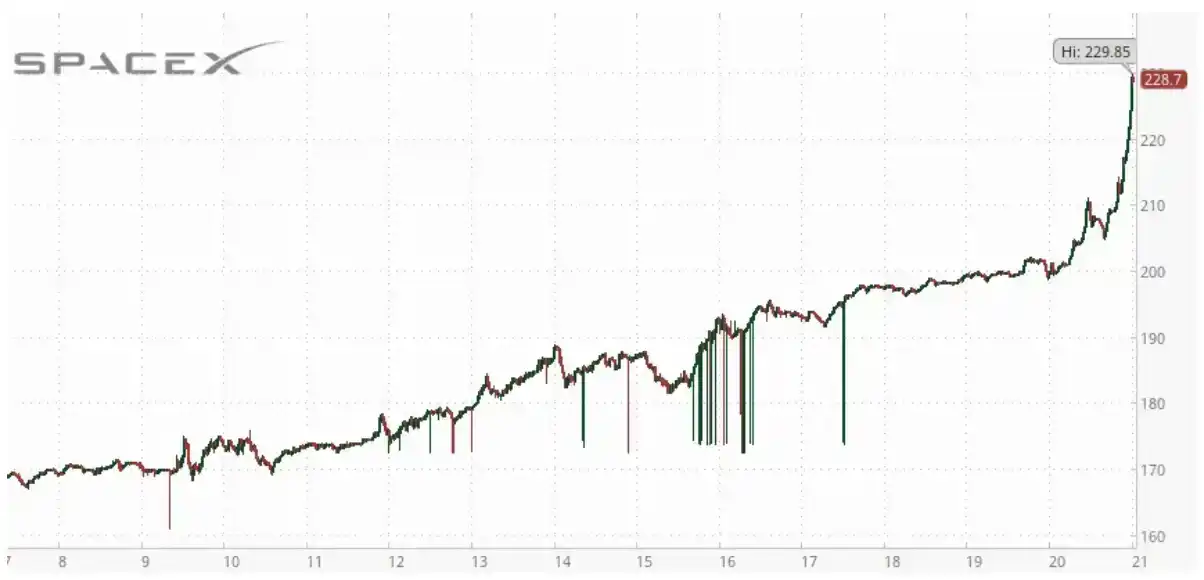
If the same kind of options-driven feedback loop that propelled Tesla after late 2019 materializes here, then these numbers no longer seem as unimaginable as they once did. And this is precisely where nobody wants to have the conversation.

Everyone wants to talk about how high SpaceX can go. Nobody wants to talk about what happens if it actually gets there.

If SpaceX reaches a $10 trillion market cap, that means one company is valued at roughly one-third of U.S. GDP. It would be large enough to dominate passive indexes, retirement accounts, ETFs, pension funds, and institutional portfolios. Its every move would increasingly dictate the performance of the entire market—all while it isn't even profitable. It would become the greatest, and most dangerous, speculative machine in human history.

Consider what this means for Elon Musk. If SpaceX is valued at $10 trillion, Musk's personal fortune would enter a realm unseen in modern history. His net worth is already equivalent to 40% of all currency in circulation.
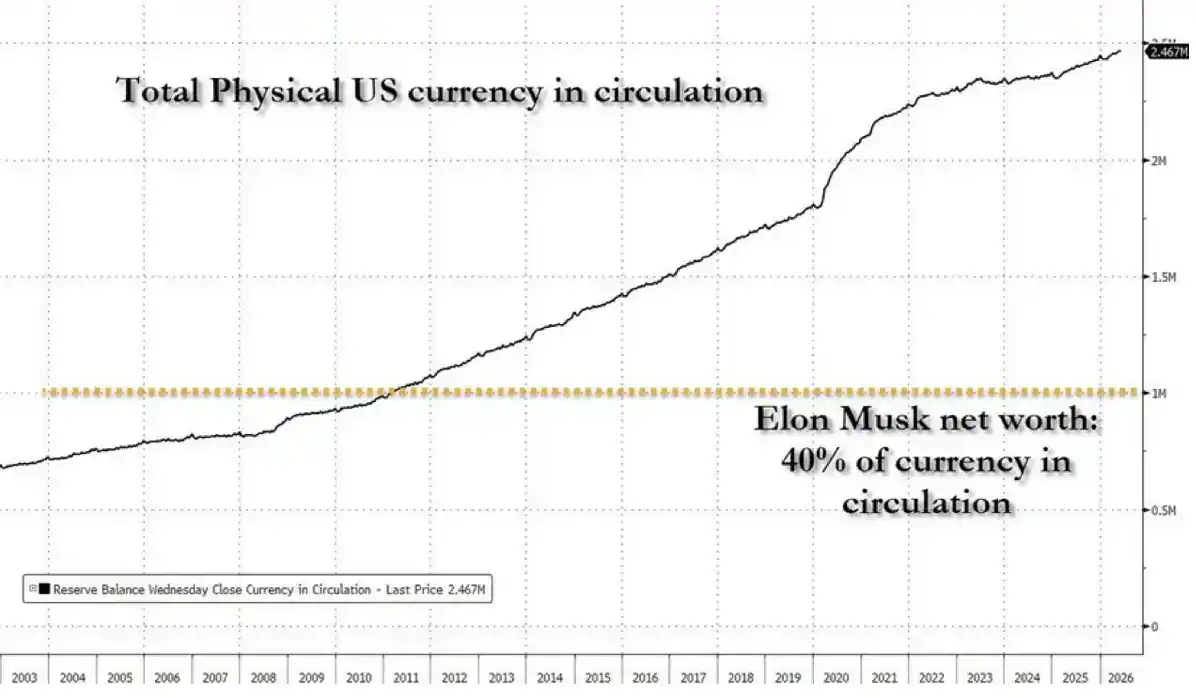
And he isn't just richer than the second-richest person. He could soon be about ten times richer.

The gap between Musk and other billionaires could exceed the total wealth of some developed nations. At that point, we are no longer discussing wealth creation in an ordinary sense.

What happens if SpaceX's market cap, due to some gamma squeeze malfunction, truly surges to $28 trillion? That's roughly equivalent to a year of U.S. economic output. Would people finally start questioning the market then? Or would they just find new reasons to rationalize it?

Because this is how every bubble in history has operated. Every new high is taken as proof the last high was too low. Every speculative mania is packaged as innovation—ask the so-called "innovation expert" Cathie Wood. Every squeeze is explained away as genius. Every warning is turned into evidence that "the skeptics don't understand the future."

The most astonishing thing about SpaceX breaking $3 trillion isn't the valuation itself.

It's that if it keeps rising, it will become too big to ignore. At some point, we must stop talking about SpaceX and start talking about the system that produced it: a speculative machine that has completely detached from its original function.

The danger is that once a company reaches sufficient scale, the distortion itself becomes a systemic risk. Every passive fund must hold it. Every major index becomes dependent on it. Pension funds, retirement accounts, sovereign wealth funds, insurance companies, and institutional portfolios become increasingly exposed to the same single trade. The higher it goes, the more unavoidable it becomes.

This is the part nobody truly understands.

If SpaceX ultimately reaches $10 trillion on a combination of hype, narrative, mechanical flows, and options-driven feedback loops, it ceases to be just a story about SpaceX. It becomes the market. Its performance will increasingly determine the performance of indexes, ETFs, and retirement accounts across the entire financial system. The market effectively becomes a referendum on a single stock.

This is how bubbles become systemic risks. Not when they're small enough to be laughed at, but when they're so big everyone is forced to participate. The same mechanisms driving the price up today will eventually create the conditions for instability tomorrow. When trillions in wealth are tied to a valuation that was never truly anchored to fundamentals, even a mild correction could have consequences far beyond that single stock.


Preguntas relacionadas

QWhat is the core concern of the author regarding SpaceX's valuation surge, beyond its business prospects?

AThe author's core concern is the health and functionality of the modern capital market structure itself. They argue that SpaceX's valuation is increasingly driven by mechanical market forces like gamma squeezes (from options trading), momentum chasing, and passive fund inflows, rather than fundamental price discovery. This creates a self-reinforcing feedback loop where price increases themselves become the justification for further buying, detaching valuation from economic reality and posing a systemic risk to the broader market and ordinary investors' portfolios.

QHow could the introduction of SpaceX options trading potentially worsen the situation, according to the article?

AThe author fears the introduction of SpaceX options trading could exacerbate price distortion through a 'gamma squeeze' feedback loop. Aggressive call option buying would force market makers to hedge by purchasing the underlying stock, pushing the stock price higher. This price rise would then attract more momentum traders and call option buyers, further reinforcing the cycle. This mechanism would make price movements almost entirely a function of market structure mechanics, not the company's business fundamentals.

QWhy does the author believe a highly inflated SpaceX could become a systemic risk rather than just a single-stock bubble?

AThe author explains that if SpaceX's market cap grows large enough, it becomes a systemic risk due to indexation and passive investment. At extreme valuations (e.g., $10 trillion), it would dominate major indices. Consequently, ETFs, pension funds, retirement accounts, and institutional portfolios would be forced to hold it in significant weightings. Its price movements would then disproportionately dictate the performance of the entire market. A correction or instability in SpaceX could therefore ripple through the financial system, impacting the savings of ordinary investors who are passively exposed.

QWhat historical market phenomenon does the author compare SpaceX's potential path to, and what is the dangerous pattern mentioned?

AThe author compares SpaceX's potential path to the gamma squeeze and feedback loop mechanisms observed in Tesla and certain 'meme stocks' in recent years. The dangerous pattern is that each new high in the stock price is used as evidence to justify the previous high, rationalizing the speculative frenzy as innovation or genius, while dismissing warnings as a lack of understanding of the future. This pattern repeats in historical bubbles.

QWhat is the 'structural paradox' of modern capital markets highlighted by the SpaceX case?

AThe structural paradox is that the very mechanisms of the modern market (options trading, passive funds, momentum algorithms) can amplify narratives, leverage, and liquidity to a point where they overwhelm fundamental analysis and price discovery. The market, meant to reflect value, instead begins to manufacture value. Systemic risk, therefore, may not start with bad companies, but with the most popular, narrative-rich companies that become too big for the market to ignore, embedding distortion at its core.

Lecturas Relacionadas

Conversation with Arthur Hayes: AI Has Drained Market Liquidity, BTC Will Be Below 100k by Year-End

In this June 2026 podcast interview, BitMEX co-founder Arthur Hayes explains his decision to sell his major crypto holdings (HYPE, NEAR, Worldcoin, Zcash). His rationale is based on a macro view linking oil prices, the Iran conflict, US politics, and an impending AI bubble burst. Hayes argues that high oil prices, driven by the ongoing war, will pressure domestic US inflation. To salvage the Republican Party's chances in the midterm elections, he believes Donald Trump may pivot to a populist, anti-AI stance—advocating for taxes and regulation—which would deflate the AI investment narrative. He sees the AI sector, particularly massive capital expenditure on data centers, as having absorbed nearly all excess market liquidity (around $1.5 trillion in debt issuance since 2025), starving other assets like Bitcoin. He highlights the upcoming SpaceX IPO at a ~$1.8 trillion valuation and 100x price-to-sales ratio as a potential tipping point. If these hyped IPOs underperform, it could shatter market confidence in AI. In such a scenario, all risk assets, including crypto, would fall together as correlations converge to 1 during a broad correction. Hayes has moved his portfolio into Treasuries and energy stocks (like ExxonMobil), predicting Bitcoin will be below $100k by year-end. He sees a potential crypto bull market only after the AI frenzy cools, liquidity stops flowing exclusively into AI, and possibly after a significant market downturn prompts new monetary stimulus.

marsbitHace 1 min(s)

Conversation with Arthur Hayes: AI Has Drained Market Liquidity, BTC Will Be Below 100k by Year-End

marsbitHace 1 min(s)

Fed's Internal Doves Flock to Hawkish Stance, Warsh's Debut "Between a Rock and a Hard Place"

U.S. Federal Reserve officials who previously advocated for rate cuts, including Governor Christopher Waller, have recently shifted their stance, with many now not ruling out the possibility of future rate hikes. This sets a challenging stage for new Fed Chair Kevin Warsh's first policy meeting. Appointed by President Trump based on his dovish views, Warsh now faces a committee where the debate has pivoted from "when to cut" to "whether to hike," driven by persistent inflation above 3%, a strong labor market, and supply-side pressures from AI infrastructure demands and geopolitical tensions. Key figures illustrate the shift. Governor Waller, once concerned about employment, now says data has pushed him toward considering rate increases. Even moderate voices like Governor Lisa Cook, while expecting inflation to ease, have indicated readiness to hike if it fails to do so. Long-time hawks such as regional Fed presidents Beth Hammack, Lorie Logan, and Neel Kashkari have grown more vocal, arguing that the real policy rate is effectively falling and that action may soon be needed. The upcoming Fed meeting is expected to keep rates steady but will likely remove the "easing bias" from its statement, signaling a neutral stance between cuts and hikes. The quarterly "dot plot" is anticipated to show most officials projecting no cuts this year, with some potentially indicating hikes. Chair Warsh, a critic of the Fed's reliance on forward guidance like the dot plot, must navigate communicating this pivot using tools he has questioned, all while steering policy in a direction counter to the preferences of the president who appointed him. The consensus suggests the Fed's next move could well be a rate increase.

marsbitHace 1 hora(s)

Fed's Internal Doves Flock to Hawkish Stance, Warsh's Debut "Between a Rock and a Hard Place"

marsbitHace 1 hora(s)

The Trillion-Yuan Market Cap 'Yi Zhong Tian': Who is the True Value King?

The article analyzes the three leading Chinese optical module companies, collectively nicknamed "Yi Zhong Tian": Xinyisheng, Zhongji Innolight, and TFC Optical Communication. It evaluates their "cost-performance" not by current stock price, but through three lenses: PEG ratio (growth vs. valuation), earnings quality, and premium/discount for certainty. Xinyisheng shows the most attractive PEG ratio and high profitability, but its valuation reflects discounts for risks like high customer concentration and reliance on overseas markets. Zhongji Innolight, the most expensive, commands a premium for its market leadership, dominant share in key products like 800G/1.6T modules, and higher earnings certainty, though it faces geopolitical risks. TFC Optical, as an upstream component supplier ("water seller"), has the highest gross margin and bets on the long-term CPO/NPO architecture trend, but trades at a high valuation with more stable, less explosive growth. The core argument is that while these companies dominate module assembly, the true profit pool and technological moat lie upstream in laser and switch chips, currently controlled by U.S. firms like Lumentum and Coherent. The long-term "cost-performance" for these Chinese leaders hinges on whether the domestic industry, exemplified by companies like Yuanjie Technology, can successfully move up the value chain into high-power laser chips. Otherwise, their high growth may remain confined to the lower-margin assembly segment.

marsbitHace 1 hora(s)

The Trillion-Yuan Market Cap 'Yi Zhong Tian': Who is the True Value King?

marsbitHace 1 hora(s)

Has the Crypto Market Bottomed? Here's What Institutions Think

The crypto market is in a period of significant debate, with leading institutions offering differing views on whether a bottom has been reached. Three prominent firms have published detailed analyses: * **Galaxy Digital** argues Bitcoin has **not yet bottomed**. Their analysis of 13 historical indicators across six dimensions (valuation, profit-taking, miner pressure, etc.) shows only four are fully met. They project a potential bottom range between $30k and $54k. * **NYDIG** states a bottom is **possible but not likely**. While metrics are close to historic bear market extremes, they note the absence of a classic panic-selling event. They also suggest increased institutional adoption may have structurally altered the market cycle, potentially leading to a shallower downturn. * **Standard Chartered Bank** asserts the **bottom has already occurred** at around $59k. They cite two key factors: potential US-Iran diplomatic progress and the anticipated SpaceX IPO, which they believe absorbed capital and caused ETF selling pressure that is now subsiding. They forecast a year-end price target of $100k. Despite the surface-level disagreement, the reports share critical common ground more valuable for long-term investors: 1. All three believe the market bottom will form **within this year**. 2. All agree the current price is **closer to the bottom than to previous highs**. 3. All maintain a **bullish long-term outlook** for Bitcoin and a new cycle. The core takeaway is that while the exact bottom price ($40k, $50k, or $60k) is debated, the consensus is that a bottom is imminent. For long-term holders, the primary focus should not be pinpointing the absolute low, but on the future potential for prices to reach $100k, $200k, or higher. The fundamental thesis for Bitcoin—sovereign debt accumulation, inflation, declining trust in centralized institutions, global digitization, and improved accessibility—remains intact and is arguably strengthening. The overall landscape is viewed as more favorable than in previous crypto winters.

marsbitHace 1 hora(s)

Has the Crypto Market Bottomed? Here's What Institutions Think

marsbitHace 1 hora(s)

Trading

Spot
Futuros

Artículos destacados

Qué es $S$

Entendiendo SPERO: Una Visión General Completa Introducción a SPERO A medida que el panorama de la innovación continúa evolucionando, la aparición de tecnologías web3 y proyectos de criptomonedas juega un papel fundamental en la configuración del futuro digital. Un proyecto que ha atraído la atención en este campo dinámico es SPERO, denotado como SPERO,$$s$. Este artículo tiene como objetivo reunir y presentar información detallada sobre SPERO, para ayudar a entusiastas e inversores a comprender sus fundamentos, objetivos e innovaciones dentro de los dominios web3 y cripto. ¿Qué es SPERO,$$s$? SPERO,$$s$ es un proyecto único dentro del espacio cripto que busca aprovechar los principios de descentralización y tecnología blockchain para crear un ecosistema que promueva la participación, la utilidad y la inclusión financiera. El proyecto está diseñado para facilitar interacciones de igual a igual de nuevas maneras, proporcionando a los usuarios soluciones y servicios financieros innovadores. En su esencia, SPERO,$$s$ tiene como objetivo empoderar a los individuos al proporcionar herramientas y plataformas que mejoren la experiencia del usuario en el espacio de las criptomonedas. Esto incluye habilitar métodos de transacción más flexibles, fomentar iniciativas impulsadas por la comunidad y crear caminos para oportunidades financieras a través de aplicaciones descentralizadas (dApps). La visión subyacente de SPERO,$$s$ gira en torno a la inclusividad, buscando cerrar brechas dentro de las finanzas tradicionales mientras aprovecha los beneficios de la tecnología blockchain. ¿Quién es el Creador de SPERO,$$s$? La identidad del creador de SPERO,$$s$ sigue siendo algo oscura, ya que hay recursos públicos limitados que proporcionan información de fondo detallada sobre su(s) fundador(es). Esta falta de transparencia puede derivarse del compromiso del proyecto con la descentralización, una ética que muchos proyectos web3 comparten, priorizando las contribuciones colectivas sobre el reconocimiento individual. Al centrar las discusiones en torno a la comunidad y sus objetivos colectivos, SPERO,$$s$ encarna la esencia del empoderamiento sin señalar a individuos específicos. Como tal, comprender la ética y la misión de SPERO sigue siendo más importante que identificar a un creador singular. ¿Quiénes son los Inversores de SPERO,$$s$? SPERO,$$s$ cuenta con el apoyo de una diversa gama de inversores que van desde capitalistas de riesgo hasta inversores ángeles dedicados a fomentar la innovación en el sector cripto. El enfoque de estos inversores generalmente se alinea con la misión de SPERO, priorizando proyectos que prometen avances tecnológicos sociales, inclusión financiera y gobernanza descentralizada. Estas fundaciones de inversores suelen estar interesadas en proyectos que no solo ofrecen productos innovadores, sino que también contribuyen positivamente a la comunidad blockchain y sus ecosistemas. El respaldo de estos inversores refuerza a SPERO,$$s$ como un contendiente notable en el dominio de proyectos cripto que evoluciona rápidamente. ¿Cómo Funciona SPERO,$$s$? SPERO,$$s$ emplea un marco multifacético que lo distingue de los proyectos de criptomonedas convencionales. Aquí hay algunas de las características clave que subrayan su singularidad e innovación: Gobernanza Descentralizada: SPERO,$$s$ integra modelos de gobernanza descentralizada, empoderando a los usuarios para participar activamente en los procesos de toma de decisiones sobre el futuro del proyecto. Este enfoque fomenta un sentido de propiedad y responsabilidad entre los miembros de la comunidad. Utilidad del Token: SPERO,$$s$ utiliza su propio token de criptomoneda, diseñado para servir diversas funciones dentro del ecosistema. Estos tokens permiten transacciones, recompensas y la facilitación de servicios ofrecidos en la plataforma, mejorando la participación y la utilidad general. Arquitectura en Capas: La arquitectura técnica de SPERO,$$s$ apoya la modularidad y escalabilidad, permitiendo la integración fluida de características y aplicaciones adicionales a medida que el proyecto evoluciona. Esta adaptabilidad es fundamental para mantener la relevancia en el cambiante paisaje cripto. Participación de la Comunidad: El proyecto enfatiza iniciativas impulsadas por la comunidad, empleando mecanismos que incentivan la colaboración y la retroalimentación. Al nutrir una comunidad sólida, SPERO,$$s$ puede abordar mejor las necesidades de los usuarios y adaptarse a las tendencias del mercado. Enfoque en la Inclusión: Al ofrecer tarifas de transacción bajas e interfaces amigables para el usuario, SPERO,$$s$ busca atraer a una base de usuarios diversa, incluyendo a individuos que anteriormente pueden no haber participado en el espacio cripto. Este compromiso con la inclusión se alinea con su misión general de empoderamiento a través de la accesibilidad. Cronología de SPERO,$$s$ Entender la historia de un proyecto proporciona información crucial sobre su trayectoria de desarrollo y hitos. A continuación se presenta una cronología sugerida que mapea eventos significativos en la evolución de SPERO,$$s$: Fase de Conceptualización e Ideación: Las ideas iniciales que forman la base de SPERO,$$s$ fueron concebidas, alineándose estrechamente con los principios de descentralización y enfoque comunitario dentro de la industria blockchain. Lanzamiento del Whitepaper del Proyecto: Tras la fase conceptual, se lanzó un whitepaper completo que detalla la visión, los objetivos y la infraestructura tecnológica de SPERO,$$s$ para generar interés y retroalimentación de la comunidad. Construcción de Comunidad y Primeras Interacciones: Se realizaron esfuerzos de divulgación activa para construir una comunidad de primeros adoptantes y posibles inversores, facilitando discusiones en torno a los objetivos del proyecto y obteniendo apoyo. Evento de Generación de Tokens: SPERO,$$s$ llevó a cabo un evento de generación de tokens (TGE) para distribuir sus tokens nativos a los primeros seguidores y establecer liquidez inicial dentro del ecosistema. Lanzamiento de la dApp Inicial: La primera aplicación descentralizada (dApp) asociada con SPERO,$$s$ se puso en marcha, permitiendo a los usuarios interactuar con las funcionalidades centrales de la plataforma. Desarrollo Continuo y Alianzas: Actualizaciones y mejoras continuas a las ofertas del proyecto, incluyendo alianzas estratégicas con otros actores en el espacio blockchain, han moldeado a SPERO,$$s$ en un jugador competitivo y en evolución en el mercado cripto. Conclusión SPERO,$$s$ se erige como un testimonio del potencial de web3 y las criptomonedas para revolucionar los sistemas financieros y empoderar a los individuos. Con un compromiso con la gobernanza descentralizada, la participación comunitaria y funcionalidades diseñadas de manera innovadora, allana el camino hacia un paisaje financiero más inclusivo. Como con cualquier inversión en el espacio cripto que evoluciona rápidamente, se anima a los posibles inversores y usuarios a investigar a fondo y participar de manera reflexiva con los desarrollos en curso dentro de SPERO,$$s$. El proyecto muestra el espíritu innovador de la industria cripto, invitando a una mayor exploración de sus innumerables posibilidades. Mientras el viaje de SPERO,$$s$ aún se desarrolla, sus principios fundamentales pueden, de hecho, influir en el futuro de cómo interactuamos con la tecnología, las finanzas y entre nosotros en ecosistemas digitales interconectados.

74 Vistas totalesPublicado en 2024.12.17Actualizado en 2024.12.17

Qué es $S$

Qué es AGENT S

Agent S: El Futuro de la Interacción Autónoma en Web3 Introducción En el paisaje en constante evolución de Web3 y las criptomonedas, las innovaciones están redefiniendo constantemente cómo los individuos interactúan con las plataformas digitales. Uno de estos proyectos pioneros, Agent S, promete revolucionar la interacción humano-computadora a través de su marco agente abierto. Al allanar el camino para interacciones autónomas, Agent S busca simplificar tareas complejas, ofreciendo aplicaciones transformadoras en inteligencia artificial (IA). Esta exploración detallada profundizará en las complejidades del proyecto, sus características únicas y las implicaciones para el dominio de las criptomonedas. ¿Qué es Agent S? Agent S se presenta como un marco agente abierto innovador, diseñado específicamente para abordar tres desafíos fundamentales en la automatización de tareas informáticas: Adquisición de Conocimiento Específico del Dominio: El marco aprende inteligentemente de diversas fuentes de conocimiento externas y experiencias internas. Este enfoque dual le permite construir un rico repositorio de conocimiento específico del dominio, mejorando su rendimiento en la ejecución de tareas. Planificación a Largo Plazo de Tareas: Agent S emplea planificación jerárquica aumentada por la experiencia, un enfoque estratégico que facilita la descomposición y ejecución eficiente de tareas complejas. Esta característica mejora significativamente su capacidad para gestionar múltiples subtareas de manera eficiente y efectiva. Manejo de Interfaces Dinámicas y No Uniformes: El proyecto introduce la Interfaz Agente-Computadora (ACI), una solución innovadora que mejora la interacción entre agentes y usuarios. Utilizando Modelos de Lenguaje Multimodal de Gran Escala (MLLMs), Agent S puede navegar y manipular diversas interfaces gráficas de usuario sin problemas. A través de estas características pioneras, Agent S proporciona un marco robusto que aborda las complejidades involucradas en la automatización de la interacción humana con las máquinas, preparando el terreno para una multitud de aplicaciones en IA y más allá. ¿Quién es el Creador de Agent S? Si bien el concepto de Agent S es fundamentalmente innovador, la información específica sobre su creador sigue siendo elusiva. El creador es actualmente desconocido, lo que resalta ya sea la etapa incipiente del proyecto o la elección estratégica de mantener a los miembros fundadores en el anonimato. Independientemente de la anonimidad, el enfoque sigue siendo en las capacidades y el potencial del marco. ¿Quiénes son los Inversores de Agent S? Dado que Agent S es relativamente nuevo en el ecosistema criptográfico, la información detallada sobre sus inversores y patrocinadores financieros no está documentada explícitamente. La falta de información disponible públicamente sobre las bases de inversión u organizaciones que apoyan el proyecto plantea preguntas sobre su estructura de financiamiento y hoja de ruta de desarrollo. Comprender el respaldo es crucial para evaluar la sostenibilidad del proyecto y su posible impacto en el mercado. ¿Cómo Funciona Agent S? En el núcleo de Agent S se encuentra una tecnología de vanguardia que le permite funcionar de manera efectiva en diversos entornos. Su modelo operativo se basa en varias características clave: Interacción Humano-Computadora Similar a la Humana: El marco ofrece planificación avanzada de IA, esforzándose por hacer que las interacciones con las computadoras sean más intuitivas. Al imitar el comportamiento humano en la ejecución de tareas, promete elevar las experiencias de los usuarios. Memoria Narrativa: Empleada para aprovechar experiencias de alto nivel, Agent S utiliza memoria narrativa para hacer un seguimiento de las historias de tareas, mejorando así sus procesos de toma de decisiones. Memoria Episódica: Esta característica proporciona a los usuarios una guía paso a paso, permitiendo que el marco ofrezca apoyo contextual a medida que se desarrollan las tareas. Soporte para OpenACI: Con la capacidad de ejecutarse localmente, Agent S permite a los usuarios mantener el control sobre sus interacciones y flujos de trabajo, alineándose con la ética descentralizada de Web3. Fácil Integración con APIs Externas: Su versatilidad y compatibilidad con varias plataformas de IA aseguran que Agent S pueda encajar sin problemas en ecosistemas tecnológicos existentes, convirtiéndolo en una opción atractiva para desarrolladores y organizaciones. Estas funcionalidades contribuyen colectivamente a la posición única de Agent S dentro del espacio cripto, ya que automatiza tareas complejas y de múltiples pasos con una intervención humana mínima. A medida que el proyecto evoluciona, sus posibles aplicaciones en Web3 podrían redefinir cómo se desarrollan las interacciones digitales. Cronología de Agent S El desarrollo y los hitos de Agent S pueden encapsularse en una cronología que resalta sus eventos significativos: 27 de septiembre de 2024: El concepto de Agent S fue lanzado en un documento de investigación integral titulado “Un Marco Agente Abierto que Usa Computadoras Como un Humano”, mostrando las bases del proyecto. 10 de octubre de 2024: El documento de investigación fue puesto a disposición del público en arXiv, ofreciendo una exploración profunda del marco y su evaluación de rendimiento basada en el benchmark OSWorld. 12 de octubre de 2024: Se lanzó una presentación en video, proporcionando una visión visual de las capacidades y características de Agent S, involucrando aún más a posibles usuarios e inversores. Estos marcadores en la cronología no solo ilustran el progreso de Agent S, sino que también indican su compromiso con la transparencia y la participación comunitaria. Puntos Clave Sobre Agent S A medida que el marco Agent S continúa evolucionando, varios atributos clave destacan, subrayando su naturaleza innovadora y potencial: Marco Innovador: Diseñado para proporcionar un uso intuitivo de las computadoras similar a la interacción humana, Agent S aporta un enfoque novedoso a la automatización de tareas. Interacción Autónoma: La capacidad de interactuar de manera autónoma con las computadoras a través de GUI significa un salto hacia soluciones informáticas más inteligentes y eficientes. Automatización de Tareas Complejas: Con su metodología robusta, puede automatizar tareas complejas y de múltiples pasos, haciendo que los procesos sean más rápidos y menos propensos a errores. Mejora Continua: Los mecanismos de aprendizaje permiten a Agent S mejorar a partir de experiencias pasadas, mejorando continuamente su rendimiento y eficacia. Versatilidad: Su adaptabilidad en diferentes entornos operativos como OSWorld y WindowsAgentArena asegura que pueda servir a una amplia gama de aplicaciones. A medida que Agent S se posiciona en el paisaje de Web3 y criptomonedas, su potencial para mejorar las capacidades de interacción y automatizar procesos significa un avance significativo en las tecnologías de IA. A través de su marco innovador, Agent S ejemplifica el futuro de las interacciones digitales, prometiendo una experiencia más fluida y eficiente para los usuarios en diversas industrias. Conclusión Agent S representa un audaz avance en la unión de la IA y Web3, con la capacidad de redefinir cómo interactuamos con la tecnología. Aunque aún se encuentra en sus primeras etapas, las posibilidades para su aplicación son vastas y atractivas. A través de su marco integral que aborda desafíos críticos, Agent S busca llevar las interacciones autónomas al primer plano de la experiencia digital. A medida que nos adentramos más en los reinos de las criptomonedas y la descentralización, proyectos como Agent S sin duda desempeñarán un papel crucial en la configuración del futuro de la tecnología y la colaboración humano-computadora.

487 Vistas totalesPublicado en 2025.01.14Actualizado en 2025.01.14

Qué es AGENT S

Cómo comprar S

¡Bienvenido a HTX.com! Hemos hecho que comprar Sonic (S) sea simple y conveniente. Sigue nuestra guía paso a paso para iniciar tu viaje de criptos.Paso 1: crea tu cuenta HTXUtiliza tu correo electrónico o número de teléfono para registrarte y obtener una cuenta gratuita en HTX. Experimenta un proceso de registro sin complicaciones y desbloquea todas las funciones.Obtener mi cuentaPaso 2: ve a Comprar cripto y elige tu método de pagoTarjeta de crédito/débito: usa tu Visa o Mastercard para comprar Sonic (S) al instante.Saldo: utiliza fondos del saldo de tu cuenta HTX para tradear sin problemas.Terceros: hemos agregado métodos de pago populares como Google Pay y Apple Pay para mejorar la comodidad.P2P: tradear directamente con otros usuarios en HTX.Over-the-Counter (OTC): ofrecemos servicios personalizados y tipos de cambio competitivos para los traders.Paso 3: guarda tu Sonic (S)Después de comprar tu Sonic (S), guárdalo en tu cuenta HTX. Alternativamente, puedes enviarlo a otro lugar mediante transferencia blockchain o utilizarlo para tradear otras criptomonedas.Paso 4: tradear Sonic (S)Tradear fácilmente con Sonic (S) en HTX's mercado spot. Simplemente accede a tu cuenta, selecciona tu par de trading, ejecuta tus trades y monitorea en tiempo real. Ofrecemos una experiencia fácil de usar tanto para principiantes como para traders experimentados.

1.0k Vistas totalesPublicado en 2025.01.15Actualizado en 2026.06.02

Cómo comprar S

Discusiones

Bienvenido a la comunidad de HTX. Aquí puedes mantenerte informado sobre los últimos desarrollos de la plataforma y acceder a análisis profesionales del mercado. A continuación se presentan las opiniones de los usuarios sobre el precio de S (S).

活动图片