Compiled & Edited: Deep Tide TechFlow
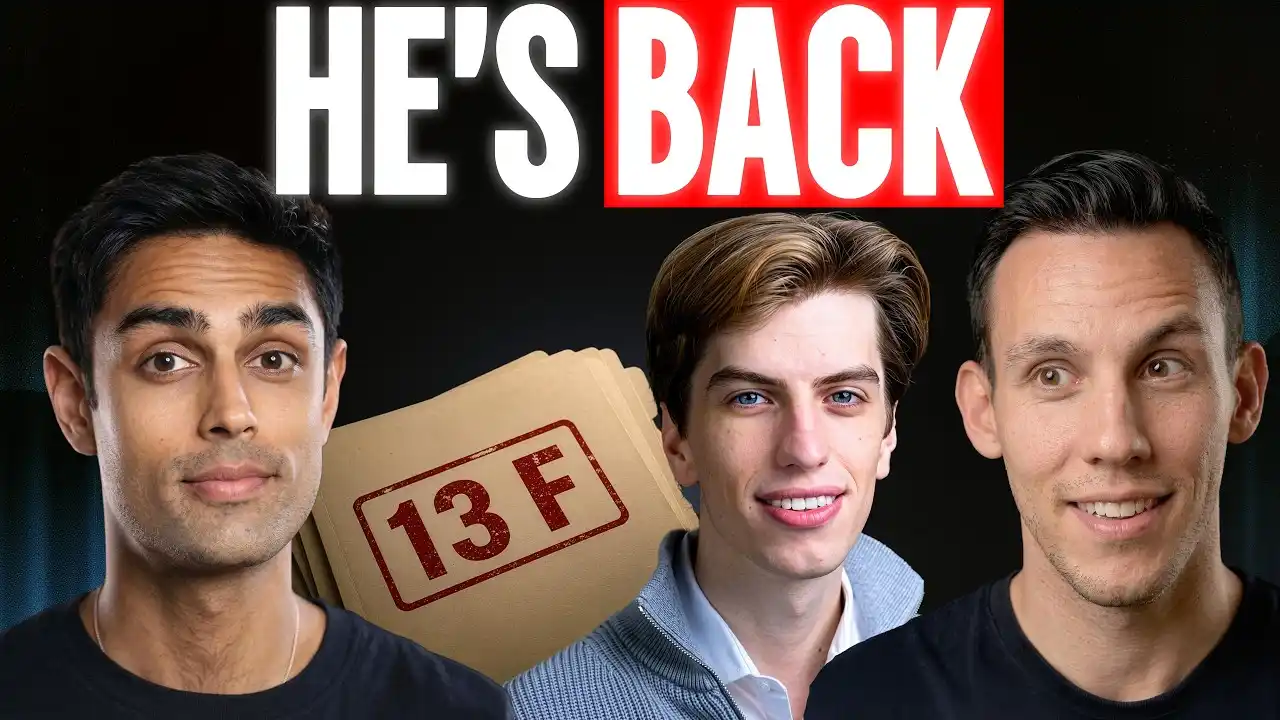
Hosts: Josh, EJ
Original Title: The Best AI Investor Just Shorted the Entire Market
Podcast Source: Limitless (AI Investment Show)
Air Date: May 19, 2026
Editor's Note
Wall Street's most prominent AI bull, Leopold Aschenbrenner (former OpenAI researcher, founder of Situational Awareness Fund, who turned $250M into $13.7B in 2 years), just filed his latest 13F with the SEC. The most unexpected signal for the entire market has appeared—he has established a massive $8 billion short position against the entire semiconductor supply chain, including Nvidia, AMD, Broadcom, ASML, and Micron. This scale is 40 times the total assets of his fund 18 months ago and marks the first time since the fund's inception that his short exposure exceeds his long exposure.
His new thesis can be condensed into one sentence: the bottleneck for AI investment is shifting from chips (design layer) to power and memory (infrastructure layer). On the long side, he continues to heavily invest in CoreWeave, Bloom Energy, and other new players in data centers and power, and has newly added positions in SanDisk, CleanSpark, Riot Platforms, Applied Digital, and IREN—bitcoin mining companies with grid access capabilities. This is a key document for understanding the AI investment narrative shift in 2026.
Key Quotes
From AI Bull to Shorting Semiconductors
- "This is the first time in the fund's history that short exposure has exceeded long exposure. An $8 billion short exposure is 40 times the fund's net value from 18 months ago. This is not a hedge; this is a directional bet."
- "If it were just to hedge realized gains, you'd see small hedge positions offsetting long book values. But when the total put size is already larger than the longs, that's a bet on the market going down."
Core Thesis: The Bottleneck Has Moved from Silicon to Electrons
- "The bottleneck has moved from chips to electrons. There are actually enough chips; the problem is where to plug them in. Anthropic is willing to partner with a competitor like SpaceX for compute not because there aren't enough chips, but because there isn't the corresponding infrastructure to deploy them at scale."
- "Leopold understands data centers and GPUs better than anyone else in this market; no one has spent more time researching this. So he knows better than anyone where the next bottleneck is, and he believes it's power and energy."
- "I don't think he's really bearish on GPUs; he just thinks this is an overcrowded trade in the short term, and his money gets a higher return in power and memory."
On Neocloud and Power: A Trade That Can Win Both Ways
- "Companies like CoreWeave possess something Nvidia itself doesn't have: power access rights. Betting on Neocloud isn't just because they can run GPUs—any well-capitalized data center can do that. More importantly, they have the grid interconnection permits and capacity within the existing infrastructure."
- "This is a win-win trade. Even if the semiconductor sector falls and the valuation of the GPUs these companies hold drops along with it, they can still benefit from the power premium because they control power capacity."
- "American bitcoin miners are set to bring online roughly 30 GW of power capacity this year. For reference, that's roughly equal to the sum of announced data center power plans by Microsoft, Google, Amazon, and Meta. They already have the power, land, and facilities; they just need to swap out mining rigs for AI accelerator cards."
Memory and the Infrastructure Layer
- "Memory prices are soaring. Over the past 9 months, average prices from major memory makers have risen 300% to 500%; if you look at production capacity, schedules are almost fully booked through the end of 2027."
- "SanDisk is up about 40,000% over the past year. Logically, this should be one of the most crowded trades, but Leopold is still bullish. Because SanDisk's core product is NAND flash, and AI models' memory and recall of context precisely rely on this type of temporary storage."
Nvidia: The Biggest Short, Possibly the Biggest Misjudgment
- "Leopold has about $1.9 billion in short exposure to Nvidia (including indirect shorts via the VanEck Semiconductor ETF SMH, where Nvidia has the highest weighting at around 20%)."
- "Nvidia's moat might be stronger than imagined. CUDA is a software lock-in platform; people who have built on it don't want to leave because re-building custom infrastructure for a new chip is very complex."
- "The secondary rental prices for Nvidia GPUs from 6 to 8 years ago are now higher than they were two years ago, and contracts have to be signed a year in advance."
Practical Advice for Retail Investors
- "If you're a retail investor just entering the market after seeing Leopold's 13F, be conservative. This is not the time to go all-in on a single stock. The S&P 500's gains over the past two years have mostly come from the Mag 7, and the money has trickled down to the companies we just discussed. This might be an overcrowded trade, so be cautious."
- "Two things I'm personally bullish on long-term: First, energy—everyone is short on power. Second, manufacturing and construction capabilities in the physical world. Anyone with anything approaching a monopoly advantage in manufacturing, building factories, or obtaining grid interconnection permits is a long-term investment-worthy target with a durable moat."
- "Nvidia reports earnings on May 20th. If their guidance for the next quarter exceeds $78 billion, these put positions will likely get burned."
The AI Bull King Turns Bearish
Josh: Wall Street's most famous AI bull just called a "top" on the entire AI market. Leopold Aschenbrenner, the 24-year-old former OpenAI researcher who, after being fired, started his own fund and turned $250 million into $13.7 billion in under 2 years—"The Son of Wall Street Version"—has made another move. And his latest portfolio is not what you'd expect. He has turned bearish on the entire stock market, establishing an $8 billion short exposure against the biggest companies in the AI industry, including Nvidia, AMD, Broadcom, and the entire semiconductor supply chain. But he's not completely pessimistic. He also revealed where his next biggest AI investment lies: power and memory. He doubled down on data centers and three new companies. We'll break it down one by one, but let's start with the biggest change.
EJ: The world's most valuable company, the representative of the AI revolution, the stock that made countless investors rich—Nvidia—is now in the crosshairs. This is Leopold's largest short position currently, but you can't tell at a glance from the filing because the top spot in his short portfolio is listed as the VanEck Semiconductor ETF (ticker SMH), with Nvidia itself close behind. He currently has a direct $1.5 billion put exposure to Nvidia. For those unfamiliar with put options, they essentially give Leopold the right, but not the obligation, to sell the underlying asset at a predetermined price. He's buying the right to sell Nvidia shares at a higher price if the stock falls below a certain level.
Josh: SMH is his number one short, with a size of about $2 billion. I checked its holdings, and its largest single holding is indeed Nvidia, with about a 20% weighting. So adding the top two shorts together, his effective short exposure to Nvidia is about $1.9 billion. That's probably a blow to those who believe Nvidia only goes up in a straight line. But Leopold clearly thinks otherwise.
Beyond that, Broadcom, Oracle, AMD, Micron, ASML, Intel, Corning—these are all new short positions. Keep in mind that Intel was once his masterpiece, his single most profitable trade in the fund's history, and he's now shorting it. Broadcom is the main builder for OpenAI's Project Stargate (OpenAI's ultra-large-scale data center plan in collaboration with SoftBank and others). By shorting Broadcom, he's essentially shorting OpenAI and Stargate. Corning is a fiberglass company; he established a large short there too. So overall, there's an $8 billion short exposure, equivalent to 40 times the fund's total assets 18 months ago. This is an extremely aggressive bet.
EJ: Very aggressive. Remember, his entire fund's thesis is built on that 64-page paper "Situational Awareness," with the core bet that compute FLOPs will grow across multiple orders of magnitude in the next decade. This $8 billion short is essentially betting against that thesis. So this only suggests two possibilities: either he thinks the current trade is overcrowded and there will be short-term volatility and downward pressure, or a component of his core thesis is wrong, and he hasn't publicly said which one.
The Long Side: Neocloud, Power, and Bitcoin Miners
EJ: He's not entirely bearish. If you look at the right side of the chart—the long book—he still holds massive stock positions in many types of companies and has also bought some call options. First, CoreWeave: he maintains his position. CoreWeave has always been one of his largest data center or Neocloud investments since the fund's inception. He's betting on CoreWeave in multiple ways, including through private investments or acquiring Core Scientific (a bitcoin mining/data center company that helps operate for CoreWeave). Neocloud, simply put, refers to new cloud service providers that procure, assemble GPU clusters, and rent them to major AI labs. CoreWeave has already signed multi-billion-dollar contracts with Meta, Anthropic, etc.
Next is Bloom Energy, his largest new position last quarter. Bloom Energy primarily produces portable gas turbines that can be airlifted to any data center site to power it. One of the biggest bottlenecks for AI data centers right now is having a bunch of GPUs but the grid can't feed them enough, so you need this supplemental power solution. Leopold didn't liquidate but trimmed his position by $1 billion. I can understand that; this position grew from about $800 million to around $2.5 billion in 3 months, so taking some money off the top is reasonable. He still holds just over $1 billion in Bloom Energy.
Further down, he added to a group of bitcoin miners: CleanSpark, Riot Platforms, Applied Digital, IREN. These names might look familiar because they are in the same Neocloud space as CoreWeave. So he's going all-in on data centers and Neocloud. What he observes is that Anthropic and OpenAI keep releasing new models, the scaling laws for compute keep expanding, so GPUs are still needed, but the current stuck point is "delivery." These companies solve the delivery problem. In comparison, the GPU manufacturers themselves (Nvidia, Broadcom, etc.) are the ones he chooses to short.
Josh: This is a new narrative trade forming. Money is moving from semiconductors themselves towards infrastructure, power, data centers, and memory. He's doubling down on the direction we saw last quarter, but this time while simultaneously building short positions, betting against companies he believes won't outperform.
A quick reminder: the 13F is a snapshot. It's based on last quarter's trades, covering January 1st to March 31st. Leopold has been right almost every time; his fund's size has grown from $220 million to a current book value of $13.7 billion. But there are places he might be wrong. For example, AMD, which he shorted, is up 74% in the past month. He might have picked the most expensive timing in the AI sector rotation to short. Is this a timing issue or a thesis issue? Another example is ASML. As far as I know, ASML is still the only company in the world that can make lithography machines—a 100% monopoly. He's shorting it too. So his thesis clearly leans towards memory, power, and infrastructure, not semiconductors themselves.
Deconstructing the Thesis: What Is Leopold Actually Betting On?
EJ: I think instead of looking at longs and shorts separately, we should directly discuss the thesis behind each of these positions. These positions are very aggressive—$8 billion short is not a small number—and many people haven't heard of the Neocloud and power companies on the long side. Are they any good? My take is that he's making a bilateral trade in opposite directions: short silicon, long electricity. He thinks GPU designers like Nvidia and Broadcom, and manufacturers like TSMC, are overcrowded trades. I don't think he's really "bearish"; I think he believes their current valuations are too high. Conversely, he's heavily long power because he knows better than anyone where the next bottleneck for data centers and GPUs is, and he's convinced it's power and energy. He doesn't believe there is enough energy or a good enough way to get electricity to GPUs right now.
He's also heavily adding to memory. SanDisk is up about 40,000% over the past year. Logically, that should be the most crowded trade, but he's still bullish. SanDisk's core product is NAND flash, and AI models' need to store temporary memory to recall context during conversations is precisely the type of storage SanDisk provides. So I don't think he's deeply bearish on GPUs themselves; he just thinks the short term is overcrowded, and money gets a higher return in power and memory.
Josh: This makes me start to wonder if he's bearish on the entire market. This is the first time in the fund's history that short exposure has exceeded long exposure. For a fund that has always been "long-only, upward-only," this is a very clear shift. Initially, when assessing, I wondered if it was just hedging—he's made too much money in the past and wants to lock in gains, protect the downside. But if it were just hedging, the position size should be significantly smaller than the longs to "offset," not a directional bet like this. Last quarter, he did have some hedge positions, but the proportion was small, not directional. This quarter, the total put size has already exceeded the longs; this is a directional trade betting on the market falling.
So he's in a strange position. He seems to think the overall AI market will fall, but even so, memory, infrastructure, and energy will continue to rise. That's his bet.
EJ: What you're describing is actually uncertainty. He himself isn't entirely sure of the outcome, and this can be seen from one detail: he paired some of his put positions with corresponding call positions. This structure in hedge funds is called a collar trade. If you don't know whether the market will go up or down, you hedge both sides, making money from the premium spread between the two sides. He did this for four companies, the largest being on Micron. If he were really bullish on memory players like SanDisk, he shouldn't theoretically be bearish on Micron, the largest US memory representative. Leopold is a US stock purist; his fund's most profitable trades are US stocks like Intel long, Bloom Energy, and Nvidia. So the short on Micron doesn't look thesis-driven; it's more like a "flat trade." He doesn't know the direction, so he hedges it. He believes the market is overcrowded but remains positive long-term. That's actually a smart move.
Four Core Assertions
Josh: I'll compress his new thesis into four points. First, the bottleneck has moved from chips to electrons. We all know there are enough chips; the problem is there's nowhere to plug them in. Look at the recently announced collaboration between SpaceX and Anthropic. Anthropic is so compute-hungry it's willing to partner with a competitor to get compute. That's not a chip shortage; it's a shortage of infrastructure to run those chips at scale.
Second, chip valuations are pricing a world that no longer exists. SMH is up 66% year-to-date, while Intel is up 200%. The whole market is pricing the entire sector with the logic that "every semiconductor company equally benefits from AI demand," but Leopold is betting against that. He thinks there are winners and losers; early winners will continue to win, and he intends to capture that part of the return.
EJ: Just looking at these long positions made me think of something: these Neocloud companies can actually benefit from the entire suite of arguments in his new portfolio. When the semiconductor sector falls, their stock prices should theoretically fall too because they hold GPUs. But companies like CoreWeave have something Nvidia doesn't: power access rights. He's investing in these Neocloud companies not because they can run GPUs—any well-capitalized data center can do that—but because they hold interconnection permits and capacity within the existing grid infrastructure. So through one company, he's expressing two layers of his thesis: long power and short semiconductors, killing two birds with one stone.
Josh: Third, he's hidden an Easter egg in "where to get power"—bitcoin miners. We briefly mentioned it last quarter; this time he's adding to those positions. American bitcoin miners are expected to bring online roughly 30 GW of power capacity this year. For comparison, that's roughly equal to the sum of announced data center power plans by Microsoft, Google, Amazon, and Meta. They already have massive amounts of critical infrastructure: power, facilities, scaled buildings. They just need to swap out mining rigs for AI accelerator cards. This is a perspective I haven't seen many people discuss—the pivot from bitcoin to AI is purely "follow the money."
EJ: Finally, what he's doubling down on is "physical infrastructure." He doesn't believe this layer will be commoditized, but he thinks the semiconductor "design layer" is overcrowded. A reminder: Nvidia itself doesn't manufacture chips; they are a design company, sending blueprints to TSMC for manufacturing. Broadcom is the same. Intel and AMD both do CPU/GPU design. All of these—Nvidia, Broadcom, Intel, AMD—are companies he's shorting this time. They design chips but don't manufacture them themselves. Intel and AMD plan to manufacture themselves but currently lack the corresponding fabs and infrastructure. So his logic is: the chip design space is overcrowded; the hardware infrastructure layer is where the money flows, and the key substrate for this layer is power.
Where It Could Go Wrong: Nvidia's Moat
Josh: Let's also discuss where this trade could blow up. We mentioned AMD being up 74% in a month—he shorted it, so that's definitely a slap in the face. His total short exposure to Nvidia is about $1.9 billion. One potential blow-up point is that Nvidia's moat might be stronger than he thinks. He's betting Nvidia will be "commoditized," thinking that custom chips like Google's TPU and Amazon's Trainium will gradually erode Nvidia's monopoly. But reality might be different. Look at purchase orders and the 80% gross margin—orders are still flooding to Nvidia. The reason behind it is CUDA, a customized, high-barrier-to-entry software stack. People who have built infrastructure in this ecosystem don't want to migrate because re-building a complete custom infrastructure for a new chip is complex. Is this true? Is Leopold wrong? We don't know.
Anthropic is taking a "less lock-in" route, partnering with Amazon for Trainium and Google for TPU while also using Nvidia. But xAI's Colossus data center is almost entirely Nvidia GPUs; they're going all-in on the latest Blackwell architecture, fully betting on CUDA. So one of these theses might win, and the other might lose. Regardless, Nvidia is the world's most valuable company; seeing it collapse is no small matter.
Even more extreme: the secondary rental prices for Nvidia GPUs shipped 6 to 8 years ago are now higher than they were two years ago, and contracts have to be signed a year in advance—meaning people are willing to rent old GPUs at a higher price than the new ones back in the day.
EJ: Leopold's style reminds me of Michael Burry. We talked about him a few months ago when he very publicly shorted Nvidia near its highs and got burned badly. I hope Leopold doesn't follow the same path. A few more potential risks or blind spots: the Situational Awareness fund is a hedge fund, not a VC fund. It's rare for a hedge fund to be so aggressively "long-only AI." All the 13F positions we discussed today are quarter-end snapshots; he has to file every three months. At this very moment we're speaking, he could have completely flipped these positions.
Another question is, when did he establish these puts? Most likely at the beginning of the year, so the fund could have taken a hit at that time. Of course, the counterexample is obvious: his fund grew from $5.5 billion to $14 billion in 3 months, so he made money. The key point is that these puts and calls are leveraged. Behind the $8 billion notional exposure, he might have actually put in only around $1 billion, while also paying premiums and fees. So this is a short-term trade.
Therefore, I must emphasize: he might have already exited some of these trades. If you watch this and think, "Oh no, I need to completely change my portfolio," remember: your way of trading is not his. You're not doing short-term, high-frequency trading; you're holding long-term. That's a completely different paradigm.
What Should Retail Investors Do? Polymarket Data and Personal Views
Josh: There's some data on Polymarket that can corroborate—things aren't as bad as they seem because retail investors and Leopold aren't playing the same game. If you think the AI bubble is about to burst, that's the implication of this 13F. But according to Polymarket, the probability of the AI bubble bursting by December 31st of this year is only 24%. I also looked at another market: on Polymarket, the probability of Nvidia remaining the world's most valuable company for the rest of this month is still 93%. This is evidence that the volatility might not be as severe as his 13F suggests. Again, this is last quarter's news; the tide has already changed. We don't know how he's traded in the past few months. But indeed, things aren't that bad; he just shifted his strategy. EJ, how would you, as a retail investor, adjust?
EJ: Two answers. If you're new and just want to trade based on Leopold's 13F after seeing it, be conservative. This is not the time to bet on a single stock, and I never recommend doing that anyway. There's a reason Leopold is being cautious. The market has averaged gains of several hundred percentage points over the past two years, which is a huge increase for a normal stock market. The S&P 500's gains mainly came from the Mag 7, and their money trickled down through AI to all the companies we just discussed. He might just be saying this is an overcrowded trade; be cautious.
But Josh, I always have an upper limit on bullishness. What I'm most bullish on right now is power and energy. I agree with Leopold on the Bloom Energy and data center line. One thing I learned from this research that got me particularly excited is that investing in leading Neocloud companies simultaneously expresses two views: long power + short semiconductors. They've signed multi-billion-dollar contracts with Anthropic and Meta, and even if semiconductors fall, they still hold power capacity. This is a trade I might take.
But I have reservations about his short on Corning and other fiber bottlenecks. Nvidia just signed a multi-billion-dollar deal with Corning, and he's shorting it. He's picking which bottlenecks to bet on. I agree he picked power, but I'm not sure if he's right on fiber. What do you think, Josh?
Josh: For me personally, the two most important things in AI investment are energy and "moving atoms in the physical world." The physical world is hard, complex, and much slower than the software world. Any company with anything approaching a monopoly advantage in manufacturing, building, or obtaining grid interconnection permits has a huge structural advantage.
Second is energy. Everyone is short on power, but nobody wants to be the "bad guy"—building data centers next to cities, taking electricity from ordinary households, driving up power prices. Everyone wants cheap, easy, fast, efficient power generation and abundant energy. Any company approaching a monopoly in these two things is worth investing in because it's durable.
As for the chip layer, competition is fierce. Amazon's Trainium, Google's TPU, Cerebras (just IPO'd last week with a new architecture)... Competition in this layer could flatten margins. They are still very high now, but there's room to come down.
Key checkpoints to watch: Nvidia's earnings on May 20th. If their next-quarter guidance exceeds $78 billion, these puts will likely get burned; AMD's Analyst Day in 2026; and some important deployment milestones for Bloom Energy. These are all points to check against Leopold's positions. But on a thematic level, the directions of energy and infrastructure won't be wrong.
Conclusion: Think, Compare, Don't Blindly Follow
EJ: About a week and a half to two weeks ago, we did an episode discussing where future AI investment money would flow. We walked down the AI infrastructure stack from top to bottom: model labs, hyperscalers (like Mag 7 companies building their own massive clouds), AI platforms, GPU/semiconductors. The conclusion was that money would flow down from the GPU/semiconductor segment like Nvidia, AMD, Broadcom towards the memory & storage layer and the power & infrastructure layer. And this is precisely the long+short direction of Leopold's 13F. We might have caught this early.
What's important is that AI is not a "one-to-one" trade. You can certainly buy and hold Nvidia long-term; the direction might be right over the next decade. But if you think just putting money in one sector is safe, you're dead wrong. Money flows across the entire supply chain. AI is like a car, taking in fuel (capital), consuming it along the entire infrastructure, and finally exhausting it out the other end. We might currently be about two-thirds of the way down this supply chain.
This isn't a fictional thesis we made up; there's factual data behind it. Memory prices have risen an average of 300% to 500% across all major manufacturers over the past 9 months. Their production capacity is basically booked through the end of 2027—orders are filled for about a year and a half. We don't know if more supply will come online or if power can magically appear, but directionally, Leopold's bet aligns with our list.
Josh: We'll keep tracking—Cerebras, Leopold's 13F, upcoming earnings. There's a lot of news. Some memes are funny: Nick Carter drew Leopold as "I don't want to play with you anymore"—he's abandoning the AI industry. And "The last glance before Intel investors panic sell"—he was long Intel for billions, then turned around and pressed sell: "I don't want it."
EJ, before we go, what do you want the audience to do? How should they adjust their portfolios based on Leopold?
EJ: My final feeling is: I'm Leopold's number one fan, but I think he might be wrong in some areas. I want to ask the comments to tell us: which part of his thesis do you disagree with? Why? I'm not speaking for Leopold, but I feel a bit uneasy myself. I'm not sure he himself entirely knows what he's doing. In fact, judging from the bilateral structures he's broken out this time, he himself isn't sure either; he's playing it safe.
Josh: If you had to pick just one thing he could be wrong about?
EJ: Nvidia. I guess you'd say the same?
Josh: Yes. If Nvidia falls, all stocks fall. That's how I see it.
$1.9 billion short on Nvidia—I'm a bit puzzled. The gross margin is so high, everyone wants Blackwell. We just got the earliest Blackwell models; the first one out is called Mythos. There's immense value in Nvidia's infrastructure stack and software. It's a one-way upward trend; it's the world's most valuable company. Not continuing to bet on the winner sounds like a loser's strategy. But then again, we'll keep tracking. We'll stay updated and share the latest developments in AI investment with you every day.
Thanks for watching. If you liked this episode, please share it with friends, leave comments, like, and give us five stars. That's all for this episode. None of the above constitutes investment advice.