LIT Token Hits Six-Month High: How Long Can the Buyback Flywheel Keep Burning Fuel?

Foresight NewsPublicado a 2026-06-18Actualizado a 2026-06-18

Resumen

The LIT token of decentralized perpetual exchange Lighter surged to a six-month high above $1.90 on June 18th, with a market cap of $425 million. After a price correction earlier this year, the recent rebound is attributed to its core "buyback flywheel" mechanism. All protocol fee revenue is used for programmatic, hourly market buybacks of LIT. Since its TGE in December 2025, approximately 15 million LIT (6% of circulating supply) has been repurchased for around $21 million. Additional price support comes from the LLP (Lighter Liquidity Pool), where providers must stake LIT worth 10% of their deposited USDC, locking significant token supply. However, challenges persist. Trading volume has declined amidst a sluggish market, with total volume at $1.68 trillion, significantly lower than leading competitor Hyperliquid's $4.37 trillion. While Lighter focuses on perpetual contracts, RWA, and Pre-IPO markets, Hyperliquid has expanded into prediction markets and boasts a U.S. spot ETF, attracting institutional investment and influencer endorsements like from Arthur Hayes. In contrast, LIT currently lacks similar high-profile backing. With 75% of LIT's total 1 billion supply still locked (team and investor tokens begin a 3-year linear unlock in December 2026), there is no immediate unlock selling pressure. The token's future performance hinges on sustaining trading volume growth, successful product iteration, and executing its transparent buyback strategy against a dominant competit...


Written by: Ma He, Foresight News


On June 18th, Lighter's token LIT broke through $1.9, reaching a new high since January of this year. Its current market cap is $425 million with an FDV of $1.7 billion. The token price has since retreated and is fluctuating around $1.6.
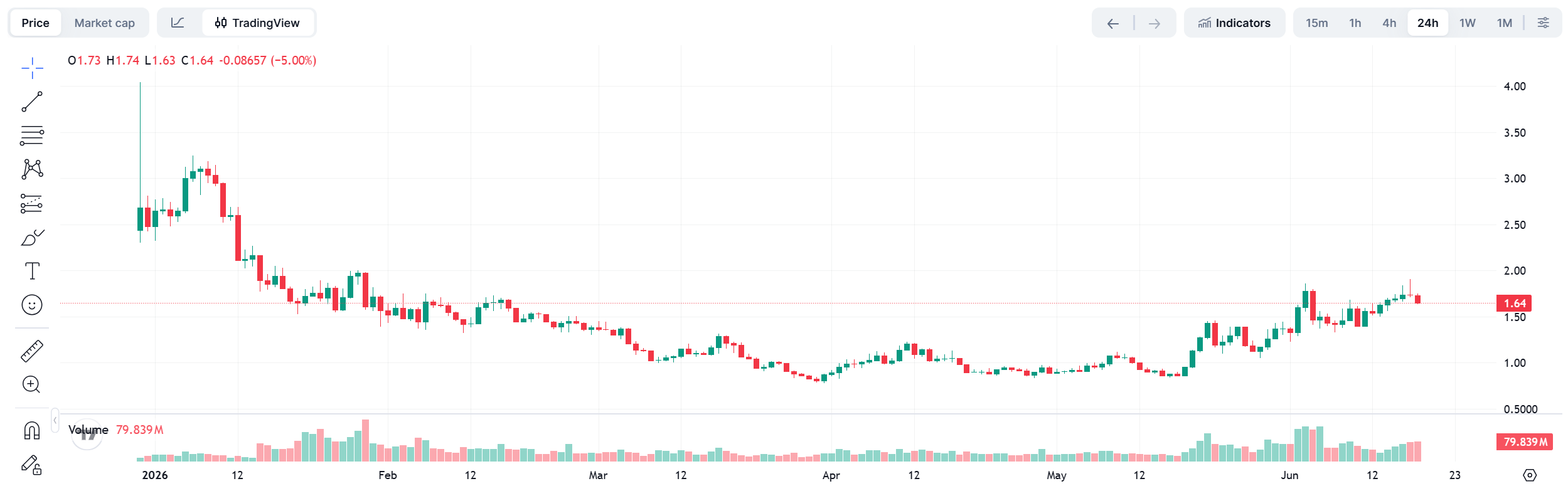


In 2026, Hyperliquid gained significant market attention through its buyback flywheel and expansion into multiple sectors, with its token price surging from $20 to a peak of $76, setting a new all-time high. After adjusting at the beginning of the year, the price of Lighter's token has rebounded significantly recently. So, what factors are currently driving this?


Lighter is a decentralized perpetual contracts exchange. In December 2025, its native token LIT officially underwent Token Generation Event (TGE), accompanied by a large-scale airdrop. The total fixed supply is 1 billion tokens. Specifically, within the ecosystem portion, 25% was automatically airdropped to early users via points seasons at TGE, with the remaining 25% reserved for future incentives, partners, and growth. The team holds 26%, and investors hold 24%. The airdrop portion was released 100% at TGE.


The team and investor portions have a 1-year cliff (starting unlocking on December 30, 2026), followed by a 3-year linear unlock.
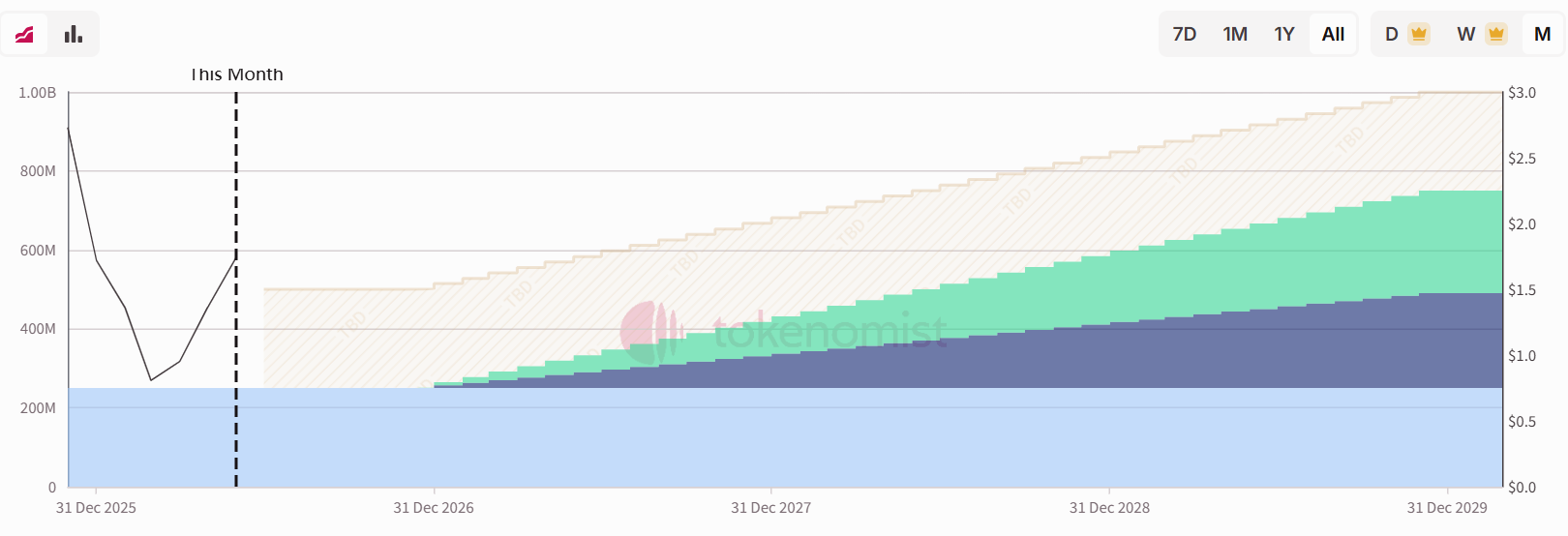


To date, the circulating supply remains at approximately 250 million tokens (25% of total supply), with the remaining 75% still locked. This means there is temporarily no VC and team unlock selling pressure in the second half of this year.


Buyback, LLP & Staking Pool


The buyback mechanism is the core of Lighter's value capture. The protocol uses all fee income generated from products like perpetual trading to buy back LIT tokens on the open market. Official disclosures show this buyback is fully programmatic: the protocol automatically aggregates all fee income hourly and places 100 limit buy orders from the current market price down to a -10% range.
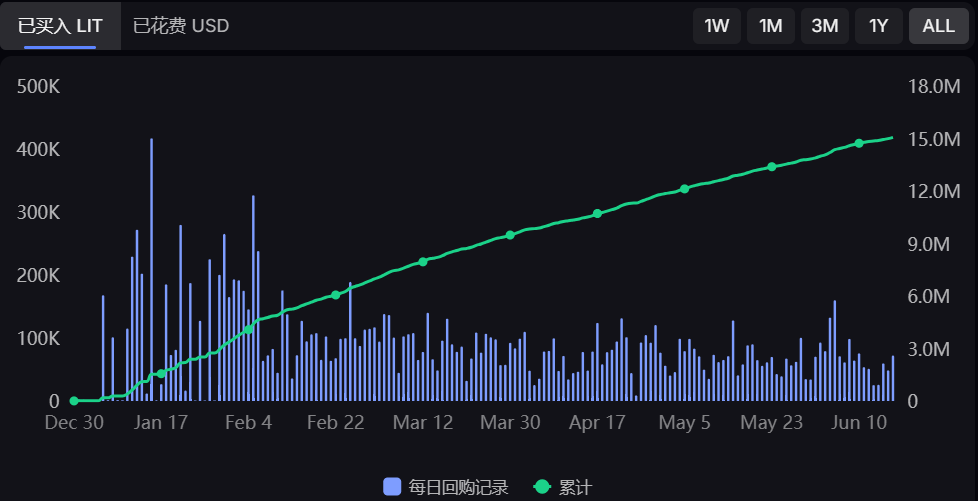


According to the latest data from Lighter, since TGE, the protocol has programmatically bought back approximately 15 million LIT, accounting for about 6% of the circulating supply, with a buyback amount of around $21 million, representing 1.51% of the total supply. These buybacks directly convert protocol revenue into continuous on-chain buy-side pressure.


So, how is Lighter currently performing in the market?


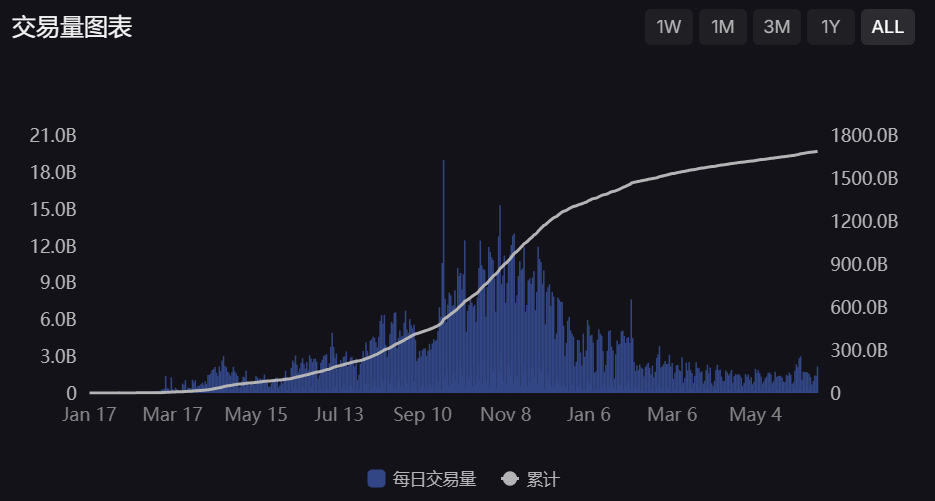
Data from the official website shows its total trading volume has exceeded $1.68 trillion. However, its trading volume has been declining this year due to factors like sluggish market conditions.


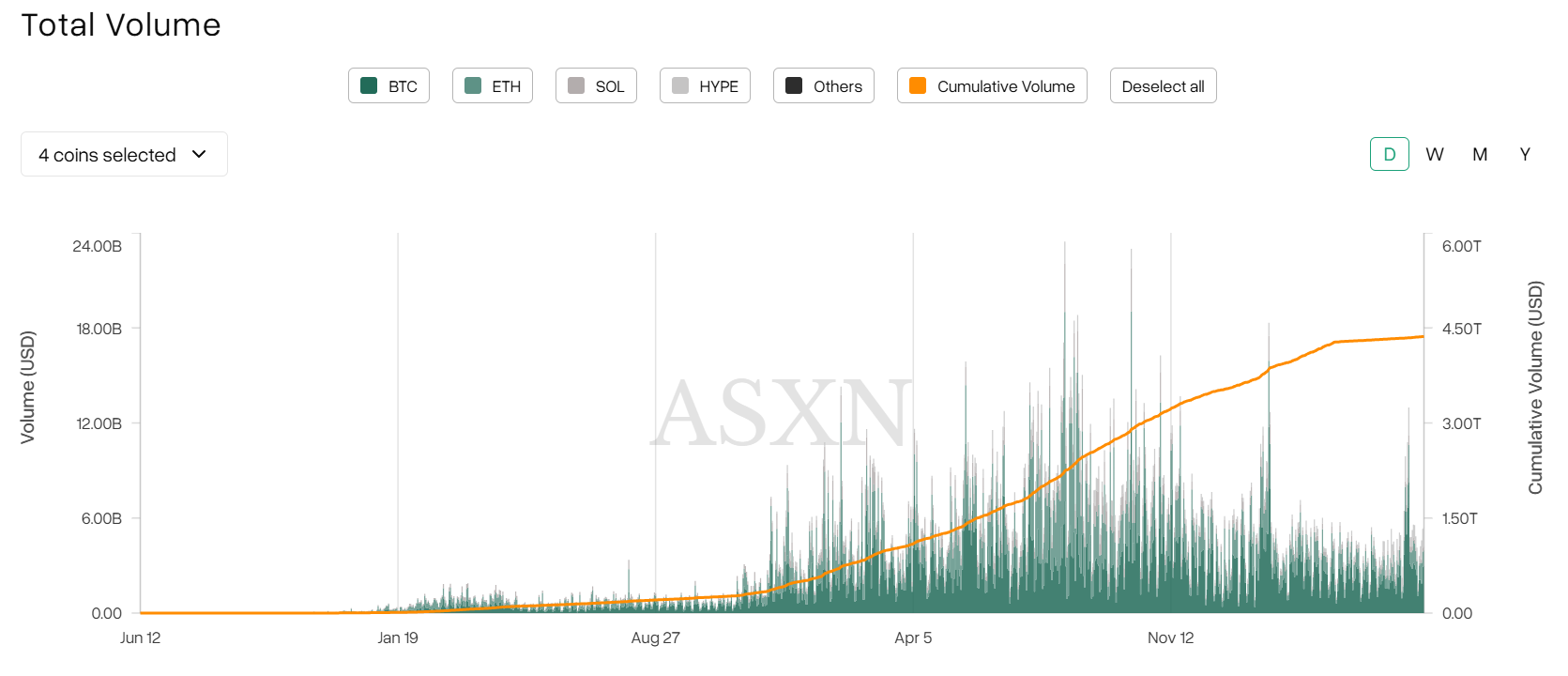
In comparison, Hyperliquid's total trading volume has surpassed $4.37 trillion, nearly three times that of Lighter, and its volume has remained stable since September-October 2025.


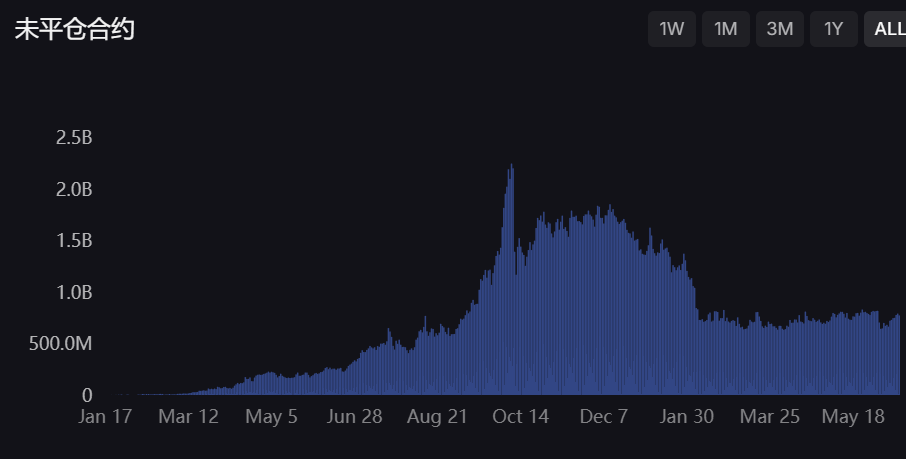
However, turning our attention to open interest, Lighter's open interest data from November 2025 was $1.6 billion, while the current data is $750 million, which isn't drastically low. Hyperliquid's open interest peaked at $9.64 billion and currently remains at $5.06 billion.


Meanwhile, Lighter continues to iterate on the product side. In May, it partnered with Insilico Terminal to introduce a professional-grade execution management system, attracting systematic traders and deepening order book liquidity. The platform has launched a Pre-IPO perpetual contracts market and introduced features like LIT fee points, expanding trading scenarios and user engagement. These actions complement the buyback flywheel, amplifying protocol revenue and buy-side effects under macro event drivers.


Simply put, the Lighter Liquidity Pool (LLP) is the market maker capital pool for the Lighter exchange. In a centralized exchange, when a user goes long, the counterparty is typically a market maker (institution) or another user going short. However, in a decentralized exchange, the underlying logic changes: the "common counterparty" for all traders' positions across the entire exchange is the LLP. In other words, if users profit from going long, the LLP pays them; if users incur losses, those losses are directly absorbed into the LLP.


According to historical big data statistics, retail traders are highly likely to lose money over long periods. Therefore, large players depositing their USDC into the LLP to act as the casino's bankroll are essentially "acting as the house," passively profiting from retail traders' losses and the exchange's fees.



According to the latest official website data, its TVL has risen to $98.42 million, with an annualized rate reaching 11.47%. According to Lighter's official rules, entering the LLP requires staking LIT tokens equivalent to 1/10th of the deposited capital amount. This design makes many large players one of the biggest spot buyers of LIT in the secondary market. The more USDC they deposit, the more LIT tokens are locked in the market.


It's important to note that the LLP liquidity pool is not shared with the staking pool; they are separate pools.


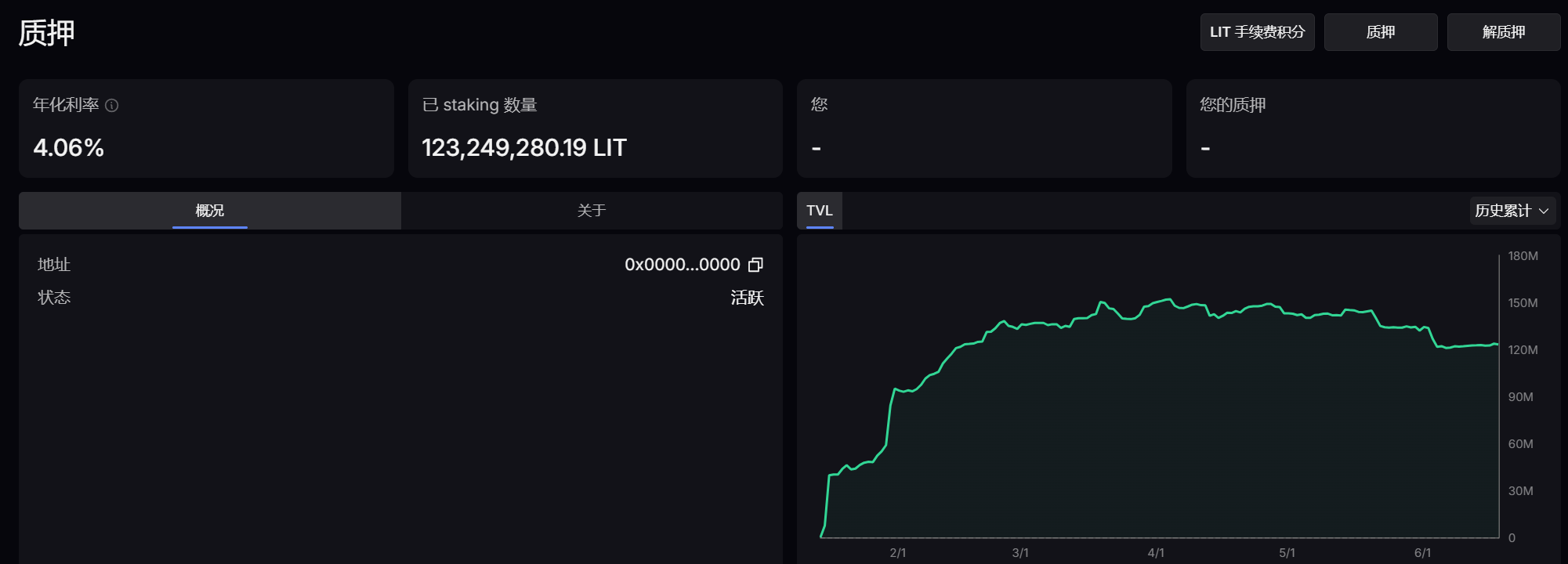
According to the latest official website data, its annualized yield is 4.06%, with 123.23 million LIT tokens staked, totaling over $204.6 million in value.


Compared to Hyperliquid, Concerns Remain


In the perpetual contracts DEX sector, Hyperliquid, with its first-mover advantage and scale effect, is the current recognized leader, while Lighter has established a unique position through technical differentiation and product focus.


Hyperliquid also implements an aggressive revenue buyback strategy with considerable scale. However, combined with staking gas fees and ecosystem incentives, it forms a more comprehensive token utility system. Lighter's buyback execution has certain advantages in transparency and predictability, while Hyperliquid's buyback is matched with a higher base of protocol revenue.


Furthermore, Hyperliquid has broader coverage: beyond perpetual contracts, it continues to expand into RWA and a more complete DeFi ecosystem, even prediction markets (e.g., Bitcoin, Ethereum price predictions). As of June 16th, the World Cup-related section within the HIP-4 prediction markets on Hyperliquid saw its 7-day trading volume surge 202% week-over-week. Continuous business expansion broadens its audience and trading volume, which in turn further boosts the buy-side pressure for the HYPE token. In contrast, Lighter is still focusing on RWA and Pre-IPO layouts and hasn't ventured into areas like prediction markets.


Institutions are also increasingly buying HYPE. According to on-chain analyst Ai Yi's monitoring, since June 1st, wallets related to a16z have withdrawn 1,229,524 HYPE ($85.54 million) and deposited them for staking. Even the prominent endorser Arthur Hayes tweeted, "Looking at the current crypto market cap rankings, most are shitcoins. I believe HYPE should at least surpass SOL before this bull cycle ends."


US institutions have also launched a HYPE spot ETF, providing stable support for its price. According to SoSoValue data, the cumulative net inflow for US HYPE spot ETFs is currently $182.56 million. In contrast, LIT still relies solely on secondary market activity and buybacks for price support.
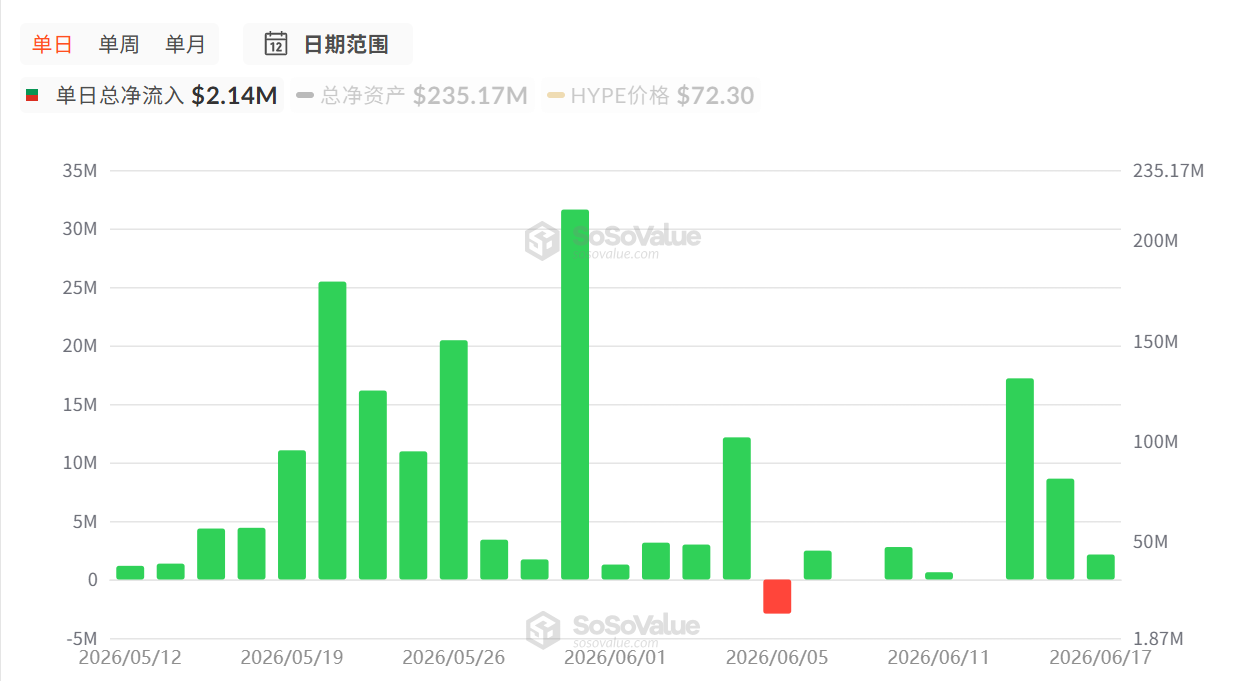


Currently, LIT lacks both influential figure endorsements and public, continuous buying by large institutions, leaving a hint of concern for its token price.


Overall, Hyperliquid currently dominates in scale, liquidity, and ecosystem breadth, while Lighter is building its competitive advantages through its ZK tech stack, transparent buyback mechanism, zero fees for retail users, and differentiated tools for institutional players.


The future relative performance of both will depend on their execution in trading volume growth, product iteration, and market adoption.


Criptos en tendencia

Preguntas relacionadas

QWhat is the core mechanism driving LIT's value appreciation, and how does it work?

AThe core mechanism is a repurchase (buyback) flywheel. Lighter uses all protocol fee revenue generated from its perpetual contracts and other products to programmatically repurchase LIT tokens on the open market. This happens hourly, placing 100 limit buy orders at prices from the current market price down to -10%, directly converting protocol income into continuous on-chain buy pressure for LIT.

QWhat is the Lighter Liquidity Pool (LLP), and what is its role in the ecosystem?

AThe Lighter Liquidity Pool (LLP) is essentially the counterparty for all traders on the Lighter exchange. It acts as the "house" or market maker in a decentralized setting. When traders profit, the LLP pays them; when traders lose, the losses flow into the LLP. This allows large liquidity providers to deposit USDC into the LLP to earn profits from overall trader losses and fees. A key rule is that providers must stake LIT tokens equal to 10% of their USDC deposit, which creates significant buy-and-lock demand for LIT in the secondary market.

QHow does Lighter's current market performance and data compare to its main competitor, Hyperliquid?

ALighter trails Hyperliquid in key metrics. As of the article's data, Lighter's total trading volume is over $1.68 trillion, while Hyperliquid's is over $4.37 trillion, nearly three times larger. Lighter's Open Interest stands at $750 million, significantly lower than Hyperliquid's $5.06 billion. Furthermore, Hyperliquid benefits from broader ecosystem expansion (like RWA and prediction markets), public endorsements from figures like Arthur Hayes, institutional buying, and a US spot ETF, which Lighter currently lacks.

QWhat is the current status of LIT's token supply and upcoming unlocks?

ALIT has a fixed total supply of 1 billion tokens. Currently, the circulating supply is approximately 250 million tokens (25% of the total). The remaining 75% are locked. The allocations for the team (26%) and investors (24%) have a 1-year cliff starting on December 30, 2026, followed by a 3-year linear vesting schedule. This means there is no unlock selling pressure from these major holders until the end of 2026.

QAccording to the article, what are the potential concerns or hidden worries for LIT's price sustainability?

AThe main concerns are its relative lack of broader market catalysts compared to Hyperliquid. Specifically, LIT lacks influential public endorsements (like Arthur Hayes' support for HYPE), visible large-scale institutional buying, and products like a US spot ETF that provide stable demand. Its price is currently supported primarily by the secondary market and the internal repurchase mechanism, making it potentially more vulnerable if trading volumes and protocol fees decline.

Lecturas Relacionadas

Ethereum 2026 Q1 Review: On-Chain Activity Hits Record Highs, Tokenized Assets Lead the Industry

Ethereum Q1 2026 Review: Record On-Chain Activity, Tokenized Assets Lead the Industry. Despite a price correction impacting USD-denominated metrics, Ethereum's on-chain usage hit all-time highs in Q1 2026. Monthly active addresses surged 85.9% year-over-year to 13.2 million, while L1 transactions and throughput also set new records. This growth occurred alongside a significant 47.9% quarterly drop in L1 transaction fees, demonstrating the impact of network scaling via upgrades like the Blob Parameter Fork. The ecosystem maintained its dominance in decentralized finance (DeFi), holding 71% of the total value locked among top chains and 79.2% of active borrowing. Ethereum solidified its position as the primary platform for tokenized real-world assets (RWAs), with a total market cap of $203.4B. It holds leading shares in stablecoins (61.8%), tokenized funds (73%), and tokenized commodities (84%) across major chains. Key developments included the ERC-8004 standard for AI agents and heightened institutional engagement at forums. Major financial institutions like BlackRock, JPMorgan, and a European banking consortium announced new tokenized products on Ethereum throughout the period. The report draws parallels to the early internet, suggesting Ethereum is sacrificing short-term fee revenue for long-term network expansion and adoption. Its strategy focuses on becoming a neutral, open settlement layer for global finance, with scaling roadmaps aiming for tens of thousands of TPS by 2029.

marsbitHace 1 hora(s)

Ethereum 2026 Q1 Review: On-Chain Activity Hits Record Highs, Tokenized Assets Lead the Industry

marsbitHace 1 hora(s)

Trading

Spot
Futuros

Artículos destacados

Cómo comprar LIT

¡Bienvenido a HTX.com! Hemos hecho que comprar Lighter (LIT) sea simple y conveniente. Sigue nuestra guía paso a paso para iniciar tu viaje de criptos.Paso 1: crea tu cuenta HTXUtiliza tu correo electrónico o número de teléfono para registrarte y obtener una cuenta gratuita en HTX. Experimenta un proceso de registro sin complicaciones y desbloquea todas las funciones.Obtener mi cuentaPaso 2: ve a Comprar cripto y elige tu método de pagoTarjeta de crédito/débito: usa tu Visa o Mastercard para comprar Lighter (LIT) al instante.Saldo: utiliza fondos del saldo de tu cuenta HTX para tradear sin problemas.Terceros: hemos agregado métodos de pago populares como Google Pay y Apple Pay para mejorar la comodidad.P2P: tradear directamente con otros usuarios en HTX.Over-the-Counter (OTC): ofrecemos servicios personalizados y tipos de cambio competitivos para los traders.Paso 3: guarda tu Lighter (LIT)Después de comprar tu Lighter (LIT), guárdalo en tu cuenta HTX. Alternativamente, puedes enviarlo a otro lugar mediante transferencia blockchain o utilizarlo para tradear otras criptomonedas.Paso 4: tradear Lighter (LIT)Tradear fácilmente con Lighter (LIT) en HTX's mercado spot. Simplemente accede a tu cuenta, selecciona tu par de trading, ejecuta tus trades y monitorea en tiempo real. Ofrecemos una experiencia fácil de usar tanto para principiantes como para traders experimentados.

455 Vistas totalesPublicado en 2026.01.15Actualizado en 2026.06.02

Cómo comprar LIT

Discusiones

Bienvenido a la comunidad de HTX. Aquí puedes mantenerte informado sobre los últimos desarrollos de la plataforma y acceder a análisis profesionales del mercado. A continuación se presentan las opiniones de los usuarios sobre el precio de LIT (LIT).

活动图片