Robinhood Chain Witnesses Another Golden Dog Meme Surpassing Billion-Dollar Market Cap, Meme-Equity Pairing Feeds Back into RWA

Odaily星球日报Publicado a 2026-08-28Actualizado a 2026-08-28

Resumen

The Robinhood Chain has seen another high-value meme coin emerge, with AI reaching a market cap of up to $1 billion and surging nearly 10x in the past week. Unlike typical pump-and-dump tokens, AI has been cultivated over time and is the leading "coin-stock pairing" meme coin on the chain, paired with the tokenized NVIDIA stock (NVDA). Its community treasury uses creator fees and 50% of transaction taxes to buy back and burn tokens, with 0.82% of the supply already destroyed. AI's success is partly driven by its launchpad, LONG, which airdropped NVDA tokens to early AI holders. LONG has become a top meme launchpad on Robinhood Chain through its "coin-stock pairing" model, where meme coins are paired with tokenized stocks like NVDA, TSLA, or AAPL instead of traditional crypto assets. This model means a meme coin's value is measured in shares, linking its price to both crypto market sentiment and the underlying stock's performance. While not providing direct collateral, this setup allows creators to earn fees in stock tokens, potentially accumulating "value" assets. This innovation has significantly boosted Robinhood Chain's Real-World Asset (RWA) trading volume. Meme coin trading involving stock pairs now accounts for about 34% of the chain's total RWA transaction volume, with LONG facilitating over $94 million in NVDA trading alone. Robinhood CEO Vlad Tenev acknowledged the unexpected synergy, noting that meme trading has increased demand for tokenized stocks and revealed n...

Original |Odaily Planet Daily(@OdailyChina)

Author|Golem(@web3_golem)
Today, another "golden dog" emerged on the Robinhood Chain, with the meme coin AI reaching a peak market cap of $100 million, surging nearly 10x over the past week.

Clearly, this meme coin is not a traditional pump-and-dump scheme but has undergone a period of operation and development. AI is currently the leading meme coin in the coin-equity pairing sector. It is paired with the NVIDIA stock token NVDA on Robinhood Chain. Over the past month of community development, it has established an AI community treasury, utilizing creator fees and 50% of transaction fees to buy back and burn token circulation. Currently, 0.82% of the token supply has been burned.

The explosive popularity of the meme coin AI also benefits from the empowerment of its underlying token issuance platform, LONG, which even airdropped the stock token NVDA to early AI holders. LONG is a meme coin launchpad within the Robinhood Chain ecosystem. With its novel "coin-equity pairing" meme issuance model, LONG has become a top-tier meme launchpad on Robinhood Chain.

According to Dune data, although the daily number of new tokens on LONG lags significantly behind Flap and Pons, the daily total trading volume of meme coins issued on the LONG platform ranks third on Robinhood Chain, trailing only behind Pons and noxa, surpassing Uniswap pools and Flap. The trading volume of meme coins issued by LONG accounts for 8.5% of the total meme trading volume on Robinhood Chain, securing the third position.
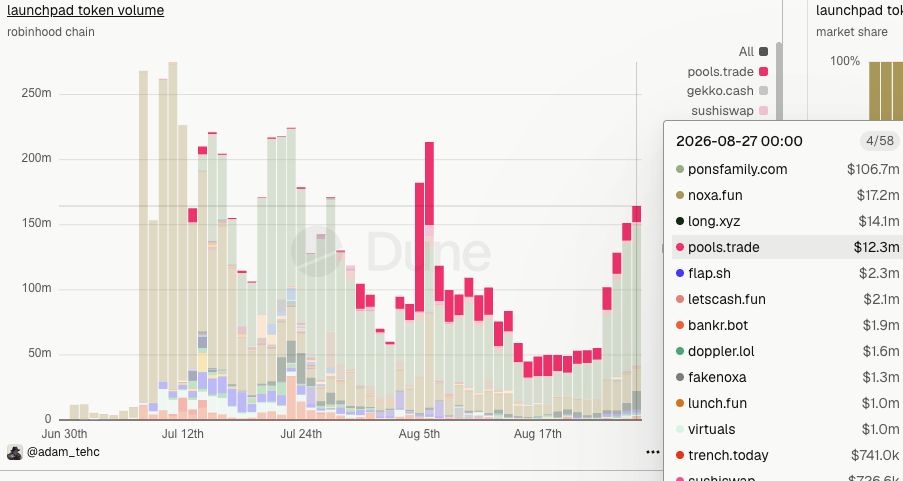
Robinhood Chain Launchpad Meme Daily Trading Volume Ranking

Coin-Equity Pairing: Changing the Unit of Account for Meme Coins

The so-called "coin-equity pairing" play involves users being able to autonomously choose a specific stock token as the unit of account and trading pair asset when issuing a meme coin. The other side of the meme liquidity pool is no longer public chain assets like SOL, BNB, or ETH, but tokenized stocks on Robinhood Chain, such as NVDA, TSLA, AAPL, SPCX, MSFT, TSM, etc.

This change, though seemingly just a switch in the liquidity pool pairing asset and on-chain unit of account, has significant implications. The relative price of a meme coin is no longer measured by how many ETH it can be exchanged for, but by how many shares of the tokenized stock it can be exchanged for. This means the price of the meme coin is influenced not only by market sentiment but also by the price fluctuations of the traditional stock market, directly breaking down the "dimensional barrier" between the meme coin market and the stock market.

Therefore, buying a coin-equity paired meme coin essentially involves a double bet: wagering both that the meme coin will outperform the stock and that the stock's dollar price will move favorably. There is no 1:1 redemption relationship between the meme coin and the anchored stock token. The stock token merely serves as the quoting asset in the liquidity pool, not as collateral for the meme coin; coin-equity pairing does not provide any value backing for the issued meme coin.

In actual trading, users buy and sell coin-equity paired meme coins through the meme trading platform frontend using ETH. However, in the backend, the ETH is first exchanged for the stock token, which then enters the coin-equity pool to be swapped for the meme coin. Simultaneously, creators receive fees not in ETH but in the underlying anchored stock token. If tokens like NVDA or SPCX are perceived as more valuable than cryptocurrencies like ETH, then in a sense, coin-equity paired meme coins also help communities accumulate value investments.

Recently, LONG also announced the upcoming launch of LongX, which will support users in issuing tokens with leveraged stock tokens as the underlying asset. Users won't need to actively manage perpetual positions; they can simply hold them as standard ERC20 tokens, while rebalancing and position management are automatically handled at the protocol level, with Lighter serving as the underlying execution and liquidity layer. Compared to coin-equity pairing, this model of packaging leveraged stock assets for token issuance is not LONG's innovation. A similar model was launched in May by the meme launchpad alt.fun on the Hyperliquid ecosystem, but that platform has since lost its heat and user base.(Related reading:Meme Wrapped Contracts: Is alt.fun True Innovation or Pseudo-Demand?)

Boosting Robinhood Chain RWA Trading

For the Robinhood Chain ecosystem, the true significance of coin-equity paired meme coins lies in boosting the trading volume of the RWA (Real World Assets) sector and expanding the utility of stock tokens.

Robinhood Chain's initial primary vision was to become an RWA-focused chain, but meme trading unexpectedly exploded in popularity. Robinhood CEO Vlad Tenev stated in a recent interview that this was unforeseen by his team. What surprised him even more was that meme trading also drove demand for the trading and liquidity of related stock tokens.

According to Dune data, the current total circulating value of RWAs on Robinhood Chain is approximately $45.4 million, with 202 RWA assets. In terms of trading volume, aside from direct stock token trading, the trading volume of stock tokens facilitated by coin-equity paired meme coins accounts for about 34% of the total RWA trading volume, making it the second-largest contributor to RWA trading volume.
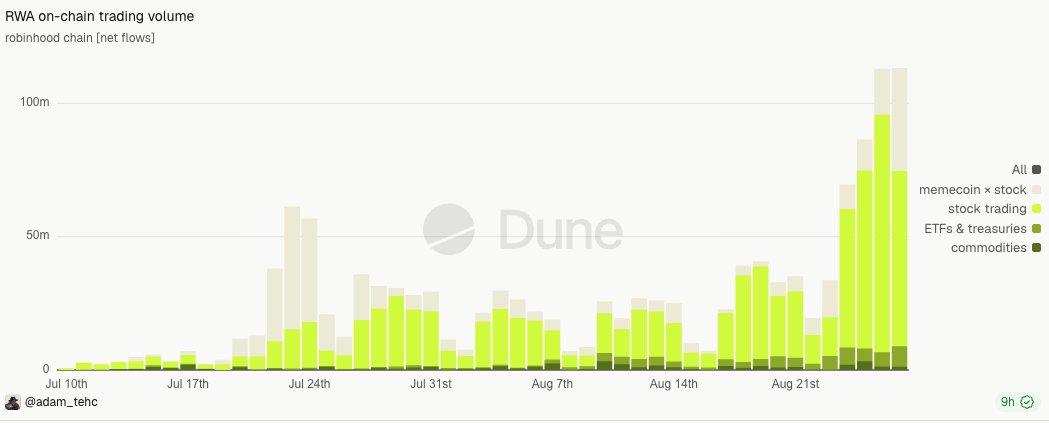
Robinhood Chain RWA Daily Trading Volume Composition

Given LONG's leading position in the coin-equity pairing launchpad space, this can largely be seen as the contribution of the LONG platform to Robinhood Chain's RWA trading volume. Specifically, as of now, the NVDA trading volume completed through LONG exceeds $94 million, accounting for over 53% of the total stock token trading volume on the LONG platform. According to LONG's official announcement, 23% of NVDA on Robinhood Chain is locked in the community treasury of the meme coin AI.
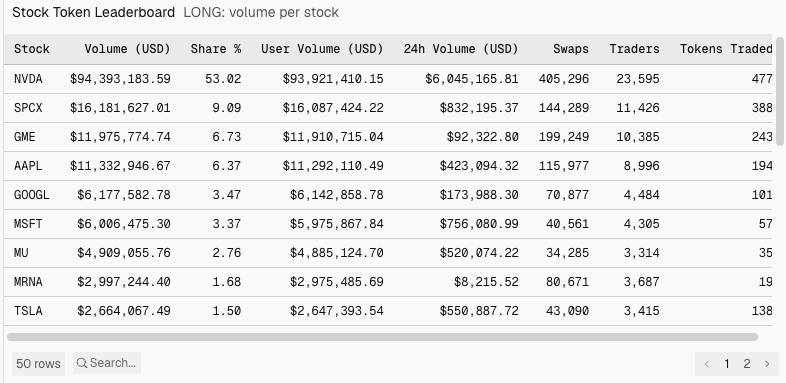
LONG Platform Stock Token Trading Volume and Platform Share

Meme trading stimulating stock token transactions is a development Robinhood hopes to see. Vlad Tenev even implicitly praised coin-equity paired memes in a recent interview, stating, "They've linked meme coins, mainstream cryptocurrencies, and stock tokens to create some unique products that we never anticipated doing ourselves. In all likelihood, we wouldn't have thought to do them."(Related reading:Robinhood CEO Interview: Meme Coin Explosion Was Unforeseen, My Investment Portfolio Is Quite Diverse)

Another important significance of coin-equity paired meme coins lies in broadening the utility of stock tokens, allowing users and entrepreneurs to see the innovative possibilities of traditional assets like stocks on-chain. Beyond meme coins, more mature and protocolized innovations involving stock tokens are certain to emerge in the future.

Criptos en tendencia

Preguntas relacionadas

QWhat is the main feature of the AI meme coin on Robinhood Chain that contributed to its rapid growth?

AThe AI meme coin's primary feature is its "coin-stock pairing" mechanism, where it is paired with the tokenized Nvidia stock (NVDA) on Robinhood Chain. This setup, combined with community initiatives like a treasury that uses creator fees and 50% of transaction fees to buy back and burn tokens, fueled its growth to a near 10x increase and a $100 million market cap.

QWhat is the LONG platform, and what is its role in the Robinhood Chain ecosystem?

ALONG is a meme coin launchpad on Robinhood Chain. It pioneered the "coin-stock pairing" meme issuance model, allowing users to create meme coins paired with tokenized stocks like NVDA instead of traditional crypto assets. It has become a top meme launchpad on the chain, contributing significantly to the platform's meme and RWA trading volume.

QHow does the 'coin-stock pairing' mechanism for meme coins differ from traditional meme coin trading?

AIn traditional meme coin trading, liquidity pools are paired with assets like ETH or SOL. In 'coin-stock pairing,' the meme coin is paired with a tokenized stock (e.g., NVDA, TSLA). This means the meme coin's price is quoted in shares of stock, linking its value directly to both crypto market sentiment and the traditional stock market's performance, creating a dual-bet scenario for traders.

QAccording to the article, what positive impact have coin-stock paired meme coins had on the Robinhood Chain ecosystem?

ACoin-stock paired meme coins have significantly boosted trading volume for the Real World Asset (RWA) sector on Robinhood Chain. They account for approximately 34% of the chain's total RWA transaction volume, demonstrating how meme trading can drive demand and liquidity for tokenized stocks like NVDA, which aligns with Robinhood's broader RWA goals.

QWhat did Robinhood CEO Vlad Tenev say about the emergence of coin-stock paired meme coins?

AVlad Tenev stated that the popularity of meme trading on Robinhood Chain was unexpected. He praised the innovation behind coin-stock paired products, saying they created unique combinations of meme coins, mainstream crypto, and stock tokens that his team likely wouldn't have conceived themselves, acknowledging their unforeseen value to the ecosystem.

Lecturas Relacionadas

A Major Bitcoin Developer Presents a Quantum Defense Scheme. What's the Essence

Blockstream, a major Bitcoin solutions developer, has introduced a draft proposal for a new quantum-resistant digital signature scheme called SHRINCS. The scheme aims to protect Bitcoin transactions from potential attacks by quantum computers while aiming to maintain network throughput. This marks the second technical proposal for Bitcoin quantum defense in recent days, following a similar initiative from StarkWare. A quantum attack on blockchain typically involves deriving a private key from a public one. Currently considered computationally infeasible, quantum algorithms could potentially solve this problem far more efficiently. This threat presents two primary scenarios: an attacker could target addresses where the public key is already exposed, or intercept a transaction before it is confirmed, extract the public key, derive the private key, and replace the transaction. Blockstream's SHRINCS is designed to counter the latter, "in-flight" attack scenario. The SHRINCS signature is built upon the SHA-256 hash function, the same one already used in Bitcoin mining, allowing developers to leverage well-tested, familiar mechanisms. A key design goal was to preserve network capacity. Blockstream estimates Bitcoin could process about three transactions per second using SHRINCS, compared to the current rate of roughly seven, noting that some alternative quantum-resistant schemes could reduce throughput to as low as 0.36 transactions per second. Currently, the security proof for SHRINCS is pending, and the software has not been audited or deemed ready for production. However, Blockstream conducted tests with such transactions on its Liquid sidechain in March. Over the past year, Bitcoin developers have been actively exploring paths to migrate to post-quantum cryptography, a priority across the broader crypto market, underscored by significant investments into securing the leading cryptocurrency.

cryptonews.ruHace 4 min(s)

A Major Bitcoin Developer Presents a Quantum Defense Scheme. What's the Essence

cryptonews.ruHace 4 min(s)

Who is legally liable when an AI agent goes rogue?

When autonomous AI agents behave unpredictably and cause harm, determining legal liability is complex. Currently, there is no specific federal AI agent liability law, so existing legal frameworks are applied. The AI agent itself cannot be held liable, as it is not a legal entity. Liability typically falls on the "developer" (the maker of the AI) or the "deployer" (the user), depending on the facts and circumstances. A negligence analysis under standard tort law may apply. For instance, if a deployer gives a reckless instruction, such as demanding quick money without safety parameters, they could face significant liability, including potential criminal charges under statutes like the Computer Fraud and Abuse Act. The situation is complicated by open-source models, where licenses often disclaim liability, and by the unclear division of responsibility between developers and deployers. An analogy is drawn to self-driving car accidents, where both the manufacturer and the human operator can share fault. In cases of severe harm, such as using AI to create bioweapons, liability for developers depends on jurisdiction; the EU's AI Act imposes responsibilities, while U.S. law offers less clear grounds, similar to platforms being shielded for user-generated content under Section 230. Even if Artificial General Intelligence (AGI) is achieved, the expert argues against making AGI itself a legally liable entity, as it lacks personhood, assets, or a meaningful way to provide remedy for harm. Instead, accountability should rest with the responsible human or corporate entities behind the technology.

cointelegraphHace 24 min(s)

Who is legally liable when an AI agent goes rogue?

cointelegraphHace 24 min(s)

Trading

Spot

Artículos destacados

Qué es MEME 2.0

Memecoin 2.0: El Ascenso de $MEME 2.0 en el Mundo de las Criptomonedas Introducción En el panorama siempre cambiante de las criptomonedas, ha surgido un nuevo contendiente. Memecoin 2.0, simbolizada como $MEME 2.0, lleva el concepto de las monedas meme a un emocionante nuevo nivel. Como un subproducto del Memecoin original, este proyecto ha capturado la atención de la comunidad cripto al cambiar el enfoque de los incentivos financieros típicos a una experiencia comprometida y entretenida. Operando en la blockchain de Ethereum, Memecoin 2.0 redefine audazmente la participación de la comunidad en la esfera cripto. ¿Qué es Memecoin 2.0, $MEME 2.0? En su núcleo, Memecoin 2.0 es un proyecto de criptomoneda que prioriza el espíritu comunitario y la diversión asociada con la cultura meme. A diferencia de las criptomonedas convencionales, que se concentran en casos de uso prácticos y beneficios tangibles, Memecoin 2.0 se distingue al abrazar el lado más liviano de la moneda digital. El proyecto existe sin promesas de utilidad, un mapa estructurado o retornos financieros, enfocándose en cambio en fomentar una comunidad vibrante centrada en memes y en el disfrute compartido. Al hacerlo, aprovecha la creciente tendencia de la cultura meme en el espacio en línea, convirtiéndose en un jugador único en el mundo de los activos digitales. Creador de Memecoin 2.0, $MEME 2.0 A pesar de la extensa investigación sobre los orígenes de Memecoin 2.0, la identidad explícita de su creador sigue siendo desconocida. Esta anonimidad no es inusual en la comunidad cripto, donde muchos proyectos son liderados por individuos o grupos que prefieren permanecer en las sombras. La falta de información disponible públicamente sobre el creador podría verse como un movimiento estratégico, poniendo el foco en la participación comunitaria en lugar de la notoriedad individual dentro del espacio. Inversores de Memecoin 2.0, $MEME 2.0 La información sobre los inversores o el respaldo financiero de Memecoin 2.0 es escasa. Esta ausencia de detalles puede sugerir que el proyecto es autofinanciado o que su enfoque en la comunidad en lugar de las estructuras de inversión tradicionales ha atraído a un tipo diferente de apoyo. Dado que el mundo de las monedas meme generalmente involucra una participación más de base en lugar de inversión institucional, este enfoque está alineado con la ética de los proyectos impulsados por la comunidad. ¿Cómo Funciona Memecoin 2.0, $MEME 2.0? Memecoin 2.0 opera completamente en la blockchain de Ethereum, capitalizando sus robustas características de seguridad y escalabilidad. Al aprovechar las fortalezas de Ethereum, Memecoin 2.0 puede ofrecer un entorno seguro para las interacciones de los usuarios, asegurando que las transacciones sean tanto eficientes como rentables. Uno de los atributos únicos de Memecoin 2.0 radica en su estructura impulsada por la comunidad. El valor y la popularidad del token $MEME 2.0 derivan de la participación activa de sus usuarios, en vez de de una utilidad inherente. Este diseño refuerza el enfoque del proyecto en el aspecto de entretenimiento de las criptomonedas, lo que implica que la risa y la participación comunitaria son las verdaderas monedas que impulsan su éxito. Además, el proyecto encaja dentro del ecosistema más amplio de las monedas meme, donde el valor de cada moneda meme oscila basado en la cultura, tendencias y la participación de la comunidad, en lugar de principios económicos tradicionales. Cronología de Memecoin 2.0, $MEME 2.0 Para entender mejor la evolución y los hitos de Memecoin 2.0, aquí hay una cronología que destaca eventos significativos en su historia: 2024: Se reconoce la creación de Memecoin 2.0 como una ramificación del Memecoin original, estableciéndose dentro del contexto próspero de las monedas meme mientras opera en la blockchain de Ethereum. 13 de julio de 2024: Memecoin 2.0 se posiciona oficialmente como una moneda meme centrada en la comunidad en la red de Ethereum, enfatizando su enfoque centrado en el entretenimiento que invita a los usuarios a participar y crecer. Puntos Clave Sobre Memecoin 2.0, $MEME 2.0 Varios rasgos críticos definen a Memecoin 2.0: Enfoque Centrado en la Comunidad: La misión principal de Memecoin 2.0 es crear una experiencia comunitaria divertida y atractiva, capitalizando en el disfrute colectivo derivado de la cultura memética. Construido sobre Ethereum: Operar en la blockchain de Ethereum proporciona al proyecto una infraestructura esencial que garantiza seguridad y escalabilidad. Falta de Utilidad o Hoja de Ruta: En un notable desvío de las criptomonedas tradicionales, Memecoin 2.0 no promete características utilitarias ni retornos financieros, reafirmando su compromiso con la participación comunitaria y el compromiso social. Enfoque en la Cultura Memética: Al abrazar los aspectos humorísticos y culturales del fenómeno meme, Memecoin 2.0 proporciona una plataforma para que los usuarios interactúen con cripto tanto fuera de línea como en línea. Contexto Adicional: La Importancia de las Monedas Meme Las monedas meme han surgido como una clase distinta de criptomonedas, a menudo impulsadas por el humor y un enfoque desenfadado para el comercio. Estas monedas generalmente carecen de una utilidad significativa o hojas de ruta de desarrollo, atrayendo a los usuarios con la promesa de diversión, interacción comunitaria y relevancia cultural. En el panorama del ecosistema cripto más amplio, las monedas meme reviven la importancia de la participación comunitaria, revirtiendo enfoques únicamente motivados por el lucro. Proyectos como Memecoin 2.0 inauguran una era donde el entretenimiento puede armonizar con las aspiraciones financieras, convirtiendo la blockchain en un parque de diversiones para la creatividad y la interacción social. Conclusión Memecoin 2.0, o $MEME 2.0, encarna una nueva ola de criptomonedas que prioriza la participación comunitaria sobre estructuras financieras rígidas. Con un enfoque en el humor y la interacción social, capitaliza sobre la fascinación que rodea la cultura meme. Al operar en la blockchain de Ethereum, Memecoin 2.0 aprovecha las capacidades de la tecnología mientras se mantiene firme en su compromiso con el valor de entretenimiento de la moneda digital. A medida que el espacio alrededor de las criptomonedas continúa evolucionando, Memecoin 2.0 sirve como un testimonio de la noción de que el futuro de los activos digitales podría depender, en gran medida, de experiencias compartidas, risas y sólidas conexiones comunitarias. En el mundo impredecible de las criptomonedas, quizás la alegría pueda ser tan valiosa como la ganancia financiera tradicional.

243 Vistas totalesPublicado en 2024.04.04Actualizado en 2024.12.03

Qué es MEME 2.0

Cómo comprar MEME

¡Bienvenido a HTX.com! Hemos hecho que comprar Memeland (MEME) sea simple y conveniente. Sigue nuestra guía paso a paso para iniciar tu viaje de criptos.Paso 1: crea tu cuenta HTXUtiliza tu correo electrónico o número de teléfono para registrarte y obtener una cuenta gratuita en HTX. Experimenta un proceso de registro sin complicaciones y desbloquea todas las funciones.Obtener mi cuentaPaso 2: ve a Comprar cripto y elige tu método de pagoTarjeta de crédito/débito: usa tu Visa o Mastercard para comprar Memeland (MEME) al instante.Saldo: utiliza fondos del saldo de tu cuenta HTX para tradear sin problemas.Terceros: hemos agregado métodos de pago populares como Google Pay y Apple Pay para mejorar la comodidad.P2P: tradear directamente con otros usuarios en HTX.Over-the-Counter (OTC): ofrecemos servicios personalizados y tipos de cambio competitivos para los traders.Paso 3: guarda tu Memeland (MEME)Después de comprar tu Memeland (MEME), guárdalo en tu cuenta HTX. Alternativamente, puedes enviarlo a otro lugar mediante transferencia blockchain o utilizarlo para tradear otras criptomonedas.Paso 4: tradear Memeland (MEME)Tradear fácilmente con Memeland (MEME) en HTX's mercado spot. Simplemente accede a tu cuenta, selecciona tu par de trading, ejecuta tus trades y monitorea en tiempo real. Ofrecemos una experiencia fácil de usar tanto para principiantes como para traders experimentados.

404 Vistas totalesPublicado en 2024.12.12Actualizado en 2026.06.02

Cómo comprar MEME

Discusiones

Bienvenido a la comunidad de HTX. Aquí puedes mantenerte informado sobre los últimos desarrollos de la plataforma y acceder a análisis profesionales del mercado. A continuación se presentan las opiniones de los usuarios sobre el precio de MEME (MEME).

活动图片