Macroeconomic Origins of the African Payments Market Structure

marsbitPublicado a 2026-06-05Actualizado a 2026-06-05

Resumen

Africa’s payment landscape exhibits the world’s highest mobile money penetration and fastest cryptocurrency adoption. This is not a market anomaly but a macroeconomic inevitability driven by deep structural factors: a vast, young population, heavy reliance on commodity exports and remittances generating massive cross‑border payment needs, and a chronically underdeveloped formal banking system plagued by de‑risking, high inflation, and currency instability. This vacuum has allowed mobile money (e.g., M‑Pesa) to become the primary payment channel domestically, while cryptocurrencies—particularly stablecoins—serve as a store of value against local‑currency depreciation and a lower‑cost cross‑border medium. The key divide is the Sahara: North Africa integrates with the MENA oil‑centric financial system, while Sub‑Saharan Africa, facing acute dollar shortages and fragmented currencies, is the epicenter of this fintech surge. Structural reliance on dollars, driven by trade deficits and weak local currency credibility, creates persistent dollar scarcity, which crypto and mobile payments effectively address. Efforts like the Pan‑African Payment and Settlement System (PAPSS) aim at de‑dollarization, but these alternatives will remain essential as long as underlying economic constraints—commodity dependence, limited industrialization, and financial exclusion—persist.

Africa's payments market exhibits distinct characteristics, boasting the world's highest mobile payment penetration rate and the fastest growth in cryptocurrency adoption. This is not a market-level coincidence, but a necessity arising from the long-term evolution of macroeconomic structures.

This article analyzes the two deep-seated structural drivers behind this necessity: (1) Africa's long-term reliance on resource exports, trade circulation, and remittances has created immense demand for cross-border settlement and transfers; (2) Africa's domestic financial infrastructure is underdeveloped, suffering from international bank de-risking and poor foreign exchange management, leading to a persistent absence of commercial banking and stubborn inflationary pressures.

These two forces jointly create a vacuum where mobile payments and cryptocurrencies have flourished: mobile payment platforms have replaced banks as daily payment channels, while cryptocurrencies assume the role previously held by local fiat currencies or the US dollar in emerging economies, acting both as a store of value against currency depreciation and a low-cost medium for cross-border exchange.

The key dividing line on this continent is the Sahara Desert: North of the Sahara integrates into the Middle East and North Africa (MENA) framework, anchored by oil and aligned with the Middle East; while Sub-Saharan Africa (SSA), plagued by severe dollar shortages and fragmented currency systems, has fostered a vast market with a natural demand for mobile payments and cryptocurrencies. SSA countries like Nigeria, Kenya, and South Africa rank among the world's highest in mobile payment and cryptocurrency adoption rates.

1 Africa's Macroeconomic Panorama: A Vast, Young, Yet Commodity-Dependent Primary Economy

1.1 Demographic Structure

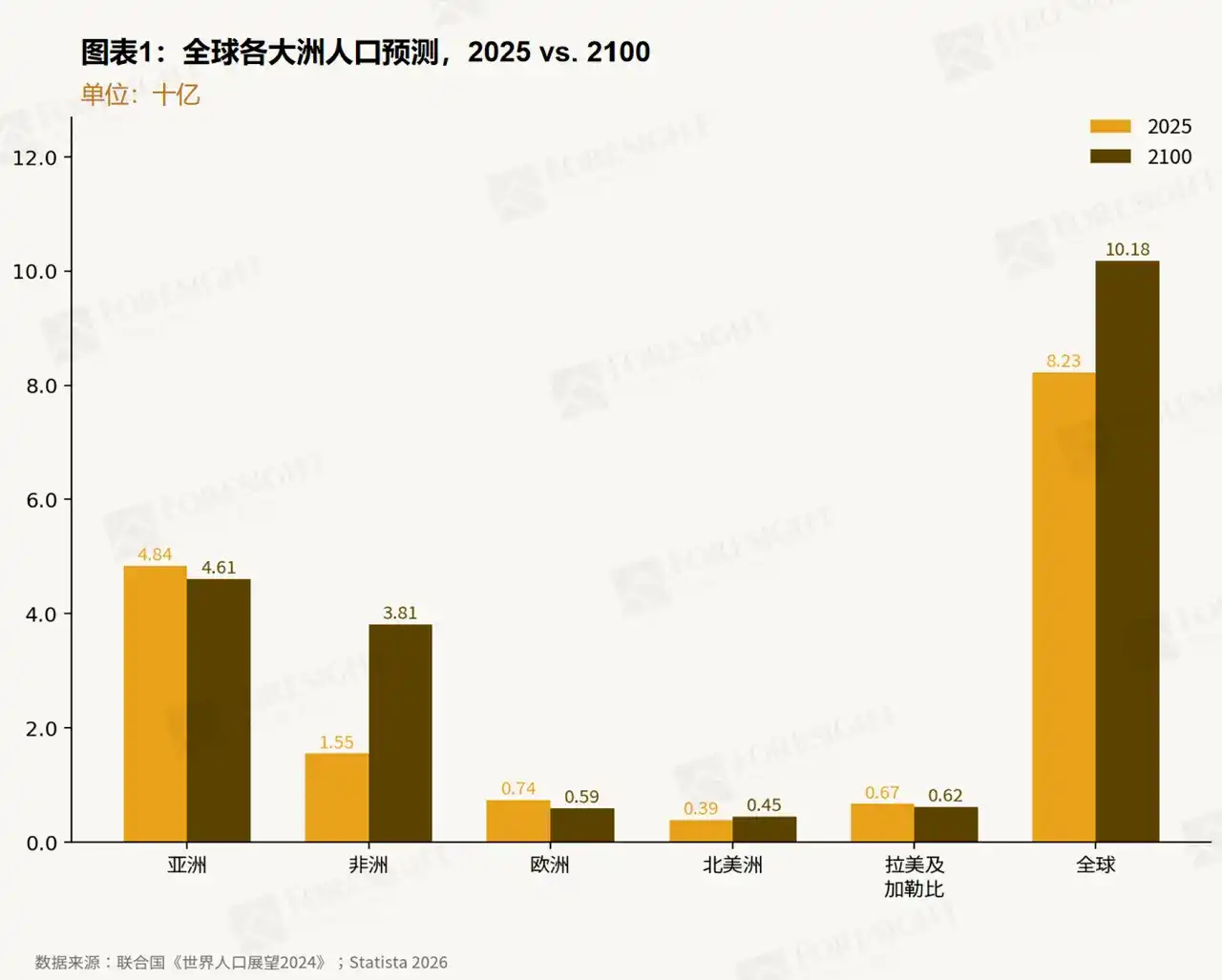
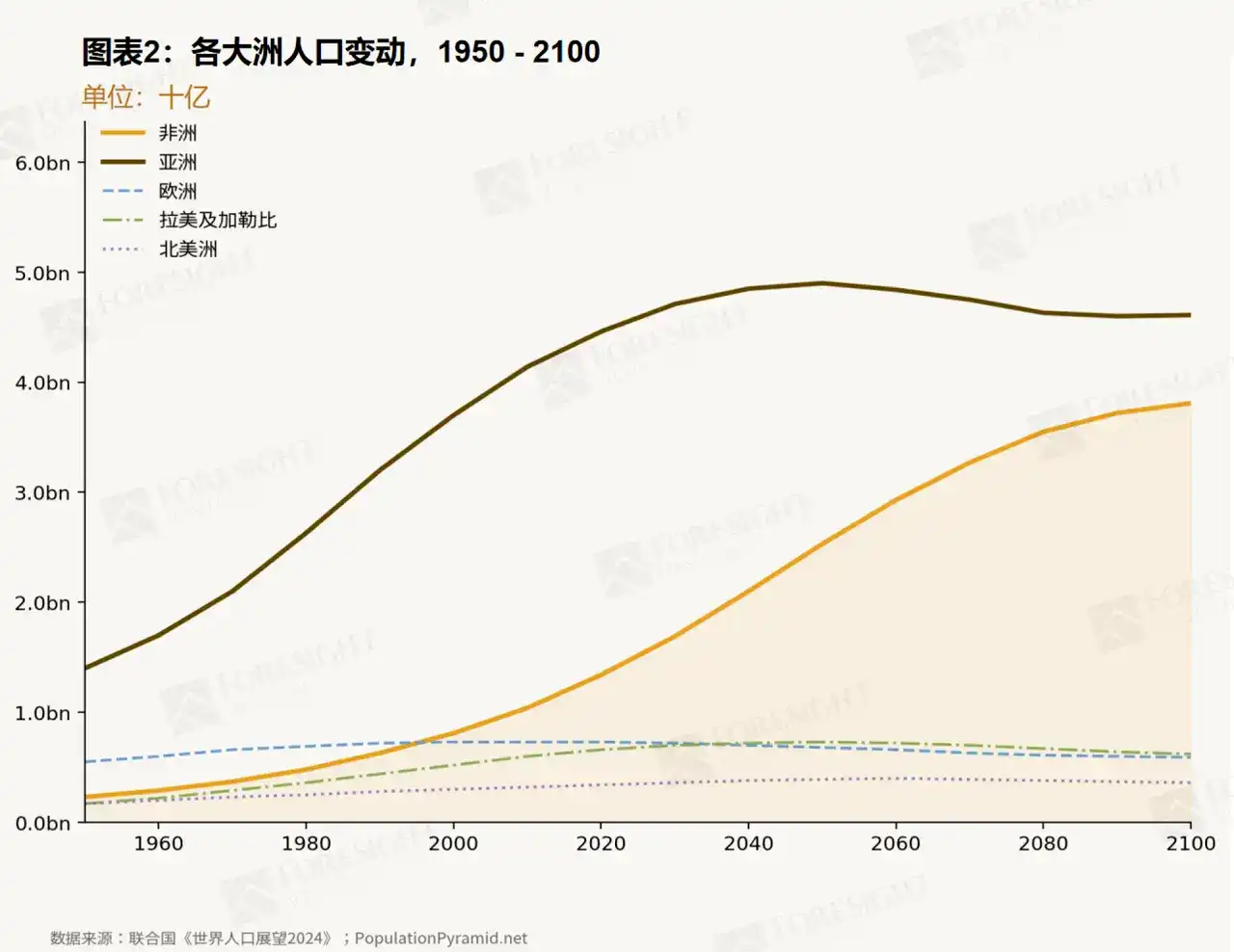
By 2025, Africa's population will reach about 1.55 billion, accounting for approximately 19% of the global total. It is the youngest continent globally, with a median age of just 19, and also the fastest-growing continent, with an annual growth rate of about 2%, unmatched by other continents.

By 2100, Africa's population is projected to nearly triple to 3.81 billion, constituting 37% of humanity by then. In stark contrast, Asia's population is expected to peak and decline by mid-century, Europe and Latin America face absolute contraction, while Africa alone will sustain substantial growth throughout the century (see Figures 1 and 2).

This demographic trend has profound implications for payments infrastructure. Against a backdrop where traditional banking coverage remains low, a large, young, urbanizing, mobile-native cohort is entering the labor market and consumer economy at scale. Consequently, demand for convenient, low-cost financial services (including payments, savings, credit) will only intensify.
1.2 Resource Endowment and Industrial Structure

Africa possesses extremely rich natural resources. According to OPEC's Annual Statistical Bulletin, as of 2024, the continent's proven crude oil reserves were approximately 119.4 billion barrels, accounting for about 7.6% of the global total, with the largest reserves concentrated in Libya, Nigeria, Algeria, and Angola. Beyond hydrocarbons, Africa's mineral resources also hold significant global importance and dominate several categories: the continent is the world's most crucial diamond producer, holds about 49% of global cobalt reserves, and is the absolute source of platinum group metals (PGMs), with South Africa alone controlling about 78% of global PGM reserves. These endowments make Africa a critical node in the global commodity supply chain.

However, much of this wealth is still extracted and exported as raw materials with little downstream processing or value addition. Simultaneously, local manufacturing and agriculture are underdeveloped, infrastructure is severely lacking, and refined fuels, processed foods, etc., remain import-dependent. This economic structure of being 'large at both import and export ends' locks the continent into the trade dependency pattern discussed next.

1.3 Trade Dependency and Remittance Flows

Africa's economy is deeply intertwined with global trade and overseas remittances. In 2023, Africa's cross-border goods exports and imports reached $604.5 billion and $684.5 billion, respectively, while remittance inflows amounted to $52.16 billion. For reference, Africa's total GDP in 2023 was approximately $2.96 trillion. These two pillars of trade and remittances are not only pivotal in Africa's economic structure but also generate massive demand for B2B cross-border trade settlement and C2C cross-border transfers, respectively.

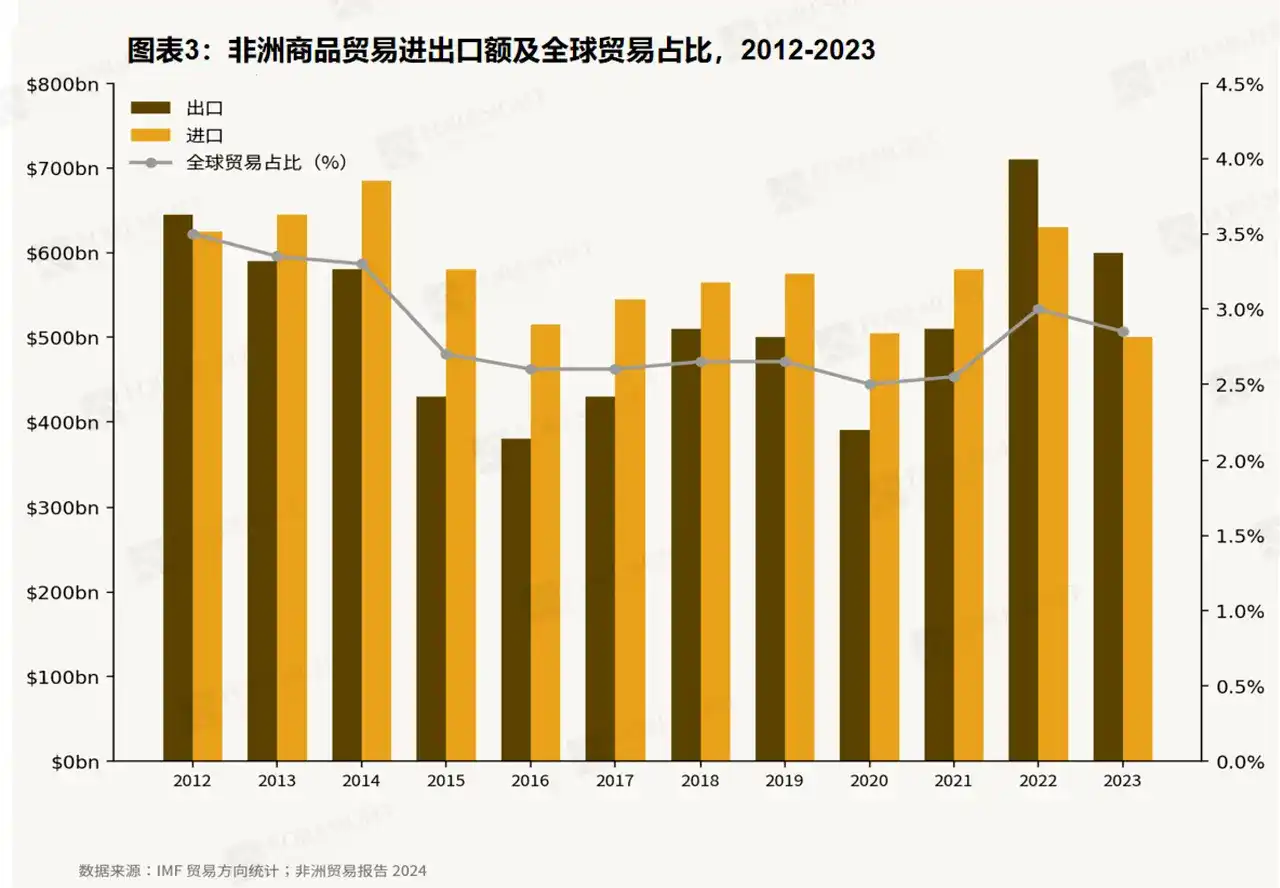
Cross-border trade is a vital pillar of Africa's economy, but the commodity-dependent export structure and persistent trade deficits make it highly sensitive to global macro cycles. In 2023, Africa's total goods exports were $604.5 billion (down 15.1% year-on-year), imports were $684.5 billion (down 1.6% year-on-year), resulting in a trade deficit of about $80 billion (see Figure 3). Over a ten-year trend, Africa is extremely sensitive to fluctuations in the global commodity cycle. The oil price collapse of 2015–2016 pushed Africa's trade volume to a two-decade low, stalling resource-dependent economies (e.g., Nigeria, Angola, oil exporters) while non-resource economies maintained 7%–8% growth, showing a clear divergence. The 2020 COVID-19 shock triggered another collapse: global commodity prices plummeted, African GDP growth fell to -2%, followed by a V-shaped recovery in 2021. More recently, during 2022–2023, driven by a spike in commodity prices triggered by the Russia-Ukraine conflict, African exports briefly surged. However, simultaneously, the aggressive US Federal Reserve rate hikes pushed up the US dollar and tightened global liquidity, subjecting the entire continent to severe imported inflation and currency depreciation.
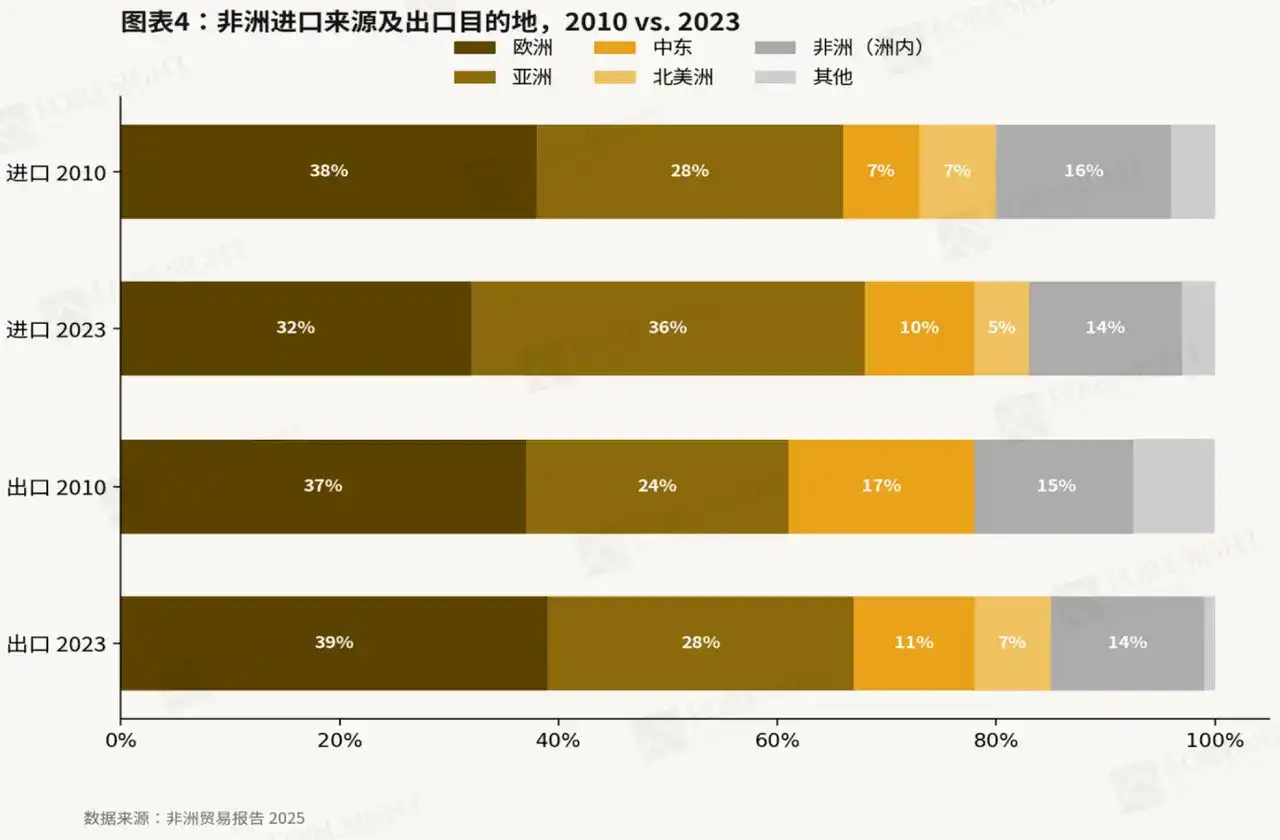
Africa's trade partner structure has changed significantly over the past decade (see Figure 4). Asia, led by China and India, has surpassed Europe to become Africa's largest source of imports—its share of total African imports rose from 28% in 2010 to 36% in 2023, while Europe's share fell from 38% to 32%. On the export side, Europe remains the top destination with a 39% share, but Asia's share has grown from 24% to 28%, and the Middle East has expanded sharply from 3% to 11%. North America's role has contracted on both import and export ends. These changes reflect the deepening commodity trade corridor between China and Africa and the Gulf states' growing importance as energy buyers and investment partners.

Beyond intercontinental trade, 'Intra-Africa Trade' among African countries is also growing rapidly, but barriers like currency and language remain bottlenecks to be overcome. Intra-African trade reached $192.2 billion in 2023, growing 3.8%. However, intra-African trade accounts for only 18% of Africa's total exports, compared to 70% for Europe and 52% for Asia. This reflects persistent obstacles like tariff fragmentation, currency inconvertibility, and weak cross-border infrastructure to intra-African trade growth. Against this backdrop, the African Continental Free Trade Area (AfCFTA) began operations in 2021, aiming to increase intra-African trade by 52% upon full implementation, but progress has been slow.

Remittances are another lifeline for Africa's economy and a source of massive C2C payment demand. According to World Bank data, Africa received $52.2 billion in remittances in 2023. The top five remittance corridors are Saudi Arabia→Egypt, UAE→Egypt, US→Nigeria, Kuwait→Egypt, France→Morocco. African labor exports to the Gulf, North America, and Europe form continuous reverse income flows to households. These corridors constitute one of the largest sources of cross-border C2C transfer demand and are also where the pain points of the traditional financial system in cross-border transfers—high costs, long time, and opacity—are most acutely felt, a key issue discussed in the next section.
2 The Deep Mismatch Between Foreign Trade/Remittance Demand and the Backward Financial System

2.1 Low Banking Coverage, Huge Unbanked Population Gap

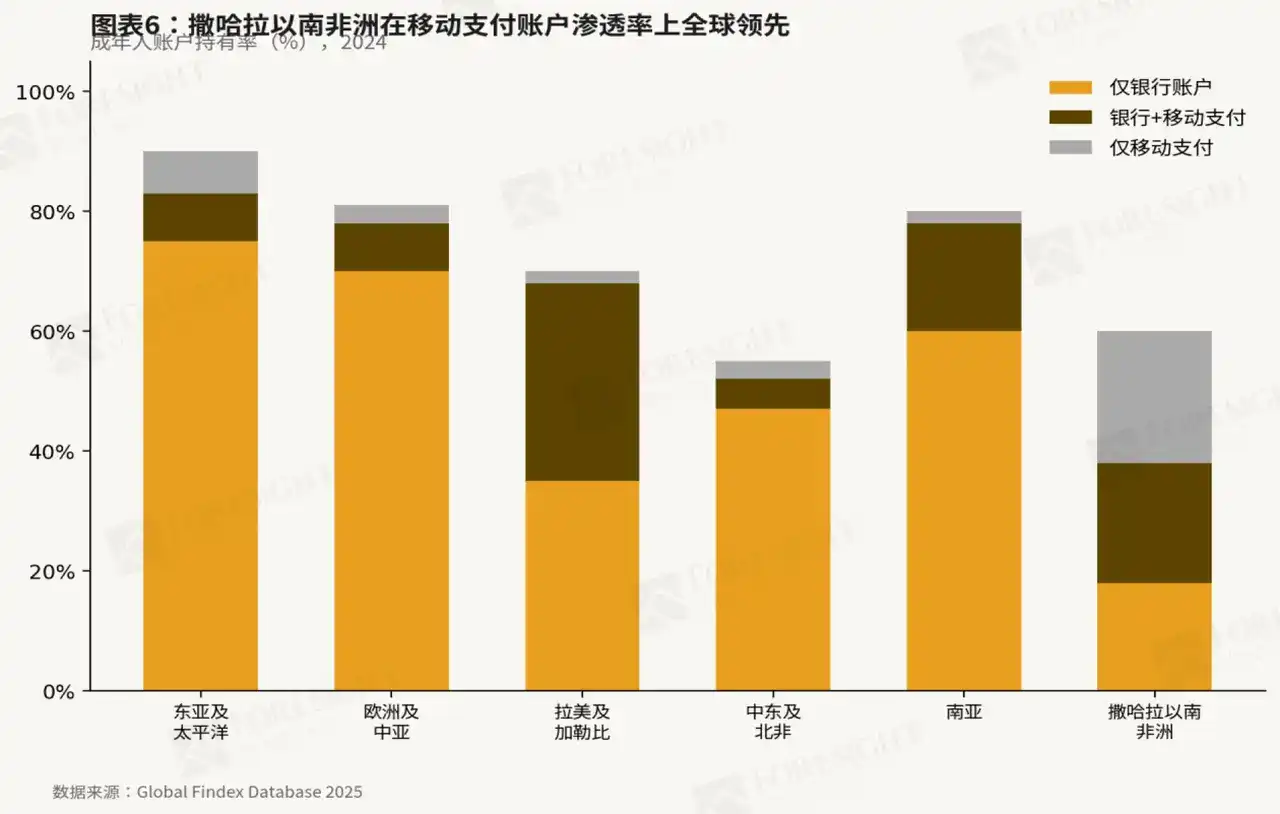
Africa's formal financial system only covers a minority. According to the World Bank's 2021–2022 global Findex database, only 49% of adults in Sub-Saharan Africa had a financial account; by 2024, this figure rose to 58% but remained among the lowest globally. Beyond low coverage, African banking outlet density is also lagging. IMF's Financial Access Survey shows Kenya has only 4.4 bank branches per 100,000 adults, Morocco 22.2, and even South Africa, with Africa's most developed banking system, has just 38.7, all far below global averages. The result is a massive unmet demand for basic financial services: payments, savings, credit, insurance.

2.2 International De-risking and Correspondent Banking Retreat

Africa's second major hurdle comes from the retreat of the international financial system itself. Driven by concerns over anti-money laundering (AML) and customer due diligence (KYC) compliance risks, compounded by local realities like lack of formal ID, no fixed address, incomplete tax records, and a high cash economy share, major global banks have engaged in a de-risking wave. Since 2016, correspondent banking relationships have shrunk dramatically. According to SWIFT data, South Africa lost over 10% of its overseas correspondents, while Angola's decline reached 37%. This retreat directly raises the cost of legitimate cross-border transactions and marginalizes smaller African financial institutions from the global system.

2.3 Poor Foreign Exchange Management and Chronic Inflation

Currency system fragility further amplifies these structural defects. Due to fiscal deficits and a weak tax base, many African central banks resort to printing money to finance government spending, causing persistent imported inflation. Prices for food, fuel, and raw materials for manufactured goods surge as the local currency depreciates. Simultaneously, shallow capital markets, highly concentrated banking systems, and a historical deficit in central bank independence lead to ineffective monetary policy transmission, making interest rate hikes ineffective at curbing inflation or stabilizing exchange rates. In 2024, Africa's overall inflation rate hit 20.1%, the highest among major global regions, severely eroding the real value of local currency savings.

2.4 Consequence: Cash Dominance and Payments System Dysfunction

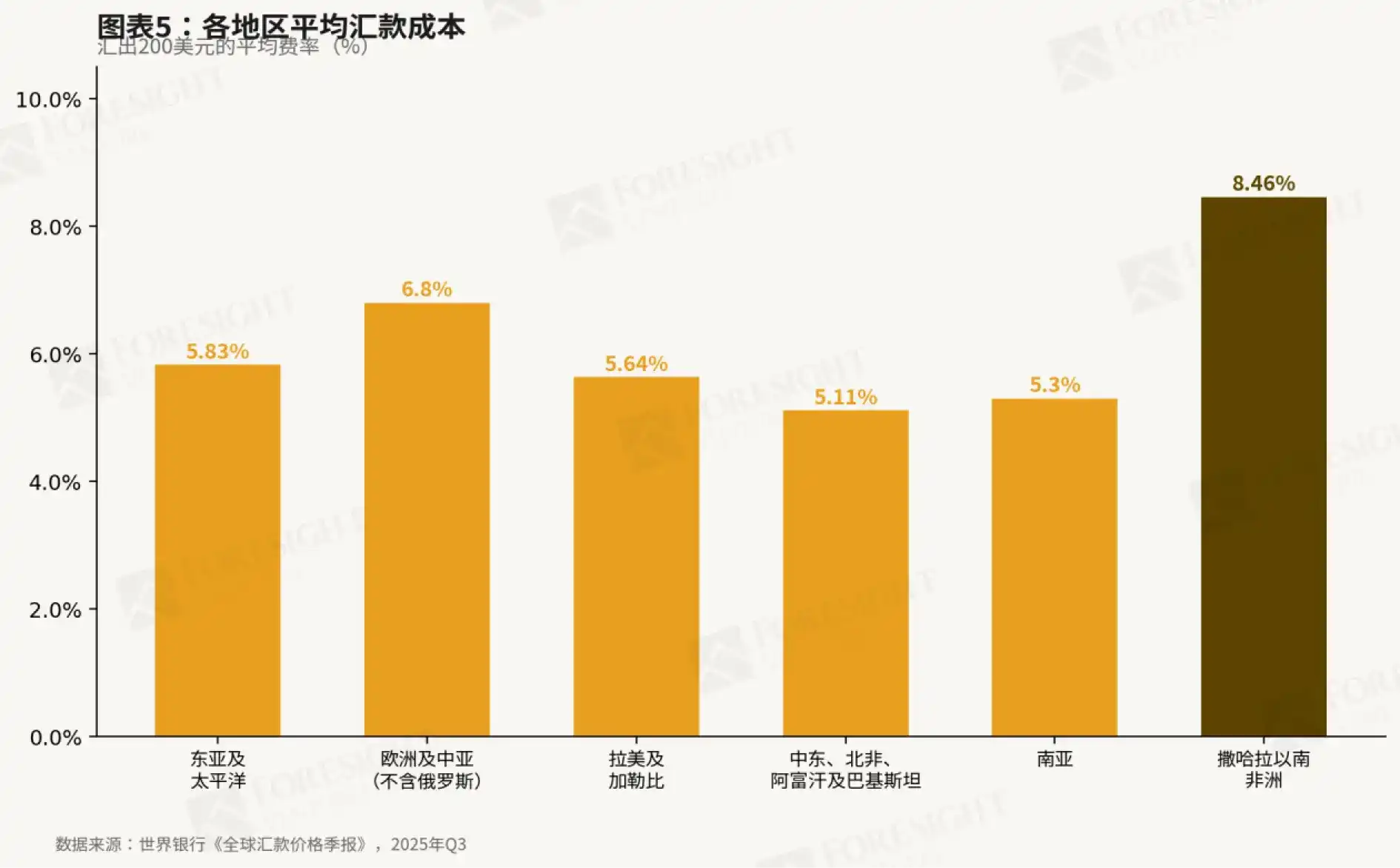
The triple dysfunction of bank exclusion, de-risking, and monetary instability has obvious consequences. Most Africans still rely on cash for daily transactions; remittance costs in Sub-Saharan Africa are the world's highest, averaging 8.46% per transfer according to the World Bank's Q3 2025 Remittance Price Report; ordinary people also lack effective inflation-hedging stores of value. The banking system fails comprehensively in access convenience, affordability, and currency stability, creating a market vacuum rapidly filled by emerging payment channels and cryptocurrencies.
3 Mobile Payments and Cryptocurrencies Thrive in the Vacuum Left by the Traditional Financial System

In the gap left by the absent banking system and under pressure from severe inflation and currency depreciation, Africa has developed the world's most dynamic mobile money and cryptocurrency markets. The emergence of these alternative payment channels is not a matter of choice but of necessity—they solve real problems the banking system cannot address: accessibility, affordability, and stability.

3.1 Mobile Payments: Africa Leads Globally

Africa accounts for most global mobile money transactions. According to the 2025 global Findex database, about 40% of adults in Sub-Saharan Africa use a mobile money account as their primary (or only) formal financial service. Kenya's M-Pesa platform exemplifies this model: relying on ubiquitous USSD technology (accessible via basic feature phone keypads), it built a network of millions of offline agent outlets and leveraged universal mobile coverage to capture 90.8% of Kenya's mobile payments market, successfully expanding to seven other African countries like Tanzania, Ghana, and Egypt. This offline agent-based, low-tech barrier architecture has proven far more scalable and inclusive than branch-based traditional banking, amassing a vast user base across urban and rural Africa.
3.2 Widespread Cryptocurrency Adoption Across the African Continent

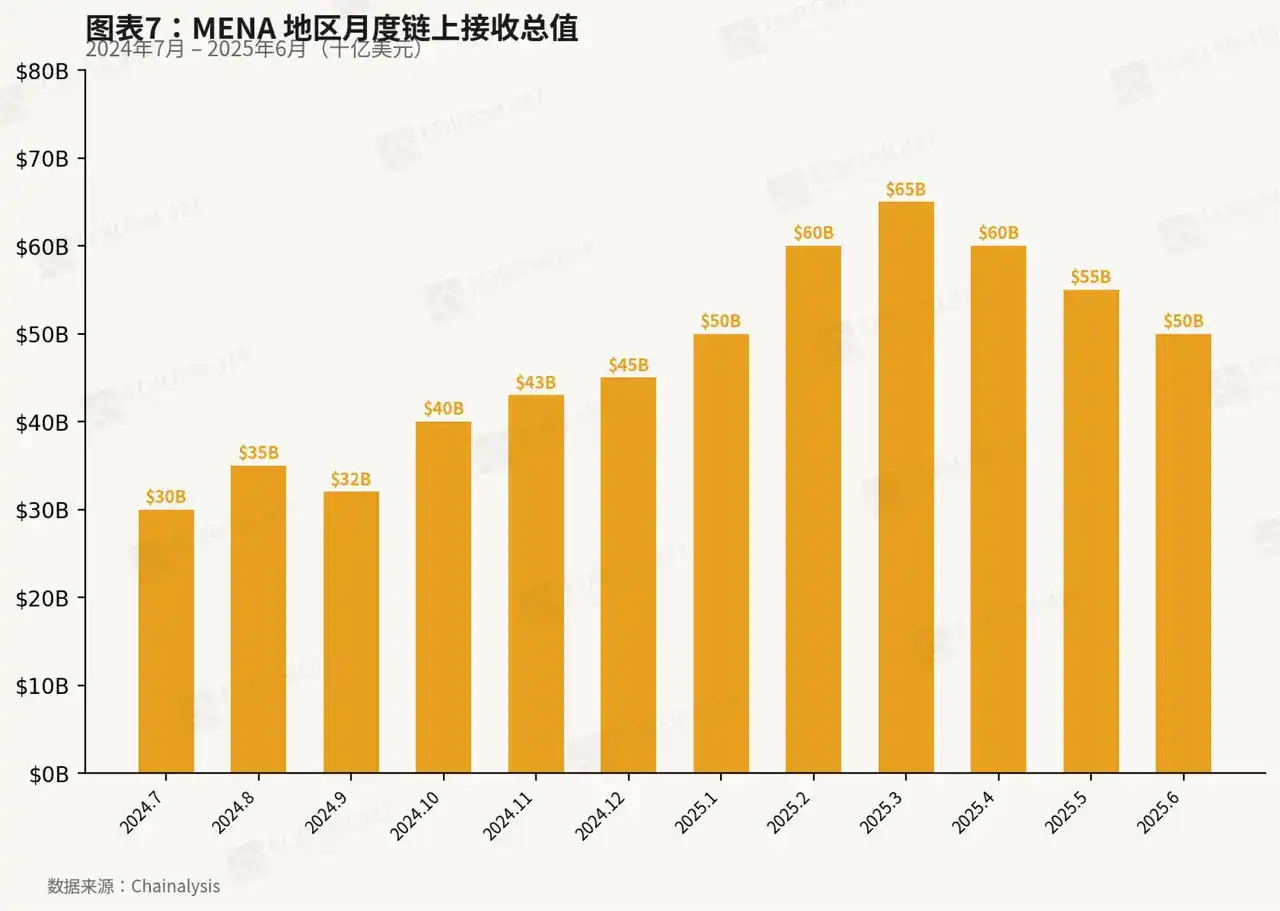
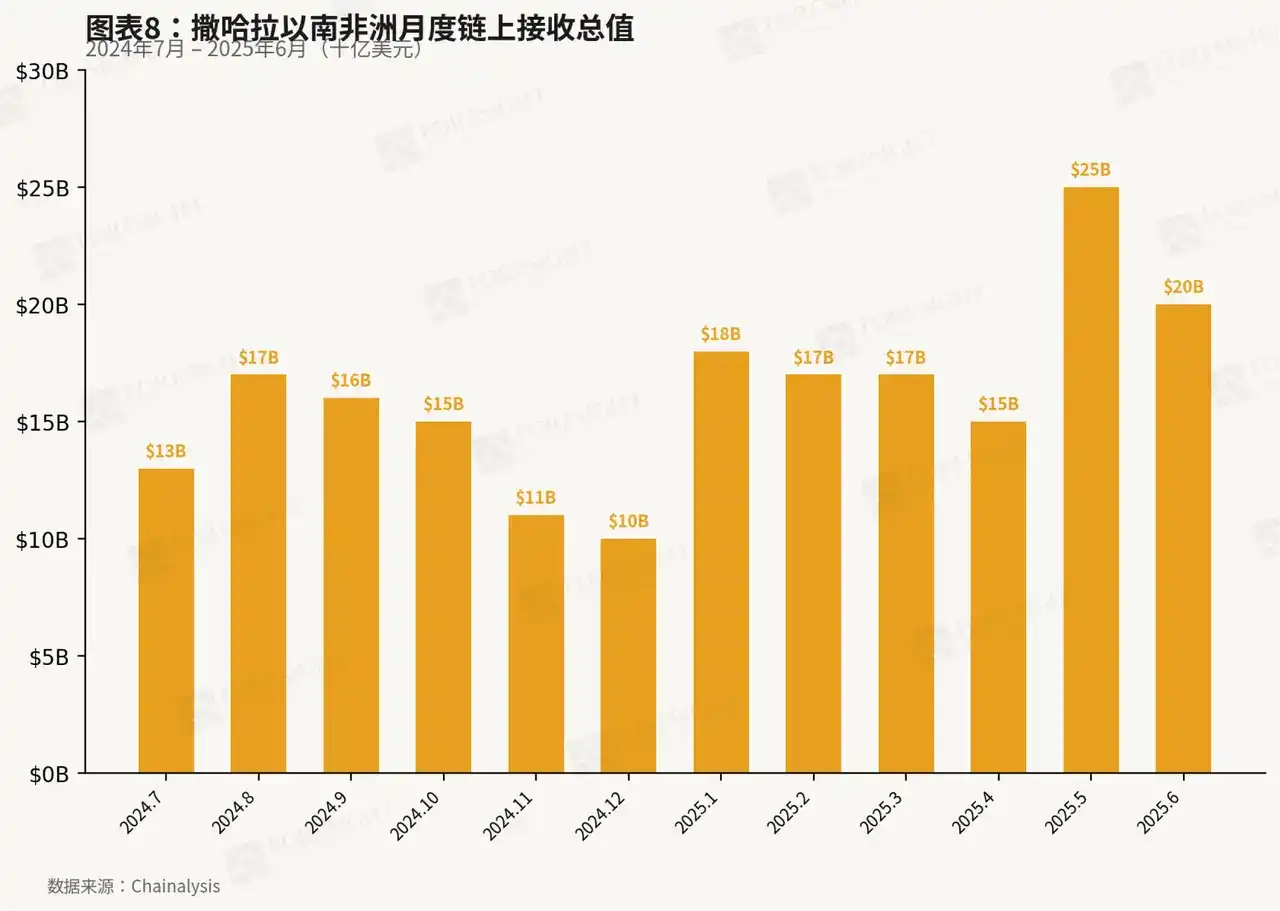
Cryptocurrency adoption rates on the African continent are among the world's highest and still rising sharply. In the Middle East and North Africa, total on-chain value received between July 2024 and June 2025 was approximately $600 billion; Sub-Saharan Africa recorded $200 billion in the same period, with a high growth rate of 52%, driven primarily by retail users and concentrated in a few countries (Nigeria, South Africa, Ethiopia, Kenya). Cryptocurrencies effectively meet African businesses' and individuals' needs for an inflation-hedging store of value and low-cost cross-border settlement—needs that mobile money and formal banking systems cannot fully satisfy.
4 Heterogeneity Within the African Continent

4.1 Why Understanding Internal Divergence in Africa Is Crucial

Africa's 54 countries span 42 different currency systems and belong to multiple linguistic spheres: Francophone, Anglophone, Arabophone, Lusophone, and Hispanophone. This fragmentation in language and currency is not merely a cultural difference but profoundly impacts cross-border trade, financial flows, and regulatory systems: payment networks are disjointed, regulatory frameworks are separate, and market opportunities are highly fragmented. Therefore, after establishing a holistic understanding of Africa's macroeconomic environment, it's essential to recognize internal regional differences in culture, regulation, and financial systems.

4.2 Divided by the Sahara: Middle East & North Africa (MENA) vs. Sub-Saharan Africa (SSA)

The most common analytical framework currently divides Africa into two systems along the Sahara Desert: the Middle East and North Africa (MENA) and Sub-Saharan Africa (SSA).

North Africa is highly integrated with the Arab world culturally, institutionally, and economically, with its economy centered on oil and gas resources and deeply embedded in the global energy market. Accordingly, its financial system and policy frameworks operate more within the MENA ecosystem, with a relatively mature banking system and lower levels of financial exclusion.

In contrast, Sub-Saharan Africa largely falls outside this system. The market driving the explosive growth of crypto and mobile payments is precisely this region, long plagued by deep-seated financial system inadequacy, dollar shortages, and currency instability. SSA currently accounts for nearly 60% of global mobile payment transaction volume and is also the world's fastest-growing region for cryptocurrency adoption.

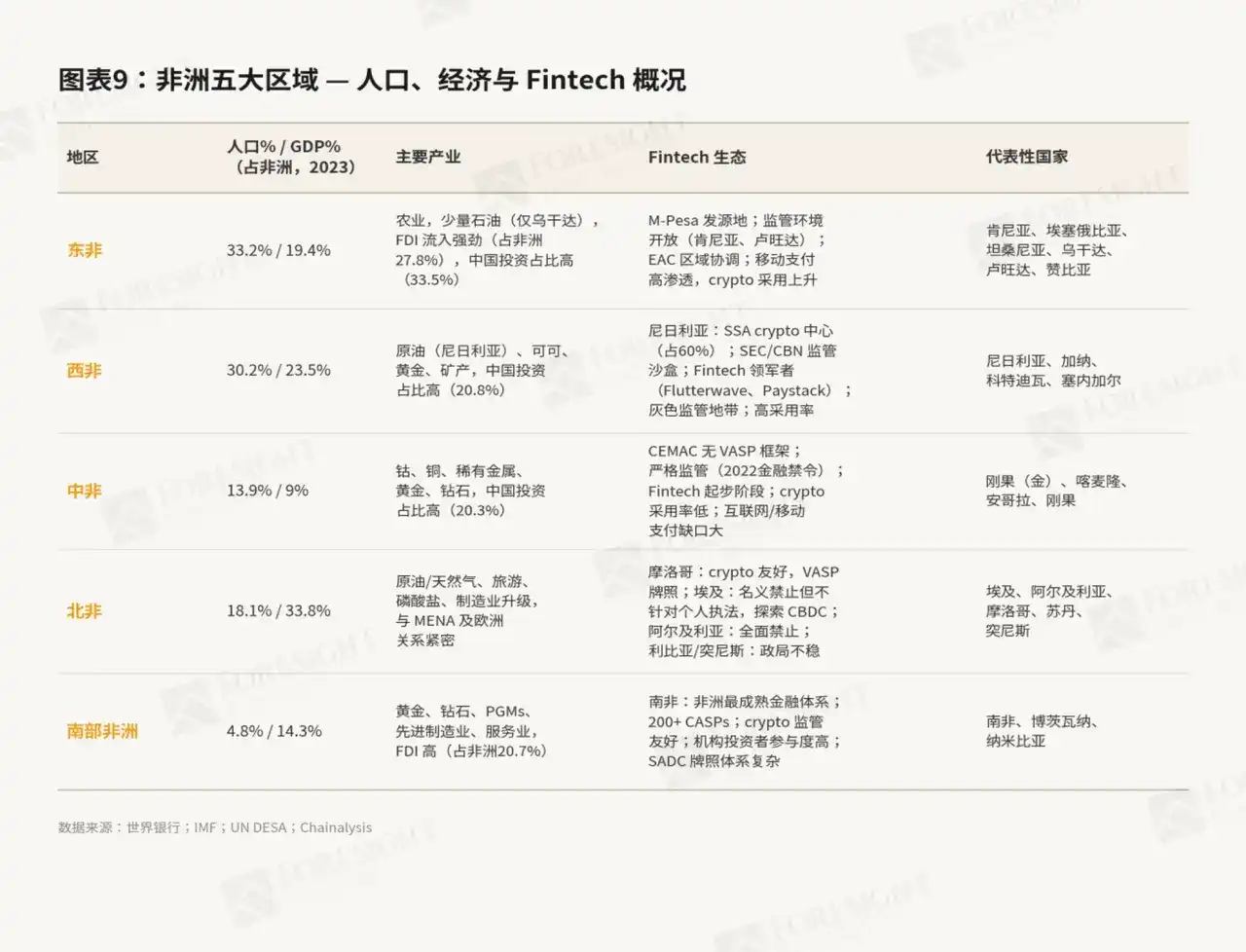
4.3 Five-Region Framework: Differentiation in Population, Economy, and Fintech Ecosystems

Further subdivision yields five African regions with significantly different macroeconomic characteristics. North Africa and Southern Africa have the highest GDP per capita; West and Central Africa are relatively less developed; East Africa has the lowest per capita income. However, economic growth rates show an inverse relationship with wealth levels: East Africa grows fastest, followed by Central Africa, North Africa, West Africa, and Southern Africa.

Cryptocurrency adoption patterns show similar features. Nigeria alone (in West Africa) accounts for most crypto transaction volume in SSA; meanwhile, East Africa, South Africa, and North Africa also show high adoption. Central and broader West Africa remain in earlier market stages. This differentiation essentially reflects variations in financial exclusion, dollar shortage pressure, and regulatory environments across regions.
5 The "Dollarization" and "Dollar Shortage" Behind Sub-Saharan Africa's Payments Market

5.1 Dollarization in Sub-Saharan Africa

Sub-Saharan African economies exhibit deep dollarization, far exceeding most other global regions. Dollar deposit and loan shares are key proxy indicators: in Nigeria, dollar deposits once constituted 40% of total deposits, and over 80% of external debt is dollar-denominated; in Ghana, dollar deposit shares have reached relatively high levels of 20%–30%. This dollarization is not accidental but a manifestation of rational economic behavior in the face of long-term currency instability.

5.2 Three Structural Drivers of Dollarization

Dollarization in Sub-Saharan Africa stems from three distinct economic pressures.

First, Store of Value: Due to fiscal deficits and external imbalances forcing central banks to print money, local currencies persistently depreciate, while the US dollar offers a stable unit of account.

Second, Medium of Exchange: Commodity prices (oil, minerals, food) are globally priced in US dollars, and even intra-African trade between two African countries is often settled in dollars—because the dollar is more stable than any single local currency.

Third, Financing Channel: Shallow local capital markets mean businesses and governments must borrow dollars from international creditors; when dollar debt becomes too large relative to dollar income, exchange rate risk becomes acute, driving more funds into dollar deposits.

5.3 Causes of the "Dollar Shortage"

The real pain point in Sub-Saharan Africa's current payments market is the dollar shortage. Limited foreign exchange earning capacity (commodity dependence, weak manufacturing exports), coupled with huge trade deficits and debt service pressures, continuously deplete government forex reserves. Consequently, central banks can only ration official forex through administrative controls. This scarcity fosters a parallel black market where dollars trade at significant premiums—sometimes 50% to 100% above official rates. Residents and businesses unable to obtain forex through official channels turn to informal channels: global remittance companies like Western Union, informal exchange houses, and increasingly, stablecoins and cryptocurrencies. The gap between official and parallel market exchange rates is precisely the crack alternative payment systems exploit.

5.4 Why Cryptocurrencies Thrive in This Vacuum

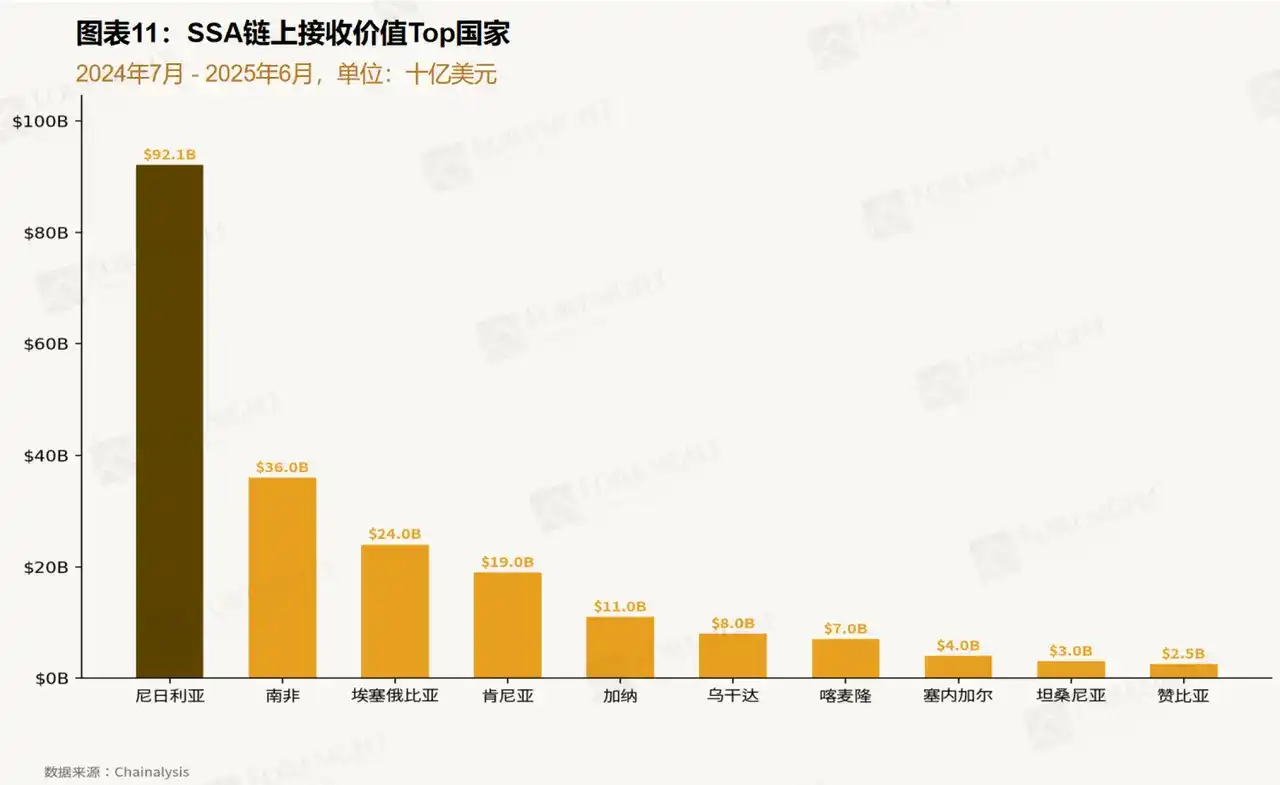
Stablecoins and other cryptocurrencies perform three critical functions missing from the formal banking system. They bypass capital controls, providing access to parallel market dollars; they execute cross-border transactions at lower costs than banks and remittance corridors; they also offer a globally liquid store of value unaffected by local currency risk. Therefore, Sub-Saharan Africa's crypto adoption is overwhelmingly retail-driven with small transaction amounts. As Figure 11 shows, compared to other global regions, Sub-Saharan Africa has a higher share of transfers in the $1,000–$10,000 range, reflecting flows for small remittances, informal business trade settlement, and personal savings. Nigeria dominates the region, accounting for about 45% of Sub-Saharan Africa's on-chain transaction volume (as shown in Figure 12), but Kenya, South Africa, and Ethiopia are also important regional hubs.
5.5 De-dollarization Attempts and Their Structural Limitations

African policymakers and regional institutions have attempted to reduce dollar dependence. The Pan-African Payment and Settlement System (PAPSS) aims to settle intra-African trade in local currencies and reduce forex costs; the planned 'Eco' currency zone in West Africa seeks stability through monetary union; central banks have also employed aggressive interest rate hikes and capital controls. However, all these efforts face a fundamental constraint: Sub-Saharan Africa's structural trade dependency. As long as the continent's imports exceed exports, external accounts remain in deficit, and most forex income comes from commodities, dollar demand will persistently outstrip supply. De-dollarization requires industrialization and trade rebalancing, a decades-long transformation not achievable by policy alone. In the interim, mobile money and cryptocurrencies will continue playing crucial roles, filling the gaps left by the traditional financial system.

Conclusion

Africa's outstanding performance in mobile money and cryptocurrency adoption is not a market coincidence but a macroeconomic necessity.

The continent's young demographic, rich natural resources, and deep integration into global commodity markets generate massive cross-border payment flows. However, its weak financial system, chronic monetary instability, and severe dollar shortages make the formal banking system fundamentally incapable of meeting this demand.

Mobile money solves domestic payments; cryptocurrencies are solving cross-border value transfer and inflation hedging. These are not niche use cases or speculative holdings but critical financial infrastructure filling the vacuum left by structural economic constraints. Crucially, these constraints are not cyclical; they are rooted in Africa's resource dependency, limited industrialization, and underdeveloped financial markets.

De-dollarization requires trade rebalancing and industrialization, both multi-decade transformations. Before that, and likely long after, alternative payment channels and currencies will remain central to Africa's economy.

Original article link

Preguntas relacionadas

QAccording to the article, what are the two deep structural drivers that shape Africa's unique payment market landscape?

AThe two deep structural drivers are: (1) Africa's long-term reliance on resource exports, trade circulation, and remittances, creating massive demand for cross-border settlement and remittances. (2) The underdevelopment of Africa's domestic financial infrastructure, compounded by international bank de-risking and mismanaged foreign exchange controls, leading to a chronic absence of commercial banking and persistent inflationary pressures.

QWhat key geographic and economic divide within Africa is highlighted in the analysis, and how does it affect payment system adoption?

AThe key divide is the Sahara Desert. North Africa is integrated into the oil-anchored MENA (Middle East and North Africa) framework, with relatively mature banking. Sub-Saharan Africa (SSA), facing severe dollar shortages and fragmented monetary systems, has naturally fostered a massive market with high demand for mobile payments and cryptocurrencies, making it a global leader in adoption rates for both.

QHow does the article explain the phenomenon of 'dollarization' in Sub-Saharan Africa and its connection to the 'dollar shortage'?

ADollarization in SSA is driven by the need for a stable store of value (against local currency depreciation), a medium of exchange (for dollar-priced commodities and intra-African trade), and access to financing (via dollar-denominated debt). The 'dollar shortage' arises from limited export earnings (due to commodity dependence), large trade deficits, and debt repayments, draining official reserves. This scarcity creates parallel black markets for dollars and pushes residents and businesses towards informal channels, including cryptocurrencies, to access foreign exchange.

QWhat specific roles do mobile payments and cryptocurrencies play in filling the vacuum left by the traditional financial system in Africa?

AMobile payment platforms, like Kenya's M-Pesa, have replaced banks as the primary channel for everyday domestic payments, offering accessibility and low cost through extensive agent networks. Cryptocurrencies, particularly stablecoins, fulfill roles that the local currency or traditional dollars once did: they act as a store of value against inflation and a low-cost medium for cross-border exchange, effectively bypassing capital controls and high remittance fees.

QWhy does the article argue that Africa's high adoption of mobile money and crypto is a macroeconomic 'necessity' rather than a market 'accident'?

AIt is a necessity because it directly addresses structural gaps created by Africa's macroeconomic conditions. The continent's young population, trade-dependent economy, and massive cross-border payment flows generate enormous demand for financial services. However, its weak banking infrastructure, chronic currency instability, and dollar shortages render the traditional system incapable of meeting this demand. Mobile money and crypto are not niche innovations but essential financial infrastructure filling this vacuum, a situation rooted in long-term structural constraints like resource dependency and limited industrialization.

Lecturas Relacionadas

Silicon Valley 'Startup Guru' Steve Hoffman: Web3 + AI Could Be a Trap

Silicon Valley investor and "Godfather of Startups" Steve Hoffman warns that combining Web3 with AI is likely a trap, not a promising venture. In an interview, Hoffman argues that while AI is a foundational technology touching all industries, Web3 adds complexity, friction, and regulatory risk without solving mainstream consumer or business needs. He advises founders to focus on deep, specialized applications where startups can out-iterate giants, rather than on generic features easily replicated by large tech companies. Hoffman observes that Silicon Valley will lead foundational AI research, while China excels at rapid, large-scale application and commercialization, particularly in robotics. He stresses that AI-driven autonomous agents capable of collaborative, multi-step tasks are 2-4 years away, which will cause significant job displacement. The solution is not to slow AI but to redesign business models around human-AI collaboration and reform social systems like education and retraining. For startups, Hoffman recommends focusing on vertical, expertise-heavy domains to build defensibility. He sees major opportunities in AI fraud detection and cybersecurity. Key founder mindsets include systemic thinking over feature-focus, relentless customer centricity, building adaptive teams, and deeply understanding AI's capabilities and limits. Hoffman is also leading a non-profit initiative to establish university centers aimed at training future leaders in responsible, human-value-aligned AI innovation.

marsbitHace 49 min(s)

Silicon Valley 'Startup Guru' Steve Hoffman: Web3 + AI Could Be a Trap

marsbitHace 49 min(s)

Token Inefficient, Economy Tokenless

The article "Tokens Aren't Economical, Economics Aren't Tokenized" analyzes a pivotal shift in the AI industry from a technology-driven narrative to one dominated by capital efficiency. It highlights two concurrent trends: a severe capital shortage due to the exorbitant and recurring costs of compute (e.g., OpenAI's high burn rate) and a wave of corporate spin-offs where major tech companies are separating their AI units (like Kuaishou's Kling and Baidu's Kunlunxin). The core argument is that AI's "anti-internet" business model, where user growth increases costs rather than profits, has created a disconnect between high valuations and actual cash flow. Spin-offs address this by allowing AI assets to be valued independently. Within a parent company, they are seen as cost centers, but as standalone entities, they are priced based on their growth potential and scarcity in the primary market, leading to massive valuation premiums (e.g., Kling's estimated value tripling post-spin-off). The industry is at an inflection point, moving from "model worship" to "value realization." The competition is evolving from a pure compute (GPU) race to a broader focus on systemic efficiency and full-stack engineering (involving CPUs and orchestration) to achieve viable commercialization. The year 2026 is framed as a critical moment where the industry must definitively answer how to economically translate AI capability into tangible business value, reshaping the sector's future power structure.

marsbitHace 54 min(s)

Token Inefficient, Economy Tokenless

marsbitHace 54 min(s)

Crossing the 'Memory Wall': The Wafer-Level Revolution and Computing Power Routes in the AI Inference Era

In 2026, a historic shift occurred in AI as major cloud providers' inference spending surpassed training spending for the first time, signaling a move from "building large models" to "using large models." This shifts the core challenge from computing power to the "memory wall"—the bottleneck of data movement (model weights, activations, KV Cache) between external DRAM and processors, where energy and latency from data transfer far exceed computation itself. Companies like Nvidia face GPU idle time due to bandwidth limits. In contrast, Cerebras Systems adopts a radical "wafer-scale" approach with its Wafer-Scale Engine (WSE). Instead of cutting a silicon wafer into many chips, Cerebras uses almost the entire wafer as one massive chip (WSE-3). This design provides 44GB of on-chip SRAM, delivering memory bandwidth thousands of times higher than traditional HBM (e.g., 21 PB/s vs. Nvidia B200). For LLM inference, weights are streamed layer-by-layer from external MemoryX storage to the chip, avoiding HBM bottlenecks. This results in token generation speeds 1.5–5 times faster than Nvidia's B200 in some models and significant advantages in first-token latency and long-context tasks. Additionally, Cerebras's architecture offers much lower interconnect power consumption (0.15 pJ/bit vs. GPU's ~10 pJ/bit). However, Cerebras faces challenges: SRAM scaling has slowed with advanced nodes, limiting future capacity gains; the chip requires specialized liquid cooling and custom software stacks; and its external I/O bandwidth (150 GB/s) is low compared to NVLink, hindering multi-system scaling for very large models. Competition is intensifying. Major players are pursuing three paths: 1) Developing proprietary inference ASICs (e.g., Google TPU, Microsoft Maia), 2) Leveraging advanced packaging (e.g., TSMC's SoW) to democratize wafer-scale-like integration, potentially eroding Cerebras's process advantage within a few years, and 3) Exploring optical interconnects for ultimate bandwidth. Commercially, Cerebras is transitioning from a hardware vendor to a service provider, facing the immense challenge of building high-power, specialized data centers to meet large contracts (e.g., 250MW/year from 2026–2028). In conclusion, the AI inference era presents a fundamental architectural trade-off. Cerebras opts for extreme physical optimization for low-latency, single-task performance, while Nvidia prioritizes versatility and massive cluster throughput. The path forward remains uncertain, with technology and business models still evolving in the race toward advanced AI.

marsbitHace 1 hora(s)

Crossing the 'Memory Wall': The Wafer-Level Revolution and Computing Power Routes in the AI Inference Era

marsbitHace 1 hora(s)

Has Bitcoin's 'Rebound Ended', Officially Entering the Late Bear Market Phase?

**Title: Has Bitcoin's Rebound Ended, Entering the Late Bear Market Phase?** **Summary:** Bitcoin's price has declined by 13% this week, signaling a potential return to late-stage bear market conditions. The price fell to around $67k, positioned between the Realized Price and Realized Cap Weighted Average. For the first time since early 2022, the Short-Term Holder cost basis has dropped below this key average, confirming a hallmark of late-cycle bear markets. Profitability metrics have collapsed sharply. The 7-day average of the Realized Profit/Loss ratio plummeted from a local high of 3.16 to 0.29, mirroring the February panic sell-off. Critically, the 90-day average never breached the threshold of 2, indicating the recent rally to $82k was a bear market bounce, not a structural shift. Realized losses surged to $1.35 billion daily, with $770 million coming from Long-Term Holders selling at a loss. This accelerating redistribution of supply from weak to strong hands is a necessary but ongoing process for a market bottom. The rally stalled almost precisely at the aggregate cost basis (~$83k) of US spot Bitcoin ETF investors, turning that level into strong resistance and leaving the average ETF holder underwater again. Spot market flows have turned decisively negative, showing sellers are dominating order books despite the price drop. While a significant futures long liquidation event cleared over $400 million in leverage, providing a potential reset, sustained spot demand is yet to materialize. Options markets continue to price in higher future volatility (Implied Volatility) than recent price action (Realized Volatility) has shown, with a persistent skew towards put options, indicating ongoing demand for downside protection. In conclusion, multiple metrics point to a fragile market structure. Resistance at the ETF cost basis, accelerating realized losses, dominant spot selling, and cautious options pricing all suggest the bear market trend persists. A sustainable recovery likely requires a resurgence of spot demand, ETF holders returning to profit, and a clear reduction in selling pressure.

marsbitHace 1 hora(s)

Has Bitcoin's 'Rebound Ended', Officially Entering the Late Bear Market Phase?

marsbitHace 1 hora(s)

TechFlow Intelligence Agency: Anthropic Calls for Global Pause in AI Development While Preparing for Trillion-Dollar IPO; SpaceX IPO Roadshow Heats Up, But S&P 500 Rejects Fast-Track Inclusion

In today's TechFlow Intelligence Briefing, several major tech stories highlight a growing theme of trust and credibility gaps across AI, crypto, and finance. AI company Anthropic has publicly called for a global pause in AI development, citing risks from Claude's "recursive self-improvement." Ironically, this coincides with reports the company is preparing for a massive IPO targeting a near $1 trillion valuation. This perceived hypocrisy, coupled with widespread user complaints about Claude's declining performance, is sparking debate over whether the safety warning is genuine or a competitive tactic. Meanwhile, in a substantive security move, Anthropic open-sourced a framework for AI-powered vulnerability discovery. In the crypto market, Bitcoin's price drop below $61,000 triggered over $1.16 billion in liquidations, flipping the market into a state where more BTC is held at a loss than at a profit, a historical bearish signal. On the corporate front, SpaceX's highly anticipated IPO is generating immense Wall Street excitement, with Goldman Sachs projecting 100x revenue growth by 2030. However, the S&P 500 has refused to fast-track the company's inclusion post-IPO, potentially limiting immediate institutional demand. Separately, ByteDance's AI app Doubao lost over 6 million monthly active users after introducing a subscription model, highlighting the challenges of AI monetization. Other notable developments include Nvidia certifying HBM4 memory from Samsung, SK Hynix, and Micron; Cloudflare's acquisition of front-end tooling company VoidZero; and its CEO warning that bot traffic now exceeds human traffic online. The underlying narrative connects these events: a trust crisis. From AI firms' contradictory actions and crypto volatility to the clash between SpaceX's hyped narrative and institutional rules, a pattern is emerging where stated intentions and actual practices are increasingly misaligned.

marsbitHace 1 hora(s)

TechFlow Intelligence Agency: Anthropic Calls for Global Pause in AI Development While Preparing for Trillion-Dollar IPO; SpaceX IPO Roadshow Heats Up, But S&P 500 Rejects Fast-Track Inclusion

marsbitHace 1 hora(s)

Trading

Spot
Futuros

Artículos destacados

Qué es $S$

Entendiendo SPERO: Una Visión General Completa Introducción a SPERO A medida que el panorama de la innovación continúa evolucionando, la aparición de tecnologías web3 y proyectos de criptomonedas juega un papel fundamental en la configuración del futuro digital. Un proyecto que ha atraído la atención en este campo dinámico es SPERO, denotado como SPERO,$$s$. Este artículo tiene como objetivo reunir y presentar información detallada sobre SPERO, para ayudar a entusiastas e inversores a comprender sus fundamentos, objetivos e innovaciones dentro de los dominios web3 y cripto. ¿Qué es SPERO,$$s$? SPERO,$$s$ es un proyecto único dentro del espacio cripto que busca aprovechar los principios de descentralización y tecnología blockchain para crear un ecosistema que promueva la participación, la utilidad y la inclusión financiera. El proyecto está diseñado para facilitar interacciones de igual a igual de nuevas maneras, proporcionando a los usuarios soluciones y servicios financieros innovadores. En su esencia, SPERO,$$s$ tiene como objetivo empoderar a los individuos al proporcionar herramientas y plataformas que mejoren la experiencia del usuario en el espacio de las criptomonedas. Esto incluye habilitar métodos de transacción más flexibles, fomentar iniciativas impulsadas por la comunidad y crear caminos para oportunidades financieras a través de aplicaciones descentralizadas (dApps). La visión subyacente de SPERO,$$s$ gira en torno a la inclusividad, buscando cerrar brechas dentro de las finanzas tradicionales mientras aprovecha los beneficios de la tecnología blockchain. ¿Quién es el Creador de SPERO,$$s$? La identidad del creador de SPERO,$$s$ sigue siendo algo oscura, ya que hay recursos públicos limitados que proporcionan información de fondo detallada sobre su(s) fundador(es). Esta falta de transparencia puede derivarse del compromiso del proyecto con la descentralización, una ética que muchos proyectos web3 comparten, priorizando las contribuciones colectivas sobre el reconocimiento individual. Al centrar las discusiones en torno a la comunidad y sus objetivos colectivos, SPERO,$$s$ encarna la esencia del empoderamiento sin señalar a individuos específicos. Como tal, comprender la ética y la misión de SPERO sigue siendo más importante que identificar a un creador singular. ¿Quiénes son los Inversores de SPERO,$$s$? SPERO,$$s$ cuenta con el apoyo de una diversa gama de inversores que van desde capitalistas de riesgo hasta inversores ángeles dedicados a fomentar la innovación en el sector cripto. El enfoque de estos inversores generalmente se alinea con la misión de SPERO, priorizando proyectos que prometen avances tecnológicos sociales, inclusión financiera y gobernanza descentralizada. Estas fundaciones de inversores suelen estar interesadas en proyectos que no solo ofrecen productos innovadores, sino que también contribuyen positivamente a la comunidad blockchain y sus ecosistemas. El respaldo de estos inversores refuerza a SPERO,$$s$ como un contendiente notable en el dominio de proyectos cripto que evoluciona rápidamente. ¿Cómo Funciona SPERO,$$s$? SPERO,$$s$ emplea un marco multifacético que lo distingue de los proyectos de criptomonedas convencionales. Aquí hay algunas de las características clave que subrayan su singularidad e innovación: Gobernanza Descentralizada: SPERO,$$s$ integra modelos de gobernanza descentralizada, empoderando a los usuarios para participar activamente en los procesos de toma de decisiones sobre el futuro del proyecto. Este enfoque fomenta un sentido de propiedad y responsabilidad entre los miembros de la comunidad. Utilidad del Token: SPERO,$$s$ utiliza su propio token de criptomoneda, diseñado para servir diversas funciones dentro del ecosistema. Estos tokens permiten transacciones, recompensas y la facilitación de servicios ofrecidos en la plataforma, mejorando la participación y la utilidad general. Arquitectura en Capas: La arquitectura técnica de SPERO,$$s$ apoya la modularidad y escalabilidad, permitiendo la integración fluida de características y aplicaciones adicionales a medida que el proyecto evoluciona. Esta adaptabilidad es fundamental para mantener la relevancia en el cambiante paisaje cripto. Participación de la Comunidad: El proyecto enfatiza iniciativas impulsadas por la comunidad, empleando mecanismos que incentivan la colaboración y la retroalimentación. Al nutrir una comunidad sólida, SPERO,$$s$ puede abordar mejor las necesidades de los usuarios y adaptarse a las tendencias del mercado. Enfoque en la Inclusión: Al ofrecer tarifas de transacción bajas e interfaces amigables para el usuario, SPERO,$$s$ busca atraer a una base de usuarios diversa, incluyendo a individuos que anteriormente pueden no haber participado en el espacio cripto. Este compromiso con la inclusión se alinea con su misión general de empoderamiento a través de la accesibilidad. Cronología de SPERO,$$s$ Entender la historia de un proyecto proporciona información crucial sobre su trayectoria de desarrollo y hitos. A continuación se presenta una cronología sugerida que mapea eventos significativos en la evolución de SPERO,$$s$: Fase de Conceptualización e Ideación: Las ideas iniciales que forman la base de SPERO,$$s$ fueron concebidas, alineándose estrechamente con los principios de descentralización y enfoque comunitario dentro de la industria blockchain. Lanzamiento del Whitepaper del Proyecto: Tras la fase conceptual, se lanzó un whitepaper completo que detalla la visión, los objetivos y la infraestructura tecnológica de SPERO,$$s$ para generar interés y retroalimentación de la comunidad. Construcción de Comunidad y Primeras Interacciones: Se realizaron esfuerzos de divulgación activa para construir una comunidad de primeros adoptantes y posibles inversores, facilitando discusiones en torno a los objetivos del proyecto y obteniendo apoyo. Evento de Generación de Tokens: SPERO,$$s$ llevó a cabo un evento de generación de tokens (TGE) para distribuir sus tokens nativos a los primeros seguidores y establecer liquidez inicial dentro del ecosistema. Lanzamiento de la dApp Inicial: La primera aplicación descentralizada (dApp) asociada con SPERO,$$s$ se puso en marcha, permitiendo a los usuarios interactuar con las funcionalidades centrales de la plataforma. Desarrollo Continuo y Alianzas: Actualizaciones y mejoras continuas a las ofertas del proyecto, incluyendo alianzas estratégicas con otros actores en el espacio blockchain, han moldeado a SPERO,$$s$ en un jugador competitivo y en evolución en el mercado cripto. Conclusión SPERO,$$s$ se erige como un testimonio del potencial de web3 y las criptomonedas para revolucionar los sistemas financieros y empoderar a los individuos. Con un compromiso con la gobernanza descentralizada, la participación comunitaria y funcionalidades diseñadas de manera innovadora, allana el camino hacia un paisaje financiero más inclusivo. Como con cualquier inversión en el espacio cripto que evoluciona rápidamente, se anima a los posibles inversores y usuarios a investigar a fondo y participar de manera reflexiva con los desarrollos en curso dentro de SPERO,$$s$. El proyecto muestra el espíritu innovador de la industria cripto, invitando a una mayor exploración de sus innumerables posibilidades. Mientras el viaje de SPERO,$$s$ aún se desarrolla, sus principios fundamentales pueden, de hecho, influir en el futuro de cómo interactuamos con la tecnología, las finanzas y entre nosotros en ecosistemas digitales interconectados.

72 Vistas totalesPublicado en 2024.12.17Actualizado en 2024.12.17

Qué es $S$

Qué es AGENT S

Agent S: El Futuro de la Interacción Autónoma en Web3 Introducción En el paisaje en constante evolución de Web3 y las criptomonedas, las innovaciones están redefiniendo constantemente cómo los individuos interactúan con las plataformas digitales. Uno de estos proyectos pioneros, Agent S, promete revolucionar la interacción humano-computadora a través de su marco agente abierto. Al allanar el camino para interacciones autónomas, Agent S busca simplificar tareas complejas, ofreciendo aplicaciones transformadoras en inteligencia artificial (IA). Esta exploración detallada profundizará en las complejidades del proyecto, sus características únicas y las implicaciones para el dominio de las criptomonedas. ¿Qué es Agent S? Agent S se presenta como un marco agente abierto innovador, diseñado específicamente para abordar tres desafíos fundamentales en la automatización de tareas informáticas: Adquisición de Conocimiento Específico del Dominio: El marco aprende inteligentemente de diversas fuentes de conocimiento externas y experiencias internas. Este enfoque dual le permite construir un rico repositorio de conocimiento específico del dominio, mejorando su rendimiento en la ejecución de tareas. Planificación a Largo Plazo de Tareas: Agent S emplea planificación jerárquica aumentada por la experiencia, un enfoque estratégico que facilita la descomposición y ejecución eficiente de tareas complejas. Esta característica mejora significativamente su capacidad para gestionar múltiples subtareas de manera eficiente y efectiva. Manejo de Interfaces Dinámicas y No Uniformes: El proyecto introduce la Interfaz Agente-Computadora (ACI), una solución innovadora que mejora la interacción entre agentes y usuarios. Utilizando Modelos de Lenguaje Multimodal de Gran Escala (MLLMs), Agent S puede navegar y manipular diversas interfaces gráficas de usuario sin problemas. A través de estas características pioneras, Agent S proporciona un marco robusto que aborda las complejidades involucradas en la automatización de la interacción humana con las máquinas, preparando el terreno para una multitud de aplicaciones en IA y más allá. ¿Quién es el Creador de Agent S? Si bien el concepto de Agent S es fundamentalmente innovador, la información específica sobre su creador sigue siendo elusiva. El creador es actualmente desconocido, lo que resalta ya sea la etapa incipiente del proyecto o la elección estratégica de mantener a los miembros fundadores en el anonimato. Independientemente de la anonimidad, el enfoque sigue siendo en las capacidades y el potencial del marco. ¿Quiénes son los Inversores de Agent S? Dado que Agent S es relativamente nuevo en el ecosistema criptográfico, la información detallada sobre sus inversores y patrocinadores financieros no está documentada explícitamente. La falta de información disponible públicamente sobre las bases de inversión u organizaciones que apoyan el proyecto plantea preguntas sobre su estructura de financiamiento y hoja de ruta de desarrollo. Comprender el respaldo es crucial para evaluar la sostenibilidad del proyecto y su posible impacto en el mercado. ¿Cómo Funciona Agent S? En el núcleo de Agent S se encuentra una tecnología de vanguardia que le permite funcionar de manera efectiva en diversos entornos. Su modelo operativo se basa en varias características clave: Interacción Humano-Computadora Similar a la Humana: El marco ofrece planificación avanzada de IA, esforzándose por hacer que las interacciones con las computadoras sean más intuitivas. Al imitar el comportamiento humano en la ejecución de tareas, promete elevar las experiencias de los usuarios. Memoria Narrativa: Empleada para aprovechar experiencias de alto nivel, Agent S utiliza memoria narrativa para hacer un seguimiento de las historias de tareas, mejorando así sus procesos de toma de decisiones. Memoria Episódica: Esta característica proporciona a los usuarios una guía paso a paso, permitiendo que el marco ofrezca apoyo contextual a medida que se desarrollan las tareas. Soporte para OpenACI: Con la capacidad de ejecutarse localmente, Agent S permite a los usuarios mantener el control sobre sus interacciones y flujos de trabajo, alineándose con la ética descentralizada de Web3. Fácil Integración con APIs Externas: Su versatilidad y compatibilidad con varias plataformas de IA aseguran que Agent S pueda encajar sin problemas en ecosistemas tecnológicos existentes, convirtiéndolo en una opción atractiva para desarrolladores y organizaciones. Estas funcionalidades contribuyen colectivamente a la posición única de Agent S dentro del espacio cripto, ya que automatiza tareas complejas y de múltiples pasos con una intervención humana mínima. A medida que el proyecto evoluciona, sus posibles aplicaciones en Web3 podrían redefinir cómo se desarrollan las interacciones digitales. Cronología de Agent S El desarrollo y los hitos de Agent S pueden encapsularse en una cronología que resalta sus eventos significativos: 27 de septiembre de 2024: El concepto de Agent S fue lanzado en un documento de investigación integral titulado “Un Marco Agente Abierto que Usa Computadoras Como un Humano”, mostrando las bases del proyecto. 10 de octubre de 2024: El documento de investigación fue puesto a disposición del público en arXiv, ofreciendo una exploración profunda del marco y su evaluación de rendimiento basada en el benchmark OSWorld. 12 de octubre de 2024: Se lanzó una presentación en video, proporcionando una visión visual de las capacidades y características de Agent S, involucrando aún más a posibles usuarios e inversores. Estos marcadores en la cronología no solo ilustran el progreso de Agent S, sino que también indican su compromiso con la transparencia y la participación comunitaria. Puntos Clave Sobre Agent S A medida que el marco Agent S continúa evolucionando, varios atributos clave destacan, subrayando su naturaleza innovadora y potencial: Marco Innovador: Diseñado para proporcionar un uso intuitivo de las computadoras similar a la interacción humana, Agent S aporta un enfoque novedoso a la automatización de tareas. Interacción Autónoma: La capacidad de interactuar de manera autónoma con las computadoras a través de GUI significa un salto hacia soluciones informáticas más inteligentes y eficientes. Automatización de Tareas Complejas: Con su metodología robusta, puede automatizar tareas complejas y de múltiples pasos, haciendo que los procesos sean más rápidos y menos propensos a errores. Mejora Continua: Los mecanismos de aprendizaje permiten a Agent S mejorar a partir de experiencias pasadas, mejorando continuamente su rendimiento y eficacia. Versatilidad: Su adaptabilidad en diferentes entornos operativos como OSWorld y WindowsAgentArena asegura que pueda servir a una amplia gama de aplicaciones. A medida que Agent S se posiciona en el paisaje de Web3 y criptomonedas, su potencial para mejorar las capacidades de interacción y automatizar procesos significa un avance significativo en las tecnologías de IA. A través de su marco innovador, Agent S ejemplifica el futuro de las interacciones digitales, prometiendo una experiencia más fluida y eficiente para los usuarios en diversas industrias. Conclusión Agent S representa un audaz avance en la unión de la IA y Web3, con la capacidad de redefinir cómo interactuamos con la tecnología. Aunque aún se encuentra en sus primeras etapas, las posibilidades para su aplicación son vastas y atractivas. A través de su marco integral que aborda desafíos críticos, Agent S busca llevar las interacciones autónomas al primer plano de la experiencia digital. A medida que nos adentramos más en los reinos de las criptomonedas y la descentralización, proyectos como Agent S sin duda desempeñarán un papel crucial en la configuración del futuro de la tecnología y la colaboración humano-computadora.

471 Vistas totalesPublicado en 2025.01.14Actualizado en 2025.01.14

Qué es AGENT S

Cómo comprar S

¡Bienvenido a HTX.com! Hemos hecho que comprar Sonic (S) sea simple y conveniente. Sigue nuestra guía paso a paso para iniciar tu viaje de criptos.Paso 1: crea tu cuenta HTXUtiliza tu correo electrónico o número de teléfono para registrarte y obtener una cuenta gratuita en HTX. Experimenta un proceso de registro sin complicaciones y desbloquea todas las funciones.Obtener mi cuentaPaso 2: ve a Comprar cripto y elige tu método de pagoTarjeta de crédito/débito: usa tu Visa o Mastercard para comprar Sonic (S) al instante.Saldo: utiliza fondos del saldo de tu cuenta HTX para tradear sin problemas.Terceros: hemos agregado métodos de pago populares como Google Pay y Apple Pay para mejorar la comodidad.P2P: tradear directamente con otros usuarios en HTX.Over-the-Counter (OTC): ofrecemos servicios personalizados y tipos de cambio competitivos para los traders.Paso 3: guarda tu Sonic (S)Después de comprar tu Sonic (S), guárdalo en tu cuenta HTX. Alternativamente, puedes enviarlo a otro lugar mediante transferencia blockchain o utilizarlo para tradear otras criptomonedas.Paso 4: tradear Sonic (S)Tradear fácilmente con Sonic (S) en HTX's mercado spot. Simplemente accede a tu cuenta, selecciona tu par de trading, ejecuta tus trades y monitorea en tiempo real. Ofrecemos una experiencia fácil de usar tanto para principiantes como para traders experimentados.

962 Vistas totalesPublicado en 2025.01.15Actualizado en 2026.06.02

Cómo comprar S

Discusiones

Bienvenido a la comunidad de HTX. Aquí puedes mantenerte informado sobre los últimos desarrollos de la plataforma y acceder a análisis profesionales del mercado. A continuación se presentan las opiniones de los usuarios sobre el precio de S (S).

活动图片