The World Cup has only been played for a few days, but some AI prediction models have already been crowned as oracles, while others have stumbled badly.

marsbitPublicado a 2026-06-16Actualizado a 2026-06-16

Resumen

The 2026 FIFA World Cup has sparked significant interest not only on the pitch but also in AI-driven match prediction. Major models like Qwen, Copilot, and ChatGPT are being used to forecast outcomes, scores, upsets, red cards, and key player performances. Qwen gained early attention by accurately predicting Mexico's 2-0 win over South Africa (including a red card risk) and South Korea's 2-1 victory over the Czech Republic in the opening matches. Copilot's pre-tournament predictions had notable successes, such as correctly calling the Mexico 2-0 scoreline, South Korea's 2-1 win, and Brazil's 1-1 draw with Morocco. However, it also had clear misses, failing to predict upsets like Australia's 2-0 win over Turkey or Switzerland's draw with Qatar. ChatGPT provided detailed analytical reasoning, correctly predicting Mexico's 2-0 win, but its full-tournament predictions tended to favor favorites, missing several underdog results and draws. Tests pitting multiple models (ChatGPT, Gemini, Grok, Claude) against the same match, like Mexico vs. South Africa, showed varying predictions, with only some hitting the exact score. In summary, while AI models like Qwen have shown promising early results in specific match details, and others have had isolated successes, they collectively struggle to consistently identify upsets and underdog performances. AI is becoming an additional reference tool for prediction markets but is far from a definitive source.

The most exciting place at this World Cup isn't just on the pitch.

As interest in World Cup prediction events heats up, more and more users are participating in trading with real money. Who will win, what will the score be, will there be an upset, will there be a red card, which player will score—these topics, originally just casual pre-match chatter among fans, are now broken down into individual tradable prediction events.

When predictions become trades, users need more than just emotions and intuition: odds fluctuations, team form, injury news, head-to-head history, and market sentiment all become reference points before making a trade. In this process, AI models are being frequently brought into World Cup prediction scenarios.

Large models like Qwen, ChatGPT, Gemini, Claude, DeepSeek, Qwen, and Copilot can not only answer 'which team is more likely to win' but also provide score predictions, likelihood of upsets, red card risks, key player performances, and match flow analysis. For prediction market participants, AI's pre-match analysis is becoming another layer of reference beyond odds, news, team data, and market sentiment.

However, predictions ultimately have to be judged against the actual matches.

With the official start of the World Cup, the results of the first few matches have come in. Those AI analyses that users consulted to aid their judgments before the matches now have answers to compare against: Were the scores predicted correctly? Were upsets foreseen? How many details like red cards, last-minute winners, and match flow were actually captured by the models?

The first to go viral was, surprisingly, Qwen

The most entertaining performance on the opening day of the World Cup undoubtedly belonged to Qwen.

For the opening match between Mexico and South Africa, Qwen's pre-match prediction was Mexico 2:0 South Africa. After the match ended, the score was indeed 2:0. What's more interesting is that the match saw a total of three red cards, which also largely aligned with Qwen's pre-match risk assessment of 'South Africa's overly aggressive defending, potentially leading to playing with ten men early on.'
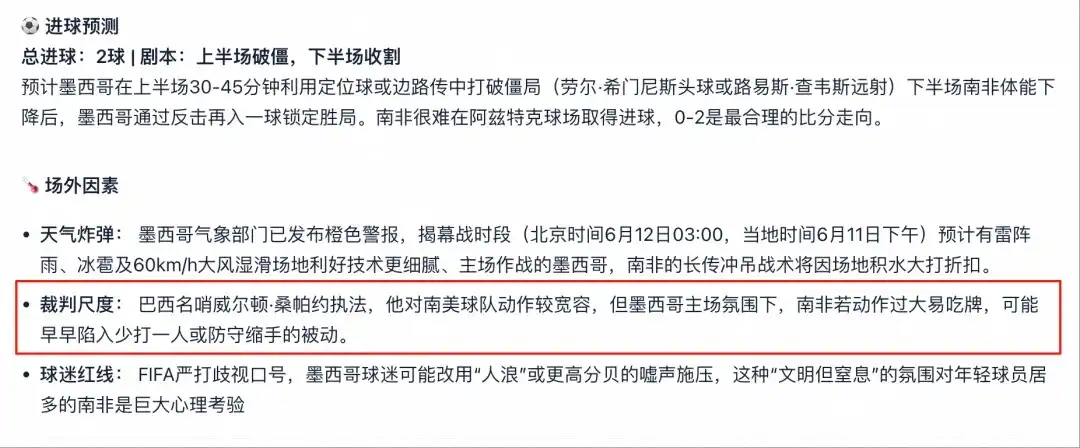
If it were just predicting a Mexico win, that wouldn't be too surprising. As one of the hosts, Mexico was favored anyway. But what Qwen nailed this time were the more specific match details: the 2:0 scoreline, South Africa's red card risk, and the pace of the game gradually opening up in the later stages.

Next, for the match between South Korea and the Czech Republic, Qwen gave a prediction of South Korea 2:1.

This match wasn't easy to call before kick-off. The Czech Republic had physicality, set-piece threats, and the usual big-tournament experience of European teams. The match process was indeed not one-sided; the Czechs took the lead first, South Korea equalized later, and the game was deadlocked at 1:1 for a long time. It wasn't until the final stages that South Korea scored the winning goal, with the final score becoming 2:1.

This gave Qwen's prediction an even stronger sense of 'scriptwriting.' Predicting the winner can rely on paper strength, score predictions can involve luck, but process details like red cards, comebacks, and last-minute winners are what truly make people think 'there's something to this.' After two matches on the opening day, Qwen first raised the profile of AI World Cup predictions.

Copilot: Moments of brilliance, but also obvious stumbles

Before the tournament, USA Today had Copilot predict all 104 matches of this World Cup. Judging from the completed matches so far, these predictions have both highlights and obvious misses.

Among them, three match predictions stood out.

For the opening match Mexico vs. South Africa, Copilot predicted Mexico 2:0, which matched the final score exactly. For South Korea vs. the Czech Republic, it predicted South Korea 2:1, again consistent with the result. For Brazil vs. Morocco, Copilot gave a 1:1 prediction, and Brazil was indeed held to a draw by Morocco.

Especially the Brazil 1:1 Morocco match, the prediction had significant merit. Brazil is, after all, a traditional powerhouse, with a squad and level of attention in the top tier.

Although Morocco reached the semi-finals in the last World Cup, predicting a draw against Brazil before the match was not a particularly safe choice. After the match, Brazil failed to get a winning start, and Morocco continued its resilience in major tournaments—Copilot's prediction for this match was indeed a 'stroke of genius.'

But Copilot's issues also became apparent quickly.

It predicted Canada would beat Bosnia and Herzegovina 2:1, but the match ended 1:1; it predicted Switzerland would edge Qatar 1:0, but Switzerland was also held to a draw; it predicted the USA would beat Paraguay 2:0—the direction was correct, but the actual score was 4:1, significantly underestimating the attacking intensity.

More obvious stumbles occurred in several matches involving upsets and strong teams being held back.

For Turkey vs. Australia, Copilot predicted Turkey would win 2:1, but Australia pulled off a 2:0 upset win. For Ecuador vs. Ivory Coast, it predicted Ecuador 2:1, but Ivory Coast won 1:0. For the Netherlands vs. Japan, it predicted the Netherlands 2:1, but Japan came back twice to level, ending in a 2:2 draw. For Sweden vs. Tunisia, it predicted 1:1, but Sweden thrashed them 5:1.

The fact that Copilot could nail the exact scores for Mexico, South Korea, and Brazil shows it doesn't just follow the favorites. But matches like Australia beating Turkey, Qatar drawing with Switzerland, and Japan drawing with the Netherlands also expose its judgments on upsets and draws as still being relatively conservative.

ChatGPT: Analysis is thorough, but not sharp enough on upsets

Compared to Copilot's full tournament predictions, ChatGPT is more like a 'pre-match analytical player.'

In its opening match prediction, ChatGPT predicted Mexico 2:0 South Africa, hitting the final score. The reasoning it provided was also quite thorough, including Mexico's home advantage, recent form, South Africa's lack of attacking threat, and factors like the high altitude of Mexico City and the home crowd atmosphere. In this prediction, ChatGPT didn't just give a result; the underlying logic also aligned with the match outcome.
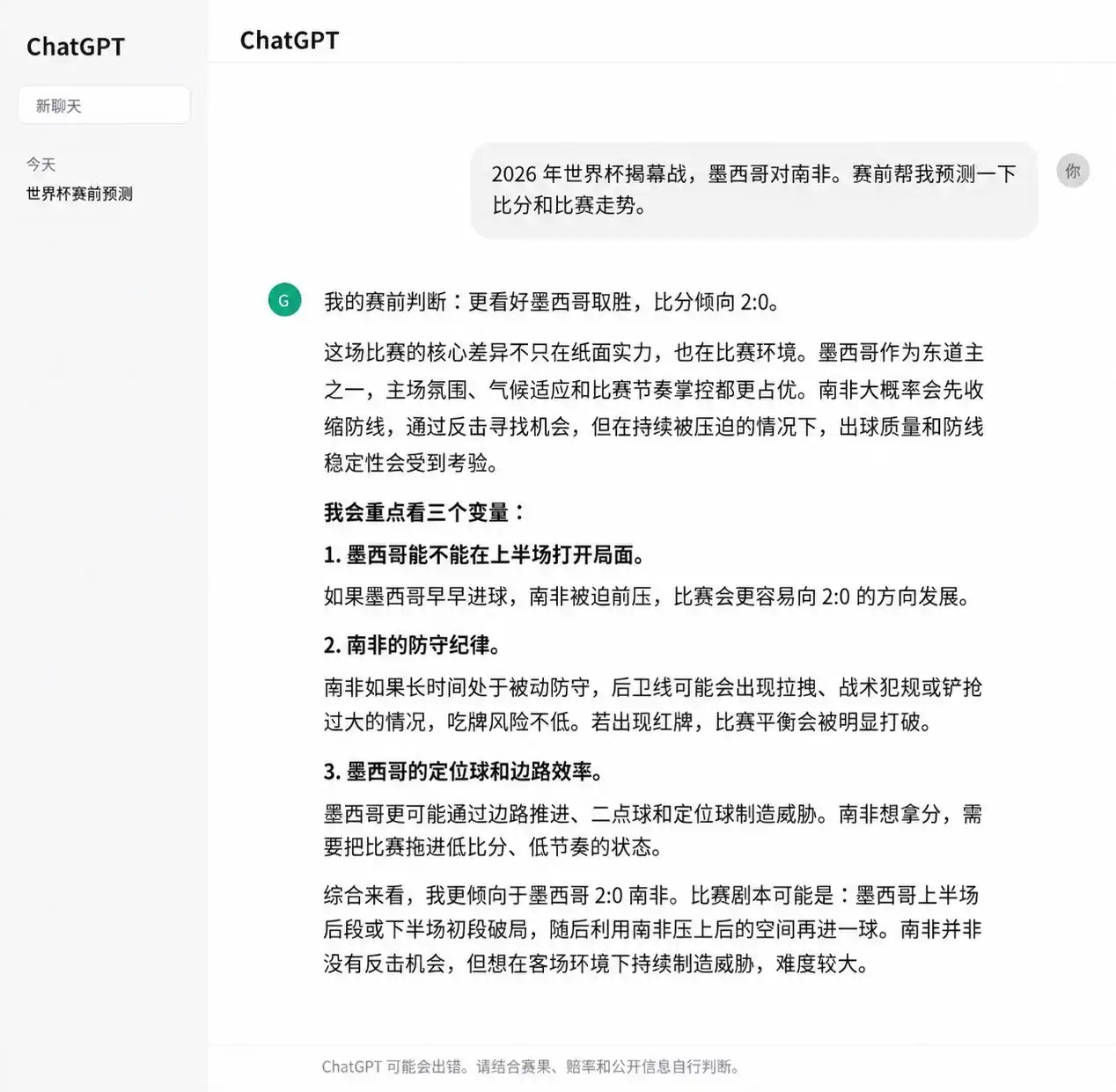
However, when it comes to full tournament predictions, ChatGPT's stability isn't as strong. While it correctly predicted Mexico 2:0 South Africa and Brazil 1:1 Morocco, and got the win/loss direction right for several matches like Scotland, Germany, and Sweden, for matches like South Korea 2:1 Czech Republic, Qatar 1:1 Switzerland, Australia 2:0 Turkey, and Japan 2:2 the Netherlands, ChatGPT's predictions favored the team with stronger paper strength. For example, it predicted Switzerland should beat Qatar, Turkey should beat Australia, and the Netherlands should edge Japan.

ChatGPT is not without predictive ability; it can break down team strength, home conditions, and recent form clearly, and can hit the score in some matches. But based on current results, it seems better at explaining 'why the favorite is more logical' rather than identifying in advance which matches might deviate from the favorite's script.

Gemini, Grok, Claude: Different models write different scripts for the same match

Besides Qwen, Copilot, and ChatGPT, some social media users have fed the same match to multiple models for pre-match predictions.

Taking the opening match Mexico vs. South Africa as an example, one blogger simultaneously tested four AI models—ChatGPT, Gemini, Grok, and Claude—for pre-match predictions. The results showed that both ChatGPT and Gemini predicted Mexico 2:0 South Africa, hitting the final score; Grok predicted Mexico 2:1, and Claude predicted Mexico 3:1. While both correctly predicted a Mexico win, they didn't nail the exact score.

For this opening match prediction, different models offered three different 'scripts.' ChatGPT Go and Gemini Pro were closer to the actual match: Mexico dominant, South Africa lacking in attack, ending with a clean sheet. Grok gave a more open scoreline, suggesting South Africa would get a goal back on the counter. Claude Sonnet set higher expectations for Mexico's attack, predicting a more open 3:1 result.

Summary

Since the number of AI prediction samples available for review is still limited at this stage, it's not yet possible to directly judge which model is the most 'football-savvy.'

But just looking at the few matches completed so far, differences are already starting to show. Qwen currently has the most memorable moments, hitting Mexico 2:0 South Africa and South Korea 2:1 Czech Republic on the opening day, and also catching red card risks and match flow, representing a standout performance in a small sample. However, whether it can sustain this accuracy requires verification from more matches.

Copilot and ChatGPT both have highlights of hitting exact scores, but they also share a common issue—their judgment remains insufficiently sensitive to matches that deviate from paper strength, like Australia beating Turkey, Qatar drawing with Switzerland, and Japan drawing with the Netherlands.

As for models like Gemini, Grok, and Claude, the publicly available samples are more focused on single matches or social media comparisons; they have reference value but are not yet suitable for direct rankings.

AI can already serve as one layer of reference for World Cup prediction market users, but it is far from being the standard answer.

Preguntas relacionadas

QAccording to the article, which AI model had the most impressive start in predicting the World Cup matches?

AAccording to the article, the AI model Qwen (千问) had the most impressive start. It correctly predicted the exact scores (2:0 for Mexico vs. South Africa and 2:1 for South Korea vs. Czech Republic) for the first two matches it covered, and also accurately flagged the risk of a red card for South Africa.

QWhat are the major strengths and weaknesses identified for Copilot's predictions in the article?

AThe article states that Copilot's major strengths included accurately predicting exact scores for several matches, notably a 1:1 draw for Brazil vs. Morocco. Its major weakness was a tendency to be conservative in predicting upsets and draws, as it missed calls for matches like Australia beating Turkey, Qatar drawing with Switzerland, and Japan drawing with the Netherlands.

QHow does ChatGPT's approach to World Cup prediction differ from Copilot's, as described in the article?

AThe article describes ChatGPT as more of a 'pre-match analysis' tool that provides detailed reasoning for its predictions, such as considering home advantage and team form. In contrast, Copilot provided a complete forecast for all 104 tournament matches. However, both models shared a similar weakness in underestimating the likelihood of upsets.

QWhat was the key difference in the predictions for the Mexico vs. South Africa opener between models like ChatGPT/Gemini and Grok/Claude?

AFor the Mexico vs. South Africa opener, ChatGPT and Gemini correctly predicted the exact 2:0 scoreline. Grok predicted a 2:1 win for Mexico, and Claude predicted a 3:1 win. While all four models correctly predicted a Mexico victory, only ChatGPT and Gemini got the specific score and the fact that South Africa would be shut out.

QWhat is the article's overall conclusion about the current state of AI models in predicting World Cup outcomes?

AThe article concludes that while AI models can provide a useful additional reference for prediction market participants, they are far from being a definitive 'standard answer.' Their performance varies, and with a limited sample size of matches, it's too early to definitively judge which model is best. Models have shown they can predict specific scores and trends, but they still struggle with consistently identifying potential upsets or unexpected results.

Lecturas Relacionadas

2029 Finale Prediction: When Cryptocurrency Completely "Vanishes", Who Can Remain in This Financial Upheaval?

By 2029, the crypto industry will have transformed into a largely invisible but foundational layer for traditional finance. This timeline outlines the key shifts from now until then. By mid-2026, the most sought-after assets on-chain will not be traditional tokens, but synthetic perpetual contracts for private, high-growth companies (like SpaceX, OpenAI). These become primary price discovery tools, highlighting the market's craving for real-world asset value. Most altcoins enter a sustained bear market as their fundamental lack of asset-backed value is exposed. In late 2026, the "AI + Crypto" narrative largely fades as AI giants prove they don't need crypto infrastructure, except for prediction markets betting on model performance. Simultaneously, a quiet but significant wave of tokenization for institutional assets (money market funds, private credit) begins. The industry splits into a noisy speculative economy and a silent institutional one. Throughout 2027, major public blockchain foundations pivot decisively to serve institutional clients, building compliance toolkits and sales teams. However, key sectors hit growth ceilings: private perpetual contracts are legally restricted from public promotion, stable币 growth is capped by looming political uncertainty, and tokenization projects remain cautious. In 2028, following a U.S. election assumed to maintain a regulatory (not prohibitive) stance, a pivotal change occurs. After a major liquidation crisis exposes the flaws of synthetic contracts lacking a real-asset anchor, new regulations allow the *public solicitation* of private security sales (secondary market shares) to accredited investors. This creates a legitimate, direct on-ramp for retail capital into previously illiquid private equity. By 2029, the resulting bull market is driven by trading in real, innovative company shares (biotech, robotics, AI labs), not speculative tokens. "Crypto" as a distinct asset class recedes; it becomes the mundane, unseen plumbing for this new global private markets infrastructure. Tokens that survive are those capturing real cash flows from this infrastructure. Speculation persists but is marginalized. The core questions posed at the start are answered: token value is tied to legally enforceable claims on real assets, frontier tech adoption happens via private market channels, and crypto's absorption into traditional finance is marked by its becoming boring and invisible. The key validation for this entire thesis is whether, by late 2028, a legal pathway exists for ordinary accredited investors to access private assets directly.

marsbitHace 26 min(s)

2029 Finale Prediction: When Cryptocurrency Completely "Vanishes", Who Can Remain in This Financial Upheaval?

marsbitHace 26 min(s)

After the U.S. Banned Fable 5, Zhipu's Stock Soared 47%

On June 15, Chinese AI company Zhipu's stock surged up to 47.6% in Hong Kong, closing with a 32.82% gain. This sharp rise followed two key industry events. On June 12, Anthropic was compelled by a U.S. government export control order to suspend global access to its latest flagship models, Claude Fable 5 and Claude Mythos 5, impacting developers and businesses reliant on them. The next day, Zhipu announced it was opening access to its new open-source flagship model, GLM-5.2, for all Coding Plan users, with API and model weights (under the MIT license) to follow. The Anthropic incident highlighted a critical shift in the AI industry: beyond raw capability, the stability, continuous accessibility, and control over AI models are becoming equally vital, especially as AI integrates deeper into business workflows. Zhipu's move, emphasizing that "frontier intelligence should not belong to a few nor be subject to arbitrary revocation," positioned its open, accessible model as an alternative. GLM-5.2 focuses on "Long Horizon Tasks" with a 1M context window, aiming for consistency in complex, extended projects. Market analysts suggest this event exposes the risk of dependency on closed-source models subject to single jurisdiction policies, potentially accelerating a shift toward domestic base models and localized deployments. The investment response indicates a new valuation metric is emerging—prioritizing which companies can provide AI capabilities that are not only advanced but also reliably and sustainably accessible.

marsbitHace 27 min(s)

After the U.S. Banned Fable 5, Zhipu's Stock Soared 47%

marsbitHace 27 min(s)

PANews Column Registration and Article Submission Guide

"PANews Column Registration and Submission Guide" provides instructions for users to register as columnists and publish articles on the PANews platform. Key application requirements are emphasized: content should focus on in-depth analysis within Crypto, Web3, blockchain, data, and viewpoints. Content primarily for brand/product introductions will not be approved, and heavily AI-generated content will be rejected. Promotional (PR/soft) content is directed to the business channel. **Registration Process:** * **Web:** Go to the official website footer, click "Apply for Column," and register with a phone number or email (login via verification code, no password). Fill in the column name, description, upload an avatar, and submit links to previously published work. * **Mobile:** Navigate to "My" -> "Contribute & Create" and complete the form. **Article Submission Tutorial:** 1. Log in to the PANews website. 2. Access the "Creator Center" from your personal homepage. 3. Use the editor to create and publish articles. **Video Upload:** The platform supports embedding videos from third-party sites (e.g., Bilibili). Copy the embed code from the source video, use the editor's "Insert/Edit media" button, paste the code under the "Embed" tab, and adjust the display size (recommended: width 100%, height 560px). **PANews Skills (AI Agent Tool):** PANews offers an official AI Agent skill set called PANews Skills, enabling AI tools to query platform content, track trends, and publish column articles directly. It includes three main skills: 1. `panews`: For tracking daily must-read lists, popular articles, and funding news. 2. `panews-creator`: For managing columns, publishing articles, and uploading images. 3. `panews-web-viewer`: For parsing PANews webpages into Markdown. These skills are compatible with various AI Agent tools (OpenClaw, Cursor, Claude Code, ChatGPT, Gemini, etc.). To use the `panews-creator` skill, users must obtain a specific authentication value from the PANews website after logging into their columnist account.

marsbitHace 38 min(s)

PANews Column Registration and Article Submission Guide

marsbitHace 38 min(s)

I Built Myself an Investment Workbench Using AI

For the past two weeks, I've been immersed in Vibe Coding—using AI to write code from natural language descriptions. This process has enabled me to quickly build functional tools that address long-standing personal ideas. Previously, I had many concepts but found execution too cumbersome. Key ideas included a unified dashboard for assets across US stocks, Crypto, HK stocks, and A-shares; a real-time alert system for price movements; an investment map visualizing sector relationships; and a tool to correlate prediction market bets with news and market data. Traditional development hurdles meant these often remained unrealized. Using AI (Codex, Claude Code, and DeepSeek API), I built four initial tools: 1. A **Cross-Market Asset Dashboard** showing total assets, daily P&L, and holdings by market, with added features for alerts and sector mapping. It's deployed locally for privacy. 2. A **Prediction Market (PM) Monitor** tracking bets on events (e.g., company valuations) and correlating probability shifts with news and market movements. I categorize bets by conviction to filter noise. 3. A **Simple Operations Backend** for managing my writing workflow (topics, progress, publishing). It's cloud-deployed for mobile access. 4. A **One-Click Formatting Tool** that automates converting drafts into various platform-specific formats, saving manual effort. While these tools are basic, they represent a significant shift: AI lowers the barrier to creating personalized systems. I believe individual investors can now feasibly build core systems for: * **Asset Observation** (tracking holdings and changes) * **Signal Monitoring** (watching for key market shifts) * **Sector Mapping** (understanding network relationships within a sector) * **Performance Review** (documenting rationale and outcomes) The power of Vibe Coding is its fast feedback loop. Ideas can be implemented, tested, and iterated on rapidly, turning "want-to-do" into "done." This marks the start of my new phase, where I'll share investment thoughts, tool tests, on-chain operations, and educational Web3 content.

marsbitHace 54 min(s)

I Built Myself an Investment Workbench Using AI

marsbitHace 54 min(s)

Trading

Spot
Futuros
活动图片